Sarga 34
आरण्यकाण्डे चतुस्त्रिंशः सर्गः — Śūrpaṇakhā Reports to Rāvaṇa; Rāma’s Might and Sītā’s Description
आरण्यकाण्ड
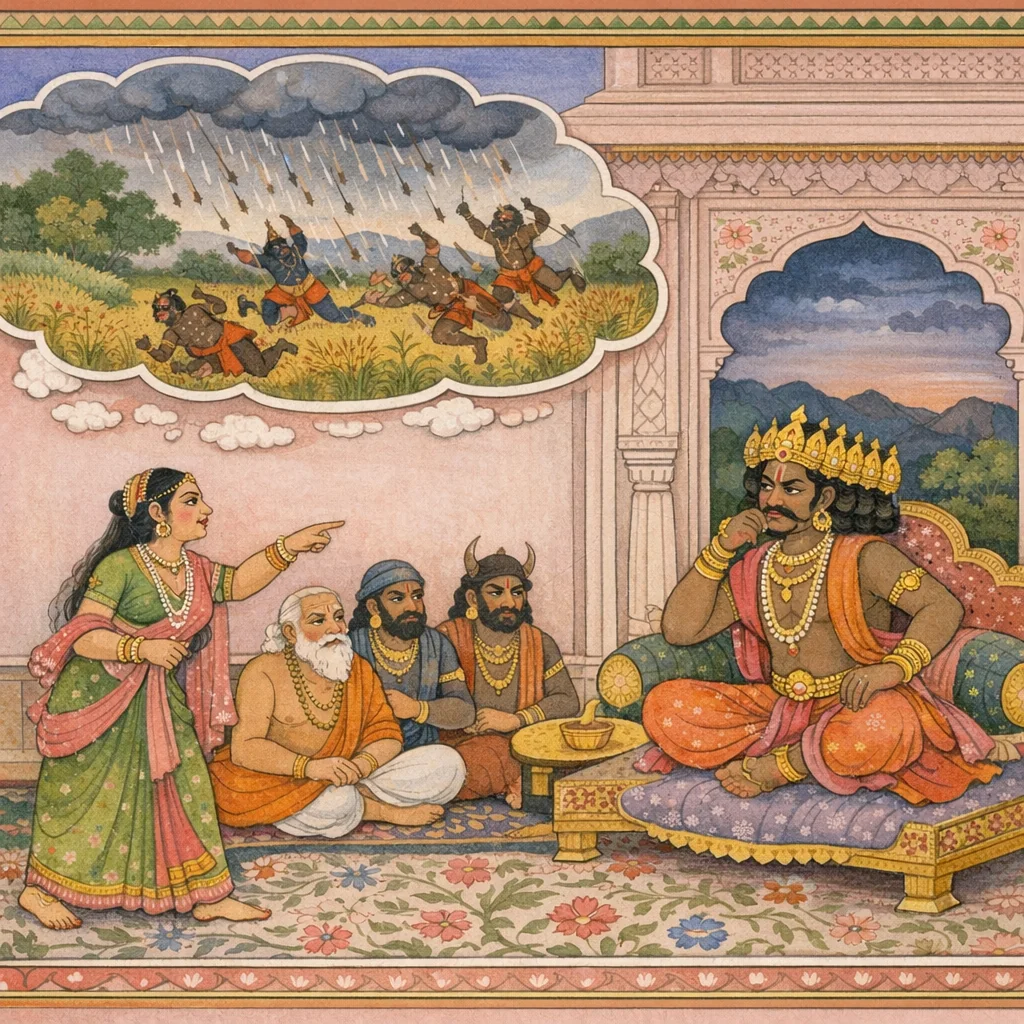
In the royal court, “amid ministers,” Rāvaṇa, angered by Śūrpaṇakhā’s harsh outburst, questions her in an orderly way about Rāma—his identity, appearance, prowess, and why he entered the “impenetrable” Daṇḍaka forest. Śūrpaṇakhā replies like a battle report: Rāma’s bow is Indra-like, his arrows fly swift and straight, and he quickly destroyed the Janasthāna host, including Khara and Dūṣaṇa, like storm and hail ruining ripened crops. She then turns from military intelligence to persuasion: Lakṣmaṇa is portrayed as equal to Rāma in valor and as his “right hand.” Sītā is lavishly praised—moon-like face, golden radiance, auspicious marks—likened to a beauty beyond the human. The argument ends in incitement: abduct Sītā as a bride, kill Rāma and Lakṣmaṇa, and thus serve rākṣasa interests. She also states an ethical subtext: Rāma hesitates to kill a woman; Śūrpaṇakhā uses this to explain her survival and to propose a strategy that exploits such restraint.
Shlokas
Verse 1
ततश्शूर्पणखां दृष्ट्वा ब्रुवन्तीं परुषं वचः।अमात्यमध्ये सङ्क्रुद्धः परिपप्रच्छ रावणः।।।।
Then, seeing Śūrpaṇakhā speaking harshly in the midst of his ministers, Rāvaṇa—angered—questioned her further.
Verse 2
कश्च रामः कथंवीर्यः किंरूपः किंपराक्रमः।किमर्थं दण्डकारण्यं प्रविष्टस्सुदुरासदम्।।।।
Who is this Rāma—what is his strength, what is his form, what is his valor? And for what purpose has he entered the hard-to-approach Daṇḍaka forest?
Verse 3
आयुधं किञ्च रामस्य निहता येन राक्षसाः।खरश्च निहतस्संख्ये दूषणस्त्रिशिरास्तथा।।।।
With what weapon of Rāma were the rākṣasas slain—Khara killed in battle, and likewise Dūṣaṇa and Triśiras?
Verse 4
इत्युक्ता राक्षसेन्द्रेण राक्षसी क्रोधमूर्छिता।ततो रामं यथातत्वमाख्यातुमुपचक्रमे।।।।
Thus addressed by the lord of the rākṣasas, the rākṣasī, overcome with wrath, then began to describe Rāma as he truly was.
Verse 5
दीर्घबाहुर्विशालाक्ष श्चीरकृष्णाजिनाम्बरः।कन्दर्पसमरूपश्च रामो दशरथात्मजः।।।।
Rāma, Daśaratha’s son, is long-armed and large-eyed; he wears bark-cloth and black antelope skin, and in beauty he resembles Kāma himself.
Verse 6
शक्रचापनिभं चापं विकृष्य कनकाङ्गदम्।दीप्तान् क्षिपति नाराचान्सर्पानिव महाविषान्।।।।
Wearing golden armlets, he draws a bow like Śakra’s and shoots blazing nārāca arrows—like serpents of deadly venom.
Verse 7
नाददानं शरान्घोरान्नमुञ्चन्तं शिलीमुखान्।न कार्मुकं विकर्षन्तं रामं पश्यामि संयुगे।।।।
In battle I did not see Rāma pause—neither in taking up dreadful arrows, nor in releasing the śilīmukhas, nor in drawing the bow; his action was unbroken.
Verse 8
हन्यमानं तु तत्सैन्यं पश्यामि शरवृष्टिभिः।इन्द्रेणेवोत्तमं सस्यमाहतन्त्वश्मवृष्टिभिः।।।।
I saw that army being cut down by showers of arrows, as if Indra were striking down a ripe crop with a storm of hailstones.
Verse 9
रक्षसां भीमरूपाणां सहस्राणि चतुर्दश।निहतानि शरै स्तीक्ष्णैस्तेनैकेन पदातिना।।।।अर्धाधिकमुहूर्तेन खरश्च सहदूषणः।
Alone and on foot, with keen arrows, he slew fourteen thousand rākṣasas of dreadful form; and within a muhurta and a half, Khara too—together with Dūṣaṇa—was brought down.
Verse 10
ऋषीणामभयं दत्तं कृतक्षेमाश्च दण्डकाः।।।।एका कथञ्चिन्मुक्ताहं परिभूय महात्मना।स्त्रीवधं शङ्कमानेन रामेण विदितात्मना।।।।
Safety has been granted to the seers, and peace has been restored in Daṇḍaka. Though humiliated by great-souled Rāma—self-knowing and hesitant to slay a woman—I alone, somehow, escaped with my life.
Verse 11
ऋषीणामभयं दत्तं कृतक्षेमाश्च दण्डकाः।।3.34.10।।एका कथञ्चिन्मुक्ताहं परिभूय महात्मना। स्त्रीवधं शङ्कमानेन रामेण विदितात्मना।।3.34.11।।
Safety has been granted to the seers, and peace has been restored in Daṇḍaka. Humiliated by great-souled, self-knowing Rāma—who hesitated to kill a woman—I alone, somehow, escaped alive.
Verse 12
भ्राता चास्य महातेजा गुणतस्तुल्यविक्रमः।अनुरक्तश्च भक्तश्च लक्ष्मणो नाम वीर्यवान्।।।।
And his brother—radiant with great splendor, equal to him in valor and virtues—is named Lakṣmaṇa: valiant, devoted, and deeply loyal.
Verse 13
अमर्षी दुर्जयो जेता विक्रान्तो बुद्धिमान्बली।रामस्य दक्षिणो बाहुर्नित्यं प्राणो बहिश्चरः।।।।
Impatient with wrong, hard to overcome, victorious, bold, intelligent, and strong—he is Rāma’s right arm, as though Rāma’s very life ever moved and acted outside him.
Verse 14
रामस्य तु विशालाक्षी पूर्णेन्दुसदृशानना।धर्मपत्नी प्रिया भर्तुर्नित्यं प्रियहिते रता।।।।
Rāma’s lawful wife is large-eyed, with a face like the full moon—beloved of her husband and ever devoted to what is dear and beneficial to him.
Verse 15
सा सुकेशी सुनासोरुस्सुरूपा च यशस्विनी।देवतेव वनस्यास्य राजते श्रीरिवापरा।।।।
Lovely-haired, fair-featured, beautiful, and illustrious, she shines in this forest like its presiding goddess—like another Śrī herself.
Verse 16
तप्तकाञ्चनवर्णाभा रक्ततुङ्गनखी शुभा।सीता नाम वरारोहा वैदेही तनुमध्यमा।।।।
Auspicious, with the hue of heated gold and with red, raised nails, she is named Sītā—Vaidehī—slender-waisted and of graceful form.
Verse 17
नैव देवी न गन्धर्वी न यक्षी न च किन्नरी।नैवंरूपा मया नारी दृष्टपूर्वा महीतले।।।।
She is neither goddess nor Gandharvī, neither Yakṣī nor Kinnarī; never before on earth have I seen a woman of such beauty.
Verse 18
यस्य सीता भवेद्भार्या यं च हृष्टा परिष्वजेत्।अतिजीवेत्स सर्वेषु लोकेष्वपि पुरन्दरात्।।।।
He whose wife Sītā would be, and whom she would embrace with joy, would deem himself more blessed than even Purandara (Indra) and would long to live beyond all others in every world.
Verse 19
सा सुशीला वपुश्श्लाघ्या रूपेणाप्रतिमा भुवि।तवानुरूपा भार्या स्यात्त्वं च तस्यास्तथा पतिः।।।।
She is well-mannered, her form is worthy of praise, and in beauty she is unmatched on earth. She would be a fitting wife for you—and you, in turn, a fitting husband for her.
Verse 20
तां तु विस्तीर्णजघनां पीनश्रोणिपयोधराम्।भार्यार्थे च तवानेतुमुद्यताहं वराननाम्।।।।विरूपितास्मि क्रूरेण लक्ष्मणेन महाभुज।
That woman—broad-hipped, full in her thighs and breasts, and fair-faced—I set out to bring to you as a wife. But, O mighty-armed one, I have been disfigured by the cruel Lakṣmaṇa.
Verse 21
तां तु दृष्ट्वाद्य वैदेहीं पूर्णचन्द्रनिभाननाम्।मन्मथस्य शराणां वै त्वं विधेयो भविष्यसि।।।।
If you were to see Vaidehī today—her face like the full moon—you would surely come under the power of Manmatha’s arrows.
Verse 22
यदि तस्यामभिप्रायो भार्यार्थे तव जायते।शीघ्रमुद्ध्रियतां पादो जयार्थमिह दक्षिणः।।।।
If the intention arises in you to take her as your wife, then at once lift your right foot and set out from here to win her.
Verse 23
कुरु प्रियं तथा तेषां रक्षसां राक्षसेश्वर।वधात्तस्य नृशंसस्य रामस्याश्रमवासिनः।।।।
O lord of the Rākṣasas, do your clan a ‘favour’: kill that Rāma, the dweller in the hermitage, whom she brands as cruel.
Verse 24
तं शरैर्निशितैर्हत्वा लक्ष्मणं च महारथम्।हतनाथां सुखं सीतां यथावदुपभोक्ष्यसि।।।।
Slay Rāma, that great warrior, with keen arrows, and Lakṣmaṇa as well; then, her protector being slain, you may enjoy Sītā in ease, as you please.
Verse 25
रोचते यति ते वाक्यं ममैतद्राक्षसेश्वर।क्रियतां निर्विशङ्केन वचनं मम रावण।।।।
If these words of mine please you, O lord of the Rākṣasas, then, O Rāvaṇa, carry out my counsel without hesitation.
Verse 26
विज्ञायेहात्मशक्तिं च ह्रियतामबला बलात्।सीता सर्वानवद्याङ्गी भार्यार्थे राक्षसेश्वर।।।।
First assess your own strength, O lord of the rākṣasas; do not carry off by force the delicate Sītā—faultless in every limb—merely to make her your wife.
Verse 27
निशम्य रामेण शरैरजिह्मगै र्हतान् जनस्थानगतान्निशाचरान्।खरं च बुद्ध्वा निहतं च दूषणं त्वमत्र कृत्यं प्रतिपत्तुमर्हसि।।।।
Having heard that the night-roamers stationed at Janasthāna were slain by Rāma with straight-flying arrows—and knowing that Khara and Dūṣaṇa too have been killed—you should now decide what must be done.
Frequently Asked Questions
The chapter foregrounds restraint in violence: Śūrpaṇakhā claims she survived because Rāma hesitated at “strī-vadha” (killing a woman), turning a moral limit into a tactical vulnerability within her counsel to Rāvaṇa.
Speech functions as destiny-shaping agency: descriptive praise and selective facts become persuasive instruments that can redirect political will, illustrating how rhetoric can weaponize aesthetics, fear, and perceived ethical constraints.
Daṇḍakāraṇya and Janasthāna anchor the narrative as contested forest-territory where āśrama protection and rākṣasa governance collide; the courtly context “amid ministers” signals a shift from battlefield report to state decision-making.