Sarga 20
विंशः सर्गः (Sarga 20): शूर्पणखाप्रेरितराक्षसवधः — The Slaying of the Fourteen Demons Sent by Śūrpaṇakhā
अरण्यकाण्ड
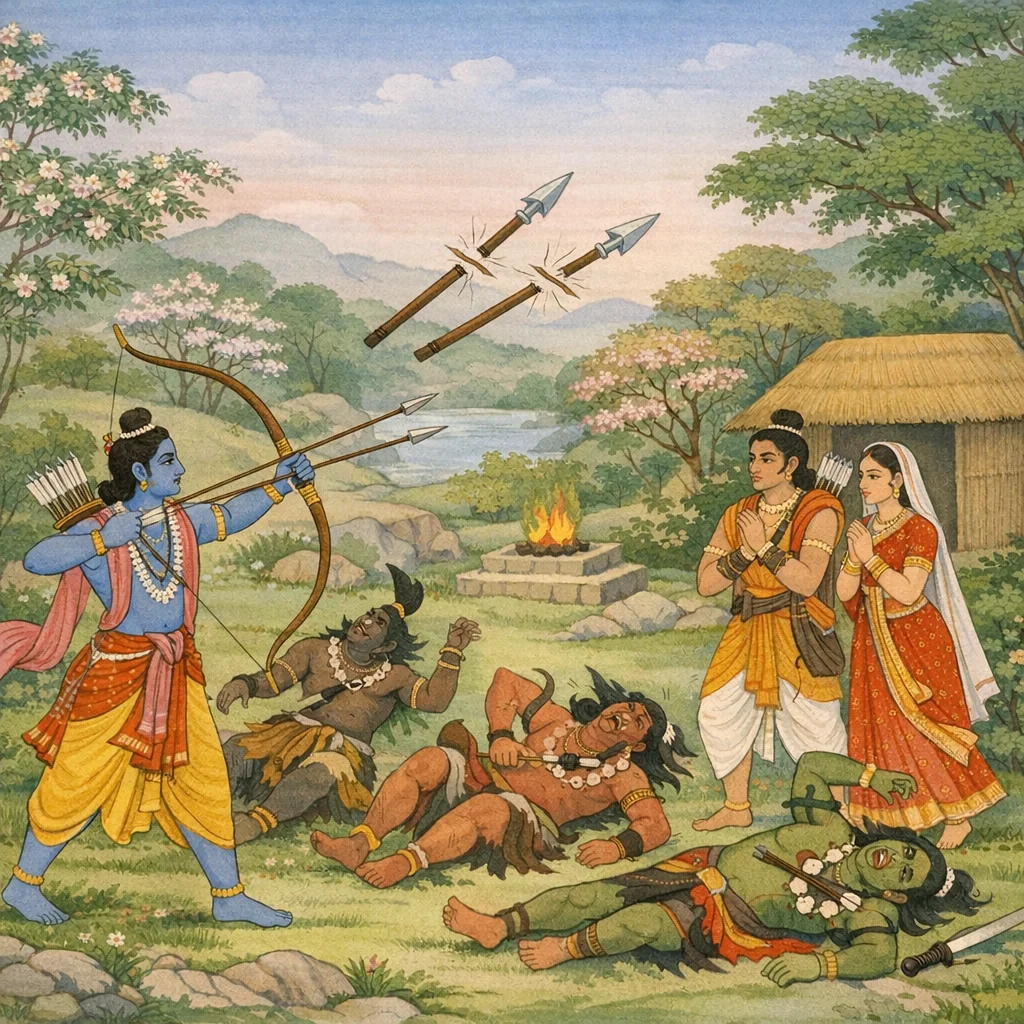
Śūrpaṇakhā comes to Rāma’s hermitage and points out Rāma, Lakṣmaṇa, and Sītā to a band of rākṣasas, bringing a direct threat upon the sacred dwelling of forest ascetics. Rāma tells Lakṣmaṇa to stand guard beside Sītā, placing her protection first while he confronts the assailants. Rāma identifies himself to the rākṣasas as Daśaratha’s son, living on forest fare, and declares that by the injunction of the ṛṣis he bears arms to destroy those who torment ascetics—thus grounding the coming violence in dharma and rightful duty. The fourteen rākṣasas answer with intimidation, boasting of their numbers, invoking Khara’s wrath, and threatening Rāma’s life. In battle, spears are hurled; Rāma severs all fourteen with an equal number of gold-adorned arrows. He then takes fourteen sun-bright nārācas and releases them like Indra’s vajra; the arrows pierce the demons’ chests, and the rākṣasas fall lifeless like uprooted trees. Śūrpaṇakhā, enraged and terrified, roars and flees to Khara, collapsing in distress and reporting in detail the destruction of the demon contingent—an episode that further intensifies the wider conflict in the forest.
Shlokas
Verse 1
ततश्शूर्पणखा घोरा राघवाश्रममागता।राक्षसानाचचक्षे तौ भ्रातरौ सह सीतया।।।।
Thereafter the dreadful Śūrpaṇakhā came to Rāma’s hermitage and pointed out to the rākṣasas the two brothers along with Sītā.
Verse 2
ते रामं पर्णशालायामुपविष्टं महाबलम्।ददृशुस्सीतया सार्धं वैदेह्या लक्ष्मणेन च।।।
They saw mighty Rāma seated in the leaf-thatched hut, together with Sītā Vaidehī and Lakṣmaṇa.
Verse 3
तान्दृष्ट्वा राघवश्श्रीमानागतांस्तां च राक्षसीम्।अब्रवीद्भ्रातरं रामो लक्ष्मणं दीप्ततेजसम्।।।।
Seeing those rākṣasas arrive—along with that demoness—Rāma, the illustrious scion of Raghu, spoke to his brother Lakṣmaṇa, radiant in energy.
Verse 4
मुहूर्तं भव सौमित्रे सीतायाः प्रत्यनन्तरः।इमानस्या वधिष्यामि पदवीमागतानिह।।।।
“O Saumitra, stay close by Sītā for a moment; I shall slay these who have come here upon her trail.”
Verse 5
वाक्यमेतत्ततश्श्रुत्वा रामस्य विदितात्मनः।तथेति लक्ष्मणो वाक्यं रामस्य प्रत्यपूजयत्।।।।
Having heard these words of self-knowing Rāma, Lakṣmaṇa assented—“So be it”—and honored Rāma’s command.
Verse 6
राघवोऽपि महच्चापं चामीकरविभूषितम्।चकार सज्यं धर्मात्मा तानि रक्षांसि चाब्रवीत्।।।।
Rama too—righteous in spirit—strung his great bow, adorned with gold, and addressed those demons.
Verse 7
पुत्रौ दशरथस्यावां भ्रातरौ रामलक्ष्मणौ।प्रविष्टौ सीतया सार्धं दुश्चरं दण्डकावनम्।।।।
We are the two sons of Daśaratha—brothers, Rama and Lakṣmaṇa—who have entered, along with Sītā, the hard-to-traverse Dandaka forest.
Verse 8
फलमूलाशनौ दान्तौ तापसौ धर्मचारिणौ।वसन्तौ दण्डकारण्ये किमर्थमुपहिंसथ।।।।
Living in the Dandaka forest as ascetics—self-restrained, following dharma, sustaining ourselves on fruits and roots—why do you harass us?
Verse 9
युष्मान्पापात्मकान्हन्तुं विप्रकारान्महाहवे।ऋषीणां तु नियोगेन प्राप्तोऽहं सशरायुधः।।।।
By the command of the sages, I have come armed with bow, arrows, and weapons, to slay in great battle sinners like you who violate and injure them.
Verse 10
तिष्ठतैवात्र सन्तुष्टा नोपावर्तितुमर्हथ।यदि प्राणैरिहार्थो वा निवर्तध्वं निशाचराः।।।।
Stay here, content, and do not think you deserve to turn back; but if you value your lives, then retreat, O night-roamers.
Verse 11
तस्य तद्वचनं श्रुत्वा राक्षसास्ते चतुर्दश।ऊचुर्वाचं सुसंक्रुद्धा ब्रह्मघ्नाश्शूलपाणयः।।।।
Hearing his words, those fourteen rākṣasas—brahmin-slayers with spears in hand—became fiercely enraged and replied.
Verse 12
क्रोधमुत्पाद्य नो भर्तुः खरस्य सुमहात्मनः।त्वमेव हास्यसे प्राणानद्यास्माभिर्हतो युधि।।।।
You have provoked the wrath of our lord Khara, that great one; today, slain by us in battle, you will forfeit your life.
Verse 13
का हि ते शक्तिरेकस्य बहूनां रणमूर्धनी।अस्माकमग्रतः स्थातुं किं पुनर्योद्दुमाहवे।।।।
What strength can you, a lone man, have at the very forefront of battle against many? How could you even stand before us—much less fight in war?
Verse 14
एहि बाहुप्रयुक्तैर्नः परिघैश्शूलपट्टिसैः।प्राणांस्त्यक्षसि वीर्यं च धनुश्च करपीडितम्।।।।
Come then—struck by the weapons we hurl with our arms, by clubs and spears and sharp blades—you will abandon your life, your valor, and even the bow gripped in your hand.
Verse 15
इत्येवमुक्त्वा सङ्कृद्धा राक्षसास्ते चतुर्दश।चिक्षिपुस्तानि शूलानि राघवं प्रति दुर्जयम्।।।।
Having spoken thus, those fourteen rākṣasas, enraged, hurled their spears at Rāghava—hard to overcome.
Verse 16
तानि शूलानि काकुत्स्थस्समस्तानि चतुर्दश।तावद्भिरेव चिच्छेद शरैः काञ्चनभूषणैः।।।।
Kākuṭstha cut all those fourteen spears to pieces with just as many arrows, adorned with gold.
Verse 17
ततः पश्चान्महातेजा नाराचान्सूर्यसन्निभान्।जग्राह परमक्रुद्धश्चतुर्दश शिलाशितान्।।।।
After that, the radiant one—now fiercely angered—took fourteen nārāca arrows, stone-sharpened and blazing like the sun.
Verse 18
गृहीत्वा धनुरायम्य लक्ष्यानुद्दिश्य राक्षसान्।मुमोच राघवो बाणान्वज्रानिव शतक्रतुः।।।।
Taking up his bow and drawing it taut, Rāghava fixed the rākṣasas as his targets and released his arrows like Śatakratu (Indra) hurling thunderbolts.
Verse 19
रुक्मपुङ्खाश्च विशिखा दीप्ता हेमविभूषिताः।ते भित्त्वा रक्षसां वेगाद्वक्षांसि रुधिराप्लुताः।।।विनिष्पेतुस्तदा भूमौ न्यमज्जन्ताशनिस्वनाः।
Those blazing arrows, with golden fletching and adorned with gold, sped forth; with force they pierced the rākṣasas’ chests, blood-soaked, burst through, and then sank into the earth with a thunder-like sound.
Verse 20
ते भिन्नहृदया भूमौ छिन्नमूला इव द्रुमाः।।।।निपेतुश्शोणितार्द्राङ्गा विकृता विगतासवः।
With hearts torn open, their bodies drenched in blood—disfigured and bereft of life—they fell upon the ground like trees cut at the root.
Verse 21
तान् दृष्ट्वा पतितान्भूमौ राक्षसी क्रोधमूर्छिता।।।।परित्रस्ता पुनस्तत्र व्यसृजद्भैरवस्वनान्।
Seeing them fallen on the ground, the demoness—overcome by rage and shaken with fear—let out terrifying cries there again.
Verse 22
उपगम्य खरं सा तु किञ्चित्संशुष्कशोणिता।।।।पपात पुनरेवार्ता सनिर्यासेव सल्लकी।
Coming to Khara, with her blood partly dried, she—afflicted—collapsed again, like a sallakī tree oozing resin.
Verse 23
पपात पुनरेवार्ता सनिर्यासेव सल्लकी ।। ।।
Afflicted, she collapsed again, like a sallakī tree that oozes resin.
Verse 24
भ्रातुस्समीपे शोकार्ता ससर्ज निनदं मुहुः।।।।सस्वरं मुमुचे बाष्पं विषण्णवदना तदा।
Then, near her brother, stricken with grief, she raised loud cries again and again; with a downcast face she shed tears with audible sobbing.
Verse 25
निपातितान् दृश्य रणे तु राक्षसान् प्रधाविता शूर्पणखा पुनस्ततः।वधं च तेषां निखिलेन रक्षसां शशंस सर्वं भगिनी खरस्य सा।।।।
When Śūrpaṇakhā saw the rākṣasas struck down in battle, she ran from there again and reported to Khara—her brother—everything in full detail about their slaughter.
Frequently Asked Questions
The chapter presents the dharma-question of justified violence in a forest-ascetic context: Rāma, though living as a tapas-like exile, acts as a protector by ṛṣi injunction, first securing Sītā’s safety through Lakṣmaṇa and then engaging the aggressors as a defensive, duty-based act.
Rāma’s self-presentation emphasizes that identity and power are subordinated to ethical mandate: arms are carried not for domination but for restoring order when innocents and sacred practices are threatened. The narrative also underscores restraint and clarity—warning the attackers, then acting decisively when deterrence fails.
Key landmarks include Rāma’s āśrama and parṇaśālā (a domestic-ascetic space) situated within Daṇḍakāraṇya. Culturally, the scene highlights the forest economy of fruits and roots, the authority of ṛṣis (niyoga), and the martial-ritual symbolism of bow, arrows, and Indra-vajra similes.