Adhyaya 54
The Abduction/Seduction of Ahalyā and Indra’s Mark (Sahasrākṣa)
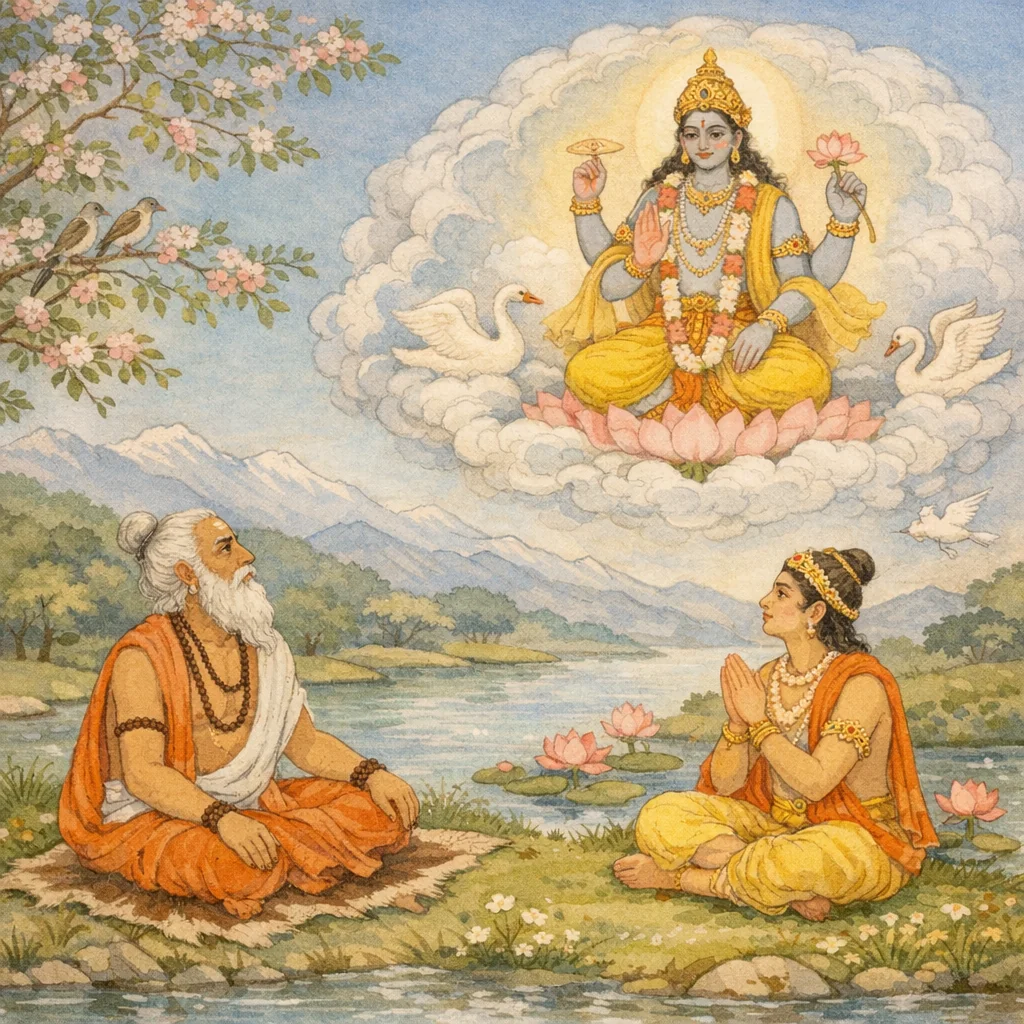
Chapter 54 presents the Ahalyā episode as a moral lesson on the peril of desire and the need for equanimity. After praising the rare virtue of being free from malice and betrayal, it tells how Ahalyā, daughter of Brahmā, is given in marriage to the sage Gautama. Indra, seized by Kāma, plots and approaches the hermitage while Gautama is away. A deceptive union occurs, yet Gautama—through inner purity and insight—discerns Indra’s deed and pronounces curses. Indra receives yoni-marks that are later transmuted into the epithet “Sahasrākṣa” (the Thousand-Eyed), along with further humiliation; Ahalyā is condemned to a withered, skeletal existence by the roadside. Compassion then tempers the sentence: in the future, Rāma’s recognition restores Ahalyā and she reunites with Gautama. Indra, ashamed, performs devotion in water and praises the Goddess Indrākṣī/Jaganmātā, who grants boons—turning stigma into honor and restoring Indra’s status—while warning that kāma endangers even the gods.
Shlokas
Verse 1
श्रीभगवानुवाच । अद्रोहकस्य चाख्यातो महिमा लोकदुःसहः । एकतल्पगतां वामां क्षांत्वा सर्वजितोऽभवत्
The Blessed Lord said: “The greatness of one who is free from malice has been proclaimed—hard for the world to bear (to equal). By forgiving his beloved who had come to the same bed, he became a conqueror of all.”
Verse 2
ज्ञानिनामपिदुःसाध्यं मुनीनां ब्रह्मचारिणां । सुरासुरमनुष्याणां विषमं तत्समं गतः
Even for the wise, for sages, and for celibate ascetics it is exceedingly difficult; for gods, demons, and humans alike, what is uneven and hard to cross becomes level for one who has attained that state of equanimity.
Verse 3
स्वभावाद्विषमं कामं जेतुं कः पुरुषः क्षमः । अद्रोहकमृते विप्र स एव भवजित्पुमान्
Who among men is capable of conquering desire—so uneven and troublesome by its very nature? O brāhmaṇa, only the person who is free from malice and betrayal truly becomes a conqueror of worldly existence.
Verse 4
संत्यज्य देवराज्यं च लब्ध्वाहं तु पुरा यथा । तमुवाच ततो देवी पापं तं मुनिशापजम्
“Just as I formerly attained my aim after renouncing even the sovereignty of the gods,” he said; then the Goddess addressed him—him who had become sinful due to a sage’s curse.
Verse 5
विदितं सर्वलोके च त्रैलोक्ये सचराचरे । द्विज उवाच । कथं च देवदेवस्य अहल्याहरणं प्रभो
It is known in every world—throughout the three realms, among all that moves and all that is still. The Brahmin said: “O Lord, how did the God of gods come to take away Ahalyā?”
Verse 6
भगांकत्वं च संप्राप सहस्राक्षः सुराधिपः । न गां कोपि भगांकत्वं संप्राप्तस्सुरराट्कथम्
And Sahasrākṣa (Indra), lord of the devas, attained the state of being marked with the yoni-sign (bhagāṅka). Yet how is it, O king of the gods, that no cow ever comes to such a condition?
Verse 7
दुःश्रुतं सुरवैकल्यं श्रोतुमिच्छामि तत्वतः । श्रीभगवानुवाच । पुरा स्वांतोद्भवां कन्यां लोकेशश्च महामनाः
I wish to hear the grievous report in truth—how the gods came to be impaired. The Blessed Lord said: Long ago, the noble Lord of the worlds, great of heart, brought forth from his own heart a maiden daughter.
Verse 8
गौतमाय ददौ धाता लोकपालाग्रतो मुदा । ततस्तु लोकपालानां मन्मथाविष्टचेतसाम्
The Creator (Dhātā) joyfully gave her to Gautama, in the presence of the Lokapālas. Thereupon the minds of those guardians of the worlds were seized by Manmatha, the god of love.
Verse 9
शचीपतेस्तु संमोहो हृदि शल्य इव स्थितः । लोकपालानतिक्रम्य सुवेषा वरवर्णिनी
Yet the delusion of Śacī’s lord (Indra) remained lodged in his heart like a thorn. Surpassing the guardians of the worlds, the exquisitely adorned woman of peerless beauty went on.
Verse 10
द्विजाय रत्नभूतैषा दत्ता किंवा करोम्यहम् । इति संचिंत्य तस्यास्तु वर्तमाने च यौवने
“This jewel-like maiden has been given to a Brahmin—what, then, should I do?” Thus pondering, while she was still in the prime of youth, he continued to deliberate.
Verse 11
पुनश्च मायया दृष्टं रूपं तस्यास्सुशोभनम् । पुनश्चिन्तयमानोऽसौ गौतमाध्यासनं गतः
Once again, through the power of māyā, he beheld her exceedingly beautiful form; and once more, lost in thought, he went to the seat of the sage Gautama.
Verse 12
पश्चात्तु तस्य गमनाद्यद्वृत्तं तच्छृणुष्व मे । एकदा गौतमः स्नातुं गतोऽसौ पुष्करं प्रति
Now, after his departure, listen from me to what happened next. Once, Gautama went to Puṣkara in order to bathe.
Verse 13
साध्वी च गृहशौचे च गृहवस्तुनि तत्परा । प्रवृत्ता देववास्तूनां बलिकर्तुं च तत्परा
She was a sādvī, a virtuous woman, devoted to the purity of the home and attentive to household duties; she was also engaged in offering bali—ritual portions—to the deities dwelling within the spaces of the house.
Verse 14
इंधनं वह्निकार्यं च नित्यकर्मानुसंचयम् । एतस्मिन्नंतरे शक्रो मुनेस्तस्य महात्मनः
He gathered firewood, attended to the duties of the sacred fire, and continued the full course of his daily rites. In the meantime, Śakra (Indra) took action concerning that great-souled sage.
Verse 15
रूपमास्थाय गात्रेण प्रविवेशोटजं मुदा । पतिव्रता पतिं दृष्ट्वा श्रद्धया परया सती
Assuming a form with her own body, she joyfully entered the hermitage. Seeing her husband, that chaste and faithful satī beheld him with supreme reverence and devotion.
Verse 16
देवस्थाने च वस्तूनां संचयं कर्तुमुद्यता । ततस्तामब्रवीदार्तो मुनिवेषधरो हरिः
As she was preparing to gather the items within the temple precincts, Hari—disguised in the guise of a sage—then addressed her, distressed.
Verse 17
प्रद्युम्नवशगो वामे देहि मे चुंबनादिकम् । एतस्मिन्नंतरे सा च त्रपायुक्ताऽब्रवीद्वचः
“O fair one, being under Pradyumna’s sway, grant me kisses and the like.” In the meantime, she—overcome with modesty—spoke these words.
Verse 18
देवकार्यादिकं त्यक्त्वा वक्तुं नार्हसि मे प्रभो । सर्वं जानासि धर्मज्ञ पुण्यानां निश्चयं मुने
O Lord, it is not fitting that, setting aside the duties concerning the devas and the like, you speak to me in this way. O knower of dharma, O sage—you know everything, even the true determination of meritorious deeds.
Verse 19
अयमर्थो हि वेलायामधुनैव न युज्यते । ततस्तां चारुसर्वांगीं दृष्ट्वा मन्मथपीडितः
“This matter is not suitable at this time just now.” Then, seeing that beautiful, well-formed woman, he was tormented by Kāma, the god of love.
Verse 20
अलं प्रियेन वक्तव्यं हृच्छयो मे प्रजायते । कर्तव्यं चाप्यकर्तव्यं पत्युर्वचनसंमतम्
Enough of sweet speech; my heart is seized by anxiety. Tell me what is to be done—and what must not be done—according to what is sanctioned by my husband’s command.
Verse 21
करोति सततं या च सा च नारी पतिव्रता । लंघयेद्या च तस्याज्ञां सुरते च विशेषतः
A woman who continually acts in accord with her husband’s will is called a pativratā, a wife vowed in devotion to her lord. But she who transgresses his command—especially regarding conjugal union—is not so regarded.
Verse 22
पुण्यं तस्या भवेन्नष्टं दुर्गतिं चाधिगच्छति । साब्रवीद्देववस्तूनि संति देवार्थतो मुने
Her merit would be destroyed, and she would fall into an evil state. She said, “O sage, these are indeed things belonging to the devas, intended for divine purposes.”
Verse 23
नित्यकर्माणि चान्यानि किं वा तेषु विपर्ययः । स चोवाच सतीं तत्र देह्यालिगादिकं मम
“And what of the other daily rites—what deviation is there in them?” Then, there he said to Satī, “Give me my liṅga and the other emblems.”
Verse 24
मनसा भयमुत्सृज्य मया दत्तानि तानि च । इत्युक्त्वा तां परिष्वज्य कृतस्तेन मनोरथः
Casting fear from his mind and saying, “Those too were given by me,” he spoke thus; then, embracing her, his desire was fulfilled through her.
Verse 25
एतस्मिन्नंतरे विप्र मुनेर्हृद्या सकल्मषम् । ततो ध्यानं समारभ्याजानाद्वृत्तं शचीपतेः
Meanwhile, O brāhmaṇa, the sage’s heart became free from all defilement. Then, beginning meditation, he came to know the account concerning Śacī’s lord (Indra).
Verse 26
तूर्णमेव द्वारदेशे गत्वा च समुपस्थितः । शक्रो मुनिं तु संलक्ष्य चौतुदेहं विवेश ह
He swiftly went to the place at the gate and stood there. Then Śakra (Indra), noticing the sage, entered into his subtle (invisible) body.
Verse 27
गच्छतः पृषदंशस्य पद्धतौ प्रचचाल ह । मुनिस्तत्रावदत्तं वै कस्त्वं मार्जाररूपधृत्
As Pṛṣadaṃśa was walking along the path, it began to move and tremble. Thereupon the sage spoke: “Who are you, assuming the form of a cat?”
Verse 28
भयात्तस्य मुनेरग्रे शक्रः प्रांजलिराश्रितः । मघवंतं पुरो दृष्ट्वा चुकोप मुनिपुंगवः
Out of fear, Śakra (Indra) stood before the sage with folded hands, seeking refuge. But on seeing Maghavan (Indra) before him, the foremost of sages became enraged.
Verse 29
यत्त्वया चेदृशं कर्म भगार्थं छलसाहसम् । कृतं तस्मात्तवांगेषु सहस्रभगमुत्तमम्
Since you have committed such a deceitful and rash act for the sake of the yoni, therefore upon your limbs there shall be the excellent mark of a thousand yonis.
Verse 30
भवत्विह तु पापिष्ठ लिंगं ते निपतिष्यति । गच्छ मे पुरतो मूढ सुरस्थानं दिवौकसः
So be it here, O most sinful one—your liṅga shall fall. Go before me, you fool, to the abode of the gods, the dwelling of the celestials.
Verse 31
पश्यंति मुनिशार्दूला नराः सिद्धास्सहोरगाः । एवमुक्त्वा मुनिश्रेष्ठो रुदंतीं तां पतिव्रताम्
The tiger-like sages looked on—along with men, Siddhas, and serpents. Having spoken thus, the foremost of sages addressed that devoted wife as she wept.
Verse 32
पप्रच्छ किमिदानीं ते कर्म दारुणमागतम् । इत्युक्ता वेपमाना सा भीता पतिमुवाच ह
He asked, “What terrible consequence of karma has now come upon you?” Thus addressed, she—trembling in fear—spoke to her husband.
Verse 33
अज्ञानाद्यत्कृतं कर्म क्षंतुमर्हसि वै प्रभो । मुनिरुवाच । परेणाभिगतासि त्वममेध्या पापचारिणी
“O Lord, forgive the deed done out of ignorance.” The sage said: “You have been violated by another; you are impure and one who follows sinful conduct.”
Verse 34
अस्थिचर्मसमाविष्टा निर्मांसा नखवर्जिता । चिरं स्थास्यसि चैकापि त्वां पश्यंतु जनाः स्त्रियः
Enclosed only by bone and skin, devoid of flesh and bereft of nails, you shall stand alone for a long time—so that the women among the people may look upon you.
Verse 35
दुःखिता तमुवाचेदं शापस्यांतो विधीयताम् । इत्युक्ते करुणाविष्टो मन्युनापि परिप्लुतः
Overcome with sorrow, she said to him: “Let the end of this curse be ordained.” When she spoke thus, he—moved by compassion, yet still flooded with anger—replied.
Verse 36
जगाद गौतमो वाक्यं रामो दाशरथिर्यदा । वनमभ्यागतो विष्णुः सीतालक्ष्मणसंयुतः
Gautama spoke these words when Rāma, the son of Daśaratha—Viṣṇu himself—came into the forest accompanied by Sītā and Lakṣmaṇa.
Verse 37
दृष्ट्वा त्वां दुःखितां शुष्कां निर्देहां पथिसंस्थितां । गदिष्यति च वै रामो वसिष्ठस्याग्रतो हसन्
Seeing you—sorrowful, withered, as if bodiless, standing by the roadside—Rāma will indeed speak, laughing in front of Vasiṣṭha.
Verse 38
किमियं शुष्करूपा च प्रतिमास्थिमयी शवा । न दृष्टं मे पुरा ब्रह्मन्रूपं लोकविपर्ययम्
What is this—dry and withered in appearance—this corpse made of bones, like an effigy? Never before, O Brahman, have I seen such a form—this inversion of the natural order of the world.
Verse 39
ततो रामं महाभागं विष्णुं मानुषविग्रहम् । यद्वृत्तमासीत्पूर्वं तद्वसिष्ठः कथयिष्यति
Then they approached the greatly fortunate Rāma—Viṣṇu in human form. What had happened earlier, that Vasiṣṭha will relate.
Verse 40
वसिष्ठवचनं श्रुत्वा रामो वक्ष्यति धर्मवित् । अस्या दोषो न चैवास्ति दोषोयं पाकशासने
Hearing Vasiṣṭha’s words, Rāma—the knower of dharma—will speak: “She has no fault at all; this fault lies with Pākaśāsana (Indra).”
Verse 41
एवमुक्ते तु रामेण त्यक्त्वा रूपं जुगुप्सितं । दिव्यं रूपं समास्थाय मद्गृहं चागमिष्यसि
When Rāma had spoken thus, you will abandon your loathsome form; assuming a divine form, you will come to my abode as well.
Verse 42
शप्त्वा तु गौतमस्तां हि तपस्तप्तुं गतो वनम् । ततोत्यंतं शुष्करूपा तथैव पथि संस्थिता
Having cursed her, Gautama indeed went to the forest to practice austerities. Then she, becoming exceedingly withered in form, remained standing there upon the path.
Verse 43
रामस्य वचनादेव गौतमं पुनरागता । गौतमोपि तया सार्द्धमद्यैवं दिवि तिष्ठति
By Rāma’s very word, she returned again to Gautama; and Gautama too, together with her, now dwells thus in heaven.
Verse 44
इंद्रोपि त्रपयायुक्तः स्थितश्चांतर्जले चिरम् । स्थित्वा चांतर्जले देवीमस्तौदिंद्राक्षिसंज्ञिताम्
Indra too, overcome with shame, remained for a long time within the waters. And while staying there, he praised the Goddess known as Indrākṣī.
Verse 45
सुप्रसन्ना ततो देवी स्तोत्रेण परितोषिता । गत्वोवाच ततः सा च वरोस्मत्तो विगृह्यताम्
Then the Goddess, greatly pleased and satisfied by the hymn of praise, came forth and said: “Choose a boon from me.”
Verse 46
ततो देवीमुवाचेदं शक्रः परपुरंजयः । त्वत्प्रसादाच्च मे देवि वैरूप्यं मुनिशापजम्
Then Śakra (Indra), conqueror of enemy cities, said to the Goddess: “O Devi, by your grace, let this disfigurement of mine—born of a sage’s curse—be removed.”
Verse 48
किंतु बुद्धिं सृजाम्यद्य येन लोकैर्न लक्ष्यते
But today I shall devise a plan, by which it will not be noticed by the people.
Verse 49
योनिमध्यगतं दृष्टि सहस्रं ते भविष्यति । सहस्राक्ष इति ख्यातस्सुरराज्यं करिष्यसि
Your sight will become a thousand eyes set across your body. Renowned as ‘Sahasrākṣa’ (the Thousand-Eyed One), you will rule the sovereignty of the gods.
Verse 50
मेषांडं तव शिश्नं च भविष्यति च मद्वरात् । इत्युक्त्वा सा जगन्माता तत्रैवांतरधीयत
“By my boon, your penis shall become like a ram’s testicle.” Having said this, the Mother of the world disappeared right there.
Verse 51
शक्रो देववरैः पूज्यो ह्यद्यापि दिवि वर्तते । इंद्रस्यैतादृशी कामादवस्था द्विजसत्तम
Śakra (Indra), revered by the foremost among the gods, still abides in heaven even today. Such, O best of the twice-born, is the state that desire (kāma) brought upon Indra.
Verse 54
इति श्रीपाद्मपुराणे प्रथमे सृष्टिखंडे अहल्याहरणंनाम चतुष्पंचाशत्तमोऽध्यायः
Thus ends the fifty-fourth chapter, called “Ahalyā-haraṇa,” in the First Book (Sṛṣṭi-khaṇḍa) of the sacred Padma Purāṇa.