Adhyaya 53
Narrative of the Śūdra’s Renunciation of Greed (with the Tulādhāra Greatness Prelude)
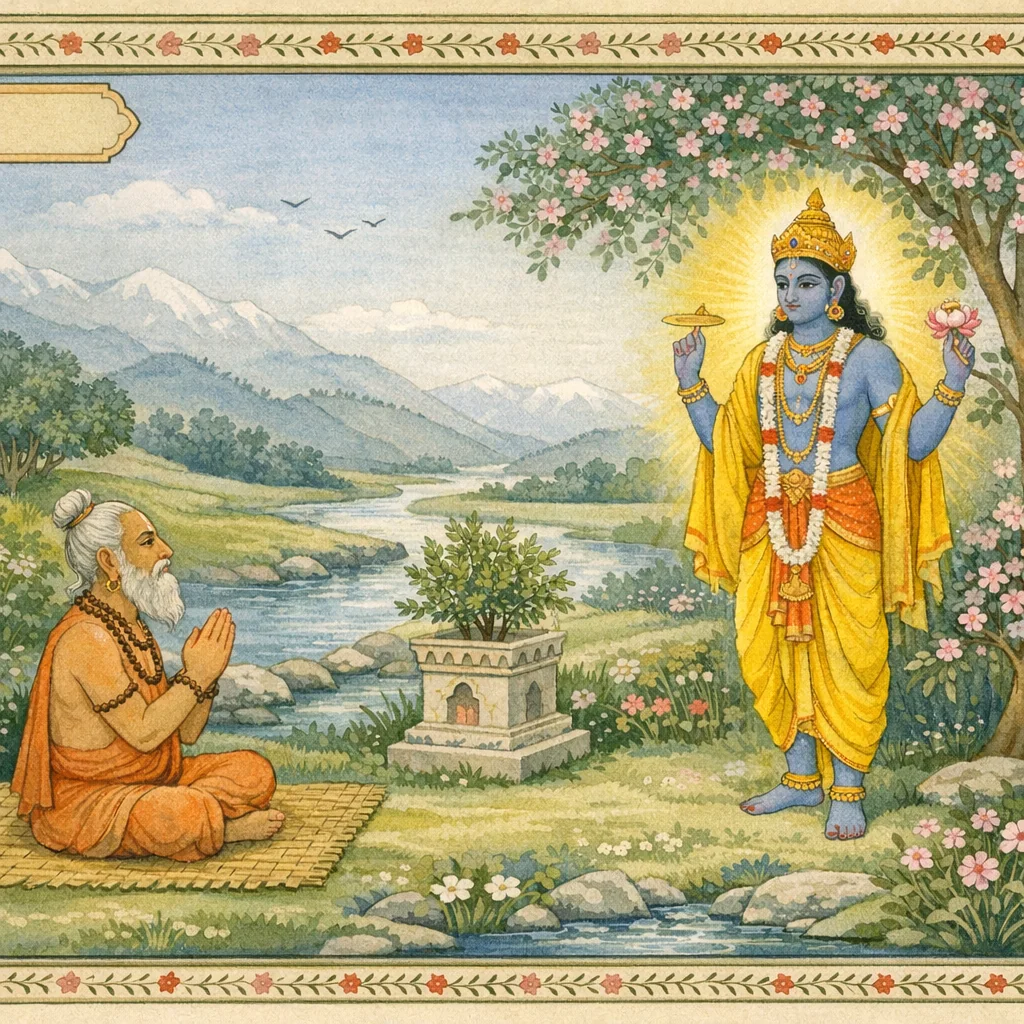
Adhyāya 53 begins with a dvija requesting the full life-story and greatness of Tulādhāra. The Lord replies that satya (truthfulness) and freedom from greed are dharma’s heaviest measures, outweighing even the tally of great sacrifices, and illustrates this through cosmic order and exemplars such as Yudhiṣṭhira, Bali, and Hariścandra. The chapter then turns to a didactic tale of a Śūdra who, though destitute, refuses theft and withstands greed when tested by “found” garments and a hidden treasure. Seeing that wealth breeds bondage, delusion, and social fear, he abandons attachment. The gods praise him; the ascetic who tested him reveals himself as Viṣṇu and grants ascent to heaven. The chapter closes by affirming Tulādhāra’s unmatched truthfulness and with a phalaśruti: hearing or reading this account destroys sins and yields the fruit of sacrifices.
Shlokas
Verse 1
द्विज उवाच । तुलाधारस्य चरितं प्रभावमतुलं प्रभो । वक्तुमर्हस्यशेषेण यदि मय्यस्त्यनुग्रहः
The brahmin said: “O Lord, if you are gracious to me, then please narrate in full the life of Tulādhāra—his incomparable greatness and power.”
Verse 2
श्रीभगवानुवाच । सत्यभावादलोभाच्च दद्याद्यो वै त्वमत्सरात् । नित्यं यज्ञशतं तस्य सुनिष्पन्नं सुदक्षिणम्
The Blessed Lord said: Whoever gives with a truthful heart, free from greed and without envy—his gift is deemed equal to the continual performance of a hundred well-accomplished yajñas, complete with proper dakṣiṇā.
Verse 3
सत्येनोदयते सूरो वाति वातस्तथैव च । न लंघयेत्समुद्रस्तु वेलां कूर्मो धरां तथा
By truth the sun rises, and likewise the wind blows; the ocean does not overstep its shore, and the Tortoise does not abandon the earth it supports.
Verse 4
सत्येन लोकास्तिष्ठंति सर्वे च वसुधाधराः । सत्याद्भ्रष्टोथ यः सत्वोप्यधोवासी भवेद्ध्रुवम्
By truth alone all worlds endure, and even the bearers of the earth stand firm. But whoever falls away from truth—though endowed with virtue—surely becomes a dweller in the lower realms.
Verse 5
सत्यवाचिरतोथस्तु सत्यकार्यरतः सदा । सशरीरेण स्वर्लोकमागत्याच्युततां व्रजेत्
But one who delights in truthful speech and is ever devoted to truthful conduct—reaching the heavenly world with this very body—attains the state of the unfailing, the imperishable.
Verse 6
सत्येन मुनयः सर्वे मां च गत्वा स्थिरं गताः । सत्याद्युधिष्ठिरो राजा सशरीरो दिवं गतः
By truthfulness all the sages reached me and attained the steadfast state. By truthfulness, King Yudhiṣṭhira too went to heaven in his very body.
Verse 7
सर्वशत्रुगणं जित्वा लोको धर्मेण पालितः । अकरोच्च मखं शुद्धं राजसूयं सुदुर्लभम्
Having conquered all hosts of enemies, he governed the people in accordance with dharma, and then performed the pure and exceedingly rare Rājasūya sacrifice.
Verse 8
चतुरशीतिसहस्राणि ब्राह्मणानां च नित्यशः । भोजयेद्रुक्मपात्रेषु राजोपकरणेषु च
Every day, he should feed eighty-four thousand Brāhmaṇas—serving them in golden vessels and with royal provisions.
Verse 9
भोजयित्वोपकरणांस्तेभ्यो दत्वा विसर्जयेत् । यदभीष्टं द्विजातीनामतोन्यद्दापयेद्धनम्
After feeding them and giving them the requisite articles, one should respectfully dismiss them. Then, one should also give wealth as a further gift—according to what the twice-born desire.
Verse 10
अदरिद्रं ततो ज्ञात्वा द्विजव्यूहं परित्यजेत् । तथैव स्नातकानां तु सहस्राणि तु षोडश । नित्यं संभोजयेद्राजा सत्येनैव विमत्सरः
Having ascertained who among the twice-born is not impoverished, one should set aside the crowd of Brāhmaṇas who come merely as an assembly. Likewise, the king—truthful and free from envy—should daily feed sixteen thousand snātakas.
Verse 11
अतिष्ठंत गृहे पूर्वं चिरं तस्य जिगीषया । जितं तेन जगत्सर्वं प्राणानुग्रहकारणात्
Formerly he stayed in his house for a long time, intent on conquering. By him the entire world was conquered—because he won the goodwill and grace of living beings.
Verse 12
सत्येन चासुरो राजा बलिरिंद्रो भविष्यति । पातालस्थस्य तस्यैव भूयस्तिष्ठामि वेश्मनि
By his truthfulness, the asura-king Bali will become Indra; and I shall again dwell in the very abode of that same Bali who resides in Pātāla.
Verse 13
निरंतरं च तिष्ठामि स्वांते पुण्यैककर्मणः । यद्वा पुरा मया बद्धो दैत्ययोनेर्विमोक्षणात्
I dwell continually within the heart of the doer whose actions are solely meritorious—or else, because long ago I was bound (by a vow) for the deliverance of one born in a daitya lineage.
Verse 14
तलं चैवामरत्वं हि शक्रत्वं प्रददाम्यहम् । हरिश्चंद्रो नृपस्सत्यात्सवाहनपरिच्छदः
“I shall indeed grant you the realm of Tala, and also immortality, and the sovereignty of Śakra (Indra). Because of his truthfulness, King Hariścandra shall be honored, endowed with vehicle and royal insignia.”
Verse 15
स्वशरीरेण शुद्धेन सत्यलोके प्रतिष्ठितः । राजानो बहवश्चान्ये ये च सिद्धा महर्षयः
Established in Satyaloka with his own purified body, there are also many kings and others there—those perfected beings and great seers.
Verse 16
ज्ञानिनो यतयश्चैव सर्वे सत्येऽच्युताऽभवन् । तस्मात्सत्यरतो लोके संसारोद्धरणक्षमः
Knowers of truth and ascetics alike—all became unwavering through truthfulness. Therefore, in this world, one devoted to truth is capable of lifting others across worldly bondage.
Verse 17
तुलाधारो महात्मा वै सत्यवाक्ये प्रतिष्ठितः । लोके तत्सदृशो नास्ति सत्यवाक्यस्य कारणात्
Tulādhāra is truly a great soul, firmly established in truthful speech. In the world there is none equal to him, because of his steadfast commitment to truth.
Verse 18
अश्वमेधसहस्रेण सत्यं तु तुलया धृतम् । अश्वमेधसहस्राद्धि सत्यमेव विशिष्यते
When truthfulness is weighed in the balance against a thousand Aśvamedha sacrifices, truthfulness is found weightier; indeed, truth surpasses even a thousand Aśvamedhas.
Verse 19
सर्वं सत्याद्भवेत्साध्यं सत्यो हि दुरतिक्रमः । सत्यवाक्येन सा धेनुर्बहुला स्वर्गगामिनी
Everything that is to be accomplished becomes attainable through truth, for truth is indeed hard to transgress. By a truthful utterance, the cow Bahulā became one who attained heaven.
Verse 20
सर्वं राष्ट्रं समाधाय पुनरावृत्तिदुर्लभा । तथायं सर्वदा साक्षी मृषा नास्ति कदाचन
Having set the entire kingdom in order, such an opportunity is seldom regained. Indeed, this is ever a witness; before it, falsehood does not exist at any time.
Verse 21
बह्वर्घमल्पमर्घं च क्रयविक्रयणे सुधीः । सत्यवाक्यं प्रशस्तं च विशेषात्साक्षिणो भवेत्
In buying and selling, whether the price is high or low, the wise should above all be a witness who speaks truthfully and is held in good repute.
Verse 22
साक्षिणः सत्यमुक्त्वा च अक्षयं स्वर्गमाययुः । वावदूकः सभां प्राप्य सत्यं वदति वाक्पतिः
Having spoken the truth, the witnesses attained the imperishable heaven. And Vāvadūka, having reached the assembly, speaks the truth—he who is the lord of speech.
Verse 23
स याति ब्रह्मणो गेहं यज्ञैरन्यैश्च दुर्लभम् । सभायां यो वदेत्सत्यमश्वमेधफलं लभेत्
He attains Brahmā’s abode—something difficult to obtain even through other sacrifices; and whoever speaks the truth in an assembly gains the merit (fruit) of the Aśvamedha sacrifice.
Verse 24
लोभाद्द्वेषान्मृषोक्त्वा च रौरवं नरकं व्रजेत् । सर्वसाक्षी तुलाधारो जनानां शूर एव च
Driven by greed and hatred, and by speaking falsehood, one goes to the Raurava hell. He is the witness of all, the bearer of the scales (of justice), and indeed the hero among people.
Verse 25
विशेषाल्लोभसंत्यागान्नाके निर्जरतां व्रजेत् । कश्चिच्छूद्रो महाभागो न लोभे वर्तते क्वचित्
Pre-eminently, by renouncing greed one attains the state of the deathless in heaven. Rare indeed is that highly fortunate Śūdra who never engages in greed at any time.
Verse 26
वृत्तिश्शाकेन दुःखेन तथा शिलोंछतो भृशम् । जर्जरं वस्त्रयुग्मं च करौ पात्रे च सर्वदा
Living miserably on a livelihood of mere vegetables, and greatly afflicted as one who gathers fallen grains, he had a pair of tattered garments, with his hands always holding a begging bowl.
Verse 27
सदापि लाभविरहो न परस्वं गृहीतवान् । तस्य जिज्ञासयैवाहं गृहीत्वा वस्त्रयुग्मकम्
Though ever deprived of gain, he never took what belonged to another. To test and understand him, I myself took a pair of garments.
Verse 28
अवकोटे नदीतीरे स्थितस्संस्थाप्य सादरम् । स दृष्ट्वा वस्त्रयुग्मं तन्न लोभे कुरते मनः
Having settled respectfully on the riverbank at Avakoṭa, he saw a pair of garments; yet his mind did not turn toward greed for them.
Verse 29
इतरस्य परिज्ञाय तत्क्षांत्या स्वगृहं ययौ । ततो विचिंतयित्वा तु हृदा स्वल्पमिति द्विज
Having understood the other’s situation, he forgave him and went back to his own home. Then, reflecting within his heart, he thought, “This is but a small matter, O brāhmaṇa.”
Verse 30
उदुंबरं हेमगर्भं मया तत्रैव पातितम् । किंकरे च नदीतीरे विकोणे जनवर्जिते
There itself I caused the Udumbara tree, bearing a “golden womb” (a treasure), to fall upon the bank of the Kinkarā river, in a secluded bend deserted by people.
Verse 31
तस्य यातस्य देशे तु दृष्टं तेन तदद्भुतम् । अलं विधानमेतत्तु कृत्रिमं चोपलक्ष्यते
When he had gone to that region, he saw something astonishing there. Yet this arrangement appears to be merely an artificial contrivance.
Verse 32
ग्रहणे वाधुना चास्य अलोभं नष्टमेव मे । अस्यैव रक्षणे कष्टमहंकारपदं त्विदम्
In taking it, and even now, my freedom from greed has truly been ruined. And in guarding this very thing there is hardship—this indeed is a station of ego.
Verse 33
यतो लोभस्ततो लाभो लाभाल्लोभः प्रवर्तते । लोभग्रस्तस्य पुंसश्च शाश्वतो निरयो भवेत्
Where there is greed, there arises gain; from gain, greed again increases. For one seized by greed, a lasting hell becomes the destined end.
Verse 34
यदि नो विगुणं वित्तं यदा वेश्मनि तिष्ठति । तदा मे दारपुत्राणामुन्मादो ह्युपपद्यते
When tainted, ill-gotten wealth remains within our home, then madness and distress befall my wife and children.
Verse 35
उन्मादात्कामसंजात विकारान्मतिविभ्रमः । भ्रमान्मोहोप्यहंकारः क्रोधलोभावतः परं
From madness arise distortions born of desire; from those distortions comes confusion of understanding. From confusion comes delusion, from delusion the sense of ego; and beyond that arise anger and greed.
Verse 36
एषां प्रचुरभावाच्च तपः क्षयं गमिष्यति । क्षीणे तपसि वर्तंते पंकाश्चित्तप्रमोहकाः
Because of their excessive prevalence, austerity (tapas) will decline. When austerity has waned, mire-like impurities take hold, deluding and bewildering the mind.
Verse 37
तैश्च शृंखलयोगैश्च बद्धो नैवोद्धृतिं व्रजेत् । एतद्विमृश्य शूद्रोऽसौ परित्यज्य गृहं गतः
Bound by those very chains and attachments, he would never attain deliverance. Reflecting on this, that Śūdra abandoned his home and departed.
Verse 38
स्वस्था देवा मुदा तत्र साधुसाध्विति चाब्रुवन् । निर्ग्रंथिरूपमादाय तस्यांतिक गृहं तथा
There, the gods—now at ease—joyfully exclaimed, “Well done! Well done!” Then, assuming the guise of an ascetic free from worldly ties, they went to a house nearby her.
Verse 39
गत्वाहं दैवसंवादमवदं भूतवर्तनम् । ततोभ्यासप्रसंगाच्च जनानां च परिप्लवात्
Having gone there, I recounted the divine dialogue and narrated the account of what had occurred. Then, due to the continuation of repeated discussion—and because the people were in turmoil and confusion—the matter proceeded further.
Verse 40
तस्य योषा तदागत्य पप्रच्छ दैवकारणम् । ततोहमवदं तस्य यद्वा चेतोगतं द्रुतम्
Then his wife came and asked about the divine cause behind it. Thereupon I quickly told her whatever had at once arisen in my mind.
Verse 41
निभृतोथ निनादस्य कारणं कथितं मया । हृद्गतं पतिना तेद्य विधिना दत्तमज्ञवत्
I have explained to you the cause of that subdued sound. Today, your husband has, as it were unknowingly, given you—by destiny—something that has entered and remained within your heart.
Verse 42
परित्यक्तं महाभागे पुनर्नास्तीह ते वसु । यावज्जीवति दौर्विध्यं तस्य भोक्ता न संशयः
O noble lady, the wealth you have renounced is no longer yours in this world. So long as that unworthy, ill-fated man lives, he will enjoy it—of this there is no doubt.
Verse 43
गच्छ मातर्गृहं शून्यमलब्धं तत्प्रपृच्छतम् । श्रुत्वा तद्वै शिवं सा च वचनं पत्युरंतिके
“Go to your mother’s house; if you find it empty and obtain nothing there, then ask him about it.” Hearing those truly auspicious words, she spoke to her husband at his side.
Verse 44
गत्वा प्रोवाच दुर्वृत्तं तच्छ्रुत्वा विस्मयं गतः । स विचिंत्य तया सार्धमागतोसौ ममांतिकम्
Having gone, he reported the wicked conduct; on hearing it, he was astonished. Then, after reflecting, he came together with her into my presence.
Verse 45
निभृतं मामुवाचेदं क्षपणत्वं च कीर्तय । क्षपणक उवाच । चाक्षुषं चिरसंशुद्धं हेलया तृणवत्कथम्
In private he said to me: “Describe also the condition of being a kṣapaṇaka.” The kṣapaṇaka said: “How could the Cākṣuṣa age—purified for so long—be scorned as though it were mere grass?”
Verse 46
त्वया त्यक्तं यतस्तात नास्ति भाग्यमकंटकम् । ऐश्वर्यमतुलं शौर्यं शीर्यते भावुकं पुनः
Since you have abandoned it, dear one, there is no fortune without thorns (without trouble). Even incomparable lordship and valor, again, wither away in one who is overly impulsive and ruled by sentiment.
Verse 47
स्वबंधूनां महद्दुःखमाजन्ममरणांतिकम् । द्रक्ष्यसे चात्मना नित्यं मृतानां या गतिर्ध्रुवम्
You will behold the great sorrow of your own kinsmen, enduring from birth until the final end in death; and you will continually witness for yourself the certain, fixed destiny that befalls the departed.
Verse 48
तस्मात्तद्गृह्यतां तूर्णं भुंक्ष्व भोग्यमकंटकम् । ऐश्वर्यमतुलं शौर्यं लोकानां विस्मयं वरम्
Therefore, take it at once—without delay. Enjoy pleasures free from hindrance: incomparable sovereignty and valor, a supreme wonder in the eyes of the worlds.
Verse 49
शूद्र उवाच । न मे वित्ते स्पृहा चास्ति धनं संसार वागुरा । तद्विधौ पतितो मर्त्यो न पुनर्मोक्षकं व्रजेत्
The Śūdra said: “I have no craving for wealth. Riches are a snare of saṃsāra. A mortal who falls into the net of that pursuit does not again attain the path that leads to liberation (mokṣa).”
Verse 50
शृणु वित्तस्य यद्दोषमिहलोके परत्र च । भयं चोराच्च ज्ञातिभ्यो राजभ्यस्तत्करादपि
Listen to the fault of wealth, in this world and in the next: it gives rise to fear—from thieves, from one’s own kinsmen, from kings, and even from their agents.
Verse 51
सर्वे जिघांसवो मर्त्याः पशुमत्स्यविविष्किराः । तथा धनवतां नित्यं कथमर्थास्सुखावहाः
All mortals are driven by the urge to kill—slaughtering beasts, fish, and birds. So how can wealth, for those who possess it, ever truly and constantly be a source of happiness?
Verse 52
प्राणस्यांतकरो ह्यर्थस्साधको दुरितस्य च । कालादीनां प्रियं गेहं निदानं दुर्गतेः परम्
Wealth indeed brings the breath of life to its end and also advances sin; it is the beloved abode of Kāla (Time) and the like, and the supreme cause of a wretched destiny.
Verse 53
इति श्रीपाद्मपुराणे प्रथमे सृष्टिखंडे शूद्रस्यालोभाख्यानं नाम त्रिपंचाशत्तमोऽध्यायः
Thus, in the revered Padma Purāṇa—within the first book, the Sṛṣṭi-khaṇḍa—ends the fifty-third chapter entitled “The Narrative of the Śūdra’s Freedom from Greed.”
Verse 54
धनेन तु विहीनस्य पुत्रदारोज्झितस्य च । कथं मित्रं कथं धर्मं दीनानां जन्मनः कथं
For one who is bereft of wealth and abandoned by son and wife—how can there be a friend, how can there be dharma? For the destitute, of what use is even birth itself?
Verse 55
सत्वादिक्रतुकार्यं च पुष्करिण्युपकारकं । दानं नाकस्य सोपानं निःस्वस्य च न सिद्ध्यति
Charitable giving supports sacred rites and works of goodness, and it benefits holy lakes and public works. Donation is a ladder to heaven; yet for one who is utterly destitute, it cannot be accomplished.
Verse 56
व्रतकार्यस्य रक्षा च धर्मादिश्रवणं भृशम् । पितृयज्ञादितीर्थं च निर्वित्तस्य न सिद्ध्यति
For one who is without wealth, neither the safeguarding of vow-related rites, nor extensive listening to teachings on dharma and the like, nor sacred observances such as the ancestral offering (pitṛ-yajña) and pilgrimage to holy places are successfully accomplished.
Verse 57
तथा रोगप्रतीकारः पथ्यमौषधसंचयं । रक्षणं विग्रहश्चैव शत्रूणां विजयो ध्रुवम्
Likewise, disease is countered by a collection of wholesome, fitting medicines; there is protection, and even conflict—by which victory over enemies is surely secured.
Verse 58
स्त्रीणां च जन्मना वार्ता वसुयोगेन लभ्यते । भूतभव्यप्रवृत्तानां सुकृतं दुष्कृतं च यत्
And the account of women’s births is obtained through association with the Vasus; likewise, one comes to know the merit and demerit of those whose course extends through past and future.
Verse 59
तस्माद्बहुधनं यस्य तस्य भोग्यं यदृच्छया । स्वर्गं वितरणादेव लप्स्यसे ह्यचिरादितः
Therefore, one who has abundant wealth should enjoy only what comes of its own accord; by giving it away, you will surely attain heaven before long.
Verse 60
शूद्र उवाच । अकामाच्च व्रतं सर्वमक्रोधात्तीर्थसेवनम् । दया जप्यसमा शुद्धं संतोषो धनमेव च
The Śūdra said: “All vows are truly fulfilled through desirelessness; service to sacred pilgrimage places is truly accomplished through freedom from anger. Compassion is equal to japa (mantra-recitation); purity is the real ‘cleanliness’; and contentment alone is wealth.”
Verse 61
अहिंसा परमा सिद्धिः शिलोंछवृत्तिरुत्तमा । शाकाहारः सुधातुल्य उपवासः परंतप
Non-violence (ahiṃsā) is the highest attainment; living by the śiloñcha mode of livelihood is the best. A diet of vegetables is like nectar, and fasting—O scorcher of foes—is a supreme discipline.
Verse 62
संतोषो मे महाभोग्यं महादानं वराटकम् । मातृवत्परदाराश्च परद्रव्याणि लोष्ठवत्
Contentment is my highest enjoyment; a mere cowrie-shell is my great charity. Other men’s wives are to me like mothers, and other people’s wealth like a clod of earth.
Verse 63
परदारा भुजंगाभाः सर्वयज्ञ इदं मम । तस्मादेनं न गृह्णामि सत्यं सत्यं गुणाकर
Another man’s wife is to me like a serpent; this is my vow in every sacred rite. Therefore I do not accept her—truth, truth, O ocean of virtues.
Verse 64
प्रक्षालनाद्धि पंकस्य दूरादस्पर्शनं वरं । इत्युक्ते तु नरश्रेष्ठ पुष्पवर्षं पपात ह
“Indeed, rather than washing off mud, it is better to avoid touching it from afar.” When this was said, O best of men, a shower of flowers fell.
Verse 65
मूर्ध्रिदेशे तनौ तस्य सर्वदेवेरितं द्विज । देवदुंदुभयो नेदुर्नृत्यंत्यप्सरसां गणाः
O brāhmaṇa, at the region of his head—impelled by all the gods—the celestial drums resounded, and hosts of Apsarases danced.
Verse 66
जगुर्गंधर्वपतयो विमानं चापतद्दिवः । ऊचुर्देवगणास्तत्र विमानमिदमारुह
The lords of the Gandharvas sang, and a celestial aerial car descended from the heavens. There, the assembled gods spoke: “Mount this aerial car.”
Verse 67
सत्यलोकं समासाद्य भुंक्ष्व भोग्यं महेंद्रवत् । संख्या तेनापि वर्तेत भोग्यकालस्य धार्मिक
Having reached Satyaloka, enjoy the pleasures fit to be enjoyed, like Mahendra (Indra). O righteous one, even he keeps account of the span of time during which enjoyments are tasted.
Verse 68
इत्युक्तेषु च देवेषु शूद्रो वचनमब्रवीत् । कथं निर्ग्रंथकस्यास्य ज्ञानं चेष्टास्य भाषणम्
When the gods had spoken thus, the Śūdra said: “How can this one—without scriptures (or without possessions)—have such knowledge, such conduct, and such speech?”
Verse 69
किं वा हरिहरौ ब्रह्मा किं वा शक्रो बृहस्पतिः । किं वा मच्छलनादेव साक्षाद्धर्म इहागतः
Is it Hari and Hara? Or Brahmā? Or Śakra with Bṛhaspati? Or, because I have been deceived, has Dharma himself come here in person?
Verse 70
इत्युक्ते क्षपणश्चासौ स्मितो वचनमब्रवीत् । विज्ञातुं चैव वो धर्ममहं विष्णुरिहागतः
When this was said, that ascetic, smiling, spoke these words: “Indeed, I—Viṣṇu—have come here to learn about your dharma.”
Verse 71
विमानेन दिवं गच्छ सकुटुंबो महामुने । मत्प्रसादाच्च युष्माकं सदैव नवयौवनम्
O great sage, go to heaven in a celestial chariot (vimāna) together with your family. By my grace, for you there shall always be renewed youthfulness.
Verse 72
भविष्यति महाप्राज्ञ भाग्यानंत्यं प्रलप्स्यथ । दिव्याभरणसंयुक्ता दिव्यवस्त्रोपशोभिताः
O greatly wise one, in the time to come you will speak of boundless good fortune—adorned with divine ornaments and resplendent in heavenly garments.
Verse 73
गतास्ते सहसा नाकं सर्वैर्बंधुजनैर्वृताः । एवं द्विजवरश्रेष्ठ लोभत्यागाद्ययुर्दिवम्
They swiftly went to heaven, surrounded by all their kinsmen. Thus, O best of the brāhmaṇas, by renouncing greed they attained the celestial realm.
Verse 74
तुलाधारस्तथाधीमान्सत्यधर्म प्रतिष्ठितः । ये न जानाति तद्वृत्तं देशांतरसमुद्भवम्
Tulādhāra was wise and firmly established in truth and dharma; yet people do not know his story, for it arose in another land.
Verse 75
तुलाधारसमो नास्ति सुरलोके प्रतिष्ठितः । तस्मात्त्वमपि भूदेव समं गत्वा दिवं व्रज
In the world of the gods there is none established as equal to Tulādhāra. Therefore you too, O venerable one, having attained equality with him, go forth and proceed to heaven.
Verse 76
य इदं शृणुयान्मर्त्यः सर्वधर्मप्रतिष्ठितः । जन्मजन्मार्जितं पापं तत्क्षणात्तस्य नश्यति
Any mortal who listens to this, being firmly established in all dharma—his sins accumulated across birth after birth are destroyed at that very moment.
Verse 77
सकृत्पठनमात्रेण सर्वयज्ञफलं लभेत् । लोकानां पुरतो विप्र देवानामर्च्यतां व्रजेत्
By merely reciting it once, one gains the fruit of all sacrifices. O brāhmaṇa, one enters the presence of the worlds and attains the state of being worshipped among the gods.