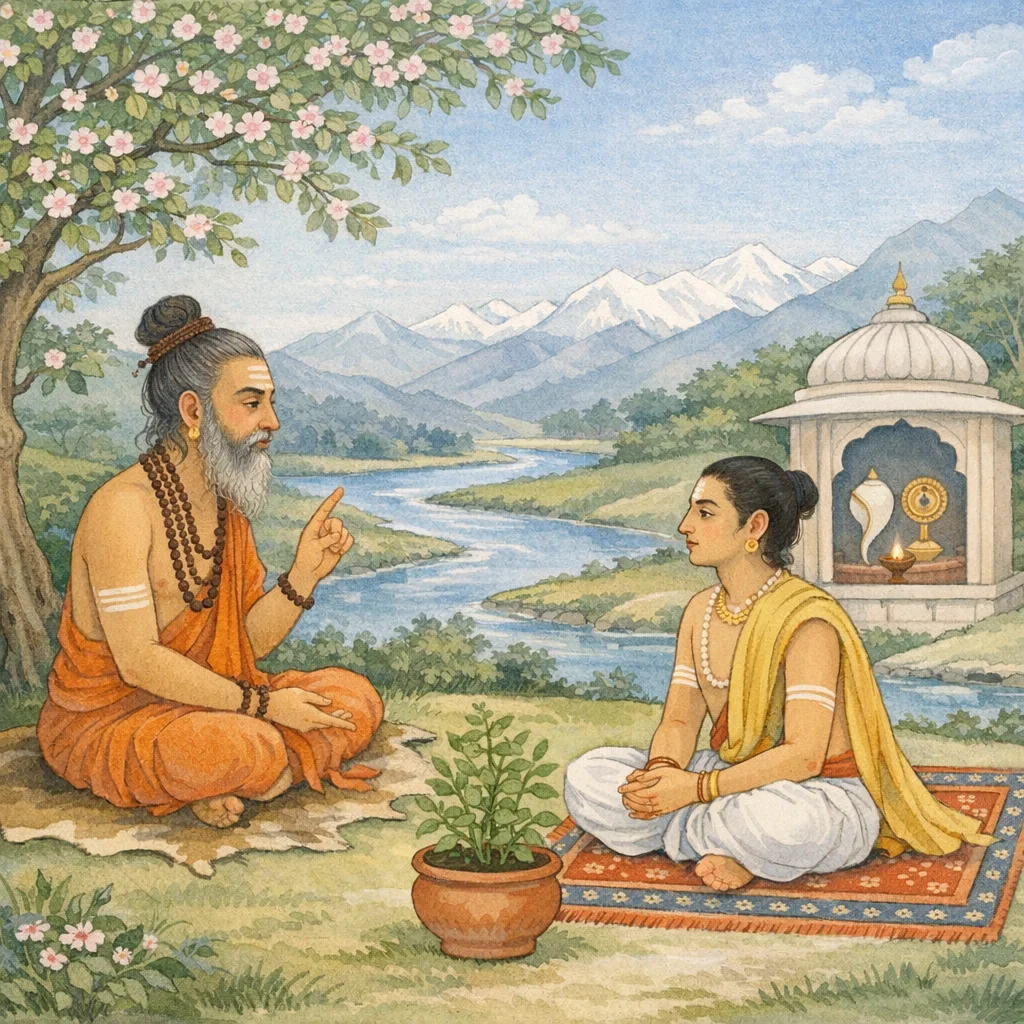
Adhyaya 52
The Account of Women (Householder Ethics, Fault, Merit, and Govinda-Nāma as Purification)
PP.1.52 opens with a dvija questioning Hari (Viṣṇu) about karmic afflictions—Māṇḍavya’s impalement and leprosy arising from moral fault. The teaching then broadens into householder ethics, warning of the harms attributed to sexual misconduct: corruption of lineage, social disorder, and the growth of sin. Introduced by the narrator through an embedded dialogue between Umā (Devī/Pārvatī) and Nārada, the chapter lists transgressions (adultery, abuse, abandonment, improper relations) and their hellish consequences. It then turns to purification, declaring that remembering and proclaiming Govinda’s Name is like fire that burns away sins, even the great mahāpātakas. Later sections describe sources of merit—hearing and reciting the Purāṇa, giving dāna, gifts connected with seed and marriage, and rules on marriage eligibility with prohibitions on bride-price—ending with a phalaśruti on the benefits of hearing this account.
Shlokas
Verse 1
द्विज उवाच । मांडव्यस्य मुनेर्विष्णोश्शूलाघातः कथं तनौ । पत्यौ पतिव्रतायाश्च कथं कुष्ठं कलेवरे
The Brahmin said: “O Viṣṇu, how did the sage Māṇḍavya come to be struck in his body by a stake? And how did leprosy arise in the body of a devoted, chaste wife because of her husband?”
Verse 2
हरिरुवाच । शिशुभावाच्च मांडव्यो झिल्लिकायामभानतः । वस्तिदेशे तृणं दत्वा मोहात्स च मुमोच ताम्
Hari said: “Māṇḍavya, speaking in a childish manner, struck at the cricket; then, placing a blade of grass upon the region of the bladder, he, in delusion, released her.”
Verse 3
तेनापवाददोषेण धर्मस्याज्ञातुरेव च । अहोरात्रं व्यथा कृच्छ्रा भुक्ता तेन द्विजन्मना
Because of the fault of slander—and because he was ignorant of true dharma—that twice-born man endured, day and night, painful and severe suffering.
Verse 4
किंतु समाधिना तेन न ज्ञातं शूलसंभवम् । कृच्छ्रं च मुनिना कृत्स्नं योगाभ्यासाद्भृशादपि
Yet, even through that samādhi, he did not understand the origin of the stake; and the sage’s entire arduous effort—despite intense practice of yoga—proved in vain.
Verse 5
कुष्ठिनो ब्रह्मणो घातादजितेंद्रियकारणात् । पूतिगंधं तनौ कुष्ठं संजातं द्विजसत्तम
From the slaying of a brāhmaṇa—and from the cause of unbridled senses—foul-smelling leprosy arose upon his body, O best among the twice-born.
Verse 6
पुरा विप्राय तेनैव दत्तं गौरीचतुष्टयम् । कन्यकात्रितयं विप्र तेन तस्य पतिव्रता
Formerly, O brāhmaṇa, he himself gave that brāhmaṇa a set of four fair maidens. And, O brāhmaṇa, he also gave him three daughters; and she became a pativrata, devoted to her husband.
Verse 7
अस्यास्तु कारणादेव स च मत्समतां व्रजेत् । अत्र ते विस्मयः कुत्र वेदकर्मपुरातनम्
Indeed, for this very reason, he too would attain equality with me. Where, then, is your astonishment here? This is the ancient ordinance of the Veda and of sacred rites.
Verse 8
द्विज उवाच । कृत्या नारी न यस्यैव तस्य स्वर्गो भवेद्ध्रुवम् । यथैतच्चरितं नाथ सर्वेषां शिवमिष्यते
The brāhmaṇa said: “He who has no wife is assuredly destined for heaven. O Lord, just as this account is, it is held to be auspicious for all.”
Verse 9
हरिरुवाच । संति कृत्याः स्त्रियः काश्चित्पुंसः सर्वस्वदस्य च । तत्राप्यरक्षणीयां च मनसापि न धारयेत्
Hari said: “There are certain women who are like kṛtyās—malevolent, destructive beings—and there are men who steal away a person’s entire wealth. Even among these, one should not keep in mind—even mentally—someone who is beyond protection, whose association is unsafe.”
Verse 10
न स्त्रीणामप्रियः कश्चित्प्रियो वापि न विद्यते । गावस्तृणमिवारण्ये प्रार्थयंति नवंनवम्
For women, there is none who is always disliked, nor any who is always dear; like cows in a forest seeking grass, they keep desiring something new again and again.
Verse 11
पुमांसं वित्तहीनं च विरूपं गुणवर्जितम् । अकुलीनं च भृत्यं च कामिनी भजते ध्रुवम्
A woman driven by lust, without fail, chooses even a man who is poor, unattractive, devoid of virtues, of low birth, and even a mere servant.
Verse 12
भर्तारं च गुणोपेतं कुलीनं च महाधनम् । सुंदरं रतिदक्षं च त्यक्त्वा नीचं भजेद्वधूः
Even after abandoning a husband who is virtuous, well-born, very wealthy, handsome, and skilled in love, a wife may still take up a base man.
Verse 13
उमानारदसंवादमाख्यानं विद्धि भूसुर । येन विद्यास्त्रियाश्चेष्टा विविधाः कृत्स्नशो द्विज
O holy brāhmaṇa, know this narrative as the dialogue between Umā and Nārada—by which, O twice-born, the diverse activities and dispositions of learned women are explained in full.
Verse 14
स्वभावान्नारदो विप्र विश्वजिज्ञासको मुनिः । स्वांते विमृश्याथ गतः कैलासं गिरिमुत्तमम्
O brāhmaṇa, Nārada—by his very nature a sage eager to know the whole world—reflected within his heart and then set out for Kailāsa, the most excellent of mountains.
Verse 15
वृषकेतुसदाख्यान सप्रतिष्ठे हिमे गिरौ । प्रणिपत्य महात्मा वै पप्रच्छ पार्वतीं मुनिः
At the sacred, well-established place called Vṛṣaketu-sadākhyāna upon the Himālaya mountain, the great sage bowed in reverence and then questioned Pārvatī.
Verse 16
देवि सीमंतिनीनांतु दुश्चेष्टां ज्ञातुमुत्सहे । कौतुकेन त्वया चर्या वधूनां संप्रयुज्यते
O Goddess, I wish to understand the improper conduct of married women. Out of curiosity, you observe and test the ways and practices of brides.
Verse 17
सर्वासामपि नारीणां स्वान्तं जानासि तत्त्वतः । तन्मां कथय सर्वेषु विनीतमज्ञमत्र च
You truly know the inner heart of all women. Therefore, tell me—here, before everyone—me who am humble and ignorant in this matter.
Verse 18
देव्युवाच । युवतीनां सदा चित्तं पुंसु तिष्ठत्यसंशयम् । अस्मिन्योनौ सुसंयोग्ये संगते वाप्यसंगते
The Goddess said: “A young woman’s mind, without doubt, ever rests upon men—whether in this very womb there is fitting union, whether there is union, or even no union.”
Verse 19
सुवेषं पुरुषं दृष्ट्वा भ्रातरं यदि वा सुतम् । योनिः क्लिद्यति नारीणां सत्यं सत्यं हि नारद
Seeing a well-adorned man—even if he be her brother or her son—a woman’s sexual organ becomes moistened; this is true, true indeed, O Nārada.
Verse 20
स्थानं नास्ति क्षणं नास्ति नास्ति प्रार्थयिता नरः । तेन नारद नारीणां सतीत्वमुपजायते
There is no occasion, not even a moment; there is no man to make solicitations. Therefore, O Nārada, the chastity and fidelity of women comes to be established.
Verse 21
घृतकुंभसमा नारी तप्तांगारसमः पुमान् । तस्माद्घृतं च वह्निं च नैकस्थाने च धारयेत्
A woman is like a pot of ghee; a man is like a heap of burning embers. Therefore, one should not keep ghee and fire together in the same place.
Verse 22
यथैवमत्तमातंगं सृणिमुद्गरयोगतः । स्ववशं कुरुते यंता तथा स्त्रीणां प्ररक्षकः
Just as a trainer, using a goad and a club, brings a maddened elephant under control, so too does the protector of women keep them under his governance.
Verse 23
पिता रक्षति कौमारे भर्ता रक्षति यौवने । पुत्राश्च स्थाविरे भावे न स्त्री स्वातंत्र्यमर्हति
In childhood a father protects her; in youth a husband protects her; and in old age her sons protect her—thus a woman is not considered fit for independence.
Verse 24
ततः स्वातंत्र्यभावाच्च स्वेच्छया च वरांगना । पुरुषेणार्थिता धीरा प्रेरणादिचरी भवेत्
Therefore, by her sense of independence and by her own choice, a noble woman—when requested by a man—should, being self-possessed, act only in response to prompting and the like, not through compulsion.
Verse 25
अरक्षणाद्यथा पाकः श्वकाकवशगो भवेत् । तथैव युवती नारी स्वच्छंदाद्दुष्टतां व्रजेत्
Just as a child, left without protection, may fall under the sway of dogs and crows, so too a young woman, through unrestrained self-will, drifts into wicked ways.
Verse 26
पुनरेव कुलं दुष्टं तस्यास्संसर्गतो भवेत् । परबीजेन यो जातः स च स्याद्वर्णसंकरः
Again, through association with her, the family becomes corrupted; and one born from another man’s seed is indeed regarded as varṇa-saṃkara, a mixing of social orders.
Verse 27
जारजः संकरः पापो नरके नियतं वसेत् । कीटजातौ गता जाताः पुनः सर्वे महीतले
One born of adultery—an impure mixed offspring, sinful—surely dwells in hell; having fallen into the state of insects, they are all born again upon the earth.
Verse 28
ततो म्लेच्छमुपानीतं कुलं स्याद्द्विजनंदन । कुलक्षयो भवेद्यस्मात्तस्माद्दुष्टां न धारयेत्
Then the family is drawn into association with the mlecchas, O delight of the twice-born; and since that brings about the destruction of the lineage, one should not accept or keep a corrupt woman.
Verse 29
ज्ञात्वैव योषितां दोषं क्षमते यो नराधमः । स तिष्ठेन्निरये घोरे रौरवे पितृभिः सह
That basest of men who, even knowing a woman’s fault, still condones it, remains in the dreadful hell called Raurava, together with his ancestors.
Verse 30
काचित्पातयते नारी काचिदुद्धरते कुलम् । तस्मात्सर्वप्रयत्नेन कुलजामुद्वहेद्बुधः
Some women cast a family into ruin, while others raise and redeem a lineage. Therefore, a wise man should, with every effort, marry a woman of good family.
Verse 31
कुलद्वयं समा नारी समयित्वा तु तिष्ठति । साध्वी तारयते वंशान्दुष्टा पातयति ध्रुवम्
Once she enters the bond of marriage, a woman stands as the equal concern of both families—her natal and her husband’s. A virtuous woman uplifts and saves the lineages; a corrupt woman surely brings them down.
Verse 32
दारेष्वधीनं स्वर्गं च कुलं पंकं यशोऽयशः । पुत्रं दुहितरं मित्रं संसारे कथयंति च
They say that in this worldly life even heaven depends upon one’s wife; that one’s family may be either a mire or a support; and that fame and disgrace, a son and a daughter, and even friendship are all spoken of as bound up with domestic life.
Verse 33
तस्मादेकां द्वितीयां वा वामामुद्वाहयेद्बुधः । संतानार्थात्तु कामाच्च बहुदोषाश्रिता च सा
Therefore, a wise man should marry one wife—or at most a second—whether for the sake of offspring or out of desire; for taking many wives is attended by numerous faults.
Verse 34
रजस्वलां च वनितां नावगच्छति यः पतिः । ब्रह्महा भ्रूणहा सोपि दुर्गतिं चाधिगच्छति
That husband who does not refrain from approaching a menstruating woman becomes, likewise, as one who slays a brāhmaṇa and as one who slays an embryo, and he falls into an evil state.
Verse 35
यो मोहाद्दुर्भगां कृत्वा साध्वीं त्यजति पापकृत् । तस्या वधेन यत्पापं तद्भुक्त्वा नरकं व्रजेत्
A sinful man who, out of delusion, deems his virtuous wife ill-fated and abandons her—after enduring the very sin that would arise from killing her, he goes to hell.
Verse 36
वनिताहरणं कृत्वा चांडलकुलतां व्रजेत् । तथैव वनिताहानात्पतितो जायते नरः
Having abducted a woman, one falls to the status of a Caṇḍāla family; likewise, by abandoning a woman, a man becomes fallen.
Verse 37
रामां विन्यस्य स्कंधे च चिरं यमपुरे वसेत् । मलमूत्रं शिरोदेशे नित्यं तस्य च संपतेत्
Having placed Rāmā upon his shoulder, he would dwell for a long time in Yama’s city; and urine and feces would constantly fall upon his head.
Verse 38
एवं वर्षसहस्राणि भारं वहति दुर्मतिः । पुनर्यावन्ति लोमानि तावत्स रौरवं व्रजेत्
Thus, for thousands of years the evil-minded one bears the burden; and for as long as his hairs grow back again and again, so long does he go to the Raurava hell.
Verse 39
पुनः कीटेषु संतीर्णस्तदा मानुषतां व्रजेत् । ततश्च कलहं शोकं प्राप्नोति पूर्वकल्मषात्
Having again passed through births among worms and insects, one then attains human status; yet, because of former impurity, one thereafter meets with quarrel and sorrow.
Verse 40
एवं जन्मत्रयं प्राप्य मुच्यते पातकान्नरः । तत्कालं नरकं भुक्त्वा सा तु काकी तु वञ्चकी
Thus, after obtaining three births, a man is freed from sins. But that deceitful woman—having endured hell for a time—becomes a she-crow (kākī).
Verse 41
उच्छिष्टनरकं भुक्त्वा मानुषे विधवा भवेत् । यः पुनश्चांत्यजां गच्छेन्म्लेछां वा पुल्कसां नरः
Having suffered the hell called Ucchiṣṭa, she is reborn among humans as a widow. Likewise, any man who again goes to an outcaste woman, or to a Mleccha woman, or to women of the Pulkaśas, incurs grave demerit.
Verse 42
द्वित्रिचतुर्गुणं भुक्त्वा तत्र संचीर्णवंचकः । मातरं गुरुभार्यां च ब्राह्मणीं महिषीं तथा
Having indulged there in sensual pleasure in two-, three-, and fourfold measure, he lived on as a practiced deceiver—violating his own mother, the wife of his teacher, a brāhmaṇa woman, and likewise a queen.
Verse 43
अन्यां वा प्रभुपत्नीं च गत्वा यात्यपुनर्भवं । भगिनीं तत्पुत्रभार्यां तथा दुहितरं स्नुषाम्
One who approaches another man’s wife—or the wife of one’s lord—goes to a state from which there is no return. Likewise, one who violates a sister, a son’s wife, a daughter, or a daughter-in-law.
Verse 44
पितृव्यां मातुलानीं तु तथैव च पितृष्वसाम् । मातृष्वस्रादिकामन्यां गत्वा नास्ति च निष्कृतिः
If one goes to one’s paternal aunt, maternal uncle’s wife, father’s sister, or mother’s sister and similar female relatives, there is no expiation prescribed for it.
Verse 45
ब्रह्महा स भवेदंधो वचसा जडतां व्रजेत् । कर्णयोर्बधिरो जातश्च्यवते नास्ति निष्कृतिः
A slayer of a brāhmaṇa becomes blind; by his speech he falls into dull-wittedness. He is born deaf in both ears, he is cast down, and there is no expiation for him.
Verse 46
उक्त्वा अश्लीलमत्यर्थमखिलं स्त्रीकृतेन हि । द्विज उवाच । एवं दुष्कृतमासाद्य कथं मोक्षो भवेत्पुनः
After uttering exceedingly obscene words—all on account of a woman—the brāhmaṇa said: “Having thus incurred such wrongdoing, how can liberation be attained again?”
Verse 47
तत्समाचक्ष्व भगवन्श्रोतुमिच्छामि तत्त्वतः । श्रीभगवानुवाच । तासां च गमनं कृत्वा तप्तां लोहस्य पुत्तलद्यं
“Explain that to me, O Blessed One; I wish to hear it in accordance with the truth.” The Blessed Lord said: “Having gone to them, (then) (something was done) involving a heated iron effigy.”
Verse 48
समालिंग्य त्यजेत्प्राणं शुचिर्लोकांतरं व्रजेत् । यो वै गृहाश्रमं त्यक्त्वा मच्चित्तो जायते नरः
Embracing Me, he should relinquish his life-breath; purified, he goes to another world. Indeed, the man who abandons the gṛhastha-āśrama and fixes his mind on Me—(attains this state).
Verse 49
नित्यं स्मरति गोविंदं सर्वपापक्षयो भवेत् । ब्रह्महत्यायुतं तेन कृतं गुर्वंगनागमात्
If one constantly remembers Govinda, the destruction of all sins occurs. Even ten thousand acts of brahma-hatyā—incurred through approaching the wife of one’s teacher—would be annulled by that remembrance.
Verse 50
शतं शतसहस्रं च पैष्टीमद्यस्य भक्षणात् । स्वर्णादेर्हरणं कृत्वा तेषां संसर्गकं चिरं
By consuming liquor distilled from flour, one incurs punishment of a hundred, even of a hundred thousand measures; and having stolen gold and the like, one remains for a long time in the company of such sinners.
Verse 51
एतान्यन्यानि पापानि महान्ति पातकानि च । अग्निं प्राप्य यथा तूलं तृणं शुष्कं प्रणश्यति
These and other sins—even the great and grievous transgressions—are destroyed, just as dry cotton or dry grass perishes upon reaching fire.
Verse 52
इति श्रीपाद्मपुराणे प्रथमे सृष्टिखंडे पंचाख्याने स्त्रीणामाख्यानंनाम । द्विपंचाशत्तमोऽध्यायः
Thus, in the Śrī Padma Purāṇa, in the first book—the Sṛṣṭi-khaṇḍa—within the fifth narrative section, ends the chapter entitled “The Account of Women”: the fifty-second chapter.
Verse 53
कृत्वा च पूजयित्वा च स पापात्सन्तरो भवेत् । भागीरथी तटे रम्ये खगस्य ग्रहणे शिवे
Having performed it and having duly worshipped, he becomes one who crosses beyond sin—on the lovely bank of the Bhāgīrathī (Gaṅgā), at the auspicious time of the eclipse of Khaga (the Sun).
Verse 54
गवां कोटिप्रदानेन यत्फलं लभते नरः । तत्फलं समवाप्नोति सहस्रं चाधिकं च यत्
Whatever merit a man gains by donating ten million cows—he attains that very merit, and even a thousand more besides.
Verse 55
गोविंदकीर्तने तात मत्पुरे चाक्षयं वसेत् । कामात्स भवने स्थित्वा सार्वभौमो भवेन्नृपः
O dear one, by singing the praises of Govinda, one dwells imperishably in my city; and if, moved by desire, a man resides in that abode, he becomes a king—an emperor over all.
Verse 56
पुराणेमत्कथां श्रुत्वा मत्सादृश्यं लभेन्नरः । कथयित्वा पुराणं च विष्णुसायुज्यतां व्रजेत्
Having heard my sacred narrative in the Purāṇa, a person attains likeness to me; and having recited and taught the Purāṇa as well, he proceeds to union with Viṣṇu.
Verse 57
तस्मान्नित्यं च श्रोतव्यं पुराणं धर्मसंचयं । श्रावितव्यं प्रयत्नेन लोके विष्णुतनुं व्रजेत्
Therefore, this Purāṇa—an accumulation of Dharma—should always be listened to; and with effort it should also be recited for others. In this very world, one attains the state of Viṣṇu.
Verse 58
अन्यद्वा स्त्रीकृते दोषे यथायोगं भवेद्ध्रुवं । निशामय प्रवक्ष्यामि तत्वतो द्विजनंदन
Or else, when a fault has been committed by a woman, the appropriate consequence certainly follows according to the case. Listen—O delight of the twice-born—I shall explain it truthfully, in accordance with reality.
Verse 59
सर्वबीजस्य दानेन सांबुकुंभं महाफलम् । दद्याद्विप्राय पुण्याहे सद्यःपूतो भवेत्क्षणात्
By donating all kinds of seeds, one obtains the great fruit (merit) called the “Sāmbukuṃbha.” One should give it to a brāhmaṇa on an auspicious day; he becomes purified immediately, in an instant.
Verse 60
सर्वं धान्यादिकं बीजं काले दद्याद्द्विजातये । सर्वपापक्षयं कृत्वा अक्षयं स्वर्गमश्नुते
At the proper time, one should offer every kind of seed—grains and the like—to a twice-born Brāhmaṇa. Thus all sins are destroyed, and one attains the imperishable heaven.
Verse 61
गुणं वक्ष्यामि विप्रर्षे सतीनां यादृशं दृढम् । शुद्धवंशो भवेत्तस्या नित्यं लक्ष्मीः प्रवर्तते
O best of Brahmins, I shall describe the steadfast virtue of righteous women: through her the lineage is purified, and Lakṣmī—prosperity—ever abides and flourishes.
Verse 62
उभयोर्वंशयोः स्वर्गो भर्तुरात्मन एव च । पतिव्रतागुणो विप्र विस्मृतः पृच्छतस्तव
For both lineages there is heaven—and for the husband’s very self as well. O brāhmaṇa, the virtue of the pativratā, the wife devoted to her lord, has been forgotten, since you ask of it.
Verse 63
पुनर्वक्ष्यामि योषाणां सर्वलोकहितं शुभम् । उषित्वा पूर्वकालं च पुण्यापुण्येन योषितः
I shall again declare, concerning women, what is auspicious and beneficial to all worlds: how in former times they lived and fared according to both merit and demerit.
Verse 64
पश्चात्पतिव्रतायाश्च ताश्च गच्छंति मद्गतिम् । षण्मासं वाथ वर्षं वा अधिकं च प्रशस्यते
Thereafter, those pativratās, devoted wives, also attain my state. For this observance, a period of six months, or a year—or even longer—is praised.
Verse 65
पतिव्रता भवेद्या च यावत्पूता व्रजेद्दिवम् । सुरापं विप्रहंतारं सर्वपापयुतं पतिम्
A woman who abides as pativratā, devoted to her husband, is purified and attains heaven—even if her husband is a drunkard, a slayer of a brāhmaṇa, and burdened with every sin.
Verse 66
पंकात्पूतं नयेत्स्वर्गं भर्त्तांरं यानुगच्छति । कंदर्पसदृशो भर्ता सा रतीव मनोरमा
She who faithfully follows her husband leads him—purified even from mire—onward to heaven. Her husband becomes like Kandarpa, and she herself becomes enchanting like Rati.
Verse 67
जिष्णोरेवचिरं लोके भुंक्तेऽनंतमयं सुखम् । पतिव्रता बलाद्या च विदूरे स्वामिपातने
In this world, the devoted wife—such as Balā and others—enjoys for a long time the boundless joy that belongs to Jiṣṇu, even while she is far away at the moment her husband falls (dies).
Verse 68
चिह्नं लब्ध्वामृता वह्नौ पापादुद्धरते पतिं । पतिव्रता च या नारी देशांतरमृते पतौ
Having obtained the auspicious sign and becoming deathless in the fire, she rescues her husband from sin. And the woman who is pativratā does not go to another land while her husband is alive.
Verse 69
सा भर्तुश्चिह्नमादाय वह्नौ सुप्त्वा दिवं व्रजेत् । या स्त्री ब्राह्मणजातीया मृतं पतिमनुव्रजेत्
Taking her husband’s token, she should lie down in the fire and go to heaven—such is the conduct prescribed for a woman of brāhmaṇa birth who follows her husband after his death.
Verse 70
सा स्वर्गमात्मघातेन नात्मानं न पतिं नयेत् । न म्रियेत समं गत्वा ब्राह्मणी ब्रह्मशासनात्
A brāhmaṇī should not seek heaven through self-destruction, nor should she bring death upon herself or her husband. She should not die by departing together with him, for such is the ordinance of Brahmā.
Verse 71
प्रव्रज्यागतिमाप्नोति मरणादात्मघातिनी । नरोत्तम उवाच । सर्वासामपि जातीनां ब्राह्मणः शस्य इष्यते
One who destroys oneself by death attains the destiny of a renunciant; yet such death is self-destruction. Narottama said: “Among all social orders, the brāhmaṇa is regarded as the most commendable.”
Verse 72
पुण्यं च द्विजमुख्येन अत्र किंवा विपर्ययः । श्रीभगवानुवाच । ब्राह्मण्यास्साहसं कर्म नैव युक्तं कदाचन
And what merit is there here for a foremost brāhmaṇa—or how could it be otherwise? The Blessed Lord said: “For one devoted to brāhmaṇahood, a rash or violent deed is never appropriate at any time.”
Verse 73
निःशेषेस्या वधं कृत्वा स नरो ब्रह्महा भवेत् । तस्माद्ब्राह्मणजातीया विप्रया च व्रतं चरेत्
Having killed her utterly, that man would become a slayer of a brāhmaṇa (brahmahā). Therefore, a woman of brāhmaṇa birth—and likewise a brāhmaṇī—should observe the prescribed vow.
Verse 74
प्रवक्ष्यामि यथातथ्यं शृणु विप्र यथार्थतः । आपणांतरमामिष्यं भक्षयेन्न कदाचन
I shall explain it exactly as it truly is—listen carefully, O brāhmaṇa, in its proper sense: one should never, at any time, eat meat obtained through trade, from the marketplace or commercial exchange.
Verse 75
अश्वमेधसहस्राणां हायने फलमाप्नुयात् । अर्हणं चेष्टदेवस्य हरेर्व्रतमनुत्तमम्
By observing this unsurpassed vow of Hari and duly worshipping one’s chosen deity, one attains within a single year merit equal to that of thousands of Aśvamedha sacrifices.
Verse 76
स्वामिनोपि जलं पिंडं संप्रदद्यादमत्सरात् । युगकोटिसहस्राणि युगकोटिशतानि च
Even a master should, free from envy, offer water and a food-ball (piṇḍa); the merit endures for thousands of crores of yugas, and for hundreds of crores of yugas as well.
Verse 77
पतिना सह सा साध्वी विष्णुलोके युता भवेत् । ततो महाव्रतं प्राप्य निरये ब्राह्मणी वधूः
That chaste woman, together with her husband, would dwell united in Viṣṇu’s world. But the brāhmaṇa bride, having undertaken the great vow, thereafter ends up in hell.
Verse 78
उद्धरेदुभयोर्वंशाञ्छतशोथ सहस्रशः । अतो बंधुजनैरेव पुत्रैर्भ्रात्रादिभिर्बुधैः
One should uplift the lineages of both parents—by the hundreds and even by the thousands. Therefore, it is indeed by one’s own kin—sons, brothers, and other wise relatives—that this is to be accomplished.
Verse 79
विनियम्य सदा तस्या व्रतलोपं न कारयेत् । हरेश्चेद्वासरं प्राप्य विधवा न व्रतं चरेत्
One should always keep her disciplined and should not cause her vow to be broken. When the day sacred to Hari arrives, a widow should not undertake that vow-observance.
Verse 80
पुनर्वैधव्यतामेति जन्मजन्मनि दुर्भगा । भोजनात्मत्स्यमांसस्य व्रतानां विप्रयोगतः
Because she eats fish and meat and becomes separated from sacred vows, the ill-fated woman falls again into widowhood, birth after birth.
Verse 81
चिरं निरयमासाद्य शुनी भवति निश्चितम् । दुष्टाया मैथुनं गच्छेद्विधवाकुलनाशिनी
After enduring hell for a long time, she certainly becomes a female dog. The wicked woman who goes to sexual relations with another man destroys the household of widows.
Verse 82
नरकाननुभूयाथ गृध्रिणी दशजन्मसु । द्विजन्मफेरवा भूत्वा ततो मानुषतां व्रजेत्
After experiencing the hells, she is born as a female vulture for ten lifetimes. Then, becoming a bat for two births, she thereafter attains human birth.
Verse 83
तथैव बालवैधव्या दासीत्वमुपगच्छति । द्विज उवाच । कन्यादानफलं ब्रूहि वद दास्याः फलं च यत्
Likewise, a woman widowed while still young comes to the state of servitude. The Brahmin said: “Tell me the fruit of giving a maiden in marriage; and also tell me what fruit accrues from giving a female servant.”
Verse 84
विधानं च यथोक्तं च यदि मेनुग्रहः प्रभो । श्रीभगवानुवाच । रूपाढ्ये गुणसंपन्ने कुलीने यौवनान्विते
“If Your favor is upon me, O Lord, then let the rite and the procedure be exactly as prescribed.” The Blessed Lord said: “(She is) endowed with beauty, possessed of virtues, of noble lineage, and in the fullness of youth.”
Verse 85
समृद्धे वित्तसंपूर्णे कन्यादानफलं शृणु । सर्वाभरणसंयुक्तां कन्यकां यो ददाति च
Hear the fruit of kanyādāna, the sacred gift of giving a maiden in marriage, when one is prosperous and wealthy: whoever gives a young maiden adorned with all ornaments receives the declared merit.
Verse 86
तेन दत्ता धरा सर्वा सशैलवनकानना । अर्द्धाभरणदानेन फलं दातुर्भवेद्ध्रुवम्
By that gift, the whole earth—together with its mountains, forests, and groves—is deemed to have been given; and by donating half of one’s ornaments, the donor’s reward becomes assured.
Verse 87
अनाभरणकन्यायाः पादैकस्य फलं भवेत् । यः पुनः शुल्कमश्नाति स याति नरके नरः
For the one who accepts it, the result is only that of a single foot of an unadorned maiden. But the man who again accepts the bride-price goes to hell.
Verse 88
विक्रीय चात्मजां मूढो नरकान्न निवर्त्तते । लोभादसदृशे पुंसि कन्यां यस्तु प्रयच्छति
The deluded man who sells his own daughter does not return from hell. And whoever, out of greed, gives a maiden in marriage to a man unfit or unequal to her meets the same fate.
Verse 89
रौरवं नरकं प्राप्य चांडालत्वं च गच्छति । अतएव हि शुल्कं च जामातुर्न कदाचन
He falls into the Raurava hell and is reborn as a caṇḍāla; therefore, at no time should one ever take a bride-price from a son-in-law.
Verse 90
गृह्णाति मनसा प्राज्ञो यद्दत्तं तस्य चाक्षयम् । भूमिं गां च हिरण्यं च धनं वस्त्रं च धान्यकम्
The wise receive inwardly, with the mind’s assent, whatever is given; for the giver that gift becomes imperishable—be it land, a cow, gold, wealth, clothing, or grain.
Verse 91
जामातुर्यौतकं दत्वा सर्वं भवति चाक्षयम् । विवाहसमये वत्स सगोत्र परगोत्रजैः
Having given the yautaka, the bridegroom’s marriage-gift, everything becomes imperishable, yielding inexhaustible merit. At the time of marriage, dear child, it should be done by those of the same lineage and of other lineages as well.
Verse 92
यौतकं दीयते किंचित्तत्सर्वं चाक्षयं भवेत् । दाता न स्मरते दानं प्रतिग्राही न याचते
Whatever little is given as yautaka becomes wholly imperishable, bringing inexhaustible merit. The giver does not dwell on the gift, and the recipient does not beg for it.
Verse 93
उभौ तौ नरकं यातश्छिन्नरज्जुर्घटो यथा । अवश्यं यौतकं दानं दातव्यं सात्विकेन हि
Both of them go to hell—like a pot whose rope has been cut. Therefore, a sāttvika person must certainly offer the yautaka as dāna, a sacred donation.
Verse 94
अदत्वा नरकं प्राप्य दासीत्वमुपगच्छति । अत्यासन्नेतिदूरस्थे चात्याढ्ये चाति दुर्गते
One who fails to give in charity reaches hell and then falls into servitude. Therefore one should give—whether the recipient is very near or very far, exceedingly wealthy, or extremely destitute.
Verse 95
कुलहीने च मूर्खे च षट्सु कन्या न दीयते । अतिवृद्धे चातिदीने रोगिष्ठे देशवासिनि
A maiden should not be given (in marriage) to any of these six: one without good lineage, a fool, one extremely old, one exceedingly poor, one afflicted by disease, or one who is a resident of the same locality.
Verse 96
अतिक्रुद्धेप्यसन्तुष्टे षट्सु कन्या न दीयते । एतेभ्यः कन्यकां दत्वा नरकं चाधिगच्छति
Even if (a suitor) is extremely angry or remains dissatisfied—among these six (types), a maiden should not be given (in marriage). Having given a girl to such men, one indeed goes to hell.
Verse 97
लोभात्संमानलाभाच्च कन्यका परिवर्तनात् । मुनीनां प्रेयसीं नारीं युवतीं रूपशालिनीम्
Out of greed, and for the gain of honor and profit, and through the exchanging of a maiden, (one obtains) a beloved woman of the sages—youthful and beautiful in form.
Verse 98
सालंकारां सशय्यां च दत्वाऽनंतफलं लभेत् । अनयोश्च फलं तुभ्यं युवती कन्ययोरपि
By giving (a maiden) adorned with ornaments and provided with a bed, one attains an endless reward. And the fruit of these (gifts) accrues to you as well, in the case of both a young woman and an unmarried girl.
Verse 99
एका वराय दातव्या अपरा ब्राह्मणाय तु । क्रीता देवा यदातव्या धीरेणाकष्टकर्मणा
One (offering) should be given to the bridegroom, and another to a Brāhmaṇa. The gifts that have been duly acquired should be given by a steadfast person who earns without distressing toil.
Verse 100
कल्पकालं भवेत्स्वर्गं नृपो वा कौ महाधनी । प्रतिजन्म लभेतैष सुपत्नीं वरवर्णिनीम्
For him, even a whole aeon becomes like heaven; he becomes a king or a man of great wealth. In every birth he obtains a virtuous wife, of excellent beauty and radiant complexion.
Verse 101
य इदं शृणुयान्नित्यं पुण्याख्यानमनुत्तमम् । सर्वपापक्षयस्तस्य सर्वशास्त्रार्थपारगः
Whoever regularly listens to this unsurpassed, meritorious sacred narrative—his every sin is destroyed, and he becomes one who has mastered the meanings of all the śāstras.
Verse 102
लभेत सोऽक्षयं स्वर्गं नारीणां वल्लभो भवेत् । क्षत्रियो विजयी चाथ लोकनाथो भवेद्ध्रुवम्
He attains the imperishable heaven and becomes beloved of women. And if he is a kṣatriya, he becomes victorious and indeed becomes a lord of the people—certainly.
Verse 103
श्रुतं हरति पापानि जन्मजन्मकृतानि च । सौभाग्यं लभते लोके तथैव च वरांगना
Hearing (this sacred account) removes sins committed across many births; and in this world, a noble woman likewise attains good fortune.