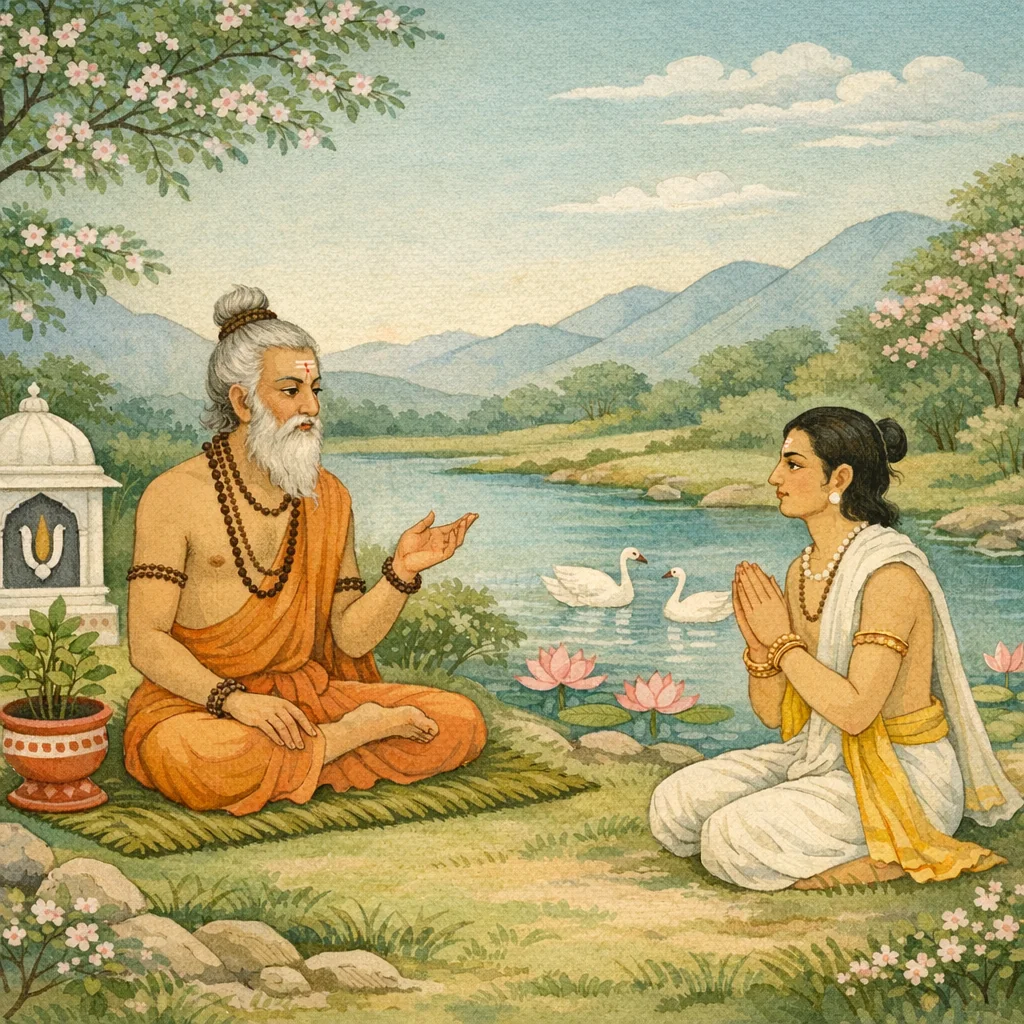
Adhyaya 50
The Five Great Sacrifices: Supremacy of Honoring Parents, Pativrata Dharma, Truthfulness, and Śrāddha
Bhīṣma asks Pulastya to declare the highest merit accepted by all. Pulastya recounts how Vyāsa instructs the dvijas on five “great sacrifices”: reverent service to one’s parents (and, for a wife, to her husband), equanimity, faithfulness to friends, and devoted worship of Śrī Hari/Viṣṇu. The chapter proclaims that honoring parents surpasses ritual sacrifices and pilgrimages. Narottama’s pride, checked by the episode of the crane, leads him to Mūka—caṇḍāla by birth yet brāhmaṇa in conduct through unwavering care of his parents. Viṣṇu appears in disguise and corrects the brahmin through exemplars: Śubhā as the ideal pativratā, Tulādhāra as a model of truth and impartiality, and Sajjanādrohaka as one who conquers desire amid public slander. Teachings then unfold on Pitṛ-yajña and śrāddha, the merits of eclipses, funeral duties, and expiations, returning to the central conclusion: the surest path to Hari’s abode is steadfast reverence for one’s parents.
Shlokas
Verse 1
भीष्म उवाच । यत्पुण्यमधिकं लोके सर्वदा सर्वसंमतम् । तद्वदस्वेच्छया विप्र यत्कृतं पूर्वपूर्वकैः
Bhīṣma said: O brāhmaṇa, speak freely—what act of merit is greatest in this world, ever and universally approved, and what was practiced by the most ancient forefathers?
Verse 2
पुलस्त्य उवाच । एकदा तु द्विजाः सर्वे व्यासशिष्यास्सहादरात् । व्यासं प्रणम्य पप्रच्छु धर्मं मां च यथा भवान्
Pulastya said: Once, all the twice-born—disciples of Vyāsa—bowed to Vyāsa with reverence and questioned him about dharma and about me as well, just as you have done.
Verse 3
द्विजा ऊचुः । पुण्यात्पुण्यतमं लोके सर्वधर्मेषु चोत्तमम् । किं कृत्वा मानवा स्वर्गं भुंजते चाक्षयं वद
The twice-born said: “Among all meritorious acts in the world, and among all dharmas, what is the most supremely excellent? By doing what do human beings enjoy heaven with imperishable reward? Tell us.”
Verse 4
लभ्यं चाकष्टकं शुद्धं वर्णानां मर्त्यवासिनाम् । गुरूणां च लघूनां च साध्यमेकं क्रतुं वद
Tell of a single pure rite—easily obtained and without hardship—for mortals of all varṇas dwelling in this world, whether eminent or humble, that can be successfully performed.
Verse 5
यद्यत्कृत्वा च देवानां पूज्यो नाके भवेन्नरः । तत्तद्वद च नो ब्रह्मन्प्रसादी भव धर्मतः
O Brahmin, tell us what acts a person should perform by which he becomes worthy of reverence by the gods in heaven. Be gracious, and speak in accordance with dharma.
Verse 6
व्यास उवाच । पंचाख्यानं वदिष्यामि शृणुध्वं तत्र पूर्वतः । पंचानामेककं कृत्वा विंदेन्मोक्षं दिवं यशः
Vyāsa said: “I shall relate the fivefold sacred narrative—listen to it first with attentive mind. By making the five into one (uniting their meaning in practice), one attains liberation, heaven, and renown.”
Verse 7
पित्रोरर्चाऽथ पत्युश्च साम्यं सर्वजनेषु च । मित्राद्रोहो विष्णुभक्तिरेते पंच महामखाः
Worship of one’s parents, and of one’s husband; equal-mindedness toward all people; not betraying one’s friends; and devotion to Viṣṇu—these are the five great sacrifices (mahāyajñas).
Verse 8
प्राक्पित्रोरर्चया विप्रा यद्धर्मं साधयेन्नरः । न तत्क्रतुशतैरेव तीर्थयात्रादिभिर्भुवि
O brāhmaṇas, whatever merit (dharma) a person attains by first worshipping the parents—such merit cannot be gained on earth even by hundreds of sacrificial rites, nor by pilgrimages and the like.
Verse 9
पिता धर्मः पिता स्वर्गः पिता हि परमं तपः । पितरि प्रीतिमापन्ने प्रीयंते सर्वदेवताः
The father is righteousness; the father is heaven; indeed, the father is the highest austerity (tapas). When the father is pleased, all the gods become pleased.
Verse 10
पितरो यस्य तृप्यंति सेवया च गुणेन च । तस्य भागीरथी स्नानमहन्यहनि वर्तते
For the person whose forefathers are satisfied through devoted service and virtuous conduct, bathing in the Bhāgīrathī (Gaṅgā) is for him as though it were performed day after day.
Verse 11
सर्वतीर्थमयी माता सर्वदेवमयः पिता । मातरं पितरं चैव यस्तु कुर्यात्प्रदक्षिणम्
The mother embodies all sacred tīrthas, and the father embodies all the gods. Whoever performs pradakṣiṇā around one’s mother and father truly honors them, as though circling all holy places and deities.
Verse 12
प्रदक्षिणीकृता तेन सप्तद्वीपा वसुंधरा । जानुनी च करौ यस्य पित्रोः प्रणमतः शिरः
By him the earth, together with its seven continents, was as it were circumambulated; for when he bowed to his parents, his knees and hands touched the ground and his head fell in reverence.
Verse 13
निपतंति पृथिव्यां च सोक्षयं लभते दिवं । तयोश्चरणयोर्यावद्रजश्चिह्नानि मस्तके
Falling down upon the earth in reverence, one attains the imperishable heavenly realm, so long as the dust-marks of those two feet remain upon one’s head.
Verse 14
प्रतीके च विलग्नानि तावत्पूतः सुतस्तयोः । पादारविंदसलिलं यः पित्रोः पिबते सुतः
So long as he remains devoted to the rites and service for them, the son of those parents is purified—especially that son who drinks the sacred water from the lotus-feet of his father and mother.
Verse 15
तस्य पापक्षयं याति जन्मकोटिशतार्जितं । धन्योसौ मानवो लोके पूतोसौ सर्वकल्मषात्
For him, the sins accumulated over hundreds of millions of births come to an end. Blessed is that person in this world; he is purified from all defilements.
Verse 16
विनायकत्वमाप्नोति जन्मनैकेन मानवः । पितरौ लंघयेद्यस्तु वचोभिः पुरुषाधमः
In a single birth a man becomes a Vināyaka, a maker of obstacles, if—being the vilest of men—he oversteps and dishonors his father and mother by his words.
Verse 17
निरये च वसेत्तावद्यावदाभूतसंप्लवं । पित्रोरनर्चनं कृत्वा भुंक्ते यस्तु सुताधमः
That vilest of sons, who eats after failing to honor and worship his father and mother, dwells in hell until the cosmic dissolution—the great cataclysm of beings.
Verse 18
क्रिमिकूपेथ नरके कल्पांतमुपतिष्ठति । रोगिणं चापि वृद्धं च पितरं वृत्तिकर्शितम्
Then, in the hell called Krimikūpa, he remains until the end of an aeon—he who has afflicted his father, whether sick or aged, emaciated through lack of livelihood.
Verse 19
विकलं नेत्रकर्णाभ्यां त्यक्त्वा गच्छेच्च रौरवम् । अंत्यजातिषु म्लेच्छेषु चांडालेष्वपि जायते
Abandoning one who is crippled, bereft of eyes and ears, one goes to the hell called Raurava, and is reborn among the lowest births—among mlecchas, outcastes, and even Caṇḍālas.
Verse 20
पित्रोरपोषणं कृत्वा सर्वपुण्यक्षयो भवेत् । नाराध्य पितरौ पुत्रस्तीर्थदेवान्भजन्नपि
If one neglects the care and support of one’s parents, all accumulated merit is destroyed. Even if a son worships sacred tīrthas and deities, without honoring his parents he gains no true fruit.
Verse 21
तयोर्न फलमाप्नोति कीटवद्रमते महीम् । कथयामि पुरावृत्तं विप्राः शृणुत यत्नतः
Of those two, one does not attain the fruit; like a worm, he merely delights in the earth. I shall relate an ancient account—O brāhmaṇas, listen with care.
Verse 22
यं श्रुत्वा न पुनर्मोहं प्रयास्यथ पुनर्भुवि । पुरासीच्च द्विजः कश्चिन्नरोत्तम इति स्मृतः
Hearing it, you will not fall again into delusion in this world. Long ago there was a certain brāhmaṇa, remembered by the name Narottama.
Verse 23
स्वपितरावनादृत्य गतोसौ तीर्थसेवया । ततः सर्वाणि तीर्थानि गच्छतो ब्राह्मणस्य च
Disregarding his own parents, he went off in the service of visiting sacred fords (tīrthas). Thereafter, as that brāhmaṇa continued going from one tīrtha to another, the tale proceeds.
Verse 24
आकाशे स्नानचेलानि प्रशुष्यंति दिने दिने । अहंकारोऽविशत्तस्य मानसे ब्राह्मणस्य च
Day after day, his bathing-cloths dried in the open air; and pride entered the mind of that brāhmaṇa.
Verse 25
मत्समो नास्ति वै कश्चित्पुण्यकर्मा महायशाः । इत्युक्ते चानने तस्य अहदच्च बकस्तदा
“Truly, there is no one equal to me—a doer of meritorious deeds, of great fame.” When this was spoken, then the crane struck at his face.
Verse 26
क्रोधाच्चैवेरितस्तस्य स शशाप द्विजो बकम् । पपात च बकः पृथ्व्यां स भस्मीभूतविग्रहः
Incited by anger, that brāhmaṇa cursed the crane. The crane fell upon the earth, its body reduced to ashes.
Verse 27
भीर्द्विजेंद्रं महामोहः प्राविशच्चांतकर्मणि । ततः पापाच्च विप्रस्य चेलं खं च न गच्छति
Then, through fear, great delusion entered the foremost of Brahmins at the time of his final rites. Because of that sin, the Brahmin’s cloth did not rise up into the sky.
Verse 28
विषादमगमत्सद्यस्ततः खं तमुवाच ह । गच्छ बाडव चांडालं मूकं परमधार्मिकम्
He fell into dejection at once. Then Kha said to him: “Go to the Bāḍava-caṇḍāla—mute, yet supremely righteous.”
Verse 29
तत्र धर्मं च जानीषे क्षेमं ते तद्वचो भवेत् । खाच्च तद्वचनं श्रुत्वा गतोसौ मूकमंदिरम्
There you will come to know dharma, and that instruction will bring you welfare. And Khā, having heard those words, went to the temple of Mūka.
Verse 30
शुश्रूषंतं च पितरौ सर्वारंभान्ददर्श सः । ददतं शीतकाले च सम्यगुष्णं जलं तयोः
He observed him devotedly serving his parents in every undertaking—giving them properly warmed water during the cold season.
Verse 31
तैलतापनतांबूलं तथा तूलवतीं पटीम् । नित्याशनं च मिष्टान्नं दुग्धखंडं तथैव च
Also offer betel prepared with oil and warming spices, a cotton-stuffed cloth (garment or covering), daily meals, sweet dishes, and likewise milk-solid confections.
Verse 32
दापयंतं वसंते च मधुमालां सुगंधिकां । अन्यानि यानि भोग्यानि कृत्यानि विविधानि च
And in the season of spring, have a fragrant garland of honey-flowers offered, along with whatever other delightful offerings and the various ritual acts that are to be performed.
Verse 33
उष्णे चावीजयत्सोपि नित्यं च पितरावपि । ततस्तयोः प्रचर्यां च कृत्वा भुंक्तेथ सर्वदा
Even in the heat, he would continually fan them; and every day he would attend upon his parents. Then, having rendered service to them, he would always take his meal.
Verse 34
श्रमस्य वारणं कुर्यात्संतापस्य तथैव च । एभिः पुण्यैः स्थितो विष्णुस्तस्य गेहोदरे चिरम्
One should ward off fatigue and likewise distress; by these meritorious deeds, Viṣṇu remains established for a long time within that person’s household.
Verse 35
अंतरिक्षे च क्रीडंतमाधारस्तंभवर्जिते । तस्यापि भवने नित्यं स्थितं त्रिभुवनेश्वरं
And he beheld the Lord of the three worlds, ever abiding in His own abode—sporting in the mid-air, in a realm that is without any supporting pillar.
Verse 36
विप्ररूपधरं कांतं नान्यैर्भूतं च सत्परम् । तेजोमयं महासत्वं शोभयंतं च मंदिरं
Assuming the form of a brāhmaṇa—radiant and charming—he was unlike any other being, supremely virtuous; made of pure splendor and great spiritual power, he illumined and beautified the temple.
Verse 37
दृष्ट्वा विस्मयमापन्नो विप्रः प्रोवाच मूककम् । विप्र उवाच । आसन्नं च ममागच्छ त्वयैवेच्छामि शाश्वतं
Seeing this, the brāhmaṇa was filled with wonder and spoke to the mute. The brāhmaṇa said: “Come near to me; it is you alone whom I desire forever.”
Verse 38
हितं मे सर्वलोकानां तत्वतो वक्तुमर्हसि । मूक उवाच । पित्रोरर्चां करोम्यद्य कथमायामि तेंतिकं
“You ought to tell me, truthfully, what is beneficial for all worlds.” Mūka said: “Today I am performing the worship of my parents; how then can I come near you?”
Verse 39
अर्चयित्वा तु पितरौ कृत्यं ते करवाणि वै । तिष्ठ मे द्वारदेशे च आतिथ्यं ते करोम्यहम्
After worshipping my parents, I will certainly do what is to be done for you. Stand for a moment at my doorway; I will offer you hospitality.
Verse 40
इत्युक्ते चैव चांडाले चुकोप ब्राह्मणस्तदा । ब्राह्मणं मां परित्यज्य किं कार्यमधिकं तव
When the Caṇḍāla had spoken thus, the brāhmaṇa then became enraged: “Abandoning me, a brāhmaṇa, what greater purpose do you have?”
Verse 41
मूक उवाच । किं कुप्यसि वृथा विप्र न बकोहं तवाधुना । कोपस्सिद्ध्यति ते तावद्बकेनान्यत्र किंचन
The Mute said: “Why do you grow angry in vain, O brāhmaṇa? I am not a crane for you now. Your wrath will not bear fruit; turn it elsewhere, if it must be turned at all.”
Verse 42
गगने स्नानशाटी ते न शुष्यति न तिष्ठति । वचनं खात्ततः श्रुत्वा मद्गृहं चागतो भवान्
Up in the sky, your bathing-cloth neither dries nor stays in place. Hearing these words from the bird, you have come to my house.
Verse 43
तिष्ठ तिष्ठ वदिष्यामि नोचेद्गच्छ पतिव्रतां । तां च दृष्ट्वा द्विजश्रेष्ठ दयितं ते फलिष्यति
“Stay, stay—I shall tell you; otherwise, go to that devoted wife, the pativrata. And having seen her, O best of the twice-born, what is dear to you will be fulfilled.”
Verse 44
ततस्तस्यगृहाद्विष्णुर्द्विजरूपधरो विभुः । विनिस्सृत्य द्विजं प्राह गेहं तस्याः प्रयाम्यहं
Then Viṣṇu, the all-powerful Lord who had assumed the form of a brāhmaṇa, came out of that man’s house and said to the brāhmaṇa: “I am going to her home.”
Verse 45
स विमृश्य द्विजश्रेष्ठस्तेन सार्धं चचाल ह । गच्छंतं तमुवाचेदं हरिं विप्रेति विस्मितः
After reflecting, the best of the twice-born set out along with him. As Hari was departing, the astonished brāhmaṇa addressed him thus:
Verse 46
किर्थं च त्वया विप्र चांडालस्य गृहोदरे । सदा संस्थीयते तात योषाजनवृते मुदा
And why, O brāhmaṇa, do you always remain, revered sir, within the house of a caṇḍāla, gladly surrounded by the women of the household?
Verse 47
हरिरुवाच । इदानीं मानसं शुद्धं न भूतं भवतो ध्रुवम् । पतिव्रतादिकं दृष्ट्वा पश्चाज्ज्ञास्यसि मां किल
Hari said: “Surely, your mind has not yet become pure. After you have witnessed the conduct of a pativratā— a devoted wife— and such virtues, you will indeed come to know Me later.”
Verse 48
विप्र उवाच । पतिव्रता च का तात किं वा तस्याश्श्रुतं महत् । येनाहं तत्र गच्छामि कारणं वद मे द्विज
The brāhmaṇa said: “O dear one, who is that pativratā, the devoted wife, and what great account have you heard of her? Tell me, O twice-born, the reason for which I should go there.”
Verse 49
हरिरुवाच । नदीनां जाह्नवी श्रेष्ठा प्रमदानां पतिव्रता । मनुष्याणां प्रजापालो देवानां च जनार्दनः
Hari said: “Among rivers, Jāhnavī—the Gaṅgā—is the best; among women, the pativratā, the devoted wife, is foremost; among humans, the protector of subjects is supreme; and among the gods, Janārdana (Viṣṇu) is supreme.”
Verse 50
पतिव्रता च या नारि पत्युर्नित्यं हिते रता । कुलद्वयस्य पुरुषानुद्धरेत्सा शतं शतं
A pativratā, a devoted wife ever intent on her husband’s welfare, uplifts the men of both families—hundreds upon hundreds.
Verse 51
स्वर्गं भुनक्ति तावच्च यावदाभूतसंप्लवं । स्वर्गाद्भ्रष्टो भवेद्वास्याः सार्वभौमो नृपः पतिः
He enjoys heaven only until the cosmic dissolution. When he falls from heaven, he becomes on earth a universal sovereign—a king, a husband.
Verse 52
अस्यैव महिषी भूत्वा सुखं विंदेदनंतरं । पुनः पुनः स्वर्गराज्यं तस्य तस्या न संशयः
Becoming the queen-consort of this very king, she would thereafter attain unbroken happiness; and again and again she would obtain sovereignty in heaven—of this there is no doubt.
Verse 53
एवं जन्मशतं प्राप्य अंते मोक्षो भवेद्ध्रुवम् । विप्र उवाच । पतिव्रता भवेत्कावा तस्याः किं वा च लक्षणं
Thus, after attaining a hundred births, liberation (mokṣa) at the end becomes certain. The brāhmaṇa said: “Who indeed is to be called a pativratā, and what are her characteristics?”
Verse 54
ब्रूहि मे द्विजशार्दूल यथा जानामि तत्त्वतः । हरिरुवाच । पुत्राच्छतगुणं स्नेहाद्राजानं च भयादथ
Tell me, O tiger among Brahmins, so that I may know the truth as it truly is. Hari said: One’s affection for a king is a hundredfold greater than that for a son—yet it arises from fear.
Verse 55
आराधयेत्पतिं शौरिं या पश्येत्सा पतिव्रता । कार्ये दासी रतौ वेश्या भोजने जननीसमा
She who reveres her husband as Śauri (Viṣṇu) and beholds him in that spirit is truly a pativratā. In duties she should be like a servant, in love like a courtesan, and in matters of food like a mother.
Verse 56
विपत्सु मंत्रिणी भर्तुः सा च भार्या पतिव्रता । भर्तुराज्ञां न लंघेद्या मनो वाक्कायकर्मभिः
In times of calamity, let her be her husband’s counsellor; and as a devoted wife, a pativratā, let her not transgress her husband’s command—by mind, by speech, or by bodily deed.
Verse 57
भुक्ते पत्यौ सदा चात्ति सा च भार्या पतिव्रता । यस्यां यस्यांतु शय्यायां पतिः स्वपिति यत्नतः
When her husband has eaten, she too eats; such a wife is ever a pativratā. And upon whatever bed her husband carefully chooses for sleep, upon that very bed she also sleeps.
Verse 58
तत्र तत्र च साभर्तुरर्चां करोति नित्यशः । नैव मत्सरमायाति न कार्पण्यं न मानिनी
Wherever she may be, she continually performs worship in honour of her husband. She never falls into envy, nor into petty miserliness, nor into prideful self-importance.
Verse 59
मानेऽमाने समानं च या पश्येत्सा पतिव्रता । सुवेषं या नरं दृष्ट्वा भ्रातरं पितरं सुतं
She is a true pativratā who regards honour and dishonour as the same; and who, on seeing a well-adorned man, looks upon him as no more than a brother, a father, or a son.
Verse 60
मन्यते च परं साध्वी सा च भार्या पतिव्रता । तां गच्छ द्विजशार्दूल वदकामं यथा तव
She is esteemed as supremely virtuous, and she is a wife devoted to her husband. Go to her, O tiger among Brahmins, and speak whatever you wish, as you desire.
Verse 61
तस्य पत्न्योऽष्ट तिष्ठंति तन्मध्ये वरवर्णिनी । रूपयौवनसंपन्ना दयायुक्ता यशस्विनी
He has eight wives. Among them is one exquisite woman—endowed with beauty and youth, compassionate in nature, and renowned.
Verse 62
शुभा नामेति विख्याता गत्वा तां पृच्छ ते हितं । एवमुक्त्वा तु भगवांस्तत्रैवांतरधीयत
“She is renowned by the name Śubhā. Go and ask her what is beneficial for you.” Having said this, the Blessed Lord then vanished from that very place.
Verse 63
तस्यैवादृश्यतां दृष्ट्वा विस्मितोभूद्द्विजस्तदा । स च साध्वीगृहं गत्वा पप्रच्छाथ पतिव्रतां
Seeing that he had become invisible, the brāhmaṇa was astonished. Then he went to the chaste woman’s house and questioned that devoted wife.
Verse 64
अतिथेर्वचनंश्रुत्वागृहान्निःसृत्यसंभ्रमात् । दृष्ट्वा द्विजं सती तत्र द्वारदेशे स्थिताभवत्
Hearing the guest’s words, she hurriedly came out of the house in agitation; and seeing the brāhmaṇa there, the virtuous lady stood at the doorway.
Verse 65
तां च दृष्ट्वा द्विजश्रेष्ठ उवाच वचनं मुदा । प्रियं ममहितं ब्रूहि यथादृष्टं त्वमेव हि
And seeing her, the best of the twice-born spoke joyfully: “Tell me what is dear to me and beneficial—exactly as you saw it, for you alone have witnessed it.”
Verse 66
पतिव्रतोवाच । सांप्रतं पत्युरर्चास्ति न चास्माकं स्वतंत्रता । पश्चात्कार्यं करिष्यामि गृहाणातिथ्यमद्य वै
The devoted wife said: “At present my husband is engaged in worship, and I have no freedom to act independently. Afterward I shall do what is required; for now, accept my hospitality today.”
Verse 67
विप्र उवाच । मम देहे क्षुधा नास्ति पिपासाद्य न च श्रमः । अभीष्टं वद कल्याणि नोचेच्छापं ददामि ते
The brāhmaṇa said: “In my body there is no hunger, no thirst, and no fatigue. Tell me, O auspicious lady, what you desire; otherwise I shall give you a curse.”
Verse 68
तमुवाच तदा सापि न बकोहं द्विजोत्तम । गच्छ धर्मतुलाधारं पृच्छ तं ते हितं द्विज
Then she too said to him: “O best of the twice-born, I am not a crane. Go to Dharmatūlādhāra and ask him; he will tell you what is for your welfare, O brāhmaṇa.”
Verse 69
इत्युक्त्वा सा महाभागा प्रययौ च गृहोदरम् । तत्रापश्यद्द्विजो विप्रं यथा चांडालवेश्मनि
Having spoken thus, that noble lady went into the interior of the house. There the twice-born man saw a brāhmaṇa, as though he were in the dwelling of a caṇḍāla.
Verse 70
विमृश्य विस्मयापन्नस्तेन सार्धं ययौ द्विजः । तिष्ठंतं च द्विजं तं च सोपश्यद्धृष्टमानसम्
After reflecting, the brāhmaṇa was filled with wonder and went along with him. Then he saw that brāhmaṇa standing there, his mind steady and unafraid.
Verse 71
स चोवाच मुदा विप्रं दृष्ट्वा तं तां सतीं च सः । देशांतरे च यद्वृत्तं तया च कथितं किल
And he, seeing that brāhmaṇa and that virtuous woman, spoke with joy; and he also recounted what had occurred in another land, just as she had truly told him.
Verse 72
कथं जानाति मद्वृत्तं चांडालोपि पतिव्रता । अतो मे विस्मयस्तात किमाश्चर्यं परं महत्
How can that chāṇḍāla woman—though devoted to her husband—know my private conduct? Therefore, dear one, I am astonished; what could be a greater wonder than this?
Verse 73
हरिउवाच । ज्ञायते कारणं तात सर्वेषां भूतभावनैः । अतिपुण्यात्सदाचाराद्यतस्त्वं विस्मयं गतः
Hari said: “Dear one, the cause is understood by all the nurturers of beings. It is because of your great merit and righteous conduct that you have fallen into wonder.”
Verse 74
किमुक्तश्च तया त्वं च वद तत्सांप्रतं मुने । विप्र उवाच । प्रष्टुं धर्मतुलाधारं सा च मां समुपादिशत्
“Tell me now, O sage—what did she say, and what did you reply?” The brāhmaṇa said: “She instructed me to go and question the very support of the balance of Dharma.”
Verse 75
हरिरुवाच । आगच्छ मुनिशार्दूल अहं गच्छामि तं प्रति । गच्छंतं च हरिं प्राह तुलाधारः क्व तिष्ठति
Hari said: “Come, O tiger among sages; I am going to him.” As Hari was setting out, Tulādhāra addressed him: “Where are you going to stay—where will you stop?”
Verse 76
हरिरुवाच । जनानां निकरो यत्र बहुद्रव्यसुविक्रये । विक्रीणाति च क्रीणाति तुलाधारस्ततस्ततः
Hari said: “That place where crowds of people gather for the buying and selling of many kinds of goods—where they sell and they buy, and where the scales and weights are set up here and there…”
Verse 77
जनो यवान्रसं स्नेहं कूटमन्नस्य संचयं । सर्वं तस्य मुखादेव गृह्णाति च ददात्यपि
A person receives and also gives everything through his mouth alone—barley, flavors, fats (ghee/oil), and even a hoard of stored food.
Verse 78
सत्यं त्यक्त्वानृतं किंचित्प्राणांते समुपस्थिते । नोक्तं नरवरश्रेष्ठस्तेनधर्मतुलाधरः
Even when death stood near, the best of men did not abandon truth to utter even a little falsehood; therefore he was a bearer of the balance of Dharma, one who upholds righteousness.
Verse 79
इत्युक्ते तु तमद्राक्षीद्विक्रीणंतं रसान्बहून् । मलपंकधरं मर्त्यं दंतकुड्मलपंकिलम्
When this was said, he then saw that mortal selling many kinds of liquids and juices—his body smeared with filthy mire, and his teeth and gums stained with grime.
Verse 80
तत्र वस्तुधनोत्थां च भाषंतं विविधां गिरम् । वृतं बहुविधैर्मर्त्यैः स्त्रीभिः पुंभिश्च सर्वतः
There, he was speaking in many kinds of words, arising from matters and wealth; and he was surrounded on all sides by various mortals—women and men.
Verse 81
कथं कथमिति प्राह स तं मधुरया गिरा । धर्मस्य मे समुद्देशं वद प्राप्तोंऽतिकं हि ते
Saying again and again, “How so? How so?”, he addressed him in a sweet voice: “Tell me the outline of dharma, for truly I have drawn near to you.”
Verse 82
तुलाधार उवाच । यावज्जनाः प्रतिष्ठंति ममैव सन्निधौ द्विज । तावन्मे स्वस्थता नास्ति यावच्च रात्रियामकः
Tulādhāra said: “O twice-born one, as long as people remain here in my very presence, I have no ease or well-being—not even for a single watch of the night.”
Verse 83
तच्चोपदेशमादाय गच्छ धर्माकरं प्रति । बकस्य मरणे दोषं खे च वस्त्राविशोषणम्
Having taken up that instruction, go to Dharmākara. (There you will learn) the fault incurred in the death of a crane, and also (the rule concerning) drying garments beneath the open sky.
Verse 84
सर्वं तत्र च जानीषे सज्जनाद्रोहकं व्रज । तत्र तस्योपदेशेन तव कामः फलिष्यति
You will come to know everything there. Go to Sajjanādrohaka; there, by his instruction, your desire will bear fruit.
Verse 85
इत्युक्त्वा तुलाधारः करोति क्रयविक्रयौ । तथा तात गमिष्यामि सज्जनाद्रोहकं प्रति
Having said this, Tulādhāra carried on with his buying and selling. Then he said, “Dear one, I shall go to Sajjanādrohaka.”
Verse 86
तुलाधारसमुद्देशान्न जानामि तदालयम् । हरिरुवाच । एह्यागच्छ गमिष्यामि त्वया सार्द्धं च तद्गृहम्
“I do not know the whereabouts of Tulādhāra, nor his dwelling.” Hari said: “Come—let us go; I shall go with you to his house.”
Verse 87
अथ वर्त्मनि गच्छंतमुवाच ब्राह्मणो हरिं । विप्र उवाच । तुलाधारे च न स्नानं न देवपितृतर्पणम्
Then, as Hari proceeded along the road, a brāhmaṇa addressed him. The brāhmaṇa said: “At Tulādhāra there is neither ritual bathing nor the offering of tarpaṇa libations to the gods and the Pitṛs (ancestors).”
Verse 88
मलदिग्धं च गात्रं तु सर्वं चेलमलक्षणम् । कथं जानाति मद्वृत्तं देशांतरसमुद्भवम्
My body is smeared with filth, and all my clothing bears the marks of dirt; how could anyone know my story—one that arose in a distant land?
Verse 89
अतो मे विस्मयस्तात सर्वं त्वं वद कारणम् । हरिरुवाच । सत्येन समभावेन जितं तेन जगत्त्रयम्
“Therefore, dear one, I am astonished. Tell me everything—the reason for this.” Hari replied: “By truthfulness and by even-mindedness, he has conquered the three worlds.”
Verse 90
तेनातृप्यंत पितरो देवा मुनिगणैः सह । भूतभव्य प्रवृत्तं च तेन जानाति धार्मिकः
By that, the Pitṛs (ancestors) are satisfied, and so too the gods along with the hosts of sages; and by that the righteous person comes to know what has been, what will be, and what is now unfolding.
Verse 91
नास्ति सत्यात्परो धर्मो नानृतात्पातकं परम् । विशेषे समभावस्य पुरुषस्यानघस्य च
There is no dharma higher than truthfulness, and no sin greater than falsehood—especially for the blameless person who keeps equal-mindedness toward all.
Verse 92
अरौ मित्रेप्युदासीने मनो यस्य समं व्रजेत् । सर्वपापक्षयस्तस्य विष्णुसायुज्यतां व्रजेत्
One whose mind remains even toward an enemy, a friend, and a neutral person—his sins are wholly destroyed, and he attains sāyujya, union with Viṣṇu.
Verse 93
एवं यो वर्तते नित्यं कुलकोटिं समुद्धरेत् । सत्यं दमः शमश्चैव धैर्यं स्थैर्यमलोभता
One who lives in this way each day uplifts ten million of his lineage. Truthfulness, self-restraint, tranquility of mind, fortitude, steadiness, and freedom from greed—these are the virtues to cultivate.
Verse 94
अनाश्चर्यमनालस्यं तस्मिन्सर्वं प्रतिष्ठितम् । तेन वै देवलोकस्य नरलोकस्य सर्वशः
In that state there is neither astonishment nor sloth; upon it everything is established. By it, indeed, the worlds of the devas and of humans are upheld in every way.
Verse 95
वृत्तं जानाति धर्मज्ञस्तस्यदेहे स्थितो हरिः । लोके तस्य समो नास्ति समः सत्यार्जवेषु च
The knower of dharma understands true conduct; within his very body Hari abides. In this world none is equal to him—especially in truthfulness and straightforwardness.
Verse 96
स च धर्ममयः साक्षात्तेनैव धारितं जगत् । द्विज उवाच । ज्ञातं मे त्वत्प्रसादाच्च तुलाधारस्य कारणम्
And he is, in truth, the very embodiment of Dharma; by him alone is the world upheld. The brāhmaṇa said: “By your grace, I have understood the reason—the true cause—behind Tulādhāra.”
Verse 97
अद्रोहकस्य यद्वृत्तं तद्ब्रूहि त्वं यदीच्छसि । हरिरुवाच । पुरैव राजपुत्रस्य कुलस्त्रीनवयौवना
“If you wish, tell me the account of Adrohaka—what happened in his case.” Hari said: “Formerly, in the household of a prince, there was a noble lady, newly arrived at youth …”
Verse 98
पत्नीव कामदेवस्य शचीव वासवस्य च । तस्य प्राणसमा भार्या सुन्दरी नाम सुन्दरी
Like the wife of Kāma-deva, and like Śacī, the consort of Vāsava (Indra), his life’s equal was his wife—named Sundarī, truly “the Beautiful.”
Verse 99
अकस्मात्पार्थिवस्यैव कार्ये गन्तुं समुद्यतः । मनसालोचितं तेन प्राणेभ्योपि गरीयसीम्
Suddenly, he set out to go on the king’s very errand; for in his mind he had resolved on something he considered even more important than life itself.
Verse 100
कस्मिन्स्थाने स्थापयामि यतो रक्षा भवेद्ध्रुवम् । इत्यालोच्यैव सहसा त्वागतोस्य गृहं प्रति
“In what place should I install it, so that protection may be assured?”—thinking thus, he at once hurriedly came toward this man’s house.
Verse 101
उक्तं च तादृशं वाक्यं श्रुत्वा स विस्मयंगतः । न तातस्ते न च भ्राता न चाहं तव बान्धवः
Hearing such words spoken, he was struck with amazement: “I am neither your father, nor your brother, nor indeed am I your kinsman.”
Verse 102
पितृमातृकुलस्यैव तस्या न हि सुहृज्जनः । कथं च मद्गृहे तात स्थित्या स्वस्थो भविष्यसि
In her paternal and maternal families there is indeed no friendly well-wisher. So how, dear one, by staying in my house, will you be at ease and remain safe?
Verse 103
एतस्मिन्नन्तरे तेन चोक्तं वाक्यं यथोचितम् । लोके त्वत्सदृशो नास्ति धर्मज्ञो विजितेन्द्रियः
Meanwhile, he spoke fitting words as was proper: “In this world there is none like you—one who knows dharma and has conquered the senses.”
Verse 104
स चाह तं च सर्वज्ञं वक्तुं नार्हसि दूषणम् । त्रैलोक्यमोहिनीं भार्यां कः पुमान्रक्षितुं क्षमः
And he said: “You ought not to speak words of blame against that all-knowing one. For who among men is capable of guarding a wife who can enchant the three worlds?”
Verse 105
राजपुत्र उवाच । धरण्यां परिविज्ञाय त्वागतोहं तवान्तिकम् । एषा तिष्ठतु तेऽगारे व्रजामि निजमन्दिरम्
The prince said: “Having searched across the earth, I have come to you. Let her remain in your house; I will go to my own palace.”
Verse 106
इत्युक्ते स पुनः प्राह नगरेऽस्मिन्प्रशोभने । बहुकामुक संपूर्णे कथं रक्षा भवेत्स्त्रियाः
When this was said, he spoke again: “In this splendid city, crowded with many men inflamed by desire, how can a woman’s protection be secured?”
Verse 107
स चोवाच पुनस्तं च कुरु रक्षां व्रजाम्यहम् । गृहस्थस्सङ्कटादाह धर्मस्य राजपुत्रकम्
And again he said to him: “Provide protection; I shall depart.” In distress, the householder spoke to the prince, the son of Dharma.
Verse 108
करोम्यनुचितं कार्यं स्वदास्यमुचितं हितम् । सदा चैवेदृशी भार्या स्थातव्या मद्गृहे पितः
I do what is improper, while I neglect what is proper and beneficial—my rightful service. Therefore, Father, such a wife should always remain in my house.
Verse 109
अरक्षारक्षणे देव वदाभीष्टं कुरु प्रियम् । मम तल्पे मया सार्धं शयानं भार्यया सह
O god, in this matter of protection and non-protection, tell me what is desired—do what is pleasing. (I saw) him lying on my bed with me, together with (his) wife.
Verse 110
मन्यसे दैवतं स्वं चेत्तिष्ठेन्नोचेत्तु गच्छतु । क्षणं विमृश्य तं प्राह राजपुत्रः पुनस्तदा
“If you deem your own chosen deity to be supreme, then stay; otherwise, you may depart.” After reflecting for a moment, the prince addressed him again at that time.
Verse 111
बाढमेतद्वचस्तात यथाभीष्टं तथा कुरु । ततो भार्यां जगादाथ अस्य वाक्याच्छिवाशिवम्
“So be it, dear one—do exactly as you wish.” Then, in reply to his words, he spoke to his wife, uttering speech both auspicious and inauspicious.
Verse 112
कर्तव्यं च न ते दोष आज्ञया मम सुंदरि । एतदुक्त्वा गतः सोपि भूपतेः शासनात्पितुः
“This indeed must be done, and no fault will cling to you, my fair one, since it is by my command.” Having said this, he too departed, acting under the order of his father, the king.
Verse 113
अनंतरं क्षपायां च यदुक्तं च तथाकृतम् । योषितोर्मध्यगः सोपि नित्यं स्वपिति धार्मिकः
Afterwards, even in the night, whatever was spoken was done accordingly; and that righteous man, lying between the two women, continues to sleep without cease.
Verse 114
धर्मान्न चलते सोपि स्वभार्यापरभार्ययोः । संस्पर्शात्स्वस्त्रियश्चास्य कामाभिलषितं मनः
Even he does not stray from dharma regarding his own wife or another man’s wife; yet, by the touch of his own womenfolk, his mind is stirred with desire.
Verse 115
तस्याः संसर्गतश्चैव दुहितैव प्रमन्यते । स्तनौ तस्यास्तु पृष्ठे च लगन्तौ च पुनःपुनः
Through her close association with him, she is regarded as his very daughter; and her breasts, again and again, cling to his back.
Verse 116
बालकस्येव पुत्रस्य स्तनौ मातुः समन्यते । तस्या अंगानि चांगेषु लगंति च पुनःपुनः
As a small child clings to his mother's breast, so he repeatedly pressed his limbs against hers, again and again.
Verse 117
ततो मातुस्सुतस्येव सोमन्यत दिने दिने । तस्य योषासुसंसर्गो निवृत्तस्त्वभवत्ततः
Then, day by day, he became subdued like a son before his mother; from that moment, his desire for association with women ceased.
Verse 118
एवं संवत्सरस्यार्द्धे तत्पतिश्चागतः पुरं । अपृच्छत्तं च लोकेषु तस्या वृत्तमथोदितम्
Thus, when half a year had passed, her husband arrived in the city. He inquired among the people about her, and her story was told.
Verse 119
केचिद्भद्रं बोधयन्तो युवानोपि सुविस्मिताः । केचिदाहुस्त्वया दत्ता तया सार्द्धं स्वपित्यसौ
Some young men were greatly astonished as they tried to awaken Bhadra. Others said, "He was given by you to her; thus, he sleeps beside her."
Verse 120
स्त्रीपुंसोरेकसंसर्गात्शांतता तु कथं भवेत् । तस्यां यस्याभिलाषोस्ति न पृष्टस्स वदेद्युवा
How can tranquility arise from the close intimacy of a man and a woman? A young man who desires her will speak out, even unasked.
Verse 121
लोकानां कुश्रुतिर्वार्ता तेन पुण्यबलाच्छ्रुता । जनापवादमोक्षार्थं बुद्धिस्तस्याभवच्छुभा
By the power of his merit he heard the ill-famed talk and rumor circulating among the people; and, to free himself from public blame, an auspicious resolve arose within him.
Verse 122
दारूणि स्वयमाहृत्याजिज्वलत्स महानलम् । एतस्मिन्नंतरे तात राजपुत्रः प्रतापवान्
Having himself brought the firewood, he kindled a great blaze. Just then, dear one, a valiant prince arrived.
Verse 123
आगमत्तद्गृहं सद्यः सोपश्यत्तं च योषितम् । प्रोत्फुल्लवदनां नारीं प्रविषादगतं नरं
He went at once to that house; and there he saw the woman—her face bright with joy—while the man had fallen into deep sorrow.
Verse 124
अनयोर्मानसं ज्ञात्वा राजपुत्रोवदद्वचः । किं न संभाषसे मां च मित्रकं चिरमागतम्
Understanding the state of mind of those two, the prince spoke: “Why do you not speak with me—your friend—who has come after a long time?”
Verse 125
अब्रवीत्सोपि धर्मात्मा राजपुत्रमनष्टधीः । यत्कृतं दुष्करं कर्म मया त्वद्धितकारणात्
Then that righteous man, of unclouded understanding, spoke to the prince: “The difficult deed that I have done was done for your welfare.”
Verse 126
सर्वं व्यर्थमहं मन्ये जनानां च प्रवादतः । अद्य वह्निमहं यास्ये प्रपश्यंतु नरास्सुराः
I deem all things futile because of the slanderous talk of people. Today I shall enter the fire—let humans and the devas behold it.
Verse 127
इत्युक्त्वा स महाभागः प्रविवेश हुताशनम् । विशतस्तस्य वह्नौ न कुसुमं चिकुरालये
Having spoken thus, that greatly blessed one entered the fire. As he went into the flames, not even a single flower in the braid of hair was scorched.
Verse 128
नांगमस्यानलोधाक्षीन्न च वस्त्रं न कुंतलम् । खे च देवा मुदा सर्वेसाधुसाध्विति चाब्रुवन्
No limb of hers was scorched by fire, nor were her eyes burned; neither her garments nor her hair were harmed. And all the devas in the sky, rejoicing, cried, “Sādhu! Sādhu!”
Verse 129
अपतन्पुष्पवर्षाणि तस्य मूर्ध्नि समंततः । यैर्यैश्च दुष्कृतं वाक्यं गदितं तावुभौ प्रति
Showers of flowers fell all around upon his head—offered by those very persons who had earlier spoken harsh and wrongful words against the two of them.
Verse 130
तेषां मुखे प्रजायंते कुष्ठानि विविधानि च । तत्रागत्य च देवाश्च वह्नेराकृष्यतं मुदा
From their mouths arose various kinds of leprosy and other skin-diseases. Then the devas came there and, joyfully, drew them away from the fire.
Verse 131
अपूजयन्सुपुष्पैश्च मुनयो विस्मयं गताः । सर्वैर्मुनिवरैरेवं मनुष्यैर्विविधैस्तदा
Then the sages, filled with wonder, worshipped him with excellent flowers; and likewise at that time all the foremost sages, together with people of many kinds, did the same.
Verse 132
अर्च्यते तु महातेजाः स च सर्वानपूजयत् । सज्जनाद्रोहकं नाम कृतं देवासुरैर्नृभिः
That mighty, radiant one was duly worshipped, and he in turn honored everyone. Yet by gods, asuras, and men there was wrought what is called “sajjanādrohaka”—treachery against the good.
Verse 133
तस्य पादरजः पूता सस्यपूर्णा धराभवत् । सुराश्चाहुश्च तं तत्र भार्या ते संप्रगृह्यताम्
Purified by the dust of his feet, the earth became abundant with crops. Then the gods and the sages said to him there: “Let your wife be duly received again.”
Verse 134
एतस्य सदृशो लोके न भूतो न भविष्यति । नास्तीति सांप्रतं पृथ्व्यां कामलोभाजितः पुमान्
In this world there has been none like him, nor will there be. Indeed, at present on earth there is no man so overcome by desire and greed.
Verse 135
देवासुरमनुष्याणां रक्षसां मृगपक्षिणाम् । कीटादीनां च सर्वेषां काम एष सुदुर्जयः
For gods, asuras, humans, rākṣasas, beasts and birds—and indeed for all creatures beginning with insects—this desire (kāma) is exceedingly hard to conquer.
Verse 136
कामाल्लोभात्तथाक्रोधान्नित्यं सत्त्वेषु जायते । संसारबंधकः कामो ह्यकामो न क्वचिद्भवेत्
From desire, from greed, and likewise from anger, it ever arises in living beings. Desire is the bond that binds one to saṃsāra; the absence of desire is found nowhere within worldly existence.
Verse 137
अनेनैव जितं सर्वं भुवनानि चतुर्दश । अमुष्य हृदये नित्यं वासुदेवो मुदास्थितः
By this alone, everything has been conquered—the fourteen worlds. In his heart, Vāsudeva ever dwells, abiding in joy.
Verse 138
एवं स्पृष्ट्वाथ दृष्ट्वा तं मनुष्याः सर्वकल्मषात् । पूयंते ह्यनघाश्चैव लभंते चाक्षयां दिवम्
Thus, by touching him and then beholding him, people are purified from all sin; becoming stainless indeed, they also attain the imperishable heavenly realm.
Verse 139
एवमुक्त्वा गता देवा विमानैश्च दिवं मुदा । मनुष्याः प्रययुस्तुष्टा दंपती स्वगृहं तथा
Having spoken thus, the gods joyfully departed to heaven in their aerial chariots; the people, satisfied, went away, and the couple likewise returned to their own home.
Verse 140
दिव्यं चक्षुस्तदा तस्य चासीद्देवान्स पश्यति । त्रैलोक्यस्य च वार्त्तां च जानाति लीलया भृशम्
Then he gained divine sight; he could behold the gods, and he came to know—effortlessly and in full measure—the happenings of the three worlds.
Verse 141
ततस्तस्य च वीथ्यां च दृष्टस्तेन सहैव सः । स पप्रच्छ मुदा तं च धर्मोद्देशं हितं वद
Then, in that very street, he was seen together with him. Joyfully he questioned him: “Tell me a beneficial instruction concerning dharma.”
Verse 142
सज्जनाद्रोह उवाच । गच्छ बाडव धर्मज्ञ वैष्णवं पुरुषोत्तमम् । तं च दृष्ट्वा त्वभीष्टं ते सांप्रतं च फलिष्यति
Sajjanādroha said: “Go, O Bāḍava—O knower of dharma—to that supreme Vaiṣṇava, the best among persons. Having seen him, your desired aim will now bear fruit.”
Verse 143
बकस्य निधनं यद्वा वस्त्रस्याशोषणं तथा । जानीषे चापरो यश्च कामस्तेऽस्ति हृदिस्थितः
Whether it is the death of the crane, or likewise the drying of a garment—you know these; and you also know the other desire that abides hidden within your heart.
Verse 144
एतच्छ्रुत्वा तु वचनमागतो वैष्णवं प्रति । विष्णुरूपद्विजेनैव सार्द्धं तेन मुदा ययौ
Having heard these words, he approached the Vaiṣṇava; and together with that brāhmaṇa who had assumed the form of Viṣṇu, he went forth joyfully.
Verse 145
अपश्यत्पुरुषं शुद्धं ज्वलंतं च पुरःस्थितम् । सर्वलक्षणसंपूर्णं दीप्यमानं स्वतेजसा
He beheld a pure Person, blazing and standing before him—complete with every auspicious mark, radiant with His own splendor.
Verse 146
अब्रवीत्स च धर्मात्मा ध्यानस्थं च हरेः प्रियम् । वदनो यद्यद्वृत्तं वै दूरात्त्वां चागतो ह्यहम्
Then that righteous-souled one spoke to Hari’s beloved, seated in meditation: “Tell me truly what has occurred, for I have come to you from far away.”
Verse 147
वैष्णव उवाच । प्रसन्नस्ते सुरश्रेष्ठो दानवारीश्वरः सदा । दृष्ट्वा त्वां च मनोऽस्माकं हृष्यतीवाधुना द्विज
The Vaiṣṇava said: “That lord of the Dānavas, foremost among the devas, is ever pleased with you. And now, on seeing you, our mind too is filled with great joy, O brāhmaṇa.”
Verse 148
कल्याणं चातुलं तेद्य फलिष्यति मनोरथः । सुरवर्त्मनि ते नित्यं चेलं शुष्यति नान्यथा
Unsurpassed auspiciousness will come to you, and today your cherished wish shall bear fruit. On the path of the gods, your garment will ever remain dry—there is no doubt of it.
Verse 149
दृष्ट्वा देवं सुरश्रेष्ठं मम गेहे हरिं स्थितम् । इत्युक्ते वैष्णवेनाथ स तु तं पुनब्रवीत्
Seeing Hari—God, the best of the devas—standing in my house, the Vaiṣṇava spoke thus; then, when he had spoken, that lord addressed him again.
Verse 150
क्वासौ विष्णुः स्थितो नित्यं दर्शयाद्य प्रसादतः । वैष्णव उवाच । अस्मिन्देवगृहे रम्ये प्रविश्य परमेश्वरम्
“Where is that Viṣṇu, eternally abiding? By your grace, show Him to me today.” The Vaiṣṇava said: “Enter this lovely temple of the god, and behold the Supreme Lord.”
Verse 151
तं दृष्ट्वा किल्बिषाद्धोरान्मुच्यसे जन्मबंधानत् । तस्य तद्वचनं श्रुत्वा प्रविश्य सदनं प्रति
“By beholding Him, you will be freed from dreadful sins and from the bondage of repeated birth.” Having heard those words, he then entered the residence.
Verse 152
अपश्यत्तं द्विजं विष्णुं तिष्ठंतं पद्मतल्पके । शिरसैव प्रवंद्याथ जग्राह चरणौ मुदा
He saw that twice-born one—Viṣṇu—standing upon a lotus-couch. Bowing with his head alone, he then joyfully clasped the Lord’s feet.
Verse 153
प्रसादी भव देवेश न ज्ञातस्त्वं पुरा मया । इहामुत्र च देवेश तवाहं किंकरः प्रभो
Be gracious, O Lord of the gods. Formerly I did not recognize You. Here and hereafter, O Lord of the gods, I am Your servant, O Master.
Verse 154
अनुग्रहश्च मे दृष्टो भवतो मधुसूदन । रूपं ते द्रष्टुमिच्छामि यदि चास्ति कृपा मयि
I have beheld Your grace, O Madhusūdana. If You have compassion for me, I wish to see Your form.
Verse 155
विष्णुरुवाच । अस्ति मे त्वयि भूदेव प्रियत्वं च सदैव हि । स्नेहात्पुण्यवतामेव दर्शनं कारितं मया
Viṣṇu said: “O Bhūdeva (revered brāhmaṇa), you are always dear to Me. Out of affection, I have granted this audience only to the meritorious.”
Verse 156
दर्शनात्स्पर्शनाद्ध्यानात्कीर्तनाद्भाषणात्तथा । सकृत्पुण्यवतामेव स्वर्गं चाक्षयमश्नुते
By merely seeing, touching, meditating upon, singing of, or even speaking about it, a person of merit—even just once—attains heaven that is imperishable.
Verse 157
नित्यमेव तु संसर्गात्सर्वपापक्षयो भवेत् । भुक्त्वा सुखमनंत च मद्देहे प्रविलीयते
Indeed, by constant association (with me), the destruction of all sins comes about. Having enjoyed boundless happiness, one dissolves into my very body (being).
Verse 158
स्नात्वा च पुण्यतीर्थेषु दृष्ट्वा मां चैव सर्वतः । दृष्ट्वा पुण्यवतां देशान्मम देहे विलीयते
Having bathed in the sacred tīrthas, and having seen Me everywhere; having beheld the regions sanctified by the virtuous—(all of that merit) dissolves into My body.
Verse 159
कथयित्वा कथां पुण्यां लोकानामग्रतः सदा । स चैव नरशार्दूल मद्देहे प्रविलीयते
Having always narrated this meritorious tale before the people, that very person—O tiger among men—dissolves into my own body.
Verse 160
उपोष्य वासरेस्माकं श्रुत्वा मच्चरितं ध्रुवम् । रात्रौ जागरणं कृत्वा मद्देहे प्रविलीयते
Having fasted on our sacred day, and having certainly listened to the account of my deeds, one who keeps vigil through the night becomes absorbed into my very form.
Verse 161
अत्यंतघोषणो नृत्यगीतवाद्यादिकैस्सदा । नामस्मरन्द्विजश्रेष्ठ मद्देहे प्रविलीयते
O best of the twice-born, one who is ever loudly jubilant—engaged in dance, song, and instruments—while remembering the Holy Name, dissolves into my very body.
Verse 162
मद्भक्तस्तीर्थभूतश्च त्वमेव बकमारणात् । यत्पापं तस्य मोक्षाय सखे स्थित्वा उवाच ह
“You are My devotee, and you have yourself become a sacred tīrtha because you slew the crane (demon). For the release of that sin, O friend…”—so, standing there, he spoke.
Verse 163
गच्छ मूकं महात्मानं तीर्थं पुण्यवतां वरम् । मूकस्य दर्शनात्तात सर्वे दृष्टा महाजनाः
Go to Mūka—the great-souled sacred tīrtha, the best among the holy places of the meritorious. Dear one, by merely beholding Mūka, it is as though all the great saints have been seen.
Verse 164
तेषां च दर्शनादेव तथा संभाषणान्मम । ममसंपर्कभावाच्च मद्गृहं चागतो भवान्
By merely seeing them, and also by speaking with me—and because of your connection and association with me—you have come to my house as well.
Verse 165
जन्मकोटिसहस्रेभ्यो यस्य पापक्षयो भवेत् । स मां पश्यति धर्मज्ञो यथा तेन प्रसन्नता
He whose sins are destroyed—even those accumulated over thousands of crores of births—truly beholds me; that knower of dharma sees me, and by that vision I become pleased.
Verse 166
ममैवानुग्रहाद्वत्सअहंदृष्टस्त्वयानघ । तस्माद्वरं गृहाण त्वं यत्ते मनसि वर्तते
O dear child, O blameless one—by my grace alone you have beheld me. Therefore receive a boon: choose whatever abides in your heart.
Verse 167
विप्र उवाच । अस्माकं सर्वथा नाथ मानसं त्वयि तिष्ठतु । त्वदृते सर्वलोकेश कदाचिन्न तु रोचताम्
The brāhmaṇa said: “O Lord, may my mind abide in You at all times. Without You, O Lord of all worlds, may nothing ever be pleasing to me.”
Verse 168
माधव उवाच । यस्मादेतादृशी बुद्धिः स्फुरते ते सदानघ । तस्मान्मत्सदृशान्भोगान्मद्गेहे संप्रलप्स्यसे
Mādhava said: “Since such understanding shines forth in you, O ever-blameless one, therefore you shall enjoy pleasures like mine and dwell in my abode.”
Verse 169
किंतु ते पितरौ पूजामाप्नुतो न त्वयानघ । पूजयित्वा तु पितरौ पश्चाद्यास्यसि मत्तनुम्
But, O blameless one, your parents have not yet received worship from you. After honoring your parents, you shall then come into my presence and attain me.
Verse 170
तयोर्निश्श्वासवातेन मन्युना च भृशं पुनः । तपः क्षरति ते नित्यं तस्मात्पूजय तौ द्विज
By the wind of their breathing, and again by their intense anger, your austerity is drained away day after day; therefore, O twice-born one, worship and honor them both.
Verse 171
मन्युर्निपतते यस्मिन्पुत्रे पित्रोश्च नित्यशः । तन्निरयं नाबाधेहं न धाता न च शंकरः
That son upon whom the parents’ anger continually falls—no one can avert that hell for him: not Dhātā (Brahmā), nor Śaṅkara (Śiva).
Verse 172
तस्मात्त्वं पितरौ गच्छ कुरु पूजां प्रयत्नतः । ततस्त्वं हितयोरेव प्रसादान्मत्पदं व्रज
Therefore, go to your parents and worship them with earnest effort. Then, by the grace of those two benefactors, you shall attain My abode.
Verse 173
इत्युक्ते तु द्विजश्रेष्ठः पुनराह जगद्गुरुम् । प्रसन्नो यदि मे नाथ रूपं स्वं दर्शयाच्युत
When this had been said, the best of the twice-born again addressed the Teacher of the world: “O Lord, if you are pleased with me, then show me Your own form, O Acyuta.”
Verse 174
ततो द्विजप्रणयतः प्रसन्नहृदयो वशी । रूपं स्वं दर्शयामास ब्रह्मण्यो ब्रह्मकर्मणे
Then, out of affection for the brāhmaṇa, the self-controlled one—his heart made glad—revealed his own form to that performer of Brahmanical rites, being ever devoted to the brāhmaṇas.
Verse 175
शंखचक्रगदापद्मधारणं पुरुषोत्तमम् । कारणं सर्वलोकस्य तेजसा पूरयज्जगत्
The Supreme Person (Puruṣottama), bearing the conch, discus, mace, and lotus, is the cause of all worlds, filling the universe with His radiance.
Verse 176
प्रणम्य दंडवद्विप्र उवाच पुनरच्युतम् । अद्य मे सफलं जन्म अद्य मे चक्षुषी शिवे
Having bowed down like a staff, the brāhmaṇa again spoke to Acyuta: “Today my birth has borne fruit; today, O auspicious one, my eyes have been blessed.”
Verse 177
अद्य मे च करौ श्लाघ्यौ धन्योहं जगदीश्वर । अद्य मे पुरुषा यांति ब्रह्मलोकं सनातनम्
Today my hands are truly worthy of praise; blessed am I, O Lord of the world. Today my men depart for the eternal realm of Brahmā, Brahmaloka.
Verse 178
नंदंति बांधवा मेद्य त्वत्प्रसादाज्जनार्दन । इदानीं च प्रसिद्धा मे सर्वे चैव मनोरथाः
Today my kinsmen rejoice, O Janārdana, by your grace; and now all my cherished desires have indeed been fulfilled.
Verse 179
किंतु मे विस्मयो नाथ मूकादि ज्ञानिनो भृशम् । कथं जानंति मद्वृत्तं देशांतरमुपस्थितम्
Yet I am greatly astonished, O Lord: how do the sages—even those who are mute and the like—know my story, when I have arrived from another land?
Verse 180
तस्य गेहोदराकाशे स्थितो विप्रोतिशोभनः । तथा पतिव्रता गेहे तुलाधारशिरस्यपि
In the open space within his house there stood a splendid brāhmaṇa; likewise, in the house there was also a devoted wife, a pativratā, as though appearing upon the very head of Tulādhāra, the bearer of the balance.
Verse 181
तथा मित्राद्रोहकस्य त्वं च वैष्णवमंदिरे । अनुग्रहाच्च मे विप्र तत्त्वतो वक्तुमर्हसि
Likewise, concerning the betrayer of a friend—and also regarding what pertains to the Vaiṣṇava temple—out of compassion for me, O brāhmaṇa, you should explain the truth exactly as it is.
Verse 182
श्रीभगवानुवाच । पित्रोर्भक्तः सदा मूकः पतिव्रता शुभा च सा । सत्यवादी तुलाधारः समः सर्वजनेषु च
The Blessed Lord said: “He is devoted to his parents, ever silent; she is a virtuous and auspicious wife, faithful to her husband. He speaks truth, is steady and even-minded, and remains impartial toward all people.”
Verse 183
लोभकामजिदद्रोहो मद्भक्तो वैष्णवः स्मृतः । संप्रीतोहं गुणैरेषां तिष्ठाम्यावसथे मुदा
One who has conquered greed and lust, bears no malice, and is devoted to Me is remembered as a Vaiṣṇava. Pleased by such people’s virtues, I dwell joyfully in their home.
Verse 184
भारतीकमलाभ्यां च सहितो द्विजसत्तम । विप्र उवाच । महापातकिसंसर्गान्नराश्चैवातिपातकाः
O best of the twice-born, accompanied by Bhāratī and Kamalā, the brāhmaṇa said: “Through association with great sinners, men too become exceedingly sinful.”
Verse 185
इति जल्पंति धर्मज्ञाः स्मृतिशास्त्रेषु सर्वदा । पुराणागमवेदेषु कथं त्वं तिष्ठसे गृहे
Thus do the knowers of dharma always declare in the Smṛti-śāstras, and in the Purāṇas, Āgamas, and Vedas: “How can you remain at home?”
Verse 186
श्रीभगवानुवाच । कल्याणानां च सर्वेषां कर्त्ता मूको जगत्त्रये । वृत्तस्थो योपि चाण्डालस्तं देवा ब्राह्मणं विदुः
The Blessed Lord said: Even a mute person—though a caṇḍāla by birth—if he performs every kind of good in the three worlds and is established in right conduct, the gods know him as a brāhmaṇa.
Verse 187
मूकस्य सदृशो नास्ति लोकेषु पुण्यकर्मतः । पित्रोर्भक्तिपरे नित्यं जितं तेन जगत्त्रयम्
In all the worlds none equals the mute person in meritorious deeds; for one who is ever devoted in reverence to his parents has, by that very devotion, conquered the three worlds.
Verse 188
तयोर्भक्त्या त्वहं तुष्टः सर्वदेवगणैः सह । तिष्ठामि द्विजरूपेण तस्य गेहोदरे च खे
Pleased by the devotion of those two, I remain—together with all the hosts of gods—assuming the form of a dvija (brāhmaṇa), within his house, and also in the sky.
Verse 189
तथा पतिव्रता गेहे तुलाधारस्य मंदिरे । अद्रोहकस्य भवने वैष्णवस्य च वेश्मनि
Likewise, (I am present) in the house of the devoted wife, the pativratā; in the shrine of Tulādhāra; in the dwelling of Adrohaka; and in the home of the Vaiṣṇava.
Verse 190
सदा तिष्ठामि धर्मज्ञ मुहूर्तं न त्यजाम्यहम् । तेन पश्यंति मां नित्यं ये त्वन्ये पापकृज्जनाः
“I always remain here, O knower of dharma; I do not depart even for a single muhūrta. Therefore those other people who commit sin behold me continually.”
Verse 191
पुण्यत्वाच्च त्वया दृष्टो ममानुग्रहकारणात् । पित्रोर्भक्तिपरः शुद्धश्चांडालो देवतां गतः
By your merit you have beheld this, through the cause of my grace. That Cāṇḍāla—pure and devoted to his father and mother—has attained the state of a deity.
Verse 193
तस्य वै मानसे नित्यं वर्तेऽहतभावनः । स तज्जानाति त्वद्वृत्तं तथा पतिव्रतादयः
He ever dwells in the mind of one whose disposition is uninjured—pure and untainted. He knows your conduct, and so do the devoted chaste women (pativratās) and others.
Verse 194
तेषां वृत्तं वदिष्यामि शृणु त्वं चानुपूर्वशः । यच्छ्रुत्वा सर्वथा मर्त्यो मुच्यते जन्मबंधनात्
I shall relate their account—listen in proper sequence—for by hearing it a mortal is, in every way, freed from the bondage of birth.
Verse 195
पितुर्मातुः परं तीर्थं देवदेवेषु नैव हि । पित्रोरर्चा कृता येन स एव पुरुषोत्तमः
There is no sacred tīrtha higher than one’s father and mother—not even among the gods. He who has worshipped his parents is truly puruṣottama, the highest of men.
Verse 196
पित्रोराज्ञा च देवस्य गुरोराज्ञा समं फलं । आराधनाद्दिवो राज्यं बाधया रौरवं व्रजेत्
Obedience to one’s parents and obedience to God bear the same fruit; likewise, obedience to one’s teacher yields an equal result. By honoring them one attains sovereignty in heaven, but by oppressing or harming them one goes to the Raurava hell.
Verse 197
स चास्माकं हृदिस्थोऽपि तस्याहं हृदये स्थितः । आवयोरंतरं नास्ति परत्रेह च मत्समः
Though He abides in our hearts, I too abide in his heart. Between the two of us there is no separation—neither here nor in the world beyond—and none is equal to Me.
Verse 198
मदग्रे मत्पुरे रम्ये सर्वैश्च बांधवैः सह । सभुंजीताक्षयं भोगमंते मयि च लीयते
In My presence, in My delightful abode, together with all his kinsmen, he enjoys imperishable bliss—and in the end he merges into Me as well.
Verse 199
अतएव हि मूकोसौ वार्त्तां त्रैलोक्यसंभवाम् । जानाति नरशार्दूल एष ते विस्मयः कुतः
Therefore, even though he is mute, he knows the tidings that have arisen throughout the three worlds. O tiger among men, why then is this your astonishment?
Verse 200
द्विज उवाच । मोहादज्ञानतो वापि न कृत्वा पितुरर्चनं । ज्ञात्वा वा किं च कर्तव्यं सदसज्जगदीश्वर
The brāhmaṇa said: “If, through delusion or ignorance, one has not performed worship of one’s father—or even after realizing this—what should be done, O Lord of the universe, who transcends both the real and the unreal?”
Verse 201
श्रीभगवानुवाच । दिनैकं मासपक्षौ वा पक्षार्धं वाथ वत्सरं । पित्रोर्भक्तिः कृता येन स च गच्छेन्ममालयं
The Blessed Lord said: Whether for a single day, for a month or a fortnight, for half a fortnight, or even for a year—whoever performs devotion and service to his parents, he too goes to My abode.