Adhyaya 36
Rāma’s Meeting with Agastya: Gift-Ethics (Dāna) and the Tale of King Śveta
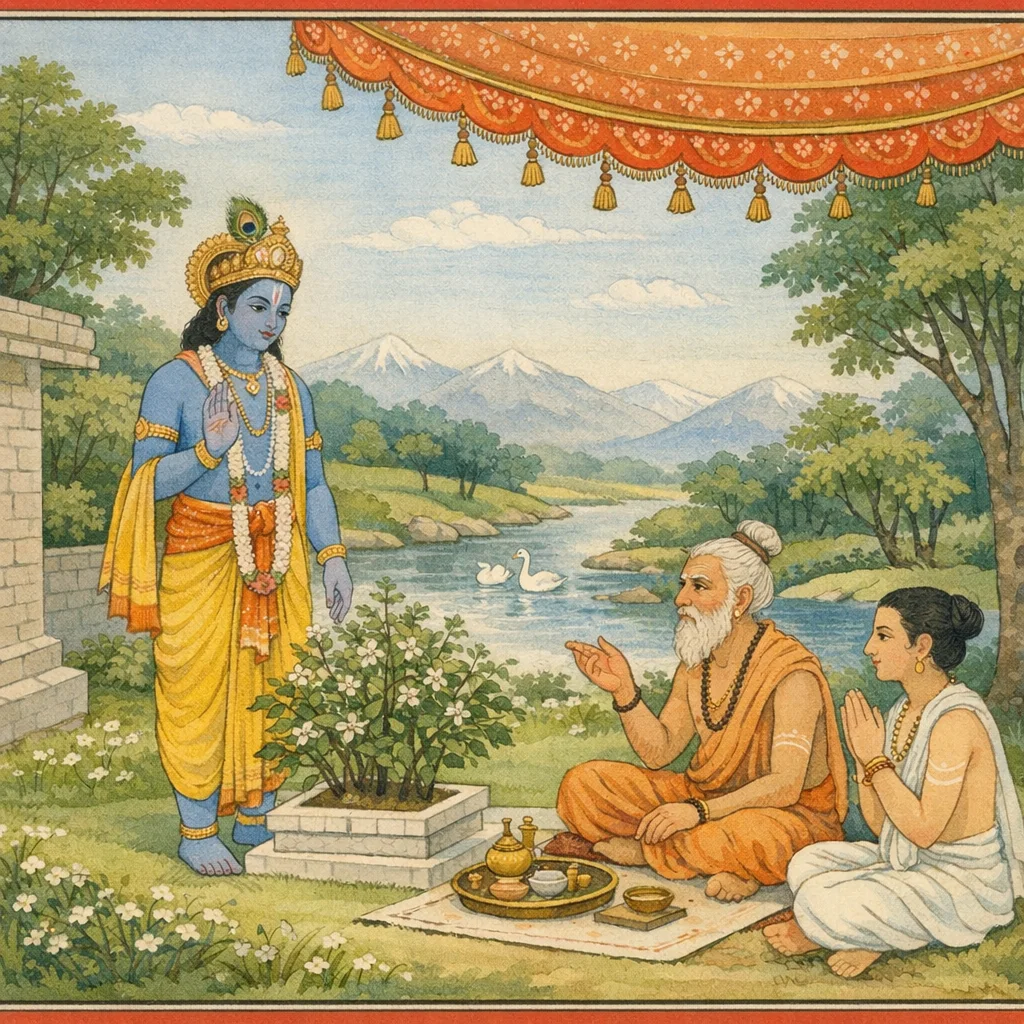
The gods depart in celestial chariots, and Rāma follows them to Agastya’s āśrama. Burdened with grief—especially over the Sītā episode and the killing of a Śūdra—Kakutstha seeks instruction to understand dharma and find relief. Agastya welcomes him and offers a divine ornament fashioned by Viśvakarman, which raises a question of righteousness: may a kṣatriya accept a brāhmaṇa’s gift, and what kinds of gifts are lawful? Agastya answers with an ancient account that roots kingship in the allotted shares of the Lokapālas, thereby defining rājadharma. He then gives a karmic exemplum: King Śveta of Vidarbha reaches Brahmaloka yet suffers hunger because, in his era, hospitality to guests (atithi-dharma) and generosity were neglected. Brahmā ordains a severe expiation until Agastya’s arrival; when the sage comes, Śveta is released and bestows the ornament. Thus the chapter weaves together rājadharma, the ethics of dāna, and atithi-dharma into a single salvific logic.
Shlokas
Verse 1
पुलस्त्य उवाच । ततो देवाः प्रयातास्ते विमानैर्बहुभिस्तदा । रामोप्यनुजगामाशु कुंभयोनेस्तपोवनम्
Pulastya said: Then, at that time, those devas departed in many vimānas; and Rāma too swiftly followed them to the ascetic grove of Kumbhayoni (Agastya).
Verse 2
उक्तं भगवता तेन भूयोप्यागमनं क्रियाः । पूर्वमेव सभायां च यो मां द्रष्टुं समागतः
Spoken by that Blessed Lord were again the rites and the instruction to come once more. And he who had earlier come into the assembly, seeking to behold me—
Verse 3
तदहं देवतादेशात्तत्कार्यार्थे महामुनिं । पश्यामि तं मुनिं गत्वा देवदानवपूजितम्
Therefore, at the command of the devas and for the sake of accomplishing that task, I went to behold the great muni—him who was revered alike by devas and Dānavas.
Verse 4
उपदेशं च मे तुष्टः स्वयं दास्यति सत्तमः । दुःखी येन पुनर्मर्त्ये न भवामि कदाचन
Pleased with me, the best among the virtuous will himself grant me sacred instruction—by which I shall never again be sorrowful in the mortal world.
Verse 5
पिता दशरथो मह्यं कौसल्या जननी तथा । सूर्यवंशे समुत्पन्नस्तथाप्येवं सुदुःखितः
My father is Daśaratha, and my mother likewise is Kauśalyā. Though born in the Solar dynasty, I am still thus grievously afflicted with sorrow.
Verse 6
राज्यकाले वने वासो भार्यया चानुजेन च । हरणं चापि भार्याया रावणेन कृतं मम
During my time of kingship, I dwelt in the forest along with my wife and my younger brother; and the abduction of my wife was indeed carried out by Rāvaṇa.
Verse 7
असहायेन तु मया तीर्त्वा सागरमुत्तमम् । रुद्ध्वा तु तां पुरीं सर्वां कृत्वा तस्य कुलक्षयम्
Alone, without aid, I crossed the excellent ocean; then, having besieged that entire city, I brought about the destruction of his lineage.
Verse 8
दृष्टा सीता मया त्यक्ता देवानां तु पुरस्तदा । शुद्धां तां मां तथोचुस्ते मया सीता तथा गृहम्
“Sītā was seen (to be pure), and yet I abandoned her in the presence of the gods. Then they said to me, ‘She is pure.’ Thus, by me, Sītā—and likewise the household—were cast aside.”
Verse 9
समानीता प्रीतिमता लोकवाक्याद्विसर्जिता । वने वसति सा देवी पुरे चाहं वसामि वै
Brought back by her beloved, she was yet sent away again because of the world’s talk. That goddess dwells in the forest, while I indeed dwell in the city.
Verse 10
जातोहमुत्तमे वंशे उत्तमोहं धनुष्मताम् । उत्तमं दुःखमापन्नो हृदयं नैव भिद्यते
I was born in an excellent lineage; among archers I am the foremost. Yet though I have fallen into the gravest sorrow, my heart does not break at all.
Verse 11
वज्रसारस्य सारेण धात्राहं निर्मितो ध्रुवम् । इदानीं ब्राह्मणादेशाद्भ्रमामि धरणीतले
Surely, the Creator fashioned me from the very essence of adamantine substance; and now, by the command of a brāhmaṇa, I wander upon the surface of the earth.
Verse 12
तपः स्थितस्तु शूद्रोसौ मया पापो निपातितः । देववाक्यात्तु मे भूयः प्राणो मे हृदि संस्थितः
That Śūdra—though engaged in austerity—was struck down by me as a sinner. But by the word of the gods, my life-breath has once again been restored and now abides within my heart.
Verse 13
पश्यामि तं मुनिं वंद्यं जगतोस्य हिते रतम् । दृष्टेन मे तथा दुःखं नाशमेष्यति सत्वरम्
I behold that venerable sage, devoted to the welfare of this world. By merely seeing him, my sorrow will quickly come to an end.
Verse 14
उदयेन सहस्रांशोर्हिमं यद्वद्विलीयते । तद्वन्मे दुःखसंप्राप्तिः सर्वथा नाशमेष्यति
Just as frost melts away at the rising of the thousand-rayed Sun, so too my experience of sorrow will, in every way, come to an end.
Verse 15
दृष्ट्वा च देवान्संप्राप्तानगस्त्यो भगवानृषिः । अर्घ्यमादाय सुप्रीतः सर्वांस्तानभ्यपूजयत्
Seeing that the gods had arrived, the venerable sage Agastya—delighted—took the arghya-offering and duly honored them all.
Verse 16
ते तु गृह्य ततः पूजां संभाष्य च महामुनिं । जग्मुस्तेन तदा हृष्टा नाकपृष्ठं सहानुगाः
Then, having accepted that worship and having conversed with the great sage, they departed at that time—delighted—toward the heavenly realms, along with their attendants.
Verse 17
गतेषु तेषु काकुत्स्थः पुष्पकादवरुह्य च । अभिवादयितुं प्राप्तः सोगस्त्यमृषिमुत्तमम्
After they had departed, Kakutstha (Rāma) descended from the Puṣpaka (aerial chariot) and approached the excellent sage Agastya to offer his salutations.
Verse 18
राजोवाच । सुतो दशरथस्याहं भवंतमभिवादितुम् । आगतो वै मुनिश्रेष्ठ सौम्येनेक्षस्व चक्षुषा
The king said: “I am the son of Daśaratha. I have come to pay my respects to you, O best of sages. Look upon me with gentle eyes.”
Verse 19
निर्धूतपापस्त्वां दृष्ट्वा भवामीह न संशयः । एतावदुक्त्वा स मुनिमभिवाद्य पुनः पुनः
“By beholding you, my sins are washed away—of this there is no doubt.” Having said thus much, he bowed again and again in reverence to the sage.
Verse 20
कुशलं भृत्यवर्गस्य मृगाणां तनयस्य च । भगवद्दर्शनाकांक्षी शूद्रं हत्वा त्विहागतः
“Is it well with the company of servants, with the deer, and with your son? Longing for the Lord’s दर्शन, you have come here after killing a Śūdra.”
Verse 21
अगस्त्य उवाच । स्वागतं ते रघुश्रेष्ठ जगद्वंद्य सनातन । दर्शनात्तव काकुत्स्थ पूतोहं मुनिभिः सह
Agastya said: “Welcome to you, best of the Raghus—revered by the world, O Eternal One. O Kakutstha, by seeing you, I—together with the sages—have been purified.”
Verse 22
त्वत्कृते रघुशार्दूल गृहाणार्घं महाद्युते । स्वागतं नरशार्दूल दिष्ट्या प्राप्तोसि शत्रुहन्
“For your sake, O tiger among the Raghus, O greatly radiant one, accept this arghya—this offering of welcome. Welcome, O tiger among men; by good fortune you have arrived, O slayer of enemies.”
Verse 23
त्वं हि नित्यं बहुमतो गुणैर्बहुभिरुत्तमैः । अतस्त्वं पूजनीयो वै मम नित्यं हृदिस्थितः
“Truly, you are ever held in highest esteem for your many excellent virtues. Therefore you are indeed worthy of worship, abiding forever within my heart.”
Verse 24
सुरा हि कथयंति त्वां शूद्रघातिनमागतं । ब्राह्मणस्य च धर्मेण त्वया वै जीवितः सुतः
Indeed, the gods speak of you as one who came here as a slayer of a Śūdra; yet, by the righteous dharma of a Brāhmaṇa, your son has truly been restored to life by you.
Verse 25
उष्यतां चेह भगवः सकाशे मम राघव । प्रभाते पुष्पकेणासि गंतायोध्यां महामते
O blessed Rāghava, stay here near me. At dawn, O great-minded one, you shall go to Ayodhyā in the Puṣpaka (vimāna).
Verse 26
इदं चाभरणं सौम्य सुकृतं विश्वकर्मणा । दिव्यं दिव्येनवपुषा दीप्यमानं स्वतेजसा
And this ornament too, O gentle one, was beautifully crafted by Viśvakarman—divine, with a celestial form, shining by its own radiance.
Verse 27
प्रतिगृह्णीष्व राजेन्द्र मत्प्रियं कुरु राघव । लब्धस्य हि पुनर्द्दाने सुमहत्फलमुच्यते
O king of kings, O Rāghava—please accept this and do what is pleasing to me. For it is said that giving again, from what one has already obtained, yields exceedingly great merit.
Verse 28
त्वं हि शक्तः परित्रातुं सेंद्रानपि सुरोत्तमान् । तस्मात्प्रदास्ये विधिवत्प्रतीच्छस्व नरर्षभ
You are indeed capable of protecting even the foremost gods, including Indra. Therefore, I shall duly bestow it—accept it properly, O best of men.
Verse 29
अथोवाच महाबाहुरिक्ष्वाकूणां महारथः । कृतांजलिर्मुनिश्रेष्ठं स्वं च धर्ममनुस्मरन्
Then spoke the mighty-armed great warrior of the Ikṣvāku line—hands joined in reverence to the foremost sage, while recalling his own dharma.
Verse 30
प्रतिग्रहो वै भगवंस्तव मेऽत्र विगर्हितः । क्षत्रियेण कथं विप्र प्रतिग्राह्यं विजानता
O Blessed one, as I understand it, accepting gifts here is blameworthy. O brāhmaṇa, how could a kṣatriya—knowing what is proper—accept gifts?
Verse 31
ब्राह्मणेन तु यद्दत्तं तन्मे त्वं वक्तुमर्हसि । सपुत्रो गृहवानस्मि समर्थोस्मि महामुने
Tell me, O great sage, what it was that the brāhmaṇa gave; you ought to explain it to me. I have a son, a household, and I am capable (of undertaking it).
Verse 32
आपदा चन चाक्रांतः कथं ग्राह्यः प्रतिग्रहः । भार्या मे सुचिरं नष्टा न चान्या मम विद्यते
Overwhelmed by misfortune, how could I accept a gift? My wife has been missing for a long time, and I have no other besides her.
Verse 33
केवलं दोषभागी च भवामीह न संशयः । कष्टां चैव दशां प्राप्य क्षत्रियोपि प्रतिग्रही
No doubt, I alone will incur the blame here. Having fallen into a grievous condition, even a kṣatriya becomes one who accepts gifts, as a dependent.
Verse 34
कुर्वन्न दोषमाप्नोति मनुरेवात्र कारणम् । वृद्धौ च मातापितरौ साध्वी भार्या शिशुः सुतः
By acting thus, one incurs no fault—Manu alone is the authority here. Therefore one should especially protect and support one’s aged mother and father, a virtuous wife, and one’s children—an infant and a son.
Verse 35
अप्यकार्यशतं कृत्वा भर्तव्या मनुरब्रवीत् । नाहं प्रतीच्छे विप्रर्षे त्वया दत्तं प्रतिग्रहं
Manu said: “Even if she has committed a hundred wrongs, she should still be maintained. But, O best of brāhmaṇas, I do not accept this gift offered by you as a donation.”
Verse 36
न च मे भवता कोपः कार्यो वै सुरपूजित
And you, O one revered by the gods, should not become angry with me.
Verse 37
अगस्त्य उवाच । न च प्रतिग्रहे दोषो गृहीते पार्थिवैर्नृप । भवान्वै तारणे शक्तस्त्रैलोक्यस्यापि राघव
Agastya said: “O king, there is no fault in accepting a gift when it has been received by kings. O Rāghava, you are indeed capable of delivering—even the three worlds.”
Verse 38
तारय ब्राह्मणं राम विशेषेण तपस्विनं । तस्मात्प्रदास्ये विधिवत्प्रतीच्छस्व नराघिप
O Rāma, rescue the brāhmaṇa—especially this ascetic. Therefore I shall give it in due rite; accept it properly, O king of men.
Verse 39
राम उवाच । क्षत्रियेण कथं विप्र प्रतिग्राह्यं विजानता । ब्राह्मणेन तु यद्दत्तं तन्मे त्वं वक्तुमर्हसि
Rāma said: “O brāhmaṇa, how should a kṣatriya who knows dharma accept gifts? And what, when given by a brāhmaṇa, ought to be accepted? Please tell me.”
Verse 40
अगस्त्य उवाच । आसीत्कृतयुगे राम ब्रह्मपूते पुरातने । अपार्थिवाः प्रजाः सर्वाः सुराणां च शतक्रतुः
Agastya said: “O Rāma, in the ancient Kṛta Yuga, when Brahmā’s order stood fully established and pure, all beings were of a non-earthly nature; and among the gods, Śatakratu (Indra) held sway.”
Verse 41
ताः प्रजा देवदेवेशं राजार्थं समुपागमन् । सुराणां विद्यते राजा देवदेवः शतक्रतुः
Those beings approached the Lord of the gods, seeking a king. For among the gods there is a king—Indra, the divine Lord, Śatakratu, the performer of a hundred sacrifices.
Verse 42
श्रेयसेस्मासु लोकेश पार्थिवं कुरु सांप्रतं । यस्मिन्पूजां प्रयुंजानाः पुरुषा भुंजते महीम्
“For the welfare of these worlds, O Lord of the worlds, establish now the earthly kingship; so that therein men, performing worship, may enjoy the earth and sustain it.”
Verse 43
ततो ब्रह्मा सुरश्रेष्ठो लोकपालान्सवासवान् । समाहूयाब्रवीत्सर्वांस्तेजोभागोऽत्र युज्यताम्
Then Brahmā, foremost among the gods, summoned the Lokapālas together with Vāsava (Indra) and addressed them all: “Let each one’s share of divine radiance be offered here.”
Verse 44
ततो ददुर्लोकपालाश्चतुर्भागं स्वतेजसा । अक्षयश्च ततो ब्रह्मा यतो जातोऽक्षयो नृपः
Then the Lokapālas, guardians of the worlds, bestowed a fourfold share by their own radiance. From that portion Brahmā became “Akṣaya,” the imperishable; and from him, O king, was born one named Akṣaya.
Verse 45
तं ब्रह्मा लोकपालानामंशं पुंसामयोजयत् । ततो नृपस्तदा तासां प्रजानां क्षेमपंडितः
Brahmā then endowed him with a portion of the divine power of the Lokapālas. Thereupon that king became, for his subjects, a wise guardian of their welfare and security.
Verse 46
तत्रैंद्रेण तु भागेन सर्वानाज्ञापयेन्नृपः । वारुणेन च भागेन सर्वान्पुष्णाति देहिनः
There, by the Indra-like portion, the king should command all; and by the Varuṇa-like portion, he nourishes and sustains all embodied beings.
Verse 47
कौबेरेण तथांशेन त्वर्थान्दिशति पार्थिवः । यश्च याम्यो नृपे भागस्तेन शास्ति च वै प्रजाः
By the Kubera-like share, the king assigns wealth and resources; and by the Yama-like share that belongs to a ruler, he indeed governs and disciplines the people.
Verse 48
तत्र चैंद्रेण भागेन नरेन्द्रोसि रघूत्तम । प्रतिगृह्णीष्वाभरणं तारणार्थे मम प्रभो
And there, by Indra’s allotted share, you are the king, O best of the Raghu line. Please accept this ornament, my lord, for the sake of my deliverance.
Verse 49
ततो रामः प्रजग्राह मुनेर्हस्तान्महात्मनः । दिव्यमाभरणं चित्रं प्रदीप्तमिव भास्करं
Then Rāma accepted from the hand of that great sage a wondrous, divine ornament, blazing like the sun.
Verse 50
प्रतिगृह्य ततोगस्त्याद्राघवः परवीरहा । निरीक्ष्य सुचिरं कालं विचार्य च पुनः पुनः
Then Rāghava, the slayer of enemy heroes, having received it from Agastya, looked on for a long time and reflected again and again.
Verse 51
मौक्तिकानि विचित्राणि धात्रीफलसमानि च । जांबूनदनिबद्धानि वज्रविद्रुमनीलकैः
There were wondrous pearls, shaped like āmalaka fruits, set in refined Jāmbūnada gold, and adorned with diamonds, coral, and sapphires.
Verse 52
पद्मरागैः सगोमेधैर्वैडूर्यैः पुष्परागकैः । सुनिबद्धं सुविभक्तं सुकृतं विश्वकर्मणा
It was fashioned with rubies (padmarāga), along with gomeda (garnets), vaidūrya (cat’s-eye gems), and puṣparāga (topaz)—firmly set, well-proportioned, and exquisitely made by Viśvakarman.
Verse 53
दृष्ट्वा प्रीतिसमायुक्तो भूयश्चेदं व्यचिंतयत् । नेदृशानि च रत्नानि मया दृष्टानि कानिचित्
Seeing it, filled with joy, he reflected again: “Never have I seen any gems like these.”
Verse 54
उपशोभानि बद्धानि पृथ्वीमूल्यसमानि च । विभीषणस्य लंकायां न दृष्टानि मया पुरा
These objects, exquisitely adorned, fastened and set in place—worth as much as the earth itself—have never been seen by me before, not even in Vibhīṣaṇa’s Laṅkā.
Verse 55
इति संचित्य मनसा राघवस्तमृषिं पुनः । आगमं तस्य दिव्यस्य प्रष्टुं समुपचक्रमे
Thus composing his mind, Rāghava again approached that sage and began to inquire about the divine Āgama, the sacred teaching that belonged to him.
Verse 56
अत्यद्भुतमिदं ब्रह्मन्न प्राप्यं च महीक्षिताम् । कथं भगवता प्राप्तं कुतो वा केन निर्मितम्
O Brahman, this is exceedingly marvelous and unattainable even for kings. How was it obtained by the Blessed Lord? From where did it come, or by whom was it made?
Verse 57
कुतूहलवशाच्चैव पृच्छामि त्वां महामते । करतलेस्थिते रत्ने करमध्यं प्रकाशते
Out of sheer curiosity, O great sage, I ask you: when a jewel is placed upon the palm, why does the middle of the hand appear illuminated?
Verse 58
अधमं तद्विजानीयात्सर्वशास्त्रेषु गर्हितम् । दिशः प्रकाशयेद्यत्तन्मध्यमं मुनिसत्तम
Know as the lowest that which is condemned in all the śāstras. But that which illuminates the directions—giving guidance and clarity—is the middling standard, O best of sages.
Verse 59
ऊर्ध्वगं त्रिशिखं यत्स्यादुत्तमं तदुदाहृतम् । एतान्युत्तमजातीनि ऋषिभिः कीर्तितानि तु
That which rises upward and bears three crests is declared the best. These indeed are the superior kinds, as proclaimed by the ṛṣis.
Verse 60
आश्चर्याणां बहूनां हि दिव्यानां भगवान्निधिः । एवं वदति काकुत्स्थे मुनिर्वाक्यमथाब्रवीत्
Thus, while the Blessed Lord—the divine treasury of many wondrous marvels—was speaking to Kakutstha (Rāma), the muni then uttered these words.
Verse 61
अगस्त्य उवाच । शृणु राम पुरावृत्तं पुरा त्रेतायुगे महत् । द्वापरे समनुप्राप्ते वने यद्दृष्टवानहम्
Agastya said: “Listen, O Rāma, to a great ancient account—of what I myself saw in a forest when the Dvāpara age had arrived, though the tale pertains to the earlier Tretā Yuga.”
Verse 62
आश्चर्यं सुमहाबाहो निबोध रघुनंदन । पुरा त्रेतायुगे ह्यासीदरण्यं बहुविस्तरम्
O mighty-armed one, O delight of the Raghus, understand this wonder: in ancient times, in the Tretā Yuga, there existed a forest of vast extent.
Verse 63
समंताद्योजनशतं मृगव्याघ्रविवर्जितम् । तस्मिन्निष्पुरुषेऽरण्ये चिकीर्षुस्तप उत्तमम्
For a hundred yojanas all around, it was free from deer and tigers. In that uninhabited forest, he, desiring to undertake the highest tapas (austerity), remained there.
Verse 64
अहमाक्रमितुं सौम्य तदरण्यमुपागतः । तस्यारण्यस्य मध्यं तु युक्तं मूलफलैः सदा
To traverse that forest, O gentle one, I came to it; and the very midst of that forest was ever furnished with roots and fruits.
Verse 65
शाकैर्बहुविधाकारैर्नानारूपैः सुकाननैः । तस्यारण्यस्य मध्ये तु पंचयोजनमायतम्
With many kinds of leafy plants, of diverse forms, it was a delightful woodland; and in the middle of that forest there stretched an area five yojanas in extent.
Verse 66
हंसकारंडवाकीर्णं चक्रवाकोपशोभितम् । तत्राश्चर्यं मया दृष्टं सरः परमशोभितम्
There I beheld a wondrous lake—filled with swans and kāraṇḍava ducks, and beautified by cakravāka birds—exceedingly splendid.
Verse 67
विसारिकच्छपाकीर्णं बकपंक्तिगणैर्युतम् । समीपे तस्य सरसस्तपस्तप्तुं गतः पुरा
Long ago he went to perform austerities near that lake, which was filled with visārikā-birds and tortoises, and frequented by flocks of herons arranged in lines.
Verse 68
देशं पुण्यमुपेत्यैवं सर्वहिंसाविवर्जितम् । तत्राहमवसं रात्रिं नैदाघीं पुरुषर्षभ
Thus, having reached a sacred land free from all violence, I stayed there for a night in the summer heat, O best of men.
Verse 69
प्रभाते पुरुत्थाय सरस्तदुपचक्रमे । अथापश्यं शवमहमस्पृष्टजरसं क्वचित्
At dawn, having risen early, I set out toward that lake. Then, somewhere, I beheld a corpse—untouched by decay.
Verse 70
तिष्ठंतं परया लक्ष्म्या सरसो नातिदूरतः । तदर्थं चिंतयानोहं मुहूर्तमिव राघव
Seeing him standing not far from the lake, endowed with supreme splendor, I pondered that matter as though for only a moment, O Rāghava.
Verse 71
अस्य तीरे न वै प्राणी को वाप्येष सुरर्षभः । मुनिर्वा पार्थिवो वापि क्व मुनिः पार्थिवोपि वा
“On this bank there is truly no living being at all. Who, then, is this—O best of the devas? Is he a muni-sage or a king? Where could there be a sage—or even a king—here?”
Verse 72
अथवा पार्थिवसुतस्तस्यैवं संभवः कृतः । अतीतेहनि रात्रौ वा प्रातर्वापि मृतो यदि
Or else, if the king’s son has come to be in this manner—if he has died after the day has passed, or in the night, or even in the morning—
Verse 73
अवश्यं तु मया ज्ञेया सरसोस्य विनिष्क्रिया । यावदेवं स्थितश्चाहं चिंतयानो रघूत्तम
“But I must certainly find out the means of release from this lake. So long as I remain in this condition, I keep reflecting, O best of the Raghus.”
Verse 74
अथापश्यं मूहूर्तात्तु दिव्यमद्भुतदर्शनम् । विमानं परमोदारं हंसयुक्तं मनोजवम्
Then, after a brief while, I beheld a divine and wondrous sight—an exceedingly splendid vimāna, yoked with swans and swift as the mind.
Verse 75
पुरस्तत्र सहस्रं तु विमानेप्सरसां नृप । गंधर्वाश्चैव तत्संख्या रमयंति वरं नरम्
There in front, O king, were a thousand Apsarases in vimānas—and Gandharvas in the same number—delighting that excellent man.
Verse 76
गायंति दिव्यगेयानि वादयंति तथा परे । अथापश्यं नरं तस्माद्विमानादवरोहितम्
Some were singing celestial songs, while others were playing instruments. Then I saw a man descending from that vimāna.
Verse 77
शवमांसं भक्षयन्तं च स्नात्वा रघुकुलोद्वह । ततो भुक्त्वा यथाकामं स मांसं बहुपीवरम्
O scion of the Raghu dynasty, after bathing, he ate even carrion-flesh; then, having eaten as much as he wished, he consumed that abundant, very fatty meat.
Verse 78
अवतीर्य सरः शीघ्रमारुरोह दिवं पुनः । तमहं देवसंकाशं श्रिया परमयान्वितम्
Having swiftly descended into the lake, he again ascended to heaven. I beheld him—radiant like a deva, endowed with supreme splendor.
Verse 79
भो भो स्वर्गिन्महाभाग पृच्छामि त्वां कथं त्विदम् । जुगुप्सितस्तवाहारो गतिश्चेयं तवोत्तमा
“O heavenly being, O greatly fortunate one, I ask you—how can this be? Your food is repulsive, yet your state and destiny are most excellent.”
Verse 80
यदि गुह्यं न चैतत्ते कथय त्वद्य मे भवान् । कामतः श्रोतुमिच्छामि किमेतत्परमं वचः
“If this is not a secret to be kept, then tell me today. I long to hear: what is this supreme teaching?”
Verse 81
को भवान्वद संदेहमाहारश्च विगर्हितः । त्वयेदं भुज्यते सौम्य किमर्थं क्व च वर्तसे
“Who are you? Speak and remove my doubt. This food is blameworthy—why do you eat it, gentle one? For what purpose, and where do you dwell?”
Verse 82
कस्यायमैश्वरोभावः शवत्वेन विनिर्मितः । आहारं च कथं निंद्यं श्रोतुमिच्छामि तत्त्वतः
“Whose divine, lordly condition is this, fashioned into the state of a corpse? And why is this food condemned? I wish to hear the truth of it completely.”
Verse 83
श्रुत्वा च भाषितं तत्र मम राम सतां वर । प्रांजलिः प्रत्युवाचेदं स स्वर्गी रघुनंदन
“Having heard what was spoken there, that heaven-dweller, with palms joined in reverence, replied: ‘O Rāma, best among the virtuous; O delight of Raghu’s line.’”
Verse 84
शृणुष्वाद्य यथावृत्तं ममेदं सुखदुःखजम् । कामो हि दुरितक्रम्यः शृणु यत्पृच्छसे द्विज
Listen now to what occurred—this experience of mine, born of both delight and sorrow. Desire indeed draws one into sin; hear, O twice-born, what you have asked.
Verse 85
पुरा वैदर्भको राजा पिता मे हि महायशाः । वासुदेव इति ख्यातस्त्रिषु लोकेषु धार्मिकः
Formerly there was a king of Vidarbha—my father—of great renown. He was known as Vāsudeva and was famed as righteous throughout the three worlds.
Verse 86
तस्य पुत्रद्वयं ब्रह्मन्द्वाभ्यां स्त्रीभ्यामजायत । अहं श्वेत इति ख्यातो यवीयान्सुरथोऽभवत्
O Brahman, he had two sons born of two wives. I became known as Śveta, and the younger one was Suratha.
Verse 87
पितर्युपरते तस्मिन्पौरा मामभ्यषेचयन् । तत्राहंकारयन्राज्यं धर्मे चासं समाहितः
When my father had passed away, the townspeople anointed me as king. There I took up the duties of sovereignty and remained steadfastly devoted to dharma.
Verse 88
एवं वर्षसहस्राणि बहूनि समुपाव्रजन् । मम राज्यं कारयतः परिपालयतः प्रजाः
Thus many thousands of years passed as I had my kingdom administered and as I protected my subjects.
Verse 89
सोहं निमित्ते कस्मिंश्चिद्वैराग्येण द्विजोत्तम । मरणं हृदये कृत्वा तपोवनमुपागमम्
Thus, by some circumstance, O best of the twice-born, dispassion arose in me; fixing death in my heart as a constant contemplation, I went to the forest of austerities.
Verse 90
सोहं वनमिदं रम्यं भृशं पक्षिविवर्जितम् । प्रविष्टस्तप आस्थातुमस्यैव सरसोंतिके
So I entered this delightful forest, utterly devoid of birds, intending to undertake austerities right here, near this very lake.
Verse 91
राज्येऽभिषिच्य सुरथं भ्रातरं तं नराधिपम् । इदं सरः समासाद्य तपस्तप्तं सुदारुणम्
After anointing his brother Suratha as king, that ruler approached this sacred lake and performed exceedingly severe austerities.
Verse 92
दशवर्षसहस्राणि तपस्तप्त्वा महावने । शुभं तु भवनं प्राप्तो ब्रह्मलोकमनामयम्
After performing austerities for ten thousand years in the great forest, he attained an auspicious abode—the flawless realm of Brahmā (Brahmaloka), free from affliction.
Verse 93
स्वर्गस्थमपि मां ब्रह्मन्क्षुत्पिपासे द्विजोत्तम । अबाधेतां भृशं चाहमभवं व्यथितेंद्रियः
O Brahmin, even though I was in heaven, hunger and thirst tormented me severely; and my senses became deeply distressed, O best of the twice-born.
Verse 94
ततस्त्रिभुवनश्रेष्ठमवोचं वै पितामहम् । भगवन्स्वर्गलोकोऽयं क्षुत्पिपासा विवर्जितः
Then I addressed Pitāmaha (Brahmā), the foremost among the three worlds: “O Blessed Lord, this heaven-world is free from hunger and thirst.”
Verse 95
कस्येयं कर्मणः पक्तिः क्षुत्पिपासे यतो हि मे । आहारः कश्च मे देव ब्रूहि त्वं श्रीपितामह
“What is the ripening of my karma, because of which I feel hunger and thirst? And what food is there for me? O Lord—tell me, revered Grandfather.”
Verse 96
ततः पितामहः सम्यक्चिरं ध्यात्वा महामुने । मामुवाच ततो वाक्यं नास्ति भोज्यं स्वदेहजम्
Then Pitāmaha, having reflected deeply for a long time, O great sage, spoke these words to me: “There is no food that is born of one’s own body.”
Verse 97
ॠते ते स्वानि मांसानि भक्षय त्वं तु हि नित्यशः । स्वशरीरं त्वया पुष्टं कुर्वता तप उत्तमम्
“Do not eat your own flesh; and by properly nourishing your body, perform the highest austerity (tapas).”
Verse 98
नादत्तं जायते तात श्वेत पश्य महीतले । आग्रहाद्भिक्षमाणाय भिक्षापि प्राणिने पुरा
“O dear Śveta, look upon the earth: nothing comes to anyone without giving. Formerly, even alms were granted to a living being only when it begged insistently.”
Verse 99
न हि दत्ता गृहे भ्रांत्या मोहादतिथये तदा । तेन स्वर्गगतस्यापि क्षुत्पिपासे तवाधुना
For, through confusion and delusion, hospitality was not offered to the guest in the house at that time; therefore, even though you have reached heaven, you now endure hunger and thirst.
Verse 100
स त्वं प्रपुष्टमाहारैः स्वशरीरमनुत्तमम् । भक्षयस्व च राजेंद्र सा ते तृप्तिर्भविष्यति
So you—having well nourished your own incomparable body with food—now eat it, O best of kings; that will indeed become your satisfaction.
Verse 101
एवमुक्तस्ततो देवं ब्रह्माणमहमुक्तवान् । भक्षिते च स्वके देहे पुनरन्यन्न मे विभो
Thus addressed, I then spoke to the god Brahmā: “O Lord, when my own body has been consumed, there will be no other body for me again.”
Verse 102
क्षुधानिवारणं नैव देहस्यास्य विनौदनं । खादामि ह्यक्षयं देव प्रियं मे न हि जायते
This is not merely to ward off hunger, nor for the comfort of this body. O God, I eat what is inexhaustible—yet nothing dear to me ever arises.
Verse 103
ततोब्रवीत्पुनर्ब्रह्मा तव देहोऽक्षयः कृतः । दिनेदिने ते पुष्टात्मा शवः श्वेत भविष्यति
Then Brahmā spoke again: “Your body has been made imperishable. Day by day, your well-nourished form will become white.”
Verse 104
यावद्वर्षशतं पूर्णं स्वमांसं खाद भो नृप । यदागच्छति चागस्त्यः श्वेतारण्यं महातपाः
“O king, eat your own flesh for a full hundred years—until the great ascetic Agastya arrives at Śvetāraṇya.”
Verse 105
भगवानतिदुर्धर्षस्तदा कृच्छ्राद्विमोक्ष्यसे । स हि तारयितुं शक्तः सेंद्रानपि सुरासुरान्
That Blessed Lord is utterly unconquerable; then you will be freed from hardship. For He is indeed capable of delivering even the gods and demons—Indra included.
Verse 106
आहारं कुत्सितं चेमं राजर्षे किं पुनस्तव । सुरकार्यं महत्तेन सुकृतं तु महात्मना
O royal sage, if even this (simple) food is considered contemptible, then what need be said of yours? Yet, by that great (deed), a mighty service to the gods has indeed been accomplished by the noble-souled one.
Verse 107
उदधिं निर्जलं कृत्वा दानवाश्च निपातिताः । विंध्यश्चादित्यविद्वेषाद्वर्धमानो निवारितः
Having made the ocean waterless, the Dānavas were struck down; and the Vindhya mountain—growing out of hatred for the Sun—was restrained.
Verse 108
लंबमाना मही चैषा गुरुत्वेनाधिवासिता । दक्षिणा दिग्दिवं याता त्रैलाक्यं विषमस्थितम्
This earth, weighed down by its heaviness, sank and hung low; the southern quarter rose up toward the sky, and the three worlds came to rest in an uneven state.
Verse 109
मया गत्वा सुरैः सार्द्धं प्रेषितो दक्षिणां दिशम् । समां कुरु महाभाग गुरुत्वेन जगत्समम्
I went forth together with the gods and was dispatched to the southern quarter. O fortunate one, make it level—equal to the world—by the weight of your majesty.
Verse 110
एवं च तेन मुनिना स्थित्वा सर्वा धरा समा । कृता राजेंद्र मुनिना एवमद्यापि दृश्यते
Thus, by that sage—having remained there—the whole earth was made even and level. O king of kings, it was accomplished by the sage, and it is seen so even today.
Verse 111
सोहं भगवत श्रुत्वा देवदेवस्य भाषितम् । भुंजे च कुत्सिताहारं स्वशरीरमनुत्तमम्
O Blessed One, though I have heard the words spoken by the God of gods, I still partake of despicable food and thus sustain this body, otherwise most excellent.
Verse 112
पूर्णं वर्षशतं चाद्य भोजनं कुत्सितं च मे । क्षयं नाभ्येति तद्विप्र तृप्तिश्चापि ममोत्तमा
O brāhmaṇa, even now my store of base, impure food does not diminish for a full hundred years, and my satisfaction too is most excellent.
Verse 113
तं मुनिं कृच्छ्रसन्तप्तश्चिंतयामि दिवानिशम् । कदा वै दर्शनं मह्यं स मुनिर्दास्यते वने
Afflicted by hardship, I contemplate that sage day and night. When indeed will that muni grant me his darśana—his blessed audience—in the forest?
Verse 114
एवं मे चिंतयानस्य गतं वर्षशतन्त्विह । सोगस्त्यो हि गतिर्ब्रह्मन्मुनिर्मे भविता ध्रुवं
As I pondered thus, a hundred years passed here. Truly, O brāhmaṇa, Agastya alone is my refuge; surely he will become my guiding sage.
Verse 115
न गतिर्भविता मह्यं कुंभयोनिमृते द्विजम् । श्रुत्वेत्थं भाषितं राम दृष्ट्वाहारं च कुत्सितम्
“There will be no refuge for me, O twice-born, except the one born of the pot—Agastya.” Hearing you speak thus, O Rāma, and seeing that contemptible food as well…
Verse 116
कृपया परया युक्तस्तं नृपं स्वर्गगामिनम् । करोम्यहं सुधाभोज्यं नाशयामि च कुत्सितम्
Moved by supreme compassion, I shall make that king—destined for heaven—fit to partake of amṛta; and I shall also destroy the vile thing.
Verse 117
चिन्तयन्नित्यवोचं तमगस्त्यः किं करिष्यति । अहमेतत्कुत्सितं ते नाशयामि महामते
Thinking to himself, Agastya said: “What can he do? O great-minded one, I shall destroy this vile thing of yours.”
Verse 118
ईप्सितं प्रार्थयस्वास्मान्मनः प्रीतिकरं परम् । स स्वर्गी मां ततः प्राह कथं ब्रह्मवचोन्यथा
“Ask of us whatever you desire—whatever is supremely pleasing to the mind.” Then that heavenly one said to me, “How could Brahmā’s word ever be otherwise?”
Verse 119
कर्तुं मुने मया शक्यं न चान्यस्तारयिष्यति । ॠते वै कुंभयोनिं तं मैत्रावरुणसंभवम्
O sage, I am able to accomplish this, and none other will be able to carry (you/this) across—save that pot-born one, Vasiṣṭha, sprung from Mitra and Varuṇa.
Verse 120
अपृष्टोपि मया ब्रह्मन्नेवमूचे पितामहः । एवं ब्रुवाणं तं श्वेतमुक्तवानहमस्मि सः
O Brahman, though I had not questioned him, the Grandsire (Brahmā) spoke to me thus. And as he spoke in this manner, I said to Śveta: “I am he.”
Verse 121
आगतस्तव भाग्येन दृष्टोहं नात्र संशयः । ततः स्वर्गी स मां ज्ञात्वा दंडवत्पतितो भुवि
By your good fortune I have come, and you have beheld me—of this there is no doubt. Then that celestial being, recognizing me, fell to the earth in full prostration.
Verse 122
तमुत्थाप्य ततो रामाब्रवं किं ते करोम्यहम् । राजोवाच । आहारात्कुत्सिताद्ब्रह्मंस्तारयस्वाद्य दुष्कृतात्
Then, having raised him up, Rāmā said, “What shall I do for you?” The king replied, “O Brahmin, deliver me today from the evil deed born of disgraceful, impure food.”
Verse 123
येन लोकोऽक्षयः स्वर्गो भविता त्वत्कृतेन मे । ततः प्रतिग्रहो दत्तो जगद्वंद्य नृपेण हि
Through your deed, an imperishable heavenly realm shall come to be for me. Therefore, O one revered by the world, the king has indeed granted you the rightful acceptance of the gift.
Verse 127
भवान्मामनुगृह्णातु प्रतीच्छस्व प्रतिग्रहम्
Show me your favor; I beseech you, accept this offering, this gift.
Verse 128
कृता मतिस्तारणाय न लोभाद्रघुनंदन । गृहीते भूषणे राम मम हस्तगते तदा
O delight of the Raghu line, my intent was to save, not out of greed. O Rāma, at that time the ornament had been taken and was in my hand.
Verse 129
मानुषः पौर्विको देहस्तदा नष्टोस्य भूपते । प्रणष्टे तु शरीरे च राजर्षिः परया मुदा
O king, his former human body was then destroyed; and when that body had perished, the royal sage was filled with supreme joy.
Verse 130
मयोक्तोसौ विमानेन जगाम त्रिदिवं पुनः । तेन मे शक्रतुल्येन दत्तमाभरणं शुभं
Thus instructed by me, he departed again to heaven in a celestial vimāna; and he—like Śakra—bestowed upon me an auspicious ornament.
Verse 131
तस्मिन्निमित्ते काकुत्स्थ दत्तमद्भुतकर्मणा । श्वेतो वैदर्भको राजा तदाभूद्गतकल्मषः
On that occasion, O Kakutstha, through Datta—whose deeds were wondrous—Śveta, the king of Vidarbha, then became freed from sin.