Adhyaya 34
Brahmā’s Puṣkara Sacrifice: Ṛtvij System, Sāvitrī’s Reconciliation, Tīrtha-Catalogue, Śrāddha & Initiation Rites, and Vrata Fruits
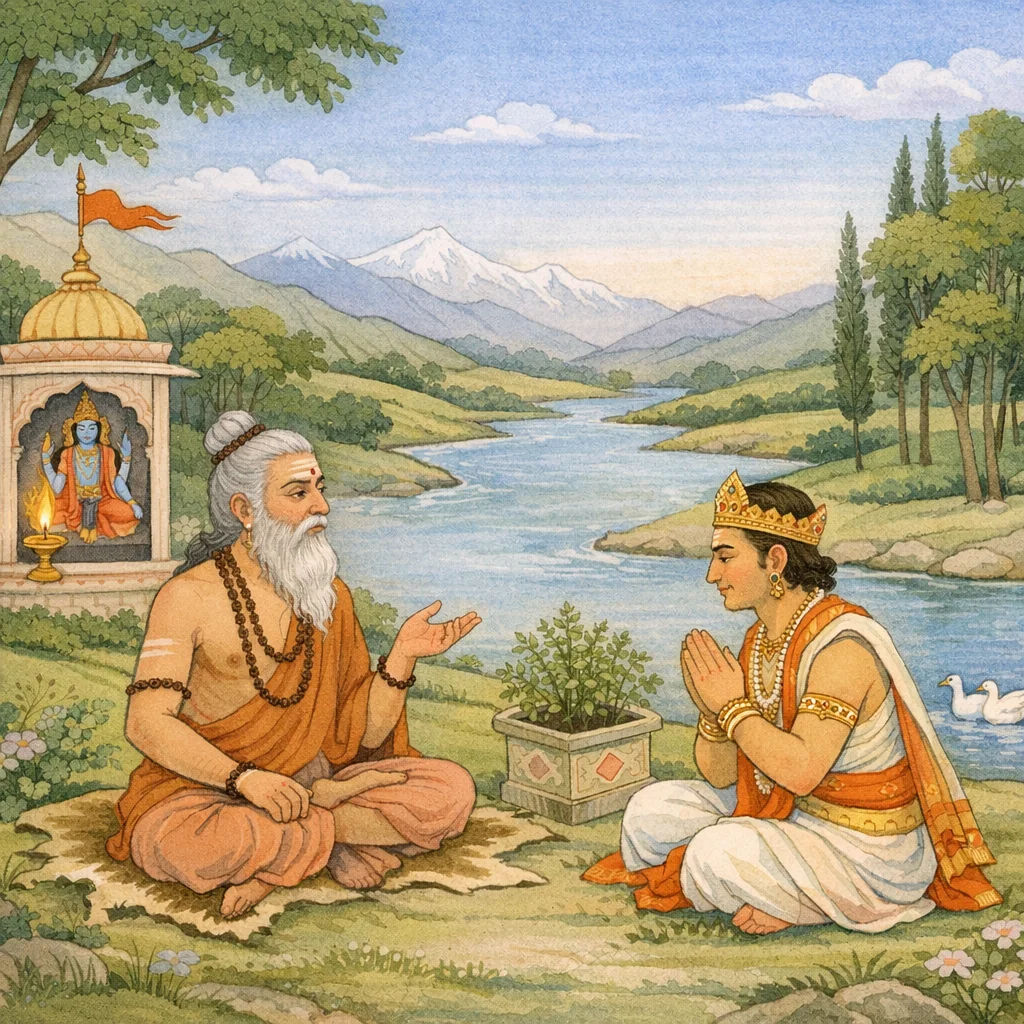
PP.1.34 begins with Bhīṣma asking about Brahmā’s primordial (paitāmaha) sacrifice—its proper time, the officiating priests, and the dakṣiṇā. Pulastya replies that Puṣkara is the sacred sacrificial ground, explains the sixteen-ṛtvij system, and names eminent sages and deities appointed to the priestly roles. The avabhṛtha concludes with a dakṣiṇā described on a cosmic scale, linked with the quarters and the worlds. A crisis then arises in the rite: Sāvitrī’s displeasure. Brahmā sends Viṣṇu as envoy to conciliate her, aided by Lakṣmī’s counsel and by Śiva and Pārvatī’s mediation, until Sāvitrī returns and is reconciled with Gāyatrī. The chapter then unfolds Puṣkara-māhātmya—tīrtha fruits (health, prosperity, sin-destruction), stotras, a catalogue of divine forms by sacred sites (108 abodes), and ritual directions for maṇḍala and kalaśa placement, dīkṣā-like procedures, śrāddha rules, and planet-pacification rites—before turning toward the exemplum of King Śveta, who suffers hunger in heaven for withholding food-gifts.
Shlokas
Verse 1
। भीष्म उवाच । कस्मिन्काले भगवता ब्रह्मणा लोककारिणा । यज्ञियैर्यष्टुमारब्धं तद्भवान्वक्तुमर्हति
Bhīṣma said: “At what time did the Blessed Brahmā, the maker of the worlds, begin to perform yajña according to the sacrificial rites? Please tell me.”
Verse 2
किं नामान ऋत्विजस्ते ब्रह्मणा ये प्रकल्पिताः । का च वै दक्षिणा तेषां दत्ता तेन महात्मना
What were the names of those ṛtviks, the sacrificial priests appointed by Brahmā? And what indeed was the dakṣiṇā—the priestly gift—bestowed upon them by that great-souled one?
Verse 3
यथाभूतं यथावृत्तं तथा त्वं मे प्रकीर्तय । सुमहत्कौतुकं जातं यज्ञं पैतामहं प्रति
Tell me just as it was, just as it happened. A very great curiosity has arisen in me concerning the paitāmaha yajña—the ancestral sacrifice.
Verse 4
पुलस्त्य उवाच । पूर्वमेव मया ख्यातं यदा स्वायंभुवो मनुः । सृष्ट्वा प्रजापतीन्सर्वानुक्तः सृष्टिं कुरुष्व वै
Pulastya said: I have already explained earlier that when Svāyambhuva Manu, having created all the Prajāpatis, was then instructed, “Do indeed carry out the creation.”
Verse 5
स्वयं तु पुष्करं गत्वा यज्ञस्याहृत्य विस्तरम् । ससंभारान्समानाय्य वह्न्यगारे स्थितोभवत्
Then he himself went to Puṣkara, brought back the full requisites for the yajña, assembled the implements and materials, and remained stationed in the sanctuary of the sacred fire.
Verse 6
गायंति नित्यं गंधर्वा नृत्यंत्यप्सरसां गणाः । ब्रह्मोद्गाता होताध्वर्युश्चत्वारो यज्ञवाहकाः
The Gandharvas sing unceasingly, and the hosts of Apsarases dance. Brahmā, the Udgātṛ, the Hotṛ, and the Adhvaryu—these four bear the yajña forward.
Verse 7
एकैकस्य त्रयश्चान्ये परिवाराः स्वयंकृताः । ब्रह्मा च ब्रह्मणाच्छंसी पोता चाग्नीध्र एव च
For each of them, three other attendants also appointed themselves: Brahmā; the Brahmanācchaṃsī, the reciter and praiser of Brahman; the Potā, a priestly functionary; and Agnīdhra as well.
Verse 8
आन्वीक्षिकी सर्वविद्या ब्राह्मी ह्येषा चतुष्टयी । उद्गाता च प्रत्युद्गाता प्रतिहर्ता सुब्रह्मण्यः
Ānvīkṣikī—Inquiry, the science of examination and reasoning—stands as the universal foundation of all knowledge; indeed, this is the fourfold Brahmic discipline: the Udgātṛ, the Pratyudgātṛ, the Pratihartṛ, and the Subrahmaṇya.
Verse 9
चतुष्टयी द्वितीयैषा तूद्गातुश्च प्रकीर्तिता । होता च मैत्रावरुणस्तथाऽच्छावाक एव च
This is proclaimed as the second set of four priests belonging to the Udgātṛ: namely, the Hotṛ, the Maitrāvaruṇa, and likewise the Acchāvāka.
Verse 10
ग्रावस्तुच्च चतुर्थोत्र तृतीया च चतुष्टयी । अध्वर्युश्च प्रतिष्ठाता नेष्टोन्नेता तथैव च
Here, the fourth is the Grāvastut, and the third is the fourfold set. Also present are the Adhvaryu, the Pratiṣṭhātṛ, the Neṣṭṛ, and likewise the Unnetṛ.
Verse 11
चतुष्टयी चतुर्थ्येषा प्रोक्ता शंतनुनंदन । एते वै षोडश प्रोक्ता ऋत्विजो वेदचिंतकैः
O son of Śantanu, this fourth set of four has been described. Thus, these sixteen officiating priests (ṛtvij) are indeed declared by those learned in Vedic lore.
Verse 12
शतानि त्रीणि षष्टिश्च यज्ञाः सृष्टाः स्वयंभुवा । एतांश्चैतेषु सर्वेषु प्रवदंति सदा द्विजान्
Three hundred and sixty sacrifices were established by Svayaṃbhū (Brahmā); and in all of them the twice-born (dvijas) ever recite and expound the sacred ordinances.
Verse 13
सदस्यं केचिदिच्छंति त्रिसामाध्वर्युमेव च । ब्रह्माणं नारदं चक्रे ब्राह्मणाच्छंसि गौतमम्
Some desired the Sadasya as an officiant, and also the Adhvaryu skilled in the three Sāman chants. Nārada appointed Brahmā as the Brahman-priest, and Gautama as the Brāhmaṇācchaṃsin.
Verse 14
देवगर्भं च पोतारमाग्नीध्रं चैव देवलम् । उद्गातांगिरसः प्रत्युद्गाता च पुलहस्तथा
There were also Devagarbha and Potāra, Āgnīdhra and Devala; Āṅgirasa as the Udgātā, the Pratyudgātā, and likewise Pulaha.
Verse 15
नारायणः प्रतिहर्ता सुब्रह्मण्योत्रिरुच्यते । तस्मिन्यज्ञे भृगुर्होता वसिष्ठो मैत्र एव च
In that sacrifice, Nārāyaṇa served as the Pratihartṛ, the responding priest; and Atri is said to have been the Subrahmaṇya. In that very yajña, Bhṛgu was the Hotṛ, and Vasiṣṭha and Maitra were also present.
Verse 16
अच्छावाकः क्रतुः प्रोक्तो ग्रावस्तुच्च्यवनस्तथा । पुलस्त्योद्ध्वर्युरेवासीत्प्रतिष्ठाता च वै शिबिः
It is said that Kratu served as the Acchāvāka priest, and Cyavana as the Grāvastut; Pulastya indeed was the Adhvaryu, and Śibi was the one who established and secured the rite.
Verse 17
बृहस्पतिस्तत्र नेष्टा उन्नेता शांशपायनः । धर्मः सदस्यस्तत्रासीत्पुत्रपौत्रसहायवान्
There, Bṛhaspati served as the chief officiating priest (neṣṭā), and Śāṃśapāyana stood forth as the leading guide (unnetā). Dharma too was present as a member of the assembly, supported by his sons and grandsons.
Verse 18
भरद्वाजः शमीकश्च पुरुकुत्सो युगंधरः । एनकस्तीर्णकश्चैव केशः कुतप एव च
Bharadvāja and Śamīka; Purukutsa and Yugaṃdhara; and also Enaka, Tīrṇaka, Keśa, and Kutapa.
Verse 19
गर्गो वेदशिराश्चैव त्रिसामाद्ध्वर्यवः कृताः । कण्वादयस्तथा चान्ये मार्कंडो गंडिरेव च
Garga and Vedaśiras were appointed, and the Adhvaryu priests of the Tri-sāman were established; likewise Kaṇva and others as well—Mārkaṇḍa and Gaṇḍira also among them.
Verse 20
पुत्रपौत्रसमेताश्च सशिष्याः सहबांधवाः । कर्माणि तत्र कुर्वाणा दिवानिशमतंद्रिताः
With their sons and grandsons, with their disciples and their kinsmen, they performed their duties there unceasingly—by day and by night—without slackness.
Verse 21
मन्वंतरे व्यतीते तु यज्ञस्यावभृथोभवत् । दक्षिणा ब्रह्मणे दत्ता प्राची होतुस्तु दक्षिणा
When the Manvantara had passed, the avabhṛtha—the concluding ablution of the yajña—was performed. The dakṣiṇā was given to Brahmā, and to the Hotṛ priest the gift was the eastern region.
Verse 22
अद्ध्वर्यवे प्रतीची तु उद्गातुश्चोत्तरा तथा । त्रैलोक्यं सकलं ब्रह्मा ददौ तेषां तु दक्षिणाम्
To the Adhvaryu he gave the western quarter, and likewise to the Udgātṛ the northern quarter; Brahmā granted them, as their dakṣiṇā—the sacrificial fee—the whole of the threefold world.
Verse 23
धेनूनां च शतं प्राज्ञैर्दातव्यं यज्ञसिद्धये । अष्टौ तु यज्ञवाहानां चत्वारिंशाधिकास्तथा
For the sacrifice to be brought to completion, the wise should bestow a hundred milch-cows; and likewise, for the beasts that bear the needs of the rite, one should give forty-eight.
Verse 24
द्वितीयस्थानिनां चैव चतुर्विंशत्प्रकीर्तिताः । षोडशैव तृतीयानां देया वै धेनवः शुभाः
For those in the second rank, twenty-four (cows) are declared; and for those in the third rank, indeed sixteen auspicious milch-cows should be given.
Verse 25
द्वादशैव तथा चान्या आग्नीध्रादिषु दापयेत् । अनया संख्यया चैव ग्रामान्दासीरजाविकं
Likewise, twelve (shares) and other allotments should be granted among the Agnīdhra and the rest; and by this same reckoning, villages, female servants, and flocks of goats and sheep should also be bestowed.
Verse 26
सहस्रभोज्यं दातव्यं स्नात्वा चावभृथे क्रतौ । यजमानेन सर्वस्वं देयं स्वायंभुवोब्रवीत्
After bathing at the avabhṛtha, the concluding rite of the kratu, one should provide a feast for a thousand. The yajamāna, the sacrificer, should give away all his wealth—so declared Svāyaṃbhuva.
Verse 27
अद्ध्वर्यूणां सदस्यानां स्वेच्छया दानमिष्यते । विष्णुं चाहूय वै ब्रह्मा वाक्यमाह मुदान्वितः
“For the adhvaryu priests and the members of the sacrificial assembly, giving gifts according to one’s own free will is approved.” Then, having summoned Viṣṇu, Brahmā spoke these words, filled with joy.
Verse 28
अभिप्रसाद्य सावित्रीं त्वमिहानय सुव्रत । त्वयि दृष्टे न सा कोपं करिष्यति शुभानना
Having appeased Sāvitrī, bring her here, O you of noble vows. Once she beholds you, that fair-faced lady will not grow angry.
Verse 29
स्निग्धैः सानुनयैर्वाक्यैर्हेतुयुक्तैर्विशेषतः । त्वं सदा मधुराभाषी जिह्वा ते स्रवतेमृतम्
With affectionate, conciliatory words—especially those grounded in sound reasoning—you always speak sweetly; from your tongue, it seems, amṛta, the nectar, flows.
Verse 30
यः करोति न ते वाक्यं त्रैलोक्ये न स दृश्यते । गंधर्वैः सहितो गत्वा प्रियां मम समानय
He who does not carry out your command is not to be found anywhere in the three worlds. Therefore, go together with the Gandharvas and bring my beloved back to me.
Verse 31
त्वया प्रसादिता साद्ध्वी तुष्टा सा त्वेष्यति ध्रुवम् । विलंबो न त्वया कार्यो व्रज माधव माचिरम्
By you that virtuous lady has been propitiated; pleased, she will surely come to you. You must not delay—go at once, O Mādhava, without waiting long.
Verse 32
लक्ष्मीस्ते पुरतो यातु सावित्र्याः सदनं शुभा । तस्यास्त्वं पदवीं गच्छ सांत्वयस्व प्रियां मम
May auspicious Lakṣmī go before you to the blessed dwelling of Sāvitrī. You, too, follow her path and console my beloved.
Verse 33
न च ते विप्रियं देवि विविक्तं कर्तुमीहते । मुखं प्रेक्ष्य सदा कालं वर्तते तव सुंदरि
And, O Goddess, he does not wish to do anything in private that would displease you. O beautiful one, he passes his time always gazing upon your face.
Verse 34
एवंविधानि वाक्यानि मधुराणि बहूनि च । देवी श्रावयितव्या सा यथातुष्टाऽचिराद्भवेत्
Many sweet words of this kind should be spoken for the Goddess to hear, so that she may quickly become pleased.
Verse 35
एवमुक्तस्तदा विष्णुर्ब्रह्मणा लोककारिणा । जगाम त्वरितो भूत्वा सावित्री यत्र तिष्ठति
Thus addressed by Brahmā, the benefactor of the worlds, Viṣṇu quickly set out and went to the place where Sāvitrī was staying.
Verse 36
दूरादेवागच्छमानं पत्न्या सह च केशवम् । उत्तस्थौ सत्वरा भूत्वा विष्णुना चाभिवंदिता
Seeing Keśava approaching from afar along with his wife, she quickly rose to her feet—and Viṣṇu duly greeted her.
Verse 37
नमस्ते देवदेवेशि ब्रह्मपत्नि नमोस्तु ते । त्वां नमस्कृत्य सर्वो हि जनः पापात्प्रमुच्यते
Salutations to You, O Goddess sovereign over the gods, consort of Brahmā—salutations to You. Truly, whoever bows to You is released from sin.
Verse 38
पतिव्रता महाभागा ब्रह्मणस्त्वं हृदि स्थिता । अहर्निशं चिंतयंस्त्वां प्रसादं तेभिकांक्षति
O greatly blessed and devoted wife, dwelling in Brahmā’s heart—he, remembering You day and night, longs for Your gracious favor.
Verse 39
सखीं चैनां प्रियां पृच्छ लक्ष्मीं भृगुसुतां सतीम् । यदि च श्रद्दधा नासि वाक्यादस्मात्सुलोचने
And ask her—your dear friend—Lakṣmī, the virtuous daughter of Bhṛgu. If you do not have faith in my words, O fair‑eyed one, then ask her.
Verse 40
एवमुक्त्वा ततः शौरिः सावित्र्याश्चरणद्वयम् । उभाभ्यां चैव हस्ताभ्यां क्षम देवि नमोस्तु ते
Having spoken thus, Śauri took Sāvitrī’s two feet in both his hands and said: “Forgive me, O Goddess; salutations to You.”
Verse 41
जगद्वंद्ये जगन्मातरिति स्पृष्ट्वाऽभ्यवन्दत । संकोच्य पादौ सा देवी स्वकरेण करौ हरेः
Touching him and saying, “O Mother of the universe, revered by all the worlds,” she bowed in reverence. Then that Goddess, drawing back her feet, with her own hand clasped the hands of Hari.
Verse 42
गृहीत्वोवाच तं विष्णुं सर्वं क्षान्तं मयाच्युत । इयं लक्ष्मीः सदा वत्स हृदये ते निवत्स्यति
Taking him by the hand, she said to Viṣṇu: “O Acyuta, you have forgiven all that I have done. This Lakṣmī, dear child, shall ever dwell within your heart.”
Verse 43
विना त्वया न चान्यत्र रतिं यास्यति कर्हिचित् । भृगोः पत्न्यां समुत्पन्ना पत्न्येषा तव सुव्रता
Without you, she will never, at any time, turn her love elsewhere. Born of Bhṛgu’s wife, this virtuous lady, steadfast in pure vows, is your wife.
Verse 44
देवदानवयत्नेन संभूता चोदधौ पुनः । भगवान्यत्र तत्रैषा अवतारं च कुर्वती
Brought forth once more from the ocean by the united striving of gods and demons, this Divine Lady—wherever and whenever the need arises—continues to assume incarnations.
Verse 45
देवत्वे देवदेहा वै मानुषत्वे च मानुषी । त्वत्सहाया न संदेहो दांपत्यव्रतिनी चिरम्
In divinity I shall indeed bear a divine body; in human life, a human one. Without doubt I will be your companion and support, long devoted to the vow of wedded life.
Verse 46
यन्मया चात्र कर्त्तव्यं प्रभोतन्मां वदस्व वै । विष्णुरुवाच । यज्ञावसानं संजातं प्रेषितोहं तवांतिकं
“O Lord, tell me truly what I should do here.” Viṣṇu said: “The yajña has reached its completion; I have been sent into your presence.”
Verse 47
सावित्रीमानय क्षिप्रं मया स्नानं समाचरेत् । आगच्छ त्वरिता देवि याहि तत्र मुदान्विता
“Bring Sāvitrī quickly, so that I may perform the sacred bathing rite. Come swiftly, O Goddess; go there, filled with joy.”
Verse 48
पश्यस्व स्वपतिं गत्वा देवैः सर्वैस्समन्वितम् । लक्ष्मीरुवाच । आर्ये उत्तिष्ठ शीघ्रं त्वं याहि यत्र पितामहः
“Go and see your own husband, accompanied by all the gods.” Lakṣmī said: “Noble lady, rise quickly and go to where the Pitāmaha (Brahmā) is.”
Verse 49
विना त्वया न यास्यामि स्पृष्टौ पादौ मया तव । उत्थाप्य साग्रहीद्धस्तं दक्षिणा दक्षिणे करे
“Without you I will not go. I have touched your feet.” Having raised him, she firmly took his hand—her right hand holding his right hand.
Verse 50
चिरायमाणां सावित्रीं ज्ञात्वा देवः पितामहः । समीपस्थं महादेवमिदमाह तदा वचः
Realizing that Sāvitrī was long in coming, the divine Pitāmaha (Brahmā) then addressed Mahādeva, who was standing nearby, with these words.
Verse 51
गच्छ त्वमनया सार्द्धं पार्वत्याऽसुरदूषण । गौरी त्वदग्रतो यातु पश्चात्त्वं गच्छ शंकर
“Go together with this Pārvatī, O destroyer of the asuras. Let Gaurī walk in front of you; and you, O Śaṅkara, go behind.”
Verse 52
प्रतिबोध्यानय यथा शीघ्रमायाति तत्कुरु । एवमुक्तौ तदा तौ तु पार्वतीपरमेश्वरौ
“Wake him and bring him here—do whatever is needed so that he comes quickly.” Thus addressed, then Parvatī and Parameśvara (Śiva) acted accordingly.
Verse 53
गत्वादिष्टौ दंपती तां प्रोचतुर्ब्रह्मणः प्रियाम् । बृहत्कृत्यं त्वया तत्र करणीयं पतिव्रते
Having gone there as instructed, the husband and wife addressed Brahmā’s beloved, saying: “O pativrata, there a great task is to be carried out by you.”
Verse 54
पृच्छस्वेमां वरारोहां गौरीं पर्वतनंदिनीम् । लक्ष्मीं चैतां विशालाक्षीमिंद्राणीं वा शुभानने
O fair-faced one, ask her—this noble lady: Gaurī, daughter of the mountain; or this wide-eyed Lakṣmī; or Indrāṇī of auspicious countenance.
Verse 55
यासां वा श्रद्धधासि त्वं पृच्छ देवि नमोस्तु ते । आशीर्वादस्तया दत्तो देवदेवस्य शूलिनः
O Goddess, whichever of them you place your faith in—ask of her; salutations to you. By her a blessing was bestowed upon Śūlin, the God of gods.
Verse 56
शरीरार्धे च ते गौरी सदा स्थास्यति शंकर । अनया शोभसे देव त्वया त्रैलोक्यसुंदर
O Śaṅkara, Gaurī shall ever dwell in one half of your body. With her you shine forth, O Deva; and through you she becomes the beauty of the three worlds.
Verse 57
सुखभागि जगत्सर्वं त्वया नाथेन शत्रुहन् । एवं ब्रुवंती सावित्री गृहीता ब्रह्मणः प्रिया
“With you as Lord, O slayer of foes, the whole world becomes a sharer in happiness.” Thus spoke Sāvitrī—the beloved of Brahmā—and she was accepted as his consort.
Verse 58
गौर्य्या च वामहस्ते तु लक्ष्म्या वै दक्षिणे करे । अभिवंद्य तु तां देवीं शंकरो वाक्यमब्रवीत्
With Gaurī in his left hand and Lakṣmī indeed in his right, Śaṅkara, having paid reverence to that Goddess, spoke these words.
Verse 59
एह्यागच्छ महाभागे यत्र तिष्ठति ते पतिः । तत्र गच्छ वरारोहे स्त्रीणां भर्ता परागतिः
Come, O fortunate one—go to where your husband abides. Go there, O fair-hipped lady; for a woman, her husband is the highest refuge.
Verse 60
बृहदाग्रहणे देवि प्रणयाद्गंतुमर्हसि । लक्ष्मीश्चैषा पार्वती च स्थिता देवि तवाग्रतः
O Goddess, out of affection you should consent to go to the great embrace. And here before you, O Devī, stand Lakṣmī and Pārvatī as well.
Verse 61
एतयोर्वचसा देवि आवयोश्च शुभानने । मानभंगो न ते कर्तुं यज्यते ब्रह्मणः प्रिये
O Goddess, O fair-faced one—by the words of these two and by our own pledge, it is not fitting for us to cause you any humiliation, O beloved of Brahmā.
Verse 62
अस्मदभ्यर्थिता देवि तत्र याहि मुदान्विता । गौर्युवाच । अहं च ते प्रिया देवि सर्वदा वदसि स्वयम्
O Goddess, having been entreated by us, go there in gladness. Gaurī said: “I too am dear to you, O Goddess—you yourself always say so.”
Verse 63
लक्ष्मीश्च ते करे लग्ना दक्षिणे च मया धृता । एह्यागच्छ महाभागे यत्र तिष्ठति ते पतिः
Lakṣmī is fastened to your hand, and I have taken your right hand. Come, O greatly fortunate one—let us go to where your husband stands.
Verse 64
नीता सा तु तदा ताभ्यां देवी सा मध्यतः कृता । पुरस्सरौ विष्णुरुद्रौ शक्राद्याश्च तथा सुराः
Then the Goddess was led by those two and placed in the midst; in front went Viṣṇu and Rudra, and likewise Indra and the other gods.
Verse 65
गंधर्वाप्सरसश्चैव त्रैलोक्यं सचराचम् । तत्रायाता च सा देवी सावित्री ब्रह्मणः प्रिया
Along with the Gandharvas and Apsarases, the entire three worlds—moving and unmoving—gathered there. Then the Goddess Sāvitrī, beloved of Brahmā, also arrived.
Verse 66
सावित्रीं सुमुखीं दृष्ट्वा सर्वलोकपितामहः । गायत्र्या सहितो ब्रह्मा इदं वचनमब्रवीत्
Seeing Sāvitrī, the lovely-faced one, Brahmā—the grandsire of all the worlds—together with Gāyatrī, spoke these words.
Verse 67
एषा देवी कर्मकरी अहं ते वशगस्थितः । समादिश वरारोहे यत्ते कार्यं मया त्विह
This Goddess stands ready as a handmaid; I too remain under your authority. Command me, O fair-hipped one—whatever task you wish done by me here.
Verse 68
एवमुक्ता च सा देवी स्वयं देवेन ब्रह्मणा । त्रपयाधोमुखी देवी न च किंचिदवोचत
Thus addressed by the god Brahmā himself, the Goddess, her face lowered in modesty, spoke not a word.
Verse 69
पादयोः पतिता देवी गायत्री ब्रह्मचोदिता । कृतवत्यपराधं ते क्षम देवि नमोस्तु ते
Urged on by Brahmā, the Goddess Gāyatrī fell at your feet and said: “I have committed an offence against you. Forgive me, O Goddess; salutations to you.”
Verse 70
आलिंग्य सादरं कंठे सा परिष्वज्य पीडितां । गायत्रीं सांत्वयामास मान्यश्चैष पतिर्मम
Embracing her respectfully around the neck, she clasped the distressed Gāyatrī and consoled her, saying, “This husband of mine is indeed worthy of honor.”
Verse 71
कर्त्तव्यं वचनं तस्य स्त्रीणां प्राणेश्वरः पतिः । उक्तं भगवता पूर्वं सृष्टिकाले विरिंचिना
For women, the husband—lord of their very life-breath—is the one whose word should be carried out. This was formerly declared by the Blessed One, Viriñci (Brahmā), at the time of creation.
Verse 72
न च स्त्रीणां पृथग्यज्ञो न व्रतं नाप्युपोषणम् । भर्ता यद्वदते वाक्यं तत्तु कुर्यादकुत्सया
For women there is no separate sacrifice, no distinct vow, nor even fasting as an independent observance. Whatever word the husband speaks as instruction, that she should do without contempt.
Verse 73
भर्तृनिंदां या कुरुते स्वसृनिंदां तथैव च । परिवादं प्रलापं वा नरकं सा तु गच्छति
A woman who speaks ill of her husband, and likewise speaks ill of her sister, and who indulges in slander or idle malicious talk—she indeed goes to hell.
Verse 74
पत्यौ जीवति या नारी उपवासव्रतं चरेत् । आयुष्यं हरते भर्तुर्मृता नरकमिच्छति
A woman who undertakes a fasting-vow while her husband is still alive steals her husband’s lifespan; and after death she goes to hell.
Verse 75
एवं ज्ञात्वा त्वया भर्तुर्न कार्यं विप्रियं सति । न चास्य दक्षिणं त्वंगं त्वया सेव्यं कथंचन
Knowing thus, O virtuous woman, you should not do anything that is displeasing to your husband; and you should never, under any circumstance, attend to or serve his right side.
Verse 76
सर्वकार्ये त्वहं चास्य दक्षिणं पक्षमाश्रिता । सव्यं त्वमायेस्साध्वि पार्श्वे नारदपुष्करौ
“In every undertaking, I remain at his right side; you, noble lady, come to his left. At the sides stand Nārada and Puṣkara.”
Verse 77
ब्रह्मस्थानानि चान्यानि स्थितान्यायतनानि च । लभे वै शोभमानेह यावत्सृष्टिः प्रजायते
May I indeed obtain the merit of these radiant abodes of Brahmā and the other established sacred seats here, for as long as creation continues to arise.
Verse 78
भवत्या च मया चैव स्थातव्यं च न संशयः । पुष्करे ब्रह्मणः पार्श्वे वामं च त्वं समाश्रय
You and I must indeed remain here—there is no doubt. At Puṣkara, by Brahmā’s side, you should take your place on the left.
Verse 79
अनेन चोपदेशेन सुखं तिष्ठ मयान्विता । गायत्र्युवाच । एवमेतत्करिष्यामि तव निर्देशकारिका
“With this instruction, remain happily, accompanied by me.” Gāyatrī said: “So be it—I shall do exactly this, in accordance with your direction.”
Verse 80
तवैवाज्ञा मया कार्या त्वं मे प्राणसमा सखी । अहं ते त्वनुजा देवि सदा मां पातुमर्हसि
Your command alone must be carried out by me. You are my friend, as dear as my very life. O Goddess, I am your younger sister—please always deign to protect me.
Verse 81
देवदेवस्तदा ब्रह्मा पुष्करे विष्णुना सह । स्नानावसाने देवानां सर्वेषां प्रददौ वरान्
Then the god of gods, Brahmā—together with Viṣṇu at Puṣkara—at the conclusion of the sacred bath, bestowed boons upon all the gods.
Verse 82
देवानां च पतिं शक्रं ज्योतिषां च दिवाकरं । नक्षत्राणां तथा सोमं रसानां वरुणं तथा
He appointed Indra (Śakra) as lord of the gods; the Sun (Divākara) as chief among the luminaries; Soma (the Moon) as lord of the constellations; and Varuṇa as lord of the waters and their essences.
Verse 83
प्रजापतीनां दक्षं च नदीनां चैव सागरं । कुबेरं च धनाध्यक्षं तथा चक्रे च रक्षसां
And he appointed Dakṣa among the Prajāpatis; Sāgara among the rivers; Kubera as overseer of wealth; and likewise he set one as ruler of the Rākṣasas.
Verse 84
भूतानां चैव सर्वेषां गणानां च पिनाकिनम् । मानवानां मनुं चैव पक्षिणां गरुडं तथा
Among all beings, he is the foremost; among the hosts (gaṇas), the wielder of the Pināka—Śiva; among men, Manu; and among birds, Garuḍa as well.
Verse 85
ऋषीणां च वसिष्ठं च ग्रहाणां च प्रभाकरं । एवमादीनि वै दत्वा देवदेवः पितामहः
And among the sages he assigned Vasiṣṭha; and among the planets he appointed Prabhākara (the Sun). Having thus bestowed these and other such stations, the divine grandsire Pitāmaha—the God of gods—proceeded further.
Verse 86
विष्णुं च शंकरं चैव ब्रह्मा प्रोवाच सादरम् । पृथिव्याः सर्वतीर्थेषु भवंतौ पूज्यसत्तमौ
Brahmā respectfully addressed Viṣṇu and Śaṅkara: “In all the sacred tīrthas upon the earth, you two are the most exalted and most worthy of worship.”
Verse 87
भवद्भ्यां न विना तीर्थं पुण्यतामेति कर्हिचित् । लिंगं वा प्रतिमा वापि दृश्यते यत्रकुत्रचित्
Without you two, no tīrtha ever attains holiness at any time; whether a liṅga or a sacred image is seen anywhere at all.
Verse 88
तत्तीर्थं पुण्यतां याति सर्वमेव फलप्रदं । मानवा ह्युपहारैश्च ये करिष्यंति पूजनं
That tīrtha attains greater sanctity and becomes wholly bestowing of fruits when people perform worship there with offerings.
Verse 89
युष्माकं मां पुरस्कृत्य तेषां रोगभयं कुतः । येषु राष्ट्रेषु युष्माकमुत्सवाः पूजनादिकाः
When they place me at the forefront as the presiding deity, how could there be any fear of disease for them—in those realms where your festivals, worship, and related rites are duly performed?
Verse 90
प्रवर्त्स्यंति क्रियाः सर्वा यत्फलं तेषु तच्छृणु । नाधयो व्याधयश्चैव नोपसर्गा न क्षुद्भयं
All the prescribed rites will proceed; now hear the fruit that arises from them: there will be no mental afflictions, no diseases, no calamities, and no fear of hunger.
Verse 91
विप्रयोगो न चापीष्टैरनिष्टैर्नापि संगतिः । नाक्षिरोगः शिरार्तिर्वा पित्तशूल भगंदराः
There is neither separation from the beloved nor association with the undesired; there is no disease of the eyes or pain in the head, nor disorders such as biliary colic and fistula.
Verse 92
नाभिचारं भयं तत्रापस्मारो न विषूचिका । वृद्धिर्निकामतस्तस्मिन्सम्यग्बुद्धिरनुत्तमा
There, no fear arises from sorcery; neither epilepsy nor cholera occurs. In that place one gains prosperity as desired, and an unsurpassed clarity of right understanding.
Verse 93
आरोग्यं सर्वतश्चैव दीर्घायुश्च प्रजाधनं । नाकाले भविता मृत्युर्गावो नाल्पपयोमुचः
There will be health on all sides, long life, and prosperity in people and wealth. Death will not come prematurely, and the cows will not yield scanty milk.
Verse 94
नाकालफलिता वृक्षा नोत्पातभयमण्वपि । एतच्छ्रुत्वा ततो विष्णुर्ब्रह्माणं स्तोतुमुद्यतः
The trees did not bear fruit out of season, nor was there even the slightest fear of calamities. Hearing this, Viṣṇu then set out to praise Brahmā.
Verse 95
विष्णुरुवाच । नमोस्त्वनंताय विशुद्धचेतसे स्वरूपरूपाय सहस्रबाहवे । सहस्ररश्मिप्रभवाय वेधसे विशालदेहाय विशुद्धकर्मणे
Viṣṇu said: Salutations to the Infinite One—of perfectly purified consciousness; to Him whose very nature is the supreme Form; to the Thousand-armed Lord; to the source of a thousand rays; to the Creator (Vedhas); to the One of vast cosmic body; and to Him whose actions are utterly pure.
Verse 96
समस्तविश्वार्तिहराय शंभवे समस्तसूर्यानलतिग्मतेजसे । नमोस्तु विद्यावितताय चक्रिणे समस्तधीस्थानकृते सदा नमः
Salutations to Śambhu, the remover of the afflictions of the entire universe, whose keen radiance equals that of all suns and fires. Salutations to the discus-bearer, the expanse of all knowledge; everlasting salutations to Him who is the ground and support of every intellect.
Verse 97
अनादिदेवाच्युत शेखरप्रभो भाव्युद्भवद्भूतपते महेश्वर । महत्पते सर्वपते जगत्पते भुवस्पते भुवनपते सदा नमः
O beginningless God, O Acyuta, O radiant Lord crowned with sovereignty; O Mahādeva, Lord of beings—of those to come, those arising, and those that have been—O Lord of the great, Lord of all, Lord of the world, Lord of the earth, Lord of the universe: to you, always, I bow.
Verse 98
यज्ञेश नारायण जिष्णु शंकर क्षितीश विश्वेश्वर विश्वलोचन । शशांकसूर्याच्युतवीरविश्वप्रवृत्तमूर्तेमृतमूर्त अव्यय
O Lord of sacrifice, Nārāyaṇa; O unconquered one; O Śaṅkara; O lord of the earth; O Lord of the universe, O all-seeing one—whose manifested form sets in motion the entire world, shining as the moon and the sun; O Acyuta, O hero of the universe—O imperishable One.
Verse 99
ज्वलद्धुताशार्चि निरुद्धमंडल प्रदेशनारायण विश्वतोमुख । समस्तदेवार्तिहरामृताव्यय प्रपाहि मां शरणगतं तथा विभो
O Nārāyaṇa, whose sphere is restrained by blazing tongues of fire, O all-faced Lord of the universe; O remover of the distress of all the gods, O deathless and imperishable One—protect me, for I have come to You for refuge, O Mighty Lord.
Verse 100
वक्त्राण्यनेकानि विभो तवाहं पश्यामि यज्ञस्य गतिं पुराणम् । ब्रह्माणमीशं जगतां प्रसूतिं नमोस्तु तुभ्यं प्रपितामहाय
O Lord, I behold your many faces. I see the ancient course and true end of sacrifice. You are Brahmā—the sovereign, the source of the worlds. Salutations to you, O Great-Grandfather.
Verse 101
संसारचक्रक्रमणैरनेकैः क्वचिद्भवान्देववराधिदेवः । तत्सर्वविज्ञानविशुद्धसत्वैरुपास्यसे किं प्रणमाम्यहं त्वाम्
Through many revolutions in the wheel of saṃsāra, at last one encounters You—the Supreme Lord, higher than the best of the gods. You are worshipped by those whose being is purified by perfect knowledge; what remains for me, then, but to bow to You?
Verse 102
एवं भवंतं प्रकृतेः पुरस्ताद्यो वेत्त्यसौ सर्वविदां वरिष्ठः । गुणान्वितेषु प्रसभं विवेद्यो विशालमूर्तिस्त्विह सूक्ष्मरूपः
Thus, he who knows You as existing prior to Prakṛti is the foremost among all knowers. Though You are powerfully discerned in beings endowed with the guṇas, here You appear in a vast form, yet Your true nature is subtle.
Verse 103
वाक्पाणिपादैर्विगतेन्द्रियोपि कथं भवान्वै सुगतिस्सुकर्मा । संसारबंधे निहितेंद्रियोपि पुनः कथं देववरोसि वेद्यः
Though You are without speech, hands, and feet, how are You indeed the blessed One, rich in meritorious deeds? And though the senses are set within the bondage of saṃsāra, how again are You known as the best of the gods, worthy to be understood?
Verse 104
मूर्त्तादमूर्त्तं न तु लभ्यते परं परं वपुर्देवविशुद्धभावैः । संसारविच्छित्तिकरैर्यजद्भिरतोवसीयेत चतुर्मुख त्वम्
From the manifest one, the supreme unmanifest is not attained; rather, the Supreme Form is attained by those whose devotion to the Lord is purified. Therefore, O Four-faced One, dwell with those who worship in ways that cut off saṃsāra.
Verse 105
परं न जानंति यतो वपुस्ते देवादयोप्यद्भुतरूपधारिन् । विभोवतारेग्रतरं पुराणमाराधयेद्यत्कमलासनस्थम्
Even the gods and others do not fully know Your supreme form, O bearer of wondrous manifestations. Therefore, O all-pervading Lord, one should worship that most excellent Purāṇa among Your manifestations—the one that abides with the lotus-seated Brahmā.
Verse 106
न ते तत्त्वं विश्वसृजोपि योनिमेकांततो वेत्ति विशुद्धभावः । परं त्वहं वेद्मि कथं पुराणं भवंतमाद्यं तपसा विशुद्धम्
Even the creator of the universe, though pure in disposition, does not fully know Your true reality—Your very source. How then could I know You, O Ancient One, primordial and purified by tapas (austerity)?
Verse 107
पद्मासनो वै जनकः प्रसिद्ध एवं प्रसिद्धिर्ह्यसकृत्पुराणात् । संचिंत्य ते नाथ विभुं भवंतं जानाति नैवं तपसाविहीनः
Janaka is indeed famed as “the lotus-seated,” and this renown is again and again affirmed in the Purāṇas. Yet, O Lord, only by profound contemplation of You—the sovereign—does one truly know You; one devoid of tapas (austerity) cannot.
Verse 108
अस्मादृशैश्च प्रवरैर्विबोध्यं त्वां देवमूर्खाः स्वमतिं विभज्य । प्रबोद्धुमिच्छन्ति न तेषु बुद्धिरुदारकीर्तिष्वपि वेदहीनाः
You are to be instructed and awakened by excellent persons like us; yet those fools, dividing and clinging to their own opinions, wish to instruct You. In them there is no true understanding; even when they utter lofty-sounding praises, they remain devoid of Vedic knowledge.
Verse 109
जन्मांतरैर्वेद विवेकबुद्धिभिर्भवेद्यथा वा यदि वा प्रकाशः । तल्लाभलुब्धस्य न मानुषत्वं न देवगंधर्वपतिः शिवः स्यात्
Even if, through many births, one were to gain the discriminative understanding of the Vedas—or even attain spiritual illumination—one who is greedy for the gain of that attainment is not truly human; such a one could never become Śiva, the auspicious lord of gods and Gandharvas.
Verse 110
न विष्णुरूपो भगवान्सुसूक्ष्मः स्थूलोसि देवः कृतकृत्यतायाः । स्थूलोपि सूक्ष्मः सुलभोसि देव त्वद्बाह्यकृत्या नरकेपतंति
O Lord—though not manifest in a Viṣṇu-form—you are supremely subtle; and yet, O God, you are also manifest, bringing beings to fulfillment. Though manifest, you are subtle; though subtle, you are easily attainable. But those whose actions are merely outward, lacking true devotion to you, fall into hell.
Verse 111
विमुच्यते वा भवति स्थितेस्मिन्दस्रेन्दुवह्न्यर्कमरुन्महीभिः । तत्वैः स्वरूपैः समरूपधारिभिरात्मस्वरूपे वितत स्वभावः
In this state, one is released (from bondage) or comes to true being; for his nature is diffused in the very form of the Self, through the tattvas in their own forms, assuming corresponding shapes as the Aśvins, the Moon, Fire, the Sun, the Wind, and the Earth.
Verse 112
इति स्तुतिं मे भगवन्ह्यनंत जुषस्व भक्तस्य विशेषतश्च । समाधियुक्तस्य विशुद्धचेतसस्त्वद्भावभावैकमनोनुगस्य
Thus, O Blessed Lord, O Ananta, graciously accept this hymn of mine—especially from me, Your devotee—one established in samādhi, with a purified mind, whose single-pointed attention follows only the contemplation of Your being.
Verse 113
सदा हृदिस्थो भगवन्नमस्ते नमामि नित्यं भगवन्पुराण । इति प्रकाशं तव मे तदीशस्तवं मया सर्वगतिप्रबुद्ध
O Blessed Lord, ever abiding in my heart—obeisance to You. O venerable, divine Purāṇa, I bow to you always. Thus, O Master, may this hymn of praise to You be made manifest through me, as one awakened to every path of understanding.
Verse 114
संसारचक्रे भ्रमणादियुक्ता भीतिं पुनर्नः प्रतिपालयस्व
Bound to wandering in the wheel of saṃsāra, we are afraid—protect us once again.
Verse 115
ब्रह्मोवाच । सर्वज्ञस्त्वं न संदेहो प्रज्ञाराशिश्च केशव । देवानां प्रथमः पूज्यः सर्वदा त्वं भविष्यसि
Brahmā said: “You are omniscient—there is no doubt of it—and you are a treasury of wisdom, O Keśava. Among the gods, you will always be the first and the one worthy of worship.”
Verse 116
नारायणादनंतरं रुद्रो भक्त्या विरिंचनम् । तुष्टाव प्रणतो भूत्वा ब्रह्माणं कमलोद्भवम्
After Nārāyaṇa, Rudra—filled with devotion—bowed down and praised Viriñca (Brahmā), the lotus-born Lord.
Verse 117
नमः कमलपत्राक्ष नमस्ते पद्मजन्मने । नमः सुरासुरगुरो कारिणे परमात्मने
Salutations to You, lotus‑petal‑eyed One; salutations to You, the lotus‑born. Salutations to the guru of gods and asuras, to the Supreme Self, the doer of all.
Verse 118
नमस्ते सर्वदेवेश नमो वै मोहनाशन । विष्णोर्नाभिस्थितवते कमलासन जन्मने
Salutations to You, Lord of all the gods; salutations indeed to the destroyer of delusion. O lotus‑seated One, born upon the lotus that abides in Viṣṇu’s navel.
Verse 119
नमो विद्रुमरक्तांग पाणिपल्लवशोभिने । शरणं त्वां प्रपन्नोस्मि त्राहि मां भवसंसृतेः
Salutations to You, whose limbs are red like coral, whose hands are lovely like tender shoots. In You I take refuge—save me from the cycle of worldly existence.
Verse 120
पूर्वं नीलांबुदाकारं कुड्मलं ते पितामह । दृष्ट्वा रक्तमुखं भूयः पत्रकेसरसंयुतम्
Formerly, O Pitāmaha, having seen that bud shaped like a dark rain‑cloud, and then again seeing it with a red‑tinted mouth, furnished with petals and filaments—
Verse 121
पद्मं चानेकपत्रान्तमसंख्यातं निरंजनम् । तत्र स्थितेन त्वयैषा सृष्टिश्चैव प्रवर्तिता
And there was a lotus with innumerable petals—countless and stainless; and with You seated upon it, this creation was indeed set into motion.
Verse 122
त्वां मुक्त्वा नान्यतस्त्राणं जगद्वंद्य नमोस्तु ते । सावित्रीशापदग्धोहं लिंगं मे पतितं क्षितौ
Apart from you there is no other refuge. O one revered by the whole world, salutations to you. Burned by Sāvitrī’s curse, I am undone; my liṅga has fallen upon the earth.
Verse 123
इदानीं कुरु मे शांतिं त्राहि मां सह भार्यया । ब्रह्मा वै पातु मे पादौ जंघे वै कमलासनः
Now grant me peace; protect me together with my wife. May Brahmā—the Lotus-seated One—guard my feet, and may the One seated on the lotus protect my shanks.
Verse 124
विरिंचो मे कटिं पातु सृष्टिकृद्गुह्यमेव च । नाभिं पद्मनिभः पातु जठरं चतुराननः
May Viriñca protect my waist, and may the Creator guard my secret parts as well. May the lotus-like one protect my navel, and may the four-faced one protect my belly.
Verse 125
उरस्तु विश्वसृक्पातु हृदयं पातु पद्मजः । सावित्रीपतिर्मे कंठं हृषीकेशो मुखं मम
May Viśvasṛk protect my chest; may Padmaja protect my heart. May the lord of Sāvitrī protect my throat, and may Hṛṣīkeśa protect my face.
Verse 126
पद्मवर्णश्च नयने परमात्मा शिरो मम । एवं न्यस्य गुरोर्नाम शंकरो नामशंकरः
Let the lotus-hued one abide in my eyes; let the Supreme Self be my head. Thus, having assigned these and set in place the Guru’s Name, he becomes “Śaṅkara”—the sanctifier of the Name.
Verse 127
नमस्ते भगवन्ब्रह्मन्नित्युक्त्वा विरराम ह । ततस्तुष्टो हरं ब्रह्मा वाक्यमेतदुवाच ह
Having thus said, “Salutations to you, O blessed Brahman,” he fell silent. Then Brahmā, pleased with Hara (Śiva), spoke these words.
Verse 128
कं ते कामं करोम्यद्य पृच्छ मां यद्यदिच्छसि । रुद्र उवाच । यदि प्रसन्नो मे नाथ वरदो यदि वा मम
“What desire of yours shall I fulfill today? Ask me whatever you wish.” Rudra said: “If you are pleased with me, O Lord—if you would grant me a boon—then for me…”
Verse 129
तदेकं मे वद विभो यस्मिन्स्थाने भवान्स्थितः । केषुकेषु च स्थानेषु त्वां पश्यंति सदा द्विजाः
O Lord, tell me that one place in which you abide; and in which places do the twice-born always behold you?
Verse 130
नाम्ना च केन ते स्थानं शोभते धरणीतले । तन्मे वदस्व सर्वेश तव भक्तिरतस्य च
And by what name does your sacred place shine upon the surface of the earth? Tell me that, O Lord of all—for I am devoted to you in bhakti.
Verse 131
ब्रह्मोवाच । पुष्करेहं सुरश्रेष्ठो गयायां च चतुर्मुखः । कान्यकुब्जे देवगर्भो भृगुकक्षे पितामहः
Brahmā said: “At Puṣkara I am known as Suraśreṣṭha; at Gayā, as Caturmukha, the Four-faced. At Kānyakubja, I am known as Devagarbha; and at Bhṛgukakṣa, as Pitāmaha, the Grandfather.”
Verse 132
कावेर्य्यां सृष्टिकर्ता च नंदिपुर्य्यां बृहस्पतिः । प्रभासे पद्मजन्मा च वानर्यां च सुरप्रियः
At the Kāverī He is Sṛṣṭikartā, the Creator; at Nandipurī He is Bṛhaspati; at Prabhāsa He is Padmajanmā; and at Vānarī He is Surapriya, beloved of the gods.
Verse 133
द्वारवत्यां तु ऋग्वेदी वैदिशे भुवनाधिपः । पौंड्रके पुंडरीकाक्षः पिंगाक्षो हस्तिनापुरे
In Dvāravatī He is worshipped as Ṛgvedī; in Vidiśā as Bhuvanādhipa, Lord of the worlds; in Pauṇḍra as Puṇḍarīkākṣa, the Lotus-eyed; and in Hastināpura as Piṅgākṣa, the Golden-eyed.
Verse 134
जयंत्यां विजयश्चास्मि जयंतः पुष्करावते । उग्रेषु पद्महस्तोहं तमोनद्यां तमोनुदः
In Jayantī I am known as Vijaya; at Puṣkarāvata I am Jayanta. Among the Ugras I am Padmahasta, the Lotus-handed; and at the Tamo River I am Tamo-nuda, the dispeller of darkness.
Verse 135
अहिच्छन्ने जया नंदी कांचीपुर्यां जनप्रियः । ब्रह्माहं पाटलीपुत्रे ऋषिकुंडे मुनिस्तथा
In Ahicchanna I am Jayā; in Kāñcīpurī I am Nandī, beloved of the people. In Pāṭalīputra I am Brahmā; and at Ṛṣikuṇḍa I am likewise the Muni, the holy sage.
Verse 136
महितारे मुकुंदश्च श्रीकंठः श्रीनिवासिते । कामरूपे शुभाकारो वाराणस्यां शिवप्रियः
In Mahitāra He is Mukunda, bestower of liberation; in Śrīnivāsa He is Śrīkaṇṭha. In Kāmarūpa He is Śubhākāra, of auspicious form; and in Vārāṇasī He is Śivapriya, beloved of Śiva.
Verse 137
मल्लिकाक्षे तथा विष्णुर्महेंद्रे भार्गवस्तथा । गोनर्दे स्थविराकार उज्जयिन्यां पितामहः
In Mallikākṣa he is worshipped as Viṣṇu; in Mahendra, as Bhārgava; in Gonarda, in the form of an aged ascetic; and in Ujjayinī, as Pitāmaha—the Grandfather, Brahmā.
Verse 138
कौशांब्यां तु महाबोधिरयोध्यायां च राघवः । मुंनींद्रश्चित्रकूटे तु वाराहो विंध्यपर्वते
In Kauśāmbī is the sacred presence of the Great Bodhi; in Ayodhyā, Rāghava (Rāma). In Citrakūṭa is the lord of sages, and on the Vindhya mountain is Varāha.
Verse 139
गंगाद्वारे परमेष्ठी हिमवत्यपि शंकरः । देविकायां स्रुचाहस्तः स्रुवहस्तश्चतुर्वटे
At Gaṅgādvāra is Parameṣṭhī (Brahmā); at Himavat is Śaṅkara (Śiva). At Devikā he is seen with the sacrificial ladle in hand, and at Caturvaṭa he holds the offering-spoon.
Verse 140
वृंदावने पद्मपाणिः कुशहस्तश्च नैमिषे । गोप्लक्षे चैव गोपीन्द्रः सचंद्रो यमुनातटे
In Vṛndāvana he is Padmapāṇi; in Naimiṣa, Kuśahasta; at Goplakṣa, Gopīndra; and on the bank of the Yamunā, he is Sa-candra.
Verse 141
भागीरथ्यां पद्मतनुर्जलानंदो जलंधरे । कौंकणे चैव मद्राक्षः कांपिल्ये कनकप्रियः
On the Bhāgīrathī (Gaṅgā) he is Padmatanū; in Jalaṅdhara he is Jalānanda. In the Koṅkaṇa region he is Madrākṣa, and in Kāmpilya he is Kanakapriya.
Verse 142
वेंकटे चान्नदाता च शंभुश्चैव क्रतुस्थले । लंकायां च पुलस्त्योहं काश्मीरे हंसवाहनः
At Veṅkaṭa I am Annadātā, the giver of food; at the sacrificial ground I am Śambhu; in Laṅkā I am Pulastya; and in Kāśmīra I am Haṃsavāhana, the one who rides the swan.
Verse 143
वसिष्ठश्चार्बुदे चैव नारदश्चोत्पलावते । मेलके श्रुतिदाताहं प्रपाते यादसांपतिः
Vasiṣṭha is present at Arbuda, and Nārada at Otpalāvata. At Melaka I am the giver of sacred learning; and at Prapāta I am the lord of aquatic beings.
Verse 144
सामवेदस्तथा यज्ञे मधुरे मधुरप्रियः । अंकोटे यज्ञभोक्ता च ब्रह्मवादे सुरप्रियः
In the sacrifice I am the Sāma Veda; in sweetness I am the lover of sweetness. In Aṃkoṭa I am the enjoyer of the sacrifice; and in discourse on Brahman I am dear to the gods.
Verse 145
नारायणश्च गोमंते मायापुर्यां द्विजप्रियः । ऋषिवेदे दुराधर्षो देवायां सुरमर्दनः
Nārāyaṇa, in Gomanta, is known as Māyāpura’s beloved of the twice-born. In Ṛṣiveda He is unconquerable; and in Devāyā He is the crusher of the gods’ foes.
Verse 146
विजयायां महारूपः स्वरूपो राष्ट्रवर्द्धने । पृथूदरस्तु मालव्यां शाकंभर्यां रसप्रियः
In Vijayā he is known as Mahārūpa, the great form; in Rāṣṭravardhana, as Svarūpa, his own true nature. In Mālavā he is Pṛthūdara; and in Śākambharī he is called Rasapriya, the lover of savor.
Verse 147
पिंडारके तु गोपालः शंखोद्धारेंगवर्द्धनः । कादंबके प्रजाध्यक्षो देवाध्यक्षः समस्थले
At Piṇḍāraka He is Gopāla; at Śaṅkhoddhāra He is Aṅga-varddhana. At Kādambaka He is Prajādhyakṣa; and at Samasthala He is Devādhyakṣa.
Verse 148
गंगाधरो भद्रपीठे जलशाप्यहमर्बुदे । त्र्यंबके त्रिपुराधीशः श्रीपर्वते त्रिलोचनः
At Bhadrapīṭha I am Gaṅgādhara, bearer of the holy Gaṅgā; at Arbuda I am Jalaśāpy(a). At Tryambaka I am Tripurādhīśa; on Śrīparvata I am Trilocana, the Three-eyed One.
Verse 149
महादेवः पद्मपुरे कापाले वैधसस्तथा । शृंगिबेरपुरे शौरिर्नैमिषे चक्रपाणिकः
In Padmapura He is worshipped as Mahādeva; in Kāpāla likewise as Vaidhāsa. In Śṛṅgiberapura He is Śauri; and in Naimiṣa He is Cakrapāṇi, the Bearer of the Disc.
Verse 150
दंडपुर्यां विरूपाक्षो गौतमो धूतपापके । हंसनाथो माल्यवति द्विजेंद्रो वलिके तथा
In Daṇḍapurī He is Virūpākṣa; in Dhūtapāpaka He is Gautama. In Mālyavatī He is Haṃsanātha; and likewise in Valikā He is Dvijendra, Lord of the twice-born.
Verse 151
इंद्रपुर्यां देवनाथो द्यूतपायां पुरंदरः । हंसवाहस्तु लंबायां चंडायां गरुडप्रियः
In Indrapurī He is Devanātha, Lord of the devas; in Dyūtapā He is Purandara. In Laṃbā He is the Swan-borne One; and in Caṇḍā He is the beloved of Garuḍa.
Verse 152
महोदये महायज्ञः सुयज्ञो यज्ञकेतने । सिद्धिस्मरे पद्मवर्णः विभायां पद्मबोधनः
At Mahodaya He is known as Mahāyajña; at Yajñaketana, as Suyajña. At Siddhismara, as Padmavarṇa; and at Vibhā, as Padmabodhana.
Verse 153
देवदारुवने लिंगं महापत्तौ विनायकः । त्र्यंबको मातृकास्थाने अलकायां कुलाधिपः
In the Deodāru forest He is the Liṅga; at Mahāpatti He is Vināyaka. At the Mothers’ seat He is Tryambaka; and in Alakā He is the Lord of the lineage.
Verse 154
त्रिकूटे चैव गोनर्दः पाताले वासुकिस्तथा । पद्माध्यक्षश्च केदारे कूष्मांडे सुरतप्रियः
At Trikūṭa He is Gonarda; likewise in Pātāla He is Vāsuki. In Kedāra He is Padmādhyakṣa, and in Kūṣmāṇḍa He is Suratapriya.
Verse 155
कुंडवाप्यां शुभांगस्तु सारण्यां तक्षकस्तथा । अक्षोटे पापहा चैव अंबिकायां सुदर्शनः
At Kuṇḍavāpī the deity is Śubhāṅga; likewise at Sāraṇyā, Takṣaka. At Akṣoṭa the deity is Pāpahā, and at Ambikā, Sudarśana.
Verse 156
वरदायां महावीरः कांतारे दुर्गनाशनः । अनंतश्चैव पर्णाटे प्रकाशायां दिवाकरः
In Varadā He is Mahāvīra; in Kāntāra, the destroyer of hardships. In Parṇāṭa He is Ananta; and in Prakāśā, Divākara—the Sun.
Verse 157
विराजायां पद्मनाभः स्वरुद्रश्च वृकस्थले । मार्कंडो वटके चैव वाहिन्यां मृगकेतनः
In Virājā is Padmanābha; in Vṛkasthala is Svarudra. In Vaṭaka is Mārkaṇḍa; and in Vāhinī is Mṛgaketana.
Verse 158
पद्मावत्यां पद्मगृहो गगने पद्मकेतनः । अष्टोत्तरं स्थानशतं मया ते परिकीर्तितम्
In Padmāvatī is Padmagṛha, and in the sky is Padmaketana. Thus have I recounted to you the one hundred and eight sacred abodes.
Verse 159
यत्र वै मम सांनिध्यं त्रिसंध्यं त्रिपुरांतक । एतेषामपि यस्त्वेकं पश्यते भक्तिमान्नरः
O Tripurāntaka, wherever my presence is felt at the three sandhyās—dawn, noon, and dusk—among these sacred observances, the devotee who truly beholds even one with faith attains the fruit.
Verse 160
स्थानं सुविरजं लब्ध्वा मोदते शाश्वतीः समाः । मानसं वाचिकं चैव कायिकं यच्च दुष्कृतम्
Having attained a supremely pure abode, one rejoices for eternal years; and whatever evil has been done—by mind, by speech, or by body—is removed.
Verse 161
तत्सर्वं नाशमायाति नात्र कार्या विचारणा । यस्त्वेतानि च सर्वाणि गत्वा मां पश्यते नरः
All that is destroyed comes to an end—there is no need for deliberation on this. But the man who, having gone through all these, beholds Me…
Verse 162
भवते मोक्षभागी च यत्राहं तत्र वै स्थितः । पुष्पोपहारैर्धूपैश्च ब्राह्मणानां च तर्पणैः
You too shall partake of liberation, for truly I am present wherever you abide—when I am worshipped with offerings of flowers, with incense, and with acts of satisfaction offered to the brāhmaṇas.
Verse 163
ध्यानेन च स्थिरेणाशु प्राप्यते परमेश्वरः । तस्य पुण्यफलं चाग्र्यमंते मोक्षफलं तथा
Through steady meditation the Supreme Lord is swiftly attained. The merit born of it is foremost, and in the end it yields the fruit of liberation as well.
Verse 164
स ब्रह्मलोकमासाद्य तत्कालं तत्र तिष्ठति । पुनः सृष्टौ भवेद्देवो वैराजानां महातपाः
Having reached Brahmaloka, he remains there for that span; and when creation begins anew, that great ascetic becomes a divine being among the Vairājas.
Verse 165
ब्रह्महत्यादि पापानि इहलोके कृतान्यपि । अकामतः कामतो वा तानि नश्यंति तत्क्षणात्
Even sins such as brahmahatyā—slaying a brāhmaṇa—though committed in this world, whether unintentionally or intentionally, are destroyed that very instant.
Verse 166
इहलोके दरिद्रो यो भ्रष्टराज्योथवा पुनः । स्थानेष्वेतेषु वै गत्वा मां पश्यति समाधिना
In this world, whether one is poor or even fallen from kingship, if one goes to these sacred places and beholds Me in samādhi, one is blessed.
Verse 167
कृत्वा पूजोपहारं च स्नानं च पितृतर्पणम् । कृत्वा पिंडप्रदानं च सोचिराद्दुःखवर्जितः
Having offered worship and gifts, having bathed and performed offerings to the ancestors, and having made the piṇḍa-offering as well, he remains for a long time free from sorrow.
Verse 168
एकच्छत्रो भवेद्राजा सत्यमेतन्न संशयः । इह राज्यानि सौभाग्यं धनं धान्यं वरस्त्रियः
He will become a sovereign king, ruling under one umbrella; this is true—there is no doubt. Here in this world he will obtain kingdoms, good fortune, wealth, grain, and excellent wives.
Verse 169
भवंति विविधास्तस्य यैर्यात्रा पुष्करे कृता । इदं यात्राविधानं यः कुरुते कारयेत वा
For those by whom the pilgrimage to Puṣkara has been performed, manifold merits and results arise. Whoever undertakes this prescribed procedure of pilgrimage—or causes it to be performed—also gains the benefit.
Verse 170
शृणोति वा स पापैस्तु सर्वैरेव प्रमुच्यते । अगम्यागमनं येन कृतं जानाति मानवः
Whoever hears this is freed from all sins. Even one who knows he has committed the transgression of approaching what should not be approached is thereby released from sin.
Verse 171
ब्रह्मक्रियाया लोपेन बहुवर्षकृतेन च । यात्रां चेमां सकृत्कृत्वा वेदसंस्कारमाप्नुयात्
Even if one has neglected the Brahma-rites, and even if the omission has continued for many years, by performing this pilgrimage just once, one attains the purificatory consecration associated with the Vedas.
Verse 172
किमत्र बहुनोक्तेन इदमस्तीह शंकर । अप्राप्यं प्राप्यते तेन पापं चापि विनश्यति
What need is there for many words here, O Śaṅkara? This is the essence: through it, even what is otherwise unattainable is attained, and sin too is destroyed.
Verse 173
सर्वयज्ञफलैस्तुल्यं सर्वतीर्थफलप्रदम् । सर्वेषां चैव वेदानां समाप्तिस्तेन वै कृता
It is equal to the fruits of all sacrifices, bestows the merit of all sacred pilgrimage-sites, and by it, indeed, the entirety of the Vedas is brought to its consummation.
Verse 174
यैः कृत्वा पुष्करे संध्यां सावित्री समुपासिता । स्वपत्नीहस्तदत्तेन पौष्करेण जलेन तु
Those who, having performed the sandhyā rites at Puṣkara, have worshiped Sāvitrī, using Puṣkara’s water offered by the hand of their own wife—
Verse 175
भृंगारेण वरेणैव मृण्मयेनापि शंकर । आनीय तज्जलं पुण्यं संध्योपास्तिर्दिनक्षये
O Śaṅkara, bringing that sacred water—whether in a fine water-pot or even in an earthen vessel—one should perform the Sandhyā worship at the close of the day.
Verse 176
समाधिना समाधेया सप्राणायामपूर्विका । तस्यां कृतायां यत्पुण्यं तच्छृणुष्व हराद्य मे
It is to be accomplished through samādhi, preceded by prāṇāyāma. When that has been performed, hear from me, O Hara, the merit that arises from it.
Verse 177
तेन द्वादशवर्षाणि भवेत्संध्या सुवंदिता । अश्वमेधफलं स्नाने दाने दशगुणं तथा
By that practice, the Sandhyā worship is duly fulfilled for twelve years; and in bathing it yields the fruit of an Aśvamedha sacrifice, and in giving charity its merit likewise becomes tenfold.
Verse 178
उपवासेप्यनंतं च स्वयं प्रोक्तं मयानघ । सावित्र्याः पुरतो यस्तु दंपत्योर्भोजनं ददेत्
O sinless one, I myself have declared the observance called Ananta even for fasting-days. But whoever, in the presence of Sāvitrī, gives a meal to a married couple—
Verse 179
तेनाहं भोजितस्तत्र भवामीह न संशयः । द्वितीयं भोजयेद्यस्तु भोजितस्तेन केशवः
Therefore, I will indeed be fed there—of this there is no doubt. But whoever provides a second meal, it is Keśava (Viṣṇu) who is fed by him.
Verse 180
लक्ष्मीसहायो वरदो वरांस्तस्य प्रयच्छति । उमासहायस्तार्तीये भोजितोसि न संशयः
The boon-giving Lord, accompanied by Lakṣmī, grants him the desired boons. And the Lord accompanied by Umā—on the third occasion—has been fed by you; of this there is no doubt.
Verse 181
अथवा या कुमारीणां भक्त्या दद्याच्च भोजनम् । तस्याः कुले भवेद्वंध्या न कदाचिच्च दुर्भगा
Or, if a woman devoutly offers food to young maidens, in her family there will never be barrenness, nor will she ever be unfortunate.
Verse 182
न कन्या जननी क्वापि न भर्तुर्या न वल्लभा । तस्मात्सर्वप्रयत्नेन सावित्र्यग्रे तु भोजनम्
A daughter is nowhere to be regarded as a mother; nor is she to be regarded as a husband’s wife or beloved. Therefore, with every effort, the offering of food should first be presented before Sāvitrī.
Verse 183
पारत्रमैहिकं वापि कामयद्भिर्नरैः सदा । दातव्यं सर्वदा भीष्म कटुतैलविवर्जितम्
O Bhīṣma, men who ever seek welfare in the next world or in this world should always give in charity that which is free from pungent, acrid oil.
Verse 184
न चाम्लं न च वै क्षारं स्त्रीणां भोज्यं कदाचन । भक्ष्यं पंचप्रकारं च रसैः सर्वैस्सुसंस्कृतम्
Women should never be served food that is sour or alkaline; rather, they should be offered the five kinds of delightful foods, well prepared and seasoned with all flavors.
Verse 185
घृतपूर्यः सुपक्वाश्च बहुक्षीरसमन्विताः । शिखरिणी तथा पेया दधिक्षीरसमन्विता
There were pastries filled with ghee, well cooked and richly supplied with much milk; and also śikhariṇī and peyā—preparations made with curd and milk.
Verse 186
आह्लादकारिणी पुंसां स्त्रीणां चातीव वल्लभा । धनधान्यां जनोपेतं नारीणां च शताकुलम्
She brings delight to men and is exceedingly dear to women; she is endowed with wealth and grain, attended by people, and has hundreds of families of women within her household and retinue.
Verse 187
पूपकं शष्कुलं तस्यां जायते नात्र संशयः । न ज्वरो न च संतापो न दुःखं न वियोगिता
In that state, pūpaka-cakes and śaṣkula-pastries arise—of this there is no doubt. There is neither fever nor burning distress, neither sorrow nor separation.
Verse 188
असौ तारयते स्वानां कुलानामेकविंशतिं । बंधुभिश्च सुतैश्चैव दासीदासैरनंतकैः
Such a person delivers twenty-one generations of his own lineage—together with kinsmen and sons, and with countless male and female servants.
Verse 189
पूरितं च कुलं तस्याः पूरिकां या प्रदास्यति । एधते च चिरं कालं पुत्रपौत्रसमन्वितम्
And the family line of the woman who offers a pūrikā becomes fulfilled; it prospers for a long time, endowed with sons and grandsons.
Verse 190
कुलं च सकलं तस्य शष्कुलं यः प्रयच्छति । पुत्रिण्यो वै दुहितरो बंधुभिः सहितं कुलम्
Whoever bestows śaṣkula for the welfare of his entire lineage—even to collateral branches—ensures that the daughters are blessed with sons, and that the whole family, together with its relatives, thrives.
Verse 191
शिखरिणीप्रदात्रीणां युवतीनां न संशयः । मोदते तु कुलं तस्याः सर्वसिद्धिप्रपूरितम्
Of those young women who bestow the ornament called śikhariṇī, there is no doubt: her family rejoices, filled to the brim with every success and accomplishment.
Verse 192
मोदकानां प्रदानेन एवमाह प्रजापतिः । एतदेव तु गौरीणां भोजनं हर शस्यते
Thus spoke Prajāpati: by the offering of modakas. Indeed, this very food is praised by Hara as the proper meal for the Gaurīs.
Verse 193
सुभगा पुत्रिणी साध्वी धनऋद्धिसमन्विता । सहस्रभोजिनी शंभो जन्मजन्म भविष्यति
O Śambhu, she will be fortunate, blessed with children, virtuous, endowed with wealth and prosperity, and a generous provider of abundant food—so shall she be, life after life.
Verse 194
पूपानि चैव पुण्यानि कृतानि मधुराणि च । द्राक्षारसप्रधानं च गुडखंडसमन्वितम्
And (there were) sacred sweet cakes as well—prepared delicacies—along with a drink chiefly made from grape-juice, and accompanied by jaggery and sugar pieces.
Verse 195
शारदेन तु धान्येन कृत्वा खंडं विमिश्रितत् । स्त्रीणां चैव तु पेयानि भक्ष्याणि च द्विजन्मनाम्
Using autumnal grain, one should prepare a sweet mixture with sugar, making drinks suitable for women and edible offerings for the twice-born (brāhmaṇas and other initiated classes).
Verse 196
इह चाविकवासांसि वर्षायोग्यानि सर्वशः । यानियानि च पेयानि तानि योग्यानि दापयेत्
Here, one should have woollen garments—suitable for the rainy season—provided in every way; and whatever drinks are appropriate, those suitable refreshments too should be given.
Verse 197
प्रतिपूज्य विधानेन वसुदानैः सकंचुकैः । कुंकुमेनानुलिप्तांग्यः स्रग्दामभिरलंकृताः
Having duly honored them according to the prescribed rite, together with gifts of wealth and garments, their limbs were anointed with kunkuma and adorned with garlands and floral wreaths.
Verse 198
दत्वा तूपानहावङ्घ्र्योर्नारिकेलं करे तथा । अक्ष्णोश्चैवांजनं दत्वा सिंदूरं चैव मस्तके
Having given footwear for the feet, and likewise a coconut into the hand; and having given añjana (collyrium) for the eyes, and sindūra (vermilion) as well for the head or parting.
Verse 199
गुडं फलानि हृद्यानि वांछितानि मृदूनि च । हस्ते दत्वा सपात्राणि प्रणिपत्य विसर्जयेत्
He should place jaggery (guḍa) and pleasing fruits—whatever is desired and gentle offerings—into the recipient’s hands, together with suitable vessels; then, having bowed down, he should respectfully take leave.
Verse 200
स्वयं भुंजीत वै पश्चात्सबंधुर्बालकैः सह । अथवा नैव संपत्तिस्तीर्थे दानं च भाजनम्
One should first feed the dependents—one’s relatives together with the children—and only afterwards eat oneself. Otherwise wealth is of no use: at the sacred ford it becomes merely something to be given away, and one becomes fit only as a ‘vessel’ for charity.