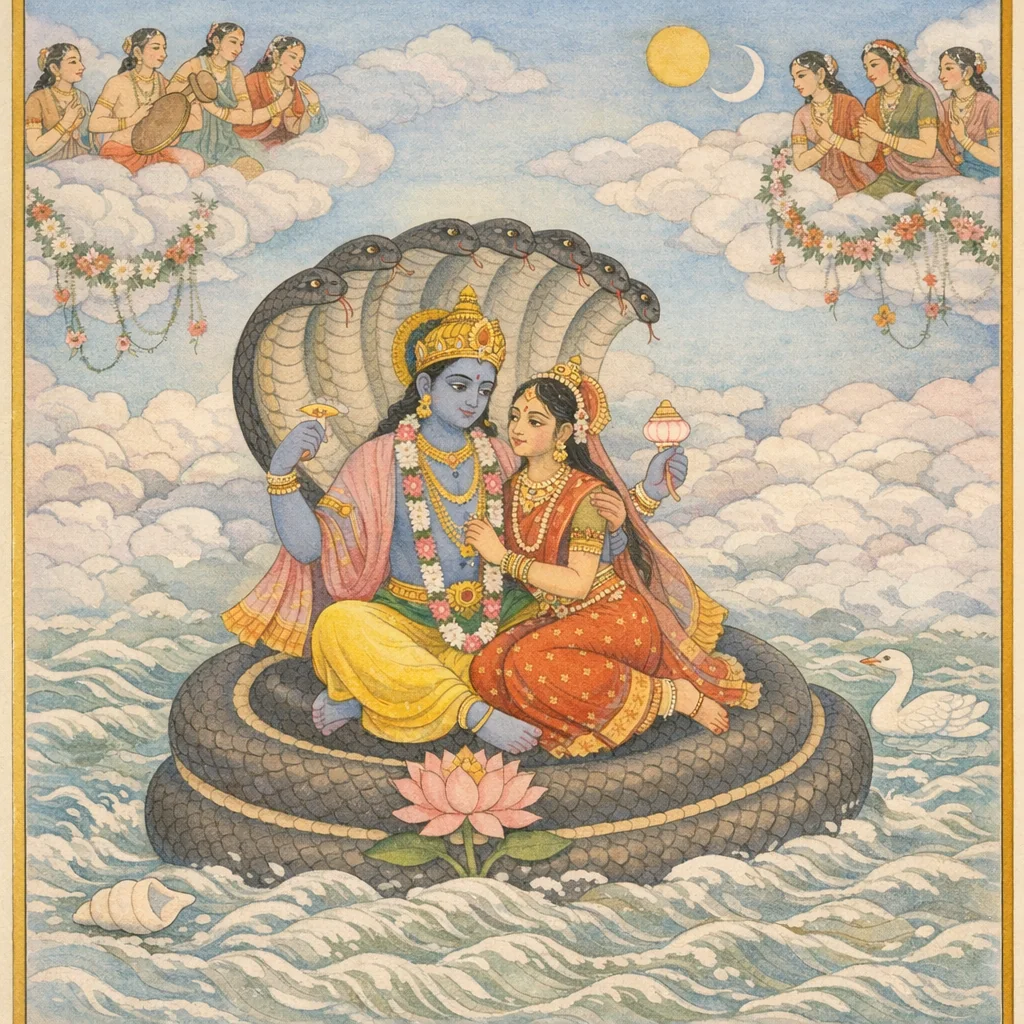
Adhyaya 26
The Rohiṇī–Candra Śayana Vow (Lunar Bed-Vow with Rohiṇī)
Bhīṣma asks Pulastya to teach in full a vow that repeatedly bestows long life, health, beauty, noble birth, and the flourishing of one’s lineage. Pulastya assents and discloses a Purāṇic “secret” vrata: the Rohiṇī–Candra-śayana, the lunar “bed-vow” connected with Rohiṇī. The chapter lays down the proper timing (Monday in the bright fortnight, especially at the full moon, with the requisite nakṣatra conditions), rites of purification (pañcagavya with mustard and mantra-recitation), and Soma-themed worship of Nārāyaṇa through lunar epithets. A stotra/nyāsa-like sequence venerates the divine limbs by specific names, and Rohiṇī is worshipped as Lakṣmī, consort of Indu. Dietary restraints (haviṣya, no meat), listening to sacred narration, monthly flower offerings, and a year-long observance are enjoined. The concluding gifts include a bed, gold images of Candra and Rohiṇī, pearls, the placing of a milk-pot, and cow-gifts. The phala-śruti promises exalted celestial sovereignty, a hard return from Candra-loka, and eligibility for women and devoted Śūdras; recitation or hearing brings honor in Viṣṇu’s abode.
Shlokas
Verse 1
भीष्म उवाच । दीर्घायुरारोग्यकुलातिवृद्धिभिर्युक्तः पुमान्रूपकुलान्वितः स्यात् । मुहुर्मुहुर्जन्मनि येन सम्यक्व्रतं समाचक्ष्व च शीतरश्मेः
Bhīṣma said: “O cool-rayed one, please explain in full the proper observance of that vow by which a man becomes endowed—again and again in successive births—with long life, good health, great prosperity of lineage, and also beauty and noble family.”
Verse 2
पुलस्त्य उवाच । त्वया पृष्टमिदं सम्यगक्षयस्वर्गकारकम् । रहस्यं तु प्रवक्ष्यामि यत्पुराणविदो विदुः
Pulastya said: You have asked rightly—this brings about imperishable heaven. Now I shall declare the secret known to the knowers of the Purāṇas.
Verse 3
रोहिणीचंद्रशयनं नामव्रतमिहोच्यते । तस्मिन्नारायणस्यार्चामर्चयेदिंदुनामभिः
Here the vow called “Rohiṇī–Candra-Śayana” is taught. On that occasion one should worship the image of Nārāyaṇa, honoring Him with the names of the Moon (Indu).
Verse 4
यदा सोमदिने शुक्ला भवेत्पंचदशी क्वचित् । अथवा ब्रह्मनक्षत्रं पौर्णमास्यां प्रजायते
When, on a Monday, the bright fortnight’s fifteenth lunar day (the Full Moon) occurs, or when the Brahmā-nakṣatra arises on the night of the Full Moon—
Verse 5
तदा स्नानं नरः कुर्यात्पंचगव्येन सर्षपैः । आप्यायस्वेति च जपेद्विद्वानष्टशतं पुनः
Then a man should bathe using pañcagavya together with mustard seeds; and the learned person should again recite the mantra “āpyāyasva” eight hundred times.
Verse 8
शूद्रोपि परया भक्त्या पाषंडालापवर्जितः । सोमाय शांताय नमोस्तु पादावनंतधाम्नेति च जानुजंघे । ऊरुद्वयं चापि जलोदराय संपूजयेन्मेढ्रमनंगधाम्ने
Even a Śūdra, if endowed with supreme devotion and free from the talk of heretical sects, may worship the Lord’s form: at the feet, saying, “Obeisance to Soma, the peaceful one,” the abode of the Infinite; then worship the knees and shanks; then both thighs, saying, “to Jalodara”; and worship the generative organ, saying, “to Anaṅga, the abode (of desire).”
Verse 9
नमोनमः कामसुखप्रदाय कटिः शशांकस्य सदार्चनीयः । तथोदरं चाप्यमृतोदराय नाभिः शशांकाय नमोभिपूज्या
Salutations, salutations—to the Moon’s waist, ever worthy of worship, bestowing the joys of love and pleasure. Likewise, salutations to his belly, like a dwelling filled with amṛta; and to the Moon’s navel—salutations, worthy of reverent adoration.
Verse 10
नमोस्तु चंद्राय मुखं च नित्यं दंता द्विजानामधिपाय पूज्याः । हास्यं नमश्चंद्रमसेऽभिपूज्यमोष्ठौ तु कौमोदवनप्रियाय
Salutations to the Moon; and ever-salutations to the face. The teeth are venerable—worthy of worship—as the lord of the twice-born. Salutations to the smile, especially to be revered for the Moon; and the lips are offered to the one beloved of the grove of night-blooming kumudā lotuses.
Verse 11
नासा च नाथाय वरौषधीनामानंदबीजाय पुनर्भ्रुवौ च । नेत्रद्वयं पद्मनिभं तथेंदोरिंदीवरव्यासकराय शौरेः
His nose became the lord of excellent healing herbs; again, his eyebrows became the seed of bliss. His pair of eyes, lotus-like, became the Moon and also Śauri (Viṣṇu), whose hands are broad like blue lotuses.
Verse 12
नमः समस्ताध्वरपूजिताय कर्णद्वयं दैत्यनिषूदनाय । ललाटमिंदोरुदधिप्रियाय केशाः सुषुम्नाधिपतेः प्रपूज्याः
Salutations to Him who is worshipped in all adhvara sacrifices; salutations to the pair of ears of the slayer of the daitya demons; salutations to the forehead beloved of the Moon and of the ocean. The hairs of that Lord, the revered master of Suṣumnā, are indeed worthy of worship.
Verse 13
शिरः शशांकाय नमो मुरारेर्विश्वेश्वरायाथ नमः किरीटं । पद्मप्रिये रोहिणीनाम लक्ष्मि सौभाग्यसौख्यामृतसागराय
Salutations to the head adorned with the Moon; salutations to Murāri, Lord of the universe; and salutations to the crown. O beloved of the lotus—Lakṣmī, known as Rohiṇī—salutations to you, the ocean of amṛta of good fortune and happiness.
Verse 14
दैवीं च संपूज्य सुगंधिपुष्पैर्नैवेद्यधूपादिभिरिंदुपत्नीम् । सुप्त्वा तु भूमौ पुनरुत्थितो यः स्नात्वा च विप्राय हविष्यभुक्तः
Having duly worshipped the Goddess, Indu’s consort, with fragrant flowers, offerings of food, incense, and the like; having slept upon the ground and then risen again; having bathed, and then—after honoring and feeding a brāhmaṇa—eaten only haviṣya, the simple sacrificial fare—whoever performs this observance…
Verse 15
देयः प्रभाते सहिरण्य वारिकुंभो नमः पापविनाशनाय । संप्राश्य गोमूत्रममांसमन्नमक्षारमष्टावथ विंशतिं च
At dawn one should offer a water-pot together with gold, with the salutation, “Homage to the Destroyer of sins.” Then, having sipped cow’s urine, one should partake of meatless food, and also offer eight and twenty measures of grain.
Verse 16
ग्रासांश्च त्रीन्सर्पियुतानुपोष्य भुक्त्वेतिहासं शृणुयान्मुहूर्तं । कदंबनीलोत्पलकेतकानि जातिःसरोजं शतपत्रिका च
Having fasted, he should take three mouthfuls mixed with ghee; then, after eating, he should listen for a short while to a sacred narrative. Offerings of kadamba, blue lotus, ketaka, jasmine, lotus, and the hundred‑petalled flower are also commended.
Verse 17
अम्लानपुष्पाण्यथ सिंदुवारं पुष्पं पुनर्भारतमल्लिकायाः । शुक्लं च पुष्पं करवीरपुष्पं श्रीचंपकं चंद्रमसे प्रदेयम्
To Candrama, the Moon, one should offer fresh, unwithered flowers—such as sinduvāra, the blossom of Bhārata-mallikā, white flowers, karavīra blossoms, and the auspicious campaka.
Verse 18
श्रावणादिषु मासेषु क्रमादेतानि सर्वदा । यस्मिन्मासे व्रतादिः स्यात्तत्पुष्पैरर्चयेद्धरिम्
In the months beginning with Śrāvaṇa, these flowers are always to be used in their proper sequence. In whatever month a vow and its attendant observances are undertaken, one should worship Hari with the flowers prescribed for that month.
Verse 19
एवं संवत्सरं यावदुपोष्य विधिवन्नरः । व्रतांते शयनं दद्याच्छयनोपस्करान्वितम्
Thus, having duly observed the prescribed fast for a full year, a man should, at the close of the vow, donate a bed furnished with the proper bedding and accessories.
Verse 20
रोहिणीचंद्रमिथुनं कारयित्वा तु कांचनम् । चंद्रः षडंगुलः कार्यो रोहिणी चतुरंगुला
Having fashioned in gold the paired figures of Rohiṇī and the Moon, the Moon should be made six finger-breadths in measure, and Rohiṇī four finger-breadths.
Verse 21
मुक्ताफलाष्टकयुतां सितनेत्रसमन्विताम् । क्षीरकुंभोपरि पुनः कांस्यपात्राक्षतान्विताम्
Endowed with eight pearls and marked with white ‘eyes’ (spots), it should again be placed upon a pot of milk, together with a bronze vessel containing unbroken rice grains.
Verse 22
दद्यान्मंत्रेण पूर्वाह्णे शालीक्षुफलसंयुताम् । श्वेतामथ सुवर्णास्यां रौप्यखुरसमन्विताम्
In the forenoon, with the proper mantra, one should give (a cow) accompanied by rice, sugarcane, and fruits—white in color, with a golden face, and furnished with silver hooves.
Verse 23
सवस्त्रभाजनां धेनुं तथा शंखं च भाजनम् । भूषणैर्द्विजदाम्पत्यमलंकृत्य गुणान्वितं
He should offer a cow together with cloth and a vessel, and also a conch (śaṅkha) used as a vessel; and he should adorn a Brahmin couple with ornaments—virtuous and well-qualified.
Verse 24
चंद्रोयं विप्ररूपेण सभार्य इति कल्पयेत् । यथा ते रोहिणी कृष्ण शयनं न त्यजेदपि
One should visualize this Moon as having assumed the form of a brāhmaṇa, together with his wife—so that, O Kṛṣṇa, your Rohiṇī may not abandon the bed (your company) even for a moment.
Verse 25
सोमरूपस्य वैतद्वन्न मे भेदो विभूतिभिः । यथा त्वमेव सर्वेषां परमानंदमुक्तिदः
In this very way, for one whose form is Soma (the Moon), there is no difference in Me through (My) various manifestations; for You alone are the giver of supreme bliss and liberation to all.
Verse 26
इति श्रीपाद्मपुराणे प्रथमे सृष्टिखंडे रोहिणीचंद्रशयनव्रतं नाम षड्विंशोऽध्यायः
Thus ends the twenty-sixth chapter, called “The Rohiṇī–Candra-śayana Vrata,” in the first (Book) of the Śrī Padma Purāṇa, within the Sṛṣṭi-khaṇḍa.
Verse 27
रूपारोग्यायुषामेतद्विधायकमनुत्तमम् । इदमेव पितॄणां च सर्वदा वल्लभं नृप
O king, this is the unsurpassed practice that bestows beauty, health, and long life; and it alone is always dear to the Pitṛs (the ancestral spirits).
Verse 28
त्रैलोक्याधिपतिर्भूत्वा सप्तकल्पशतत्रयम् । चंद्रलोकमवाप्नोति पुनरावृत्तिदुर्लभम्
Having become the sovereign of the three worlds for three hundred and seven kalpas, one attains the realm of the Moon—a station from which return is hard to obtain.
Verse 29
नारी वा रोहिणीचंद्रशयनं या समाचरेत् । सापि तत्फलमाप्नोति पुनरावृत्तिदुर्लभम्
Even a woman who duly undertakes the observance called ‘Rohiṇī–Candra-śayana’ attains that very same fruit—one in which return to worldly rebirth is hard to obtain, that is, rare.
Verse 30
इति पठति शृणोति वा य इत्थं मधुमथनार्चनमिंदुकीर्तनेन । मतिमपि च ददाति सोपि शौरेर्भवनगतः परिपूज्यतेमरौघैः
Whoever thus recites or listens to this praise—this worship of Madhusūdana through a moon-like hymn—and even one who bestows understanding and guidance upon others, he too, having entered the abode of Śauri (Viṣṇu), is fully honored by hosts of immortals.