Adhyaya 20
Vrata–Dāna Compendium at Puṣkara: Puṣpavāhana’s Account and the Ṣaṣṭhī-vrata Purification Rite
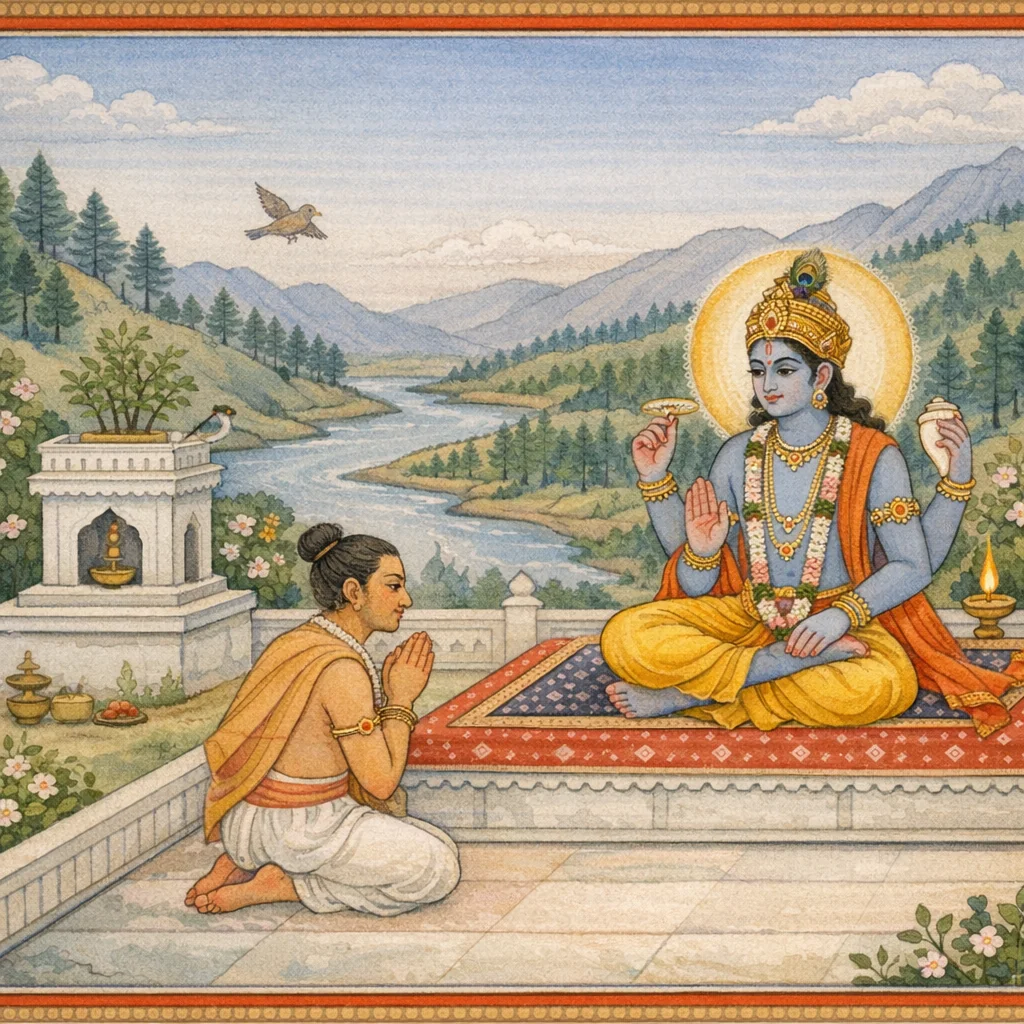
In Adhyaya 20 (PP.1.20), Pulastya answers Bhīṣma by recounting King Puṣpavāhana, who receives from Brahmā a golden lotus and lotus-chariot. An embedded causation tale links austerity, moral reform, and worship of Viṣṇu at Puṣkara and Lavaṇācala, revealing the sanctifying power of the tīrtha and of dharma. The chapter then unfolds as a compendium of vows and gifts, listing many vrata by name with their disciplines—ekabhakta and naktam regimens, Dvādaśī cycles, and Cāturmāsya restraints—together with dāna prescriptions. It describes offerings such as cows, a golden lotus, a trident, a conch, a “sesame-cow,” and gifts of house or bed, assigning their fruits to the lokas of Viṣṇu, Śiva/Rudra, Indra, Varuṇa, Sarasvatī, and Brahmā. It culminates by turning to the Ṣaṣṭhī-vrata rite of purification: bathing and invoking Gaṅgā, reciting mṛttikā mantras, performing tarpaṇa for deities, sages, and pitṛs, offering arghya to Sūrya, and concluding with domestic worship and feeding brāhmaṇas.
Shlokas
Verse 1
भीष्म उवाच । अत्याश्चर्यवती रम्या कथेयं पापनाशिनी । विस्तरेण च मे ब्रूहि याथातथ्येन पृच्छतः
Bhīṣma said: This tale is exceedingly wondrous, delightful, and sin-destroying. Tell it to me in full detail, exactly as it is, since I am asking.
Verse 2
माहात्म्यं मध्यमस्यापि ऋषिभिः परिकीर्तितम् । फलं चान्नस्य कथितं माहात्म्यं च दमस्य तु
The sages have also proclaimed the greatness of the ‘middle’ path of moderation. They have spoken of the fruit of proper sustenance, and likewise of the greatness of self-restraint.
Verse 3
विष्णुना च पदन्यासः कृतो यत्र महामुने । कनीयसस्तथोत्पत्तिर्यथाभूता वदस्व मे
O great sage, tell me of that place where Viṣṇu set down His foot; and also explain to me, as it truly happened, the origin of the younger one.
Verse 4
पुलस्त्य उवाच । पुरा रथंतरे कल्पे राजासीत्पुष्पवाहनः । नाम्ना लोकेषु विख्यातस्तेजसा सूर्यसन्निभः
Pulastya said: In former times, in the Rathaṃtara kalpa, there was a king named Puṣpavāhana—renowned throughout the worlds, and radiant like the sun in splendor.
Verse 5
तपसा तस्य तुष्टेन चतुर्वक्त्रेण भारत । कमलं कांचनं दत्तं यथाकामगमं नृप
O Bhārata, pleased with his austerities, the four-faced one (Brahmā) granted him, O king, a golden lotus by which he could go wherever he wished.
Verse 6
सप्तद्वीपानि लोकं च यथेष्टं विचरत्सदा । कल्पादौ तु समं द्वीपं तस्य पुष्करवासिना
He always wandered at will through the seven continents and the worlds; but at the beginning of the aeon, that continent was made level and equal by the one dwelling at Puṣkara.
Verse 7
वत्सरं त्वेकभक्ताशी सभक्ष्यजलकुंभदः । शिवलोके वसेत्कल्पं प्राप्तिव्रतमिदं स्मृतम्
But if one, for a year, eats only once a day and gives a water-pot along with provisions, one is said to dwell in Śiva’s realm for a kalpa. This is remembered as the Prāpti-vrata, the vow that brings attainment.
Verse 8
नक्ताशी त्वष्टमीषु स्याद्वत्सरांते तु धेनुदः । पौरंदरं पुरं याति सुगतिव्रतमुच्यते
Let one eat only at night on the eighth lunar days; and at the end of the year, one should donate a cow. By this one goes to Paurandara’s city (Indra’s heaven). This observance is called the Sugati-vrata, the vow that leads to a good destiny.
Verse 9
तपोनुभावादथ तस्य राज्ञी नारी सहस्रैरभिवंद्यमाना । नाम्ना च लावण्यवती बभूव या पार्वतीवेष्टतमा भवस्य
Then, by the power of her austerities, that king’s queen—revered by thousands of women—became known as Lāvaṇyavatī, dearest to Bhava (Śiva), as though she were Pārvatī herself.
Verse 10
तस्यात्मजानामयुतं बभूव धर्मात्मनामग्र्यधनुर्धराणाम् । तदात्मजांस्तानभिवीक्ष्य राजा मुहुर्मुहुर्विस्मयमाससाद
He had ten thousand sons—righteous by nature and foremost among bow-bearing warriors. Seeing those sons of his, the king was struck again and again with wonder.
Verse 11
सोभ्यागतं पूज्य मुनिप्रवीरं प्रचेतसं वाक्यमिदं बभाषे । कस्माद्विभूतिरचलामरमर्त्यपूजा जाता कथं कमलजा सदृशी सुराज्ञी
Having welcomed and honored the venerable sage Pracetas, he spoke: “From what cause did this unshakable glory—revered by gods and mortals—arise? And how did the divine queen come to be like Kamalajā (Lakṣmī)?”
Verse 12
भार्या मयाल्पतपसा परितोषितेन दत्तं ममांबुजगृहं च मुनींद्र धात्रा । यस्मिन्प्रविष्टमपि कोटिशतं नृपाणां सामात्यकुंजररथौघजनावृतानां
O lord of sages, the Creator (Dhātṛ), though my austerities were slight, was pleased with me and granted me a wife and also this lotus-like dwelling. Into it even a hundred crores of kings—surrounded by ministers, by throngs of elephants and chariots, and by multitudes of people—could enter.
Verse 13
नालक्ष्यते क्वगतमम्बरगामिभिश्च तारागणेंदुरविरश्मिभिरप्यगम्यम् । तस्मात्किमन्यजननीजठरोद्भवेन धर्मादिकं कृतमशेषजनातिगं यत्
It cannot be discerned where it has gone—beyond the reach even of those who move through the sky, and inaccessible even to the rays of the hosts of stars, the moon, and the sun. Therefore, what can one born of another mother’s womb accomplish—dharma and the rest—that would surpass all beings?
Verse 14
सर्वैर्मयाथ तनयैरथ वानयापि सद्भार्यया तदखिलं कथय प्रचेतः । सोप्यभ्यधादथ भवांतरितं निरीक्ष्य पृथ्वीपते शृणु तदद्भुतहेतुवृत्तम्
“Together with me, with your sons, and with your wife—your noble consort—tell us all of it in full, O Pracetas.” Then he too, as though looking within and recalling what lay in the past, replied: “O lord of the earth, listen to the account of the wondrous cause.”
Verse 15
जन्माभवत्तव तु लुब्धकुलेपि घोरं जातस्त्वमप्यनुदिनं किल पापकारी । वपुरप्यभूत्तव पुनः पुरुषांगसंधिदुर्गंधिसत्त्वकुनखाभरणं समंतात्
Your birth arose in a harsh and dreadful hunter lineage, and you yourself, day after day, truly committed sinful deeds. Even your outward form became a mark of impurity—coarse limbs and joints, pervasive foulness, and repellent “ornaments” of skin and nails all around—serving as a teaching on the karmic consequence of persistent wrongdoing.
Verse 16
न च ते सुहृन्न सुतबंधुजनो न तादृक्नैवस्वसा न जननी च तदाभिशस्ता । अतिसंमता परमभीष्टतमाभिमुखी जाता मही शतवयोषिदियं सुरूपा
You have neither a true friend nor a son or kinsman of that sort; there was then neither a sister nor even a mother to speak up for you. Yet this Earth—highly honored, most desirable, and turned toward you—has come to you, fair in form, like a hundred young maidens.
Verse 17
अभूदनावृष्टिरतीव रौद्रा कदाचनाहारनिमित्तमस्यां । क्षुत्पीडितेन भवता तु यदा न किंचिदासादितं वन्यफलादि भक्ष्यं
Once there came a most fierce drought, and in that time food became the cause of great distress in this land. When you were tormented by hunger and could obtain nothing to eat—no wild fruits or the like—
Verse 18
अथाभिदृष्टं महदंबुजाढ्यं सरोवरं पंकपरीतरोधः । पद्मान्यथादाय ततो बहूनि गतः पुरं वैदिश नामधेयं
Then he beheld a great lake rich with lotuses, its banks encircled by mud. Gathering many lotuses from there, he went on to the city called Vaidisha.
Verse 19
तन्मूल्यलाभाय पुरं समस्तं भ्रांतं त्वयाशेषमहस्तदासीत् । क्रेता न कश्चित्कमलेषु जातः क्लांतः परं क्षुत्परिपीडितश्च
To obtain its price, you wandered through the entire city all day; yet no buyer was found for the lotuses. You became utterly exhausted and sorely afflicted by hunger.
Verse 20
उपविष्टस्त्वमेकस्मिन्सभार्यो भवनांगणे । ततो रात्रौ भवांस्तत्र अश्रौषीन्मंगलध्वनिं
You were seated in a certain courtyard of the house, together with your wife. Then, during the night, you heard there an auspicious sound.
Verse 21
सभार्यस्तत्र गतवान्यत्रासौ मंगलध्वनिः । तत्र मंडलमध्यस्था विष्णोरर्चाविलोकिता
Along with his wife, he went there where that auspicious sound was heard; and there, in the middle of the consecrated circle, he beheld the revered image of Viṣṇu.
Verse 22
वेश्यानंगवती नाम बिभ्रती द्वादशीव्रतं । समाप्य माघमासस्य द्वादश्यां लवणाचलं
A courtesan named Anaṅgavatī, observing the Dvādaśī vow, completed it on the twelfth day of the month of Māgha at Lavaṇācala.
Verse 23
न्यवेदयत्तु गुरवे शय्यां चोपस्करान्विताम् । अलंकृत्य हृषीकेशं सौवर्णं सममादरात्
Then, with due reverence, he presented to his guru a bed furnished with all accessories; and—having adorned Hṛṣīkeśa—he respectfully offered a golden gift.
Verse 24
सा तु दृष्टा ततस्ताभ्यामिदं च परिचिंतितं । किमेभिः कमलैः कार्यं वरं विष्णुरलंकृतः
When she was seen, the two reflected: “What use are these lotuses? Better that Viṣṇu himself be adorned with them.”
Verse 25
इति भक्तिस्तदा जाता दंपत्योस्तु नरेश्वर । तत्प्रसंगात्समभ्यर्च्य केशवं लवणाचलं
Thus, O king of men, devotion arose in that husband and wife; and in that very context they duly worshipped Keśava at Lavaṇācala.
Verse 26
शय्या च पुष्पप्रकरैः पूजिताभूच्च सर्वशः । अथानंगवती तुष्टा तयोर्धान्यशतत्रयम्
And the bed too was worshipped on all sides with heaps of flowers. Then Anaṅgavatī, being pleased, bestowed upon the two of them three hundred measures of grain.
Verse 27
दीयतामादिदेशाथ कलधौतपलत्रयं । न गृहीतं ततस्ताभ्यां महासत्वावलंबनात्
He then ordered, “Let three golden bowls be given.” Yet those two did not accept them, relying on their own great strength of character.
Verse 28
अनंगवत्या च पुनस्तयोरन्नं चतुर्विधं । आनीय व्याहृतं चान्नं भुज्यतामिति भूपते
Then Anaṅgavatī again brought, for the two of them, four kinds of food; and having served the meal, she said, “O king, please partake of this food.”
Verse 29
ताभ्यां च तदपि त्यक्तं भोक्ष्यावः श्वो वरानने । प्रसंगादुपवासो नौ तवाद्यास्तु शुभावहः
And that too has been set aside because of those two. We shall eat tomorrow, O fair-faced one. By circumstance we fast today; may this day of yours be auspicious and bring good.
Verse 30
जन्मप्रभृति पापिष्ठावावां देवि दृढव्रते । त्वत्प्रसंगाद्भवद्गेहे धर्मलेशोस्तु नाविह
From birth we two have been most sinful, O Devī of firm vows. Yet through our association with you, in your house here there is at least a small trace of dharma.
Verse 31
इति जागरणं ताभ्यां तत्प्रसंगादनुष्ठितं । प्रभाते च तया दत्ता शय्या सलवणाचला
Thus, due to that very occasion, the two of them duly kept a night-long vigil; and at dawn she gave them a bed as a gift, together with the Lavaṇācala (Salt Mountain).
Verse 32
ग्रामश्च गुरवे भक्त्या विप्रेभ्यो द्वादशैव तु । वस्त्रालंकारसंयुक्ता गावश्च कनकान्विताः
With devotion, a village was given to the teacher; and to the brāhmaṇas, twelve cows—adorned with cloth and ornaments, and accompanied by gold.
Verse 33
भोजनं च सुहृन्मित्रदीनांधकृपणैः सह । तच्च लुब्धकदांपत्यं पूजयित्वा विसर्जितम्
Food was also given, along with care for friends and well-wishers, and for the poor, the blind, and the destitute. Then that hunter-couple was honored and respectfully sent on their way.
Verse 34
स भवान्लुब्धको जातः सपत्नीको नृपेश्वरः । पुष्करप्रकरात्तस्मात्केशवस्य तु पूजनात्
O lord of kings, from that sacred precinct of Puṣkara, by worshipping Keśava you were born again as a hunter—together with your wife.
Verse 35
विनष्टाशेषपापस्य तव पुष्करमंदिरं । तस्य सत्यस्य माहात्म्यादलोभतपसा नृप
O king, your Puṣkara-temple will destroy all remaining sins, through the greatness of that truth and by ascetic practice free from greed.
Verse 36
प्रादात्कामगमं यानं लोकनाथश्चतुर्मुखः । संतुष्टस्तव राजेंद्र पुष्करं त्वं समाश्रय
The four-faced Lord of the worlds (Brahmā) granted you a chariot that moves at will. Pleased with you, O king of kings, he said: “Take refuge in Puṣkara.”
Verse 37
कल्पं सत्वं समासाद्य विभूतिद्वादशीव्रतं । कुरु राजेंद्र निर्वाणमवश्यं समवाप्स्यसि
O king of kings, having duly embraced the pure (sāttvika) discipline, observe the Vibhūti-Dvādaśī vow; you will surely attain liberation (nirvāṇa).
Verse 38
एतदुक्त्वा तु स मुनिस्तत्रैवांतरधीयत । राजा यथोक्तं च पुनरकरोत्पुष्पवाहनः
Having said this, the sage vanished then and there. And King Puṣpavāhana again did exactly as he had been instructed.
Verse 39
इदमाचरतो राजन्नखंडव्रतता भवेत् । यथाकथंचित्कालेन द्वादशद्वादशीर्नृप
O King, by practicing this one attains unbroken observance of the vow; and in due course of time, somehow or other, one completes the twelve Dvādaśīs, O ruler.
Verse 40
कर्तव्या शक्तितो देव विप्रेभ्यो दक्षिणा नृप । ज्येष्ठे गावः प्रदातव्या मध्यमे भूमिरुत्तमा
O king, O revered one: one should give dakṣiṇā (sacrificial gifts) to the Brāhmaṇas according to one’s capacity. As the foremost gift, cows should be given; as the middling, excellent land.
Verse 41
कनिष्ठे कांचनं देयमित्येषा दक्षिणा स्मृता । प्रथमं ब्रह्मदैवत्यं द्वितीयं वैष्णवं तथा
For the lowest grade, gold should be given—this is remembered as the proper dakṣiṇā. The first portion is presided over by Brahmā, and the second likewise is Vaiṣṇava, presided over by Viṣṇu.
Verse 42
तृतीयं रुद्रदैवत्यं त्रयो देवास्त्रिषु स्थिताः । इति कलुषविदारणं जनानां पठति च यस्तु शृणोति चापि भक्त्या
The third is presided over by Rudra; the three deities abide in the three. Whoever, with devotion, recites—or even hears—this teaching that rends away the impurities of people, is purified.
Verse 43
मतिमपि च स याति देवलोके वसति च रोमसमानि वत्सराणि । अथातः संप्रवक्ष्यामि व्रतानामुत्तमं व्रतं
He attains right understanding and goes to the world of the gods, dwelling there for as many years as there are hairs on the body. Now, therefore, I shall explain the supreme vow among vows.
Verse 44
कथितं तेन रुद्रेण महापातकनाशनम् । नक्तमब्दं चरित्वा तु गवासार्धं कुटुंबिने
Thus Rudra declared that which destroys great sins. And having observed the naktam vow for a year, one should give a cow—together with an additional half-share of gift—to a householder.
Verse 45
हैमं चक्रं त्रिशूलं च दद्याद्विप्राय वाससी । एवं यः कुरुते पुण्यं शिवलोके स मोदते
One should give a brāhmaṇa a golden discus and a trident, and also garments. Whoever performs such meritorious giving rejoices in Śiva’s world.
Verse 46
एतदेव व्रतं नाम महापातकनाशनम् । यस्वेकभक्तेन क्षिपेद्धेनुं वृषसमन्विताम्
This indeed is the vow called the destroyer of great sins—when a person, with single-minded devotion, gives as a gift a cow accompanied by a bull.
Verse 47
धेनुं तिलमयीं दद्यात्स पदं याति शांकरम् । एतद्रुद्रव्रतं नाम भयशोकविनाशनम्
One should donate a cow fashioned of sesame; by doing so one attains the abode of Śaṅkara. This observance is called the Rudra-vrata, and it destroys fear and sorrow.
Verse 48
यश्च नीलोत्पलं हैमं शर्करापात्रसंयुतम् । एकांतरितनक्ताशी समांते वृषसंयुतम्
And whoever offers a blue lotus made of gold, together with a vessel of sugar, observing the regimen of eating only at night at alternate intervals, and at the year’s end also offers a bull—(obtains the stated religious merit).
Verse 49
वैष्णवं स पदं याति नीलव्रतमिदं स्मृतम् । आषाढादिचतुर्मासमभ्यंगं वर्जयेन्नरः
He attains the Vaishnava abode; this observance is remembered as the Nīla-vrata. From Āṣāḍha onward, throughout the four months of Cāturmāsya, a man should refrain from oil-anointing and the oil-bath (abhyaṅga).
Verse 50
भोजनोपस्करं दद्यात्स याति भवनं हरेः । जनप्रीतिकरं नॄणां प्रीतिव्रतमिहोच्यते
One who gives utensils and provisions for meals attains the abode of Hari. Since it brings delight to people, it is here called the Priti-vrata, the vow of pleasing others.
Verse 51
वर्जयित्वा मधौ यस्तु दधिक्षीरघृतैक्षवम् । दद्याद्वस्त्राणि सूक्ष्माणि रसपात्रेण संयुतम्
He who avoids intoxicating liquor and offers curd, milk, ghee, and sugarcane-juice, and who gives fine garments together with a vessel for drink, gains sacred merit.
Verse 52
संपूज्य विप्रमिथुनं गौरी मे प्रीयतामिति । एतद्गौरीव्रतं नाम भवानीलोकदायकम्
Having duly worshipped the Brahmin couple, one should pray, “May Gaurī be pleased with me.” This observance is called the Gaurī-vrata, and it bestows the world, the realm of Bhavānī.
Verse 53
पुष्यादौ यस्त्रयोदश्यां कृत्वा नक्तमथो पुनः । अशोकं कांचनं दद्यादिक्षुयुक्तं दशांगुलम्
Whoever, beginning with the asterism Puṣya, observes the thirteenth lunar day by taking only a night-meal (nakta), and then, on the prescribed occasion, donates a golden aśoka offering together with sugarcane measuring ten finger-breadths, obtains great merit.
Verse 54
विप्राय वस्त्रसंयुक्तं प्रद्युम्नः प्रीयतामिति । कल्पं विष्णुपुरे स्थित्वा विशोकस्स्यात्पुनर्नृप
“May Pradyumna be pleased with this garment offered to a brāhmaṇa.” Having dwelt in Viṣṇu’s city for a kalpa, he becomes free from sorrow again, O king.
Verse 55
एतत्कामव्रतं नाम सदा शोकविनाशनम् । आषाढादि व्रते यस्तु वर्जयेद्यः फलाशनम्
This observance is called the Kāma-vrata; it always destroys sorrow. In the vow-cycle beginning with Āṣāḍha, the one who refrains from taking fruit as food …
Verse 56
चातुर्मास्ये निवृत्ते तु घटं सर्पिर्गुडान्वितम् । कार्तिक्यां तत्पुनर्हैमं ब्राह्मणाय निवेदयेत्
When the Cāturmāsya observance has ended, one should offer to a brāhmaṇa a pot filled with ghee mixed with jaggery; then again in the month of Kārtika, one should offer a golden vessel to a brāhmaṇa.
Verse 57
स रुद्रलोकमाप्नोति शिवव्रतमिदं स्मृतम् । वर्जयेद्यस्तु पुष्पाणि हेमंते शिशिरावृते
He attains Rudra’s realm—this is remembered as the observance of Śiva’s vow. But one who, in the Hemanta season, when the cold prevails, avoids offering flowers, fails in this observance.
Verse 58
पुष्पत्रयं च फाल्गुन्यां कृत्वा शक्त्या च कांचनम् । दद्याद्द्विकालवेलायां प्रीयेतां शिवकेशवौ
In the month of Phālguna, having prepared a triad of flowers and, according to one’s capacity, some gold, one should offer it at the time of the two daily rites; then Śiva and Keśava (Viṣṇu) are pleased.
Verse 59
दत्वा परं पदं याति सौम्यव्रतमिदं स्मृतम् । फाल्गुनादि तृतीयायां लवणं यस्तु वर्जयेत्
Having observed it, one attains the supreme state; this is remembered as the gentle (Saumya) vow. On the third lunar day (tithi) beginning with the month of Phālguna, whoever refrains from salt observes this vow.
Verse 60
समांते शयनं दद्याद्गृहं चोपस्करान्वितम् । संपूज्य विप्रमिथुनं भवानी प्रीयतामिति
At the end of the year, one should give a bed, and also a house furnished with household goods. Having duly honored the Brāhmaṇa couple, one should say, “May Bhavānī be pleased.”
Verse 61
गौरीलोके वसेत्कल्पं सौभाग्यव्रतमुच्यते । संध्यामौनं नरः कृत्वा समांते घृतकुंभकम्
Dwelling in Gaurī’s world for a kalpa is called the Saubhāgya-vrata, the vow of good fortune. Having observed silence at the twilight rites (sandhyā), a man should, at the end of the year, offer a jar filled with ghee.
Verse 62
वस्त्रयुग्मं तिलान्घंटां ब्राह्मणाय निवेदयेत् । लोकं सारस्वतं याति पुनरावृत्तिदुर्लभम्
One who offers a pair of garments and a bell made of sesame (that is, a gift connected with sesame) to a Brāhmaṇa attains the Sārasvata world—a realm from which return to rebirth is difficult.
Verse 63
एतत्सारस्वतं नाम रूपविद्याप्रदायकम् । लक्ष्मीमभ्यर्च्य पंचम्यामुपवासी भवेन्नरः
This observance is called Sārasvata and it bestows knowledge of form (arts and beauty). Having worshipped Lakṣmī, a person should fast on the fifth lunar day (pañcamī).
Verse 64
समांते हेमकमलं दद्याद्धेनुसमन्वितम् । स वै विष्णुपदं याति लक्ष्मीः स्याज्जन्मजन्मनि
At the year’s end, one should gift a golden lotus together with a cow. Truly, such a person attains the abode of Viṣṇu, and Lakṣmī—prosperity—accompanies them birth after birth.
Verse 65
एतल्लक्ष्मीव्रतं नाम दुःखशोकविनाशनम् । कृत्वोपलेपनं शंभोरग्रतः केशवस्य च
This is called the Lakṣmī-vrata, the vow that destroys sorrow and grief. Having performed the smearing with sacred paste before Śambhu (Śiva) and also before Keśava (Viṣṇu)…
Verse 66
यावदब्दं पुनर्देया धेनुर्जलघटस्तथा । जन्मायुतं स राजा स्यात्ततः शिवपुरं व्रजेत्
So long as a year endures, a cow and a water-pot should be given again and again. By doing so, he becomes a king for ten thousand births; thereafter, he goes to Śiva’s city, Śivapura.
Verse 67
एतदायुर्व्रतं नाम सर्वकामप्रदायकम् । अश्वत्थं भास्करं गंगां प्रणम्यैकाग्रमानसः
This is called the Āyur-vrata, the vow that bestows the fulfillment of all desires. With a single-pointed mind, one should bow to the sacred aśvattha tree, to the Sun, and to the river Gaṅgā.
Verse 68
एकभक्तं नरः कुर्यादब्दमेकं विमत्सरः । व्रतांते विप्रमिथुनं पूज्यं धेनुत्रयान्वितम्
Free from envy, a man should observe the ekabhakta discipline—taking food only once—for one full year. At the conclusion of the vow, he should honor a pair of Brahmins, together with three cows.
Verse 69
वृक्षं हिरण्मयं दद्यात्सोश्वमेधफलं लभेत् । एतत्कीर्तिव्रतं नाम भूतिकीर्तिफलप्रदम्
One who donates a golden tree attains the fruit of the Aśvamedha sacrifice. This is called the Kīrti-vrata, bestowing the fruits of prosperity and fame.
Verse 70
घृतेन स्नपनं कृत्वा शंभोर्वा केशवस्य वा । अक्षताभिः सपुष्पाभिः कृत्वा गोमयमंडलम्
After bathing the image with ghee—whether of Śambhu (Śiva) or of Keśava (Viṣṇu)—one should fashion a ritual circle of cow-dung and offer worship with unbroken rice grains and flowers.
Verse 71
समांते हेमकमलं तिलधेनुसमन्वितम् । शूलमष्टांगुलं दद्याच्छिवलोके महीयते
At the year’s end, one should give a golden lotus together with a tiladhenu (a sesame-cow), and donate a trident eight aṅgulas in length; thereby one is honored in Śiva’s world.
Verse 72
सामगायनकं चैव सामव्रतमिहोच्यते । नवम्यामेकभक्तं तु कृत्वा कन्याश्च शक्तितः
Sāma-chanting is indeed what is here called the Sāma-vrata. On the ninth day, having observed a one-meal fast, one should also give gifts to young maidens according to one’s capacity.
Verse 73
भोजयित्वा समं दद्याद्धेमकंचुकवाससी । हैमं सिंहं च विप्रा यदद्याच्छिवपदं व्रजेत्
After feeding the brāhmaṇas, one should also give them a golden bodice and garments; and, O brāhmaṇas, whoever donates a golden lion attains the abode of Śiva.
Verse 74
जन्मार्बुदं सुरूपः स्याच्छत्रुभिश्चापराजितः । एतद्वीरव्रतं नाम नराणां च सुखप्रदम्
For myriad births one becomes fair of form and is not overcome by enemies. This is called the “Hero’s Vow” (vīra-vrata), and it bestows happiness upon people.
Verse 75
चैत्रादि चतुरोमासाञ्जलं दद्याद्दयान्वितः । व्रतांते मणिकं दद्यादन्नं वस्त्रसमन्वितम्
With compassion, one should give water throughout the four months beginning with Caitra. At the conclusion of the vow, one should donate a small gem, along with food accompanied by clothing.
Verse 76
तिलपात्रं हिरण्यं च ब्रह्मलोके महीयते । कल्पांते भूतिजननमानंदव्रतमुच्यते
A vessel filled with sesame and gold is honored in Brahmaloka. At the end of the aeon, this is said to be the Ānandavrata, the vow that generates prosperity and well-being.
Verse 77
पंचामृतेन स्नपनं कृत्वा संवत्सरं विभोः । वत्सरांते पुनर्दद्याद्धेनुं पंचामृतान्वितां
Having performed the Lord’s bathing rite with pañcāmṛta for a full year, at the end of the year one should again donate a cow, accompanied by pañcāmṛta.
Verse 78
विप्राय दद्याच्छंखं च सपदं याति शांकरम् । राजा भवति कल्पांते धृतिव्रतमिदं स्मृतम्
If one gives a conch (śaṅkha) to a brāhmaṇa, one immediately attains Śaṅkara’s abode; and at the end of the cosmic cycle one becomes a king—this is remembered as the vow called Dhṛti.
Verse 79
वर्जयित्वा पुमान्मांसं व्रतांते गोप्रदो भवेत् । तद्वद्धेममृगं दद्यात्सोश्वमेधफलं लभेत्
A man who abstains from meat and, at the close of his vow, gives a cow in gift becomes a true giver of cows. Likewise, if he offers a golden deer, he attains merit equal to the fruit of the Aśvamedha sacrifice.
Verse 80
अहिंसाव्रतमित्युक्तं कल्पांते भूपतिर्भवेत् । कल्यमुत्थाय वै स्नानं कृत्वा दांपत्यमर्चयेत्
This is called the vow of non-violence; at the end of the kalpa one becomes a king. Rising at dawn, one should bathe and then worship the divine principle of sacred conjugal union.
Verse 81
भोजयित्वा यथाशक्ति माल्यवस्त्रविभूषणैः । सूर्यलोके वसेत्कल्पं सूर्यव्रतमिदं स्मृतम्
Having fed others according to one’s capacity, and having offered garlands, clothing, and ornaments, one dwells in the world of the Sun for an entire kalpa; this is remembered as the Sūrya-vrata.
Verse 82
आषाढादि चतुर्मासं प्रातःस्नायी भवेन्नरः । विप्राय भोजनं दत्वा कार्तिक्यां गोप्रदो भवेत्
From Āṣāḍha onward, throughout the sacred four-month period, one should bathe in the early morning. Having given food to a brāhmaṇa, in the month of Kārttika one should perform the gift of a cow.
Verse 83
स वैष्णवपदं याति विष्णुव्रतमिदं स्मृतम् । अयनादयनं यावद्वर्जयेत्पुष्पसर्पिषी
He attains the abode of Viṣṇu; this is declared to be the vow of Viṣṇu. From one solstice to the next, one should abstain from (offerings of) flowers and ghee.
Verse 84
तदंते पुष्पमन्नानि घृतधेन्वा सहैव तु । दत्वा शिवपदं याति विप्राय घृतपायसम्
Thereafter, having offered flower-foods together with a ghee-yielding cow, and having given ghee-sweet rice to a brāhmaṇa, one attains the state (abode) of Śiva.
Verse 85
एतच्छीलव्रतं नाम शीलारोग्यफलप्रदम् । यावत्समं भवेद्यस्तु पंचदश्यां पयोव्रतः
This is called the Śīla-vrata; it bestows the fruits of good conduct and health. Whoever, on the fifteenth lunar day, undertakes the milk-vow and continues it until the vowed period is completed—
Verse 86
समांते श्राद्धकृद्दद्याद्गाश्च पंच पयस्विनीः । वासांसि च पिशंगानि जलकुंभयुतानि च
At the conclusion (of the year), the performer of the śrāddha should give as gifts five milk-yielding cows, and also tawny garments along with water-pitchers.
Verse 87
स याति वैष्णवं लोकं पितॄणां तारयेच्छतम्
He attains the Vaiṣṇava world, and he delivers a hundred of his ancestral forefathers.
Verse 88
कल्पांते राजराजेंद्र पितृव्रतमिदं स्मृतम् । संध्यादीप प्रदो यस्तु घृतैस्तैलं विवर्जयेत्
O king of kings, at the end of an aeon this is remembered as a rite for the Pitṛs (ancestral spirits): one who offers a lamp at twilight should avoid using ghee and oil.
Verse 89
समांते दीपकं दद्याच्चक्रं शूलं च कांचनम् । वस्त्रयुग्मं च विप्राय स तेजस्वी भवेन्नरः
At the end of the year, one should offer a lamp, a discus, a trident, and gold, and also a pair of garments to a brāhmaṇa; that person becomes radiant and illustrious.
Verse 90
रुद्रलोकमवाप्नोति दीप्तिव्रतमिदं स्मृतम् । कार्तिकादि तृतीयायां प्राश्य गोमूत्र यावकम्
He attains Rudra’s world; this is remembered as the “Dīpti-vrata.” On the third lunar day beginning in Kārtika, one should partake of barley prepared with cow-urine.
Verse 91
नक्तं चरेदब्दमेकमब्दान्ते गोप्रदो भवेत् । गौरीलोके वसेत्कल्पं ततो राजा भवेदिह
If one practices the nocturnal vow for a full year, then at the end of that year one becomes a giver of cows. One dwells for an aeon in Gaurī’s world, and thereafter becomes a king here on earth.
Verse 92
एतद्रुद्रव्रतं नाम सदा कल्याणकारकम् । वर्जयेच्चतुरो मासान्यस्तु गन्धानुलेपनम्
This is called the Rudra-vrata, and it is always a cause of auspiciousness. One who undertakes it should abstain for four months from applying perfumes and fragrant unguents.
Verse 93
शुक्तिगन्धाक्षतान्दद्याद्विप्राय सितवाससी । वारुणं पदमाप्नोति दृढव्रतमिदं स्मृतम्
A woman wearing white garments should offer fragrant rice-grains to a brāhmaṇa; by doing so she attains the realm of Varuṇa. This is remembered as a firm religious observance.
Verse 94
वैशाखे पुष्पलवणं वर्जयेदथ गोप्रदः । भूत्वा विष्णुपदे कल्पं स्थित्वा राजा भवेदिह
In the month of Vaiśākha, one should refrain from flower-salt; then, becoming a giver of cows, one dwells in Viṣṇu’s abode for a kalpa and thereafter becomes a king here on earth.
Verse 95
एतच्छान्तिव्रतं नाम कीर्तिकामफलप्रदम् । ब्रह्माण्डं काञ्चनं कृत्वा तिलराशि समन्वितम्
This is called the Śānti-vrata; it bestows fame and the fulfillment of desired aims. One should fashion a golden brahmāṇḍa, the “cosmic egg,” and offer it together with a heap of sesame seeds.
Verse 96
घृतेनान्यप्रदो भूत्वा वह्निं संतर्प्य सद्विजम् । संपूज्य विप्रदांपत्यं माल्यवस्त्रविभूषणैः
Becoming one who gives ghee and other gifts, he should satisfy the sacred fire and the virtuous Brahmin; and, having duly honored the Brahmin couple, he should worship them with garlands, garments, and ornaments.
Verse 97
शक्तितस्त्रिपलादूर्ध्वं विश्वात्मा प्रीयतामिति । पुण्येऽह्नि दद्यादपरे ब्रह्म यात्यपुनर्भवम्
According to one’s capacity, if one gives a gift of at least three palas or more, with the prayer, “May the Soul of the universe be pleased,” then by giving on an auspicious day one attains Brahman and does not return to rebirth.
Verse 98
एतद्ब्रह्मव्रतं नाम निर्वाणफलदं नृणाम् । यश्चोभयमुखीं दद्यात्प्रभूतसकलान्विताम्
This is called the Brahma-vrata, and for humans it bestows the fruit of liberation (nirvāṇa). And whoever gives an obhayamukhī—a two-mouthed vessel—well supplied and furnished with all requirements, likewise attains that merit.
Verse 99
दिनं पयोव्रतं तिष्ठेत्स याति परमं पदम् । एतद्वै सुव्रतं नाम पुनरावृत्तिदुर्लभम्
Whoever observes the payovrata—the milk-vow—for a single day attains the Supreme Abode. This indeed is called the “excellent vow,” by which return to rebirth is averted.
Verse 100
त्र्यहं पयोव्रतः स्थित्वा काञ्चनं कल्पपादपम् । पलादूर्ध्वं यथाशक्ति तण्डुलप्रस्थसंयुतम्
Having observed the milk-only vow for three days, one should offer a golden wish-fulfilling tree, furnished—according to one’s capacity—with a measure of rice, in a quantity of one pala or more.
Verse 101
दत्त्वा ब्रह्मपदं याति भीमव्रतमिदं स्मृतम् । मासोपवासी यो दद्याद्धेनुं विप्राय शोभनाम्
Having given this offering, one attains the state of Brahmā; this is declared to be the Bhīma-vrata. One who fasts for a month and then gives a fine cow to a brāhmaṇa attains that exalted goal.
Verse 102
स वैष्णवपदं याति भीमव्रतमिदं स्मृतम् । दद्याद्विंशत्पलादूर्ध्वं महीं कृत्वा तु काञ्चनीम्
He attains the abode of Viṣṇu—this is known as the Bhīma-vrata. One should then donate an image of the Earth made of gold, weighing not less than twenty palas.
Verse 103
दिनं पयोव्रतस्तिष्ठेद्रुद्रलोके महीयते । धनप्रदमिदं प्रोक्तं सप्तकल्पशतानुगम्
One who observes the payovrata—the milk-vow—even for a single day is honored in Rudra’s world. This vow is said to bestow wealth, with its merit enduring through seven hundred kalpas.
Verse 104
माघेमास्यथ चैत्रे वा गुडधेनुप्रदो भवेत् । गुडव्रतं तृतीयायां गौरीलोके महीयते
Whether in the month of Māgha or in Caitra, one should bestow a “jaggery-cow” (jaggery fashioned in the form of a cow). The observance called the Guḍa-vrata, performed on the third lunar day (tṛtīyā), is greatly honored in Gaurī’s realm.
Verse 105
महाव्रतमिदं नाम परमानन्दकारकम् । पक्षोपवासी यो दद्याद्विप्राय कपिलाद्वयम्
This is called the Great Vow, and it brings supreme bliss. One who fasts for a fortnight and gives to a brāhmaṇa a pair of tawny cows gains its merit.
Verse 106
स ब्रह्मलोकमाप्नोति देवासुरसुपूजितः । कल्पान्ते सर्वराजा स्यात्प्रभाव्रतमिदं स्मृतम्
He attains the world of Brahmā, honored by gods and asuras alike; and at the end of the aeon he becomes a universal ruler—this is remembered as the Prabhā-vrata.
Verse 109
इंधनं यो ददेद्विप्रे वर्षादींश्चतुरस्त्वृतून् । घृतधेनुप्रदोंते च स परं ब्रह्म गच्छति
Whoever gives fuel-wood to a brāhmaṇa for the four seasons beginning with the rains—and, at life’s end, also gives a ghee-cow—attains the Supreme Brahman.
Verse 110
वैश्वानरव्रतं नाम सर्वपापप्रणाशनम् । एकादश्यां तु नक्ताशी यश्चक्रं विनिवेदयेत्
The vow called Vaiśvānara is said to destroy all sins. On the eleventh lunar day (ekādaśī), one who eats only at night and offers a cakra (disc) as an offering observes it.
Verse 111
कृत्वा समांते सौवर्णं विष्णोः पदमवाप्नुयात् । एतत्कृष्णव्रतं नाम कल्पांते राज्यलाभकृत्
Having completed it, at the end of the observance one should offer a gift of gold, and thus attain the abode of Viṣṇu. This is called the Kṛṣṇa-vrata; at the end of a kalpa it becomes a cause of gaining sovereignty and royal fortune.
Verse 112
पायसाशी समांते तु दद्याद्विप्राय गोयुगम् । लक्ष्मीलोके वसेत्कल्पमेतद्देवीव्रतं स्मृतं
At the conclusion of the observance, having subsisted on rice-milk (pāyasa), one should give a pair of cows to a brāhmaṇa. By this one dwells in Lakṣmī’s world for a full kalpa. This is remembered as the Devī-vrata.
Verse 113
सप्तम्यां नक्तभुग्दद्यात्समाप्ते गां पयस्विनीं । सूर्यलोकमवाप्नोति भानुव्रतमिदं स्मृतम्
On the seventh lunar day (saptamī), one should eat only at night; and at the completion of the observance one should donate a milk-yielding cow. By this one attains the world of Sūrya. This is known as the Bhānu-vrata.
Verse 114
चतुर्थ्यां नक्तभुग्दद्याद्धेमंते गोयुगं तथा । एतद्वैनायकं नाम शिवलोकफलप्रदम्
On the fourth lunar day (caturthī), one should observe the night-fast, and in the winter season give a pair of cows as a gift. This rite is called the Vaināyaka observance, and it bestows the fruit of attaining Śiva’s world.
Verse 115
महाफलानि यस्त्यक्त्वा चातुर्मास्ये द्विजातये । हैमानि कार्तिकेदद्याद्धोमान्ते गोयुगं तथा
Having set aside the great fruits for oneself, during the Cāturmāsya observance one should give a twice-born (dvija, brāhmaṇa) gifts of gold in the month of Kārtika; and at the conclusion of the homa (fire-offering) one should likewise donate a pair of cows.
Verse 116
एतत्सौरव्रतं नाम सूर्यलोकफलप्रदम् । द्वादशाद्वादशीर्यस्तु समाप्योपोषणे नृप
This is called the Saura-vrata, bestowing the fruit of attaining the world of Sūrya. O king, whoever completes it from one Dvādaśī to the next, concluding it with fasting…
Verse 117
गोवस्त्रकांचनैर्विप्रान्पूजयेच्छक्तितो नरः । परं पदमवाप्नोति विष्णुव्रतमिदं स्मृतम्
A person should honor the brāhmaṇas, according to his ability, with cows, garments, and gold; he attains the supreme state—this is remembered as a vow devoted to Viṣṇu.
Verse 118
चतुर्दश्यां तु नक्ताशी समान्ते गोयुगप्रदः । शैवं पदमवाप्नोति त्रैयंबकमिदं स्मृतम्
On the fourteenth lunar day, one should eat only at night; and at the conclusion of the observance, one should gift a pair of cows. By doing so, one attains the state of Śiva—this is remembered as the vow called Traiyambaka.
Verse 119
सप्तरात्रोषितो दद्याद्घृतकुंभं द्विजातये । वरव्रतमिदं प्राहुर्ब्रह्मलोकफलप्रदम्
After observing this vow for seven nights, one should give a pot of ghee to a twice-born (dvijāta). This is declared to be an excellent vow, bestowing the fruit of attaining the world of Brahmā.
Verse 120
असौ काशीं समासाद्य धेनुं दत्ते पयस्विनीम् । शक्रलोके वसेत्कल्पमिदं मंत्रव्रतं स्मृतम्
Having reached Kāśī, he gives a milch-cow rich in milk; he dwells for an aeon (kalpa) in Indra’s world—this is remembered as a mantra-observance (mantra-vrata).
Verse 121
मुखवासं परित्यज्य समांते गोप्रदो भवेत् । वारुणं लोकमाप्नोति वारुणव्रतमुच्यते
Abandoning the use of mouth-perfume, one should, at the end of the year, donate a cow. One attains Varuṇa’s world—this is called the Vāruṇa-vrata.
Verse 122
चांद्रायणं च यः कुर्याद्धैमं चंद्रं निवेदयेत् । चंद्रव्रतमिदं प्रोक्तं चंद्रलोकफलप्रदम्
Whoever performs the Cāndrāyaṇa observance and offers a golden image of the Moon—this is declared to be the Candra-vrata, bestowing the fruit of attainment of the Moon-world (Candra-loka).
Verse 123
ज्येष्ठे पंचतपा योंते हेमधेनुप्रदो दिवम् । यात्यष्टमीचतुर्दश्यो रुद्रव्रतमिदं स्मृतम्
In the month of Jyeṣṭha, one who, at the end, performs the fivefold austerity and gifts a golden cow attains heaven. This is remembered as the Rudra-vrata, to be observed on the eighth and the fourteenth lunar days.
Verse 124
सकृद्विधानकं कुर्यात्तृतीयायां शिवालये । समाप्ते धेनुदो याति भवानीव्रतमुच्यते
On the third day, one should perform the prescribed rite once in a Śiva temple. When it is completed, the devotee should give a cow in charity—this is called the Bhavānī-vrata.
Verse 125
माघे निश्यार्द्रवासाः स्यात्सप्तम्यां गोप्रदो भवेत् । दिविकल्पं वसित्वेह राजा स्यात्पवनव्रतम्
In the month of Māgha, one should wear damp garments at night; on the seventh lunar day one should give a cow in charity. Having lived here in a manner like the gods, one becomes a king in this world—this is the Pavanavrata observance.
Verse 126
त्रिरात्रोपोषितो दद्यात्फाल्गुन्यां भवनं शुभम् । आदित्यलोकमाप्नोति धामव्रतमिदं स्मृतम्
After fasting for three nights, in the month of Phālguna one should donate an auspicious dwelling; by this observance, remembered as the Dhāma-vrata, one attains the world of Āditya, the Sun.
Verse 127
त्रिसंध्यं पूज्य दांपत्यमुपवासी विभूषणैः । ददन्मोक्षमवाप्नोति मोक्षव्रतमिदं स्मृतम्
One who worships the Divine Couple at the three junctions of the day, fasting and offering ornaments, attains liberation; this is remembered as the mokṣa-vrata.
Verse 128
दत्त्वासितद्वितीयायामिंदौ लवणभाजनम् । समाप्ते गोप्रदो याति विप्राय शिवमंदिरम्
Having given a vessel of salt on the second lunar day of the bright fortnight, when the Moon is in Indu, at the rite’s conclusion one should donate a cow and then go to a brāhmaṇa and to Śiva’s temple.
Verse 129
कांस्यं सवस्त्रं राजेन्द्र दक्षिणासहितं तथा । समाप्ते गां च यो दद्यात्स याति शिवमंदिरम्
O king of kings, whoever donates a bronze vessel together with cloth and the prescribed dakṣiṇā, and at the conclusion also gives a cow, attains the abode of Śiva.
Verse 130
कल्पांते राजराजस्स्यात्सोमव्रतमिदं स्मृतम् । प्रतिपत्स्वेकभक्ताशी समाप्ते च फलप्रदः
At the end of the kalpa one becomes a king among kings—such is this vow remembered as the Soma-vrata. Observed on pratipad days by taking a single meal, it bestows its reward upon completion.
Verse 131
वैश्वानरपदं याति शिखिव्रतमिदं स्मृतम् । हैमं पलद्वयादूर्द्ध्वं रथमश्वयुगान्वितम्
This observance is remembered as the Śikhī-vrata; by it one attains the state of Vaiśvānara. As its fruit, one gains a golden chariot exceeding two palas, yoked with horses.
Verse 132
दद्यात्कृतोपवासः स दिवि कल्पशतं वसेत् । तदंते राजराजस्स्यादश्वव्रतमिदं स्मृतम्
Having observed a fast, if one then gives in charity, he dwells in heaven for a hundred kalpas; and at the end of that, he becomes a king of kings—this is remembered as the Aśva-vrata, the Horse Vow.
Verse 133
तद्वद्धेमरथं दद्यात्करिभ्यां संयुतं पुनः । सत्यलोके वसेत्कल्पं सहस्रमपि भूमिपः
Likewise, if a king again donates a golden chariot yoked with a pair of elephants, he dwells in Satyaloka for a thousand kalpas.
Verse 134
भवेदिहागतो भूम्यां करिव्रतमिदं स्मृतम् । दशम्यामेकभक्ताशी समाप्ते दशधेनुदः
Thus is remembered this observance called the Kari-vrata, the Elephant Vow, for one who has come here upon the earth. On the tenth day he should eat a single meal; and at its completion, he should donate ten cows.
Verse 135
दीपं च कांचनं दद्याद्ब्रह्माण्डाधिपतिर्भवेत् । एतद्विश्वव्रतं नाम महापातकनाशनम्
One who donates a lamp and gold becomes a lord of the cosmic sphere. This is called the Viśvavrata, a vow that destroys even the gravest sins.
Verse 136
कन्यादानं तु कार्तिक्यां पुष्करे यः करिष्यति । एकविंशद्गुणोपेतो ब्रह्मलोकं गमिष्यति
Whoever performs the sacred kanyādāna at Puṣkara in the month of Kārtika gains merit multiplied twenty-onefold and goes to Brahmā’s world (Brahmaloka).
Verse 137
कन्यादानात्परं दानं नैव चास्त्यधिकं क्वचित् । पुष्करे तु विशेषेण कार्तिक्यां तु विशेषतः
No gift surpasses kanyādāna, the giving of a maiden in marriage; nowhere is there a greater donation. This is especially so at Puṣkara, and most especially in the month of Kārttika.
Verse 138
विप्राय विधिवद्देयं तेषां लोकोक्षयो भवेत् । तिलपिष्टमयं कृत्वा गजं रत्नसमन्वितम्
It should be given to a brāhmaṇa according to proper rite; thereby their heavenly abode becomes imperishable. Having fashioned an elephant of sesame-paste and adorned it with jewels, one should donate it.
Verse 139
विप्राय ये प्रयच्छंति जलमध्ये स्थिता नराः । तेषां चैवाक्षयो लोको भविता भूतसंप्लवम्
Those who, standing in the midst of water, make gifts to a brāhmaṇa will indeed have an imperishable abode, even at the time of the cosmic deluge (pralaya).
Verse 140
यः पठेच्छृणुयाद्वापि व्रतषष्ठिमनुत्तमाम् । मन्वंतरशतं सोपि गंधर्वाधिपतिर्भवेत्
Whoever reads, or even merely hears, this unsurpassed observance called the Vrata-ṣaṣṭhī likewise becomes the lord of the Gandharvas for a hundred Manvantaras.
Verse 141
षष्ठिव्रतं भारत पुण्यमेतत्तवोदितं विश्वजनीनमद्य । श्रोतुं यदीच्छा तवराजराज शृणु द्विजातेः करणीयमेतत्
O Bhārata, this sacred Ṣaṣṭhī-vrata you have spoken of is truly meritorious and beneficial to all. If you, O king of kings, wish to hear, then listen—this is the rite to be performed by the twice-born (dvija).
Verse 142
नैर्मल्यं भावशुद्धिश्चविनास्नानं न विद्यते । तस्मान्मनोविशुद्ध्यर्थं स्नानमादौ विधीयते
Without bathing, neither purity nor the cleansing of one’s inner disposition is attained. Therefore, bathing is enjoined at the outset for the purification of the mind.
Verse 143
अनुद्धृतैरुद्धृतैर्वा जलैः स्नानं समाचरेत् । तीर्थं प्रकल्पयेद्विद्वान्मूलमंत्रेण मंत्रवित्
Using water that is naturally available (not drawn) or water that has been drawn, one should duly perform the bath. A learned person skilled in mantras should ritually establish a sacred tīrtha by means of the root-mantra.
Verse 144
नमो नारायणायेति मूलमंत्र उदाहृतः । सदर्भपाणिर्विधिना आचांतः प्रयतः शुचिः
“Namo Nārāyaṇāya”—thus the root-mantra is proclaimed. Then, holding kuśa grass in his hand, having performed ācamana as prescribed, he remains disciplined and pure.
Verse 145
चतुर्हस्तसमायुक्तं चतुरश्रं समंततः । प्रकल्प्यावाहयेद्गंगामेभिर्मंत्रैर्विचक्षणः
Having prepared on all sides a square space measuring four hands, the discerning one should invoke the Goddess Gaṅgā there by means of these mantras.
Verse 146
विष्णोः पादप्रसूतासि वैष्णवी विष्णुदेवता । त्राहि नस्त्वेनसस्तस्मादाजन्ममरणांतिकात्
O Vaiṣṇavī, born from the feet of Viṣṇu, O goddess whose very divinity is Viṣṇu—save us from that sin, from this birth until life’s end (death).
Verse 147
तिस्रः कोट्योर्धकोटी च तीर्थानां वायुरब्रवीत् । दिवि भुव्यंतरिक्षे च तानि ते संति जाह्नवि
Vāyu declared that there are three crores and a half-crore of sacred tīrthas; and, O Jāhnavī (Gaṅgā), those holy places are found in heaven, on earth, and in the intermediate realm (the atmosphere).
Verse 148
नंदिनीत्येव ते नाम देवेषु नलिनीति च । दक्षा पृथ्वी च सुभगा विश्वकाया शिवासिता
“Among humans your name is indeed Nandinī, and among the gods you are called Nalinī. You are also known as Dakṣā, Pṛthvī, Subhagā, Viśvakāyā, and Śivāsitā.”
Verse 149
विद्याधरी सुप्रसन्ना तथा लोकप्रसादिनी । क्षेमा च जाह्नवी चैव शांता शांतिप्रदायिनी
She is Vidyādharī, ever gracious, and a giver of favor to the worlds; she is also Kṣemā and Jāhnavī, and Śāntā—the bestower of peace.
Verse 150
एतानि पुण्यनामानि स्नानकाले प्रकीर्त्तयेत् । भवेत्सन्निहिता तत्र गंगा त्रिपथगामिनी
One should recite these sacred names at the time of bathing; then the Gaṅgā—who flows through the three worlds—becomes present there.
Verse 151
सप्तवाराभिजप्तेन करसंपुटयोजितम् । मूर्ध्नि कुर्याज्जलं भूयस्त्रिचतुःपंचसप्तधा
Having consecrated the water by reciting the mantra seven times, and holding it in the joined hollow of the hands, one should again pour that water upon the crown of the head—three, four, five, or seven times.
Verse 152
स्नानं कुर्यान्मृदातद्वदामंत्र्य तु विधानतः । अश्वक्रांते रथक्रांते विष्णुक्रांते वसुंधरे
He should bathe using that earth (clay), and likewise—having invoked it—according to the prescribed rite: ‘O Earth, trodden by a horse, trodden by a chariot, trodden by Viṣṇu—O Sustainer of the world.’
Verse 153
मृत्तिके हर मे पापं यन्मया दुष्कृतं कृतम् । उद्धृतासि वराहेण कृष्णेन शतबाहुना
O sacred clay, remove my sin—whatever evil deed has been done by me. You were lifted up by Varāha, by Kṛṣṇa of a hundred arms.
Verse 154
नमस्ते सर्वलोकानां प्रभवोरणि सुव्रते । एवं स्नात्वा ततः पश्चादाचम्य तु विधानतः
Salutations to you, O virtuous lady—source of all the worlds. Having thus bathed, one should thereafter perform ācamana in accordance with the prescribed rule.
Verse 155
उत्थाय वाससी शुभ्रे शुद्धे तु परिधाय वै । ततस्तु तर्पणं कुर्यात्त्रैलोक्याप्यायनाय वै
Rising up, one should put on clean, pure, and auspicious garments; then one should perform the tarpaṇa (ritual offering of water), for the nourishment and well-being of the three worlds.
Verse 156
ब्रह्माणं तर्पयेत्पूर्वं विष्णुं रुद्रं प्रजापतीन् । देवायक्षास्तथा नागा गंधर्वाप्सरसां गणाः
First one should offer tarpaṇa to Brahmā, then to Viṣṇu, Rudra, and the Prajāpatis; likewise to the gods, the Yakṣas, the Nāgas, and the hosts of Gandharvas and Apsarases.
Verse 157
क्रूरास्सर्पाः सुपर्णाश्च तरवो जंभकादयः । विद्याधरा जलधरास्तथैवाकाशगामिनः
There were also cruel serpents, Suparṇa‑like (Garuḍa‑like) birds, trees, and beings such as the Jambhakas—along with Vidyādharas, cloud‑bearers, and others who move through the sky.
Verse 158
निराधाराश्च ये जीवा पापधर्मरताश्च ये । तेषामाप्यायनायैतद्दीयते सलिलं मया
For those beings who are without support, and for those devoted to sinful conduct, I give this water for their refreshment and sustenance.
Verse 159
कृतोपवीतो देवेभ्यो निवीती च भवेत्ततः । मनुष्यांस्तर्पयेद्भक्त्या ऋषिपुत्रानृषींस्तथा
Having properly arranged the sacred thread for the gods, one should then wear it in the nivītī manner. Thereafter, with devotion, one should offer tarpaṇa to human beings, and likewise to the sons of the sages and to the sages themselves.
Verse 160
सनकश्च सनंदश्च तृतीयश्च सनातनः । कपिलश्चासुरिश्चैव वोढुः पंचशिखस्तथा
Sanaka, Sananda, and the third, Sanātana; Kapila and Āsuri as well; and Voḍhu, and likewise Pañcaśikha.
Verse 161
सर्वे ते तृप्तिमायांतु मद्दत्तेनांबुना सदा । मरीचिमत्र्यंगिरसौ पुलस्त्यं पुलहं क्रतुम्
May all of them ever be satisfied by the water bestowed by me—Marīci, Atri, Aṅgiras, Pulastya, Pulaha, and Kratu.
Verse 162
प्रचेतसं वसिष्ठं च भृगुं नारदमेव च । देवब्रह्मऋषीन्सर्वांस्तर्पयेत्साक्षतोदकैः
With water taken directly in the hands, one should offer tarpaṇa—libations—to Pracetas, Vasiṣṭha, Bhṛgu, and Nārada, and indeed to all the divine sages born of Brahmā.
Verse 163
अपसव्यं ततः कृत्वा सव्यं जानु च भूतले । अग्निष्वात्तांस्तथा सौम्यान्हविष्मंतस्तथोष्मपान्
Then, having turned to the left in accordance with the rite and placing the left knee upon the ground, one should reverently invoke the gentle Agniṣvāttas, as well as the Haviṣmants and the Uṣmapas.
Verse 164
सुकालिनो बर्हिषदस्तथा चैवाज्यपान्पुनः । संतर्पयेत्पितॄन्भक्त्या सतिलोदकचंदनैः
With devotion, one should again satisfy the Pitṛs—the timely ones, the Barhiṣads, and the ghee-drinkers—by offerings of water mixed with sesame and by sandalwood.
Verse 165
सदर्भपाणिर्विधिना पितॄंन्स्वांस्तर्पयेतत्तः । पित्रादीन्नामगोत्रेण तथा मातामहानपि
Holding kuśa-grass in his hand and following the prescribed rite, he should then offer tarpaṇa to his own ancestors; likewise to his father and other forebears—reciting their names and lineages—and also to the maternal grandfathers.
Verse 166
संतर्प्य विधिवद्भक्त्या इमं मंत्रमुदीरयेत् । यो बांधवा बांधवा ये येन्यजन्मनि बांधवाः
After duly offering satisfaction with devotion according to the rite, one should recite this mantra—for one’s relatives, and for those who were relatives in another birth.
Verse 167
ते तृप्तिमखिलायां तु येप्यस्मत्तोयकांक्षिणः । आचम्य विधिना सम्यगालिखेत्पद्ममग्रतः
And those too who, desiring water from us, seek their satisfaction—having properly performed ācamana in the prescribed manner, one should then correctly draw a lotus in front.
Verse 168
साक्षताद्भिस्सपुष्पाभिः सतिलारुणचंदनैः । अर्घ्यं दद्यात्प्रयत्नेन सूर्यनामानुकीर्तनैः
With unbroken rice grains, flowers, sesame seeds, and red sandalwood, one should carefully offer arghya, reciting the names of the Sun.
Verse 169
नमस्ते विश्वरूपाय नमस्ते विष्णुरूपिणे । सर्वदेवनमस्तेस्तु प्रसीद मम भास्कर
Salutations to You of the universal form; salutations to You whose form is Viṣṇu. May the salutations of all the gods be unto You—be gracious to me, O Bhāskara.
Verse 170
दिवाकर नमस्तेस्तु प्रभाकर नमोस्तु ते । एवं सूर्यं नमस्कृत्य त्रिः कृत्वा च प्रदक्षिणम्
“O Divākara, salutations to You; O Prabhākara, salutations to You.” Having thus paid homage to Sūrya, one should perform pradakṣiṇa, circumambulating three times.
Verse 171
द्विजं गां कांचनं चैव दृष्ट्वा स्पृष्ट्वा गृहं व्रजेत् । स्वगेहस्थां ततः पुण्यां प्रतिमां चापि पूजयेत्
After seeing and reverently touching a brāhmaṇa, a cow, and gold, one should return home; then, in one’s own house, one should worship the auspicious sacred image (deity).
Verse 172
भोजनं च ततः पश्चाद्द्विजपूर्वं च कारयेत् । अनेन विधिना सर्वॠषयः सिद्धिमागताः
After that, one should arrange the meal, first serving the twice-born (brāhmaṇas). By this very procedure, all the sages attained success (spiritual accomplishment).