Adhyaya 8
Agastya’s Instruction to Raghunātha (Rāma): Sin, Remorse, and the Aśvamedha Remedy
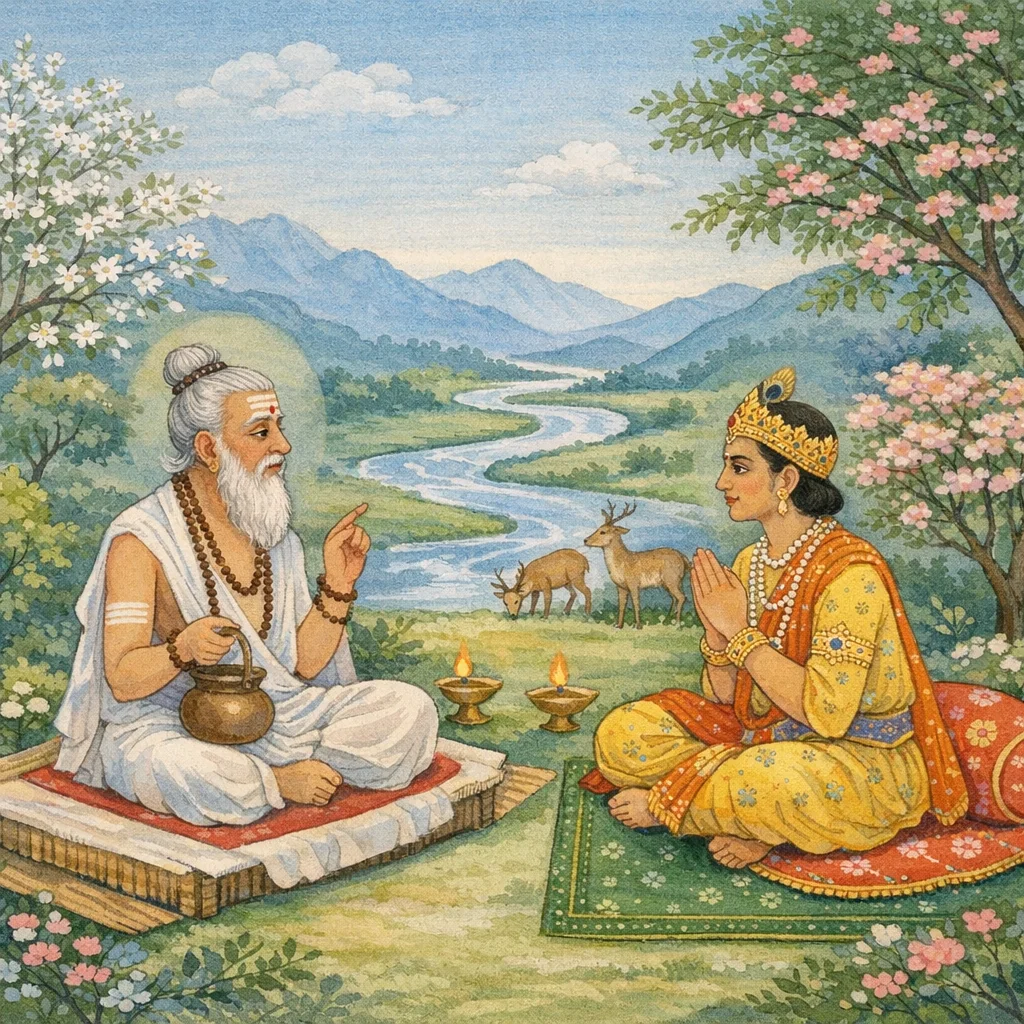
Within the Śeṣa–Vātsyāyana dialogue frame, the chapter turns to an embedded scene: Śrī Rāma, overcome by grief, lies unconscious and is revived by the sage Agastya (Kumbhajanma). Rāma laments a grave offense against brāhmaṇas, confessing a desire-driven fault and the killing of venerable brāhmaṇas, and he fears hell and an impurity that cannot be undone. The text heightens the dharmic teaching that the brāhmaṇa stands as the root of Vedic dharma. Reassurance then follows: Agastya declares that Rāma’s divine mission is the destruction of the wicked and that guilt will not cling to him. Yet Rāma distinguishes intentional from unintentional sin and insists that deliberate wrongdoing demands a definite remedy. Agastya prescribes the Aśvamedha (Vājimedha), citing ancestral precedents—Dilīpa, Manu, Sagara, Marutta—and Indra’s hundred sacrifices. Rāma resolves to perform the great rite and seeks guidance on its procedure, moving from despair toward dharmic restoration.
Shlokas
Verse 1
शेष उवाच । वात्स्यायनमुनिश्रेष्ठ कथा पापप्रणाशिनी । ब्रह्मण्यदेवदेवस्य सर्वधर्मैकरक्षितुः
Śeṣa said: “O best of sages, the account of Vātsyāyana is a destroyer of sins; it concerns the God of gods, the protector of devoted Brāhmaṇas, the sole guardian of all dharma.”
Verse 2
राजानं मूर्च्छितं दृष्ट्वा कुंभजन्मा तपोनिधिः । शनैःशनैः करेणाशु पस्पर्शाश्रु जगाद च
Seeing the king lying unconscious, the sage born of the pot—treasure-house of austerity—gently, little by little, quickly touched him with his hand; and, with tears, he spoke.
Verse 3
भो रामाश्वसिहि क्षिप्रं किमर्थमवसीदसि । भवान्दैत्यकुलच्छेत्ता महाविष्णुः सनातनः
O Rāma, take heart at once—why do you sink into despondency? You are the destroyer of the Daitya race, the eternal Mahāviṣṇu Himself.
Verse 4
भूतं भव्यं भवच्चैव जगत्स्थास्नु चरिष्णु च । त्वदृते नास्ति संचारी किमर्थमिह मूर्च्छितः
The past, the future, and the present—this world too, both the unmoving and the moving—without you nothing can proceed. So for what reason have you fallen unconscious here?
Verse 5
श्रुत्वा वाक्यं महाराजः कुंभजन्मसमीरितम् । उत्तस्थौ विगलन्नेत्र बाष्पपूरितसन्मुखः
Hearing the words spoken by Kumbhajanma, the great king rose up, his eyes streaming and his face filled with tears.
Verse 6
उवाच दीनदीनं च विस्पष्टाक्षरविस्तरम् । त्रपाभर नमन्मूर्तिर्ब्रह्मद्रोहपराङ्मुखः
He spoke in a very humble and pitiable manner, with words clearly articulated and fully expressed—his form bent in shame, bowing down, and turning away from hostility toward brāhmaṇas (and Brahmā).
Verse 7
श्रीराम उवाच । अहो मे पश्यता ज्ञानं विमूढस्य दुरात्मनः । यद्ब्राह्मणकुले रूढं हतवान्कामलोलुपः
Śrī Rāma said: “Alas! Though I possessed knowledge, I—deluded and of wicked mind—became lust-driven and killed one who had risen within a brāhmaṇa family.”
Verse 8
इति श्रीपद्मपुराणे पातालखंडे शेषवात्स्यायनसंवादे रामाश्वमेधे रघनाथस्यागस्त्योपदेशोनामाष्टमोऽध्यायः
Thus, in the Śrī Padma Purāṇa, in the Pātāla-khaṇḍa, in the dialogue of Śeṣa and Vātsyāyana, in the account of Raghunātha’s Rāma-Aśvamedha, the eighth chapter—entitled “Agastya’s Instruction to Raghunātha”—comes to its close.
Verse 9
इक्ष्वाकूणां कुले जातु ब्राह्मणो न दुरुक्तिभाक् । ईदृशं कुर्वता कर्म मयैतत्सुकलंकितम्
In the lineage of Ikṣvāku, a brāhmaṇa should never be one of harsh speech. By such a deed I have laid a grievous stain upon this house.
Verse 10
ये ब्राह्मणास्तु पूजार्हा दानसम्मानभोजनैः । ते मया निहता विप्राः शरसंघातसंहितैः
Those brāhmaṇas who were truly worthy of worship—through gifts, honor, and sacred hospitality—those venerable vipras were slain by me with volleys of arrows.
Verse 11
कांल्लोकान्नु गमिष्यामि कुंभीपाकोऽपि दुःसहः । न तादृशं तीर्थमस्ति यन्मां पावयितुं क्षमम्
To which worlds shall I go? Even Kumbhīpāka is unbearable. There is no tīrtha, no sacred ford, that has the power to purify me.
Verse 12
न यज्ञो न तपो दानं न वा चैव व्रतादिकम् । यत्तु वै ब्राह्मणद्रोग्धुर्ममपावनतारकम्
No sacrifice (yajña), no austerity (tapas), no charity (dāna), nor even vows and the like can purify me; for having become an offender against a brāhmaṇa—this itself is the mark of my unpurified state.
Verse 13
यैः कोपितं ब्रह्मकुलं नरैर्निरयगामिभिः । ते नरा बहुशो दुःखं भोक्ष्यंति निरयं गताः
Those men bound for hell who have angered the Brahmin lineage—those men, having gone to hell, will suffer again and again.
Verse 14
वेदा मूलं तु धर्माणां वर्णाश्रमविवेकिनाम् । तन्मूलं ब्राह्मणकुलं सर्ववेदैकशाखिनः
For those who rightly discern the duties of varṇa and āśrama, the Vedas are indeed the root of dharma; and the root of that Vedic dharma is the Brahmin lineage, devoted to a single branch of the Veda.
Verse 15
मूलच्छेत्तुर्ममौद्धत्यात्को लोकोनु भविष्यति । किमद्यकरणीयं वै येन मे हि शिवं भवेत्
Because of my arrogance, I have cut at the very root—what fate will now be mine? What should I do today, so that auspiciousness, Śiva’s grace, may truly come to me?
Verse 16
शेष उवाच । विलपंतं भृशं रामं राजेंद्रं रघुपुंगवम् । मायामनुष्यवपुषं कुंभजन्माब्रवीद्वचः
Śeṣa said: As Rāma—the king of kings, the foremost of the Raghu line—lamented intensely, the pot-born sage spoke words to him, to that Lord who, by divine māyā, bore a human form.
Verse 17
अगस्त्य उवाच । मा विषादं महाधीर कुरु राजन्महामते । न ते ब्राह्मणहत्या स्याद्दुष्टानां नाशमिच्छतः
Agastya said: “Do not grieve, O great and steadfast one—O king of lofty understanding. No guilt of brahmin-slaying will be yours, since you seek the destruction of the wicked.”
Verse 18
त्वं पुराणः पुमान्साक्षादीश्वरः प्रकृतेः परः । कर्ता हर्ताऽविता साक्षी निर्गुणः स्वेच्छया गुणी
You are the primeval Puruṣa, the Supreme Lord Himself, beyond Prakṛti. You are the creator, the withdrawer, the protector, and the witness; though attributeless, by Your own will You appear endowed with guṇas.
Verse 19
सुरापो ब्रह्महत्याकृत्स्वर्णस्तेयी महाघकृत् । सर्वे त्वन्नामवादेन पूताः शीघ्रं भवंति हि
Even a drunkard, a slayer of a brāhmaṇa, a thief of gold, and one who commits great sins—all of them, by uttering Your Holy Name, quickly become purified indeed.
Verse 20
इयं देवी जनकजा महाविद्या महामते । यस्याः स्मरणमात्रेण मुक्ता यास्यंति सद्गतिम्
This goddess—Janaka’s daughter—is the great Mahāvidyā, O wise one. By her mere remembrance, the liberated attain the auspicious highest path, final beatitude.
Verse 21
रावणोऽपि न वै दैत्यो वैकुंठे तव सेवकः । ऋषीणां शापतोऽवाप्तो दैत्यत्वं दनुजांतक
Even Rāvaṇa was not truly a demon; in Vaikuṇṭha he was Your attendant. Through the curse of the ṛṣis he came to acquire the state of being a demon—O slayer of the Danujas.
Verse 22
तस्यानुग्रहकर्ता त्वं न तु हंता द्विजन्मनः । एवं संचिंत्य मा भूयो निजं शोचितुमर्हसि
You are the benefactor of that twice-born man, not his killer. Reflecting thus, you should not grieve again over your own self.
Verse 23
इति श्रुत्वा ततो वाक्यं रामः परपुरंजयः । उवाच मधुरं वाक्यं गद्गदस्वरभाषितम्
Having heard those words, Rāma—the conqueror of enemy cities—spoke gently and sweetly, his voice choked with emotion.
Verse 24
श्रीराम उवाच । पातकं द्विविधं प्रोक्तं ज्ञाताज्ञातविभेदतः । ज्ञातं यद्बुद्धिपूर्वं हि अज्ञातं तद्विवर्जितम्
Śrī Rāma said: Sin is declared to be of two kinds, distinguished as done knowingly or unknowingly. What is performed deliberately, with prior intent, is ‘known’; what is done without knowing is not counted in that category.
Verse 25
बुद्धिपूर्वं कृतं कर्म भोगेनैव विनश्यति । नश्येदनुशयादन्यदिदं शास्त्रविनिश्चितम्
An act performed deliberately, with full awareness, is exhausted only by experiencing its fruit. But another kind of karma is destroyed through remorse; this is the settled conclusion of the śāstras.
Verse 26
कुर्वतो बुद्धिपूर्वं मे ब्रह्महत्यां सुनिंदिताम् । न मे दुःखापनोदाय साधुवादः सुसंमतः
Since I deliberately committed the utterly blameworthy sin of brahmin-slaying, words of praise are not, in my view, an acceptable means to remove my sorrow.
Verse 27
प्रब्रूहि तादृशं मह्यं यादृशं पापदाहकम् । व्रतं दानं मखं किंचित्तीर्थमाराधनं महत्
Tell me of that practice which burns away sins—whether it be a sacred vow (vrata), a gift (dāna), some sacrifice (yajña), or the great worship of a holy tīrtha.
Verse 28
येन मे विमला कीर्तिर्लोकान्वै पावयिष्यति । पापाचाराप्तकालुष्यान्ब्रह्महत्याहतप्रभान्
By this, my spotless fame will indeed purify the worlds—even those defiled by sinful conduct, whose splendor has been struck down by the sin of slaying a brāhmaṇa.
Verse 29
शेष उवाच । इत्युक्तवंतं तं रामं जगाद स तपोनिधिः । सुरासुरनमन्मौलि मणिनीराजितांघ्रिकम्
Śeṣa said: Having thus addressed Rāma, that treasury of austerity spoke to him—to Rāma, whose feet shine with jewel-like radiance, and before whom gods and asuras alike bow their heads.
Verse 30
शृणु राम महावीर लोकानुग्रहकारक । विप्रहत्यापनोदाय तव यद्वचनं ब्रुवे
Listen, O Rāma—great hero, benefactor of the worlds. To remove the sin of slaying a brāhmaṇa, I shall tell you the words you should utter.
Verse 31
सर्वं स पापं तरति योऽश्वमेधं यजेत वै । तस्मात्त्वं यज विश्वात्मन्वाजिमेधेन शोभिना
Whoever indeed performs the Aśvamedha sacrifice crosses beyond all sin. Therefore, O Universal Self, perform the splendid Vājimedha—the horse-sacrifice.
Verse 32
सप्ततंतुर्महीभर्त्रा त्वया साध्यो मनीषिणा । महासमृद्धियुक्तेन महाबलसुशालिना
O wise one—endowed with great prosperity, immense strength, and noble conduct—you are able to accomplish the “sevenfold weaving” rite for the lord of the earth, the king.
Verse 33
स वाजिमेधो विप्राणां हत्यायाः पापनोदनः । कृतवान्यं महाराजो दिलीपस्तव पूर्वजः
That Aśvamedha sacrifice, which removes the sin arising from the killing of brāhmaṇas, was performed by the great king Dilīpa—your ancestor.
Verse 34
शतक्रतुः शतं कृत्वा क्रतूनां पुरुषर्षभः । पदमापामरावत्यां देवदैत्यसुसेवितम्
Śatakratu (Indra), the bull among men, having performed a hundred sacrifices, attained a revered state in Amarāvatī—honoured and attended by both gods and demons.
Verse 35
मनुश्च सगरो राजा मरुत्तो नहुषात्मजः । एते ते पूर्वजाः सर्वे यज्ञं कृत्वा पदं गताः
Manu, King Sagara, and Marutta—the son of Nahusha—these are all your forefathers. Having performed sacrifice (yajña), they attained the supreme state.
Verse 36
तस्मात्त्वं कुरु राजेंद्र समर्थोऽसि समंततः । भ्रातरो लोकपालाभा वर्तंते तव भावुकाः
Therefore, O king of kings, act—on every side you are fully capable. Your brothers, resembling the guardians of the worlds, stand devotedly disposed toward you.
Verse 37
इत्युक्तमाकर्ण्य मुनेः स भाग्यवान् रघूत्तमो ब्राह्मणघातभीतः । पप्रच्छ यागे सुमतिं चिकीर्षन्विधिं पुरावित्परिगीयमानः
Hearing these words of the sage, that fortunate best of the Raghus—afraid of the sin of killing a brāhmaṇa—wished to perform a sacrifice; so he asked Sumati about the proper procedure, as it is sung by the sages of old.