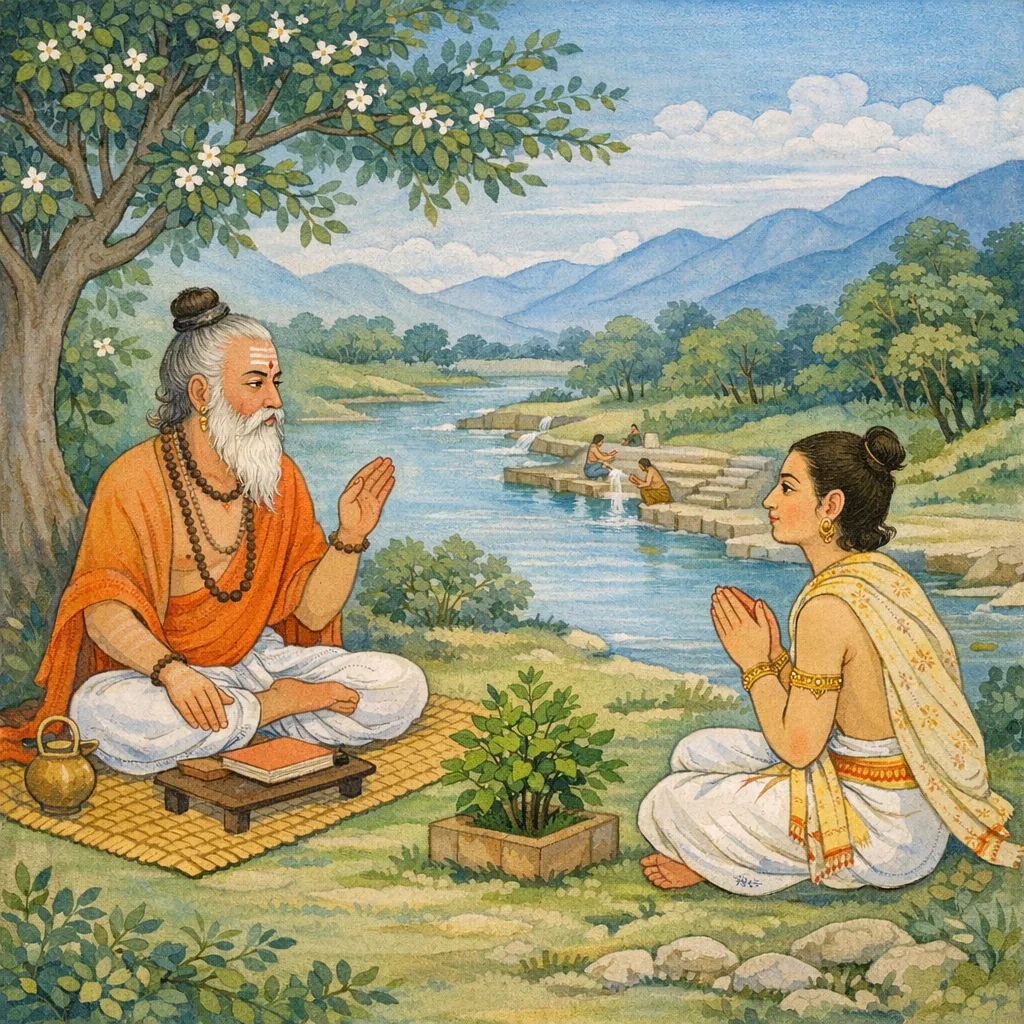
Adhyaya 14
The Episode of Cyavana (Cyavana’s Hermitage and the Power of Tapas)
Chapter 14 begins with royal hospitality: King Sumada welcomes Śatrughna and confesses his longing to behold Raghunātha (Rāma). After three nights, Śatrughna departs with the king’s support, gifts, and a well-ordered retinue, traveling by river and through regions inhabited by sages, where Rāma’s virtues are repeatedly praised. The journey reaches an āśrama resonant with Vedic recitation, marked by signs of yajña, and surrounded by a non-hostile, peaceful nature. Śatrughna asks Sumati whose hermitage it is; Sumati identifies it as Cyavana’s and recounts the sage’s greatness. The narrative then turns to Cyavana’s origin and tapas: a rākṣasa abducts Bhṛgu’s pregnant wife; the embryo falls, and the offender is reduced to ashes. Bhṛgu’s curse upon Agni is softened by a sage’s boon, so that Agni remains pure though called the “eater of all.” Cyavana performs immense austerities on the banks of the Revā; later, a king’s daughter injures the ascetic, bringing ominous portents that cease only when the king offers his daughter in marriage as restitution—revealing the cosmic force of tapas and the dharmic necessity of making amends.
Shlokas
Verse 1
शेष उवाच । अथ स्वागतसंतुष्टं शत्रुघ्नं प्राह भूमिपः । रघुनाथकथां श्रेष्ठां शुश्रूषुः पुरुषर्षभः
Śeṣa said: Then the king, pleased by the welcome, spoke to Śatrughna—the bull among men—who was eager to hear the excellent narrative of Raghunātha (Rāma).
Verse 2
सुमद उवाच । कच्चिदास्ते सुखं रामः सर्वलोकशिरोमणिः । भक्तरक्षावतारोऽयं ममानुग्रहकारकः
Sumada said: “Does Rāma—the crest-jewel of all worlds—abide in happiness? He is the incarnation who protects devotees, and who bestows grace upon me.”
Verse 3
धन्या लोका इमे पुर्यां रघुनाथमुखांबुजम् । ये पिबंत्यनिशं चाक्षिपुटकैः परिमोदिताः
Blessed are the people of this city, who—ever delighted—unceasingly drink in, with the cups of their eyes, the lotus-like face of Raghunātha (Lord Rāma).
Verse 4
अर्थजातं मदीयं च नितरां पुरुषर्षभ । कृतार्थं कुलभूम्यादि वस्तुजातं महामते
“All my accumulated wealth, O bull among men, and indeed all my possessions—such as my family estate and lands—have become truly fruitful, O great-minded one.”
Verse 5
कामाक्षया प्रसादो मे कृतः पूर्वं दयार्द्रया । रघुनाथमुखांभोजं द्रक्ष्येद्य सकुटुंबकः
Previously, the compassionate Kāmākṣī bestowed her favor upon me; today, together with my family, I shall behold the lotus-like face of Raghunātha.
Verse 6
इत्युक्तवति वीरे तु सुमदे पार्थिवोत्तमे । सर्वं तत्कथयामास रघुनाथगुणोदयम्
When the heroic Sumadā—the best among kings—had spoken thus, he then narrated in full the glorious rise of the virtues of Raghunātha.
Verse 7
त्रिरात्रं तत्र संस्थित्य रघुनाथानुजः परम् । गंतुं चकार धिषणां राज्ञा सह महामतिः
Having stayed there for three nights, the great-minded younger brother of Raghunātha then resolved to depart, together with the king.
Verse 8
तज्ज्ञात्वा सुमदः शीघ्रं पुत्रं राज्येऽभ्यषेचयत् । शत्रुघ्नेन महाराज्ञा पुष्कलेनानुमोदितः
Knowing this, Sumada swiftly anointed his son to the kingship—an act approved by the great king Śatrughna and by Puṣkala.
Verse 9
वासांसि बहुरत्नानि धनानि विविधानि च । शत्रुघ्नसेवकेभ्योऽसौ प्रादात्तत्र महामतिः
There, that great-minded one bestowed garments, many jewels, and various kinds of wealth upon the attendants and servants of Śatrughna.
Verse 10
ततो गमनमारेभे मंत्रिभिर्बहुवित्तमैः । पत्तिभिर्वाजिभिर्नागैः सदश्वैरथ कोटिभिः
Then he began his journey, accompanied by ministers of great wealth, along with infantry, horses, elephants, and countless chariots drawn by fine horses.
Verse 11
शत्रुघ्नः सहितस्तेन सुमदेन धनुर्भृता । जगाम मार्गे विहसन्रघुनाथप्रतापभृत्
Śatrughna, accompanied by that bow-bearing Sumada, proceeded on the road, smiling—upheld by the valor of Raghunātha (Rāma).
Verse 12
पयोष्णीतीरमासाद्य जगाम स हयोत्तमः । पृष्ठतोऽनुययुः सर्वे योधा वै हयरक्षिणः
Reaching the bank of the Payoṣṇī River, that excellent horse went on; and all the warriors—indeed, the horse’s guards—followed behind.
Verse 13
आश्रमान्विविधान्पश्यन्नृषीणां सुतपोभृताम् । तत्रतत्र विशृण्वानो रघुनाथगुणोदयम्
Beholding the many kinds of hermitages of sages rich in austere tapas, he listened here and there to the rising glory of Raghunātha’s virtues.
Verse 14
इति श्रीपद्मपुराणे पातालखंडे शेषवात्स्यायनसंवादे रामाश्वमेधे । च्यवनोपाख्यानंनाम चतुर्दशोऽध्यायः
Thus, in the holy Padma Purāṇa—within the Pātāla-khaṇḍa, in the dialogue between Śeṣa and Vātsyāyana, in the section on Rāma’s Aśvamedha—ends the fourteenth chapter, called “The Episode of Cyavana.”
Verse 15
इति शृण्वञ्छुभा वाचो मुनीनां परितः प्रभुः । तुतोष भक्त्युत्कलितचित्तवृत्तिभृतां महान्
Hearing in this way the auspicious words of the sages all around him, the Lord—the great one—was pleased with those whose minds were uplifted and stirred by devotion.
Verse 16
ददर्श चाश्रमं शुद्धं जनजंतुसमाकुलम् । वेदध्वनिहताशेषा मंगलं शृण्वतां नृणाम्
He beheld a pure hermitage, filled with people and living creatures; there, men heard the auspicious sound of recitation, and all remaining inauspiciousness was dispelled by the resonance of the Vedas.
Verse 17
अग्निहोत्रहविर्धूम पवित्रितनभोखिलम् । मुनिवर्यकृतानेक यागयूपसुशोभितम्
Its entire sky was purified by the smoke of oblations from the Agnihotra, and it was splendid with many yūpas—sacrificial posts—from numerous yajñas performed by eminent sages.
Verse 18
यत्र गावस्तु हरिणा पाल्यंते पालनोचिताः । मूषका न खनंत्यस्मिन्बिडालस्य भयाद्बिलम्
Where the cows—worthy of protection—are truly tended by the deer, there the mice do not dig their burrows, out of fear of the cat.
Verse 19
मयूरैर्नकुलैः सार्द्धं क्रीडंति फणिनोनिशम् । गजैः सिंहैर्नित्यमत्र स्थीयते मित्रतां गतैः
At night the serpents sport together with peacocks and mongooses; and here elephants and lions continually dwell, having entered into friendship.
Verse 20
एणास्तत्रत्य नीवारभक्षणेषु कृतादराः । न भयं कुर्वते कालाद्रक्षिता मुनिवृंदकैः
The deer there, devoted to feeding on the wild rice of that place, feel no fear of Time (death), for they are protected by groups of sages.
Verse 21
गावः कुंभसमोधस्का नंदिनी समविग्रहाः । कुर्वंति चरणोत्थेन रजसेलां पवित्रिताम्
The cows, whose udders are like water-pots and whose forms resemble Nandinī, purify the earth with the dust that rises from their hooves.
Verse 22
मुनिवर्याः समित्पाणि पद्मैर्धर्मक्रियोचिताम् । दृष्ट्वा पप्रच्छसुमतिं सर्वज्ञं राम मंत्रिणम्
Seeing the foremost sages holding sacred fuel in their hands, and Sumati—adorned with lotuses and fit for the performance of dharmic rites—he questioned Sumati, the all-knowing minister of Rāma.
Verse 23
शत्रुघ्न उवाच । सुमते कस्य संस्थानं मुनेर्भाति पुरोगतम् । निर्वैरिजंतु संसेव्यं मुनिवृंदसमाकुलम्
Śatrughna said: “O Sumati, whose hermitage is this that shines before us, the dwelling of a sage—visited by beings free of enmity and thronged with multitudes of rishis?”
Verse 24
श्रोष्यामि मुनिवार्तां च विदधामि पवित्रताम् । निजं वपुस्तदीयाभिर्वार्ताभिर्वर्णनादिभिः
I shall listen to the accounts of the rishis and thereby cultivate purity; through those very narratives—by recounting them, describing them, and the like—I will purify my own body.
Verse 25
इति श्रुत्वा महद्वाक्यं शत्रुघ्नस्य महात्मनः । कथयामास सचिवो रघुनाथस्य धीमतः
Having heard these weighty words of the great-souled Śatrughna, the wise minister of Raghunātha (Rāma) then related the matter.
Verse 26
सुमतिरुवाच । च्यवनस्याश्रमं विद्धि महातापसशोभितम् । निर्वैरिजंतुसंकीर्णं मुनिपत्नीभिरावृतम्
Sumati said: “Know this to be Cyavana’s hermitage—adorned by great ascetics, filled with creatures free of enmity, and surrounded by the wives of the rishis.”
Verse 27
योऽसौ महामुनिः स्वर्गवैद्ययोर्भागमादधात् । स्वायंभुवमहायज्ञे शक्रमानविभेदनः
That great sage—who, in the grand sacrifice of Svāyaṃbhuva Manu, allotted the due portions to the two celestial physicians—was the one who humbled Śakra (Indra)’s pride.
Verse 28
महामुनेः प्रभावोऽयं न केनापि समाप्यते । तपोबलसमृद्धस्य वेदमूर्तिधरस्य ह
This greatness of the great sage cannot be fully measured by anyone—he is abundant in the power of austerity and bears the Veda in embodied form.
Verse 29
श्रुत्वा रामानुजो वार्तां च्यवनस्य महामुनेः । सर्वं पप्रच्छ सुमतिं शक्रमानादिभंजनम्
Hearing the account concerning the great sage Cyavana, Rāma’s younger brother questioned Sumati about everything—Sumati, famed for breaking the pride of Indra and others.
Verse 30
शत्रुघ्न उवाच । कदासौ दस्रयोर्भागं चकार सुरपंक्तिषु । किं कृतं देवराजेन स्वायंभुव महामखे
Śatrughna said: “When did he assign a share to the two Dasras among the rows of the gods? And what was done by the king of the gods at the great sacrifice of Svāyambhuva (Manu)?”
Verse 31
सुमतिरुवाच । ब्रह्मवंशेऽतिविख्यातो मुनिर्भृगुरिति श्रुतः । कदाचिद्गतवान्सायं समिदाहरणं प्रति
Sumati said: “In the lineage of Brahmā there was a sage, renowned far and wide, known by the name Bhṛgu. Once, in the evening, he set out to gather firewood.”
Verse 32
तदा मखविनाशाय दमनो राक्षसो बली । आगत्योच्चैर्जगादेदं महाभयकरं वचः
Then, intent on destroying the sacrifice, the mighty Rākṣasa Damana came forth and, raising his voice, spoke these exceedingly terrifying words.
Verse 33
कुत्रास्ति मुनिबंधुः स कुत्र तन्महिलानघा । पुनः पुनरुवाचेदं वचो रोषसमाकुलः
“Where is that kinsman of the sage, and where is that blameless woman?” Again and again he spoke these words, his mind shaken with anger.
Verse 34
तदाहुतवहो ज्ञात्वा राक्षसाद्भयमागतम् । दर्शयामास तज्जायामंतर्वत्नीमनिंदिताम्
Then the sacrificial fire, Agni, knowing that the fear had come from a rākṣasa, revealed his wife—blameless and with child.
Verse 35
जहार राक्षसस्तां तु रुदंतीं कुररीमिव । भृगो रक्षपते रक्ष रक्ष नाथ तपोनिधे
Then the rākṣasa carried her off, as she wept like a wailing kurarī bird. “O Bhṛgu! O lord of protection, protect me—protect me, O master, treasure-house of tapas!”
Verse 36
एवं वदंतीमार्तां तां गृहीत्वा निरगाद्बहिः । दुष्टो वाक्यप्रहारेण बोधयन्स भृगोः सतीम्
As she spoke thus in distress, he seized her and went outside. That wicked one, striking her with harsh words, kept taunting and provoking Bhṛgu’s chaste wife.
Verse 37
ततो महाभयत्रस्तो गर्भश्चोदरमध्यतः । पपात प्रज्वलन्नेत्रो वैश्वानर इवांगजः
Then, terrified by a great fear, the embryo fell from the midst of the womb—its eyes blazing, like a son born of Vaiśvānara, the fire.
Verse 38
तेनोक्तं मा व्रजाशु त्वं भस्मी भव सुदुर्मते । न हि साध्वी परामर्शं कृत्वा श्रेयोऽधियास्यसि
He said to her: “Do not go—stop at once, you wicked-minded one. Become ashes! For a virtuous woman does not attain what is truly good after engaging in such improper conduct.”
Verse 39
इत्युक्तः स पपाताशु भस्मीभूतकलेवरः । माता तदार्भकं नीत्वा जगामाश्रममुन्मनाः
Thus addressed, he at once fell down, his body reduced to ashes. Then the mother, taking that child with her, went to the hermitage, her mind overwhelmed.
Verse 40
भृगुर्वह्निकृतं सर्वं ज्ञात्वा कोपसमाकुलः । शशाप सर्वभक्षस्त्वं भव दुष्टारिसूचक
When Bhṛgu realized that all of this had been done by Agni, he became overwhelmed with anger and cursed him: “You shall become an eater of everything, and a revealer of wicked enemies.”
Verse 41
तदा शप्तोऽतिदुःखार्तो जग्राहांघ्र्याशुशुक्षणिः । कुरु मेऽनुग्रहं स्वामिन्कृपार्णव महामते
Then, having been cursed and stricken with intense sorrow, he quickly seized his lord’s feet: “Show me favor, O master—O ocean of compassion, O great-minded one.”
Verse 42
मयानृतं वचोभीत्या कथितं न गुरुद्रुहा । तस्मान्ममोपरि कृपां कुरु धर्मशिरोमणे
Out of fear I spoke false words; I am not one who betrays the guru. Therefore, O crest-jewel of righteousness, show compassion to me.
Verse 43
तदानुग्रहमाधाच्च सर्वभक्षो भवाञ्छुचिः । इत्युक्तवान्हुतभुजं दयार्द्रो मुनितापसः
Then, bestowing his grace, the compassionate ascetic-sage said to Huta-bhuj (Agni): “Become an eater of all, yet remain pure.”
Verse 44
गर्भाच्च्युतस्य पुत्रस्य जातकर्मादिकं शुचिः । चकार विधिवद्विप्रो दर्भपाणिः सुमंगलः
For the son who had slipped from the womb, the pure Brahmin—auspicious and holding darbha grass in his hand—performed the birth-rites and the other ceremonies in accordance with proper rule.
Verse 45
च्यवनाच्च्यवनं प्राहुः पुत्रं सर्वे तपस्विनः । शनैःशनैः स ववृधे शुक्ले प्रतिपदिंदुवत्
Because he was born of Cyavana, all the ascetics called the son “Cyavana.” He grew little by little, like the moon on the first day of the bright fortnight.
Verse 46
स जगाम तपः कर्तुं रेवां लोकैकपावनीम् । शिष्यैः परिवृतः सर्वैस्तपोबलसमन्वितैः
He went to the Revā (Narmadā)—the sole purifier of the worlds—to perform austerities, surrounded by all his disciples, endowed with the power born of penance.
Verse 47
गत्वा तत्र तपस्तेपे वर्षाणामयुतं महान् । अंसयोः किंशुकौ जातौ वल्मीकोपरिशोभितौ
Having gone there, the great one performed austerities for ten thousand years. On his shoulders, two kiṁśuka trees sprang forth, made splendid by an anthill (valmīka) upon them.
Verse 48
मृगा आगत्य तस्यांगे कंडूं विदधुरुत्सुकाः । न किंचित्स हि जानाति दुर्वारतपसावृतः
The deer came eagerly and began to scratch the itch upon his body; for he, enveloped in irresistible austerity, was aware of nothing at all.
Verse 49
कदाचिन्मनुरुद्युक्तस्तीर्थयात्रां प्रति प्रभुः । सकुटुंबो ययौ रेवां महाबलसमावृतः
Once, the lord Manu, intent on a pilgrimage to the sacred fords, set out with his family and went to the Revā (Narmadā), accompanied by great strength.
Verse 50
तत्र स्नात्वा महानद्यां संतर्प्य पितृदेवताः । दानानि ब्राह्मणेभ्यश्च प्रादाद्विष्णुप्रतुष्टये
There, having bathed in the great river and having offered satisfaction to the ancestral deities, he gave gifts to the Brahmins, for the pleasure of Viṣṇu.
Verse 51
तत्कन्या विचरंती सा वनमध्ये इतस्ततः । सखीभिः सहिता रम्या तप्तहाटकभूषणा
That maiden wandered about within the forest, here and there—charming, accompanied by her friends, and adorned with ornaments of refined gold.
Verse 52
तत्र दृष्ट्वाथ वल्मीकं महातरुसुशोभितम् । निमेषोन्मेषरहितं तेजः किंचिद्ददर्श सा
There she then saw an anthill, beautifully adorned by great trees; and she beheld there a certain radiance—steady, without the blinking and unblinking of the eyes.
Verse 53
गत्वा तत्र शलाकाभिरतुदद्रुधिरं स्रवत् । दृष्ट्वा राज्ञांगजा खेदं प्राप्तवत्यतिदुःखिता
Going there, she pierced him with needles, and blood began to flow. Seeing the king’s daughter in distress, she was overcome with exceeding sorrow.
Verse 54
न जनन्यै तथा पित्रे शशंसाघेन विप्लुता । स्वयमेवात्मनात्मानं सा शुशोच भयातुरा
Overwhelmed by the burden of sin, she confessed it neither to her mother nor to her father. Stricken with fear, she grieved within herself—her own self lamenting to itself.
Verse 55
तदा भूश्चलिता राजन्दिवश्चोल्का पपात ह । धूम्रा दिशो भवन्सर्वाः सूर्यश्च परिवेषितः
Then, O King, the earth shook, and from the sky a meteor fell. All the directions grew smoke-dark, and the sun was encircled by a halo.
Verse 56
तदा राज्ञो हया नष्टा हस्तिनो बहवो मृताः । धनं नष्टं रत्नयुतं कलहोभून्मिथस्तदा
Then the king’s horses were lost, many elephants died, and wealth—together with its jewels—was destroyed; and at that time a quarrel arose among them.
Verse 57
तदालोक्य नृपो भीतः किंचिदुद्विग्नमानसः । जनानपृच्छत्केनापि मुनये त्वपराधितम्
Seeing this, the king grew afraid, his mind somewhat disturbed, and he asked the people, “By whom has this sage been offended?”
Verse 58
पारंपर्येण तज्ज्ञात्वा स्वपुत्र्याः परिचेष्टितम् । ययौ सुदुःखितस्तत्र समृद्धबलवाहनः
Having learned—through trustworthy report—the conduct of his own daughter, he went there in deep distress, though endowed with abundant strength and many conveyances.
Verse 59
तं वै तपोनिधिं वीक्ष्य महता तपसायुतम् । स्तुत्वा प्रसादयामास मुनिवर्य दयां कुरु
Seeing that treasure-house of austerity, endowed with great penance, he praised him and sought his favor, saying: “O best of sages, show compassion.”
Verse 60
तस्मै तुष्टो जगादायं मुनिवर्यो महातपाः । तवात्मजाकृतं सर्वमुत्पाताद्यमवेहि तत्
Pleased with him, the great ascetic—the best of sages—spoke: “Know that all these ominous portents and the like have been caused by your son.”
Verse 61
तव पुत्र्या महाराज चक्षुर्विस्फोटनं कृतम् । बहुसुस्राव रुधिरं जानती त्वामुवाच न
O great king, your daughter inflicted an injury that burst another’s eye; much blood flowed out. Yet, though she knew, she did not tell you.
Verse 62
तस्मादियं महाभूप मह्यं देया यथाविधि । ततश्चोत्पातशमनं भविष्यति न संशयः
Therefore, O great king, this should be given to me according to the proper rite; then the pacification of ominous portents will occur—of this there is no doubt.
Verse 63
तच्छ्रुत्वा दुःखितो राजा प्रज्ञाचाक्षुष आत्मजाम् । ददौ कुलवयोरूप शीललक्षणसंयुताम्
Hearing this, the king was stricken with sorrow, and he gave his own daughter—endowed with wisdom and clear discernment—of noble lineage, fitting age and beauty, and possessed of exemplary conduct and auspicious marks.
Verse 64
दत्ता यदा नृपेणेयं कन्या कमललोचना । तदोत्पाताः शमं याताः सर्वे मुनिरुषोद्गताः
When the king gave this lotus-eyed maiden in marriage, then all the ominous portents—arisen from the sages’ wrath—were pacified and came to rest.
Verse 65
राजा दत्त्वात्मजां तस्मै मुनये तपसांनिधे । प्राप स्वां नगरीं भूयो दुःखितोऽयं दयायुतः
Having given his daughter to that sage—an ocean of austerities—the king returned again to his own city, sorrowful, yet filled with compassion.