Adhyaya 17
The Greatness of Viṣṇu’s Foot-Water (Pādodaka) as a Destroyer of Sin
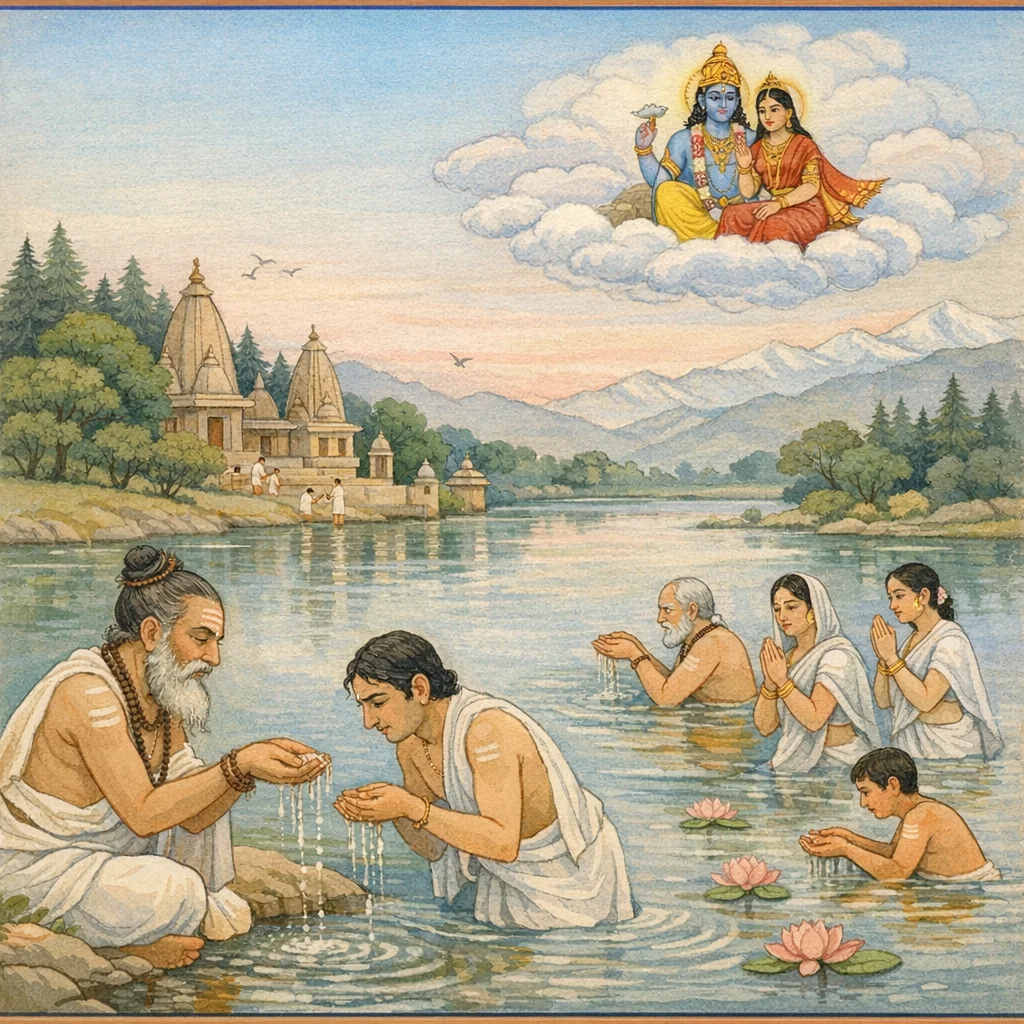
Śaunaka asks Sūta to explain fully the sin-destroying power of the water that has washed Viṣṇu’s feet (pādodaka/caraṇodaka). Sūta praises this foot-water as liberating by mere contact: it equals or surpasses the merit of pilgrimages, bathing in the Gaṅgā, vast gifts, and countless sacrifices—especially when, with tulasī, it is reverently borne upon the head. Śaunaka then requests an illustrative precedent. Sūta recounts Sudarśana, a sinful brāhmaṇa condemned for violating Hari’s sacred day, Ekādaśī; judged by Yama on Citragupta’s testimony, he undergoes hellish rebirths. At last, contact with Hari’s foot-water kept at a doorway becomes the turning point that annihilates accumulated sin, showing that pādodaka—heard of, touched, or consumed—can redirect karmic destiny toward Hari’s abode.
Shlokas
Verse 1
शौनक उवाच । विष्णुपादोदकस्यापि माहात्म्यं पापनाशनम् । कथयस्व महाप्राज्ञ समूलं मे कृपार्णव
Śaunaka said: “O great sage, tell me in full—O ocean of compassion—the sin-destroying greatness of the water that has washed Viṣṇu’s feet.”
Verse 2
सूत उवाच । समस्तपातकध्वंसि विष्णुपादोदकं शुभम् । कणमात्रं वहेद्यस्तु सर्वतीर्थफलं लभेत्
Sūta said: The auspicious water that has washed Viṣṇu’s feet destroys all sins. Whoever bears even a single drop of it attains the merit of all sacred pilgrimage-places.
Verse 3
विष्णुपादोदकं ब्रह्मन्स्पर्शतः पापनाशनम् । अकालमरणं नास्ति गंगास्नानफलं लभेत्
O Brahman, the water from Viṣṇu’s feet destroys sins by mere contact. There is no untimely death for one who receives it, and one attains the merit equal to bathing in the Gaṅgā.
Verse 4
विष्णुपादोदकं पापी यः पिबेत्तस्य किल्बिषम् । शरीरस्थं क्षयं याति कृतं ब्रह्मन्न संशयः
Even if a sinful person drinks the water that has washed Viṣṇu’s feet, his sin—lodged within the body—perishes. This is assured, O Brahman; there is no doubt.
Verse 5
तुलसीपर्णसंयुक्तं विष्णुपादोदकं द्विज । यो वहेच्छिरसा भक्त्या चांते याति हरेर्गृहम्
O twice-born one, whoever, with devotion, bears upon his head the water from Viṣṇu’s feet mixed with tulasī leaves—at the end of life he goes to Hari’s abode.
Verse 6
मेरुतुल्यसुवर्णानि दत्त्वा यत्फलमाप्यते । हरिपादोदकं स्पृष्ट्वा प्राप्यते तत्फलं नरैः
The same merit that is obtained by donating gold equal in mass to Mount Meru is obtained by people merely by touching the water that has washed the feet of Hari (Viṣṇu).
Verse 7
धेनुकोटिसहस्राणि यत्फलं लभते नरैः । दत्वा पादोदकं स्पृष्ट्वा तत्फलं प्राप्यते ध्रुवम्
The merit that people gain by gifting thousands of crores of cows is surely attained as well by offering and reverently touching the pādodaka—the sacred water from the feet.
Verse 8
यज्ञकोटिसहस्राणि कृत्वा यत्फलमाप्यते । हरिपादोदकं स्पृष्ट्वा तस्मात्कोटिगुणं नरैः
The merit gained by performing tens of millions of sacrifices—by merely touching the water that has washed Hari’s feet—people obtain merit a crore times greater than that.
Verse 9
कोटिकन्याप्रदानेन यत्फलं लभ्यते जनैः । विष्णुपादोदकं स्पृष्ट्वा फलं तस्माद्द्विजाधिकम्
Whatever merit people obtain by giving away ten million maidens in charity—by merely touching the water that has washed Lord Viṣṇu’s feet, one gains a reward greater than that, O twice-born.
Verse 10
दंतिकोटिप्रदानेन सप्तिकोटिप्रदानतः । यत्फलं लभते मर्त्यः स्पृष्ट्वा पादोदकं हरेः
The merit a mortal attains by merely touching the water that has washed Hari’s feet equals the merit gained by gifting ten million elephants or by gifting seventy million cows.
Verse 11
दत्वा मर्त्यः सप्तद्वीपां ससस्यां यत्फलं लभेत् । विष्णुपादोदकं स्पृष्ट्वा तस्माद्विप्राधिकं लभेत्
Whatever merit a mortal would obtain by gifting the seven continents together with their grain and produce—by merely touching the water that has washed Viṣṇu’s feet, one gains merit even greater than that.
Verse 12
शृणु विप्र प्रवक्ष्यामि संक्षेपेणाधिकं किमु । विष्णुपादोदकं स्पृष्ट्वा पापी याति हरेर्गृहम्
Listen, O brāhmaṇa; I shall speak in brief—what need is there to say more? By merely touching the water that has washed Viṣṇu’s feet, even a sinner reaches Hari’s abode.
Verse 13
शौनक उवाच । स्पृष्ट्वा पीत्वा पुरा केन प्राणिना प्रापि वै गृहम् । कथयस्व हरेः सूत मम त्वं चानुकंपया
Śaunaka said: “In former times, what living being touched it and drank it, and thereby truly attained your abode? O Sūta, tell me—out of compassion—this account connected with Hari.”
Verse 14
सूत उवाच । पुरा त्रेतायुगे पापी नाम्ना विप्रः सुदर्शनः । जनार्द्दनदिने नित्यमश्नीयात्स द्विजोत्तम
Sūta said: In ancient times, in the Tretā Yuga, there was a sinful brāhmaṇa named Sudarśana. Yet that best of the twice-born would regularly eat (only) on the day sacred to Janārdana (Viṣṇu).
Verse 15
शास्त्रनिंदाकरो नित्यं व्रतनिंदाकरः सदा । असावन्यं न जानाति केवलं स्वोदरं विना
He constantly disparaged the śāstras and always mocked sacred vows; such a man acknowledged nothing but his own belly—he knew no one else.
Verse 16
एकदा प्राप्तकालस्तु निधनं प्राप्तवान्द्विज । यमदूताः समायाता बद्ध्वा नीतो यमालयम्
Once, when his destined time had arrived, the brāhmaṇa met his death. The messengers of Yama came, bound him, and carried him to Yama’s abode.
Verse 17
इति श्रीपाद्मे महापुराणे ब्रह्मखंडे सूतशौनकसंवादे चरणोदकमाहात्म्ये । सप्तदशोऽध्यायः
Thus, in the illustrious Padma Mahāpurāṇa, within the Brahma-khaṇḍa, in the dialogue of Sūta and Śaunaka, in the section proclaiming the greatness of caraṇodaka—the sacred water from the Lord’s feet—the seventeenth chapter comes to its close.
Verse 18
असौ विप्रो महापापी क्रूरकर्म्मेव दृश्यते
That brāhmaṇa is a great sinner; indeed he is seen to be engaged in cruel deeds.
Verse 19
चित्रगुप्त उवाच । आकर्णय चास्य पापं पुण्यं नास्त्यणुमात्रकम् । वासरेऽपि हरेर्नित्यमकरोद्भोजनं विभो
Citragupta said: “Hear also this man’s sin—there is not even an atom of merit in him. Even on Hari’s sacred day, O Lord, he would regularly eat food, violating the fast.”
Verse 20
वासरे कमलाभर्तुश्चाश्नीयाद्यो नराधमः । पुरीषं सोऽश्नीयाद्राजन्निरयं याति दारुणम्
O King, the vilest of men who eats on the day sacred to the Lord of Kamalā (Viṣṇu) is as though he were eating filth, and he goes to a dreadful hell.
Verse 21
मन्वंतरशतं देहि स्थानं तु निरयेऽप्यमुम् । ग्रामक्रोडस्य योनौ हि ततो जन्म भविष्यति
“Assign him a place in hell for a hundred Manvantaras. Thereafter, he will be born from the womb of a village sow.”
Verse 22
सूत उवाच । यमाज्ञया ततो विप्र तस्य दूतैर्भयंकरैः । पातितस्तु पुरीषे वै मन्वंतरशताधिकम्
Sūta said: Then, O brāhmaṇa, by Yama’s command, he was cast by Yama’s terrifying messengers into excrement indeed, for more than a hundred manvantaras.
Verse 23
ततो मुक्तोऽभवच्चासौ पृथिव्यां ग्रामसूकरः । चिरं नरकमश्नीयाद्धरिवासरभोजनात्
Then he was released and, on earth, became a village boar; for a long time he would suffer hell because he had eaten on Hari’s sacred day (Ekādaśī).
Verse 24
ततो विप्र प्राप्तकालः पंचत्वं स जगाम ह । काकयोनौ पुनर्जन्म लेभेऽसौ विड्भुजः सदा
Then, O brāhmaṇa, when his allotted time arrived, he met his end. He was then reborn in the womb of a crow, and from that time onward he lived as one who constantly ate filth.
Verse 25
एकस्मिन्दिवसे विप्र श्रीहरेश्चरणोदकम् । द्वारदेशेस्थितं पीत्वा सर्वपापविवर्जितः
O brāhmaṇa, on a certain day, by drinking the water that has washed the feet of Śrī Hari, kept at the doorway, one becomes free from all sins.
Verse 26
तस्मिन्नेव दिने काकः पतितः शबरस्य च । काले मृत्युदशां प्राप्तो व्याधेन वायसोपि च
On that very day, the crow also fell (met with calamity), and the Śabara as well; in due course, the hunter too—along with the crow—reached the condition of death.
Verse 27
आगते स्यंदने दिव्ये राजहंसयुते शुभे । आरुह्य बलिभुग्विप्र ययौ स हरिमंदिरम्
When the splendid, auspicious divine chariot arrived, yoked with royal swans, the brāhmaṇa—enjoyer of the offerings—mounted it and went to the temple of Hari.
Verse 28
पादोदकस्य माहात्म्यं कथितं पापनाशनम् । यः शृणोति नरः पापी तस्य पापं विनश्यति
The greatness of pādodaka has been described as a destroyer of sins. Even a sinful person who listens to it has his sin destroyed.