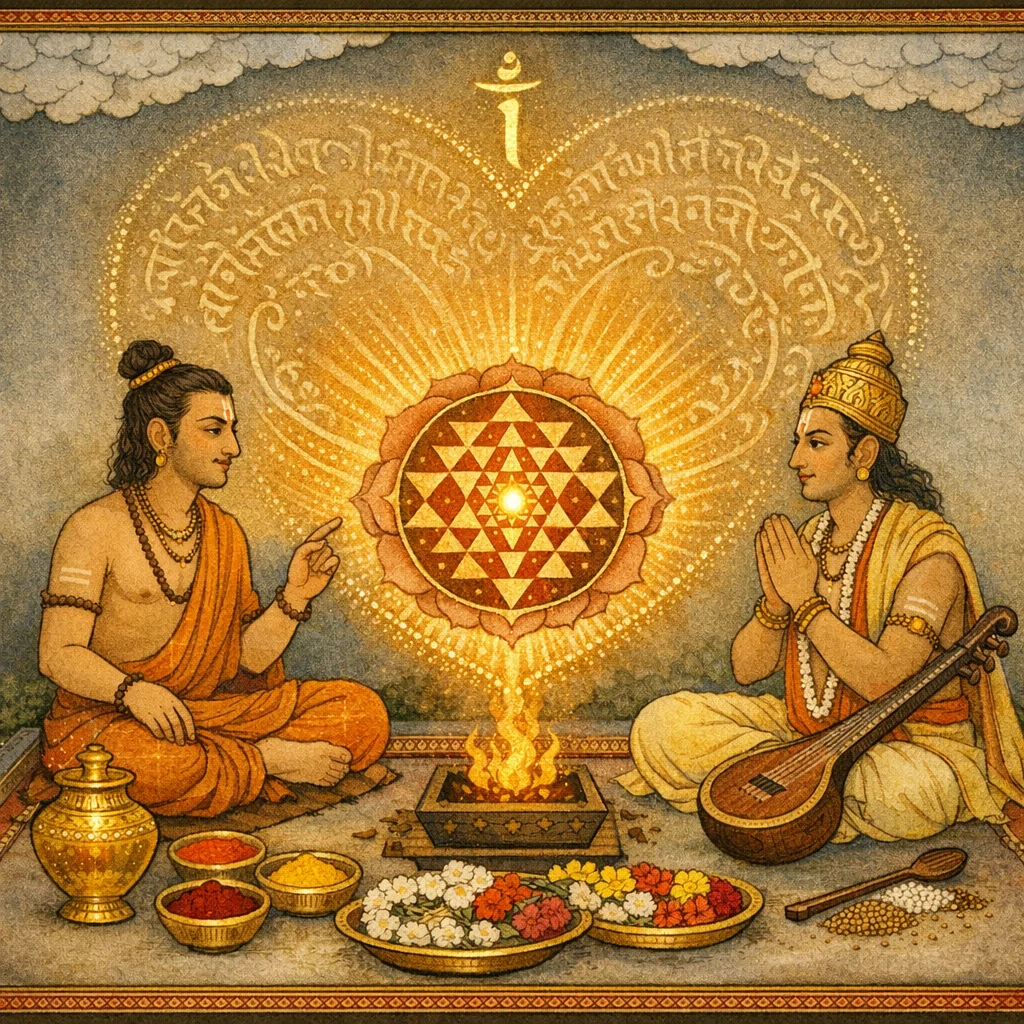
Nityā-paṭala-prakaraṇa (The Exposition of the Nityā-paṭala)
Sanatkumāra teaches Nārada a “lamp” of daily worship centered on Ādyā Lalitā as the one Śivā–Śakti. It opens with mantra-metaphysics: Lalitā’s name as condensed meaning, the cosmos as hṛllekhā, and phonetic completion through the ī-vowel and bindu. It then turns to ritual method—Piṇḍakartṛ bīja-mālā classifications and ways of arranging the text—followed by contemplations on emergence (Devī) and repose (Śiva) culminating in nondual Self-luminosity (sphurattā). A detailed guide explains preparing āsavas (gauḍī, paiṣṭī, mādhvī, and plant ferments) for arghya and worship, with strict ethical cautions on consumption. Next come kāmya worship calendars by month and weekday, site-specific rites (mountains, forests, seashores, cremation grounds), and mappings of flowers/substances to results (health, prosperity, speech, victory, subjugation). The chapter codifies cakra/yantra construction (triangles, pigments, saffron requirement), lists Devī epithets (Vivekā, Sarasvatī, etc.), and prescribes japa–homa–tarpaṇa–mārjana–brāhmaṇa-bhojana ratios, yuga-based counts, and japa quotas for siddhi of named Śrīvidyā forms—concluding that all prayogas depend on a prepared yantra and disciplined practice.
Shlokas
Verse 1
सनत्कुमार उवाच । अथातो विप्र नित्यानां प्रयोगादिसमन्वितम् । पटलं तेऽभिधास्यामि नित्याभ्यर्चनदीपकम् ॥ १ ॥
Sanatkumāra said: Now then, O brāhmaṇa, I shall explain to you a section—complete with practical applications and related procedures—serving as a lamp, a clear guide for daily worship.
Verse 2
ललितायास्त्रिभिवर्णैः सकलार्थोऽभिधीयते । शेषेण देवीरूपेण तेन स्यादिदमीरितम् ॥ २ ॥
In the name “Lalitā,” the entire meaning is conveyed by three syllables; and by the remaining portion—taken as the Goddess’s own form—this statement is thus expressed.
Verse 3
अशेषतो जगत्कृत्स्नं हृल्लेखात्मकमुच्यते । तस्याश्चार्थस्तु कथितः सर्वतंत्रेषु गोपितः ॥ ३ ॥
In its entirety, this whole universe is said to be of the nature of “hṛllekhā”—the inner inscription of consciousness. Yet its true meaning, though taught, remains concealed throughout all the Tantras.
Verse 4
व्योम्ना प्रकाशमानत्वं ग्रसमानत्वमग्निना । तयोर्विमर्श ईकारो बिंदुना तन्निफालनम् ॥ ४ ॥
By space (vyoman) there is the condition of shining forth; by fire (agni) there is the condition of consuming. The reflective contact (vimarśa) of these two becomes the vowel “ī”; and by the bindu (nasal point) that sound is brought to completion (niphālana).
Verse 5
पिंडकर्तरि बीजाख्या मन्त्रा मालाभिधाः क्रमात् । एकार्णवन्तो द्व्यर्णाश्च त्रिदिङ्मुखार्णकाः ॥ ५ ॥
In the rite called Piṇḍakartṛ, the mantras known as “bīja” (seed) mantras are, in due order, also called “mālā” (garlands). They are of three kinds: those of one syllable, those of two syllables, and those of three syllables arranged as facing the three directions.
Verse 6
वृत्तिजार्णांल्लिखेदंकैर्व्यत्यस्तक्रमयोगतः । तैर्भेदयो जनं कुर्यात्संदर्भाणामशेषतः ॥ ६ ॥
One should write out the metrical patterns (vṛtti), arranging them by reversing and permuting their sequence; and by those methods one should, without omission, produce the complete classification and organization of the textual compositions (sandarbhas).
Verse 7
देव्यात्मकं समुदयं विश्रांतिं च शिवात्मकम् । उभयात्मकमप्यात्मस्वरूपं तैश्च भावयेत् ॥ ७ ॥
One should contemplate creative arising as of the nature of the Goddess (Devī), and repose—dissolution and peace—as of the nature of Śiva; and one should also contemplate the Self’s essential nature (Ātman) as embodying both.
Verse 8
कालेनान्यञ्च दुःखार्त्तिवासनानाशनो ध्रुवम् । पराहंतामयं सर्वस्वरूपं चात्मविग्रहम् ॥ ८ ॥
In time, surely, there is also the destruction of other sorrow-afflicted vāsanās (latent impressions). It is the Supreme, free from the disease of egoism (ahaṃtā), of the nature of all, and having the Self (Ātman) as its embodiment.
Verse 9
सदात्मकं स्फुरताख्यमरोषोपाधिवर्जितम् । प्रकाशरूपमात्मत्वे वस्तु तद्भासते परम् ॥ ९ ॥
That supreme Reality shines as the Self—of the nature of pure Being, known as the ever-manifest “sphurattā” (inner luminosity), free from the limiting adjuncts of passion and anger, and of the form of pure light (conscious illumination).
Verse 10
यत एवमतो लोके नास्त्यमंत्रं यदक्षरम् । यद्विद्येति समाख्यातं सर्वथा सर्वतः सदा ॥ १० ॥
Therefore, in this world there is no syllable that is not a mantra. Whatever is called “vidyā” (knowledge) is, in every way, everywhere, and always, pervaded by that mantra-power.
Verse 11
वासरेषु तु तेष्वेवं सर्वापत्तारकं भवेत् । तद्विधानं च वक्ष्यामि सम्यगासवकल्पनम् ॥ ११ ॥
On those particular days, done in this manner, it becomes a means of deliverance from all kinds of adversity. Now I shall explain its procedure—the correct preparation of āsava (a fermented medicinal formulation).
Verse 12
गौडी पैष्टी तथा माध्वीत्येवं तत्त्रिविधं स्मृतम् । गतुडमुष्णोदके क्षिप्त्वा समालोड्य विनिक्षिपेत् ॥ १२ ॥
Thus it is remembered to be of three kinds—gauḍī, paiṣṭī, and mādhvī. Having thrown the fermenting starter (gatuḍa) into warm water, one should stir it well and then set it aside (for use).
Verse 13
घटे काचमये तस्मिन् धातकीसुमनोरजः । खात्वा भूमौ संध्ययोस्तु करैः संक्षोभ्य भूयसा ॥ १३ ॥
In that glass vessel, the pollen of dhātakī blossoms should be placed; then, at both twilights (morning and evening), it should be dug into the earth and vigorously stirred with the hands, repeatedly.
Verse 14
मासमात्रे गते तस्मिन्निमग्ने रजसि द्रुतम् । संशोध्य पूजयेत्तेन गौडी सा गुडयोगतः ॥ १४ ॥
When one month has passed and it has swiftly sunk into the sediment, it should be promptly filtered and then used for worship; that preparation is called “Gauḍī”, because it is made by combining it with jaggery.
Verse 15
एवं मधुसमायोगान्माध्वी पैष्टीं श्रृणु प्रिय । अध्यर्द्धद्विगुणे तोये श्रपयेत्तंदुलं शनैः ॥ १५ ॥
Thus, after describing the proper admixture of honey, listen, dear one, to the preparation of mādhvī (a mead-like drink) from flour: in water measuring two-and-a-half times the quantity, one should slowly boil the rice-grains.
Verse 16
दिनत्रयोषिते तस्मिन्धात्र्यंकुररजः क्षिपेत् । दिनमेकं धृते वाते निवाते स्थापयेत्ततः ॥ १६ ॥
After it has been kept for three days, one should sprinkle in the pollen/dust of the sprouts of dhātrī (āmalakī). Then, for one day, when the wind is steady, it should be placed in a windless (sheltered) spot.
Verse 17
उदकैर्लिलितं पश्चाद्गलितं पैष्टिकं मधु । वृक्षजं फलजं चेति द्विविधं क्रियते मधु ॥ १७ ॥
Honey (this sweet drink) is prepared in two ways: (1) that made from flour—first mixed with water and then strained; and (2) that derived from plants—either from trees or from fruits.
Verse 18
तन्निर्माणं श्रृणुष्वाद्य यदास्वादान्मनोलयः । मृद्वीकांवाथ खर्जूरफलं पुष्पमथापि वा ॥ १८ ॥
Now hear its preparation—by tasting which the mind becomes absorbed and stilled: it may be made from grapes, or from the fruit of dates (khārjūra), or even from flowers.
Verse 19
मधूकस्यांभसि क्षिप्त्वा शतृमर्द्धावशेषितम् । प्राक्सृतासवलेशेन मिलितं दिवसद्वयात् ॥ १९ ॥
After casting the remaining portion of madhūka left from pressing into water, one should blend it with a small measure of previously prepared fermented āsava; within two days it becomes well united and begins to ferment as āsava.
Verse 20
गालितं स्वादु पूजार्हं मनोलयकरं शुभम् । वार्क्षं तु नालिकेरं स्याद्धिंतालस्याथ तालतः ॥ २० ॥
The filtered sap is sweet, worthy of worship, auspicious, and soothing to the mind. The tree-born drink is called nālikera (coconut), and it is also obtained from hiṅtāla and from tāla (palmyra).
Verse 21
फलकांडात्स्नुतं दुग्धं नीतं सद्यो रसावहम् । नालिके रफलांतस्थसलिले शशिना युते ॥ २१ ॥
Milk that oozes from the stalk of a fruit-bearing plant—freshly drawn and at once rich with its essential potency—should be carried and placed in a tube (nālikā), within water in which the “moon” (śaśin) is present.
Verse 22
अर्द्धपूगफलोत्थं तु रमं संक्षिप्य तापयेत् । आतपे सद्य एवैतदासवं देवताप्रियाम् ॥ २२ ॥
But the extract prepared from half a pūga (betel-nut) fruit should be reduced and gently warmed. Set in the sun, this āsava becomes ready at once and is pleasing to the deities.
Verse 23
आसवैरेभिरुदितैरर्ध्यं देव्यै निवेदयेत् । देवैः कृत्वा ततः सद्यो दद्यात्तत्सिद्धये द्वयम् ॥ २३ ॥
With these prescribed āsava offerings, one should present the arghya (honor-offering) to the Goddess. Then, having performed the rite with the deities, one should immediately bestow the pair of offerings/gifts for the successful completion of that observance.
Verse 24
साधको नियताहारः समाधिस्थः पिबेत्सदा । न कदाचित्पिबोत्सिद्धो देव्यर्थमनिवेदितम् ॥ २४ ॥
A sādhaka, regulated in diet and established in samādhi, may regularly drink the prescribed substance. But one who is not yet perfected should never drink it at any time without first offering it to the Devī, the Goddess.
Verse 25
पानं च तावत्कुर्वीत यावता स्यान्मनोलयः । ततः करोति चेत्सद्यः पातकी भवति ध्रुवम् ॥ २५ ॥
One should drink only so long as the mind becomes quiet and settled. If one continues beyond that, one certainly becomes a sinner at once.
Verse 26
देवतागुरुशिष्टान्यं पिबन्नासवमाशया । पातकी राजदंड्यश्च रिक्थोपासक एव ॥ २६ ॥
One who drinks intoxicating liquor with the intention of offering it to the gods, the guru, or the learned and righteous is still a sinner; he is liable to the king’s punishment and is deemed a mere worshipper of impure remnants.
Verse 27
साध्यसाधकयोरेतत्काम्य एव समीरितम् । सिद्धस्य सर्वदा प्रोक्तं यतोऽसौ तन्मयो भवेत् ॥ २७ ॥
For one still to be accomplished and for the sādhaka, this is taught as a kāmya (desire-motivated, optional) practice; but for the siddha, the perfected one, it is prescribed at all times, because he becomes of the very nature of That.
Verse 28
पूजयेत्प्रोक्तरूपस्तु प्रोक्तरूपाश्च ताः क्रमात् । उपचारैरासवैश्च मत्स्यैर्मांसैस्तु संस्कृतैः ॥ २८ ॥
Assuming the prescribed form, he should worship them in due order, in the forms that have been stated—offering the customary upacāras (services), along with fermented libations (āsava), and with prepared fish and meat.
Verse 29
अथ काम्यार्चनं वक्ष्ये प्रयोगांश्चापि नारद । येषामाचरणात्सिद्धिं साधको लभते ध्रुवम् ॥ २९ ॥
Now, O Nārada, I shall explain kāmyārcana—worship prompted by desire—and its practical procedures; by performing them, the practitioner surely attains the intended siddhi.
Verse 30
चैत्रे दमनकैरर्चेत्पूर्णायां मदनोत्सवम् । वैशाखे मासि पूर्णायां पूजयेद्धेमपुष्पकैः ॥ ३० ॥
On the full-moon day of the month of Caitra, one should worship (the Deity) with damanaka blossoms, celebrating the Madana festival; and on the full-moon day of Vaiśākha, one should worship with golden flowers.
Verse 31
ज्यैष्ठ्यां फलैर्यजेंद्देवीं कदलीपनसाम्नजैः । आषाढ्यां चन्दनैरेलाजातीकंकोलकुंकुमैः ॥ ३१ ॥
In the month of Jyaiṣṭha, one should worship the Goddess with fruits such as bananas and jackfruits. In the month of Āṣāḍha, one should worship her with sandalwood, cardamom, jasmine, kaṅkola (a fragrant spice), and saffron (kunkuma).
Verse 32
श्रावण्यामागमोक्तेन विधिनार्चेत्पवित्रकैः । प्रौष्ठपद्यां गन्धपुष्पैर्यजेद्वा केतकीसुमैः ॥ ३२ ॥
In the month of Śrāvaṇa, one should worship the Lord with pavitra-threads according to the procedure taught in the Āgamas. In the month of Proṣṭhapadā, one should worship with fragrant flowers—or with ketakī blossoms.
Verse 33
आश्वायुज्यां कन्यकार्चा भूषावस्त्रधनादिभिः । कार्तिक्यां कुंकुमैश्चैव निशि दीपगणैरपि ॥ ३३ ॥
In the month of Āśvayuja, one should perform kanyā-arcā, honoring young maidens with ornaments, garments, wealth, and similar gifts. In Kārtika, likewise, one should worship with saffron (kunkuma) and, at night, with many lamps.
Verse 34
सचंद्रैर्मार्गशीर्ष्यां तु नालिकेरैरपूपकैः । पौष्यां सशर्करगुडैर्गवां दुग्धैः समर्चयेत् ॥ ३४ ॥
In the month of Mārgaśīrṣa, one should duly worship the Deity with moon-like sweets (candra), together with coconuts and apūpa cakes; and in the month of Pauṣa, one should worship with sugar and jaggery, along with cow’s milk.
Verse 35
स्वर्णरौप्यैः पंकजैस्तु माघ्यां सौगन्धिकादिभिः । फाल्गुन्यां विविधैर्द्रव्यैः फलैः पुष्पैः सुगंधिभिः ॥ ३५ ॥
In the month of Māgha, one should offer lotus-flowers fashioned of gold and silver, along with fragrant blossoms such as the saugandhikā; in Phālguna, one should worship with various offerings—fragrant fruits and flowers.
Verse 36
पर्वताग्रे यजेद्देवीं पलाशकुसुमैर्निशि । सिद्धद्रव्यैश्च सप्ताहात्खेचरीमेलनं भवेत् ॥ ३६ ॥
At the summit of a mountain, at night, one should worship the Goddess with palāśa blossoms; and by means of consecrated, siddha ritual substances, within seven nights there arises a meeting—an inner communion—with the Khecarī.
Verse 37
अरण्ये वटमूले वा कुंजे वा धरणीभृताम् । कदम्बगजातिपुष्पाभ्यां सिद्धद्रव्यैः शिवां यजेत् ॥ ३७ ॥
In a forest—at the root of a banyan tree, or in a grove upon the mountains—one should worship Śivā, the auspicious Goddess, with siddha ritual substances, offering kadamba and jāti flowers.
Verse 38
मासेन सिद्धा यक्षिण्यः प्रत्यक्षा वांछितप्रदाः । केतकीकुसुमैः सिद्धाश्चेटका वारिधेस्तटे ॥ ३८ ॥
Within a month the Yakṣiṇīs become accomplished—manifesting directly and granting the desired boons. By the rite employing ketakī blossoms, the attendant spirit Ceṭaka is accomplished on the seashore.
Verse 39
आज्ञामभीष्टां कुर्वन्ति रणे मायां महाद्भुताम् । वसूनि मालां भूषां च दद्युरस्येहयानिशम् ॥ ३९ ॥
They fulfill the desired command; in battle they display a most wondrous māyā. And here, day and night, they keep presenting him with riches, garlands, and ornaments.
Verse 40
पीठमृक्षद्रुमैः कृत्वा तत्र देवीं यजेन्निशि । शाल्मलैः कुसुमैः सिद्धद्रव्यैर्मासं तु निर्भयम् ॥ ४० ॥
Having prepared a pīṭha (ritual pedestal) from the prescribed sacred trees, one should worship the Goddess there at night; with śālmali flowers and ritually perfected offerings (siddha-dravya), one remains fearless for a month.
Verse 41
श्यशानदेशे विप्रेंद्र सिद्ध्यंत्यस्य पिशाचकाः । अश्मपातप्रहाराद्यैर्जीयादाभिर्द्विषश्चिरम् ॥ ४१ ॥
O best of brāhmaṇas, in a cremation-ground the piśācas (ghoulish spirits) become subservient to him. By such means—stones falling, violent blows, and the like—his enemies are tormented for a long time.
Verse 42
निर्जने विपिने रात्रौ मासमात्रं तु निर्भयः । यजेद्देवीं चक्रगतां सिद्धद्रव्यसमन्विताम् ॥ ४२ ॥
In a solitary forest, at night, remaining fearless for a full month, one should worship the Goddess who is established within the ritual circle (cakra), using the consecrated substances (siddha-dravya).
Verse 43
मालतीजातपुन्नागकेतकीमरुभिः क्रमात् । तेन सिद्ध्यंति वेतालास्तानारुह्येच्छया चरेत् ॥ ४३ ॥
Using, in due order, mālatī, jāti, punnāga, ketakī, and maru flowers, the vetālas become subservient; mounting them, one may then roam wherever one wishes.
Verse 44
श्मशाने चंडिकागेहे निर्जने विपिनेऽपि वा । मध्यरात्रे यजेद्देवीं कृष्णवस्त्रविभूषणैः ॥ ४४ ॥
In a cremation ground, in the shrine of Caṇḍikā, or even in a solitary forest, at midnight one should worship the Goddess, adorning her with black garments and ornaments.
Verse 45
कृष्णचक्रेऽतिकृष्णां तामतिक्रुद्धाशयो यजेत् । साध्य योनिं तदग्रे तु बलिं छिंदन्निवेदयेत् ॥ ४५ ॥
Upon the black circular diagram (kṛṣṇa-cakra), he should worship that exceedingly dark Form, with the mind set in fierce resolve. Then, having established the prescribed ‘yoni’ emblem before it, he should offer the bali as though cutting it off.
Verse 46
सिद्धद्रव्यसमेतं तु मासात्तद्भाललोचनात् । जायन्ते भीषणाः कृत्यास्ताभ्यः सिद्धिं निवेदयेत् ॥ ४६ ॥
But when it is accompanied by perfected substances (siddha-dravya), within a month—through the ‘eye’ upon the forehead—terrifying kṛtyās (magically projected beings/operations) arise. One should then present to them the intended accomplishment (siddhi).
Verse 47
विश्वसंहारसंतुष्टाः पुनरेत्य निजेच्छया । देव्या ललाटनेत्रे स्युः प्रार्थिते तु तिरोहिताः ॥ ४७ ॥
Delighting in the dissolution of the universe, they return again by their own will. They abide in the Goddess’s forehead-eye; yet when invoked, they vanish from sight.
Verse 48
रक्तभूषांबरालेपमालाभूषितविग्रहाः । उद्याने निर्जने देवीं चक्रे संचिंत्य पूजयेत् ॥ ४८ ॥
Having adorned the image with red ornaments, red garments, red unguents, and garlands, in a solitary garden one should meditate upon the Goddess within a ritual circle (cakra) and then worship her.
Verse 49
कह्लारचंपकाशोकपाटलाशतपत्रकैः । सिद्धद्रव्यसमोपेतैर्मायाः सिद्ध्यंति मासतः ॥ ४९ ॥
With kahlāra (blue lotus), campaka, aśoka, pāṭalā, and śatapatra (the hundred‑petalled lotus), together with perfected ritual substances (siddha-dravyas), the intended sacred operations (māyāḥ) are successfully accomplished within a month.
Verse 50
यासां प्रसादलाभेन कामरूपो भवेन्नरः । याभिर्विश्वजयी विश्वचारी विश्वविनोदवान् ॥ ५० ॥
By obtaining the grace (prasāda) of those divine powers/vidyās, a person becomes able to assume any form at will; through them one becomes a conqueror of the world, a wanderer throughout the world, and one who delights in the whole world.
Verse 51
षडाधाराब्जमध्ये तु चक्रं संछित्य पूजयेत् । चंद्रचंदनकस्तूरीमृगनाभिमहोदयैः ॥ ५१ ॥
Then, having installed the sacred cakra within the lotus of the six supports (the six inner centers), one should worship it with offerings such as camphor, sandalwood, musk, mṛganābhi (deer-musk fragrance), and other excellent aromatics.
Verse 52
त्रिकालज्ञो भवेद्देवीं तेषु सम्यग्विचिंतयेत् । पूर्णप्रतीतौ भव्यानि विकलेऽभव्यमीरितम् ॥ ५२ ॥
O Goddess, one should become a knower of the three times and reflect correctly upon those signs. When the apprehension is complete, the result is declared auspicious; when it is deficient, the result is said to be inauspicious.
Verse 53
देवीं चक्रेण सहितां स्मरेद्भक्तियुतो नरः । विवेका विभवा विश्वा वितता च प्रकीर्तिता ॥ ५३ ॥
A person endowed with bhakti should meditate on the Goddess together with the cakra. She is praised as Vivekā (Discernment), Vibhavā (Prosperity), Viśvā (All-pervading), and Vitatā (All-expansive).
Verse 54
कामिनी खेचरी गर्वा पुराणा परमेश्वरी । गौरी शिवा ह्यमेया च विमला विजया परा ॥ ५४ ॥
She is Kāminī, Khecarī, Garvā, Purāṇā, and the Supreme Goddess (Parameśvarī); she is also Gaurī, Śivā, the immeasurable (Ameyā), the stainless (Vimalā), the victorious (Vijayā), and the transcendent (Parā).
Verse 55
पवित्रा पीडनी विद्या विश्वेशी शिववल्लभा । अशेषरूपा स्वानंदांबुजाक्षी चाप्यनिंदिता ॥ ५५ ॥
That Vidyā (sacred knowledge) is purifying; she chastens ego and ignorance; she is the Sovereign of the universe and dear to Śiva. She assumes limitless forms; she abides in self-bliss, lotus-eyed, and truly beyond reproach.
Verse 56
वरदा वाक्यदा वाणी विविधा वेदविग्रहा । विद्या वागीश्वरी सत्या संयता च सरस्वती ॥ ५६ ॥
She is the granter of boons, the giver of right speech; she is Vāṇī—Speech itself—manifold in expression, the very embodiment of the Veda. She is Knowledge, the sovereign of eloquence, truthful and self-restrained—she is Sarasvatī.
Verse 57
निर्मलानन्दरूपा च ह्यमृता मानदा तथा । पूषा चैव तथा तुष्टिः पुष्टिश्चापि रतिर्धृतिः ॥ ५७ ॥
She is of the nature of pure, stainless bliss; she is immortal; she bestows honor. She is also Pūṣā, the nourisher, and likewise Tuṣṭi (contentment), Puṣṭi (nourishment), Rati (delight/affection), and Dhṛti (steadfastness).
Verse 58
शाशिनी चंद्रिका कांतिर्ज्योत्स्ना श्रीः प्रीतिरंगदा । देवीनामानि चैतानि चुलुके सलिले स्मरन् ॥ ५८ ॥
Remembering—over a palmful of water—these names of the Goddess: Śāśinī, Candrikā, Kānti, Jyotsnā, Śrī, Prīti, and Aṅgadā.
Verse 59
मातृकासहितां विग्नां त्रिरावृत्त्यामृतात्मिकाम् । ताडीं सारस्वतीं जिह्वां दीपाकारां स्मरन्पिबेत् ॥ ५९ ॥
Remembering the tongue as Sarasvatī—luminous like a flame—and as the Tāḍī, the inner channel of utterance, one should drink that nectar-like current which, together with the Mātr̥kās (syllabic powers), removes obstacles and, by triple repetition, becomes ambrosial in its very nature.
Verse 60
अब्दाञ्चतुर्विधं तस्य पांडित्यं भुवि जायते । एवं नित्यमुषः काले यः कुर्याच्छुद्धमानसः ॥ ६० ॥
For him, within a year, fourfold scholarship arises in this world—if, with a purified mind, he practices in this manner every day at dawn.
Verse 61
स योगी ब्रह्मविज्ञानी शिवयोगी तथात्मवित् । अनुग्रहोक्तचक्रस्थां देवीं ताभिर्वृतास्मरेत् ॥ ६१ ॥
That practitioner is a true yogin—one who knows Brahman, who is established in Śiva-yoga, and who is a knower of the Self. He should meditate on the Goddess abiding in the chakra taught through divine grace, surrounded by those attendant powers.
Verse 62
चंपकेंदीवरैर्मासादारोग्यमुपजायते । ज्वरभूतग्रहोन्मादशीतकाकामलाक्षिहृत् ॥ ६२ ॥
By worship or offerings with campaka and blue-lotus flowers, within a month health arises—removing fever, afflictions from spirits and grahas (seizing influences), insanity, chills, jaundice, and diseases of the eyes.
Verse 63
दंतकर्णज्वरशिरः शूलगुल्मादि कुक्षिजाः । व्रणप्रमेहच्छर्द्यर्शोग्रहण्यामत्रिदोषजाः ॥ ६३ ॥
Tooth- and ear-ailments, fevers, headaches, abdominal colic, gulma (abdominal lumps) and other belly-born disorders; also wounds, prameha (urinary/metabolic disorders), vomiting, hemorrhoids, grahaṇī-disease (malabsorption), and āma (toxic indigestion)—all these are said to arise from the derangement of all three doṣas.
Verse 64
सर्वे तथा शमं यांति पूजया परमेश्वरी । द्रव्यं चक्रस्य निर्माणे काश्मीरं समुदी रितम् ॥ ६४ ॥
O Supreme Goddess, by proper worship all alike attain tranquility; and for the making of the ritual cakra, kāśmīra—saffron—is declared to be the required substance.
Verse 65
सिंदूरं गैरिकं लाक्षा दरदं चंदनद्वयम् । बिलद्वारे लिखेत्त्र्यस्रं षोडशत्र्यस्रसंयुतम् ॥ ६५ ॥
Using sindūra (vermilion), gairika (red ochre), lākṣā, darada (a red mineral pigment), and the two kinds of sandalwood, one should draw at the doorway a triangular figure, joined with sixteen subsidiary triangles.
Verse 66
दरदेनास्य मध्यस्थां पूजयेत्परमेश्वरीम् । ताभिस्तच्छक्तिभिः साकं सिद्धद्रव्यैः सुगंधिभिः ॥ ६६ ॥
With darada (an aromatic resin), one should worship the Supreme Goddess who abides in the center; and together with those—her śaktis—one should perform the worship using perfected ritual substances and fragrant offerings.
Verse 67
कुसुमैर्मासमात्रेण नागकन्यासमन्वितम् । पातालादिषु लोकेषु रमयत्यनिशं चिरम् ॥ ६७ ॥
With the offering of flowers for merely a month, one is accompanied by Nāga-maidens and is made to delight unceasingly for a long time in the worlds beginning with Pātāla, the nether realms.
Verse 68
यक्षराक्षसगंधर्वसिद्धविद्याधरांगनाः । पिशाचा गुह्यका वीराः किन्निरा भुजगास्तथा ॥ ६८ ॥
Yakṣas, Rākṣasas, Gandharvas, Siddhas, and the maidens of the Vidyādharas; Piśācas, Guhyakas, heroic beings, Kinnaras, and likewise the Bhujagas, the serpent-races as well—all are included.
Verse 69
सिद्ध्यंति पूजनात्तत्र तथा तत्प्रोक्तकालतः । किंशुकैर्भूषणावाप्तौ पाटलैर्गजसिद्धये ॥ ६९ ॥
In that rite, the intended fruits are fulfilled by worship, and likewise by performing it at the time prescribed. With kiṃśuka flowers one attains ornaments; with pāṭala flowers one gains success connected with elephants.
Verse 70
रक्तोत्पलैरश्वसिद्धौ कुमुदैश्चरसिद्धये । उत्पलैरुष्ट्रसंसिद्ध्यै तगरैः पशुसिद्धये ॥ ७० ॥
With red lotuses one accomplishes efficacy regarding horses; with white lotuses (kumuda) one gains success concerning grazing animals. With lotuses one brings about full success regarding camels; and with tagara blossoms one accomplishes success concerning cattle and other beasts.
Verse 71
जंबीरैर्महिषावाप्त्यै लकुचैरजसिद्धये । दाडिमैर्निधिसंसिद्ध्यै मधुकैर्गानसिद्धये ॥ ७१ ॥
By offering jambīra (citron) one attains buffaloes; by lakuca (wood-apple) one gains mastery regarding goats. By dāḍima (pomegranate) one perfects success in obtaining treasure; and by madhūka one attains perfection in song.
Verse 72
बकुलैरंगनासिद्ध्यै कह्लारैः पुत्रसिद्धये । शतपत्रैर्जयावाप्त्यै केतकैर्वाहनाप्तये ॥ ७२ ॥
With bakula flowers one accomplishes success concerning women; with kahlāra flowers one gains the fruition of a son. With hundred-petalled lotuses (śatapatra) one attains victory; and with ketaka flowers one obtains a vehicle or mount.
Verse 73
सौरभाढ्यैः प्रसूनैस्तु नित्यं सौभाग्यसिद्धये । पूजयेन्मासमात्रं वा द्विगुणं त्रिगुणं तु वा ॥ ७३ ॥
For the attainment of good fortune, one should worship daily with fragrant flowers—whether for just one month, or for twice that duration, or even three times that.
Verse 74
यावत्फलावाप्तिकांक्षी शर्कराघृतपायसैः । सचक्रपरिवारां तां देवीं सलिलमध्यगाम् ॥ ७४ ॥
So long as the seeker yearned to obtain the desired fruits, he approached that Goddess—surrounded by her discus-bearing retinue—there in the midst of the waters, bearing as an offering sweet pāyasa prepared with sugar and ghee.
Verse 75
तर्प्पयेत्कुसुमैः सार्ध्यैः सर्वोपद्रवशान्तये । घृतैः पूर्णायुषः सिद्ध्यै क्षौद्द्रैः सौभाग्यसिद्धये ॥ ७५ ॥
One should perform tarpaṇa with flowers to pacify all disturbances; with ghee to attain a full span of life; and with honey to accomplish good fortune and auspiciousness.
Verse 76
दुग्धैरारोग्यसंसिद्ध्यै त्रिभिरैश्वर्यसिद्धये । नालिकेरोदकैः प्रीत्यै हिमतोयैर्नृपाप्तये । सर्वार्थसिद्धय तौर्यैरभिषिंचेन्महेश्वरीम् ॥ ७६ ॥
For the complete attainment of health, one should bathe Maheśvarī with milk; for prosperity and lordly power, with the three sweet offerings; for delight and gracious favor, with coconut-water; for gaining royal patronage, with ice-cold water; and for the accomplishment of all aims, one should perform Maheśvarī’s abhiṣeka accompanied by instrumental music.
Verse 77
पूगोद्याने यजेद्देवीं सिद्धद्रव्यैर्दिवानिशम् । निवसंस्तत्र तत्पुष्पैर्जायते मन्मथोपमः ॥ ७७ ॥
In a grove of areca-palms, one should worship the Goddess day and night with perfected ritual substances (siddha-dravyas). By residing there and serving her with the flowers from that very place, one becomes handsome like Kāma (Manmatha).
Verse 78
पूर्णासु नियत्तं देवीं कन्यकायां समर्चयन् । कृत्याः परेरिता मंत्रा विमुखांस्तान् ग्रसंति वै ॥ ७८ ॥
When one duly worships the Goddess—properly regulated—in the form of a maiden at the prescribed auspicious times, then the mantras impelled by the kṛtyā (a ritualized act of sorcery) indeed seize and devour those who have turned away (from the rite / from right conduct).
Verse 79
लिंगत्रयमयीं देवीं चक्रस्थाभिश्च शक्तिभिः । पूजयन्निष्टमखिलं लभतेऽत्र परत्र च ॥ ७९ ॥
Worshipping the Goddess who embodies the three liṅgas, together with the powers (Śaktis) stationed in the sacred chakra, the devotee attains every desired goal—both in this world and in the world beyond.
Verse 80
शतमानकृतैः स्वर्णपुष्पैः सौरभ्यवासितैः । पूजयन्मासमात्रेण प्राग्जन्माद्यैर्विमुच्यते ॥ ८० ॥
By worshipping for just one month with golden flowers—each fashioned to the measure of a śatamāna and made fragrant with perfume—one is freed from sins and afflictions that begin from prior births.
Verse 81
तथा रत्नैश्च नवभिर्मासं तु यदि पूजयेत् । विमुक्तसर्वपापौघैस्तां च पश्यति चक्षुषा ॥ ८१ ॥
Likewise, if one worships Her for a month with nine kinds of jewels, then—freed from torrents of every sin—one beholds Her with one’s own eyes.
Verse 82
अंशुकैरर्चयेद्देवीं मासमात्रं सुगंधिभिः । मुच्यते पापकृत्यादिदुःखौघैरितरैरपि ॥ ८२ ॥
If one worships the Goddess for just one month with offerings of garments (aṃśuka) and fragrant substances, one is freed from the flood of sufferings that begins with sinful deeds—and from other troubles as well.
Verse 83
देवीरूपं स्वमात्मानं चक्रं शक्तीः समंततः । भावयन्विषयैः पुष्पैः पूजयंस्तन्मयो भवेत् ॥ ८३ ॥
Meditating on one’s own Self as the very form of the Goddess, and on the surrounding chakra-circle as Her Śaktis on every side, one who worships with the ‘flowers’ of sense-objects becomes absorbed into Her, becoming of Her very nature.
Verse 84
षोडशानां तु नित्यानां प्रत्येक तिथयः क्रमात् । तत्तित्तिथौ तद्भजनं जपहोमादिकं चरेत् ॥ ८४ ॥
For the sixteen daily (nitya) observances, each has its corresponding lunar date (tithi) in proper sequence. On each such tithi, one should worship the respective deity/observance, performing japa, homa, and related rites.
Verse 85
घृतं च शर्करा दुग्धमपूपं कदलीपलम् । क्षौद्रं गुडं नालिकेरफलं लाजा तिलं दधि ॥ ८५ ॥
Also offer: ghee, sugar, milk, sweet cakes, and bananas; likewise honey, jaggery, coconut, parched rice (laja), sesame, and curd (dadhi).
Verse 86
पृथुकं चणकं मुद्गपायसं च निवेदयेत् । कामेश्वर्यादिशक्तीनां सर्वासामपि चोदितम् ॥ ८६ ॥
As naivedya one should offer flattened rice, chickpeas, and a sweet pāyasa made with green gram (mudga); this is enjoined for the worship of all the Śaktis beginning with Kāmeśvarī.
Verse 87
आद्याया ललितायास्तु सर्वाण्येतानि सर्वदा । निवेदयेञ्च जुहुयाद्वह्नौ दद्यान्नृणामपि ॥ ८७ ॥
All these should always be offered to Ādyā Lalitā; they should also be given as oblations into the sacred fire, and even distributed as gifts to people.
Verse 88
तत्तद्विद्याक्षरप्रोक्तमौषधं तत्प्रमाणतः । संपिष्य गुटिकीकृत्य ताभिः सर्वं च साधयेत् ॥ ८८ ॥
One should take the medicinal substance prescribed by the syllables of that vidyā, in the stated measure; grind it, form it into pills, and by means of those pills accomplish all intended rites and results.
Verse 89
रविवारेऽरुणांभोजैः कुमुदैः सोमवारके । भौमे रक्तोत्पलैः सौम्ये वारे तगरसंभवैः ॥ ८९ ॥
On Sunday one should offer red lotuses; on Monday, kumuda—white water-lilies; on Tuesday, red lotuses; and on Wednesday, fragrant blossoms born of the tagara plant.
Verse 90
गुरुवारे सुकह्लारैः शुक्रवारे सितांबुजैः । नीलोत्पलैर्मंदवारे पूजयेदिष्टमादरात् ॥ ९० ॥
On Thursday one should worship the chosen deity with white water-lilies; on Friday with white lotuses; and on Saturday with blue lotuses—performing the worship with reverent care.
Verse 91
निवेदयेत्क्रमात्तेषु रविवारादिषु क्रमात् । पायसं दुग्धकदलीनवनीतसिताघृतम् ॥ ९१ ॥
In these weekday observances, one should present the offerings in proper sequence, beginning with Sunday: pāyasa (sweet rice), milk, bananas, fresh butter, white sugar, and ghee.
Verse 92
एवमिष्टं समाराध्य देवीं गंधादिभिर्यजेत् । ग्रहपीडां विजित्याशुसुखानि च समश्नुते ॥ ९२ ॥
Having thus duly propitiated the chosen Goddess, one should worship the Devī with fragrances and the like; swiftly conquering the affliction caused by the planets, one attains happiness as well.
Verse 93
अर्धरात्रे तु साध्यां स्त्रीं स्मरन्मदनवह्निना । दह्यमानां हृतस्वांतां मस्तकस्थापितांजलिम् ॥ ९३ ॥
At midnight, remembering the woman he desires, he is inflamed by the fire of passion; she too is as if burning, her heart carried away, standing with folded palms placed upon her head.
Verse 94
विकीर्णकेशीमालोललोचनामरुणारुणाम् । वायुप्रेंखत्पताकास्थपदा पद्मकलेवराम् ॥ ९४ ॥
Her hair was loosened and scattered; her eyes were restless and wavering; she shone with a deep crimson hue. Her feet were set upon banners fluttering and swaying in the wind, and her body was lotus-like in form and radiance.
Verse 95
विवेकविधुरां मत्तां मानलज्जाभयातिगाम् । चिंतयन्नर्चयेञ्चक्रं मध्ये देवीं दिगंबराम् ॥ ९५ ॥
Meditating upon the Devī—bereft of ordinary discrimination, intoxicated with divine frenzy, and transcending pride, shame, and fear—one should worship the ritual cakra, establishing the sky-clad Digambarā Devī at its center.
Verse 96
जपादाडिमबंधूककिंशुकाद्यैः समर्चयेत् । अन्यैः सुगंधिशेफालीकुसुमाद्यैः समर्चयेत् ॥ ९६ ॥
One should worship with flowers such as japā (hibiscus), pomegranate-blossom, bandhūka, kiṃśuka, and the like; and one should also worship with other fragrant flowers such as sephālī and similar blossoms.
Verse 97
त्रिसप्तरात्रादायाति प्रोक्तरूपा मदाकुला । यावच्छरीरपातः स्याच्छापो वानपगास्य सा ॥ ९७ ॥
After three times seven nights, she returns—assuming the form that was declared—bewildered by intoxication; and that curse remains upon her, not to be removed, until the fall of the body, that is, until death.
Verse 98
पद्मैरक्तैस्त्रिमध्वक्तैर्होमाल्लक्ष्मीमवाप्नुयात् । तथैव कैरवै रक्तैरंगनाः स्ववशं नयेत् ॥ ९८ ॥
By offering a fire-oblation (homa) with red lotuses anointed with three kinds of honey, one may obtain Lakṣmī—prosperity. Likewise, by using red kairava (white water-lilies) in the same way, one may bring women under one’s control.
Verse 99
समानरूपवत्सायाः शुक्लाया गोः पयःप्लुतैः । मल्लिकामालतीजातीशतपत्रैर्हुतैर्भवेत् ॥ ९९ ॥
One should offer into the sacred fire jasmine (mallikā), mālatī, jāti, and śatapatra flowers, moistened with the milk of a white cow whose calf is of the same color.
Verse 100
कीर्तिविद्याधनारोग्यसौभाग्यवित्तपादिकम् । आरग्वधप्रसूनैस्तु क्षौद्राक्तैर्हवनाद्भवेत् ॥ १०० ॥
By offering havana with āragvadha blossoms anointed with honey, one attains the boon that grants fame, learning, wealth, health, good fortune, and prosperity.
Verse 101
स्वर्णादिस्तं भनं शत्रोर्नृपादीनां क्रुधोऽपि च । आज्याक्तैः करवीरोत्थैः प्रसूनैररुणैर्हुतैः ॥ १०१ ॥
By offering into the fire red karavīra (oleander) flowers anointed with ghee, one wards off the enemy’s assault and also pacifies the wrath of kings and other authorities.
Verse 102
रक्तांबराणि वनिता भूपामात्यवशं तथा । भूषावाहनवाणिज्यसिद्धयश्चास्य वांछिताः ॥ १०२ ॥
For him, red garments, women, and the power to bring kings and ministers under his influence are obtained; likewise, the desired successes in ornaments, vehicles, and commerce also arise.
Verse 103
लवणैः सर्षर्पैरैरितरैर्वाथ होमतः । सतैलाक्तैर्निशामध्ये त्वानयेद्वांछितां वधूम् ॥ १०३ ॥
By offering homa with salt, mustard seeds, and similar substances into the fire, anointed with oil, one may, in the middle of the night, cause the desired bride to be brought under one’s influence.
Verse 104
तैलाक्तैर्जुहुयात्कृष्णदरपुष्पैर्निशातरे । मासादरातेस्तस्यार्तिर्ज्वरेण भवति ध्रुवम् ॥ १०४ ॥
If one offers oblations with niśā-tarā (night-blooming jasmine) flowers anointed with oil, then within a month a certain enemy will surely be afflicted with suffering in the form of fever.
Verse 105
आरुष्करैर्धृताभ्यक्तैस्तद्बीजैर्निशि होमतः । शत्रोर्द्दाहव्रणानि स्युर्दुःसाध्यानि चिकित्सकैः ॥ १०५ ॥
If, at night, one performs a fire-offering with the seeds of the āruṣkara plant anointed with ghee, then the enemy will develop burn-wounds—wounds difficult for physicians to cure.
Verse 106
तथा तत्तैलसंसिक्तैर्बीजैरंकोलकैरपि । मरिचैः सर्षपाज्याक्तौनशि होमानुसारतः ॥ १०६ ॥
Likewise, according to the prescribed procedure of auṣadhi-homa (medicinal oblations), one should offer seeds anointed with that oil, together with aṅkola-seeds, black pepper, and mustard mixed with ghee.
Verse 107
वांछितां वनितां कामज्वरार्तामानयेद्द्रुतम् । शालिभिश्चाज्यसंसिक्तैर्होमाच्छालीनवाप्नुयात् ॥ १०७ ॥
By offering oblations into the fire with rice grains moistened with ghee, one quickly causes the desired woman—afflicted by the fever of passion—to be brought (under one’s influence); and from such a homa one obtains an abundance of rice.
Verse 108
मुद्गैर्मुद्गं घृतैराज्यं सिद्धैरित्थं हुतैर्भवेत् । साध्यर्क्षवृक्षसंभूतां पिष्टपादरजःकृताम् ॥ १०८ ॥
With mudga (green gram) one should offer mudga; with ghee one should offer ghee—thus, by such properly prepared oblations, the rite becomes accomplished. (The offering/powder) should be made from the produce of the Sādhya and Ṛkṣa trees, prepared as a fine powder from the dust or filings produced by pounding with the foot.
Verse 109
राजीमरीचिलोणोत्थां पुत्तलीं जुहुयान्निशि । प्रपदाभ्यां च जंघाभ्यां जानुभ्यामुरुयुग्मतः ॥ १०९ ॥
At night, one should offer into the fire a small figurine prepared from the saline efflorescence of the rays of the mustard plant; for the sake of the feet, shanks, knees, and the pair of thighs.
Verse 110
नाभेरधस्ताद्धृदयाद्भिन्नेनाकण्ठस्तथा । शिरसा च सुतीक्ष्णेन च्छित्वा शस्त्रेण वै क्रमात् ॥ ११० ॥
With a sharp weapon, one should cut in due order: first below the navel, then at the heart, then up to the throat; and thereafter, with an exceedingly sharp blade, sever the head as well.
Verse 111
एवं द्वादशधा होमान्नरनारीनराधिपाः । वश्या भवंति सप्ताडाज्ज्वरार्त्तीश्चास्य वांछया ॥ १११ ॥
Thus, by performing the homa in twelve prescribed ways, men, women, and even kings become amenable within seven days; and those afflicted with fever also become relieved according to his intention.
Verse 112
पिष्टेन गुडयुक्तेन मरिचैर्जीरकैर्युताम् । कृत्वा पुत्तलिकां साध्यनामयुक्तामथो हृदि ॥ ११२ ॥
With flour mixed with jaggery—also combined with black pepper and cumin—one should fashion a small doll, inscribe it with the name of the person to be treated, and then place it upon the chest.
Verse 113
सनामहोमसंपातघृतेपाच्यतां पुनः । स्पृशन्निजकराग्रेण सहस्रं प्रजपेन्मनुम् ॥ ११३ ॥
Then it should again be cooked in ghee that has been sanctified by oblations offered with the mantra’s name; and, touching it with the tips of one’s own fingers, one should recite the mantra a thousand times.
Verse 114
अभ्यर्च्य तद् घृताभ्यक्तं भक्षयेत्तद्धिया जपन् । नरनारीनृपास्तस्य वश्याः स्युर्मरणावधिं ॥ ११४ ॥
Having duly worshipped it, then eating that substance anointed with ghee while repeating the mantra with the mind fixed upon it, men, women, and even kings become submissive to him—until the time of death.
Verse 115
शक्तयष्टगंधं संपिष्य कन्यया शिशिरे जले । तेन वै तिलकं भाले धारयन्वशयेज्जगत् ॥ ११५ ॥
Having a maiden grind the fragrant substance known as śaktayaṣṭa-gandha in cool water, one should wear it as a tilaka upon the forehead; by bearing that tilaka, one is said to bring the world under one’s influence.
Verse 116
शालितंदुलमादाय प्रस्थं भांडे नवे क्षिपेत् । समानवर्णेवत्साया रक्ताया गोः पयस्तथा ॥ ११६ ॥
Taking one prastha measure of rice-grains, one should place them in a new vessel; likewise, one should add the milk of a red cow whose calf is of the same colour.
Verse 117
द्विगुणं तत्र निक्षिप्य श्रपयेत्संस्कृतेऽनले । घृतेन सिक्तं सिक्थं तु कृत्वा तत्ससितं करे ॥ ११७ ॥
Placing in that mixture a double measure of the ingredient, one should boil it over a properly prepared fire. Then, after moistening the wax with ghee, one should shape it and take it in the hand together with a white powder (sugar or another white substance).
Verse 118
विधाय विद्यामष्टोर्द्धूशतं जप्त्वा हुनेत्ततः । एवं होमो महालक्ष्मीमावहेत्प्रतिपत्कृतः ॥ ११८ ॥
Having performed the prescribed rite and recited the mantra one hundred and eight times, one should then offer oblations (āhuti) into the fire. Performed in this manner on Pratipat (the first lunar day), this homa invokes Mahālakṣmī.
Verse 119
शुक्रवारेष्वपि तथा वर्षान्नृपसमो भवेत् । पंचम्यां तु विशेषेण प्राग्वद्धोमं समाचरेत् ॥ ११९ ॥
Likewise, if this observance is performed on Fridays as well, then over the course of a full year one becomes the equal of a king. But especially on the lunar day Pañcamī, one should perform the homa exactly as prescribed earlier.
Verse 120
तस्यां तिथौ त्रिमध्वक्तैर्मल्लिकाद्यैः सितैर्हुनेत् । अन्नाज्याभ्यां च नियतं हुत्वान्नाढ्यो भवेन्नरः ॥ १२० ॥
On that tithi, one should offer into the sacred fire the three sweet substances, together with white jasmine and similar white flowers. And by regularly offering cooked rice and ghee, a person becomes prosperous.
Verse 121
यद्यद्धि वांछितं वस्तु तत्तत्सर्वं तु सर्वदा । घृतहोमादवाप्नोति तथैव तिलतंदुलैः ॥ १२१ ॥
Whatever object a person desires—each and every one—he surely obtains through oblations of ghee; and likewise through offerings of sesame and rice-grains.
Verse 122
अरुणैः पंकजैर्होमं कुर्वंस्त्रिमधुराप्लुतैः । मंडलाल्लभते लक्ष्मीं महतीं श्लाध्यविग्रहाम् ॥ १२२ ॥
Performing the homa with red lotuses, each moistened with the three sweet substances, one obtains from that maṇḍala great prosperity—Lakṣmī—endowed with an admirable and praiseworthy form.
Verse 123
कह्लारैः क्षौद्रसंसिक्तैः पूर्णाद्यं तद्दिनावधि । जुहुयान्नित्यशो भक्त्या सहस्रं विकचैः शुभैः ॥ १२३ ॥
With fully blossomed kahlāra flowers sprinkled with honey, beginning from the Pūrṇā (full-moon observance) and continuing until the end of that day, one should daily offer oblations with devotion—one thousand offerings—using auspicious, freshly opened blossoms.
Verse 124
स तु कीर्तिं धनं पुत्रान्प्राप्नुयान्नात्र संशयः । चंपकैः क्षौद्रसंसिक्तैः सहस्रहवनाद्ध्रुवम् ॥ १२४ ॥
He will indeed attain fame, wealth, and sons—of this there is no doubt—by surely performing a thousand homa oblations with campaka flowers anointed with honey.
Verse 125
लभते स्वर्णनिष्काणां शतं मासेन नारद । पाटलैर्घृतसंसिक्तैस्त्रिसहस्रं हुतैस्तथा ॥ १२५ ॥
O Nārada, within a month one obtains a hundred gold niṣkas; likewise, by offering three thousand homa oblations into the sacred fire with pāṭala-wood smeared with ghee, one gains that very result.
Verse 126
दर्शादिमासाल्लभते चित्राणि वसनानि च । कर्पूरचंदनाद्यानि सुगन्धानि तु मासतः ॥ १२६ ॥
From the month beginning with Darśa (the new-moon observance), one obtains variegated garments; and month by month one also gains fragrant substances such as camphor, sandalwood, and the like.
Verse 127
वस्तूनि लभते हृद्यैरन्यैर्भोगोपयोगिभिः । शालिभिः क्षीरसिक्ताभिः सप्तमीषु शतं हुतम् ॥ १२७ ॥
By offering a hundred homa oblations on the Saptamī days with śāli rice grains moistened with milk, one obtains pleasing objects and other enjoyment-giving goods fit for worldly use.
Verse 128
तेन शालिसमृद्धिः स्याज्मासैः षड्रभिरसंशयम् । तिलैर्हुतैस्तु दिवसैर्वर्षादारोग्यमाप्नुयात् ॥ १२८ ॥
By that observance, one surely gains an abundance of rice within six months—without doubt. And by offering sesame seeds into the sacred fire day after day, one attains health within a year.
Verse 129
स्वजन्मर्क्षत्रिषु तथा दूर्वाभिर्ज्जुहुयान्नरः । निरातंको महाभोगः शतं वर्षाणि जीवति ॥ १२९ ॥
Likewise, on the three lunar asterisms connected with one’s birth, a person should offer oblations in the homa with dūrvā grass. He becomes free from affliction, enjoys great prosperity, and lives for a hundred years.
Verse 130
गुडूचीतिलदूर्वाभिस्त्रिषु जन्मसु वा हुनेत् । तेनायुःश्रीयशोभोगपुण्यनिध्यादिमान्भवेत् ॥ १३० ॥
If one performs homa with guḍūcī, sesame, and dūrvā grass—even across three births—by that practice one becomes endowed with long life, prosperity, fame, enjoyments, and a treasury of merit and the like.
Verse 131
घृतपायसदुग्धैस्तु हुतैस्तेषु त्रिषु क्रमात् । आयुरारोग्यविभवैर्नृपामात्यो भवेत्तथा ॥ १३१ ॥
But if, in those three oblations, one offers ghee, rice-pudding (pāyasa), and milk in due order, then he likewise becomes a king’s minister, endowed with long life, freedom from disease, and prosperity.
Verse 132
सप्तम्यां कदलीहोमात्सौभाग्यं लभतेऽन्वहम् । दूर्वात्रिकैस्तु प्रादेशमानैस्त्रिस्वादुसंयुतैः ॥ १३२ ॥
On the seventh lunar day (saptamī), by performing an oblation in the homa with banana, one gains good fortune day after day. And one should offer three bundles of dūrvā grass, each a prādeśa (hand-span) in measure, combined with the three sweet substances.
Verse 133
जुहुयाद्दिनशो घोरे सन्निपातज्वरे तथा । तद्दिनेषु जपेद्विद्यां नित्यशः सलिलं स्पृशन् ॥ १३३ ॥
In a dreadful fever arising from the combined derangement (sannipāta), one should perform fire-offerings day by day. On those very days, one should also continuously recite the mantra-vidyā while repeatedly touching water.
Verse 134
सहस्रवारं तत्तोयैः स्नानं पानं समाचरेत् । पाकाद्यमपि तैरव कुर्याद्रोगविमुक्तये ॥ १३४ ॥
A thousand times one should duly bathe and drink with that water; and with that very water one should also cook food and the like, for release from disease.
Verse 135
साध्यर्क्षवृक्षसंचूर्णं त्र्यूषणं सर्षपं तिलम् । पिष्टं च साध्यपादोत्थरजसा च समन्वितम् ॥ १३५ ॥
One should prepare a paste by combining the powdered parts of the sādhyarkṣa tree with the three pungent spices (tryūṣaṇa), mustard, and sesame, and then mix it with the dust taken from the feet of the worthy (sādhya).
Verse 136
कृत्वा पुत्तलिकां सम्यग्धृदये नामसंयुताम् । प्राग्वच्छित्वायसैस्तीक्ष्णैः शस्त्रैः पुत्तलिकां हुनेत् ॥ १३६ ॥
Having properly fashioned a small effigy and inscribed the intended name upon its heart-region, one should, as prescribed earlier, cut it with sharp iron instruments and then offer that effigy into the ritual fire.
Verse 137
एवं दिनैः सप्तभिस्तु साध्यो वश्यो भवेद्दृढम् । तथाविधां पुत्तलिकां कुंडमध्ये निखन्य च ॥ १३७ ॥
Thus, within seven days the intended person becomes firmly compliant. And to complete the rite, one should also bury the effigy made in that prescribed manner in the middle of the fire-pit (kuṇḍa).
Verse 138
उपर्यग्निं निधायाथ विद्यया दिनशो हुनेत् । त्रिसहस्रं त्रियमायां सर्षपैस्तद्रसाप्लुतैः ॥ १३८ ॥
Then, placing it above the fire, one should perform daily oblations with the prescribed mantra-vidyā—three thousand offerings over the course of three yāmas—using mustard seeds soaked in its expressed juice.
Verse 139
शतयोजनदूरादप्यानयेद्वनितां बलात् । वशयेद्वनितां होंमात्कौशिकैर्मधुमिश्रितैः ॥ १३९ ॥
Even from a distance of a hundred yojanas, one could bring a woman by force; and by performing a homa—an offering into the sacred fire—with kuśa-grass mixed with honey, one could bring a woman under one’s control.
Verse 140
नालिकेरफलोपे तैर्गुडैर्लक्ष्मीमवाप्नुयात् । तथाज्यसिक्तैः कह्लारैः क्षीराक्तैररुणोत्पलैः ॥ १४० ॥
By offering jaggery together with coconuts, one obtains Lakṣmī—prosperity and grace. Likewise, by offering kahlāra lotuses sprinkled with ghee and red lotuses anointed with milk, one attains auspicious good fortune.
Verse 141
त्रिमध्वक्तैश्चंपर्कश्च प्रसूनैर्बकुलोद्भवैः । मधूकजैः प्रसूनैश्च हुतैः कन्यामवाप्नुयात् ॥ १४१ ॥
By performing homa—offering into the sacred fire—the three kinds of honey together with campaka blossoms, bakula-born flowers, and madhūka flowers, one obtains a maiden, that is, a fitting bride for marriage.
Verse 142
पुन्नागजैर्हुतैर्वस्त्राण्याज्यैरिष्टमवाप्नुयात् । माहिषैर्महिषीराजैरजान् गव्यैश्च गास्तथा ॥ १४२ ॥
By offering pūnnāga-wood into the sacred fire one obtains garments; by offering ghee one attains the desired fruit. By offering buffaloes and the best of she-buffaloes one gains goats, and by offering cattle one gains cows as well.
Verse 143
अवाप्नोति हुतैराज्यैः रत्नै रत्नं च साधकः । शालिपिष्टमयीं कृत्वा पुत्तलीं ससितां ततः ॥ १४३ ॥
By making offerings of ghee, the sādhaka attains sovereignty; and by offering jewels, he gains jewels. Then, having fashioned a small white effigy from rice-flour paste, he should proceed further with the rite.
Verse 144
हृद्देशन्यस्तनामार्णां पचेत्तैलाज्ययोर्निशि । तन्मनाश्च दिवारात्रौ विद्याजप्तां तु भक्षयेत् ॥ १४४ ॥
At night, having placed the syllables of the Holy Name upon the region of the heart, one should cook the offering in sesame oil or in ghee. With the mind fixed on That (deity/mantra) through day and night, one should then partake of what has been sanctified by the japa of the vidyā-mantra.
Verse 145
सप्तरात्रप्रयोगेण नरो नारी नृपोऽपि वा । दासवद्वशमायाति चित्तप्राणादि चार्पयेत् ॥ १४५ ॥
By performing the seven-night rite, whether one be a man, a woman, or even a king, one becomes controllable like a servant; and then the practitioner should offer up and surrender the mind, the vital-breath (prāṇa), and the rest.
Verse 146
हयारिपुष्पैररुणैः सितैर्वा जुहुयात्तथा । त्रिसप्तरात्रान्महतीमवाप्नोति श्रियन्नरः ॥ १४६ ॥
Likewise, if a man performs oblations (homa) with the flowers of Hayāri—red or white—then, over three times seven nights, he attains great prosperity, the blessing of Śrī.
Verse 147
छागमांसैस्त्रिमध्वक्तैर्होमात्स्वर्णमवाप्नुयात् । क्षीराक्तैः सस्यसंपन्नां भुवमाप्नोति मंडलात् ॥ १४७ ॥
By performing a fire-offering (homa) with goat meat anointed with the three kinds of honey, one obtains gold. By offerings anointed with milk, one gains, from the maṇḍala-realm, a land rich in crops and prosperity.
Verse 148
पद्माक्षैर्हवनाल्लक्ष्मीमवाप्नोति त्रिभिर्दिनैः । बिल्वैर्दशांशं जुहुयान्मंत्राद्यैः साधने जपे ॥ १४८ ॥
By performing a fire-offering (havana/homa) with lotus seeds, one attains Lakṣmī within three days. And with bilva leaves, when undertaking mantra-practice and japa, one should offer into the fire as oblations a tenth part of the mantra-count.
Verse 149
एवं संसिद्धमंत्रस्तु मंत्रितैश्चुलुकोदकैः । फणिदष्टमृतानां तु मुखे संताड्य जीवयेत् ॥ १४९ ॥
Thus, when the mantra has been duly perfected, taking a palmful (culuka) of water consecrated by that mantra, one should strike the mouth of one who has died from a serpent’s bite and thereby restore him to life.
Verse 150
तत्कर्णयोर्जपन्विद्यां यष्ट्या वा जपसिद्धया । संताड्यशीर्षं सहसा मृतमुत्थापयेदिति ॥ १५० ॥
He should mutter the mantra-knowledge into both ears; or—having attained success through japa—strike the head at once with a staff; thus it is said that even a dead person may be suddenly raised.
Verse 151
कृत्वा योनिं कुंडमध्ये तत्राग्नौ विधिवद्ध्रुनेत् । तिलसर्षपगोधूमशालिधान्ययवैर्हुनेत् ॥ १५१ ॥
Having fashioned the yoni-shaped (womb-like) form in the middle of the fire-pit, one should, according to proper rule, kindle the fire there and then perform oblations with sesame, mustard, wheat, fine rice, grains, and barley.
Verse 152
त्रिमध्वक्तैरेकशो वा समेतैर्वा समृद्धये । बकुलैश्चंपकैरब्जैः कह्लारैररुणोत्पलैः ॥ १५२ ॥
For the sake of prosperity, one should offer the three honey preparations (trimadhu), either separately or mixed together, along with bakula blossoms, campaka flowers, lotuses, kahlāra water-lilies, and red utpala lotuses.
Verse 153
कैरवैर्मल्लिकाकुंदमधूकैरिंदिराप्तये । अशोकैः पाटलैर्विल्वैर्जातीविकंकतैः सितैः ॥ १५३ ॥
To gain the favor of Indirā (Śrī Lakṣmī), one should offer white kairava water-lilies, mallikā jasmine, kunda blossoms, and madhūka flowers; likewise one should offer aśoka and pāṭala flowers, bilva leaves, white jātī jasmine, and the white vikaṅkata blossoms.
Verse 154
नवनीलोत्पलैरश्वरिपुजैः कर्णिकारजैः । होमाल्लक्ष्मीं च सौभाग्यं निधिमायुर्यशो लभेत् ॥ १५४ ॥
By performing homa with fresh blue lotuses, aśvaripujā flowers, and karṇikāra blossoms, one gains Lakṣmī (prosperity), good fortune, treasure/wealth, long life, and fame.
Verse 155
दूर्वां गुडूचीमश्वत्थं वटमारग्वधं तथा । सितार्कप्लक्षजं हुत्वा चिरान्मुच्येत रोगतः ॥ १५५ ॥
Having offered into the sacred fire dūrvā grass, guḍūcī, (the wood/leaves of) aśvattha, vaṭa, and māragvadha, as well as the white arka and plakṣa, one is, in due course, freed from disease.
Verse 156
इक्षुजंबूनालिकेरमोचागुडसितायुतैः । अचलां लभते लक्ष्मीं भोक्ता च भवति ध्रुवम् ॥ १५६ ॥
With an offering accompanied by sugarcane, jambu-fruit, coconut, banana, jaggery, and sugar, one attains unwavering Lakṣmī (prosperity) and certainly becomes an enjoyer of comforts.
Verse 157
सर्षपाज्यैर्हुते मृत्युः काष्ठाग्नौ वैरिमृत्यवे । चतुरंगुलजैर्होमाञ्चतुरंगबले रिपोः ॥ १५७ ॥
When mustard-seed mixed with ghee is offered into a wood-fed fire, it brings about death—specifically, the death of an enemy. Likewise, by performing homa with offerings prepared in the measure of four aṅgulas, the enemy’s fourfold military strength is destroyed.
Verse 158
सप्ताहाद्रोगदुःखार्तिर्भवत्येव न संशयः । नित्यं नित्यार्चनं कुर्यात्तथा होमं घृतेन वै ॥ १५८ ॥
Within a week, the affliction of disease and sorrow surely arises—of this there is no doubt. Therefore one should perform daily worship regularly, and likewise offer a ghee oblation in the sacred fire.
Verse 159
विद्याभिमंत्रितं तोयं पिबेत्प्रातस्तदाप्तये । चंदनोशीरकर्पूरकस्तूरीरोचनान्वितैः ॥ १५९ ॥
To attain the desired fruit, one should drink at dawn water consecrated by a vidyā-mantra, prepared with sandalwood, uśīra (vetiver), camphor, musk, and gorocanā.
Verse 160
काश्मीरकालागुरुभिर्मृगस्वेदमयैरपि । पूजयेच्च शिवामेतैर्गंधैः सर्वार्थसिद्धये ॥ १६० ॥
With saffron, black aloe-wood (kālāguru), and even fragrances prepared from musk, one should worship Śivā with these perfumes, for the accomplishment of all aims.
Verse 161
सर्वाभिरपि नित्याभिः प्रातर्मातृकया समम् । त्रिजप्ताभिः पिबेत्तोयं तथा वाक्सिद्वये शिवम् ॥ १६१ ॥
At dawn, together with the Mātṛkā (the sacred matrix of letters) and with all the Nityā (ever-present divine energies), having recited three times, one should drink water; and likewise, in the pair of speech-attainments (vāk-siddhi), one should establish Śiva—auspiciousness.
Verse 162
विदध्यात्साधनं प्राग्वद्वर्णलक्षं पयोव्रतः । त्रिस्वादुसिक्तैररुणैरंबुजैर्हवनं चरेत् ॥ १६२ ॥
Let the observer of the milk-vow (payo-vrata) prepare the ritual implements as described earlier, marked with the prescribed color-signs; and let him perform the fire-offering (homa) using red lotuses sprinkled with the three sweet substances.
Verse 163
जपतर्पणहोमार्चासेकसिद्धमनुर्नरः । कुर्यादुक्तान्प्रयोगांश्च न चेत्तन्मनुदेवताः ॥ १६३ ॥
One should perform the stated applications—japa, tarpaṇa, homa, worship (arcā), and consecratory sprinkling/ablution (seka)—only with a mantra duly perfected for those rites; otherwise, the deities presiding over that mantra do not respond.
Verse 164
प्राणांस्तस्य ग्रसंत्येव कुपितास्तत्क्षणान्मुने । अनया विद्यया लोके यदसाध्यं न तत्क्वचित् ॥ १६४ ॥
O sage, enraged, they at that very instant swallow up his very life-breath. By this vidyā in the world, nowhere does anything remain impossible to accomplish.
Verse 165
अरण्यवटमूले च पर्वताग्रगुहासु च । उद्यानमध्यकांतारे मातृपादपमूलतः ॥ १६५ ॥
At the root of a banyan in the forest, in caves upon mountain peaks, in the secluded wilderness within a garden, and at the base of a sacred “mother-tree”—such places may be chosen as fitting retreats for practice.
Verse 166
सिंधुतीरे वने चैता यक्षिणीः साधयेन्नरः । कमलैः कैरवै रक्तैः सितैः सौगंधिकोत्पलैः ॥ १६६ ॥
On the bank of the Sindhu and within a forest, a man should perform sādhana to propitiate these Yakṣiṇīs, offering lotuses—red and white kairava water-lilies, and the fragrant blue lotus (saugandhika-utpala).
Verse 167
सुगंधिशिफालिकया त्रिमध्वक्तैर्यथाविधि । होमात्सप्तसु वारेषु तन्मंडलत एव वै ॥ १६७ ॥
Using the fragrant śiphālikā offering, blended with the three sweet substances and ghee, one should perform the homa according to rule. When the fire-offering is done for seven days, the desired fruit indeed arises from that very maṇḍala.
Verse 168
विजयं समवाप्रोति समरे द्वंद्वयुद्धके । मल्लयुद्धे शस्त्रयुद्धे वादे द्यूतह्नयेऽपि च ॥ १६८ ॥
He attains victory in battle—whether in a duel, in wrestling (malla-yuddha), in armed combat, in debate, and even in a contest of dice.
Verse 169
व्यवहारेषु सर्वत्र जयमाप्नोति निश्चितम् । चतुरंगुलजैः पुप्पैर्होमात्संस्तंभयेदरीन् ॥ १६९ ॥
In all worldly dealings, one surely attains victory. By performing a homa (fire-offering) with flowers measuring four finger-breadths, one can immobilize one’s enemies.
Verse 170
तथैव कर्णिकारोत्थैः पुन्नागोत्थैर्नमेरुजैः । चंपकैः केतकै राजवृक्षजैर्माधवोद्भवैः ॥ १७० ॥
Likewise, worship should be performed with flowers of karṇikāra, punnāga, and those that grow on Mount Meru; with campaka and ketaka blossoms; and with flowers born of the rājavṛkṣa and the mādhava creeper as well.
Verse 171
प्राग्वद्दारेषु जुहुयात्क्रमात्पुष्पैस्तु सप्तभिः । प्रोक्तेषु स्तंभनं शत्रोर्भंगो वा भवति ध्रुवम् ॥ १७१ ॥
As stated earlier, one should perform the oblations at the doorways in due order, using seven flowers. When these prescribed acts are carried out, the enemy is certainly immobilized—or else brought to ruin.
Verse 172
शत्रोर्नक्षत्रवृक्षाग्नौ तत्समिद्धिस्तु होमतः । सर्षपाज्यप्लुताभिस्ते प्रणमंत्येव पादयोः ॥ १७२ ॥
In the fire kindled with the enemy’s nakṣatra-associated sacred wood, one should perform a homa using its proper kindling; with offerings drenched in mustard-seed and ghee, they (the adversaries) will indeed bow down at your feet.
Verse 173
मृत्युकाष्ठानले मृत्युपत्रपुष्पफलैरपि । समिद्भिर्जुहुयात्सम्यग्वारे शार्चनपूर्वकम् ॥ १७३ ॥
In the fire kindled with the ‘mṛtyu’ (death-averting) sacred fuel-wood, one should duly offer oblations—also using the leaves, flowers, and fruits designated for the ‘mṛtyu’ rite—together with kindling-sticks, performing the offering properly on the prescribed day, preceded by worship.
Verse 174
अरातेश्चतुरंगं तु बलं रोगार्द्दितं भवेत् । तेनास्य विजयो भूयान्निधनेनापि वा पुनः ॥ १७४ ॥
But if the enemy’s fourfold army is stricken by disease, then victory becomes most likely—either by that very weakening, or again even through the enemy’s death.
Verse 175
अर्कवारेऽर्कजैरिध्मैः समिद्धेऽग्नौ तदुद्भवैः । पत्रैः पुष्पैः फलैः काण्डैर्मूलैश्चापि हुनेत्क्रमात् ॥ १७५ ॥
On Sunday, having kindled the sacred fire with fuel-sticks taken from the arka plant, one should then, in due order, offer homa oblations into that fire with the arka’s own products—its leaves, flowers, fruits, stalks, and also its roots.
Verse 176
सवर्णारुणवत्साया घृतसिक्तैस्तु मण्डलात् । अरातिदिङ्मुखो भूत्वा कुंडे त्र्यस्रे विधानतः ॥ १७६ ॥
From a circular altar-diagram, after sprinkling it with ghee, one should—according to the prescribed rule—stand facing the direction opposite to the enemy and perform the rite in a triangular fire-pit.
Verse 177
पलायते वा रोगार्तः प्रणमेद्वा भयान्वितः । पलाशेध्मानले तस्य पंचांगैस्तद्घृताप्लुतैः ॥ १७७ ॥
Whether the afflicted person flees in distress from illness or bows down in fear, one should still perform the rite for him: offering homa into a fire kindled with palāśa fuel, using its five parts (pañcāṅga) anointed with that ghee.
Verse 178
होमेन सोमवारे च भवेत्प्राग्वन्न संशयः । खादिरेध्मानले तस्य पंचांगैस्तद्घृताप्लुतैः ॥ १७८ ॥
By performing a homa on a Monday, one certainly attains the same result as previously stated, without doubt. That oblation should be offered into a fire fed with khadira-wood, using its five parts, each moistened with ghee.
Verse 179
वारे भौमस्य हवनात्तदाप्नोति सुनिश्चितम् । अपामार्गस्य सौम्येऽह्नि पिप्पलस्य गुरोर्दिने ॥ १७९ ॥
By offering a fire-oblation (homa) on Tuesday, one surely attains the stated fruit. Likewise, an oblation with apāmārga on Wednesday, and with pippala on Thursday—the day of Guru—yields its own assured result.
Verse 180
उदुंबरस्य भृगुजे शम्या मांदेऽह्नि गोघृतैः । शुभ्रपीतसितश्यामवर्णाद्याः पूर्ववत्तथा ॥ १८० ॥
On Bhṛgu’s day (Friday), one should perform homa with śamī kindling from the udumbara tree; and on Manda’s day (Saturday), with cow’s ghee. The signs and results—white, yellow, pale, dark, and the like—are to be understood just as described earlier.
Verse 181
तत्फलं समवाप्नोति तत्समिद्दीपितेऽनले । प्रतिपत्तिथिमारभ्य पंचम्यंतं क्रमेण वै ॥ १८१ ॥
One attains that very fruit when the sacrificial fire is kindled with those sticks and offerings. Beginning from the tithi Pratipat, one should proceed in proper sequence up to the fifth day, Pañcamī.
Verse 182
शालीचणकमुद्गैश्च यवमाषैश्च होमतः । माहिषाज्यप्लुतैस्ताभिस्तिथिभिः समवाप्नुयात् ॥ १८२ ॥
By performing homa with offerings of rice, chickpeas, mung beans, barley, and black gram—each oblation moistened with buffalo ghee—one attains the fruits corresponding to those lunar dates (tithis).
Verse 183
षष्ठ्यादिसप्तम्यंतं तु चाजाभवघृतैस्तथा । प्रागुक्तैर्निस्तुषैर्होमात्प्रागुक्तफलमाप्नुयात् ॥ १८३ ॥
But from the sixth tithi up to the seventh, one should likewise perform the fire-offering using ghee produced from a goat, together with the previously mentioned huskless grains; by such a homa one obtains the same fruit that was stated earlier.
Verse 184
तद्वर्द्धं पंचके त्वेतैः समस्तैश्च तिलद्वयैः । सितान्नैः पायसैः सिक्तैराविकैस्तु घृतैस्तथा ॥ १८४ ॥
In the set of five offerings, one should increase that measure by another half, using all together: the two kinds of sesame, sweetened rice, rice cooked in milk (pāyasa), items moistened with pāyasa, and also ghee (ghṛta) made from ewe’s milk.
Verse 185
हवनात्तदवाप्नोति यदादौ फलमीरितम् । एवं नक्षत्रवृक्षोत्थवह्नौ तैस्तैर्मधुप्लुतैः ॥ १८५ ॥
By performing the havana (fire-oblation), one attains the very result declared at the outset. Likewise, when offerings—each moistened with honey—are cast into the fire kindled from the trees associated with the respective nakṣatras, the stated fruits are obtained.
Verse 186
हवनादपि तत्प्राप्तिर्भवत्येव न संशयः । विद्यां संसाध्य पूर्वं तु पस्चादुक्तानशेषतः ॥ १८६ ॥
Even through havana, that attainment surely arises—there is no doubt. Yet first one must perfect the requisite sacred knowledge (vidyā); thereafter, all the prescribed instructions should be carried out in full.
Verse 187
प्रयोगान्साधयेद्धीमान् मंगलायाः प्रसादतः । संपूज्य देवतां विप्रकुमारीं कन्यकां तु वा ॥ १८७ ॥
A wise person should successfully accomplish the prescribed prayogas (ritual applications) through the grace of Maṅgalā, the auspicious deity. Having first worshipped the deity, he should duly honor either a Brahmin maiden or a young unmarried girl.
Verse 188
सशुभावयवां मुग्धां स्नातां धौतांबरां शुभाम् । तथाविधं कुमारं वा संस्थाप्यभ्यर्च्य विद्यया ॥ १८८ ॥
Having seated before oneself an innocent young maiden with auspicious limbs—bathed, clad in freshly washed garments, and of pure demeanor—or else a boy of the same kind, one should worship that chosen form with the prescribed vidyā, the sacred rite.
Verse 189
स्पृष्टशीर्षो जपेद्विद्यां शतवारं तथार्चयेत् । प्रसूनैररुणैः शुभ्रैः सौरभाढ्यैरथापि वा ॥ १८९ ॥
Touching the sacred seat or the Deity with one’s head in reverence, one should recite the holy vidyā a hundred times, and likewise perform worship—offering red or white flowers, or any flowers rich in fragrance.
Verse 190
दद्याद्गुग्गुलधूपं च यावत्कर्मावसानकम् । ततो देव्या समाविष्टे तस्मिन्संपूज्य भक्तितः ॥ १९० ॥
One should offer the fragrant guggulu incense until the rite is completed. Then, when the Goddess has entered and become present in that image or vessel, one should worship that presence with devotion.
Verse 191
ततस्तामुपचारैस्तैः प्रागुक्तैर्विद्यया व्रती । प्रजपंस्तां ततः पृच्छेदभीष्टं कथयेच्च सा ॥ १९१ ॥
Then the vow-observing practitioner, using the offerings previously described and the prescribed vidyā-rite, should repeatedly recite to Her; thereafter he should ask for what is desired, and She will declare it.
Verse 192
भूतं भवद्भविष्यं च यदन्यन्मनसि स्थितम् । जन्मांतराण्यतीतानि सर्वं सा पूजिता वदेत् ॥ १९२ ॥
The past, the present, and the future—and whatever else is lodged in the mind—along with the births of former lives: when duly worshipped, She reveals it all.
Verse 193
ततस्तां प्राग्वदभ्यर्च्य स्वात्मन्युद्वास्य तां जपेत् । सहस्रवारं स्थिरधीः पूर्णात्मा विचरेत्सुखी ॥ १९३ ॥
Then, worshipping Her again as before and installing Her within one’s own Self, one should recite that mantra. Repeating it a thousand times, with steady understanding, one becomes inwardly fulfilled and moves about happily.
Verse 194
मधुरत्रयसंसिक्तैररुणैरंबजैः श्रियम् । प्राप्नोति मंडलं होमात्सितैश्च महद्यशः ॥ १९४ ॥
By performing homa with red lotus-flowers moistened with the three sweet substances, one attains prosperity; and by offering white lotuses in the homa, one gains great fame.
Verse 195
क्षौद्राक्तैरुप्तलै रक्तैर्हवनात्प्रोक्तकालतः । सुवर्णं समवाप्नोति निधिं वा वसुधां तु वा ॥ १९५ ॥
By performing a fire-offering at the prescribed time with red lotuses anointed with honey, one obtains gold—or else a treasure, or even land.
Verse 196
क्षीराक्तैः कैरवैर्होमात्प्रोक्तं काममवाप्नुयात् । धान्यानि विविधान्याशु सुभगः स भवेन्नरः ॥ १९६ ॥
By performing a homa with kumuda (white water-lily) flowers anointed with milk, a person attains the stated desired aim. He quickly gains diverse grains, and that man becomes fortunate and prosperous.
Verse 197
आज्याक्तैरुत्पलैर्होमाद्वांछितं समवाप्नुयात् । तदक्तैरपि कह्लारैर्हवनाद्राजवल्लभः ॥ १९७ ॥
By offering a homa with blue lotuses anointed with ghee, one obtains the desired result. And by making oblations with kahlāra-lotuses likewise anointed, one becomes dear to the king.
Verse 198
पलाशपुष्पैस्त्रिस्वादुयुक्तैस्तत्कालहोमतः । चतुर्विधं तु पांडित्यं भवत्येव न संशयः ॥ १९८ ॥
By performing a timely fire-offering (homa) using palāśa blossoms endowed with the three sweet tastes, one surely attains fourfold scholarly mastery—of this there is no doubt.
Verse 199
लाजैस्त्रिमधुरोपेतैस्तत्कालहवनेन वै । कन्यकां लभते पत्नीं समस्तगुणसंयुताम् ॥ १९९ ॥
By offering parched grains (lāja) together with the three sweet substances, and by performing the fire-oblation at the appointed time, one indeed obtains a maiden as a wife—endowed with every noble quality.
Verse 200
नालिकेरफलक्षोदं ससितं सगुडं तु वा । क्षौद्राक्षं जुहुयात्तद्वदयत्नाद्धनदोपमः ॥ २०० ॥
One should offer into the sacred fire coconut essence (coconut water/milk) mixed with sugar, or else with jaggery; likewise, honey mixed with grapes or raisins. By this, without strain, one becomes prosperous like Kubera, Lord of Wealth.
Frequently Asked Questions
It standardizes mantra-sādhana into a measurable completion protocol: homa is one-tenth of japa, tarpaṇa one-tenth of homa, mārjana one-tenth of tarpaṇa, and feeding brāhmaṇas one-tenth of mārjana—presented as the prerequisite framework for vidyā-siddhi before attempting prayogas.
It permits regulated use for worship and for a disciplined practitioner only after offering to the Goddess, warns against excess beyond mind-settling, and declares even ‘devatā/guru’ pretexts insufficient to excuse intoxicant-use when it becomes mere consumption of remnants—thereby framing ritual substances within dharmic restraint.
It functions as a compact catalog of mantra theory, yantra geometry, calendrical worship schedules, pharmacological/fermentation recipes, homa material science (woods, flowers, oils), and outcome taxonomies—organizing diverse technical domains into a single procedural map.