The Recitation of the Thousand Names of Rādhā and Kṛṣṇa (Yugala-Sahasranāma) and Śaraṇāgati-Dharma
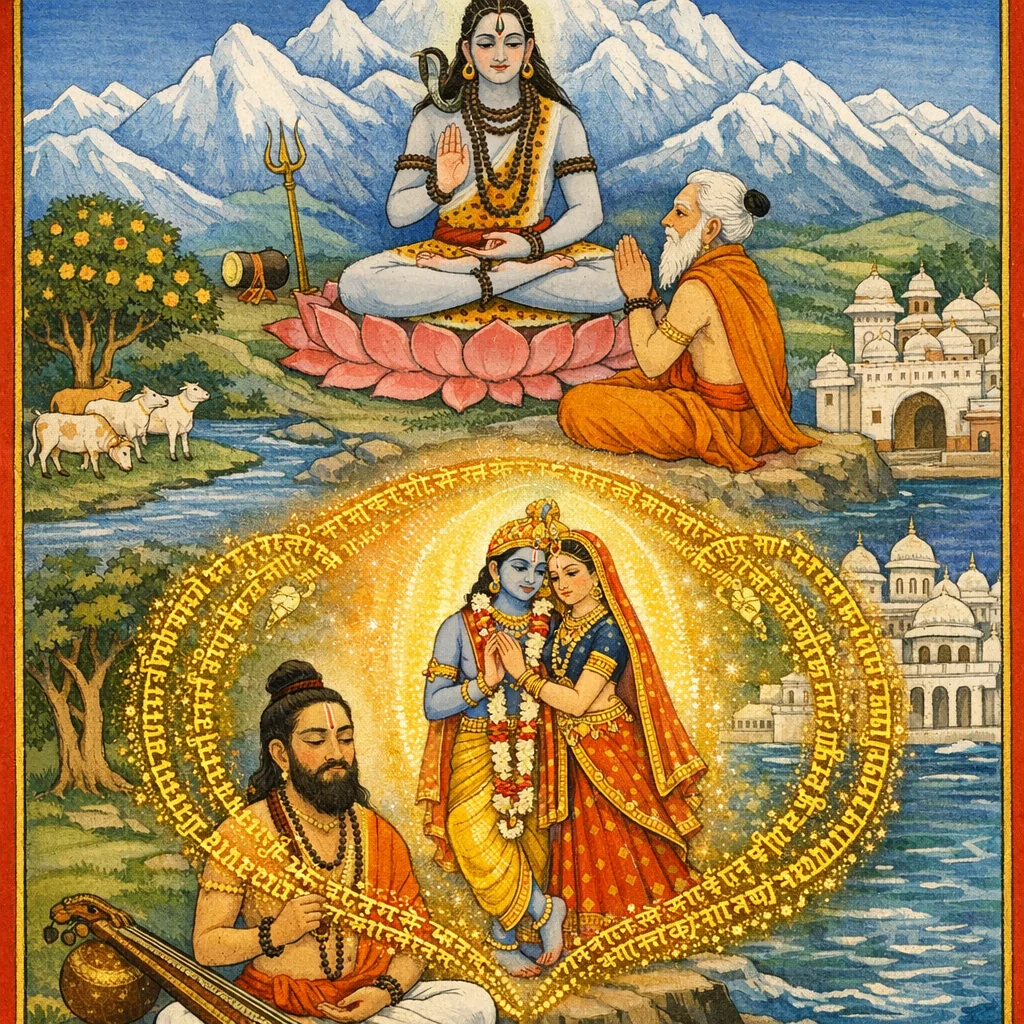
Sanatkumāra urges Nārada to recover knowledge from a prior kalpa: the secret Kṛṣṇa-mantra once received directly from Śiva in a paired (Yugala) form. In meditation Nārada recalls his former-birth deeds, and Sanatkumāra frames the teaching in an earlier cycle of the Sarasvata-kalpa, recounting how “Nārada as Kāśyapa” questioned Kailāsa-dwelling Śiva about the Supreme Reality. Śiva discloses the mantra and its ritual markers—ṛṣi (Manu), chandas (Surabhi/Gāyatrī), devatā (the all-pervading Lord beloved of the gopīs), and a refuge-centered viniyoga—stressing that siddhi-preliminaries, purifications, and nyāsa are unnecessary; contemplation alone reveals nitya-līlā. The chapter then lays down the inner dharma of the surrendered: guru-bhakti, learning śaraṇāgata-dharmas, honoring Vaiṣṇavas, continual Kṛṣṇa-smaraṇa and arcā-sevā, detachment from the body, and strict avoidance of offenses to guru/sādhu/Vaiṣṇava and to the Holy Name. Its core liturgy is the Yugala Sahasranāma: Kṛṣṇa’s names trace Vraja play through Mathurā and Dvārakā exploits, while Rādhā’s names proclaim her supremacy as rasa, śakti, and the cosmic creatrix-preserver-dissolver. The phalaśruti promises destruction of sin, relief from poverty and disease, fertility, and bhakti to Rādhā–Mādhava, concluding with the chapter colophon.
Shlokas
Verse 1
सनत्कुमार उवाच । किं त्वं नारद जानासि पूर्वजन्मनि यत्त्वया । प्राप्तं भगवतः साक्षाच्छूलिनो युगलात्मकम् ॥ १ ॥
Sanatkumāra said: “O Nārada, do you remember what you knew in your former birth—what you directly received from the Blessed Lord Śūlin (Śiva), in his paired, dual form?”
Verse 2
कृष्णमंत्ररहस्यं च स्मर विस्मृतिमागतम् । सूत उवाच । इत्युक्तो नारदो विप्राः कुमारेण तु धीमता ॥ २ ॥
“And recall the secret of the Kṛṣṇa-mantra, which had slipped from memory.” Sūta said: Thus addressed by the wise Kumāra, Nārada (O brāhmaṇas) …
Verse 3
ध्याने विवेदाशु चिरं चरितं पूर्वजन्मनः । ततश्चिरं ध्यानपरो नारदो भगवत्प्रियः ॥ ३ ॥
Through meditation he quickly came to know, in full, the long course of deeds from his former birth. Thereafter, for a long time, Nārada—dear to the Blessed Lord—remained devoted to meditation.
Verse 4
ज्ञात्वा सर्वं सुवृत्तांतं सुप्रसन्नाननोऽब्रवीत् । भगवन्सर्ववृत्तांतः पूर्वकल्पसमुद्बवः ॥ ४ ॥
Having understood the entire auspicious account, his face bright with great delight, he spoke: “O Blessed One, this whole narrative has arisen from a previous kalpa (cosmic cycle).”
Verse 5
मम स्मृतिमनुप्राप्तो विना युगललंभनम् । तच्छ्रुत्वा वचनं तस्य नारदस्य महात्मनः ॥ ५ ॥
Without any intervening prompting, it arose in my recollection; hearing those words of the great-souled sage Nārada, I responded accordingly.
Verse 6
सनत्कुमारो भगवान् व्याजहार यथातथम् । सनत्कुमार उवाच । श्रृणु विप्र प्रवक्ष्यामि यस्मिञ्जन्मनि शूलिनः ॥ ६ ॥
The venerable Sanatkumāra spoke exactly as it was. Sanatkumāra said: “Listen, O brāhmaṇa; I shall explain in which birth the Trident-bearer (Śiva) appeared/was born.”
Verse 7
प्राप्तं कृष्णरहस्यं वै सावधानो भवाधुना । अस्मात्सारस्वतात्कल्पात्पूर्वस्मिन्पंचविंशके ॥ ७ ॥
You have indeed obtained Kṛṣṇa’s secret teaching; now be attentive. It belongs to the earlier twenty-fifth section of this Sarasvata Kalpa.
Verse 8
कल्पे त्वं काश्यपो जातो नारदो नाम नामतः । तत्रैकदा त्वं कैलासं प्राप्तः कृष्णस्य योगिनः ॥ ८ ॥
In a certain kalpa, you were born as Kāśyapa, known by the name Nārada. Then once you reached Kailāsa, the abode of Kṛṣṇa, the supreme Yogi.
Verse 9
संप्रष्टुं परमं तत्वं शिवं कैलासवासिनम् । त्वया पृष्टो महादेवो रहस्यं स्वप्रकाशितम् ॥ ९ ॥
To inquire into the Supreme Reality, you questioned Śiva, the dweller on Kailāsa; and Mahādeva, being asked by you, revealed the secret through his own luminous insight.
Verse 10
कथयामास तत्वेन नित्यलीलानुगं हरेः । ततस्तदन्ते तु पुनस्त्वया विज्ञापितो हरः ॥ १० ॥
Then he explained, in accordance with truth, the ever-continuing nitya-līlā—the Lord Hari’s eternal divine play; and when that account concluded, you once again addressed Hara (Śiva) with a request.
Verse 11
नित्यां लीलां हरेर्द्रष्टुं ततः प्राह सदाशिवः । गोपीजनपदस्यांते वल्लभेति पदं ततः ॥ ११ ॥
Then Sadāśiva spoke, longing to behold the Lord Hari’s nitya-līlā: “At the end of the word gopī-janapada, add the word vallabha.”
Verse 12
चरणाच्छरणं पश्चात्प्रपद्ये इति वै मनुः । मंत्रस्यास्य ऋषिः प्रोक्तो सुरभिश्छंद एव च ॥ १२ ॥
“From one refuge I go on to another refuge; thereafter I surrender,” thus indeed (says) Manu. For this mantra, the seer (ṛṣi) is declared to be Manu, and the metre (chandas) is Surabhi.
Verse 13
गायत्री देवता चास्य बल्लवीवल्लभो विभुः । प्रपन्नोऽस्मीति तद्भक्तौ विनियोग उदाहृतः ॥ १३ ॥
For this mantra, the metre is Gāyatrī, and the presiding deity is the all-pervading Lord—Vallabha, beloved of the gopīs. Its stated application (viniyoga) is: “I have taken refuge,” for the sake of devotion (bhakti) to Him.
Verse 14
नास्य सिद्धादिकं विप्र शोधनं न्यासकल्पनम् । केवलं चिंतनं सद्यो नित्यलीलाप्रकाशकम् ॥ १४ ॥
O brāhmaṇa, for this practice there is no need of siddhi-like preliminaries, no purificatory rites, and no imagined arrangement of nyāsa. Mere contemplation alone immediately reveals the Lord’s nitya-līlā, His eternal divine play.
Verse 15
आभ्यंतरस्य धर्मस्य साधनं वच्मि सांप्रतम् ॥ १५ ॥
Now I shall declare the means for cultivating inner dharma—the inward discipline of righteousness.
Verse 16
संगृह्य मन्त्रं गुरुभक्तियुक्तो विचिंत्य सर्वं मनसा तदीहितम् । कृपां तदीयां निजधर्मसंस्थो विभावयन्नात्मनि तोषयेद्गुरुम् ॥ १६ ॥
Having received the mantra and endowed with devotion to the guru, one should contemplate in the mind all that the guru intends; established in one’s own dharma, one should internalize the guru’s grace within oneself and thereby please the guru.
Verse 17
सताः शिक्षेत वै धर्मांन्प्रपन्नानां भयापहान् । ऐहिकामुष्मिकीचिंताविधुरान् सिद्धिदायकान् ॥ १७ ॥
One should indeed learn from the virtuous the dharmas meant for those who have taken refuge—dharmas that remove fear, free one from anxiety about this world and the next, and bestow true accomplishment (siddhi).
Verse 18
स्वेष्टदेवधिया नित्यं तोषयेद्वैष्णवांस्तथा । भर्त्सनादिकमेतेषां न कदाचिद्विचिंतयेत् ॥ १८ ॥
Knowing them to be connected with one’s chosen Lord, one should always please the Vaiṣṇavas; and one should never, at any time, even entertain thoughts of censuring them or the like.
Verse 19
पूर्वकर्मवशाद्भव्यमैहिकं भोग्यमेव च । आयुष्यकं तथा कृष्णः स्वयमेव करिष्यति ॥ १९ ॥
Under the compulsion of one’s former deeds, whatever must occur in this world—whatever is to be experienced and enjoyed—and likewise whatever pertains to one’s lifespan, Kṛṣṇa Himself will bring it to pass.
Verse 20
श्रीकृष्णं नित्यलीलास्थं चिंतयेत्स्वधियानिशम् । श्रीमदर्चावतारेण कृष्णं परिचरेत्सदा ॥ २० ॥
With one’s own mind, one should ceaselessly contemplate Śrī Kṛṣṇa, ever established in His eternal divine līlā. And through His auspicious arcā-avatāra—the consecrated Deity form—one should always serve Kṛṣṇa.
Verse 21
अनन्यचिंतनीयोऽसौ प्रपन्नैः शरणार्थिभिः । स्थेयं च देहगेहादावुदासीनतया बुधैः ॥ २१ ॥
Those who have surrendered and seek shelter should contemplate Him alone, with no other thought. And the wise should remain detached toward the body, the home, and the like.
Verse 22
गुरोरवज्ञां साधूनां निंदां भेदं हरे हरौ । वेदनिंदां हरेंर्नामबलात्पापसमीहनम् ॥ २२ ॥
Disrespecting one’s guru, condemning the sādhus, sowing division among Hari’s devotees, criticizing the Vedas, and committing sins on the strength of chanting Hari’s Name—these are grave offenses.
Verse 23
अर्थवादं हरे र्नाम्नि पाषंडं नामसंग्रहे । अलसे नास्तिके चैव हरिनामोपदेशनम् ॥ २३ ॥
To regard Hari’s Name as mere exaggeration (arthavāda), to harbor heretical views while taking up nāma-saṅkīrtana, and to instruct the Name of Hari to the lazy or to an atheist—these are to be avoided as offenses to the Holy Name.
Verse 24
नामविस्मरणं चापि नाम्न्यनादरमेव च । संत्यजेद् दूरतो वत्स दोषानेतान्सुदारुणान् ॥ २४ ॥
One should also avoid forgetting the Holy Name, and likewise any disrespect toward the Name. O dear one, these exceedingly dreadful faults should be abandoned from afar.
Verse 25
प्रपन्नोऽस्मीति सततं चिंतयेद्धृद्गतं हरिम् । स एव पालनं नित्यं करिष्यति ममेति च ॥ २५ ॥
One should constantly contemplate Hari, who dwells within the heart, thinking, “I am surrendered.” And one should hold this firm conviction as well: “He alone will ever protect me.”
Verse 26
तवास्मि राधिकानाथ कर्मणा मनसा गिरा । कृष्णकांतेति चैवास्मि युवामेव गतिर्मम ॥ २६ ॥
O Lord of Rādhikā, I am Yours—by my deeds, by my mind, and by my speech. Truly, I am “Kṛṣṇa’s beloved”; You two alone are my refuge and my final goal.
Verse 27
दासाः सखायः पितरः प्रेयस्यश्च हरेरिह । सर्वे नित्या मुनिश्रेष्ठ चिंतनीया महात्मभिः ॥ २७ ॥
Here, O best of sages, the servants, friends, fathers, and beloved ones of Hari are all eternal; therefore, great-souled devotees should ever contemplate them.
Verse 28
गमनागमने नित्यकरोति वनगोष्टयोः । गोचारणं वयस्यैश्च विनासुरविघातनम् ॥ २८ ॥
He regularly goes to and fro between the forest and the cowherds’ settlement; he grazes the cattle with his companions, and he destroys the obstructing demons.
Verse 29
सखायो द्वादशाख्याता हरेः श्रीदामपूर्वकाः । राधिकायाः सुशीलाद्याः सख्यो द्वात्रिंशदीरिताः ॥ २९ ॥
Twelve companions of Hari have been named, beginning with Śrīdāma; and thirty-two female companions (sakhīs) of Rādhikā have been declared, beginning with Suśīlā.
Verse 30
आत्मानं चिंतयेद्वत्स तासां मध्ये मनोरमाम् । रूपयौवनसंपन्नां किशोरीं च स्वलंकृताम् ॥ ३० ॥
Dear child, contemplate yourself—among them—as a most delightful maiden, endowed with beauty and youth, a young girl adorned with ornaments.
Verse 31
नानाशिल्पकलाभिज्ञां कृष्णभोगानुरूपिणीम् । तत्सेवनसुखाह्लादभावेनातिसुनिर्वृताम् ॥ ३१ ॥
She was skilled in many crafts and arts, perfectly suited to Krishna’s enjoyments, and was supremely content—her heart overflowing with joy in the happiness of serving him.
Verse 32
ब्राह्मं मुहूर्तमारभ्य यावदर्धनिशा भवेत् । तावत्परिचरेत्तौ तु यथाकालानुसेवया ॥ ३२ ॥
Beginning from the brāhma-muhūrta and continuing until midnight, one should attend upon those two, following the prescribed schedule at the proper times.
Verse 33
सहस्रं च तयोर्न्नाम्नां पठेन्नित्यं समाहितः । एतसाधनमुद्दिष्टं प्रपन्नानां मुनीश्वर ॥ ३३ ॥
And, O lord among sages, one should daily recite with focused mind the thousand names of those two deities; this discipline has been prescribed as the spiritual means for those who have taken refuge.
Verse 34
नाख्येयं कस्यचित्तुभ्यं मया तत्त्वं प्रकाशितम् । सनत्कुमार उवाच । ततस्त्वं नारद पुनः पृष्टवान्वै सदाशिवम् ॥ ३४ ॥
Sanatkumāra said: “This truth that I have revealed to you is not to be disclosed to just anyone.” Then you, O Nārada, again questioned Sadāśiva.
Verse 35
नाम्नां सहस्रं तच्चापि प्रोक्तवां स्तच्छृणुष्व मे । ध्यात्वा वृंदावने रम्ये यमुनातीरसंगतम् ॥ ३५ ॥
I have also proclaimed that litany of a thousand Names—now hear it from me. First, meditate upon the Lord who is present in delightful Vṛndāvana, united with the bank of the Yamunā.
Verse 36
कल्पवृक्षं समाश्रित्य तिष्ठंतं राधिकायुतम् । पठेन्नामसहस्रं तु युगलाख्यं महामुने ॥ ३६ ॥
O great sage, taking refuge at the wish-fulfilling tree, one should recite the ‘Yugala’ Thousand Names, meditating upon Him who stands there together with Rādhikā.
Verse 37
देवकीनंदनः शौरिर्वासुदेवो बलानुजः । गदाग्रजः कंसमोहः कंससेवकमोहनः ॥ ३७ ॥
He is the joy of Devakī, the heroic scion of the Śūra lineage; Vāsudeva; the younger brother of Bala (Balarāma); the elder brother of Gadā (Gadādhara). He is the deluder of Kaṃsa, and the one who bewilders even Kaṃsa’s servants.
Verse 38
भिन्नर्गलः भिन्नलोहः पितृबाह्यः पितृस्तुतः । मातृस्तुतः शिवध्येयो यमुनाजलभेदनः ॥ ३८ ॥
He is the Breaker of bolts, the Splitter of iron; beyond the reach of the Pitṛs, yet praised by the Pitṛs; praised by the Mothers; to be meditated upon as Śiva; and the One who parts the waters of the Yamunā.
Verse 39
व्रजवासी व्रजानंदी नंदबालो दयानिधिः । लीलाबालः पद्मनेत्रो गोकुलोत्सव ईश्वरः ॥ ३९ ॥
He dwells in Vraja and fills Vraja with bliss; the beloved child of Nanda, an ocean of compassion. The playful divine boy, lotus-eyed; the Lord who is the very festival and joy of Gokula.
Verse 40
गोपिकानंदनः कृष्णो गोपानंदः सतां गतिः । बकप्राणहरो विष्णुर्बकमुक्तिप्रदो हरिः ॥ ४० ॥
Kṛṣṇa is the delight of the gopīs, the joy of the cowherds, and the refuge of the righteous. As Viṣṇu He took Baka’s life, and as Hari He even bestowed liberation upon Baka.
Verse 41
बलदोलाशयशयः श्यामलः सर्वसुंदरः । पद्मनाभो हृषीकेशः क्रीडामनुजबालकः ॥ ४१ ॥
He reclines upon the couch that is the serpent Bala; dark-hued and supremely beautiful in every way—Padmanābha, Hṛṣīkeśa—He sports among men like a child.
Verse 42
लीलाविध्वस्तशकटो वेदमंत्राभिषेचितः । यशोदानंदनः कांतो मुनिकोटिनिषेवितः ॥ ४२ ॥
In divine play He shattered the cart-demon; He is consecrated with Vedic mantras; Yaśodā’s beloved son—charming and adored—served and worshipped by crores of sages.
Verse 43
नित्यं मधुवनावासी वैकुंठः संभवः क्रतुः । रमापतिर्यदुपतिर्मुरारिर्मधुसूदनः ॥ ४३ ॥
He ever dwells in Madhuvana; He is Vaikuṇṭha; He is Sambhava; He is Kratu. He is the Lord of Ramā (Lakṣmī), the Lord of the Yadus, the slayer of Mura, and Madhusūdana, the destroyer of Madhu.
Verse 44
माधवो मानहारी च श्रीपतिर्भूधरः प्रभुः । बृहद्वनमहालीलो नंदसूनुर्महासनः ॥ ४४ ॥
He is Mādhava, the remover of pride; Śrīpati, the Lord of Lakṣmī; Bhūdhara, the Upholder of the earth; the Supreme Master. His divine play is celebrated in the great forest; He is the son of Nanda, and He who is seated upon the highest throne.
Verse 45
तृणावर्तप्राणहारी यशोदाविस्मयप्रदः । त्रैलोक्यवक्त्रः पद्माक्षः पद्महस्तः प्रियंकरः ॥ ४५ ॥
He who took the life of Tṛṇāvarta; He who filled Yaśodā with wonder; He whose mouth contains the three worlds; the Lotus-eyed; the Lotus-handed; the One who bestows what is dear and auspicious.
Verse 46
ब्रह्मण्यो धर्मगोप्ता च भूपतिः श्रीधरः स्वराट् । अजाध्यक्षः शिवाध्यक्षो धर्माध्यक्षो महेश्वरः ॥ ४६ ॥
He is devoted to the brāhmaṇas and the Veda; the protector of dharma; the sovereign Lord; Śrīdhara, bearer of Śrī (Lakṣmī); the self-ruling King. He presides over the Unborn (Brahmā), presides over Śiva, presides over dharma itself, and is the Great Lord.
Verse 47
वेदांतवेद्यो ब्रह्मस्थः प्रजापतिरमोघदृक् । गोपीकरावलंबी च गोपबालकसुप्रियः ॥ ४७ ॥
He is knowable through the Vedānta; established in Brahman; the Lord of creatures, whose vision never fails. He is the One held by the hands of the gopīs, and exceedingly dear to the cowherd boys.
Verse 48
बालानुयीयी बलवान् श्रीदामप्रिय आत्मवान् । गोपीगृहांगणरतिर्भद्रः सुश्लोकमंगलः ॥ ४८ ॥
He follows after the children, is strong, dear to Śrīdāma, self-possessed; He delights in the courtyards of the gopīs’ homes—auspicious, and a bringer of blessing through well-spoken praise.
Verse 49
नवनीतहरो बालो नवनीतप्रियाशनः । बालवृन्दी मर्कवृंदी चकिताक्षः पलायितः ॥ ४९ ॥
The Child who steals fresh butter, who loves to eat butter; surrounded by groups of boys and troops of monkeys—wide-eyed in surprise, He runs away.
Verse 50
यशोदातर्जितः कंपी मायारुदितशोभनः । दामोदरोऽप्रमेयात्मा दयालुर्भक्तवत्सलः ॥ ५० ॥
Trembling when threatened by Yaśodā, and made beautiful by His illusory crying—He is Dāmodara, the immeasurable Self: compassionate, and tenderly devoted to His devotees.
Verse 51
सुबद्धोलूखले नम्रशिरा गोपीकदर्थितः । वृक्षभंगी शोकभंगी धनदात्मजमोक्षणः ॥ ५१ ॥
He who was firmly bound to the mortar, who bowed His head in humility, who was chastised by the cowherd women; the breaker of the trees, the destroyer of sorrow, the liberator of Kubera’s sons.
Verse 52
देवर्षिवचनश्लाघी भक्तवात्सल्यसागरः । व्रजकोलाहलकरो व्रजानदविवर्द्धनः ॥ ५२ ॥
He who delights in the words of the divine sages; an ocean of affectionate love for His devotees; the one who stirs Vraja with joyful commotion; the one who ever increases the bliss of Vraja.
Verse 53
गोपात्मा प्रेरकः साक्षी वृंदावननिवासकृत् । वत्सपालो वत्सपतिर्गोपदारकमंडनः ॥ ५३ ॥
He whose very essence is the Cowherd (Gopa); the inner Impeller; the Witness of all; the One who brought about residence in Vṛndāvana; the Protector of the calves; the Lord of the calves; and the Ornament (delight and glory) of the cowherd children.
Verse 54
बालक्रीडो बालरतिर्बालकः कनकांगदी । पीताम्बरो हेममाली मणिमुक्ताविभूषणः ॥ ५४ ॥
He is playful like a child, delighting in childlike sport; appearing as a youthful boy, wearing golden armlets. Clad in yellow garments, adorned with a garland of gold, and ornamented with jewels and pearls.
Verse 55
किंकिणीकटकी सूत्री नूपुरी मुद्रि कान्वितः । वत्सासुरपतिध्वंसी बकासुरविनाशनः ॥ ५५ ॥
Adorned with tinkling bracelets, the sacred thread (yajñopavīta), anklets, and signet-rings—He who destroyed the lord of Vatsāsura and brought about the ruin of Bakāsura.
Verse 56
अघासुरविनाशी च विनिद्रीकृतबालकः । आद्य आत्मप्रदः संगी यमुनातीरभोजनः ॥ ५६ ॥
He is the destroyer of Aghāsura; He awakened the sleeping boys; He is the Primal Being; the giver of Self-knowledge that liberates; the ever-companion of His devotees; and He who took His meal on the bank of the Yamunā.
Verse 57
गोपालमंडलीमध्यः सर्वगोपालभूषणः । कृतहस्ततलग्रासो व्यंजनाश्रितशाखिकः ॥ ५७ ॥
He stands amid the circle of cowherds, the very ornament of all the gopālas; taking His meal in the hollow of His hand, He rests in the shade of a tree, accompanied by side-dishes.
Verse 58
कृतबाहुश्रृंगयष्टिगुंजालंकृतकंठकः । मयूरपिच्छमुकुटो वनमालाविभूषितः ॥ ५८ ॥
His neck is adorned with ornaments of a guñjā-bead garland and a horn-shaped staff; He wears a crown of peacock feathers and is beautified by the forest-garland (vanamālā).
Verse 59
गैरिकाचित्रितवपुर्नवमेघवपुः स्मरः । कोटिकंदर्पलावण्यो लसन्मकरकुंडलः ॥ ५९ ॥
Smara (Kāma) appeared with a form tinted in red-ochre hues, his body like a fresh rain-cloud—possessing the beauty of ten million Cupids, and wearing shining makara-shaped earrings.
Verse 60
आजानुबाहुर्भगवान्निद्रारहितलोचनः । कोटिसागरगाभीर्यः कालकालः सदाशिवः ॥ ६० ॥
The Blessed Lord, whose arms reach to His knees and whose eyes know no sleep—deep as ten million oceans—the very “Death of Time,” beyond time itself, is Sadāśiva.
Verse 61
विरंचिमोहनवपुर्गोपवत्सवपुर्द्धरः । ब्रह्मांडकोटिजनको ब्रह्ममोहविनाशकः ॥ ६१ ॥
His form bewilders even Virāñci (Brahmā); He assumes the guise of the cowherd and the calf; He begets crores of cosmic eggs (universes); and He destroys Brahmā’s delusion.
Verse 62
ब्रह्मा ब्रह्मेडितः स्वामी शक्रदर्पादिनाशनः । गिरिपूजोपदेष्टा च धृतगोवर्द्धनाचलः ॥ ६२ ॥
He is Brahmā; He is the Lord praised even by Brahmā; the sovereign Master who crushes Indra’s pride. He taught the worship of the mountain, and He held aloft Mount Govardhana.
Verse 63
पुरंदरेडितः पूज्यः कामधेनुप्रपूजितः । सर्वतीर्थाभिषिक्तश्च गोविंदो गोपरक्षकः ॥ ६३ ॥
Govinda is the venerable One praised by Purandara (Indra), worshipped even by Kāmadhenū; anointed with the waters of all sacred tīrthas, He is the protector of cows and the cowherd folk.
Verse 64
कालियार्तिकरः क्रूरो नागपत्नीडितो विराट् । धेनुकारिः प्रलंबारिर्वृषासुरविमर्दनः ॥ ६४ ॥
He is the fierce One who tormented Kāliya; the mighty Virāṭ, all-encompassing, praised by the serpent’s wives; the slayer of Dhenuka, the foe of Pralamba, and the crusher of Vṛṣāsura.
Verse 65
मायासुरात्मजध्वंसी केशिकंठविदारकः । गोपगोप्ता धेनुगोप्ता दावाग्निपरिशोषकः ॥ ६५ ॥
He who destroyed the son of the demon Māyāsura; who tore open Keśin’s throat; the protector of the cowherds; the guardian of the cattle; and He who dried up and quenched the raging forest-fire.
Verse 66
गोपकन्यावस्त्रहारी गोपकन्यावरप्रदः । यज्ञपत्न्यन्नभोजी च मुनिमानापहारकः ॥ ६६ ॥
He who took the garments of the gopī maidens; who bestowed a boon upon the gopīs; who partook of the food of the wives of the sacrificers; and who humbled the sages, taking away their pride.
Verse 67
जलेशमानमथनो नन्दगोपालजीवनः । गन्धर्वशापमोक्ता च शंखचूडशिरोहरः ॥ ६७ ॥
He is the churning-staff of the Lord of the waters; the very life of Nanda and Gopāla; the liberator from a Gandharva’s curse; and He who severed Śaṅkhacūḍa’s head.
Verse 68
वंशी वटी वेणुवादी गोपीचिन्तापहारकः । सर्वगोप्ता समाह्वानः सर्वगोपीमनोरथः ॥ ६८ ॥
He who bears the flute; the Lord of the sacred grove Vāṭī; the divine player of the bamboo veṇu; the remover of the gopīs’ anxieties; the protector of all; whose call gathers all; and the fulfiller of every gopī’s heart-desire.
Verse 69
व्यंगधर्मप्रवक्ता च गोपीमण्डलमोहनः । रासक्रीडारसास्वादी रसिको राधिकाधवः ॥ ६९ ॥
He is the teacher who expounds dharma through subtle, indirect instruction; the enchanter of the circle of the gopīs; the taster of the nectar of the Rāsa‑līlā; the supreme Rasika—Śrī Kṛṣṇa, the beloved Lord of Rādhikā.
Verse 70
किशोरीप्राणनाथश्च वृषभानसुताप्रियः । सर्वगोपीजनानंदी गोपीजनविमोहनः ॥ ७० ॥
He is the Lord of the very life of the youthful maiden; beloved of Vṛṣabhānu’s daughter; the delight of all the gopīs; and the One who enchants the gopīs.
Verse 71
गोपिकागीतचरितो गोपीनर्तनलालसः । गोपीस्कन्धाश्रितकरो गोपिकाचुंबनप्रियः ॥ ७१ ॥
His deeds are sung in the songs of the gopīs; He delights in dancing with the gopīs; His hand rests upon the shoulders of the gopīs; and He is fond of kissing the gopīs.
Verse 72
गोपिकामार्जितमुखो गोपीव्यंजनवीजितः । गोपिकाकेशसंस्कारी गोपिकापुष्पसंस्तरः ॥ ७२ ॥
His face was wiped clean by the gopīs; He was fanned by the gopīs with fans; His hair was adorned and arranged by the gopīs; and He reclined upon a bed of flowers spread by the gopīs.
Verse 73
गोपिकाहृदयालंबी गोपीवहनतत्परः । गोपिकामदहारी च गोपिकापरमार्जितः ॥ ७३ ॥
He abides as the support within the hearts of the gopīs; ever intent on bearing and carrying the gopīs; He removes the gopīs’ pride and burning passion; and He is supremely worshipped and honored by the gopīs.
Verse 74
गोपिकाकृतसंनीलो गोपिकासंस्मृतप्रियः । गोपिकावन्दितपदो गोपिकावशवर्तनः ॥ ७४ ॥
He becomes dark-blue by the gopīs’ adorning; He is beloved when remembered by the gopīs; His feet are worshipped by the gopīs; and He moves under the loving sway of the gopīs.
Verse 75
राधा पराजितः श्रीमान्निकुञ्जेसुविहारवान् । कुञ्जप्रियः कुञ्जवासी वृन्दावनविकासनः ॥ ७५ ॥
He is the glorious Lord, conquered by Rādhā; He delights in sportive līlā within the nikunja groves. Fond of the bowers, dwelling in those bowers, He makes Vṛndāvana blossom in divine splendor.
Verse 76
यमुनाजलसिक्तांगो यमुनासौख्यदायकः । शशिसंस्तंभनः शूरः कामी कामविमोहनः ॥ ७६ ॥
His body is bathed in the waters of the Yamunā; He bestows the bliss of the Yamunā. He overpowers the moon; He is the valiant hero, the lord of desire, and the One who bewilders and subdues desire itself.
Verse 77
कामाद्याः कामनाथश्च काममानसभेदनः । कामदः कामरूपश्च कामिनीकामसंचयः ॥ ७७ ॥
He is the source and beginning of desire, the lord of desire, who pierces and stirs the mind through desire. He grants what is longed for, assumes forms according to longing, and is the very accumulation of yearning in the hearts of the enamored.
Verse 78
नित्यक्रीडो महालीलः सर्वः सर्वगतस्तथा । परमात्मा पराधीशः सर्वकारणकारणः ॥ ७८ ॥
He is ever engaged in divine play, the Lord of the great līlā. He is all, and all-pervading. He is the Supreme Self (Paramātmā), the highest Sovereign, the cause of all causes.
Verse 79
गृहीतनारदवचा ह्यक्रूरपरिचिंतितः । अक्रूरवन्दितपदो गोपिकातोषकारकः ॥ ७९ ॥
Having accepted Nārada’s words, He became the object of Akrūra’s contemplation. Akrūra worshiped His feet, and He became the cause of joy for the gopīs.
Verse 80
अक्रूरवाक्यसंग्राही मथुरावासकारणः । अक्रूरतापशमनो रजकायुःप्रणाशनः ॥ ८० ॥
He accepted Akrūra’s words; He became the cause of dwelling in Mathurā; He soothed Akrūra’s anguish; and He destroyed the washerman Rājaka and his life.
Verse 81
मथुरानन्ददायी च कंसवस्त्रविलुण्ठनः । कंसवस्त्रपरीधानो गोपवस्त्रप्रदायकः ॥ ८१ ॥
He brings joy to Mathurā; He seized Kaṁsa’s garments; He wore Kaṁsa’s garments; and He bestowed garments upon the cowherds.
Verse 82
सुदामगृहगामी च सुदामपरिपूजितः । तंतुवाय कसंप्रीतः कुब्जाचंदनलेपनः ॥ ८२ ॥
He went to Sudāmā’s house and was reverently honored by Sudāmā; He delighted in the weaver; and He accepted the sandalwood anointing offered by Kubjā.
Verse 83
कुब्जारूपप्रदो विज्ञो मुकुंदो विष्टरश्रवाः । सर्वज्ञो मथुरालोकी सर्वलोकाभिनंदनः ॥ ८३ ॥
He bestowed upon Kubjā a straight and fair form; the Wise One who knows all; Mukunda, the giver of liberation; He whose fame is vast and far-spread; the Omniscient; the Lord who abides in Mathurā; and the One praised and rejoiced in by all worlds.
Verse 84
कृपाकटाक्षदर्शी च दैत्यारिर्देवपालकः । सर्वदुःखप्रशमनो धनुभर्ङ्गी महोत्सवः ॥ ८४ ॥
He whose gracious glance bestows mercy; the foe of the Daityas and protector of the gods; He who quells all sorrows; the breaker of the bow; and He Himself, the great festival of auspiciousness.
Verse 85
कुवलयापीडहंता दंतस्कंधबलाग्रणीः । कल्परूपधरोधीरो दिव्यवस्त्रानुलेपनः ॥ ८५ ॥
He who slew Kuvalayāpīḍa; the foremost in strength, bearing the burden upon His tusk-like shoulder; He who assumes forms at will; the steadfast and wise One, adorned with divine garments and celestial unguents.
Verse 86
मल्लरूपो महाकालः कामरूपी बलान्वितः । कंसत्रासकरो भीमो मुष्टिकांतश्च कंसहा ॥ ८६ ॥
Assuming the form of a wrestler, He became like Mahākāla; able to take any form at will and endowed with strength—terrifying Kaṃsa, formidable, the slayer of Muṣṭika, and indeed the killer of Kaṃsa.
Verse 87
चाणूरघ्नो भयहरः शलारिस्तोशलांतकः । वैकुंठवासी कंसारिः सर्वदुष्टनिषूदनः ॥ ८७ ॥
He is the slayer of Cāṇūra, the remover of fear; the enemy of Śalāri and the destroyer of Tośalā. He dwells in Vaikuṇṭha; He is the foe of Kaṃsa, the annihilator of all wicked beings.
Verse 88
देवदुंदुभिनिर्घोषी पितृशोकनिवारणः । यादवेंद्रः सतांनाथो यादवारिप्रमर्द्दनः ॥ ८८ ॥
He whose fame resounds like the kettledrums of the gods; the remover of the sorrow of the forefathers; the lord of the Yādavas; the protector of the virtuous; and the crusher of the enemies of the Yādavas.
Verse 89
शौरिशोकविनाशी च देवकीतापनाशनः । उग्रसेनपरित्राता उग्रसेनाभिपूजितः ॥ ८९ ॥
He is the destroyer of the sorrow of Śauri (Kṛṣṇa) and the remover of Devakī’s anguish; the protector of Ugrasena, and the One who is revered by Ugrasena.
Verse 90
उग्रसेनाभिषेकी च उग्रसेनदया परः । सर्वसात्वतसाक्षी च यदूनामभिनंदनः ॥ ९० ॥
Acyuta is he who enthroned Ugrasena, who is supremely compassionate toward Ugrasena; who stands as the witness of all the Sātvatas (devotees); and who is the delight of the Yadu lineage.
Verse 91
सर्वमाथुरसंसेव्यः करुणो भक्तबांधवः । सर्वगोपालधनदो गोपीगोपाललालसः ॥ ९१ ॥
He is to be lovingly worshipped by all the people of Mathurā; compassionate, the kinsman and support of devotees. He bestows prosperity upon all the cowherds, and yearns for the company of the gopīs and the gopālas.
Verse 92
शौरिदत्तोपवीती च उग्रसेनदयाकरः । गुरुभक्तो ब्रह्मचारी निगमाध्ययने रतः ॥ ९२ ॥
He wore the sacred thread (yajñopavīta) bestowed by Śauri; he was compassionate to Ugrasena; devoted to his teacher; a brahmacārī, a celibate student; and constantly engaged in the study of the Nigamas—the Vedic scriptures.
Verse 93
संकर्षणसहाध्यायी सुदामसुहृदेव च । विद्यानिधिः कलाकोशो मृतपुत्रदस्तथा ॥ ९३ ॥
He is also the fellow-student of Saṅkarṣaṇa, the intimate friend of Sudāmā; the very treasury of knowledge, a repository of the arts, and likewise the giver of a son to one whose child had died.
Verse 94
चक्री पांचजनी चैव सर्वनारकिमोचनः । यमार्चितः परो देवो नामोच्चारवसो ऽच्युतः ॥ ९४ ॥
Bearing the discus and the Pañcajanya conch, he is the liberator of all who have fallen into hellish states. Even Yama worships that Supreme Deity—Achyuta—who becomes accessible through the mere utterance of his Name.
Verse 95
कुब्जा विलासी सुभगो दीनबंधुरनूपमः । अक्रूरगृहगोप्ता च प्रतिज्ञापालकः शुभः ॥ ९५ ॥
He is the redeemer of Kubjā; the sportive Lord of sacred līlā; the auspicious and beautiful One; the friend of the distressed, incomparable. He is also the protector of Akrūra’s house, the keeper of His vow, and the beneficent Bestower of good.
Verse 96
जरासंधजयी विद्वान् यवनांतो द्विजाश्रयः । मुचुकुंदप्रियकरोजरासंधपलायितः ॥ ९६ ॥
He is the learned conqueror of Jarāsandha, the destroyer of the Yavanas, the refuge of the dvija, the twice-born. He delighted Mucukunda; before Him Jarāsandha fled.
Verse 97
द्वारकाजनको गूढो ब्रह्मण्यः सत्यसंगरः । लीलाधरः प्रियकरो विश्वकर्मा यशःप्रदः ॥ ९७ ॥
He is the founder of Dvārakā; the hidden, mysterious One; the protector and benefactor of the brāhmaṇas; steadfast in the battle for truth. He bears the divine līlā, grants what is dear, is Viśvakarmā the cosmic architect, and bestows fame.
Verse 98
रुक्मिणीप्रियसंदेशो रुक्मशोकविवर्द्धनः । चैद्यशोकालयः श्रेष्ठो दुष्टराजन्यनाशनः ॥ ९८ ॥
He is the beloved messenger who brought joy to Rukmiṇī; He who increased Rukmī’s grief; the very abode of Caidya (Śiśupāla)’s sorrow. He is the Supreme Excellent One, and the destroyer of wicked royal lineages.
Verse 99
रुक्मिवैरूप्यकरणो रुक्मिणीवचने रतः । बलभद्रवचोग्राही मुक्तरुक्मी जनार्दनः ॥ ९९ ॥
Janārdana is He who disfigured Rukmī, who rejoiced to fulfill Rukmiṇī’s words, who accepted the counsel of Balabhadra, and who released—sparing the life of—Rukmī.
Verse 100
रुक्मिणीप्राणनाथश्च सत्यभामापतिः स्वयम् । भक्तपक्षी भक्तिवश्यो ह्यक्रूरमणिदायकः ॥ १०० ॥
He is the Lord of Rukmiṇī’s very life, and Himself the husband of Satyabhāmā—ever siding with His devotees, conquered by bhakti, and the giver of the jewel to Akrūra.
Verse 101
शतधन्वाप्राणहारी ऋक्षराजसुताप्रियः । सत्राजित्तनयाकांतो मित्रविंदापहारकः ॥ १०१ ॥
He is the slayer of Śatadhanvā; beloved of Ṛkṣarāja’s daughter (Jāmbavatī); the cherished lord of Satrājit’s daughter (Satyabhāmā); and He who carried away Mitravindā.
Verse 102
सत्यापतिर्लक्ष्मणाजित्पूज्यो भद्राप्रियंकरः । नरका सुरघातीं च लीलाकन्याहरो जयी ॥ १०२ ॥
He is the Lord of Truth; unconquered even by Lakṣmaṇā, worthy of worship; the auspicious bestower of what is dear; the destroyer of Naraka and slayer of the gods’ foes; the victorious One who, in divine play, carried away the maiden Līlā.
Verse 103
मुरारिर्मदनेशोऽपि धरित्रीदुःखनाशनः । वैनतेयी स्वर्गगामी अदित्य कुंडलप्रदः ॥ १०३ ॥
He is Murāri, the foe of Mura, and also the Lord of Kāma. He dispels the sorrows of the Earth. He is Vainateyī (Garuda), who bears devotees to heaven; and He is Āditya, the giver of radiant earrings (kuṇḍalas).
Verse 104
इंद्रार्चितो रमाकांतो वज्रिभार्याप्रपूजितः । पारिजातापहारी च शक्रमानापहारकः ॥ १०४ ॥
He is worshipped by Indra; the beloved of Ramā (Lakṣmī); and greatly revered by Śacī, the thunderbolt-bearer’s wife. He carried off the Pārijāta tree and humbled Indra’s pride.
Verse 105
प्रद्युम्नजनकः सांबतातो बहुसुतो विधुः । गर्गाचार्यः सत्यगतिर्धर्माधारो धारधरः ॥ १०५ ॥
He is the father of Pradyumna, the sire of Sāmba, the Moon with many sons; He is also called Garga-ācārya, whose path is truth, the very support of Dharma, and the bearer of the earth.
Verse 106
द्वारकामंडनः श्लोक्यः सुश्लोको निगमालयः । पौंड्रकप्राणहारी च काशीराजशिरोहरः ॥ १०६ ॥
He is the ornament of Dvārakā, worthy to be praised in sacred verse; He is the embodiment of auspicious hymns and the abode of the Vedas. He slew Pauṇḍraka and took the head of the King of Kāśī.
Verse 107
अवैष्णवविप्रदाही सुदक्षिणभयाबहः । जरासंधविदारीं च धर्मनन्दनयज्ञकृत् ॥ १०७ ॥
He burns away the sin of the non-Vaiṣṇava brāhmaṇa; He removes fear for one who offers proper dakṣiṇā; He tore apart Jarāsandha; and He performed the yajña for Dharma’s son, Nara (Dharmanandana).
Verse 108
शिशुपालशिररश्चेदी दंतवक्रविनाशनः । विदूरथांसकः श्रीशः श्रीदो द्विविदनाशनः ॥ १०८ ॥
He severed the head of Śiśupāla, destroyed Dantavakra, and slew Vidūratha; He is the Lord of Śrī (Lakṣmī), the giver of prosperity, and the destroyer of Dvivida.
Verse 109
रुक्मिणीमानहारी च रुक्मिणीमानवर्द्धनः । देवर्षिशापहर्ता च द्रौपदीवाक्यपालकः ॥ १०९ ॥
He removes Rukmiṇī’s wounded pride and also upholds and increases her honor; He lifts the curse of the divine sages (devarṣis); and He faithfully keeps Draupadī’s word and vow.
Verse 110
दुर्वासो भयहाति व पांचालीस्मरणागतः । पार्थदूतः पार्थमन्त्री पार्थदुःखौधनाशनः ॥ ११० ॥
He dispels the fear brought by Durvāsā; He comes when Pāñcālī (Draupadī) remembers Him; He served as Pārtha’s messenger; He is Pārtha’s counselor; and He destroys the flood of Pārtha’s sorrows.
Verse 111
पार्थमानापहारी च पार्थजीवनदायकः । पांचाली वस्त्रदाता च विश्वपालकपालकः ॥ १११ ॥
He removed Pārtha’s humiliation and bestowed life upon Pārtha; He granted garments to Pāñcālī (Draupadī); and He protects the protectors of the world.
Verse 112
श्वेताश्वसारथिः सत्यः सत्यसाध्यो भयापहः । सत्यसंधः सत्यरतिः सत्यप्रिय उदारधीः ॥ ११२ ॥
He is the charioteer of the white steeds; He is Truth itself—attainable through truth—and the remover of fear. True to His vow, delighting in truth, loving truth, He is of noble and generous intellect.
Verse 113
महासेनजयी चैव शिवसैन्यविनाशननः । बाणासुरभुजच्छेत्ता बाणबाहुवरप्रदः ॥ ११३ ॥
He is the conqueror of the great army, the destroyer of Śiva’s forces, the cutter of Bāṇāsura’s arms, and the gracious giver of a boon—restoring Bāṇa’s arms as an act of favor.
Verse 114
तार्क्ष्यमानापहारी च तार्क्ष्यतेजोविवर्द्धनः । रामस्वरूपधारी च सत्यभामामुदावहः ॥ ११४ ॥
He removes Tārkṣya’s (Garuḍa’s) pride and increases Garuḍa’s splendor; He bears the form of Rāma; and He is the exalted Lord who has Satyabhāmā as His consort.
Verse 115
रत्नाकरजलक्रीडो व्रजलीलाप्रदर्शकः । स्वप्रतिज्ञापरिध्वंसी भीष्माज्ञापरिपालकः ॥ ११५ ॥
He who sports in the waters of the ocean; who reveals the divine līlās of Vraja; who overturns even His own vow; and who upholds Bhīṣma’s command—may that Lord be remembered and praised.
Verse 116
वीरायुधहरः कालः कालिकेशो महाबलः । वर्वरीषशिरोहारी वर्वरीषशिरःप्रदः ॥ ११६ ॥
He is Kāla, Time, who strips the heroes of their weapons; Kālikeśa, the immensely mighty—He who took away Varvarīṣa’s head, and He who bestowed Varvarīṣa’s head.
Verse 117
धर्मपुत्रजयी शूरदुर्योधनमदांतकः । गोपिकाप्रीतिनिर्बंधनित्यक्रीडो व्रजेश्वरः ॥ ११७ ॥
He who conquered the son of Dharma (Yudhiṣṭhira) and destroyed the pride of the heroic Duryodhana; ever bound to the gopīs’ love and ever engaged in divine play—He is the Lord of Vraja.
Verse 118
राधाकुंडरतिर्धन्यः सदांदोलसमाश्रितः । सदामधुवनानन्दी सदावृंदावनप्रियः ॥ ११८ ॥
Blessed is the devotee whose delight is in Rādhā-kuṇḍa—ever taking refuge in the āndolā swing-festival, ever rejoicing in Madhuvana, and ever cherishing Vṛndāvana.
Verse 119
अशोकवनसन्नद्धः सदातिलकसंगतः । सदागोवर्द्धनरतिः सदा गोकुलवल्लभः ॥ ११९ ॥
Ever adorned with the Aśoka grove, ever graced with auspicious tilaka, ever delighting in Govardhana, and ever the beloved of Gokula—such is the Lord.
Verse 120
भांडीरवटसंवासी नित्यं वंशीवटस्थितः । नन्दग्रामकृतावासो वृषभानुग्रहप्रियः ॥ १२० ॥
He dwells at Bhāṇḍīra-vata and ever abides at Vaṃśī-vata; He has made Nandagrāma His home, and He delights in bestowing grace upon Vṛṣabhānu and his family.
Verse 121
गृहीतकामिनीरूपो नित्यं रासिविलासकृत् । वल्लवीजनसंगोप्ता वल्लवीजनवल्लभः ॥ १२१ ॥
Assuming the form of a beloved maiden, He ever sports in the bliss of the rāsa-dance; He is the protector of the gopīs’ community, and the dearest beloved of the gopīs.
Verse 122
देवशर्मकृपाकर्ता कल्पपादपसंस्थितः । शिलानुगन्धनिलयः पादचारी घनच्छविः ॥ १२२ ॥
He showed compassion to Devaśarman, abiding beneath the wish-fulfilling kalpa tree; dwelling amid fragrant rocks, walking on foot, and bearing a deep, dark luster like a raincloud.
Verse 123
अतसीकुसुमप्रख्यः सदा लक्ष्मीकृपाकरः । त्रिपुरारिप्रियकरो ह्युग्रधन्वापराजितः ॥ १२३ ॥
He is radiant like the atasī blossom, ever bestowing Lakṣmī’s grace. Dear to the slayer of Tripura (Śiva), as Ugradhanvā He is Aparājita—the Unconquered.
Verse 124
षड्धुरध्वंसकर्ता च निकुंभप्राणहारकः । वज्रनाभपुरध्वंसी पौंड्रकप्राणहारकः ॥ १२४ ॥
He is the destroyer of Ṣaḍdhura, the slayer of Nikumbha, the demolisher of the city of Vajranābha, and the taker of Pauṇḍraka’s life.
Verse 125
बहुलाश्वप्रीतिकर्ता द्विजवर्यप्रियंकरः । शिवसंकटहारी च वृकासुरविनाशनः ॥ १२५ ॥
He gladdens Bahulāśva, delights the foremost among the twice-born; He removes Śiva’s distress, and He destroyed the demon Vṛkāsura.
Verse 126
भृगुसत्कारकारी च शिवसात्त्विकताप्रदः । गोकर्णपूजकः सांबकुष्ठविध्वंसकारणः ॥ १२६ ॥
He causes Bhṛgu to be duly honored; He bestows sāttvika purity like that of Śiva; He worships Gokarṇa; and by Sāmba’s grace He is the cause of destroying leprosy (kuṣṭha).
Verse 127
वेदस्तुतो वेदवेत्ता यदुवंशविवर्द्धनः । यदुवंशविनाशी च उद्धवोद्धारकारकः ॥ १२७ ॥
Praised by the Vedas, He is the true knower of the Vedas; He increases the Yadu dynasty and also brings about its dissolution; and He is the cause of Uddhava’s deliverance.
Verse 128
राधा च राधिका चैव आनंदा वृषभानुजा । वृन्दावनेश्वरी पुण्या कृष्णमानसहारिणी ॥ १२८ ॥
She is Rādhā, and also Rādhikā; She is Ānandā, the daughter of Vṛṣabhānu; the holy and auspicious Sovereign of Vṛndāvana, who captivates Kṛṣṇa’s very mind.
Verse 129
प्रगल्भा चतुरा कामा कामिनी हरिमोहिनी । ललिता मधुरा माध्वी किशोरी कनकप्रभा ॥ १२९ ॥
She is bold and confident, clever and skilled; She is kāma itself and the Beloved, the enchantress who can beguile even Hari. Playful and sweet, honey-like; ever a youthful maiden, radiant with golden splendor.
Verse 130
जितचंद्रा जितमृगा जितसिंहा जितद्विपा । जितरंभा जितपिका गोविंदहृदयोद्भवा ॥ १३० ॥
She who has surpassed the Moon, surpassed the deer, surpassed the lion, and surpassed the elephant; who has surpassed Rambhā and surpassed the cuckoo—she is born from the heart of Govinda.
Verse 131
जितबिंबा जितशुका जितपद्मा कुमारिका । श्रीकृष्णाकर्षणा देवी नित्यं युग्मस्वरूपिणी ॥ १३१ ॥
She who surpasses the bimba-fruit in redness, the parrot in charm, and the lotus in beauty—ever the youthful maiden; the Goddess who draws Śrī Kṛṣṇa to Herself, eternally abiding in a paired (dual) form.
Verse 132
नित्यं विहारिणी कांता रसिका कृष्णवल्लभा । आमोदिनी मोदवती नंदनंदनभूषिता ॥ १३२ ॥
She ever delights in divine play; she is the beloved, the connoisseur of sacred rasa, and Krishna’s dearest. She is fragrant with joy, full of bliss, and adorned by Nanda’s son (Krishna).
Verse 133
दिव्यांबरा दिव्यहारा मुक्तामणिविभूषिता । कुञ्जप्रिया कुञ्जवासा कुञ्जनायकनायिका ॥ १३३ ॥
She is clad in celestial garments and wears heavenly garlands, adorned with pearls and jewels. Fond of bowers, dwelling in bowers, she is the beloved consort of the Lord of the bowers.
Verse 134
चारुरूपा चारुवक्त्रा चारुहेमांगदा शुभा । श्रीकृष्णवेणुसंगीता मुरलीहारिणी शिवा ॥ १३४ ॥
She is of lovely form and a beautiful face, auspicious, adorned with charming golden armlets; she is attuned to the music of Śrī Kṛṣṇa’s flute, the enchantress who steals the heart with the murali, and she is auspiciousness itself (Śivā).
Verse 135
भद्रा भगवती शांता कुमुदा सुन्दरी प्रिया । कृष्णरतिः श्रीकृष्णसहचारिणी ॥ १३५ ॥
She is Bhadrā, the Auspicious; Bhagavatī, the Divine; Śāntā, the Peaceful; Kumudā, lotus-like; Sundarī, the Beautiful; Priyā, the Beloved. She delights in Śrī Kṛṣṇa (Kṛṣṇaratī) and is the ever-companion of Śrī Kṛṣṇa (Śrī-kṛṣṇa-sahacāriṇī).
Verse 136
वंशीवटप्रियस्थाना युग्मायुग्मस्वरूपिणी । भांडीरवासिनी शुभ्रा गोपीनाथप्रिया सखी ॥ १३६ ॥
She loves the sacred abode of Vaṁśīvaṭa; her form is both paired and unpaired; she dwells at Bhāṇḍīra. Radiant and pure, she is the dear sakhī, the beloved friend of Gopīnātha (Śrī Kṛṣṇa).
Verse 137
श्रुतिनिःश्वसिता दिव्या गोविंदरसदायिनी । श्रीकृष्णप्रार्थनीशाना महानन्दप्रदायिनी ॥ १३७ ॥
She is the divine out-breath of the Śruti (the Vedas), bestowing the nectar of Govinda’s rasa; the sovereign power that enables prayer to Śrī Kṛṣṇa, and the giver of great bliss.
Verse 138
वैकुंठजनसंसेव्या कोटिलक्ष्मी सुखावहा । कोटिकंदर्पलावण्या रतिकोटिरतिप्रदा ॥ १३८ ॥
She is honored and served by the residents of Vaikuṇṭha; she bestows the happiness of countless Lakṣmīs. Her beauty surpasses millions of Kāma-devas, and she grants delights exceeding millions upon millions of pleasures.
Verse 139
भक्तिग्राह्या भक्तिरूपा लावण्यसरसी उमा । ब्रह्मरुद्रादिसंराध्या नित्यं कौतूहलान्विता ॥ १३९ ॥
Umā is apprehended through bhakti; she is bhakti embodied—an exquisite lake of beauty. Brahmā, Rudra, and the other devas worship her always, and she is ever filled with wondrous delight.
Verse 140
नित्यलीला नित्यकामा नित्यश्रृंगारभूषिता । नित्यवृन्दावनरसा नन्दनन्दनसंयुता ॥ १४० ॥
She abides forever in divine līlā, possessed of eternal loving desire and ever adorned with sacred ornaments; she ever tastes the rasa of Vṛndāvana and is inseparably united with the Son of Nanda.
Verse 141
गोपगिकामण्डलीयुक्ता नित्यं गोपालसंगता । गोरसक्षेपणी शूरा सानन्दानन्ददायिनी ॥ १४१ ॥
Ever accompanied by a circle of gopīs and always in the company of Lord Gopāla, she boldly pours forth the milk’s essence and bestows joy and ever-increasing ānanda.
Verse 142
महालीला प्रकृष्टा च नागरी नगचारिणी । नित्यमाघूर्णिता पूर्णा कस्तूरीतिलकान्विता ॥ १४२ ॥
Her līlā is vast and most exalted; refined like a lady of the city, yet roaming the mountains. Ever whirling in delight, complete in every way, she is adorned with a kastūrī (musk) tilaka upon her brow.
Verse 143
पद्मा श्यामा मृगाक्षी च सिद्धिरूपा रसावहा । कोटिचन्द्रानना गौरी कोटिकोकिलसुस्वरा ॥ १४३ ॥
She is Padmā, lotus-like; Śyāmā, dark-hued; and Mṛgākṣī, doe-eyed. She is the very form of Siddhi and the bearer of divine rasa. Her face shines like countless moons; she is Gaurī, fair and radiant, and her voice is sweeter than millions of cuckoos.
Verse 144
शीलसौंदर्यनिलया नन्दनन्दनलालिता । अशोकवनसंवासा भांडीरवनसङ्गता ॥ १४४ ॥
She is the abode of virtue and beauty, cherished by the Son of Nanda; she dwells in the Aśoka grove and is associated with the Bhāṇḍīra forest.
Verse 145
कल्पद्रुमतलाविष्टा कृष्णा विश्वा हरिप्रिया । अजागम्या भवागम्या गोवर्द्धनकृतालया ॥ १४५ ॥
She abides beneath the Kalpadruma, the wish-fulfilling tree—dark-hued, all-pervading, and beloved of Hari. Unapproachable to the unawakened ordinary being, yet attainable to those still within worldly becoming; her dwelling is established at Govardhana.
Verse 146
यमुनातीरनिलया शश्वद्गोविंदजल्पिनी । शश्वन्मानवती स्निग्धा श्रीकृष्णपरिवन्दिता ॥ १४६ ॥
Dwelling on the bank of the Yamunā, she ever speaks and chants of Govinda. Ever compassionate to people, tender with affection, she is revered by Śrī Kṛṣṇa.
Verse 147
कृष्णस्तुता कृष्णवृता श्रीकृष्णहृदयालया । देवद्रुमफला सेव्या वृन्दावनरसालया ॥ १४७ ॥
She is praised by Kṛṣṇa, encompassed by Kṛṣṇa, and dwells within the heart of Śrī Kṛṣṇa. She is to be reverently served as the fruit of the divine Devadruma, and she is the very abode of Vṛndāvana’s nectar-like rasa.
Verse 148
कोटितीर्थमयी सत्या कोटितीर्थफलप्रदा । कोटियोगसुदुष्प्राप्या कोटियज्ञदुराश्रया ॥ १४८ ॥
Satya—Truthfulness—embodies the merit of countless tīrthas and bestows the fruits of innumerable sacred fords. It is harder to attain than a crore of yogas, and a refuge rarer than a crore of yajñas.
Verse 149
मनसा शशिलेखा च श्रीकोटिसुभगाऽनघा । कोटिमुक्तसुखा सौम्या लक्ष्मीकोटिविलासिनी ॥ १४९ ॥
In the mind alone she is Śaśilekhā—spotless, and more charming than millions of splendors. Gentle and serene, she grants the bliss of countless muktis, and sports in the radiance of millions of Lakṣmīs.
Verse 150
तिलोत्तमा त्रिकालस्था त्रिकालज्ञाप्यधीश्वरी । त्रिवेदज्ञा त्रिलोकज्ञा तुरीयांतनिवासिनी ॥ १५० ॥
She is Tilottamā, abiding in the three times; knower of the three times and the supreme sovereign. She knows the three Vedas and the three worlds, and she dwells in the innermost reality of the Fourth (turīya) state.
Verse 151
दुर्गाराध्या रमाराध्या विश्वाराध्या चिदात्मिका । देवाराध्या पराराध्या ब्रह्माराध्या परात्मिका ॥ १५१ ॥
She is to be worshipped as Durgā; she is to be worshipped as Ramā (Lakṣmī). She is worship-worthy as the very universe, and her essence is pure consciousness. She is worshipped by the gods; she is the Supreme object of worship; she is worshipped as Brahman, and she is the Supreme Self.
Verse 152
शिवाराध्या प्रेमसाध्या भक्ताराध्या रसात्मिका । कृष्णप्राणार्पिणी भामा शुद्धप्रेमविलासिनी ॥ १५२ ॥
Bhāmā is worshipful even to Śiva; she is attained through love, adored by devotees, and is the very essence of devotional rasa. She offers her very life to Kṛṣṇa and sports in the play of pure, stainless love.
Verse 153
कृष्णाराध्या भक्तिसाध्या भक्तवृन्दनिषेविता । विश्वाधारा कृपाधारा जीवधारातिनायिका ॥ १५३ ॥
She is to be worshipped through Kṛṣṇa; attained through devotion; attended upon by multitudes of devotees. She is the support of the universe, a fountain of compassion, and the supreme guide who upholds the lives of beings.
Verse 154
शुद्धप्रेममयी लज्जा नित्यसिद्धा शिरोमणिः । दिव्यरूपा दिव्यभोगा दिव्यवेषा मुदान्विता ॥ १५४ ॥
Modesty (lajjā), made wholly of pure love, is eternally perfected and the crown-jewel; she has a divine form, divine enjoyments, divine attire, and is filled with joy.
Verse 155
दिव्यांगनावृन्दसारा नित्यनूतनयौवना । परब्रह्मावृता ध्येया महारूपा महोज्ज्वला ॥ १५५ ॥
She is the very essence of the hosts of celestial maidens, ever endowed with youth that is forever fresh. Enveloped by the Supreme Parabrahman, she is to be meditated upon—vast in form and exceedingly radiant.
Verse 156
कोटिसूर्यप्रभा कोटिचन्द्रबिंबाधिकच्छविः । कोमलामृतवागाद्या वेदाद्या वेददुर्लभा ॥ १५६ ॥
Her radiance is like ten million suns, and her beauty surpasses ten million full moons. Her speech is tender and nectar-like; she is foremost, rooted in the Vedas—yet difficult to attain even through the Vedas.
Verse 157
कृष्णासक्ता कृष्णभक्ता चन्द्रावलिनिषेविता । कलाषोडशसंपूर्णा कृष्णदेहार्द्धधारिणी ॥ १५७ ॥
She is absorbed in Krishna, devoted to Krishna, and attended upon by Chandravali. Complete with all sixteen divine arts, she bears half of Krishna’s very body.
Verse 158
कृष्णबुद्धिः कृष्णसाराकृष्णरूपविहारिणी । कृष्णकान्ता कृष्णधना कृष्णमोहनकारिणी ॥ १५८ ॥
Her intellect is fixed on Krishna; her essence is Krishna; she delights in Krishna’s form. She is beloved of Krishna, her wealth is Krishna, and through Krishna she captivates others.
Verse 159
कृष्णदृष्टिः कृष्णगोत्री कृष्णदेवी कुलोद्वहा । सर्वभूतस्थितावात्मा सर्वलोकनमस्कृता ॥ १५९ ॥
Her gaze is fixed on Krishna; she belongs to Krishna’s sacred lineage, is Krishna’s own goddess, and upholds the family line. Her very Self abides within all beings, and she is revered by all the worlds.
Verse 160
कृष्णदात्री प्रेमधात्री स्वर्णगात्री मनोरमा । नगधात्री यशोठात्री महादेवी शुभंकरी ॥ १६० ॥
She bestows Kṛṣṇa, she nurtures love; her form is golden and enchanting. She upholds the mountains and upholds renown—she is the Mahādevī, the benefactress who brings auspiciousness.
Verse 161
श्रीशेषदेवजननी अवतारगणप्रसूः । उत्पलांकारविंदांका प्रसादांका द्वितीयका ॥ १६१ ॥
She is Śrī—the mother of Śeṣa and the divine source from whom multitudes of avatāras arise. She is also called Utpalāṅkā, Aravindāṅkā, and Prasādāṅkā—the second in this enumeration.
Verse 162
रथांका कुंजरांका च कुंडलांकपदस्थिता । छत्रांका विद्युदंका च पुष्पमालांकितापि च ॥ १६२ ॥
She bears the mark of a chariot and the mark of an elephant, and stands upon a footprint bearing the emblem of an earring. She is marked with a parasol and with lightning, and is adorned as well with a garland of flowers.
Verse 163
दंडांका मुकुटांका च पूर्णचन्द्रा शुकांकिता । कृष्णात्रहारपाका च वृन्दाकुंजविहारिणी ॥ १६३ ॥
She bears the emblem of a staff and the emblem of a crown; she is marked with the full moon and with the sign of a parrot. Clad in a dark garment and wearing a necklace of stars, she delights in sporting within Vṛndā’s bower-groves of Vṛndāvana.
Verse 164
कृष्णप्रबोधनकरी कृष्णशेषान्नभोजिनी । पद्मकेसरमध्यस्था संगीतागमवेदिनी ॥ १६४ ॥
She is the awakener of Kṛṣṇa; she partakes of Kṛṣṇa’s sacred remnants of food. She abides amid the lotus filaments, and she knows the traditional sacred science of music.
Verse 165
कोटिकल्पांतभ्रूभंगा अप्राप्तप्रलयाच्युता । सर्वसत्त्वनिधिः पद्मशंखादिनिधिसेविता ॥ १६५ ॥
Even at the end of millions of kalpas her brow does not frown; she remains steadfast, unshaken, and is not overcome though cosmic dissolution (pralaya) has not yet come. She is the treasure-house of all beings, attended and served by divine riches such as Padma and Śaṅkha (the sacred conch) and other celestial treasures.
Verse 166
अणिमादिगुणैश्वर्या देववृन्दविमोहिनी । सस्वानन्दप्रदा सर्वा सुवर्णलतिकाकृतिः ॥ १६६ ॥
Endowed with sovereign powers and qualities beginning with aṇimā (minuteness), she bewilders even multitudes of gods. She grants her own bliss to all, and her form is like a golden creeper.
Verse 167
कृष्णाभिसारसंकेता मालिनी नृत्यपंडिता । गोपीसिंधुसकाशाह्वां गोपमंडपशोभिनी ॥ १६७ ॥
She who had the agreed tryst-sign for going to meet Kṛṣṇa; Mālinī, skilled in dance; she who is called “Gopī-sindhu-sakāśā”; and she who adorns the pavilion of the cowherds.
Verse 168
श्रीकृष्णप्रीतिदा भीता प्रत्यंगपुलकांचिता । श्रीकृष्णालिंगनरता गोविंदविरहाक्षमा ॥ १६८ ॥
She who delights Śrī Kṛṣṇa trembles in awe; her whole body is adorned with horripilation. Ever eager for Śrī Kṛṣṇa’s embrace, she is unable to endure separation from Govinda.
Verse 169
अनंतगुणसंपन्ना कृष्णकीर्तनलालसा । बीजत्रयमयी मूर्तिः कृष्णानुग्रहवांछिता ॥ १६९ ॥
Endowed with infinite divine qualities, she longs to sing the kīrtana of Kṛṣṇa’s glories. She is a form constituted of the three seed-syllables (bīja), and she seeks Kṛṣṇa’s gracious favor.
Verse 170
विमलादिनिषेव्या च ललिताद्यार्चिता सती । पद्मवृन्दस्थिता हृष्टा त्रिपुरापरिसेविता ॥ १७० ॥
She is served by Vimala and the other goddesses; the virtuous Goddess is worshipped by Lalitā and the rest. Abiding amid a multitude of lotuses, she is joyful, and she is continually attended upon by Tripurā.
Verse 171
वृन्तावत्यर्चिता श्रद्धा दुर्ज्ञेया भक्तवल्लभा । दुर्लभा सांद्रसौख्यात्मा श्रेयोहेतुः सुभोगदा ॥ १७१ ॥
That Śraddhā—reverent faith—worshipped at Vṛntāvatī is hard to comprehend, dear to devotees, and rare to attain. Its very nature is concentrated bliss; it is the cause of the highest good and bestows noble enjoyments.
Verse 172
सारंगा शारदा बोधा सद्वृंदावनचारिणी । ब्रह्मानन्दा चिदानन्दा ध्यानान्दार्द्धमात्रिका ॥ १७२ ॥
She is Sāraṅgā; she is Śāradā; she is Bodhā—Awakening. She moves in the true Vṛndāvana. She is Brahmānanda and Cidānanda—the bliss of Brahman and the bliss of pure Consciousness; she is the joy born of meditation, whose measure is but half a mātrā.
Verse 173
गंधर्वा सुरतज्ञा च गोविंदप्राणसंगमा । कृष्णांगभूषणा रत्नभूषणा स्वर्णभूषिता ॥ १७३ ॥
She is a Gandharvī, skilled in the arts of love; her very life is united with Govinda. She adorns the limbs of Kṛṣṇa, is ornamented with jewels, and is embellished with gold.
Verse 174
श्रीकृष्णहृदयावासमुक्ताकनकनालि का । सद्रत्नकंकणयुता श्रीमन्नीलगिरिस्थिता ॥ १७४ ॥
She who dwells in the heart of Śrī Kṛṣṇa—adorned with a pearl-and-gold garland, wearing bracelets set with noble gems, and abiding on the auspicious Nīlagiri, the Blue Mountain.
Verse 175
स्वर्णनूपुरसंपन्ना स्वर्णकिंकिणिमंडिता । अशेषरासकुतुका रंभोरूस्तनुमध्यमा ॥ १७५ ॥
Adorned with golden anklets and decked with golden tinkling bells, she longed for every kind of dance-play; her thighs were like Rambhā’s, and her waist was slender.
Verse 176
पराकृतिः पररानन्दा परस्वर्गविहारिणी । प्रसूनकबरी चित्रा महासिंदूरसुन्दरी ॥ १७६ ॥
Transcendent in nature, she delighted in the supreme bliss and wandered in the highest heaven. Her tresses were adorned with flowers; wondrously radiant, she was exquisitely beautiful with a grand vermilion sindūra.
Verse 177
कैशोरवयसा बाला प्रमदाकुलशेखरा । कृष्णाधरसुधा स्वादा श्यामप्रेमविनोदिनी ॥ १७७ ॥
A maiden in the fresh bloom of youth, the crest-jewel among love-struck women—sweet as the nectar of Kṛṣṇa’s lips—she delighted in prema for Śyāma, the Dark-hued Lord.
Verse 178
शिखिपिच्छलसच्चूडा स्वर्णचंपकभूषिता । कुंकुमालक्तकस्तूरीमंडिता चापराजिता ॥ १७८ ॥
Her hair was adorned with a fine crest of peacock feathers; she was decorated with golden campaka ornaments; and beautified with kuṅkuma, red lac-dye, and musk—ever unconquered and resplendent.
Verse 179
हेमहरान्वितापुष्पा हाराढ्या रसवत्यपि । माधुर्य्यमधुरा पद्मा पद्महस्ता सुविश्रुता ॥ १७९ ॥
Adorned with golden garlands and flower-ornaments, rich in necklaces and filled with delightful rasa. Sweet with sweetness itself, she is the Lotus-one—lotus-handed and widely renowned.
Verse 180
भ्रूभंगाभंगकोदंडकटाक्षशरसंधिनी । शेषदेवाशिरस्था च नित्यस्थलविहारिणी ॥ १८० ॥
She who, by the faint arching and unarching of her brows, sets the arrows of her sidelong glances upon the unbroken bow; she who abides upon the heads of Śeṣa; and she who ever sports within her own eternal abode.
Verse 181
कारुण्यजलमध्यस्था नित्यमत्ताधिरोहिणी । अष्टभाषवती चाष्टनायिका लक्षणान्विता ॥ १८१ ॥
She abides amid the waters of compassion; she ever mounts the intoxicated elephant of inspired utterance. Endowed with the eight modes of speech, she also bears the defining marks of the eight nāyikā, the heroine‑types.
Verse 182
सुनूतिज्ञा श्रुतिज्ञा च सर्वज्ञा दुःखहारिणी । रजोगुणेश्वरी चैव जरच्चंद्रनिभानना ॥ १८२ ॥
She is skilled in right conduct and discipline, versed in Śruti—the Vedas—omniscient, and the remover of sorrow. She presides over the guṇa of rajas, and her face shines like the aged moon.
Verse 183
केतकीकुसुमाभासा सदा सिंधुवनस्थिता । हेमपुष्पाधिककरा पञ्चशक्तिमयी हिता ॥ १८३ ॥
She shines like the ketakī blossom, ever dwelling in the Sindhu forest; her hands are adorned with golden flowers. Beneficent, she embodies the fivefold powers.
Verse 184
स्तनकुभी नराढ्या च क्षीणापुण्या यशस्वनी । वैराजसूयजननी श्रीशा भुवनमोहिनी ॥ १८४ ॥
Full-breasted, adorned and honored by men; though her merit be spent, she remains renowned. She is the mother of Vairāja and Sūya, the sovereign of Śrī—splendour—and the enchantress who beguiles the worlds.
Verse 185
महाशोभा महामाया महाकांतिर्महास्मृतिः । महामोहा महाविद्या महाकीर्तिंर्महारतिः ॥ १८५ ॥
She is of great splendor—Mahāmāyā, the mighty power of illusion—of great radiance and great remembrance. She is the great delusion and the great knowledge, great fame, and great delight: the joy of bhakti and exalted enjoyment.
Verse 186
महाधैर्या महावीर्या महाशक्तिर्महाद्युतिः । महागौरी महासंपन्महाभोगविलासिनी ॥ १८६ ॥
She is of great steadfastness and great valor, endowed with immense power and radiant splendor. She is Mahāgaurī, supremely fair and pure, richly prosperous, and delighting in abundant enjoyments and noble pleasures.
Verse 187
समया भक्तिदाशोका वात्सल्यरसदायिनी । सुहृद्भक्तिप्रदा स्वच्छा माधुर्यरसवर्षिणी ॥ १८७ ॥
She is timely and well-measured, granting bhakti and removing sorrow. She bestows vatsalya-rasa, the flavor of tender affection; gives devotion like a true well-wisher; is pure and transparent, and showers the nectar of sweetness, mādhurya-rasa.
Verse 188
भावभक्तिप्रदा शुद्धप्रेमभक्तिविधायिनी । गोपरामाभिरामा च क्रीडारामा परेश्वरी ॥ १८८ ॥
She grants bhakti filled with bhāva and establishes pure, love-suffused prema-bhakti. Enchanting among the gopīs, she is Rāma’s delight and the Divine Lady who rejoices in līlā—the supreme sovereign, Pareśvarī.
Verse 189
नित्यरामा चात्मरामा कृष्णरामा रमेश्वरी । एकानैकजगद्व्याप्ता विश्वलीलाप्रकाशिनी ॥ १८९ ॥
She is Nityarāmā, ever-delighting, and Ātmarāmā, rejoicing in the Self; she is Kṛṣṇarāmā, the joy of Kṛṣṇa, and Rameśvarī, the sovereign Lady of Śrī. Though one, she pervades the many worlds and illumines the divine līlā of the entire universe.
Verse 190
सरस्वतीशा दुर्गेशा जगदीशा जगद्विधिः । विष्णुवंशनिवासा च विष्णुवंशसमुद्भवा ॥ १९० ॥
She is the sovereign of Sarasvatī—learning and eloquence—the Lady Durgā of protective power, the Lord of the universe and the very ordainer of the world; she abides in Viṣṇu’s lineage and is born within Viṣṇu’s lineage.
Verse 191
विष्णुवंशस्तुता कर्त्री विष्णुवंशावनी सदा । आरामस्था वनस्था च सूर्य्यपुत्र्यवगाहिनी ॥ १९१ ॥
She composes praises of Viṣṇu’s lineage and is ever the guardian of Viṣṇu’s dynasty. She abides in gardens and in forests alike, and she is the sacred stream into which—even the Sun’s daughter, it is said—enters to bathe.
Verse 192
प्रीतिस्था नित्ययंत्रस्था गोलोकस्था विभूतिदा । स्वानुभूतिस्थिता व्यक्ता सर्वलोकनिवासिनी ॥ १९२ ॥
She abides in prīti, divine love, and is established in the eternal cosmic order. She dwells in Goloka and bestows vibhūti—spiritual powers and splendor. Firm in direct self-realization, she is manifest and resides throughout all worlds.
Verse 193
अमृता ह्यद्भुता श्रीमन्नारायणसमीडिता । अक्षरापि च कूटस्था महापुरुषसंभवा ॥ १९३ ॥
She is amṛtā—immortal—and wondrous, praised by the glorious Nārāyaṇa; she is also akṣara, imperishable, and kūṭasthā, unchanging, born from the Mahāpuruṣa, the Supreme Person.
Verse 194
औदार्यभावसाध्या च स्थूलसूक्ष्मातिरूपिणी । शिरीषपुष्पमृदुला गांगेयमुकुरप्रभा ॥ १९४ ॥
She is attainable through the spirit of generosity, and she appears in forms that are gross, subtle, and transcendent. Tender as the śirīṣa blossom, she shines with the luster of a mirror born of the Gaṅgā.
Verse 195
नीलोत्पलजिताक्षी च सद्रत्नकवरान्विता । प्रेमपर्यकनिलया तेजोमंडलमध्यगा ॥ १९५ ॥
Her eyes outshone the blue lotus, and she was adorned with splendid gems. Resting upon a couch of love, she sat in the very midst of a radiant halo.
Verse 196
कृष्णांगगोपनाऽभेदा लीलावरणनायिका । सुधासिंधुसमुल्लासामृतास्यंदविधायिनी ॥ १९६ ॥
She is non-different from the śakti that veils Kṛṣṇa’s own form; she is the foremost heroine of His divine līlā, the veil that makes it possible—causing the ocean of amṛta to surge and pouring forth streams of immortality.
Verse 197
कृष्णचित्ता रासचित्ता प्रेमचित्ता हरिप्रिया । अचिंतनगुणग्रामा कृष्णलीला मलापहा ॥ १९७ ॥
Her mind is fixed on Kṛṣṇa; her mind is absorbed in the rāsa; her mind is filled with prema—she is dear to Hari. She is a treasury of virtues beyond thought, and Kṛṣṇa’s līlā removes all impurity.
Verse 198
राससिंधुशशांका च रासमंडलमंडीनी । नतव्रता सिंहरीच्छा सुमीर्तिः सुखंदिता ॥ १९८ ॥
She is also named Rāsasiṃdhuśaśāṅkā, Rāsamaṇḍalamaṇḍinī, Natavratā, Siṃharīcchā, Sumīrti, and Sukhaṃditā.
Verse 199
गोपीचूडामणिर्गोपीगणेड्या विरजाधिका । गोपप्रेष्ठा गोपकन्या गोपनारी सुगोपिका ॥ १९९ ॥
She is the crest-jewel among the Gopīs, worshipped by the host of cowherd maidens, surpassing even Virajā in purity. She is most dear to the gopas—the cowherd girl, the cowherd woman—indeed, the most excellent of Gopikās.
Verse 200
गोपधामा सुदामांबा गोपाली गोपमोहिनी । गोपभूषा कृष्णभूषा श्रीवृन्दावनचंद्रिका ॥ २०० ॥
She is the radiant abode of the gopas; the revered mother of Sudāmā; Gopālī, the enchantress who beguiles the cowherd host; the ornament of the gopas; the very adornment of Śrī Kṛṣṇa; the auspicious moonlight of Śrī Vṛndāvana.
Frequently Asked Questions
The chapter uses Śiva (Sadāśiva/Śūlin) as an authoritative transmitter of Hari-tattva, portraying sectarian complementarity: Śiva, asked on Kailāsa, reveals the Kṛṣṇa-mantra through his own ‘luminous insight’ and frames it as access to Hari’s nitya-līlā.
The text specifies the mantra’s seer (ṛṣi) as Manu, indicates chandas as Surabhi/Gāyatrī across the instructions, names the presiding deity as the all-pervading Lord beloved of the gopīs, and gives a refuge-oriented viniyoga (“I have taken refuge”) aimed at devotion.
Disrespecting guru, condemning sādhus, creating schism among Hari’s devotees, criticizing the Vedas, sinning on the strength of the Name, treating the Name as exaggeration (arthavāda), maintaining heretical views while chanting, and giving the Name to the lazy or an atheist; additionally, forgetting or disrespecting the Name is condemned.
Receive mantra with guru-devotion, internalize the guru’s intent and grace, learn śaraṇāgata-dharmas from the virtuous, please Vaiṣṇavas, maintain continual Kṛṣṇa-smaraṇa (especially through the night/always), serve via arcā-avatāra, and cultivate body/home indifference while avoiding aparādhas.
It serves as a compressed theological and narrative map: Kṛṣṇa’s epithets traverse Vraja līlā into Mathurā and Dvārakā deeds, while Rādhā’s epithets articulate her as rasa-śakti and cosmic mother—supporting meditation that aims at participation in nitya-līlā.