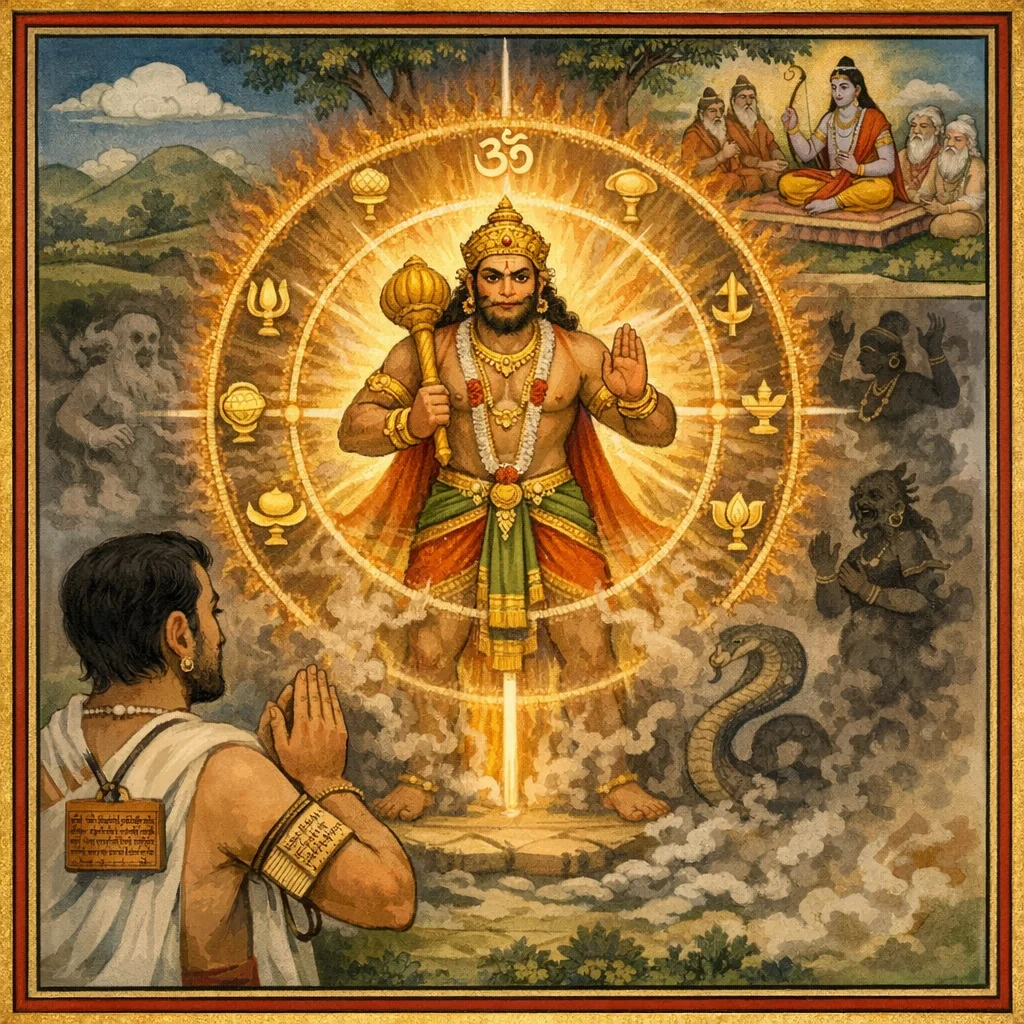
The Exposition of Hanumān’s Protective Kavaca (Māruti-kavaca)
Sanatkumāra tells Nārada that after teaching the Kārtavīrya kavaca he will now transmit the victorious Māruti (Hanumān) kavaca, which destroys delusion and removes disturbances. He recalls an earlier visit to Śrī Rāma in Ānandavanikā, where Rāma—worshipped by the gods—bestowed this kavaca at the close of the narrative up to Rāvaṇa’s slaying, commanding that it not be revealed indiscriminately. The kavaca unfolds as a protective mapping: Hanumān is invoked to guard the directions, above/below/middle, and every part of the body from head to toes, and to protect across actions and environments (land, sky, fire, ocean, forest; battle and crisis). Threats such as ḍākinī-śākinī, Kālarātri, piśācas, serpents, rākṣasīs, disease, and hostile mantras are neutralized by Hanumān’s terrifying divine form. The hymn culminates in expansive theology, praising Hanumān as Veda- and Praṇava-form, as Brahman and vital wind, and as Brahmā–Viṣṇu–Maheśvara. The chapter ends with instructions on secrecy, inscribing it with eight fragrant substances, wearing it on the neck or right arm, and the claim that japa-siddhi enables even the “impossible”.
Shlokas
Verse 1
सनत्कुमार उवाच । कार्तवीर्यस्य कवचं कथितं ते मुनीश्वर । मोहविध्वंसनं जैत्रं मारुतेः कवचं श्रृणु ॥ १ ॥
Sanatkumāra said: O great sage, I have told you the kavaca of Kārtavīrya. Now listen to the kavaca of Māruti (Hanumān)—victorious, and a destroyer of delusion.
Verse 2
यस्य संधारणात्सद्यः सर्वे नश्यंत्युपद्रवाः । भूतप्रेतारिजं दुःखं नाशमेति न संशयः ॥ २ ॥
By merely retaining it (in mind or recitation), all disturbances are destroyed at once; suffering caused by bhūtas, pretas, or enemies comes to an end—of this there is no doubt.
Verse 3
एकदाहं गतो द्रष्टुं रामं रमयतां वरम् । आनंदवनिकासंस्थं ध्यायंतं स्वात्मनः पदम् ॥ ३ ॥
Once I went to behold Rāma, the foremost of those who gladden all beings. He dwelt in the grove called Ānandavanikā, meditating upon the supreme state of his own Self.
Verse 4
तत्र रामं रमानाथं पूजितं त्रिदशेश्वरैः । नमस्कृत्य तदादिष्टमासनं स्थितवान् पुरः ॥ ४ ॥
There I bowed to Rāma—Ramanātha, the Lord of Ramā (Lakṣmī)—who was being worshipped by the lords of the thirty-three gods. Having offered homage, I stood before him and took the seat assigned to me.
Verse 5
तत्र सर्वं मया वृत्तं रावणस्य वधांतकम् । पृष्टं प्रोवाच राजेंद्रः श्रीरामः स्वयमादरात् ॥ ५ ॥
There I recounted everything that had occurred, up to the slaying of Rāvaṇa. When asked, Śrī Rāma himself—the foremost of kings—spoke of it with reverence and care.
Verse 6
ततः कथांते भगवान्मारुतेः कवचं ददौ । मह्यं तत्ते प्रवक्ष्यामि न प्रकाश्यं हि कुत्रचित् ॥ ६ ॥
Then, at the close of the narration, the Blessed Lord bestowed upon me Māruti’s (Hanumān’s) kavaca, the protective armor. Now I shall teach it to you just as it was taught to me—for it is not to be disclosed indiscriminately anywhere.
Verse 7
भविष्यदेतन्निर्द्दिष्टं बालभावेन नारद । श्रीरामेणांजनासूनासूनोर्भुक्तिमुक्तिप्रदायकम् ॥ ७ ॥
O Nārada, this has been foretold for the time to come: by taking on the mood of a child, Śrī Rāma will grant to Añjanā’s grandson—Māruti (Hanumān)—both worldly enjoyment and liberation.
Verse 8
हनुमान् पूर्वतः पातु दक्षिणे पवनात्मजः । पातु प्रतीच्यामक्षघ्नः सौम्ये सागरतारकः ॥ ८ ॥
May Hanumān protect me in the east; in the south, may the son of the Wind-god protect. In the west, may the slayer of Akṣa protect; and in the north, may he who helped cross the ocean protect.
Verse 9
ऊर्द्ध पातु कपिश्रेष्ठः केसरिप्रियनंदनः । अधस्ताद्विष्णुभक्तस्तु पातु मध्ये च पावनिः ॥ ९ ॥
From above, may the foremost of monkeys—the beloved son who delights Kesarin—protect me. From below, may that devotee of Viṣṇu protect me; and in the middle, may the Purifier guard me.
Verse 10
लंकाविदाहकः पातु सर्वापद्भ्यो निरंतरम् । सुग्रीवसचिवः पातु मस्तकं वायुनंदनः ॥ १० ॥
May the burner of Laṅkā protect me ceaselessly from every calamity; may Vāyu’s son—Sugrīva’s minister—protect my head.
Verse 11
भालं पातु महावीरो भ्रुवोर्मध्ये निरंतरम् । नेत्रे छायापहारी च पातु नः प्लवगेश्वरः ॥ ११ ॥
May the great hero protect my forehead; may he constantly guard the space between my eyebrows. And may the Lord of the monkeys—he who removes obscuring shadows—protect our eyes.
Verse 12
कपोलौ कर्णमूले च पातु श्रीरामकिंकरः । नासाग्रमंजनासूनुः पातु वक्त्रं हरीश्वरः ॥ १२ ॥
May Śrī Rāma’s devoted servant protect my cheeks and the roots of my ears. May the son of Añjanā protect the tip of my nose; and may Hari, the Supreme Lord, protect my face.
Verse 13
पातु कंठे तु दैत्यारिः स्कंधौ पातु सुरारिजित् । भुजौ पातु महातेजाः करौ च चरणायुधः ॥ १३ ॥
May the Slayer of the daityas protect my throat; may the Conqueror of the gods’ foes protect my shoulders. May the Greatly Radiant One protect my arms, and may He whose weapon is His feet protect my hands.
Verse 14
नखान्नाखायुधः पातु कुक्षौ पातु कपीश्वरः । वक्षो मुद्रापहारी च पातु पार्श्वे भुजायुधः ॥ १४ ॥
May Nakhāyudha, whose weapon is the nails, protect me at the nails; may Kapīśvara, Lord of the vānaras, protect my belly. May Mudrāpahārī protect my chest, and may Bhujāyudha, whose weapon is the arms, protect my sides.
Verse 15
लंकानिभंजनः पातु पृष्टदेशे निरंतरम् । नाभिं श्रीरामभक्तस्तु कटिं पात्वनिलात्मजः ॥ १५ ॥
May the Destroyer of Laṅkā protect my back unceasingly. May Śrī Rāma’s devotee protect my navel, and may the son of the Wind-god protect my waist.
Verse 16
गुह्यं पातु महाप्रज्ञः सक्थिनी अतिथिप्रियः । ऊरू च जानुनी पातु लंकाप्रासादभंजनः ॥ १६ ॥
May the Great-Wise One protect my private parts; may the Lover of guests protect my thighs. May the Breaker of the palaces of Laṅkā protect my hips and my knees.
Verse 17
जंघे पातु कपिश्रेष्ठो गुल्फौ पातु महाबलः । अचलोद्धारकः पातु पादौ भास्करसन्निभः ॥ १७ ॥
May the foremost of the monkeys protect my shanks; may the mighty one protect my ankles; may the lifter of a mountain protect my feet—he whose radiance is like the Sun.
Verse 18
अङ्गानि पातु सत्त्वाढ्यः पातु पादांगुलीः सदा । मुखांगानि महाशूरः पातु रोमाणि चात्मवान् ॥ १८ ॥
May the One abounding in sattva protect my limbs; may He always protect the toes of my feet. May the Great Hero protect the organs of my face, and may the Self-possessed One protect even the hairs of my body.
Verse 19
दिवारात्रौ त्रिलोकेषु सदागतिलुतोऽवतु । स्थितं व्रजंतमासीनं पिबंतं जक्षतं कपिः ॥ १९ ॥
May Kapi—ever moving through the three worlds by day and by night—protect me: whether standing still, walking, sitting, drinking, or eating.
Verse 20
लोकोत्तरगुणः श्रीमान् पातु त्र्यंबकसंभवः । प्रमत्तमप्रमत्तं वा शयानं गहनेंऽबुनि ॥ २० ॥
May the illustrious One, endowed with qualities beyond the world—born of Tryambaka—protect us, whether heedless or heedful, even if lying in the deep waters.
Verse 21
स्थलेंऽतरिक्षे ह्यग्नौ वा पर्वते सागरे द्रुमे । संग्रामे संकटे घोरे विराङ्रूपधरोऽवतु ॥ २१ ॥
On land, in the sky, in fire, on a mountain, in the ocean, or amid trees; in battle, in peril, and in dreadful crises—may the Lord who bears the cosmic form (Virāṭ) protect me.
Verse 22
डाकिनीशाकिनीमारीकालरात्रिमरीचिकाः । शयानं मां विभुः पातु पिशाचोरगराक्षसीः ॥ २२ ॥
May the all-pervading Lord (Vibhu) protect me as I lie down to sleep—from ḍākinīs and śākinīs, from pestilence, from dreadful Kālarātri, from deceptive apparitions, and from piśācas, serpents, and rākṣasīs.
Verse 23
दिव्यदेहधरो धीमान्सर्वसत्त्वभयंकरः । साधकेंद्रावनः शश्वत्पातु सर्वत एव माम् ॥ २३ ॥
May that wise Lord—bearing a divine body, terrifying to all hostile beings, and ever the protector of the foremost among spiritual practitioners—constantly guard me from every direction.
Verse 24
यद्रूपं भीषणं दृष्ट्वा पलायंते भयानकाः । स सर्वरूपः सर्वज्ञः सृष्टिस्थितिकरोऽवतु ॥ २४ ॥
Seeing that terrifying form, even the dreadful ones flee in fear. May He—of all forms, all-knowing, and the maker of creation and preservation—protect us.
Verse 25
स्वयं ब्रह्मा स्वयं विष्णुः साक्षाद्देवो महेश्वरः । सूर्यमंडलगः श्रीदः पातु कालत्रयेऽपि माम् ॥ २५ ॥
May He—who is Himself Brahmā, Himself Viṣṇu, and directly the divine Maheśvara—abiding in the solar orb and bestowing prosperity, protect me in all the three times (past, present, and future).
Verse 26
यस्य शब्दमुपाकर्ण्य दैत्यदानवराक्षसाः । देवा मनुष्यास्तिर्यंचः स्थावरा जङ्गमास्तथा ॥ २६ ॥
On hearing whose sound (utterance), the Daityas, Dānavas, and Rākṣasas—as well as the gods, human beings, animals, and even beings that are immobile and mobile—are all affected (brought under its influence).
Verse 27
सभया भयनिर्मुक्ता भवंति स्वकृतानुगाः । यस्यानेककथाः पुण्याः श्रूयंते प्रतिकल्पके ॥ २७ ॥
Those who follow the fruits of their own deeds become free from fear, even amid assemblies. Of him, many holy narratives are heard in every age-cycle (kalpa after kalpa).
Verse 28
सोऽवतात्साधकश्रेष्ठं सदा रामपरायणः । वैधात्रधातृप्रभृति यत्किंचिद्दृश्यतेऽत्यलम् ॥ २८ ॥
May that supreme among sādhakas—ever devoted to Rāma—protect us. From the Creator’s cosmic ordinance onward, whatever little is seen in this world is exceedingly insignificant before Him.
Verse 29
विद्ध्वि व्याप्तं यथा कीशरूपेणानंजनेन तत् । यो विभुः सोऽहमेषोऽहं स्वीयः स्वयमणुर्बृहत् ॥ २९ ॥
Know that He pervades all—subtly, without any taint—appearing in the form of the Lord. That all-pervading One is “I”; this very “I” is His own Self, and by His own power He is both minute and vast.
Verse 30
ऋग्यजुःसामरूपश्च प्रणवस्त्रिवृदध्वरः । तस्मै स्वस्मै च सर्वस्मै नतोऽस्म्यात्मसमाधिना ॥ ३० ॥
In inward samādhi upon the Self, I bow to Him who is of the form of the Ṛg, Yajus, and Sāman; who is the sacred Praṇava (Oṁ); who is the threefold holy rite—to that One, to the Self within, and to the All I offer reverence.
Verse 31
अनेकानन्तब्रह्माण्डधृते ब्रह्मस्वरूपिणे । समीरणात्मने तस्मै नतोऽस्म्यात्मस्वरूपिणे ॥ ३१ ॥
I bow to Him who upholds countless infinite universes; who is of the very nature of Brahman; who abides as the vital life-breath. To that One—who is the Self’s own true form—I offer reverence.
Verse 32
नमो हनुमते तस्मै नमो मारुतसूनवे । नमः श्रीरामभक्ताय श्यामाय महते नमः ॥ ३२ ॥
Salutations to that Hanumān; salutations to the son of Māruta, the Wind-god. Salutations to the bhakta of Śrī Rāma—to the dark-hued one, the great one—salutations again.
Verse 33
नमो वानर वीराय सुग्रीवसख्यकारिणे । संकाविदहनायाथ महासागरतारिणे ॥ ३३ ॥
Salutations to the heroic Vanara who forged friendship with Sugrīva; who burned Laṅkā, and who enabled the crossing of the great ocean.
Verse 34
सीताशोकविनाशाय राममुद्राधराय च । रावणांतनिदानाय नमः सर्वोत्तरात्मने ॥ ३४ ॥
Salutations to the Supreme Self beyond all—who destroys Sītā’s sorrow, who bears Rāma’s signet-ring, and who is the decisive cause of Rāvaṇa’s end.
Verse 35
मेघनादमखध्वंसकारणाय नमोनमः । अशोकवनविध्वंसकारिणे जयदायिने ॥ ३५ ॥
Repeated salutations to the One who became the cause of the destruction of Meghanāda’s sacrifice, who laid waste the Aśoka grove, and who bestows victory.
Verse 36
वायुपुत्राय वीराय आकाशोदरगामिने । वनपालशिरश्छेत्रे लंकाप्रासादभंजिने ॥ ३६ ॥
Salutations to the heroic son of Vāyu, who moves through the vast expanse of the sky; who cut down the head of the forest-guardian, and who shattered the palaces of Laṅkā.
Verse 37
ज्वलत्कांचनवर्णाय दीर्घलांगूलधारिणे । सौमित्रिजयदात्रे च रामदूताय ते नमः ॥ ३७ ॥
Salutations to you—the blazing, golden-hued one; the bearer of a long tail; the giver of victory to Saumitrī (Lakṣmaṇa); and the messenger of Rāma.
Verse 38
अक्षस्य वधकर्त्रे च ब्रह्मशस्त्रनिवारिणे । लक्ष्मणांगमहाशक्तिजातक्षतविनाशिने ॥ ३८ ॥
Salutations to Him who slew Akṣa, who averted the Brahmā-weapon (Brahmāstra), and who destroyed the wound caused by the great Śakti that struck Lakṣmaṇa’s body.
Verse 39
रक्षोघ्नाय रिपुघ्नाय भूतघ्नाय नमोनमः । ऋक्षवानरवीरौघप्रासादाय नमोनमः ॥ ३९ ॥
Repeated salutations to Him who destroys the rākṣasas, who destroys enemies, who destroys malevolent beings. Repeated salutations to Him who is the exalted refuge and support of the hosts of heroic bears and vānaras.
Verse 40
परसैन्यबलघ्नाय शस्त्रास्त्रघ्नाय ते नमः । विषघ्नाय द्विषघ्नाय भयघ्नाय नमोनमः ॥ ४० ॥
Salutations to You, the destroyer of the strength of enemy armies; salutations to You, the neutralizer of weapons and missiles (astras). Salutations again and again to You, the remover of poison, the destroyer of foes, and the dispeller of fear.
Verse 41
महीरिपुभयघ्नाय भक्तत्राणैककारिण । परप्रेरितमन्त्राणां मंत्राणां स्तंभकारिणे ॥ ४१ ॥
Salutations to Him who destroys the fear caused by enemies on earth; who is solely devoted to protecting His devotees; and who can paralyze, rendering ineffective, mantras impelled by others.
Verse 42
पयः पाषाणतरणकारणाय नमोनमः । बालार्कमंडलग्रासकारिणे दुःखहारिणे ॥ ४२ ॥
Repeated salutations to Him who makes even stones cross over by water; salutations to Him who can swallow the orb of the rising sun, the remover of sorrow.
Verse 43
नखायुधाय भीमाय दन्तायुधधराय च । विहंगमाय शवाय वज्रदेहाय ते नमः ॥ ४३ ॥
Salutations to You—armed with claws, the Terrible One; bearing teeth as weapons; the Bird-like One; the One who lies like a corpse in yogic stillness; and the One whose body is adamantine like the thunderbolt-vajra.
Verse 44
प्रतिग्रामस्थितायाथ भूतप्रेतवधार्थिने । करस्थशैलशस्त्राय राम शस्त्राय ते नमः ॥ ४४ ॥
Salutations to You—O Rāma-weapon—who abides in every village, whose purpose is the destruction of bhūtas and pretas, and whose weapon is a rocky missile held in the hand.
Verse 45
कौपीनवाससे तुभ्यं रामभक्तिरताय च । दक्षिणाशाभास्कराय सतां चन्द्रोदयात्मने ॥ ४५ ॥
Salutations to You—who wear only a loincloth, who delight in devotion to Rāma; who are like the sun rising in the southern quarter, and who are, for the virtuous, the very essence of moonrise—cool, auspicious illumination.
Verse 46
कृत्याक्षतव्यथाघ्नाय सर्वक्लेशहराय च । स्वाम्याज्ञापार्थसंग्रामसख्यसंजयकारिणे ॥ ४६ ॥
Salutations to Him who destroys the pain caused by hostile rites and injuries, and who removes every affliction; who, by the command of His Lord, became the charioteer-companion in Arjuna’s battle, and who brings about victory.
Verse 47
भक्तानां दिव्यवादेषु संग्रामे जयकारिणे । किल्किलावुवकाराय घोरशब्दकराय च ॥ ४७ ॥
Salutations to Him who grants victory to devotees in the divine contest of battle—who raises the jubilant war-cries, the “kilkilā” shouts, and who produces the awe-inspiring, thunderous sound.
Verse 48
सर्वाग्निव्याधिसंस्तंभकारिणे भयहारिणे । सदा वनफलाहारसंतृप्ताय विशेषतः ॥ ४८ ॥
Salutations to Him who arrests all fevers and diseases, who removes fear, and who is especially pleased by one who is ever content with a diet of forest fruits.
Verse 49
महार्णवशिलाबद्ध्वसेतुबंधाय ते नमः । इत्येतत्कथितं विप्र मारुतेः कवचं शिवम् ॥ ४९ ॥
Salutations to you, the one who—having bound stones—constructed the bridge across the great ocean. Thus, O brāhmaṇa, has been declared the auspicious protective hymn (kavaca) of Māruti (Hanumān).
Verse 50
यस्मै कस्मै न दातव्यं रक्षणीयं प्रयत्नतः । अष्टगंधैर्विलिख्याथ कवचं धारयेत्तु यः ॥ ५० ॥
It should not be given to just anyone; it must be carefully guarded. And whoever inscribes it with the eight fragrant substances and then wears this protective amulet (kavaca) obtains its protection.
Verse 51
कंठे वा दक्षिणे बाहौ जयस्तस्य पदे पदे । किं पुनर्बहुनोक्तेन साधितं लक्षमादरात् ॥ ५१ ॥
Whether worn on the neck or on the right arm, victory attends him at every step. What need is there to say more? The goal is surely accomplished with reverent care.
Verse 52
प्रजप्तमेतत्कवचमसाध्यं चापि साधयेत् ॥ ५२ ॥
When this protective kavaca is properly recited and perfected through japa, it can accomplish even what is considered impossible.
Verse 53
इति श्रीबृहन्नारदीयपुराणे पूर्वभागे बृहदुपाख्याने तृतीयपादे हनुमत्कवचनिरूपणं नामाष्टसप्ततितमोऽध्यायः ॥ ७८ ॥
Thus ends the seventy-eighth chapter, entitled “The Exposition of Hanumān’s Protective Kavaca,” in the earlier section of the Śrī Bṛhannāradīya Purāṇa, within the Great Narrative, in the Third Pāda.
Frequently Asked Questions
Kavacas are treated as mantra-technology requiring adhikāra, restraint, and correct handling; secrecy preserves efficacy, prevents misuse, and maintains the integrity of the guru-to-disciple transmission emphasized by Purāṇic and Tantric-inflected norms.
It resembles kavaca/nyāsa logic: the deity is installed as guardian of the dik (quarters), ūrdhva-adhaḥ (above/below), madhya (center), and aṅgas (limbs), creating a sacralized protective field around the practitioner for daily acts and extraordinary dangers.
Spirit afflictions (bhūta, preta, piśāca), ḍākinī/śākinī influences, Kālarātri fear, deceptive apparitions, serpents and rākṣasīs, disease/fever, enemy weapons, and hostile or externally impelled mantras.
While invoking Hanumān for concrete protection and victory, it also praises him as Veda- and Praṇava-form, as Brahman and prāṇa, and as identical with Brahmā–Viṣṇu–Maheśvara—linking bhakti practice to a non-dual, all-pervading theological vision.