The Account of Kārtavīrya’s Protective Kavaca (Kārtavīrya-kavaca-vṛttānta)
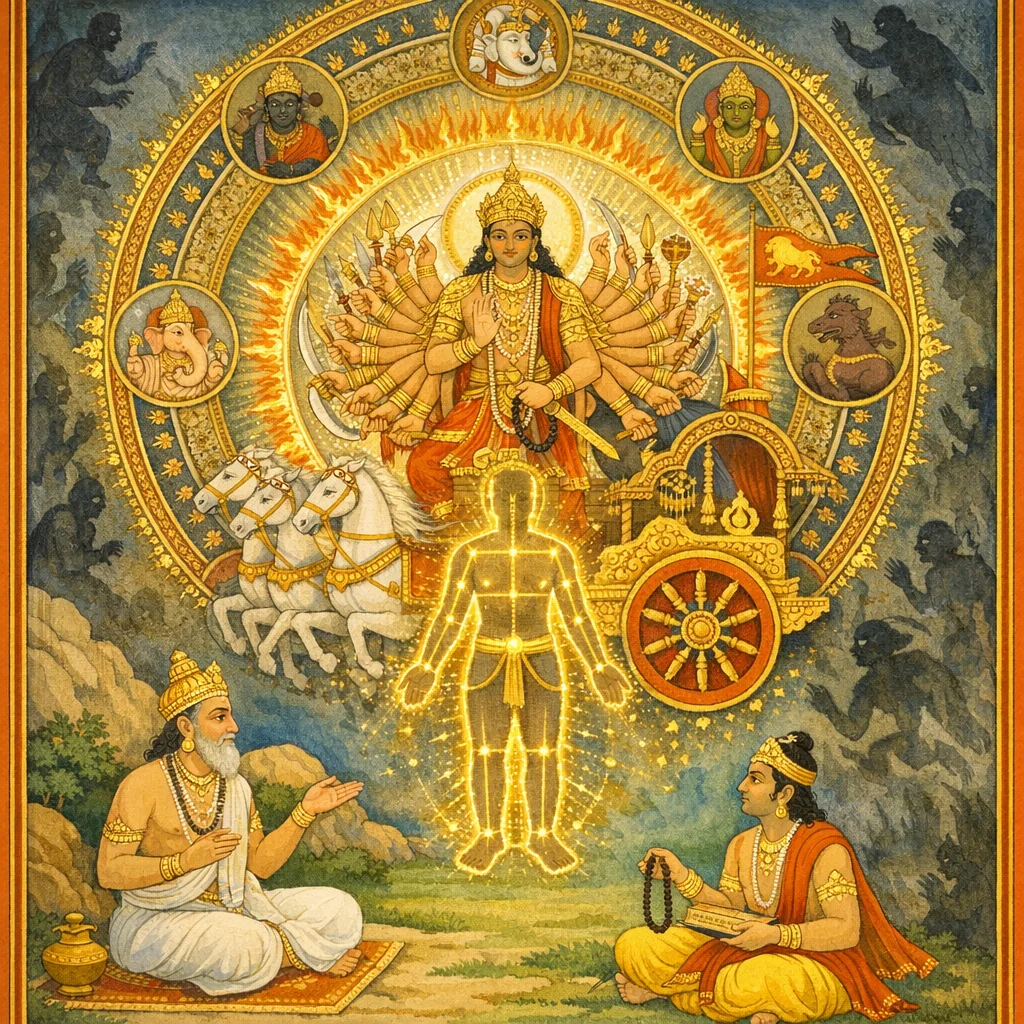
Nārada praises Sanatkumāra for disclosing a hidden tantra procedure and asks for the kavaca of Kīrtavīrya/Kārtavīrya. Sanatkumāra teaches a wondrous protective armor-hymn that grants siddhi in undertakings. It begins with a visionary image of the thousand-armed, weapon-bearing sovereign on a radiant chariot, then instructs meditation on the form descended from Hari’s Cakra and the utterance of “rakṣā.” Protection is arranged by directions, their guardians, and āvaraṇa powers, followed by an extensive limb-by-limb and marma-point safeguarding. The kavaca is applied against thieves, enemies, sorcery, epidemics, nightmares, grahas, bhūtas/pretas/vetālas, poisons, serpents, wild beasts, evil omens, and planetary afflictions. A stotra-like catalogue of Kārtavīrya’s qualities culminates in phalaśruti and prayoga, giving recitation counts for recovering stolen goods, winning disputes, easing disease, release from bondage, and safe travel. Sanatkumāra attributes the teaching to Dattātreya and enjoins Nārada to preserve it as a fulfiller of desired aims.
Shlokas
Verse 1
नारद उवाच । साधु साधु महाप्राज्ञ सर्व तंत्रविशारद । त्वया मह्यं समाख्यातं विधानं तंत्रगोपितम् ॥ १ ॥
Nārada said: “Excellent, excellent! O greatly wise one, well-versed in every tantra—you have explained to me the prescribed procedure that is kept concealed within the tantras.”
Verse 2
अधुना तु महाभाग कीर्तवीर्यहनूमतोः । कवचे श्रोतुमिच्छामि तद्वदस्वकृपानिधे ॥ २ ॥
Now, O greatly fortunate one, I wish to hear the protective hymn (kavaca) of Kīrtavīrya Hanūmān. O treasure-house of compassion, please teach it to me.
Verse 3
सनत्कुमार उवाच । श्रृणु विप्रेन्द्र वक्ष्यामि कवचं परमाद्भुतम् । कार्तवीर्यस्य येनासौ प्रसन्नः कार्यसिद्धिकृत् ॥ ३ ॥
Sanatkumāra said: “Listen, O best of brāhmaṇas; I shall declare a supremely wondrous protective hymn (kavaca). By this, Kārtavīrya became pleased and thus became the accomplisher of success in one’s undertakings.”
Verse 4
सहस्रादित्यसंकाशे नानारत्नसमुज्ज्वंले । भास्वद्ध्वजपताकाढ्ये तुरगायुतभूषिते ॥ ४ ॥
It shone like a thousand suns, blazing with many kinds of jewels—adorned with radiant banners and flags, and embellished with thousands of horses.
Verse 5
महासंवर्तकांभोधिभीमरावविराविणि । समुद्धृतमहाछत्र्रवितानितवियत्पथे ॥ ५ ॥
On the sky-path where vast, uplifted canopies like great umbrellas are spread out, there resounded the terrifying roar of the mighty saṃvartaka clouds of cosmic dissolution.
Verse 6
महारथवरे दीप्तनानायुधविराजिते । सुस्थितं विपुलोदारं सहस्रभुजमंडितम् ॥ ६ ॥
Upon that most excellent great chariot, radiant with the splendor of many kinds of weapons, there stood a form—steadfast and firmly established—vast and magnificent, adorned with a thousand arms.
Verse 7
वामैरुद्दंडकोदंडान्दधानमपरैः शरान् । किरीटहारमुकुटकेयूरवलयांगदैः ॥ ७ ॥
With some of his left hands he held the staff and the bow; with his other hands he held arrows—adorned with crown and garland, diadem, armlets, bracelets, and ornaments upon the upper arms.
Verse 8
मुद्रिकोदरबन्धाद्यैर्मौंजीनूपुरकादिभिः । भूषितं विविधाकल्पैर्भास्वरैः सुमहाधनैः ॥ ८ ॥
Adorned with rings, waist-bands and the like, with the sacred muñja-girdle, anklets, and other ornaments—arrayed in many kinds of brilliant embellishments of great worth.
Verse 9
आबद्धकवचं वीरं सुप्रसन्नाननांबुजम् । धनुर्ज्या सिंहनादेन कंपयंतं जगत्र्रयम् ॥ ९ ॥
I beheld that heroic warrior, clad in firmly fastened armor, his lotus-like face radiantly serene—who, with the lion-roar twang of his bowstring, made the three worlds tremble.
Verse 10
सर्वशत्रुक्षयकरं सर्वव्याधिविनाशनम् । सर्वसंपत्प्रदातारं विजयश्रीनिषेवितम् ॥ १० ॥
It brings about the destruction of all enemies, annihilates all diseases, bestows every form of prosperity, and is attended by the splendor of victory and good fortune.
Verse 11
सर्वसौभाग्यदं भद्रं भक्ताभयविधायिनम् । दिव्यमाल्यानुलेपाढ्यं सर्वलक्षणसंयुतम् ॥ ११ ॥
Auspicious and bestowing all good fortune, granting fearlessness to devotees—adorned with divine garlands and fragrant unguents, and endowed with every mark of excellence.
Verse 12
रथनागाश्वपादातवृंदमध्यगमीश्वरम् । वरदं चक्रवर्तीनं सर्वलोकैकपालकम् ॥ १२ ॥
In the midst of the troops of chariots, elephants, horses, and foot-soldiers moved the Lord—the boon-giver, the universal sovereign (cakravartin), the sole protector of all the worlds.
Verse 13
समानोदितसाहस्रदिवाकरसमद्युतिम् । महायोगभवैश्वर्यकीर्त्याक्रांतजगत्र्रयम् ॥ १३ ॥
Radiant like a thousand suns risen together, and pervading the three worlds with the fame of the sovereignty born of supreme yogic power.
Verse 14
श्रीमच्चक्रं हरेरंशादवतीर्णं महीतले । सम्यगात्मादिभेदेन ध्यात्वा रक्षामुदीरयेत् ॥ १४ ॥
Having properly meditated on the glorious discus (Cakra) that has descended upon the earth as a portion of Hari, distinguishing it in its aspects beginning with the Self, one should then utter the protective formula (rakṣā).
Verse 15
अस्यांगमूर्तयः पंच पांतु मां स्फटिकोज्ज्वलाः । अग्नीशासुरवायव्यकोणेषु हृदयादिकाः ॥ १५ ॥
May the five limb-manifestations of this (deity/mantra), radiant like crystal, protect me—stationed in the directions and corners: the heart and the rest, in the southeast, east, southwest, and northwest.
Verse 16
सर्वतोस्रज्वलद्रूपा दरचर्मासिपाणयः । अव्याहतबलैश्वर्यशक्तिसामर्थ्यविग्रहाः ॥ १६ ॥
Blazing in form on every side, with skin and sword in their hands, they bore bodies endowed with unimpaired strength, sovereign power, sacred energy, and complete capability.
Verse 17
क्षेमंकरीशक्तियुतश्चौरवर्गविभञ्जनः । प्राचीं दिशं रक्षतु मे बाणबाणासनायुधः ॥ १७ ॥
May He, endowed with the Kṣemaṅkarī-Śakti, the shatterer of bands of thieves, and armed with arrows and bow, protect me in the eastern direction.
Verse 18
श्रीकरीशक्तिसहितो मारीभयविनाशकः । शरचापधरः श्रीमान् दिशं मे पातु दक्षिणाम् ॥ १८ ॥
May the glorious Lord—attended by the Śrīkarī-Śakti that bestows prosperity, the destroyer of fears born of epidemics and afflictions, the illustrious bearer of bow and arrows—protect my southern direction.
Verse 19
महावश्यकरीयुक्तः सर्वशत्रुविनाशकृत् । महेषुचापधृक्पातु मम प्राचेतसीं दिशम् ॥ १९ ॥
May the Lord who bears the great bow, endowed with the power of supreme subjugation (Mahāvaśyakarī) and the destroyer of all enemies, protect my Prācetasa direction.
Verse 20
यशःकर्या समायुक्तो दैत्यसंघविनाशनः । परिरक्षतु मे सम्यग्विदिशं चैत्रभानवीम् ॥ २० ॥
May Caitrabhānavī—joined with the power that brings fame and the destroyer of the hordes of Dāityas—fully and rightly protect me in the intermediate direction (vidiś).
Verse 21
विद्याकरीसमायुक्तः सुमहहुःखनाशनः । पातु मे नैर्ऋतीं चापपाणिर्विदिशमीश्वरः ॥ २१ ॥
May the Lord—bestower of knowledge and destroyer of great suffering—protect me in the south‑western direction; may the Sovereign, bow in hand, guard my quarter.
Verse 22
धनकर्या समायुक्तो महादुरित नाशनः । इष्वासनेषुधृक्पातु विदिशं मम वायवीम् ॥ २२ ॥
May the wielder of the bow and bearer of arrows—endowed with the power of prosperity and the destroyer of great sin—protect my north‑western direction, the Vāyavī quarter.
Verse 23
आयुःकर्या युतः श्रीमान्महाभयविनाशनः । चापेषुधारी शैवीं मे विदिशं परिरक्षतु ॥ २३ ॥
May the auspicious, life‑bestowing, and prosperous Lord—destroyer of great fear—bearing a bow and a quiver of arrows, protect my Śaiva quarter, the direction of the south‑east.
Verse 24
विजयश्रीयुतः साक्षात्सहस्रारधरो विभुः । दिशमूर्द्ध्वामवतु मे सर्वदुष्टभयंकरः ॥ २४ ॥
May the all‑pervading Lord—manifest in truth, endowed with the glory of victory and bearing the thousand‑spoked chakra—protect me from the upward direction, He who is terrifying to all wicked beings.
Verse 25
शंखभृत्सुमहाशक्तिसंयुतोऽप्यधरां दिशम् । परिरक्षतु मे दुःखध्वांतसम्भेदभास्करः ॥ २५ ॥
May the radiant One like the Sun, who shatters the darkness of my sorrow, protect me in the lower direction as well—He who bears the conch and is endowed with supreme divine power.
Verse 26
महायोगसमायुक्तः सर्वदिक्चक्रमंडलः । महायोगीश्वरः पातु सर्वतो मम पद्मभृत् ॥ २६ ॥
May the Lord, united with the Supreme Yoga, whose sphere is the wheel of all directions—the Great Lord of yogins, the Lotus-bearer—protect me from every side.
Verse 27
एतास्तु मूर्तयो रक्ता रक्तमाल्यांशुकावृताः । प्रधानदेवतारूपाः पृथग्रथवरे स्थिताः ॥ २७ ॥
These forms, however, are crimson—adorned with red garlands and clothed in red garments—each embodying a principal deity, and each stationed separately upon an excellent chariot.
Verse 28
शक्तयः पद्महस्ताश्चत नीलेंदीवरसन्न्निभाः । शुक्लमाल्यानुवसनाः सुलिप्ततिलकोज्ज्वलाः ॥ २८ ॥
The divine powers (Śaktis), lotus in hand, appeared like blue water-lilies; adorned with white garlands and garments, they shone brilliantly with well-applied tilaka marks.
Verse 29
तत्पार्शदेश्वराः स्वस्ववाहनायुधभूषणाः । स्वस्वदिक्षु स्थिताः पांतु मामिंद्राद्या महाबलाः ॥ २९ ॥
May the mighty ones beginning with Indra—those guardian lords stationed on every side, each bearing their own mounts, weapons, and ornaments—protect me from their respective directions.
Verse 30
एतस्तस्य समाख्याताः सर्वावरणदेवताः । सर्वतो मां सदा पातुं सर्वशक्तिसमन्विताः ॥ ३० ॥
Thus, the deities presiding over all the protective enclosures (āvaraṇas) of that (rite/mantra) have been declared. Endowed with every power, may they always protect me on all sides.
Verse 31
हृदये चोदरे नाभौ जठरे गुह्यमण्डले । तेजोरूपाः स्थिताः पातुं वांछासुखनद्रुमाः ॥ ३१ ॥
May those radiant, fiery powers—abiding in the heart, the belly, the navel, the abdomen, and the secret region—protect the practitioner, becoming wish-fulfilling trees that grant the happiness one seeks.
Verse 32
दिशं चान्ये महावर्णा मन्त्ररूपा महोज्ज्वलाः । व्यापकत्वेन पांत्वस्मानापादतलमस्तकम् ॥ ३२ ॥
And may those other great, radiant powers—of majestic form and of the very nature of mantra—protect us from every direction, pervading us completely, from the soles of the feet up to the crown of the head.
Verse 33
कार्तवीर्यः शिरः पातु ललाटं हैहयेश्वरः । सुमुखो मे मुखं पातु कर्णौ व्याप्तजगत्त्रयः ॥ ३३ ॥
May Kārtavīrya protect my head; may Haihayeśvara protect my forehead. May Sumukha protect my face, and may the One who pervades the three worlds protect my ears.
Verse 34
सुकुमारो हनुं पातु भ्रूयुगं मे धनुर्धरः । नयनं पुंमडरीकाक्षगो नासिकां मे गुणाकरः ॥ ३४ ॥
May Sukumāra protect my jaw; may Dhanurdhara protect my pair of eyebrows. May Puṇḍarīkākṣa protect my eyes; may Guṇākara protect my nose.
Verse 35
अधरोष्ठौ सदा पातु ब्रह्ज्ञेयो द्विजान्कविः । सर्वशास्त्रकलाधारी जिह्वां चिबुकमव्ययः ॥ ३५ ॥
May my lower lip always be protected by the knower of Brahman—the poet among the twice-born. May the imperishable bearer of all scriptures and arts protect my tongue and my chin.
Verse 36
दत्तात्रेयप्रियः कंठं स्कंधौ राजकुलेश्वरः । भुजौ दशास्यदर्पघ्नो हृदयं मे महाबलः ॥ ३६ ॥
May the Beloved of Dattātreya protect my throat; may Rājakuleśvara guard my shoulders; may the Slayer of the pride of the Ten-faced (Rāvaṇa) protect my arms; and may the Greatly Powerful One safeguard my heart.
Verse 37
कुक्षिं रक्षतु मे विद्वान् वक्षः परपुरंजयः । करौ सर्वार्थदः पातुकराग्राणि जगत्प्रियः ॥ ३७ ॥
May the All-knowing Lord protect my abdomen; may the Conqueror of hostile cities protect my chest. May the Bestower of all aims protect my hands, and may the Beloved of the world protect my fingertips.
Verse 38
रेवांबगुलीलासंहप्तो जठरं परिरक्षतु । वीरशूरस्तु मे नाभिं पार्श्वौ मे सर्वदुष्टहा ॥ ३८ ॥
May Reva—whose sportive play is in the waters—protect my belly; and may the heroic, valiant one guard my navel; may the destroyer of all wickedness protect my sides.
Verse 39
सहस्रभुजनृत्पृष्टं सप्तद्वीपाधिपः कटिम् । ऊरू माहिष्मतीनाथो जानुनी वल्लभो भुवः ॥ ३९ ॥
May the lord of the seven continents protect my hips; may the thousand-armed king guard my back; may the ruler of Māhiṣmatī protect my thighs; and may the beloved of the earth protect my knees.
Verse 40
जंघे वीराधिपः पातु पातु पादौ मनोजवः । पातु सर्वायुधधरः सर्वांगं सर्वमर्मसु ॥ ४० ॥
May Vīrādhipa protect my shanks; may Manojava protect my feet. May the Bearer of all weapons protect my entire body—especially at all the vital points (marmas).
Verse 41
सर्वदुष्टांतकः पातु धात्वष्टककलेवरम् । प्राणादिदशजीवेशान्सर्वशिष्टेष्टदोऽवतु ॥ ४१ ॥
May the Destroyer of all wickedness protect this body, formed of the eight elemental constituents; and may the Bestower of all that the righteous desire protect the ten life-forces beginning with prāṇa, the lords of embodied life.
Verse 42
वशीकृतेंद्रियग्रामः पातु सर्वेन्द्रियाणि मे । अनुक्तमपि यत्स्थान शरीरांतर्बहिश्च यत् ॥ ४२ ॥
May He who has brought the host of senses under perfect control protect all my senses; and may He also protect every place not expressly named—whatever lies within my body and whatever lies outside it.
Verse 43
तत्सर्वं पातु मे सर्वलोकनाथेश्वरेश्वरः । वज्रात्सारतरं चेदं शरीरं कवचावृतम् ॥ ४३ ॥
May the Supreme Lord—sovereign even over the Lord of all worlds—protect me in every way. Covered by this protective armor, may this body become harder than a thunderbolt.
Verse 44
बाधाशतविनिर्मुक्तमस्तु मे भयवर्जितम् । बद्धेदं कवचं दिव्यमभेद्यं हैहयेशितुः ॥ ४४ ॥
May I be freed from hundreds of afflictions and remain without fear. This divine armour (kavaca) has been fastened upon me; it is impenetrable, belonging to the Lord of the Haihayas.
Verse 45
विचरामि दिवा रात्रौ निर्भयेनांतरात्मना । राजमार्गे महादुर्गे मार्गे चौरा दिसंकुले ॥ ४५ ॥
I move about by day and by night with an inwardly fearless spirit—on the king’s highway, on perilous paths, and even on roads crowded with thieves.
Verse 46
विषमे विपिने घोरे दावाग्नौ गिरिकंदरे । संग्रामे शस्त्रसंघाते सिंहव्याघ्रनिषेविते ॥ ४६ ॥
In a perilous and dreadful wilderness; amid a forest-conflagration; in a mountain-cave; in battle, in the clash of weapons; and in places frequented by lions and tigers—even there, the Lord Vishnu’s protection prevails.
Verse 47
गह्वरे सर्वसंकीर्णे संध्याकाले नृपालये । विवादे विपुलावर्ते समुद्रे च नदीतटे ॥ ४७ ॥
In a deep ravine; in a place crowded on every side; at twilight; within a king’s residence; amid dispute; in a mighty whirlpool; and at the sea or on a riverbank—one should be wary and not undertake improper acts there or then.
Verse 48
परिपंथिजनाकीर्णे देशे दस्युगणावृते । सर्वस्वहरणे प्राप्ते प्राप्ते प्राणस्य संकटे ॥ ४८ ॥
When one is in a land crowded with hostile travelers, surrounded by bands of robbers; when the loss of all one’s possessions has arrived, and even one’s very life has come into danger—
Verse 49
नानारोगज्वरावेशे पिशाचप्रेतयातने । मारीदुःस्वप्नपीडासु क्लिष्टे विश्वासघातके ॥ ४९ ॥
In the grip of many diseases and feverish attacks; in torments caused by piśācas and pretas; in afflictions from epidemics and distressing nightmares; and in severe crises marked by betrayal of trust—take refuge in Hari’s holy Name for protection and relief.
Verse 50
शारीरे च महादुःखे मानसे च महाज्वरे । आधिव्याधिभये विघ्नज्वालोपद्रवकेऽपि च ॥ ५० ॥
In great bodily suffering and in intense mental fever; even in fear of afflictions and disease; and amid obstacles, blazing dangers, and calamities—then is the time to take refuge in Hari and apply the prescribed spiritual remedy.
Verse 51
न भवतु भयं किंचित्कवचेनावृतस्य मे । आंगुतुकामानखिलानस्मद्वसुविलुंपकान् ॥ ५१ ॥
May there be no fear whatsoever for me, who am covered by this protective armor; may it repel all intruders who seek an opening and would plunder my possessions.
Verse 52
निवारयतु दोर्दंडसहस्रेण महारथः । स्वकरोद्धृतसाहस्रपाशबद्धान्सुदुर्जयान् ॥ ५२ ॥
Let the great chariot-warrior restrain them with a thousand arm-staffs—those utterly hard to conquer, bound fast by a thousand nooses lifted by his own hands.
Verse 53
संरुद्धूगतिसामर्थ्यान्करोतु कृतवीर्यजः । सृणिसाहस्रनिर्भिन्नान्सहस्रशरखंडितान् ॥ ५३ ॥
Let the son of Kṛtavīrya display his power of restrained onrush and speed—piercing a thousand men of the Sṛṇi clan and cutting them down with a thousand arrows.
Verse 54
राजचूडामणिः क्षिप्रं करोत्वस्मद्विरोधकान् । खङ्ग साहस्रदलितान्सहस्रमुशलार्दितान् ॥ ५४ ॥
May Rājacūḍāmaṇi swiftly reduce those who oppose us—splitting them into a thousand pieces by the sword, and crushing them with a thousand iron clubs.
Verse 55
चौरादि दुष्टसत्त्वौघान्करोतु कमलेक्षणः । स्वशंखनादसंत्रस्तान्सहस्रारसहस्रभृत् ॥ ५५ ॥
May the lotus-eyed Lord—He who bears the thousand-spoked discus—drive away the swarms of wicked beings such as thieves, terrifying them by the thunder of His own conch-blast.
Verse 56
अवतारो हरेः साक्षात्पालयत्वखिलं मम । कार्तवीर्य महावीर्य सर्वदुष्टविनाशन ॥ ५६ ॥
May You—Hari’s own manifest incarnation—protect all that is mine. O Kārtavīrya, mighty hero, destroyer of all the wicked!
Verse 57
सर्वत्र सर्वदा दुष्टचौरान्नाशाय नाशय । किं त्वं स्वपिषि दुष्टघ्न किं तिष्टसि चिरायासि ॥ ५७ ॥
Everywhere, at all times—destroy the wicked thieves, bringing about their ruin. O slayer of the wicked, why do You sleep? Why do You stand still and delay so long?
Verse 58
उत्तिष्ठ पाहि नः सर्वभयेभ्यः स्वसुतानिव । ये चौरा वसुहर्तारो विद्विषो ये च हिंसकाः ॥ ५८ ॥
Rise up and protect us from every fear, as You would protect Your own sons—against thieves, plunderers of wealth, enemies, and the violent.
Verse 59
साधुभीतिकरा दुष्टाश्छद्मका ये दुराशयाः । दुर्हृदो दुष्टभू पाला दुष्टामात्याश्च पापकाः ॥ ५९ ॥
The wicked who strike fear into the righteous—deceitful, of evil intent; ill-wishers; corrupt rulers of the land; and sinful, wicked ministers—are to be known as dangerous.
Verse 60
ये च कार्यविलोप्तोरो ये खलाः परिपंथिनः । सर्वस्वहारिणां ये च पंच मायाविनोऽपरेः ॥ ६० ॥
And those who obstruct one’s rightful undertakings; the wicked who waylay others on the road; those who seize away everything; and the other five deceitful tricksters as well—all such persons are to be known as harmful.
Verse 61
महाक्लेशकरा म्लेच्छा दस्यवो वृषलाश्च ये । येऽग्निदा गरदातारो वंचकाः शस्त्रपाणयः ॥ ६१ ॥
The mlecchas, bandits, and depraved men who bring great anguish—those who set fires, administer poison, practice deceit, and roam about armed—are all reckoned among the grievously harmful.
Verse 62
ये पापा दुष्टकर्माणो दुःखदा दुष्टबुद्धयः । व्याजकाः कुपथासक्ता ये च नानाभयप्रदाः ॥ ६२ ॥
Those who are sinful and given to wicked deeds—who inflict suffering, whose minds are perverse; those who live by deceit, cling to wrong paths, and spread many kinds of fear—
Verse 63
छिद्रान्वेषरता नित्यं येऽस्मान्बाधितुमुद्यताः । ते सर्वे कार्तवीर्यस्य महाशंखरवाहताः ॥ ६३ ॥
Those ever intent on seeking faults and eager to harass us—every one of them is struck down by the mighty blast of Kārtavīrya’s great conch.
Verse 64
सहसा विलयं यान्तु दूरदिव विमोहिताः । ये दानवा महादित्या ये यक्षा ये च राक्षसाः ॥ ६४ ॥
May they suddenly rush to destruction, as though driven far away in utter delusion—those Dānavas, the great Ādityas, the Yakṣas, and the Rākṣasas.
Verse 65
पिशाचा ये महासत्त्वा ये भूतब्रह्मराक्षसाः । अपस्मारग्रहा ये च ये ग्रहाः पिशिताशनाः ॥ ६५ ॥
Whether they be Piśācas of great might, or Bhūtas and Brahma-rākṣasas; whether seizure-spirits that bring on epilepsy (apasmāra-grahas), or any flesh-eating Grahas—such afflictive beings are what is meant here.
Verse 66
महालोहितभोक्तारो वेताला ये च गुह्यकाः । गंधर्वाप्सरसः सिद्धा ये च देवादियोनयः ॥ ६६ ॥
Those who feed on great blood—the Vetālas and the secretive Guhyakas; the Gandharvas and Apsarases; the Siddhas; and also those born of divine and other superhuman kinds—all are included.
Verse 67
डाकिन्यो द्रुणसाः प्रेताः क्षेत्रपाला विनायकाः । महाव्याघ्रमहामेघा महातुरागरूपकाः ॥ ६७ ॥
Dākinīs, flesh-eating Druṇasas, and pretas; guardians of sacred precincts and Vināyakas; appearing as mighty tigers, as vast storm-clouds, and in the forms of great and terrifying horses—such beings are described.
Verse 68
महागजा महासिंहा महामहिषयोनयः । ऋक्षवाराहशुनकवानरोलूकमूर्तयः ॥ ६८ ॥
They are born as great elephants and great lions, and from the wombs of mighty buffaloes; and they assume forms such as bears, boars, dogs, monkeys, and owls.
Verse 69
महोष्ट्रखरमार्जारसर्पगोवृषमस्तकाः । नानारूपा महासत्त्वा नानाक्लेशसहस्रदाः ॥ ६९ ॥
With heads like great camels, donkeys, cats, serpents, cows, and bulls, these mighty beings appear in many forms and inflict thousands of different afflictions.
Verse 70
नानारोगकराः क्षुद्रा महावीर्या महाबलाः । वातिकाः पैत्तिका घोरा श्लैष्मिकाः सान्निपातिकाः ॥ ७० ॥
They are small in form, yet potent and strong, bringing forth many diseases—some arising from vāta, some from pitta; some dreadful, some from kapha, and some caused by the combined imbalance of all three doṣas (sannipāta).
Verse 71
माहेश्वरा वैष्णवाश्च वैरिंच्याश्च महाग्रहाः । स्कांदा वैनायकाः क्रूरा ये च प्रमथगुह्यकाः ॥ ७१ ॥
The great afflictive forces (mahā-grahas) are of many kinds—those connected with Maheśvara, with Viṣṇu, and with Vairiñca (Brahmā); likewise the Skanda-type and the Vināyaka-type, and the fierce ones such as the Pramathas and the Guhyakas.
Verse 72
महाशत्रुहा रौद्रा महामारीमसूरिकाः । ऐकाहिका व्द्याहिकाश्च त्र्याहिकाश्च महाज्वराः ॥ ७२ ॥
‘The great foe-destroyer’ fever, the ‘fierce’ (raudra) fever, the great epidemic, and asūrikā (smallpox); and the one-day, two-day, and three-day fevers—these are the great fevers (mahā-jvaras).
Verse 73
चातुर्थिकाः पाक्षिकाश्च मास्याः षाण्मासिकाश्च ये । सांवत्सरा दुर्निवार्या ज्वराः परमदारुणाः ॥ ७३ ॥
The fevers that recur every fourth day, every fortnight, every month, and every six months—and those that last for a year—are exceedingly dreadful and difficult to ward off.
Verse 74
स्वाप्निका ये महोत्पाता ये च दुःस्वाप्निका ग्रहाः । कूष्मांडा जृंभिका भौमा द्रोणाः सान्निध्यवंचकाः ॥ ७४ ॥
Those great portents that arise through dreams, and those grahas that cause evil dreams—together with the influences known as Kūṣmāṇḍas, Jṛmbhikās, Bhaumas, Droṇas, and the Sānnidhya-vañcakas—are to be understood as ominous disturbances.
Verse 75
भ्रमिकाः प्राणहर्तारो ये च बालग्रहादयः । मनोबुद्वीन्द्रियहराः स्फोटकाश्च महाग्रहाः ॥ ७५ ॥
The Bhramikās, the life-destroyers, and the grahas beginning with those that seize children—those that rob the mind, intellect, and senses—and the Sphoṭakas: these too are great afflictive mahā-grahas.
Verse 76
महाशना बलिभुजो महाकुणपभोजनाः । दिवाचरा रात्रिचरा ये च संध्यासु दारुणाः ॥ ७६ ॥
They are ravenous eaters, feeding on bali (offerings) and consuming great heaps of carrion; some roam by day, some by night, and others are especially dreadful at the sandhyā junctions—dawn and dusk.
Verse 77
प्रमत्ता वाऽप्रमत्ता वै ये मां बाधितुमुद्यताः । ते सर्वे कार्त्तवीर्यस्य धनुर्मुक्तशराहताः ॥ ७७ ॥
Whether heedless or vigilant, all who rose up to trouble me were struck down by the arrows released from Kārttavīrya’s bow.
Verse 78
सहस्रधा प्रणश्यंतु भग्नसत्त्वबलोद्यमाः । ये सर्पा ये महानागा महागिरिबिलेशयाः ॥ ७८ ॥
May they perish in a thousand ways—those serpents and great nāgas who dwell in the caves of mighty mountains—once their courage, strength, and aggressive force are shattered.
Verse 79
कालव्याला महादंष्ट्रा महाजगरसंज्ञकाः । अनंतशूलिकाद्याश्च दंष्ट्राविषमहाभयाः ॥ ७९ ॥
There are serpents called Kālavyāla, Mahādaṃṣṭrā, and Mahājagara; and others such as Anantaśūlikā—terrifying because of the poison in their fangs, a great cause of fear.
Verse 80
अनेकशत शीर्षाश्च खंडपुच्छाश्च दारुणाः । महाविषजलौकाश्च वृश्चिका रुक्तपुच्छकाः ॥ ८० ॥
There were terrifying creatures with many hundreds of heads and with severed tails; and there were leeches filled with deadly poison, and scorpions with painful stinging tails.
Verse 81
आशीविषाः कालकूटा महाहालाहलाह्वयाः । जलसर्पा जलव्याला जलग्राहाश्च कच्छपाः ॥ ८१ ॥
Venomous serpents, the Kālakūṭa poison, and that great poison called Hālāhala; water-snakes, aquatic monsters, water-crocodiles, and tortoises as well—(all these are mentioned).
Verse 82
मत्स्यका विषपुच्छाश्च ये चान्ये जलवासिनः । जलजाः स्थलजाश्चैव कृत्रिमाश्च महाविषाः ॥ ८२ ॥
Fish and those with venomous tails, and other creatures that dwell in water—whether born in water or on land—and even artificially prepared poisons: all of these are regarded as highly poisonous.
Verse 83
गुप्तरूपा गुप्तविषा मूषिका गृहगोधिकाः । नानाविषाश्च ये घोरा महोपविषसंज्ञकाः ॥ ८३ ॥
Those that conceal their form and conceal their venom—such as rats and house-lizards—and other dreadful creatures with various poisons are designated as ‘greatly poisonous’ (mahopaviṣa).
Verse 84
येऽस्मान्बाधितुमिच्छंति शरीरप्राणनाशकाः । ते सर्वे कार्तवीर्यस्य खङ्कसाहस्रदारिताः ॥ ८४ ॥
Those who wish to harm us—destroyers of body and life-breath (prāṇa)—have all been cut down by Kārtavīrya, torn apart by his thousand swords.
Verse 85
दूरादेव विनश्यंतु प्रणष्टेंद्रियसाहसाः । मनुष्याः पशवो त्वृक्षवानरा वनगोचराः ॥ ८५ ॥
May those reckless beings, whose senses are ruined and uncontrolled, perish from afar—whether they be humans, animals, tree-dwelling monkeys, or other creatures that roam the forests.
Verse 86
सिंहव्याघ्रवराहाश्च महिषा ये महामृगाः । गजास्तुरंगा गवया रासभाः शरभा वृकाः ॥ ८६ ॥
Lions, tigers, and boars; buffaloes and other mighty beasts; elephants, horses, wild oxen, asses, śarabhas, and wolves—all these are spoken of here.
Verse 87
शुनका द्वीपिनः शुभ्रा मार्जारा बिललोलुपाः । श्रृगालाः शशकाः श्येना गुरुत्मन्तो विहंगमाः ॥ ८७ ॥
Dogs; white leopards; cats fond of burrows; jackals; hares; hawks; and mighty birds like Garuḍa—these too are counted among the beings spoken of here.
Verse 88
भेरुंडा वायसा गूध्रा हंसाद्याः पक्षिजातयः । उद्भिज्जाश्चांडजाश्चैव स्वेदजाश्च जरायुजाः ॥ ८८ ॥
Bheruṇḍas, crows, vultures, and birds such as swans are among the classes of winged creatures; and beings are also classified as sprout-born (plants), egg-born, sweat/moisture-born, and womb-born (viviparous).
Verse 89
नानाभेदकुले जाता नानाभेदाः पृथग्विधाः । येऽस्मान्बाधितुमिच्छंति सेध्यासु च दिवा निशि ॥ ८९ ॥
Born in clans of many divisions and appearing in many distinct forms, those who wish to afflict us—at the sandhyās, by day, or by night—may they be restrained and driven back.
Verse 90
ते सर्वे कार्तवीर्यस्य गदासाहस्रदारिताः । दूरादेव विनश्यंतु विनष्टगतिपौरुषाः ॥ ९० ॥
May all those—shattered by the thousand blows of Kārtavīrya’s mace—perish from afar, their course and manly prowess utterly ruined.
Verse 91
ये चाक्षेमप्रदातारः कूटमायाविनश्च ये । मारणोत्सादनोन्मूलद्वेषमोहनकारकाः ॥ ९१ ॥
And those who bring insecurity and harm, and those who practice deceitful sorcery—those who cause killing, ruin, uprooting, hatred, and delusion.
Verse 92
विश्वास घातका दुष्टा ये च स्वामिद्रुहो नराः । ये चाततायिनो दुष्टा ये पापा गोप्यहारिणः ॥ ९२ ॥
Wicked people who betray trust, men who are treacherous to their masters, vile assailants who commit violent outrages, and sinful thieves who steal what should be kept secret—all such persons are condemned.
Verse 93
दाहोपद्यातगरलशस्त्रपातातिदुःखदाः । क्षेत्रवित्तादिहरणबंधनादिभयप्रदाः ॥ ९३ ॥
They cause extreme suffering through burning, sudden calamities, poison, and the falling of weapons; and they instill fear through the seizure of land and wealth, imprisonment, and other such threats.
Verse 94
ईतयो विविधाकारो ये चान्ये दुष्टजातयः । पीडाकरा ये सततं छिद्रमिच्छंति बाधितुम् ॥ ९४ ॥
The various kinds of pestilences and other evil-born forces—those that continually cause torment and ever seek a weakness in order to obstruct—
Verse 95
ते सर्वे कार्तवीर्यस्य चक्रसाहस्रदारिताः । दूरादेव क्षयं यांतु विनष्टबलसाहसाः ॥ ९५ ॥
All of them—torn apart by the thousand discus-wheels of Kārtavīrya—were destroyed from afar, their strength and daring utterly spent.
Verse 96
ये मेघा ये महावर्षा ये वाता याश्च विद्युतः । ये महाशनयो दीप्ता ये निर्घाताश्च दारुणाः ॥ ९६ ॥
Those clouds, those torrential rains, those winds and flashes of lightning; those blazing great thunderbolts and those dreadful thunderclaps—of all these it is spoken here.
Verse 97
उल्कापाताश्च ये घोरा ये महेंद्रायुधादयः । सूर्येंदुकुजसौम्याश्च गुरुकाव्यशनैश्चराः ॥ ९७ ॥
And those dreadful meteor-falls, and the portents beginning with Indra’s weapon (the vajra, lightning); and also the Sun, the Moon, Mars, Mercury, Jupiter, Venus, and Saturn—these too are included.
Verse 98
राहुश्च केतवो घोरा नक्षत्रा राशयस्तथा । तिथयः संक्रमा मासा हायना युगनायकाः ॥ ९८ ॥
Rāhu and Ketu—terrifying in their effects—together with the lunar mansions and the zodiacal signs; the tithis, the saṅkrāntis, the months, the years, and the rulers of the yugas are also to be understood.
Verse 99
मन्वंतराधिपाः सिद्धा ऋषयो योगसिद्धयः । निधयो ऋग्यजुःसामाथर्वाणश्चैव वह्नयः ॥ ९९ ॥
The perfected lords of the Manvantaras, the Siddhas and the Ṛṣis; the yogic attainments, the treasures (nidhis), the sacred fires, and also the Ṛg-, Yajur-, Sāma-, and Atharva-Vedas—all these are encompassed here.
Verse 100
ऋतवो लोकपालाश्च पितरो देवसंहतिः । विद्याश्चैव चतुःषष्टिभेदा या भुवनत्रये ॥ १०० ॥
The seasons, the Lokapālas (guardians of the worlds), the Pitṛs (ancestral fathers), the hosts of the gods, and indeed the sixty-four divisions of sacred knowledge (vidyā)—these are present throughout the three worlds.
Verse 101
ये त्वत्र कीर्तिताः सर्वे चये चान्ये नानुकीर्तिताः । ते संतु नः सदा सौम्याः सर्वकालसुखावहाः ॥ १०१ ॥
May all those praised here—and also those others not named—ever be gracious to us, O gentle one, and bring us happiness at all times.
Verse 102
आज्ञया कार्तवीर्यस्य योगीन्द्रस्यामितद्युतेः । कार्तवीर्यार्जुनो धन्वी राजेन्द्रो हैहयेश्वरः ॥ १०२ ॥
By the command of Kartavīrya—the lord among yogins, of immeasurable splendor—there arose Kartavīrya Arjuna, the bow-bearing emperor, the sovereign of the Haihayas.
Verse 103
दशास्यदर्पहा रेवालीलादृप्तकः सुदुर्जयः । दुःखहा चौरदमनो राजराजेश्वरः प्रभुः ॥ १०३ ॥
He destroys the pride of the ten-faced one (Rāvaṇa); in Revā (the Narmadā) he shines in playful līlā and is invincible. He removes sorrow, subdues thieves, and stands as the Lord of kings—the Supreme Master.
Verse 104
सर्वज्ञः सर्वदः श्रीमान् सर्वशिष्टेष्टदः कृती । राजचूडामणिर्योगी सप्तद्वीपाधिनायकः ॥ १०४ ॥
He is omniscient, the giver of all, and radiant with divine splendor; he grants what all the virtuous desire and is ever capable of accomplishment. He is the crest-jewel among kings, a true yogin, and the sovereign lord of the seven continents.
Verse 105
विजयी विश्वजिद्वाग्मी महागतिरलोलुपः । यज्वा विप्रप्रियो विद्वान् ब्रह्मज्ञेयः सनातनः ॥ १०५ ॥
He is ever-victorious, the conqueror of all; eloquent in speech; of exalted course, free from greed. He performs Vedic sacrifices, is beloved of the Brahmins, truly learned, to be known as Brahman, and eternal.
Verse 106
माहिष्मतीपतिर्योधा महाकीर्तिर्महाभुजः । सुकुमारो महावीरो मारीघ्नो मदिरेक्षणः ॥ १०६ ॥
He was a warrior, the lord of Māhiṣmatī—of great renown and mighty-armed; tender in appearance yet a great hero, a slayer of enemies, with eyes dark and intoxicating in beauty.
Verse 107
शत्रुघ्नः शाश्वतः शूरः शँखभृद्योगिवल्लभः । महाभागवतो धीमान्महाभयविनाशनः ॥ १०७ ॥
He is the slayer of enemies, eternal and heroic; the bearer of the conch, beloved of yogins; a great devotee, wise, and the destroyer of great fear.
Verse 108
असाध्यी विग्रहो दिव्यो भावो व्याप्तजगत्त्रयः । जितेंद्रियो जितारातिः स्वच्छंदोऽनंतविक्रममः ॥ १०८ ॥
His form is unconquerable and divine; His very being pervades the three worlds. He is the master of the senses, the vanquisher of enemies, self-willed (independent), and of limitless valor and prowess.
Verse 109
चक्रभृत्परचक्रघ्नः संग्रामविधिपूजितः । सर्वशास्त्रकलाधरी विरजा लोकवंदितः ॥ १०९ ॥
He who bears the discus, the destroyer of the enemy’s battle-formations—honored according to the proper codes of warfare; the upholder of all śāstras and arts; stainless (free from passion) and praised by the worlds.
Verse 110
वीरो विमलसत्त्वाढ्यो महाबलपराक्रमः । विजयश्रीमहामान्यो जितारिर्मंत्रनायकः ॥ ११० ॥
He is heroic, endowed with a stainless and pure nature, and possessed of great strength and valor. Greatly honored by the splendor of victory, he has conquered his foes and stands as a foremost leader in counsel and sacred deliberation.
Verse 111
खङ्गभृत्कामदः कांतः कालघ्नः कमलेक्षणः । भद्रवादप्रियो वैद्यो विबुधो वरदो वशी ॥ १११ ॥
He is the Bearer of the sword; the Giver of desired boons; the Beloved, radiant One; the Destroyer of Time (death); the Lotus-eyed Lord. He delights in auspicious speech; He is the Divine Physician; the all-knowing Wise One; the Bestower of blessings; and the self-controlled Master.
Verse 112
महाधनो निधिपतिर्महायोगी गुरुप्रियः । योगाढ्यः सर्वरोगघ्नो राजिताखिलभूतलः ॥ ११२ ॥
He becomes immensely wealthy, a lord of treasures, a great yogin, and dear to his guru; endowed with yogic power, he destroys all diseases and shines forth across the whole earth.
Verse 113
दिव्यास्त्रभृदमेयात्मा सर्वगोप्ता महोज्ज्वलः । सर्वायुधधरोऽभीष्टप्रदः परपुरंजयः ॥ ११३ ॥
He bears the celestial missiles; His inner nature is immeasurable. He is the universal Protector, supremely radiant. Bearing every weapon, He grants the desired boons and conquers the cities of the enemy.
Verse 114
योगसिद्धो महाकायो महावृंदशताधिपः । सर्वज्ञाननिधिः सर्वसिद्ध्विदानकृतोद्यमः ॥ ११४ ॥
He is perfected through Yoga, vast in form, the lord of hundreds of great retinues; a treasury of all knowledge, ever intent on bestowing every kind of accomplishment and success.
Verse 115
इत्यष्टशतनामोत्त्या मूर्तयो दश दिक्पथि । सम्यग्दशदिशो व्याप्य पालयंतु च मां सदा ॥ ११५ ॥
Thus, having been invoked through the recitation of the one-hundred-and-eight names, may the ten divine forms stationed on the paths of the ten directions fully pervade those ten quarters and always protect me.
Verse 116
स्वस्थाः सर्वेन्द्रियाः संतुं शांतिरस्तु सदा मम । शेषाद्या मूर्तयोऽष्टौ च विक्रमेणैव भास्वराः ॥ ११६ ॥
May all my senses remain sound and steady; may peace ever abide in me. And may the eight radiant manifestations beginning with Śeṣa shine forth through the Lord’s mighty prowess alone.
Verse 117
अग्निनिर्ऋतिवाय्वीशकोणगाः पांतु मां सदा । मम सौख्यमसंबाधमारोग्यमपराजयः ॥ ११७ ॥
May the deities presiding over the directions—Agni, Nirṛti, Vāyu, and Īśa—ever protect me, granting me unobstructed happiness, good health, and invincibility (freedom from defeat).
Verse 118
दुःखहानिरविघ्नश्च प्रजावृद्धिः सुखो दयः । वांछाप्तिरतिकल्याणमवैषम्यमनामयम् ॥ ११८ ॥
The removal of sorrow and the absence of obstacles; increase of progeny; happiness and compassion; the attainment of desired aims; great auspiciousness; impartiality; and freedom from disease—these are the promised results.
Verse 119
अनालस्यमभीष्टं स्यान्मृत्युहानिर्बलोन्नतिः । भयहानिर्यशः कांतिर्विद्या ऋद्धिर्महाश्रियः ॥ ११९ ॥
Freedom from laziness brings the fulfillment of one’s aims; it destroys untimely death and raises strength and stature. It removes fear and grants fame, radiance, knowledge, prosperity, and great fortune.
Verse 120
अनष्टद्रव्यता चैव नष्टस्य पुनरागमः । दीर्घायुष्यं मनोहर्षः सौकुमार्यमभीप्सितम् ॥ १२० ॥
One gains freedom from loss of wealth, the return of what has been lost, long life, gladness of mind, and the much-desired delicacy and ease of the body.
Verse 121
अप्रधृष्यतमत्वं च महासामर्थ्यमेव च । संतु मे कार्तवीर्य्यस्य हैहयेंद्रस्य कीर्तनात् ॥ १२१ ॥
By the kīrtana—praise of Kārtavīrya, lord of the Haihayas—may invincibility and great might truly arise within me.
Verse 122
य इदं कार्तवीर्य्यस्य कवच पुण्यवर्द्धनम् । सर्वपापप्रशमनं सर्वोपद्रवनाशनम् ॥ १२२ ॥
Whoever recites or employs this protective kavaca of Kārtavīrya, which increases merit, finds it to pacify all sins and destroy every calamity.
Verse 123
सर्वशांतिकरं गुह्यं समस्तभयनाशनम् । विजयार्थप्रदं नॄणां सर्वसंपत्प्रदं शुभम् ॥ १२३ ॥
Secret and supremely auspicious, it brings complete peace, destroys every fear, grants success and victory to people, and bestows all prosperity.
Verse 124
श्रृणुयाद्वा पठेद्वापि सर्वकामानवाप्नुयात् । चौरैर्हृतं यदा पश्येत्पश्वादिधनमात्मनः ॥ १२४ ॥
Whether one listens to it or recites it, one attains all desired aims. And when one comes to see one’s own wealth—cattle and the like—that had been stolen by thieves, this is its assured result.
Verse 125
सप्तवारं तदा जप्येन्निशि पश्चिमदिङ्मुखः । सप्तरात्रेण लभते नष्टद्रव्यं न संशयः ॥ १२५ ॥
Then one should recite it seven times at night, facing west. Within seven nights, one obtains the lost property—of this there is no doubt.
Verse 126
सप्तविंशतिधा जप्त्वा प्राचीदिग्वदनः पुमान् । देवासुरनिभं चापि परचक्रं निवारयेत् ॥ १२६ ॥
Facing the eastern quarter, a man who recites this twenty-seven times can ward off even an enemy host, whether of the nature of devas or of asuras.
Verse 127
विवादे कलहेघोरे पंचधा यः पठेदिदम् । विजयो जायते तस्य न कदाचित्पराजयः ॥ १२७ ॥
In dispute, quarrel, or dreadful conflict, whoever recites this five times attains victory; for him there is never defeat at any time.
Verse 128
सर्वरोगप्रपीडासु त्रेधा वा पंचधा पठेत् । स रोगमृत्युवेतालभूतप्रेतैर्न बाध्यते ॥ १२८ ॥
When afflicted by any disease, one should recite it three times or five times. Such a person is not tormented by disease, untimely death, vetālas, bhūtas, or pretas.
Verse 129
सम्यग्द्वादशाधा रात्रौ प्रजपेद्बंधमुक्तये । त्रिदिनान्निगडादूद्ध्वो मुच्यते नात्र संशयः ॥ १२९ ॥
For release from bondage, one should properly perform japa during the night in the prescribed twelvefold manner. Within three days, the bound person is freed from fetters—of this there is no doubt.
Verse 130
अनेनैव विधानेन सर्वसाधनकर्मणि । असाध्यमपि सप्ताहात्साधयेन्मंत्रवित्तमः ॥ १३० ॥
By this very procedure, in every rite of spiritual accomplishment, the adept knower of mantras can accomplish even what seems impossible—within seven days.
Verse 131
यात्राकाले पठित्वेदं मार्गे गच्छति यः पुमान् । न दुष्टचौरव्याघ्राद्यैर्भयं स्यात्परिपंथिभिः ॥ १३१ ॥
Whoever, at the time of a journey, recites this and proceeds along the road, will have no fear of wicked thieves, tigers and the like, nor of highwaymen who waylay travelers.
Verse 132
जपन्नासेचनं कुर्वञ्जलेनांजलिना तनौ । न चासौ विषकृत्यादिरोगस्फोटैः प्रबाध्यते ॥ १३२ ॥
While continuing his japa, he should sprinkle his body with water using a cupped palm; and he will not be afflicted by ailments such as poisoning and eruptive diseases.
Verse 133
कार्तवीर्यः खलद्वेषी कृतवीर्यसुतो बली । सहस्रबाहुः शत्रुघ्नो रक्तवासा धनुर्धरः ॥ १३३ ॥
Kārtavīrya—hater of the wicked, the mighty son of Kṛtavīrya—was the thousand-armed one, the slayer of enemies, clad in red, and a bearer of the bow.
Verse 134
रक्तगंधोरक्तमाल्यो राजा स्मर्तुरभीष्टदः । द्वादशैतानि नामानि कार्तवीर्यस्य यः पठेत् ॥ १३४ ॥
‘Raktagandha’ and ‘Raktamālya’—the king—grants the desired boon to one who remembers him. Whoever recites these twelve names of Kārtavīrya attains the wished-for results.
Verse 135
संपदस्तस्य जायंते जनास्तस्य वशे सदा । यः सेवते सदा विप्र श्रीमच्चचक्रावतारकम् ॥ १३५ ॥
Prosperity arises for him, and people remain ever under his influence—O brāhmaṇa—who continually serves the glorious Śrīmat Cakrāvatāraka.
Verse 136
तस्य रक्षां सदा कुर्याच्चक्रं विष्णोर्महात्मनः । मयैतत्कवचं विप्र दत्तात्रेयान्मुनीश्वरात् ॥ १३६ ॥
One should ever secure one’s protection by the Cakra of great-souled Lord Viṣṇu. O brāhmaṇa, this protective kavaca was bestowed upon me by the lordly sage Dattātreya.
Verse 137
श्रुतं तुभ्यं निगदितं धारयस्वाखिलेष्टदम् ॥ १३७ ॥
What you have heard has been declared to you; hold it firmly in your heart, for it bestows the fulfillment of all desired aims.
Verse 138
इति श्रीबृहन्नारदीयपुराणे पूर्वभागे बृहदुपाख्याने तृतीयपादे कार्तवीर्यकवचकथनं नाम सप्तसप्ततितोमोऽध्यायः ॥ ७७ ॥
Thus ends the Seventy-seventh Chapter, entitled “The Account of Kārtavīrya’s Protective Kavaca,” in the Pūrva-bhāga (First Part) of the Śrī Bṛhan-Nāradīya Purāṇa, within the Great Narrative (Bṛhad-upākhyāna), in the Third Pada.
Frequently Asked Questions
Dik-rakṣā organizes the kavaca as a complete protective enclosure (āvaraṇa) by assigning empowered forms/śaktis and guardians to the quarters, creating a ritual map that extends protection from cosmic space (directions, planets, omens) into the practitioner’s body (limbs, marmas, prāṇas).
Key prayogas include: theft-recovery by seven nightly recitations facing west; enemy-warding by 27 recitations facing east; victory in quarrel by five recitations; disease relief by three or five recitations; and bondage-release via prescribed nocturnal japa in a twelvefold manner, with results promised within days.