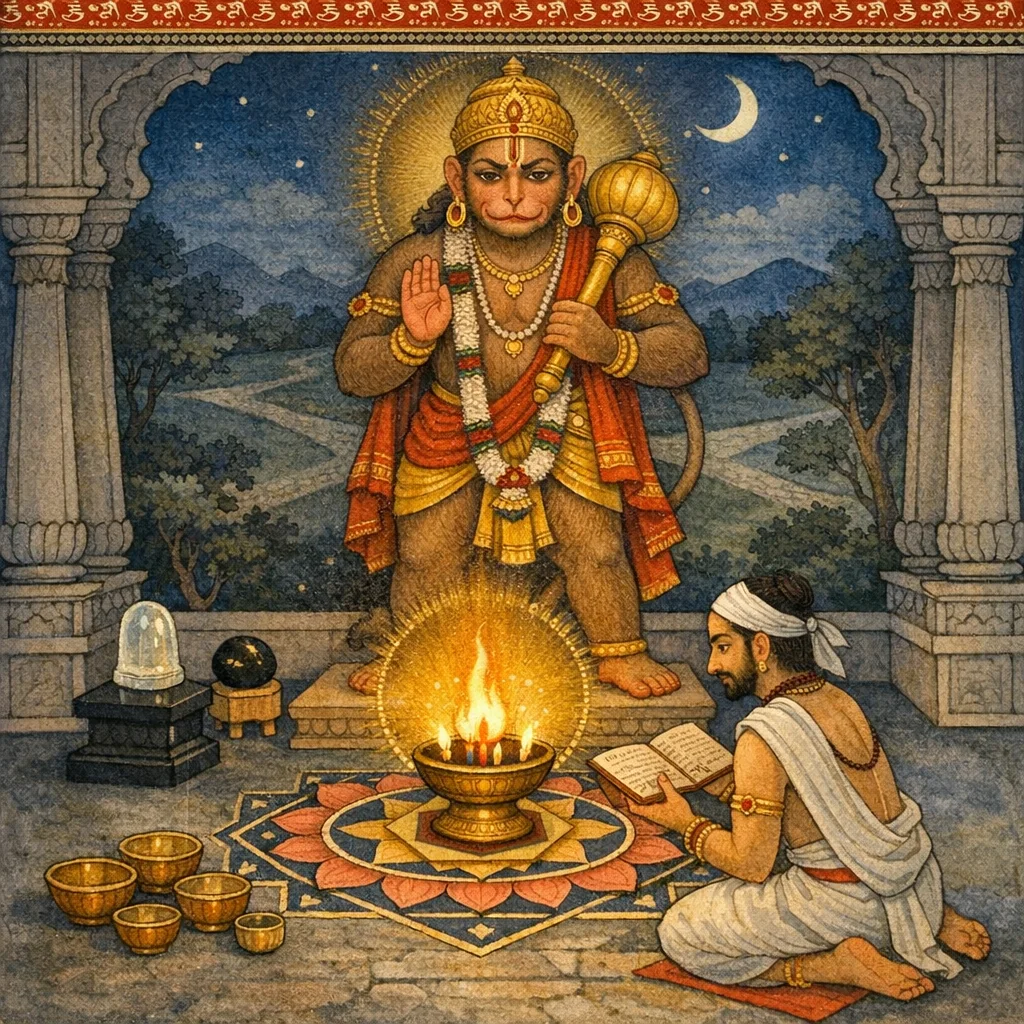
Dīpa-vidhi-vyākhyānam (Procedure for Lamp-Offering to Hanumān)
Sanatkumāra teaches a specialized lamp-offering to Śrī Hanumān (dīpa-dāna / nitya-dīpa) together with its “inner secret” (rahasya). The chapter reads like a ritual manual: it prescribes the lamp-vessel and oil measures, and links particular oils, grains, flours, colors, and fragrances to targeted prayogas—prosperity, attraction, disease-removal, uccāṭana, vidveṣa, māraṇa, and the return of one who has traveled. It explains traditional metrology (pala, prasṛta, kuḍava, prastha, āḍhaka, droṇa, khārī), wick thread-counts and colors, and rules for handling oils and for grinding and kneading. It then lists proper venues (Hanumān image, Śiva temple, crossroads, planetary/spirit sites; crystal liṅga and śālagrāma), diagrammatic worship (hexagon, eight-petalled lotus; ṣaḍaṅga placement; Vasu-lotus worship of key vānaras), and mantra usage (kavaca, mālā-mantra, twelve-syllable vidyā, sun-syllable). Two extended protective and war-oriented applications follow, then mantra-lakṣaṇa for a 26-syllable tattva-jñāna mantra (ṛṣi Vasiṣṭha; anuṣṭubh) and a weapon-mantra that drives away grahas/spirits (ṛṣi Brahmā; gāyatrī), concluding with rules of confidentiality and disciple eligibility.
Shlokas
Verse 1
सनत्कुमार उवाच । अथ दीपविधिं वक्ष्ये सरहस्यं हनूमतः । यस्य विज्ञानमात्रेण सिद्धो भवति साधकः ॥ १ ॥
Sanatkumāra said: Now I shall explain Hanumān’s lamp-rite, together with its inner secret; by merely understanding it, the practitioner becomes accomplished.
Verse 2
दीपपात्रप्रमाणं च तैलमानं क्रमेण तु । द्रव्यस्य च प्रमाणं वै तत्तु मानमनुक्रमात् ॥ २ ॥
In proper sequence, one should state the correct measure of the lamp-vessel, then the measure of the oil, and likewise the measure of the other materials; these measurements are to be given in orderly progression.
Verse 3
स्थानभेदं च मंत्रं च दीपदानमनुं पृथक् । पुष्पवासिततैलेन सर्वकामप्रदं मतम् ॥ ३ ॥
The distinction of the place (where it is performed), the mantra, and the specific rule for lamp-offering are each to be treated separately; yet it is held that offering a lamp with oil perfumed by flowers grants the fulfillment of all desired aims.
Verse 4
तिलतैलं श्रियः प्राप्त्यै पथिकागमनं प्रति । अतसीतैलमुद्दिष्टं वश्यकर्मणि निश्चितम् ॥ ४ ॥
Sesame oil is prescribed for attaining prosperity and for causing the arrival of a traveler. Linseed (flax) oil is specifically indicated and is held to be effective for rites of attraction (vaśya-karman).
Verse 5
सार्षापं रोगनाशाय कथितं कर्मकोविदैः । मारणे राजिकोत्थं वा विभीतकसमुद्भवम् ॥ ५ ॥
Those skilled in ritual procedure declare a mustard-based preparation for the removal of diseases; but for destructive rites (māraṇa) they speak of one made from black mustard, or one derived from the bibhītaka tree.
Verse 6
उच्चाटने करजोत्थं विद्वेषे मधुवृक्षजम् । अलाभे सर्वतैलानां तिलजं तैलमुत्तमम् ॥ ६ ॥
For rites of driving away (uccāṭana), oil derived from karaja is prescribed; for rites that incite enmity (vidveṣa), oil obtained from the madhu-tree is used. When other oils are unavailable, sesame oil is declared the best among all oils.
Verse 7
गोधूमाश्च तिला माषा मुद्गा वै तंडुलाः क्रमात् । पंचधान्यमिदं प्रोक्तं नित्यदीपं तु मारुतेः ॥ ७ ॥
Wheat, sesame, black gram (māṣa), green gram (mudga), and rice—listed in due order—are declared to be the five grains; and (this offering is prescribed) for maintaining the perpetual lamp of Maruti (Hanuman).
Verse 8
पंचधान्यसमुद्भूतं पिष्टमात्रं सुशोभनम् । सर्वकामप्रदं प्रोक्तं सर्वदा दीपदानके ॥ ८ ॥
A lamp (or lamp-offering) made solely from flour produced from the five grains, and fashioned beautifully, is declared to grant all desired aims—at all times—in the rite of gifting a lamp (dīpadāna).
Verse 9
वश्ये तडुलपिष्टोत्थं मारणे माषपिष्टजम् । उञ्चाटने कृष्णतिलपिष्टजं च प्रकीर्तितम् ॥ ९ ॥
For vaśya (subjugation), what is made from rice-flour is prescribed; for māraṇa (destruction), what is made from black-gram flour; and for uñcāṭana (driving away), what is made from black-sesame flour—so it is declared.
Verse 10
पथिकागमने प्रोक्तं गोधूमोत्थं सतंडुलम् । मोहने त्वाढकीजात विद्वेषे च कुलत्थजम् ॥ १० ॥
For the rite that brings a traveller swiftly into one’s presence, it is taught that rice-grains prepared from wheat should be used. For a rite of delusion or infatuation, use grains produced from āḍhakī; and for a rite meant to stir enmity, use grains produced from kulattha.
Verse 11
संग्रामे केवला माषाः प्रोक्ता दीपस्य पात्रके । संधौ त्रिपिष्टजं लक्ष्मीहेतोः कस्तूरिकाभवम् ॥ ११ ॥
In time of battle, it is prescribed that only māṣa (black gram) be used as the lamp’s vessel or support. At the saṃdhyā junctions, one should use a preparation called tripiṣṭaja; and for prosperity, for the sake of Lakṣmī, one should employ something made of musk (kastūrikā).
Verse 12
एलालवंगकर्पूरमृगनाभिसमुद्भवम् । कन्याप्राप्त्यै तथा राजवंश्ये सख्ये तथैव च ॥ १२ ॥
Cardamom, clove, camphor, and musk—fragrant substances born of perfume—are prescribed for attaining a bride, for alliance with a royal lineage, and likewise for winning friendship.
Verse 13
अलाभे सर्ववस्तूनां पंचधान्यं वरं स्मृतम् । अष्टमुष्टिर्भवेत्किञ्चित्किञ्चिदष्टौ चः पुष्कलम् ॥ १३ ॥
When other articles are unobtainable, the offering of the five grains (pañcadhānya) is declared the best substitute. A small quantity is said to be eight handfuls, while a plentiful quantity is eight times that.
Verse 14
पुष्कलानां चतुर्णां च ह्याढकः परिकीर्तितः । चतुराढको भवेद्द्रोणः खारी द्रोणचतुष्टयम् ॥ १४ ॥
Four puṣkalā-s are declared to make one āḍhaka. Four āḍhaka-s make one droṇa, and a khārī consists of four droṇa-s.
Verse 15
खारीचतुष्टय प्रस्थसंज्ञा च परिकीर्तिता । अथवान्यप्रकारेण मानमत्र निगद्यते ॥ १५ ॥
A set of four khārīs is also proclaimed to be known by the name “prastha.” Otherwise, the system of measurement is stated here in another manner.
Verse 16
पलद्वयं तु प्रसृतं द्विगुणं कुडवं मतम् । चतुर्भिः कुडवैः प्रस्थस्तैश्चतुर्भिस्तथाढकः ॥ १६ ॥
Two palas are said to make one prasṛta; double that is regarded as a kuḍava. Four kuḍavas make one prastha, and four prasthas likewise make one āḍhaka.
Verse 17
चतुराढको भवेद्द्रोणःऋ खारी द्रोणचतुष्टयम् । क्रमेणैतेन ते ज्ञेयाः पात्रे षट्कर्मसंभवे ॥ १७ ॥
Four āḍhakas make one droṇa; a khārī consists of four droṇas. These measures should be understood in this very sequence, in connection with vessels (pātras) employed in the six ritual acts.
Verse 18
पञ्च सप्त नव तथा प्रमाणास्ते यथाक्रमम् । सौगंधे नैव मानं स्यात्तद्यथारुचि संमतम् ॥ १८ ॥
The measures are, in order, five, seven, and nine. But for perfumes and fragrances there is no fixed measure; it is approved to be according to one’s taste.
Verse 19
नित्यपात्रे तु तैलानां नियमो वार्तिकोद्भवः । सोमवारे गृहीत्वातद्ध्वान्यं तोयप्लुतं धरेत् ॥ १९ ॥
As for oils kept in a vessel meant for daily use, the rule is one that arises from practical customary procedure. On a Monday, having taken that oil, one should sprinkle it with water and then keep it covered and protected.
Verse 20
पश्चात्प्रमाणतो ज्ञेयं कुमारीहस्तपेषणम् । तत्पिष्टं शुद्धपात्रे तु नदीतोयेन पिंडितम् ॥ २० ॥
Next, one should know the procedure according to the proper measure: the grinding is to be done by the hand of a maiden. That paste, placed in a pure vessel, should then be kneaded into a single lump with river-water.
Verse 21
दीपपात्रं ततः कुर्याच्छुद्धः प्रयतमानसः । दीपपात्रे ज्वाल्यमाने मारुतेः कवचं पठेत् ॥ २१ ॥
Then, being purified and with a disciplined mind, one should prepare the vessel for the lamp. As the lamp in that vessel is kindled, one should recite the protective kavaca hymn of Māruti (Hanumān).
Verse 22
शुद्धभूमौ समास्थाप्य भौमे दीपं प्रदापयेत् । मालामनूनां ये वर्णाः साध्यनामसमन्विताः ॥ २२ ॥
Having duly set it upon purified ground, one should light the lamp upon the earth. The letters (varṇas) of the garland-mantras (mālā-mantras), joined with the name of the sādhya—the intended deity or aim—are to be employed in the rite.
Verse 23
वर्तिकायां प्रकर्त्तव्यास्तंतवस्तत्प्रमाणकाः । तत्त्रिंशांशेन वा ग्राह्या गुरुकार्येऽखिलाढ्यता ॥ २३ ॥
In the measuring cord (vartikā), threads should be prepared in accordance with that prescribed measure; or they may be taken as one-thirtieth of it. In major works, complete provision of materials and measure is required.
Verse 24
कूटतुल्याः स्मृता नित्ये सामान्येऽथ विशेषके । रुद्राः कूटगणाः प्रोक्ता न पात्रे नियमो मतः ॥ २४ ॥
In the permanent (nitya) rites, and in observances both general and special, they are ever remembered as “equal to a lump or heap (kūṭa).” The Rudras are said to belong to the “kūṭa-groups”; and in this matter it is held that there is no fixed restriction regarding the recipient (pātra).
Verse 25
एकविंशतिसंख्याकास्तन्तवोऽथाध्वनि स्मृताः । रक्तसूत्रं हनुमतो दीपदाने प्रकीर्तितम् ॥ २५ ॥
On the ritual path (adhvan), the threads are declared to be twenty-one in number. And in the offering of lamps (dīpa-dāna), a red thread is prescribed in connection with Hanumān.
Verse 26
कृष्णमुञ्चाटने द्वेषेऽरुणं मारणकर्मणि । कूटतुल्यपलं तैलं गुरुकार्ये शिवैर्गुणम् ॥ २६ ॥
For rites of driving away (muncāṭana), black materials are to be employed; for acts arising from enmity, red; and for operations meant to destroy, the prescribed red is used. Oil measured as one pala, equal in weight to a kūṭa, is said to be efficacious and endowed with auspicious qualities for weighty undertakings.
Verse 27
नित्ये पंचपलं प्रोक्तमथवा मानसी रुचिः ॥ २७ ॥
For the daily observance, a measure of five palas is prescribed; or else one may follow the inclination that arises within the mind—performing the offering inwardly, according to one’s inner capacity.
Verse 28
हनुमत्प्रतिमायास्तु सन्निधौ दीपदापनम् । शिवालयेऽथवा कुर्यान्नित्यनैमित्तिके स्थले ॥ २८ ॥
One should offer a lamp in the presence of an image of Hanumān; or else one may do so in a Śiva-temple, at a place appointed for regular and occasional rites.
Verse 29
विशेषोऽस्त्यत्र यः कश्चिन्मारुते रुच्यते मया ॥ २९ ॥
Here, with regard to Māruta—the doctrine of the winds—there is a certain particular point, one that is especially pleasing to me.
Verse 30
प्रतिमाग्रे प्रमोदेन ग्रहभूतग्रहेषु च । चतुष्पथे तथा प्रोक्तं षट्सु दीपप्रदापनम् ॥ ३० ॥
With gladness, one should offer a lamp before the sacred image, and also at places connected with the planets (grahas) and spirit-beings (bhūtas). Likewise, at a crossroads lamp-offering is prescribed—thus the gift of lamps is taught in these six settings.
Verse 31
सन्निधौ स्फाटिके लिंगे शालग्रामस्य सन्निधौ । नानाभोगश्रियै प्रोक्तं दीपदानं हनूमतः ॥ ३१ ॥
In the presence of a crystal liṅga and in the presence of the Śālagrāma, the offering of a lamp is declared—so taught by Hanūmān—to bestow prosperity and the enjoyment of many kinds of comforts.
Verse 32
गणेशसन्निधौ विघ्नमहासंकटनाशने । विषव्याधिभये घोरे हनुमत्सन्निधौ स्मृतम् ॥ ३२ ॥
In the presence of Gaṇeśa, the removal of obstacles and great calamities is remembered; and in dreadful fear arising from poison and disease, the protective presence of Hanūmān is to be recalled.
Verse 33
दुर्गायाः सन्निधौ प्रोक्तं संग्रामे दीपदापनम् । चतुष्पथे व्याधिनष्टौ दुष्टदृष्टौ तथैव च ॥ ३३ ॥
In the presence of Devī Durgā, the offering of a lamp is prescribed; likewise in time of battle, at a crossroads, for the removal of disease, and also to ward off the evil gaze, one is enjoined to offer light.
Verse 34
राजद्वारे बंधमुक्तौ कारागारेऽथवा मतम् । अश्वत्थवटमूले तु सर्वकार्यप्रसिद्धये ॥ ३४ ॥
At the king’s gate, offering a lamp is prescribed for release from bondage; likewise it is held effective even in a prison. But at the root of an aśvattha or a banyan tree, it brings the successful accomplishment of all undertakings.
Verse 35
वश्ये भये विवादे च वेश्मसंग्रामसंकटे । द्यूते दृष्टिस्तंभने च विद्वेषे मारणे तथा ॥ ३५ ॥
It is employed in rites of subjugation, in fear and in disputes; in dangers arising from one’s house and from battle; in gambling, in immobilizing another’s gaze, in sowing hostility, and likewise in destructive (māraṇa) operations.
Verse 36
मृतकोत्थापने चैव प्रतिमाचालने तथा । विषे व्याधौ ज्वरे भूतग्रहे क्रृत्याविमोचने ॥ ३६ ॥
Likewise, (these mantra-procedures are employed) for reviving the dead, for causing an idol to move, and also in cases of poison, disease, fever, spirit-possession, and for release from hostile sorcery (kr̥tyā).
Verse 37
क्षतग्रंथौ महारण्ये दुर्गेव्याघ्ने च दंतिनि । क्रूरसत्त्वेषु सर्वेषु शश्वदूंधविमोक्षणे ॥ ३७ ॥
In cases of wounds or ruptured swellings, in a vast forest, in difficult terrain, when faced with a tiger or a tusked elephant, amid all fierce creatures, and for constant release from peril—(this is to be applied/recited).
Verse 38
पथिकागमने चैव दुःस्थाने राजमोहने । आगमे निर्गमे चैव राजद्वारे प्रकीर्तितम् ॥ ३८ ॥
It is taught that (these omens/indications are to be considered) at the arrival of travellers, in inauspicious or troubled places, in matters involving the king’s confusion or delusion, and also at times of entering and departing—especially at the king’s gate.
Verse 39
दीपदानं हनुमतो नात्र कार्या विचारणा ॥ ३९ ॥
As for offering a lamp to Hanumān—there is no need for any further deliberation about it (it is certainly to be done).
Verse 40
रुद्रैकविंशपिंडांश्च त्रिधा मंडलमानकम् । लघुमानं स्मृतं पंच सप्त वा नव वा तथा ॥ ४० ॥
Twenty-one ‘Rudra’ pellets (piṇḍas) make one maṇḍala-measure, fixed by a threefold division. The ‘light’ standard (laghu) is remembered as consisting of five—or else seven, or nine—of those same units as well.
Verse 41
क्षीरेण नवनूतेन दध्ना वा गोमयेन च । प्रतिमाकरणं प्रोक्तं मारुतेर्दीपदापने ॥ ४१ ॥
It is taught that, for offering a lamp to Māruti (Hanumān), an image (pratimā) may be fashioned from milk, fresh butter, curd, or even cow-dung.
Verse 42
दक्षिणाभिमुखं वीरं कृत्वा केसरिविक्रमम् ॥ ४२ ॥
Having made the heroic one face south, they portrayed him as lion-like in prowess.
Verse 43
ऋक्षविन्यस्तपादं च किरीटेन विराजितम् । लिखेद्भित्तौ पटे वापि पीठे वा मारुतेः शुभे ॥ ४३ ॥
One should depict auspicious Māruti (Hanumān) with his feet set upon a bear, resplendent with a crown—whether drawn on a wall, on a cloth, or upon a blessed pedestal (altar).
Verse 44
मालामंत्रेण दातव्यं दीपदानं हनूमतः । नित्यदीपः प्रकर्त्तव्यो द्वादशाक्षरविद्यया ॥ ४४ ॥
For Hanumān, the offering of a lamp should be made with the rosary-mantra (mālā-mantra); and a perpetual lamp should be established by means of the twelve-syllabled sacred formula (dvādaśākṣara-vidyā).
Verse 45
विशेषस्तत्र यस्तं वै दीपदानेऽवधारय । षष्ट्यादौ च द्वितीयादाविमं दीपमितीरयेत् ॥ ४५ ॥
Understand well the specific rule that applies there in the offering of a lamp. At the beginning of Ṣaṣṭī (the sixth lunar day) and also at the beginning of Dvitīyā (the second lunar day), one should offer this very lamp as prescribed.
Verse 46
गृहाणेति पदं पश्चाच्छेषं पूर्ववदुच्चरेत् । कूटादौ नित्यदीपे च मंत्रं सूर्याक्षरं वदेत् ॥ ४६ ॥
Afterwards one should utter the word “gṛhāṇa” (“accept/receive”), and then recite the remaining portion just as stated earlier. At the beginning (kūṭa) and also before the ever-burning lamp, one should pronounce the mantra consisting of the Sun-syllable.
Verse 47
तत्र मालाख्यमनुना तत्तत्कार्येषु कारयेत् । गोमयेनोपलिप्तायां भूमौ तद्गतमानसः ॥ ४७ ॥
There, he should have the respective rites performed with the mantra known as “Mālā”. Seated on ground smeared with cow-dung, he should keep his mind absorbed in that rite and its deity.
Verse 48
षट्कोणं वसुपत्रं च भूमौ रेखासमन्वितम् । कमलं च लिखेद्भद्रं तत्र दीपं निधापयेत् ॥ ४८ ॥
On the ground, one should draw a hexagon and a vāsupatra figure (eight-petalled lotus), marked with guiding lines. Then, drawing an auspicious lotus there, one should place a lamp within that diagram.
Verse 49
शैवे वा वैष्णवे पीठे पूजयेदंजनासुतम् । कूटषट्कं च षट्कोणे अंतराले परलिखेत् ॥ ४९ ॥
On a Śaiva or a Vaiṣṇava altar-platform, one should worship Añjanā’s son (Hanumān). And within the hexagonal figure, in the intervening spaces, one should also draw the six ‘peaks’ (kūṭa-ṣaṭka).
Verse 50
षट्कोणेषु षडंगानि बीजयुक्तानि संलिखेत् । सौम्यं मध्यगतं लेख्यं तत्र संपूज्य मारुतिम् ॥ ५० ॥
In the six corners of the hexagonal diagram, one should inscribe the six aṅgas, each joined with its seed-syllable (bīja). In the center one should write the auspicious mantra/form; and there, having duly worshipped, one should worship Māruti (Hanumān).
Verse 51
षट्कोणेषु षडंगानि नामानि च पुरोक्तवत् । वसुपत्रे क्रमात्पूज्या अष्टावेते च वानराः ॥ ५१ ॥
In the six angles of the diagram, the six limbs (ṣaḍ-aṅga) and their names are to be placed, just as stated earlier. On the eight-petalled lotus of the Vasus, these eight “Vānaras” are to be worshipped in due order.
Verse 52
सुग्रीवायांगदायाथ सुषेणाय नलाय च । नीलायाथो जांबवते प्रहस्ताय तथैव च ॥ ५२ ॥
(Offer worship) to Sugrīva and Aṅgada, and also to Suṣeṇa and Nala; to Nīla, to Jāmbavān, and likewise to Prahasta.
Verse 53
सुवेषाय ततः पश्चाद्यजेत्षडंगदेवताः । आदावंजनापुत्राय ततश्च रुद्रमूर्तये ॥ ५३ ॥
Then, after offering worship to Suveṣa, one should worship the deities of the six auxiliaries (ṣaḍaṅga). First (offer) to Añjanā’s son, and thereafter to the one whose form is Rudra.
Verse 54
ततो वायुसुतायाथ जानकीजीवनाय च । रामदूताय ब्रह्मास्त्रनिवारणाय तत्परम् ॥ ५४ ॥
Then (offer) to the son of Vāyu—Hanumān—who is the very life of Jānakī, the messenger of Rāma, ever intent on warding off the Brahmāstra.
Verse 55
पंचोपचारैः संपूज्य देशकालौ च कीर्तेत् । कुशोदकं समादाय दीपमंत्रं समुञ्चरेत् ॥ ५५ ॥
Having duly worshipped with the five offerings, one should proclaim the place and the time. Then, taking water infused with kuśa grass, one should recite the lamp-mantra.
Verse 56
उत्तगभिमुखो जप्त्वा साधयेत्साधकोत्तमः । तं मंत्रं कूटधा जप्त्वा जलं भूमौ विनिक्षिपेत् ॥ ५६ ॥
Facing north, the excellent practitioner should accomplish the rite by recitation. Having recited that mantra in a concealed manner, he should pour the water upon the ground.
Verse 57
ततः करपुटं कृत्वा यथाशक्ति जपेन्मनुम् । अनेन दीपवर्येण उदङ्मुखगतेन वै ॥ ५७ ॥
Then, forming the hands into a cupped gesture (karapuṭa), one should chant the mantra to the best of one’s ability, facing north, with this excellent lamp placed before oneself.
Verse 58
तथा विधेहि हनुमन्यथा स्युर्मे मनोरथाः । त्रयोदशैवं द्रव्याणि गोमयं मृत्तिका मसी ॥ ५८ ॥
“So arrange it, O Hanumān, that my heart’s wishes may be fulfilled.” Thus there are thirteen materials—among them cow-dung, clay, and ash.
Verse 59
अलक्तं दरदं रक्तचंदनं चंदनं मधु । कस्तूरिका दधि क्षीरं नवनीतं धृतं तथा ॥ ५९ ॥
Lac-dye (alakta), darada (a fragrant mineral or pigment), red sandalwood, sandalwood, honey, musk, curd, milk, fresh butter, and ghee as well—these are to be gathered and used as prescribed.
Verse 60
गोमयं द्विविधं तत्र प्रोक्तं गोमहिषीभवम् । पश्चाद्विनष्टद्रव्याप्तौ माहिषं गोमयं स्मृतम् ॥ ६० ॥
There it is taught that cow-dung is of two kinds—born of the cow and born of the buffalo. When, later, the proper substance is unavailable or lost, buffalo-dung is to be regarded as “cow-dung,” accepted as its substitute.
Verse 61
पथिकागमने दूरान्महादुर्गस्य रक्षणे । बालादिरक्षणे चैव चौरादिभयनाशने ॥ ६१ ॥
It is employed to bring back a traveler from afar, to safeguard a great fortress, to protect children and the like, and to destroy fears arising from thieves and similar dangers.
Verse 62
स्त्रीवश्यादिषु कार्येषु शस्तं गोगोमयं मने । भूमिस्पृष्टं न तद्ग्राह्यमंतरिक्षाञ्च भाजने ॥ ६२ ॥
For rites such as those meant to win a woman’s favor and similar aims, cow-dung is regarded as the prescribed purifying substance. Yet if it has touched the ground it should not be taken up; it should be kept in a vessel not in contact with the earth (held above the ground).
Verse 63
चतुर्विधा मृत्तिका तु श्वेता पीतारुणासिता । तत्र गोपीचंदनं तु हरितालं च गौरिकम् ॥ ६३ ॥
Ritual clay is of four kinds—white, yellow, red, and black. Among these are also counted gopī-candana, haritāla, and gaurikā, as special sacred earths/minerals used for holy markings and rites.
Verse 64
मषी लाक्षारसोद्भूता सर्वं वान्यत्स्फुटं मतम् । कृत्वा गोपीचदंनेन चतुरस्रं गृहं सुधीः ॥ ६४ ॥
Ink prepared from lac-resin is recommended; and it is also held best that all else used for writing be clear and distinct. Having drawn a square enclosure with gopī-candana, the wise person should then proceed with the prescribed writing.
Verse 65
तन्मध्ये माहिषेणाथ कुर्यान्मूर्तिं हनूमतः । बीजं क्रोधाञ्च तत्पुच्छं लिखेन्मंत्री समाहितः ॥ ६५ ॥
In the midst of that sacred diagram, O Lord, one should fashion the image of Hanumān with buffalo-gall; and the practitioner, steady in mind, should inscribe the bīja (seed-syllable) and the krodha (wrath) syllables upon his tail.
Verse 66
तैलेन स्नापयेन्मूर्तिं गुडेन तिलकं चरेत् । शतपत्रसमो धूपः शालनिर्याससंभवः ॥ ६६ ॥
One should bathe the deity’s image with oil and apply a tilaka made of jaggery. The incense should be fragrant like the hundred-petalled lotus, prepared from the resin exuded by the śāla tree.
Verse 67
कुर्य्याञ्च तैलदीपं तु वर्तिपंचकसंयुतम् । दध्योदनेन नैवेद्यं दद्यात्साधकसत्तमः ॥ ६७ ॥
The best of practitioners should prepare an oil lamp furnished with five wicks, and should offer as naivedya rice with curd.
Verse 68
वारत्रयं कंठदेशे सशेषविषमुञ्चरन् । एवं कृते तु नष्टानां महिषीणां गवामपि ॥ ६८ ॥
Let him release the remaining poison at the throat-region three times. When this is done, even lost she-buffaloes and cows are recovered.
Verse 69
दासीदासादिकानां च नष्टानां प्राप्तिरीरिता । चौरादिदुष्टसत्त्वानां सर्पादीनां भये पुनः ॥ ६९ ॥
It is taught that what has been lost—such as maidservants, servants, and the like—can be recovered; and likewise, in times of fear from thieves and other wicked beings, and from snakes and similar dangers, protection is gained again.
Verse 70
तालेन च चतुर्द्वारं गृहं कृत्वा सुशोभनम् । पूर्वद्वारे गजः स्थाप्यो दक्षिणे महिषस्तथा ॥ ७० ॥
By the tāla-measure, one should build a beautiful, auspicious house with four gateways. At the eastern gate an elephant is to be installed, and at the southern gate likewise a buffalo.
Verse 71
सर्पस्तु पश्चिमे द्वारे व्याघ्रश्चैवोत्तरे तथा । एवं क्रमेण खड्गं च क्षुरिकादंडमुद्गरान् ॥ ७१ ॥
At the western gate place the serpent, and at the northern gate likewise the tiger. Thus, in proper sequence, arrange also the sword, the dagger, the staff, and the mace.
Verse 72
विलिख्य मध्ये मूर्तिं च महिषीगोमयेन वै । कृत्वा डमरुहस्तां च चकिताक्षीं प्रयत्नतः ॥ ७२ ॥
Then, in the center of the prepared place, one should carefully draw a figure using buffalo and cow dung, fashioning her form with a ḍamaru (small drum) in her hand and with wide, startled eyes, with due effort.
Verse 73
पयसा स्नापनं रक्तचंदनेनानुलेपनम् । जातीपुष्पैस्तु संपूज्य शुद्धधूप प्रकल्पयेत् ॥ ७३ ॥
One should bathe (the sacred image) with milk, anoint it with red sandalwood paste, worship fully with jasmine flowers, and prepare pure incense.
Verse 74
घृतेन दीपं दत्त्वाथ पायसान्नं निवेदयेत् । गगनं दीपिकेंद्वाढ्यां शास्त्रं च पुरतो जपेत् ॥ ७४ ॥
Having offered a lamp with ghee, one should then present pāyasa (sweet rice) as the food-offering. With the sky illumined by many lamps and by moonlight, one should recite the sacred śāstra before (the altar).
Verse 75
एवं सप्तदिनं कृत्वा मुच्यते महतो भयात् । अनयोर्भौमवारे तु कुर्यादारंभमादरात् ॥ ७५ ॥
Having observed it thus for seven days, one is freed from great fear. Of these two methods, one should begin the observance with reverent care on Tuesday (Bhauma-vāra).
Verse 76
शत्रुसेनाभये प्राप्ते गैरिकेण तु मंडलम् । कृत्वा तदंतरे तालमीष्टन्नम्रं समालिखेत् ॥ ७६ ॥
When danger from an enemy army arises, one should draw a circular maṇḍala with red ochre; and within it, carefully sketch a tāla palm, slightly bent as desired.
Verse 77
तत्रावलंबमानां च प्रतिमां गोमयेन तु । वामहस्तेन तालाग्रं दक्षिणे ज्ञानमुद्रिका ॥ ७७ ॥
There one should fashion (or set in place) an image using cow-dung; in its left hand it holds the tip of a tāla leaf, and in the right it bears the gesture of knowledge (jñāna-mudrā).
Verse 78
तालमूलात्स्वकाष्टायां मार्गे हस्तमिते गृहम् । चतुरस्र विधायाथ तन्मध्ये मूर्तिमालिखेत् ॥ ७८ ॥
From the base of a tāla tree, upon one’s own wooden plank placed along the path, one should make a house-like space measured as one hasta. Having made it square, one should then draw the sacred mūrti in its center.
Verse 79
दक्षिणाभिमुखीं रम्यां हृदये विहितांजलिम् । तोयेन स्नानगंधादि यथासंभवमर्पयेत् ॥ ७९ ॥
Facing south, with a pleasing, composed demeanor and hands joined in añjali at the heart, one should offer according to one’s means: water for bathing and other offerings such as fragrances.
Verse 80
कृशारान्नं च नैवेद्यं साज्यं तस्यै निवेदयेत् । किलिद्वयं जपं प्रोक्तमेवं कुर्याद्दिने दिने ॥ ८० ॥
One should offer as naivedya kṛśāra (boiled grains), together with pure ghee, unto her. The japa is declared to be “kilidvaya”; thus one should perform it day after day.
Verse 81
एवं कृते भवेच्छीघ्रं पथिकानां समागमः । श्यामपाषाणखण्डेन लिखित्वा भूपतेर्गृहम् ॥ ८१ ॥
When this is done, a gathering of travelers will quickly occur; using a piece of dark stone, one should inscribe the sign and mark the king’s residence.
Verse 82
प्राकारं तु चतुर्द्वारयुक्तं द्वारेषु तत्र वै । अन्योन्यपुच्छ रिधित्रययुक्तां हनूमतः ॥ ८२ ॥
(Construct) an enclosing rampart furnished with four gateways; and at those gateways place the threefold arrangement marked by interlinked ‘tails’, belonging to Hanūmān.
Verse 83
कुर्यान्मूर्तिं गोमयेन धत्तूरकुसुमैयजेत् । जटामांसीभवं धूपं तैलाक्तघृतदीपकम् ॥ ८३ ॥
One should fashion an image from cow-dung and worship it with dhattūra flowers, offer incense prepared from jaṭāmāṃsī, and light a ghee lamp whose wick is anointed with oil.
Verse 84
नैवेद्यं तिलतैलाक्तसक्षारा माषरोटिका । ध्येयो दक्षिणहस्तेन रोटिकां भक्षयन्हरिः ॥ ८४ ॥
As naivedya, one should offer a roṭikā made of māṣa (black gram), anointed with sesame oil and mixed with alkaline salt; and one should meditate on Hari as eating that roṭikā with His right hand.
Verse 85
वामहस्तेन पाषाणैस्त्रासयन्परसैनिकान् । प्नारयन्भ्रुकुटीं बद्ध्वा भीषयन्मथयन्स्थितः ॥ ८५ ॥
With his left hand he hurled stones, striking terror into the enemy soldiers; knitting his brows into a stern frown, he stood there—threatening them and throwing their ranks into confusion.
Verse 86
जपेञ्च भुग्भुगिति वै सहस्रं ध्यानतत्परः । एवं कृतविधानेन परसैन्यं विनाशयेत् ॥ ८६ ॥
Absorbed in meditation, one should also repeat the mantra “bhug bhug” a thousand times. By performing the rite in this prescribed manner, one can bring about the destruction of the enemy’s army.
Verse 87
रक्षा भवति दुर्गाणां सत्यं सत्य न संशयः । प्रायोगा बहवस्तत्र संक्षेपाद्गदिता मया ॥ ८७ ॥
These observances indeed become a protection in times of hardship—true, true, without doubt. Many practical ritual applications exist there; I have stated them only in brief.
Verse 88
प्रत्यहं यो विधानेन दीपदानं हनूमतः । तस्यासाध्यं न वै किंचिद्विद्यते भुवनत्रये ॥ ८८ ॥
For the one who, every day, offers a lamp to Hanumān according to the prescribed rite, there is truly nothing unattainable anywhere in the three worlds.
Verse 89
न देयं दुष्टहृदये दुष्टचिंतनबुद्धये । अविनीताय शिष्याय पिशुनाय कदाचन ॥ ८९ ॥
One should never impart sacred teaching to a person with a wicked heart, whose intellect is set on evil thoughts—nor to an undisciplined student, nor to a slanderer, at any time.
Verse 90
कृतघ्नाय न दातव्यं दातव्यं च परीक्षिते । बहुना किमिहोक्तेन सर्वं दद्यात्कपीश्वरः ॥ ९० ॥
Nothing should be given to the ungrateful; one should give only after due examination. What is the use of saying much here? Kapīśvara Hanumān gave everything—indeed, his very self.
Verse 91
अथ मन्त्रान्तरं वक्ष्ये तत्त्वज्ञानप्रदायकम् । तारो नमो हनुमते जाठरत्रयमीरयेत् ॥ ९१ ॥
Now I shall declare another mantra that bestows knowledge of reality (tattva). One should first utter the Tāra, the Praṇava; then say “namo hanumate,” and thereafter pronounce the three jāṭhara sounds.
Verse 92
दनक्षोभं समाभाष्य संहरद्वयमीरयेत् । आत्मतत्त्वं ततः पश्चात्प्रकाशययुगं ततः ॥ ९२ ॥
Having recited the portion called Danakṣobha, one should then utter the pair of Saṃhāra (dissolution) formulas. After that, one should expound the truth of the Self (Ātman); and thereafter teach the pair pertaining to Prakāśa, illumination.
Verse 93
वर्मास्त्रवह्निजायांतः सार्द्धूषड्विंशदर्णवान् । वसिष्ठोऽस्य मुनिश्छन्दोऽनुष्टुप् च देवताः पुनः ॥ ९३ ॥
This mantra begins with “varmāstra” and ends with “vahnijāyā”; it contains twenty-six syllables in all. Its seer (ṛṣi) is the sage Vasiṣṭha, its metre is Anuṣṭubh, and its presiding deities are likewise to be understood accordingly.
Verse 94
हनुमान्मुनिसप्तर्तुवेदाष्टनिगमैः क्रमात् । मंत्रार्णैश्च षडंगानि कृत्वा ध्यायेत्कपीश्वरम् ॥ ९४ ॥
In due sequence, using the mantra-syllables associated with Hanumān, the sages, the seven seasons, the Vedas, and the eight Nigamas, one should perform the sixfold ancillary rite (ṣaḍaṅga-nyāsa) and then meditate upon Kapīśvara—Hanumān, the Lord of the monkeys.
Verse 95
जानुस्थावामबाहुं च ज्ञानमुद्रापरं हृदि । अध्यात्मचित्तमासीनं कदलीवनमध्यगम् ॥ ९५ ॥
With his left arm resting upon his knee, and his hand at his heart in the mudrā of spiritual knowledge, he sat absorbed in inner contemplation, in the midst of a grove of banana trees.
Verse 96
बालार्ककोटिप्रतिमं ध्यायेज्ज्ञानप्रदं हरिम् । ध्यात्वैवं प्रजपेल्लक्षं दशांशं जुहुयात्तिलैः ॥ ९६ ॥
One should meditate on Hari, the bestower of knowledge, whose radiance is like ten million rising suns. Having thus meditated, one should recite the mantra one lakh (one hundred thousand) times, and then offer as oblation one-tenth of that count, using sesame seeds.
Verse 97
साज्यैः संपूजयेत्पीठे पूर्वोक्ते पूर्ववत्प्रभुम् । जप्तोऽयं मदनक्षोभं नाशयत्येव निश्चितम् ॥ ९७ ॥
On the pīṭha described earlier, one should worship the Lord as previously prescribed, offering oblations mixed with ghee. When this mantra is recited, it certainly destroys the agitation caused by Kāma (passion).
Verse 98
तत्त्वज्ञानमवाप्नोति कपींद्रस्य प्रसादतः । अथ मंत्रातरं वाक्ष्ये भूतविद्रावणं परम् ॥ ९८ ॥
By the grace of Kapīndra (the Lord of monkeys), one attains true knowledge of tattva, the reality-principle. Now I shall declare another mantra—supreme for driving away spirits and disruptive beings.
Verse 99
तारः काशींकुक्षिपरवराहश्चांजनापदम् । पवनो वनपुत्रांते आवेशिद्वयमीरयेत् ॥ ९९ ॥
One should utter in proper sequence the syllables/words: “Tāra”, “Kāśī”, “Kukṣi”, “Para”, “Varāha”, and “Cāñjanāpada”; and then “Pavana” at the end of “Vanaputrā”. Thus the pair called “Āveśi” is to be pronounced.
Verse 100
तारः श्रीहनुमत्यश्चादस्त्ररचभुजाक्षरः । ब्रह्मा मुनिः स्याद्गायत्री छंदोऽत्र देवता पुनः ॥ १०० ॥
The seed-syllable is Tāra (Oṃ); joined with “Śrī” and “Hanumatī,” it becomes the mantra spoken of as the “weapon-form,” furnished with the “arm-syllables.” Here, Brahmā is the seer (ṛṣi), the metre is Gāyatrī, and the presiding deity is again as previously stated.
Verse 101
हनुमान्कमला बीजं फट् शक्तिः परिकीर्तितः । षड्दीर्घाढ्येन बीजेन षडङ्गानि समाचरेत् ॥ १०१ ॥
The bīja is declared to be “hanumān-kamalā,” and the śakti (mantric exclamation) is “phaṭ.” With the bīja endowed with six long vowels, one should perform the sixfold (ṣaḍ-aṅga) application.
Verse 102
आंजनेय पाटलास्यं स्वर्णाद्रिसमविग्रहम् । पारिजातद्रुमूलस्थं चिंतयेत्साधकोत्तमः ॥ १०२ ॥
The best of practitioners should meditate on Āñjaneya (Hanumān): with a rosy-hued face, possessing a form like a golden mountain, and abiding at the root of the pārijāta tree.
Verse 103
एवं ध्यात्वा जपेल्लक्षं दशांशं जुहुयात्तिलैः । त्रिमध्वक्तैर्यंजत्पीठे पूर्वोक्तेपूर्ववत्सुधीः ॥ १०३ ॥
Having thus meditated, the wise practitioner should recite the mantra one lakh times; then, as a tenth part, he should offer oblations with sesame seeds—anointed with the three kinds of honey—upon the previously described sacrificial altar, following the same procedure as stated earlier.
Verse 104
अनेन मनुना मंत्री ग्रहग्रस्तं प्रमार्जयेत् । आक्रंदंस्तं विमुच्याथ ग्रहः शीघ्रं पलायते ॥ १०४ ॥
With this mantra, the knower of mantra should ritually wipe and cleanse the person afflicted by a graha. As the afflicted one cries out, he is released, and the graha swiftly flees away.
Verse 105
मनवोऽमी सदागोप्या न प्रकाश्या यतस्ततः । परीक्षिताय शिष्याय देया वा निजसूनवे ॥ १०५ ॥
These sacred instructions are to be kept confidential and not disclosed here and there. They should be given only to a tested disciple—or else to one’s own son.
Verse 106
हनुमद्भजनासक्तः कार्तवीर्यार्जुनं सुधीः । विशेषतः समाराध्य यथोक्तं फलमाप्नुयात् ॥ १०६ ॥
A wise person, devoted to the worship of Hanumān, should in particular propitiate Kārtavīryārjuna; thus he will obtain the result described earlier, exactly as stated.
Verse 107
इति श्रीबृहन्नारदीयपुराणे पूर्वभागे बृहदुपाख्याने तृतीयपादे दीपविधिनिरूपणं नाम पञ्चसप्ततितमोऽध्यायः ॥ ७५ ॥
Thus ends the seventy-fifth chapter, called “The Explanation of the Procedure for Lamps (Dīpa-vidhi),” in the Śrī Bṛhan-Nāradīya Purāṇa—within the Pūrvabhāga, in the Great Supplementary Narrative (Bṛhad-upākhyāna), in the Third Pada.
Frequently Asked Questions
A codified Hanumān dīpa-dāna and nitya-dīpa procedure, including materials, measurements, places, maṇḍala design, and mantra-application, aimed at both welfare (prosperity, safety) and protective outcomes.
It frames Hanumān worship as heartfelt offering (glad lamp-offering before images) while operationalizing it through precise correspondences—oil types, grain-flours, thread colors/counts, nyāsa, and mantra-lakṣaṇa—typical of a practical vrata-kalpa manual.
Before a Hanumān image (or in a Śiva temple), at crossroads, at sites linked to planets/spirits, and in the presence of a crystal liṅga or Śālagrāma; additional situational placements include the king’s gate, prison contexts, and sacred trees like aśvattha/banyan.
It explicitly restricts teaching to an examined, disciplined disciple (or one’s son), warning against sharing with malicious, undisciplined, slanderous, or ungrateful persons—presenting secrecy as part of ritual integrity.