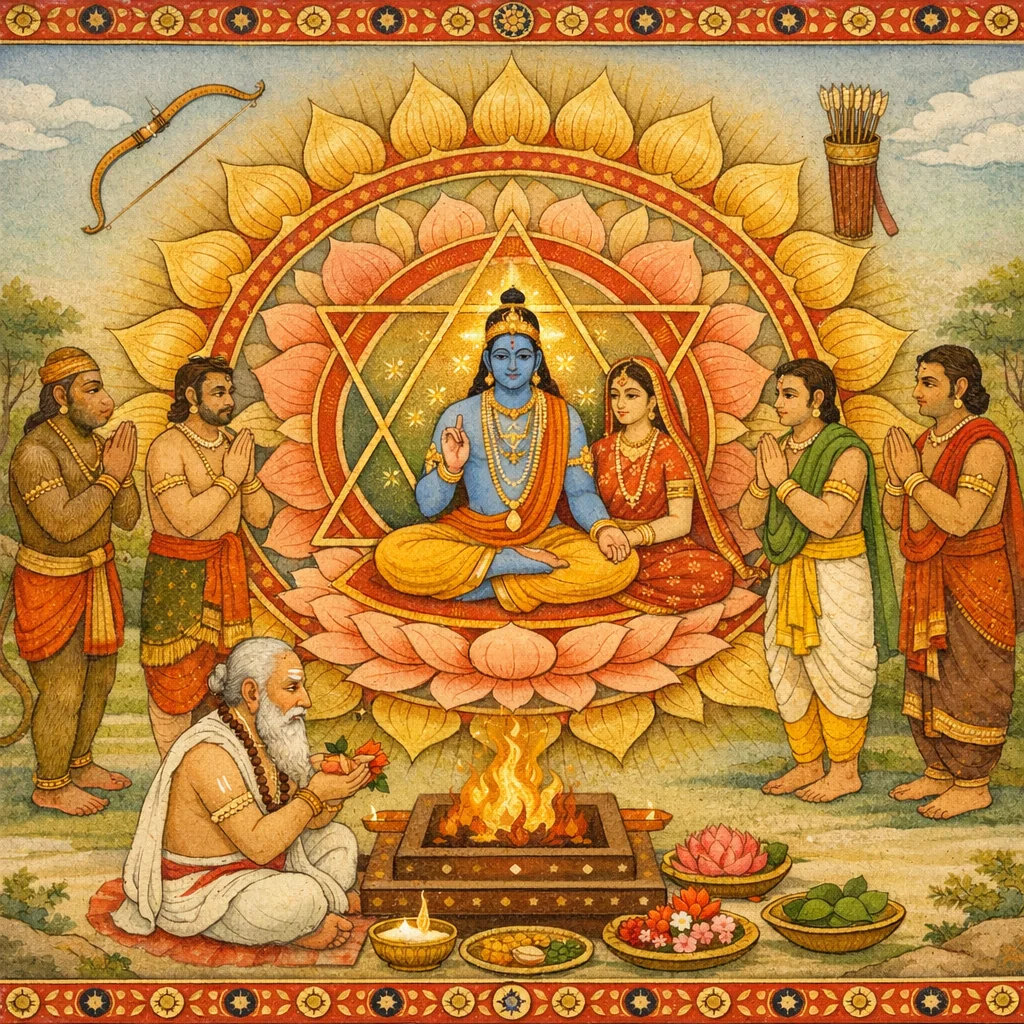
The Description of the Worship of Rāma and Others (Rāmādi-pūjā-vidhāna)
Sanatkumāra teaches the supremacy of Rāma-mantras within Vaiṣṇava mantra traditions, praising their power to destroy sin and lead to mokṣa. He supplies the mantra credentials (ṛṣi, chandas, devatā, bīja, śakti, viniyoga), prescribes ṣaḍaṅga-nyāsa and letter-placement on bodily loci, and instructs heart-centered meditation on Rāma with Sītā and Lakṣmaṇa. The chapter lays out the full pūjā design—attendant deities, weapons (Śārṅga and arrows), allies (Hanumān, Sugrīva, Bharata, Vibhīṣaṇa, etc.), and lotus-mandala worship—then details puraścaraṇa and homa rules with offerings for prosperity, health, sovereignty, poetic brilliance, and disease-pacification, warning against merely utilitarian ritual that forgets the hereafter. A major section describes the Yantra-rāja (king of yantras): its hexagon/lotus/sun-petal geometry, inscription materials, methods of wearing, and activation rites tied to auspicious days and nakṣatras. Many mantra-forms (six-, eight-, ten-, thirteen-, eighteen-, nineteen-syllable and more) are cataloged with consistent ritual templates, culminating in sub-worship of Sītā and Lakṣmaṇa and applications from liberation to restoration of kingship.
Shlokas
Verse 1
सनत्कुमार उवाच । अथ रामस्य मनवो वक्ष्यंते सिद्धिदायकाः । येषामाराधनान्मर्त्यास्तरंति भवसागरम् ॥ १ ॥
Sanatkumāra said: Now I shall proclaim the mantras of Śrī Rāma, bestowers of spiritual attainments; by worship through them, mortals cross the ocean of saṃsāra.
Verse 2
सर्वेषु मंत्रवर्येषु श्रेष्ठं वैष्णवमुच्यते । गाणपत्येषु सौरेषु शाक्तशैवेष्वभीष्टदम् ॥ २ ॥
Among all the most excellent mantras, the Vaiṣṇava mantra is declared the best; and among the Gāṇapatya, Saura, Śākta, and Śaiva mantras, it is the one that grants the desired results.
Verse 3
वैष्णवेष्वपि मंत्रेषु राममंत्राः फलाधिकाः । गाणपत्यादिमंत्रेभ्यः कोटिकोटिगुणाधिकाः ॥ ३ ॥
Even among the Vaiṣṇava mantras, the Rāma-mantras are superior in their fruits; compared with the Gāṇapatya and other mantras, their efficacy is greater by crores upon crores.
Verse 4
विष्णुशय्यास्थितो वह्निरिंदुभूषितमस्तकः । रामाय हृदयांतोऽयं महाघौधविनाशनः ॥ ४ ॥
This sacred Fire abides upon Viṣṇu’s couch; his head is adorned with the moon. For Rāmā, he becomes the indwelling presence within the heart, destroying the vast flood of great sins.
Verse 5
सर्वेषु राममंत्रषु ह्यतिश्रेष्टः षडक्षरः । ब्रह्महत्यासहस्राणि ज्ञाताज्ञातकृतानि च ॥ ५ ॥
Among all the mantras of Śrī Rāma, the six-syllabled one is indeed the most excellent; it destroys thousands of sins as grave as brahma-hatyā, whether done knowingly or unknowingly.
Verse 6
स्वर्णस्तेय सुरापानगुरुतल्पायुतानि च । कोटिकोटिसहस्राणि ह्युपपापानि यानि वै ॥ ६ ॥
Innumerable subsidiary sins (upapāpas) exist—countless by crores and thousands—together with grave offenses such as stealing gold, drinking intoxicants, and violating the teacher’s bed (adultery with the guru’s wife).
Verse 7
मंत्रस्योञ्चारणात्सद्यो लयं यांति न संशयः । ब्रह्मा मुनिः स्याद्गायत्री छंदो रामश्च देवता ॥ ७ ॥
By the very utterance of this mantra, obstacles swiftly dissolve—there is no doubt. Brahmā is its seer (ṛṣi), Gāyatrī its metre (chandas), and Rāma its presiding deity (devatā).
Verse 8
आद्यं बीजं च हृच्छक्तिर्विनियोगोऽखिलाप्तये । षड्दीर्घभाजा बीजेन षडंगानि समाचरेत् ॥ ८ ॥
The first syllable is the bīja; the heart-power (hṛcchakti) is to be employed, and the stated application (viniyoga) is the attainment of all results. With that bīja—endowed with six long vowels—one should duly perform the six-limbed (ṣaḍaṅga) rite.
Verse 9
ब्रह्मरंध्रे भ्रुवोर्मध्ये हृन्नाभ्योर्गुह्यपादयोः । मंत्रवर्णान्क्रमान्न्यस्य केशवादीन्प्रविन्यसेत् ॥ ९ ॥
Placing the syllables of the mantra in due order at the brahma-randhra (crown of the head), between the eyebrows, in the heart, at the navel, in the secret region, and in the feet, one should then carefully install (nyāsa) the divine names beginning with Keśava.
Verse 10
पीठन्यासादिकं कृत्वा ध्यायेद्धृदि रघूत्तमम् । कालांभोधरकांतं च वीरासनसमास्थितम् ॥ १० ॥
Having performed the preliminary rites such as the pīṭha-nyāsa, one should meditate within the heart on Raghūttama (Rāma)—radiant like a dark rain-cloud and seated firmly in the heroic posture (vīrāsana).
Verse 11
ज्ञानमुद्रां दक्षहस्ते दधतं जानुनीतरम् । सरोरुहकरां सीतां विद्युदाभां च पार्श्वगाम् ॥ ११ ॥
He bore the mudrā of knowledge in his right hand, while the other hand rested upon his knee; at his side stood Sītā, lotus-handed, radiant like lightning.
Verse 12
पश्यंतीं रामवक्राब्जं विविधाकल्पभूषिताम् । ध्यात्वैवं प्रजपेद्वर्णलक्षं मंत्री दशांशतः ॥ १२ ॥
Visualizing her as gazing upon Rāma’s lotus-like face, adorned with manifold ornaments and embellishments, the mantra-practitioner should meditate thus and then repeat the mantra for one hundred thousand syllables, performing the prescribed tenth-part as the ancillary observance.
Verse 13
कमलैर्जुहुयाद्वह्नौ ब्राह्मणान्भोजयेत्ततः । पूजयेद्वैष्णवे पीठे विमलादिसमन्विते ॥ १३ ॥
One should offer oblations into the sacred fire with lotus-flowers; then one should feed the brāhmaṇas. Thereafter, one should perform worship at the Vaiṣṇava altar-seat, accompanied by Vimalā and the other attendant powers.
Verse 14
मूर्तिं मूलेन संकल्प्य तस्यामावाह्य साधकः । सीतां वामे समासीनां तन्मन्त्रेण प्रपूजयेत् ॥ १४ ॥
Having mentally formed the deity’s image by means of the root-mantra, the practitioner should invoke the deity into it; and then, with that very mantra, he should duly worship Sītā seated on the left.
Verse 15
रमासीतापदं ङेंतं द्विठांतो जानकीमनुः । अग्रेः शार्ङ्गं च सम्पूज्य शरान्पार्श्वद्वयेऽर्चयेत् ॥ १५ ॥
Having placed the padas of Ramā and Sītā, and using the Jānakī-mantra endowed with the two ṭhā-s, one should first duly worship Śārṅga, the divine bow, in front, and then worship the arrows on both sides.
Verse 16
केशरेषु षडंगानि पत्रेष्वेतान्समर्चयेत् । हनुमंतं च सुग्रीवं भरतं सबिभीषणम् ॥ १६ ॥
Upon the filaments (of the lotus), one should worship the six auxiliaries (ṣaḍaṅga); and upon the petals one should duly worship these—Hanumān, Sugrīva, Bharata, and Bibhīṣaṇa.
Verse 17
लक्ष्मणांगदशत्रुघ्नान् जांबवंतं क्रमात्पुनः । वाचयंतं हनूमंतग्रतो धृतपुस्तकम् ॥ १७ ॥
Then, in due order again, (he saw) Lakṣmaṇa, Aṅgada, and Śatrughna, and Jāmbavān—reciting (the text) while holding a book, with Hanumān seated in front (as the listener).
Verse 18
यजेद्भरतशत्रुघ्नौ पार्श्वयोर्धृतचामरौ । धृतातपत्रं हस्ताभ्यां लक्ष्मणं पृष्टतोऽर्चयेत् ॥ १८ ॥
One should worship Bharata and Śatrughna standing at the sides holding chowries; and worship Lakṣmaṇa behind (the Lord), holding a royal parasol with both hands.
Verse 19
ततोऽष्टपत्रे सृष्टिं च जपंतं विजयं तथा । सुराष्ट्रं राष्ट्रपालं च अकोपं धर्मपालकम् ॥ १९ ॥
Then, upon the eight-petalled (lotus), one should perform japa of the (names) Sṛṣṭi, Vijaya, Surāṣṭra, Rāṣṭrapāla, Akopa, and Dharmapālaka.
Verse 20
सुमंतं चेति सम्पूज्य लोके शानायुधैर्युतान् । एवं रामं समाराध्य जीवन्मुक्तः प्रजायते ॥ २० ॥
Thus, having duly worshipped Sumaṅta and others in the world—those endowed with auspicious weapons—one who worships Rāma in this manner is born as a jīvanmukta, liberated while still living.
Verse 21
चंदनाक्तैः प्रजुहुयाज्जातीपुष्पैः समाहितः । राजवश्याय कमलैर्धनधान्यादिसिद्धये ॥ २१ ॥
With a mind firmly composed, one should duly offer into the sacred fire jasmine blossoms anointed with sandal paste; and with lotuses one performs the oblation to bring a king under one’s influence and to attain success in wealth, grains, and related prosperity.
Verse 22
लक्ष्मीकामः प्रजुहुयात्प्रसूनैर्विल्वसंभवैः । आज्याक्तैर्नीलकमलैर्वशयेदखिलं जगत् ॥ २२ ॥
One who desires Lakṣmī—prosperity—should duly offer oblations with flowers born of the bilva tree; and by offering blue lotuses anointed with ghee, he brings the whole world under his influence.
Verse 23
घृताक्तशतवर्वीभिर्दीर्घायुश्च निरामयः । रक्तोत्पलानां होमेन धनं प्राप्नोति वांछितम् ॥ २३ ॥
By offering śatāvarī stalks anointed with ghee into the fire, one becomes long-lived and free from disease; and by performing a homa with red lotuses, one obtains the desired wealth.
Verse 24
पालाशकुसुमैर्हुत्वा मेधावी जायते नरः । तज्जप्तांभः पिबेत्प्रातर्वत्सरात्कविराड् भवेत् ॥ २४ ॥
By offering oblations with palāśa blossoms, a person becomes endowed with keen intelligence. If, in the morning, he drinks the water over which that mantra has been recited, then within a year he becomes a radiant, eminent poet-sage.
Verse 25
तन्मंत्रितान्नं भुंजीतमहारोगप्रशांतये । रोगोक्तौषधहोमेन तद्रोगान्मुच्यते क्षणाम् ॥ २५ ॥
To pacify a severe illness, one should partake of food consecrated by that mantra. By performing a fire-offering with the medicinal herbs prescribed for the disease, one is freed from that illness at once.
Verse 26
नदीतीरे च गोष्ठे वा जपेल्लक्षं पयोब्रतः । पायसेनाज्ययुक्तेन हुत्वा विद्यानिधिर्भवेत् ॥ २६ ॥
Observing the milk-vow (payovrata), one should recite the mantra one hundred thousand times on a riverbank or in a cowshed; then, having offered sweet rice (pāyasa) mixed with ghee into the sacred fire, one becomes a treasury of holy knowledge (vidyā).
Verse 27
परिक्षीणाधिपत्यो यः शाकाहारो जलांतरे । जपेल्लक्षं च जुहुयाद्विल्वपुष्पैर्दशांशतः ॥ २७ ॥
He whose sovereignty has waned should subsist on vegetables and remain in water; he should complete one lakh (one hundred thousand) recitations, and then offer oblations equal to one-tenth of that number with bilva flowers.
Verse 28
तदैव पुनराप्नोति स्वाधिपत्यं न संशयः । उपोष्य गङ्गातीरांते स्थित्वा लक्षं जपेन्नरः ॥ २८ ॥
Then, without delay, he regains his own sovereignty—of this there is no doubt. Having fasted, a man should remain on the bank of the Gaṅgā and recite the mantra one hundred thousand times.
Verse 29
दशांशं कमलैर्हुत्वा विल्वोत्थैर्वा प्रसूनकैः । मधुरत्रयसंयुक्तैरादज्यश्रियमवाप्नुयात् ॥ २९ ॥
Having offered the prescribed tenth portion as oblations with lotus flowers—or with blossoms of the bilva tree—together with the three sweet substances, one attains prosperity and auspicious fortune.
Verse 30
मार्गमासे जले स्थित्वा कन्दमूलफलाशनः । लक्षं जप्त्वा दशांशेन पायसैर्जुहुयाद्वसौ ॥ ३० ॥
In the month of Mārgaśīrṣa, standing in water and subsisting on roots, tubers, and fruits, one should complete one lakh recitations; then, for the tenth part of that number, one should offer sweet rice (pāyasa) into the sacred fire on the day of the Vasus.
Verse 31
श्रीरामचन्द्रसदृशः पुत्रः पौत्रोऽपि जायते । अन्येऽपि बहवः संति प्रयोगामन्त्रराजके ॥ ३१ ॥
Through the proper application of the Mantrarāja, a son—and even a grandson—may be born resembling Śrī Rāmacandra; and many other attainments, too, are possible.
Verse 32
किंतु प्रयोगकर्तॄणां परलोको न विद्यते । षट्कोणं वसुपत्रं च तद्बाह्यार्कदलं लिखेत् ॥ ३२ ॥
But for those who employ such ritual applications merely as techniques, there is no attainment of the hereafter. One should draw a hexagon, then an eight-petalled lotus, and outside that a sun-like circle of petals.
Verse 33
षट्कोणेषु षडर्णानि मन्त्रस्य विलिखेद् बुधः । अष्टपत्रे तथाष्टार्णांल्लिखेत्प्रणवगर्भितान् ॥ ३३ ॥
A wise practitioner should inscribe the mantra’s six syllables within the six triangles of the hexagon; likewise, upon the eight-petalled lotus he should write the mantra’s eight syllables, each containing the Praṇava (Oṁ) within it.
Verse 34
कामबीजं रविदले मध्ये मन्त्रावृताभिधाम् । सुदर्शनावृतं बाह्ये दिक्षु युग्मावृतं तथा ॥ ३४ ॥
In the middle of the sun-like petal (ravi-dala) place the Kāma-bīja, encircled by the name of the mantra. On the outside, enclose it with Sudarśana; and in the directions as well, arrange paired enclosures likewise.
Verse 35
वज्रोल्लसद्भूमिगेहं कन्दर्पांकुशपाशकैः । भूम्या च विलसत्कोणं यन्त्रराजमिदं स्मृतम् ॥ ३५ ॥
That diagram in which the ground-plan and enclosing structure shine like a vajra, furnished with the signs of Kāma, the aṅkuśa (goad), and the pāśa (noose), and in which the corners of the ground-space are made clearly manifest—this is remembered as the “Yantrarāja,” the King of Yantras.
Verse 36
भूर्जेऽष्टगन्धैः संलिख्य पूजयेदुक्तवर्त्मना । षट्कोणेषु दलार्काब्जान्यावेष्टवृत्तयुग्मतः ॥ ३६ ॥
Having inscribed it on birch-bark (bhūrja) with the fragrant eightfold paste (aṣṭagandha), one should worship it according to the procedure already taught; and within the six triangles one should draw the petalled sun-lotus, enclosed by a pair of concentric circles.
Verse 37
केशरेष्वष्टपत्रस्य स्वरद्वंद्वं लिखेद् बुधः । बहिस्तु मातृकां चैव मन्त्रं प्राणनिधयनम् ॥ ३७ ॥
A learned practitioner should write the pairs of vowels upon the filaments (keśara) of the eight-petalled lotus; and on the outside he should write the Mātr̥kā, the matrix of letters, along with the prāṇa-nidhāna mantra for installing the life-breath.
Verse 38
यन्त्रमेतच्छुभे घस्रे कण्ठे वा दक्षिणे भुजे । मूर्ध्नि वा धारयेन्मंत्री सर्वपापैः प्रमुच्यते ॥ ३८ ॥
On an auspicious day, the mantra-practitioner should wear this yantra—on the neck, on the right arm, or upon the head; by doing so, one is released from all sins.
Verse 39
सुदिने शुभनक्षत्रे सुदेशे शल्यवर्जिते । वश्याकर्षणविद्वेषद्रावणोच्चाटनादिकम् ॥ ३९ ॥
On an auspicious day, under a favorable nakṣatra, in a suitable place free from impurities and obstructions, one should undertake rites such as vaśya (subjugation), ākṛṣaṇa (attraction), vidveṣa (causing enmity), drāvaṇa (driving away), uccāṭana (expulsion), and the like.
Verse 40
पुष्यद्वयं तथादित्यार्द्रामघासु यथाक्रमम् । दूर्वोत्था लेखनी वश्ये तथाकृष्टौ करंजजा ॥ ४० ॥
In the two Puṣya nakṣatras, and likewise in Ādityā, Ārdrā, and Maghā respectively, for the vaśya rite a stylus made from dūrvā grass is prescribed; and for the ākṛṣṭi (attraction) rite, a stylus made from karañja wood is prescribed.
Verse 41
नरास्थिजा मारणे तु स्तंभने राजवृक्षजा । शांतिपुष्टष्ट्यायुषां सिद्धयै सर्वापच्छमनाय च ॥ ४१ ॥
A preparation made from human bone is employed in rites of māraṇa (destruction), while one made from the rājavṛkṣa tree is used in rites of stambhana (immobilization). These are also applied to attain peace and prosperity, to promote longevity, and to pacify all calamities.
Verse 42
विभ्रमोत्पादने चैव शिलायां विलिखेद् बुधः । खरचर्मणि विद्वेषे ध्वजे तूञ्चाटनाय च ॥ ४२ ॥
A learned practitioner should inscribe it on stone to produce confusion, on a donkey’s hide to stir enmity, and on a banner for uccāṭana—the act of driving away or repelling.
Verse 43
शत्रूणां ज्वरसन्तापशोकमारणकर्मणि । पीतवस्रं लिखित्वा तु साधयेत्साधकोत्तमः ॥ ४३ ॥
In rites meant to afflict enemies with fever, burning torment, grief, or even death, the foremost sādhaka should accomplish the act by writing it upon a yellow cloth.
Verse 44
वश्याकृष्टौ चाष्टगन्धैः सम्पूज्य च यथाविधि । चितांगारादिना चैव ताडनोच्चाटनादिकम् ॥ ४४ ॥
For rites of vaśya (subjugation) and ākarṣaṇa (attraction), one should first worship in due manner with the “eight fragrances” (aṣṭa-gandha). Thereafter, using charred embers and the like, one performs acts such as tāḍana (striking), uccāṭana (driving away), and other similar operations.
Verse 45
विषार्कक्षीरयोगेन मारणं भवति ध्रुवम् । लिखित्वैवं यंत्रराजं गन्धपुष्पादिभिर्यजेत् ॥ ४५ ॥
By combining poison with the milky sap of the arka plant, death is said to occur unfailingly. Having thus inscribed the “king of yantras,” one should worship it with fragrances, flowers, and the like.
Verse 46
त्रिलोहवेष्टितं कृत्वा धारयेत्साधकोत्तमः । बीजं रामाय ठद्वंद्वं मन्त्रोऽयं रसवर्णकः ॥ ४६ ॥
Having encased it with three metals, the foremost sādhaka should wear it. The seed-syllable is “rāmāya,” and the paired syllables “ṭha” are prescribed—this mantra is called “rasavarṇaka,” being formed of coded technical syllables.
Verse 47
महासुदर्शनमनुः कथ्यते सिद्धिदायकः । सुदर्शनमहाशब्दाच्चक्रराजेश्वरेति च ॥ ४७ ॥
The mantra called “Mahā-sudarśana” is declared to bestow siddhis, spiritual attainments. And from the great sacred utterance “Sudarśana,” it is also named “Cakra-rājeśvara,” the Lord of the king of discs—the Sudarśana Cakra.
Verse 48
दुष्टांतकदुष्टभयानकदुष्टभयंकरम् । छिंधिद्वयं भिंधियुग्मं विदारययुगं ततः ॥ ४८ ॥
“O destroyer of the wicked; O terrifying to the wicked; O maker of fear for the wicked! Then utter: ‘Cut, cut’; ‘Pierce, pierce’; ‘Rend asunder, rend asunder.’”
Verse 49
परमन्त्रान् ग्रसद्वंद्वं भक्षयद्वितयं ततः । त्रासयद्वितयं वर्मास्त्राग्निजायांतिमो मनुः ॥ ४९ ॥
Then the final Manu—born of Agni—swallowed the opposing pair of hostile mantras, consumed the next pair, and terrified yet another pair by means of the protective armour-mantra (varma) and the weapon-mantra (astra).
Verse 50
अष्टषष्ट्यक्षरः प्रोक्तो यंत्रसंवेष्टने त्वयम् । तारो हृद्भगवान् ङेंतो ङेंतो हि रघुनन्दनः ॥ ५० ॥
For the wrapping and enclosing of the yantra, a formula of sixty-eight syllables has been taught. The praṇava “oṃ” is Bhagavān in the heart; and “ṅeṃto, ṅeṃto”—indeed—refers to Raghunandana, Śrī Rāma.
Verse 51
रक्षोघ्नविशदायांते मधुरादिप्रसन्न च । वरदानायामितांते नुतेजसेपदमीरयेत् ॥ ५१ ॥
At the close of the mantric section beginning with “Rakṣoghna” and “Viśadāyānte”, likewise at the end of the pleasing section beginning with “Madhurādi”, and at the end of the section beginning with “Varadānāya” and “Amitānte”, one should utter the word (pada) “Tejase”.
Verse 52
बालायांते तु रामाय विष्णवे हृदयांतिमः । सप्तचत्वारिंशदर्णो मालामन्त्रोऽयमीरितः ॥ ५२ ॥
With the seed syllable “bālā” placed at the end, and with “Rāmāya Viṣṇave” as the concluding heart-formula, this is declared to be a rosary-mantra consisting of forty-seven syllables.
Verse 53
विश्वामित्रो मुनिश्चास्य गायत्री छंद ईरितम् । श्रीरामो देवता बीजं ध्रुवः शक्तिश्च ठद्वयम् ॥ ५३ ॥
For this mantra/vidyā, the sage is declared to be Viśvāmitra; the metre is said to be Gāyatrī. Śrī Rāma is the presiding deity; the seed-syllable is “bīja”, Dhruva is the śakti, and the pair “ṭha” is stated as an additional identifying element.
Verse 54
षड्दीर्घस्वरयुग्मायाबीजेनांगानि कल्पयेत् । ध्यानपूजादिकं सर्वमस्य पूर्ववदाचरेत् ॥ ५४ ॥
With the seed-mantra of “Ṣaḍ-dīrgha-svara-yugmā”, one should assign the limbs (perform aṅga-nyāsa); and for this practice, meditation, worship, and all related rites should be carried out exactly as previously described.
Verse 55
अयमाराधितो मन्त्रः सर्वान्कामान्प्रयच्छति । स्वकामसत्यवाग्लक्ष्मीताराढ्यः पञ्चवर्णकः ॥ ५५ ॥
When duly propitiated, this mantra bestows all desired aims. This five-syllabled formula—endowed with the power of one’s chosen desire, truthfulness of speech, and the grace of Lakṣmī and Tārā—grants fulfillment.
Verse 56
षडक्षरः षड्विधः स्याञ्चतुर्वर्गफलप्रदः । ब्रह्मा संमोहनः शक्तिर्दक्षिणामूर्तिसंज्ञकः ॥ ५६ ॥
The six-syllabled mantra is said to be of six kinds and to bestow the fruits of the four aims of life. Its forms are known as Brahmā, Saṃmohana (the enchanting form), Śakti, and the one called Dakṣiṇāmūrti.
Verse 57
अगस्त्यः श्रीशिवः प्रोक्तास्ते तेषां मुनयः क्रमात् । अथवा कामबीजादेर्विश्वामित्रो मुनिः स्मृतः ॥ ५७ ॥
Agastya and the venerable Śiva are declared as the presiding authorities; and, in due order, the sages (ṛṣis) for those mantras are stated accordingly. Alternatively, for the Kāma-bīja and related seed-syllables, Viśvāmitra is remembered as the seer.
Verse 58
छन्दः प्रोक्तं च गायत्री श्रीरामो देवता पुनः । बीजशक्तिराधमांत्यं मन्त्रार्णैः स्यात्षडंगकम् ॥ ५८ ॥
The metre is declared to be Gāyatrī, and the presiding deity again is Śrī Rāma. The bīja and śakti are the first and the last syllables; and by the syllables of the mantra the sixfold ancillary limbs (ṣaḍaṅga) are to be formed.
Verse 59
बीजैः षड्दीर्घयुक्तैर्वा मंत्रार्णान्पूर्ववन्न्यसेत् । ध्यायेत्कल्पतरोर्मूले सुवर्णमयमण्डपे ॥ ५९ ॥
Using seed-syllables—either those furnished with six long vowels—or else, one should place (perform nyāsa of) the mantra-syllables as previously taught. Then one should meditate at the root of the wish-fulfilling tree, within a pavilion made of gold.
Verse 60
पुष्पकाख्यविमानांतः सिंहासनपरिच्छदे । पद्मे वसुदलेदेवमिंद्रनीलसमप्रभम् ॥ ६० ॥
Inside the aerial chariot called Puṣpaka, amid the furnishings of a lion-throne, (he beheld) the God seated upon a lotus with eight petals, radiant like the sapphire (indranīla).
Verse 61
वीरासनसमासीनं ज्ञानमुद्रोपशोभितम् । वामोरुन्यस्ततद्धस्तसीतालक्ष्मणसेवितम् ॥ ६१ ॥
Seated in vīrāsana and adorned with the jñāna-mudrā, his hand resting upon his left thigh, he was reverently attended by Sītā and Lakṣmaṇa.
Verse 62
रत्नाकल्पं विभुंध्यात्वा वर्णलक्षं जपेन्मनुम् । यद्वा स्मारादिमन्त्राणां जयाभं च हरिं स्मरेत् ॥ ६२ ॥
Having meditated on the all-pervading Lord in the form called Ratnākalpa, one should repeat the mantra to the measure of a hundred thousand syllables; or, by the Smāra and related mantras, one should remember Hari, bestower of victory and splendor.
Verse 63
येजनं काम्यकर्माणि सर्वं कुर्यात्षडर्णवत् । रामश्च चन्द्रभ द्रांतो ङेनमोंतो ध्रुवादिकः ॥ ६३ ॥
One should perform sacrifices and all desire-motivated rites wholly in the manner prescribed for the six-syllabled mantra. ‘Rāma’ and other six-syllabled forms—those ending in ‘candrabha’, those ending in ‘ṅe-namoṃ’, and those beginning with ‘dhruva’—are to be applied as appropriate.
Verse 64
मन्त्रावष्टाक्षरौ ह्येतौ तारांत्यौ चेन्नवाक्षरौ । एतेषां यजनं सर्वं कुर्यान्मंत्री षडर्णवत् ॥ ६४ ॥
These two mantras are indeed eight-syllabled; but if they end with the syllable ‘tārā’ (oṃ), they become nine-syllabled. For all of them, the officiating practitioner should perform every rite of worship in the same manner as for the six-syllabled mantra.
Verse 65
जानकीवल्लभो ङेंतो द्विठांतः कवचादिकः । दशार्णोऽयं महामन्त्रो विशिष्टोऽस्य मुनिः स्वराट् ॥ ६५ ॥
[The mantra] begins with ‘Jānakīvallabha’ and ends with ‘ṅeṃ’, being concluded with the syllable ‘dviṭhāṃ’, and is used for a protective kavaca and related rites. This is a ten-syllabled (daśārṇa) great mantra, and its distinguished seer (ṛṣi) is Svarāṭ.
Verse 66
छन्दश्च देवता सीता पतिर्बीजं तथादिमम् । स्वाहा शक्तिश्च कामेन कुर्यादंगानि षट् क्रमात् ॥ ६६ ॥
The metre (chandas) and presiding deity is Sītā; her Lord, Rāma, is declared to be the seed-syllable (bīja) and likewise the primal opening formula. “Svāhā” is the power (śakti). Seeking the intended fruit, one should then perform the six limbs (aṅga-nyāsa) in proper order.
Verse 67
शिरोललाटभ्रूमध्यतालुकण्ठेषु हृद्यपि । नाभ्यंघ्रिजानुपादेषु दशार्णान्विन्यसेन्मनोः ॥ ६७ ॥
One should mentally install the ten syllables (of the mantra) upon the head, forehead, the space between the eyebrows, the palate, the throat, and also the heart—then upon the navel, the feet, the knees, and the legs—performing the nyāsa with the mind.
Verse 68
अयोध्यानगरे रत्नचित्रसौवर्णमण्डपे । मंदारपुष्पैराबद्धविताने तोरणान्विते ॥ ६८ ॥
In the city of Ayodhyā, upon a golden pavilion adorned with gem-like designs—its canopy fastened with mandāra flowers and fitted with ceremonial archways— the sacred setting was arranged.
Verse 69
सिंहासनसमासीन पुष्पकोपरि राघवम् । रक्षोभिर्हरिभिर्देवैः सुविमानगतैः शुभैः ॥ ६९ ॥
Rāghava, seated upon a throne in the Puṣpaka (aerial chariot), was surrounded by auspicious beings—rākṣasas, vānara (monkey hosts), and gods—each stationed in splendid celestial vimānas.
Verse 70
संस्तूयमानं मुनिभिः प्रह्वैश्च परिसेवितम् । सीतालंकृतवामांगं लक्ष्मणेनोपशोभितम् ॥ ७० ॥
Praised by sages and attended by the reverent, with Sītā adorning His left side and Lakṣmaṇa enhancing His splendor, He was continually served with devotion (bhakti).
Verse 71
श्यामं प्रसन्नवदनं सर्वाभरणभूषितम् । एवं ध्यात्वा जपेन्मंत्री वर्णलक्षं समाहितः ॥ ७१ ॥
Thus meditating on the dark-hued Lord—serene of face and adorned with every ornament—the mantra-practitioner, with mind fully gathered, should repeat the mantra to the measure of one hundred thousand syllables.
Verse 72
दशांशः कमलैर्होमो यजनं च षडर्णवत् । रामो ङेंन्तो धनुष्पाणिर्ङैतोंऽते वह्निसुंदरी ॥ ७२ ॥
Let a tenth portion be offered; let homa be performed with lotus-flowers; and let the sacrifice be carried out in the six-syllabled mantric form. “Rāma” is to be recited with the nasal “ṅ” as onset; “Dhanus-pāṇi” (the Bow-in-hand) is pronounced likewise; and at the end the form “Vahni-sundarī”—the Beauty of Fire—is stated.
Verse 73
दशाक्षरोऽयं मंत्रोऽस्य मुनिर्ब्रह्मा विराट् पुनः । छन्दस्तु देवता प्रोक्तो रामो राक्षसमर्दनः ॥ ७३ ॥
This is a ten-syllabled mantra. Its seer (ṛṣi) is Brahmā; its metre (chandas) is Virāṭ. Its presiding deity (devatā) is declared to be Rāma, the destroyer of the rākṣasas.
Verse 74
आद्यं बीजं द्विठः शक्तिबींजेनांगानि कल्पयेत् । वर्णन्यासं तथा ध्यानं पुरश्चर्यार्चनादिकमन् ॥ ७४ ॥
Using the primary seed-mantra and the twofold arrangement, one should fashion the ancillary limbs (aṅga) with the seed of Śakti. Thereafter one should perform letter-nyāsa (varṇa-nyāsa), meditation, and the disciplines beginning with puraścaraṇa and ritual worship (arcana) and the like.
Verse 75
दशाक्षरोक्तवत्कुर्याच्चापबाणधरं स्मरेत् । तारो नमो भगवते रामान्ते चंद्रभद्रकौ ॥ ७५ ॥
One should perform it as taught for the ten-syllabled mantra, and meditate on the Lord bearing bow and arrows. (The mantra is:) the praṇava “oṁ”, then “namo bhagavate”, and at the end of “Rāma” add “Candra” and “Bhadraka”.
Verse 76
ङेंतावर्काक्षरौ मंत्रौ ऋषिध्यानादि पूर्ववत् । श्रीपूर्वं जयपूर्वं च तद्द्विधा रामनाम च ॥ ७६ ॥
The two mantras are made of the syllables “ṅeṃtā” and “varka”; their ṛṣi, meditation (dhyāna), and other ancillary particulars are as stated earlier. They are to be prefixed with “Śrī” and with “Jaya”; and in that same twofold manner, the Name “Rāma” is also to be employed.
Verse 77
त्रयोदशाक्षरो मंत्रो मुनिर्ब्रह्मा विराट् स्मृतम् । छन्दस्तु देवता प्रोक्तो रामः पापौघनाशनः ॥ ७७ ॥
This is a mantra of thirteen syllables; its ṛṣi is Brahmā, and its chandas is Virāṭ. Its presiding deity is declared to be Rāma, the destroyer of masses of sins.
Verse 78
षडंगानि प्रकुर्वीत द्विरावृत्त्या पदत्रयैः । ध्यानार्चनादिकं सव ह्यस्य कुर्याद्दशार्णवत् ॥ ७८ ॥
One should perform the sixfold auxiliary nyāsa (ṣaḍaṅga-nyāsa), repeating the three-word formula twice. And for this rite, the entire procedure—meditation, worship (arcana), and the rest—should be carried out exactly as prescribed in the Daśārṇa practice.
Verse 79
तारो नमो भगवते रामायांते महापदम् । पुरुषाय हृदंतोऽयं मनुरष्टादशाक्षरः ॥ ७९ ॥
The syllable “tāra” (Oṁ), then “namo bhagavate”, ending with “rāmāya”—this is the great sacred formula. When joined with “puruṣāya” and held within the heart, this mantra becomes an eighteen-syllabled (aṣṭādaśākṣara) formula.
Verse 80
विश्वामित्रो मुनिश्छदो धृती रामोऽस्य देवता । तारो बीजं नमः शक्तिश्चंद्राक्ष्यब्ध्यग्निषड्भुजैः ॥ ८० ॥
For this mantra, the ṛṣi is Viśvāmitra; the metre (chandas) is Muni; its sustaining power is Dhṛtī; and its presiding deity is Rāma. The seed-syllable (bīja) is “tāra”, the activating power (śakti) is “namaḥ”, and its nyāsa is applied by the numerical code: moon–eyes–ocean–fire–six-armed.
Verse 81
वर्णैमंत्रोत्थितैः कुर्यात्षडंगानि समाहितः । निश्शाणभेरीपटहशंखतुर्यादिनिःस्वनैः ॥ ८१ ॥
With the mind composed in concentration, one should perform the six auxiliaries (ṣaḍaṅga rites) with syllables born of mantra, accompanied by the resounding tones of horns, kettle-drums, drums, conches, trumpets, and other instruments.
Verse 82
प्रवृत्तनृत्ये परितो जयमंगलभाषिते । चंदनागरुकस्तूरीकर्पूरादिसुवासिते ॥ ८२ ॥
All around, dance had begun; the air resounded with cries of victory and auspicious blessings, and the place was richly perfumed with sandalwood, agaru, musk, camphor, and other fragrances.
Verse 83
नानाकुसुमसौरभ्यवाहिगंधवहान्विते । देवगंधर्वनारीभिर्गायन्तीभिरलकृते ॥ ८३ ॥
It was filled with breezes bearing the fragrance of many kinds of flowers, and it was adorned by celestial Gandharva maidens who were singing.
Verse 84
सिंहासने समासीनं पुष्पकोपरि राघवम् । सौमित्रिसीतासहितं जटामुकुटशोभितम् ॥ ८४ ॥
He beheld Rāghava seated upon a royal throne on the Puṣpaka (aerial car), accompanied by Saumitrī (Lakṣmaṇa) and Sītā, resplendent with a crown-like arrangement of matted locks.
Verse 85
चापबाणधरं श्यामं ससुग्रीवविभीषणम् । हत्वा रावणमायांतं कृतत्रैलोक्यरक्षणम् ॥ ८५ ॥
Dark-hued, bearing bow and arrows, accompanied by Sugrīva and Vibhīṣaṇa—having slain Rāvaṇa who had come forth, he accomplished the protection of the three worlds.
Verse 86
एवं ध्यात्वा जपेद्वर्णं लक्षं मत्री दशांशतः । घृताक्तैः पायसैर्हुत्वा यजनं पूर्ववञ्चरेत् ॥ ८६ ॥
Thus having meditated, the mantra-practitioner should repeat the sacred syllable one hundred thousand times; and as one-tenth of that, he should offer oblations in the homa with pāyasa (rice-milk) anointed with ghee. In this way he should perform the rite exactly according to the procedure taught earlier.
Verse 87
प्रणवो हृदयं सीतापतये तदनंतरम् । रामाय हनयुग्मांते वर्मास्त्राग्निप्रियांतिमः ॥ ८७ ॥
The Praṇava (Oṁ) is to be placed upon the heart. Immediately after, it is offered to the Lord of Sītā; then to Rāma. At the end, with the pair of syllables “ha-na”, the final application is made to the beloved Fire-weapon—thus forming the protective kavaca (armour) and astra (weapon) arrangement.
Verse 88
एकोनविंशद्वर्णोऽयं मंत्रः सर्वार्थसाधकः । विश्वामित्रो मुनिश्चास्यानुष्टुप्छन्द उदाहृतम् ॥ ८८ ॥
This mantra consists of nineteen syllables and is able to accomplish all aims. Its seer (ṛṣi) is the sage Viśvāmitra, and its metre (chandas) is declared to be Anuṣṭubh.
Verse 89
देवता रामभद्रो जं बीजं शक्तिर्नम इति । मंत्रोत्थितैः क्रमाद्वर्णैस्ततो ध्यायेञ्च पूर्ववत् ॥ ८९ ॥
The presiding deity is Rāmabhadra; “jaṃ” is the seed-syllable (bīja); and “namaḥ” is declared to be the śakti. Then, using the letters that arise from the mantra in their proper sequence, one should meditate thereafter as previously taught.
Verse 90
पूजनं काम्यकर्मादि सर्वमस्य षडर्णवत् । तारः स्वबीजं कमला रामभद्रेति संपठेत् ॥ ९० ॥
For this (mantra/deity), worship and all desire-motivated rites are to be performed in the manner of the six-syllabled mantra. One should recite: “Tāra”, one’s own seed-syllable (svabīja), “Kamalā”, and “Rāmabhadrā”.
Verse 91
महेष्वासपदांते तु रघुवीर नृपोत्तम । दशास्यांतकशब्दांते मां रक्ष देहि संपठेत् ॥ ९१ ॥
At the close of the word “Maheṣvāsa,” and again at the close of “Daśāsyāntaka,” one should recite: “O Raghu-hero, best of kings—protect me; grant me refuge.”
Verse 92
परमांते मे श्रियं स्यान्मंत्रो बाणगुणाक्षरः । बीजैर्वियुक्तो द्वात्रिंशदर्णोऽयं फलदायकः ॥ ९२ ॥
“May supreme prosperity (Śrī) come to me.” This mantra is arranged by the prescribed count of “arrows” and “qualities” in its syllables; when set apart from the seed-syllables (bīja), this thirty-two-syllabled formula is said to bestow results.
Verse 93
विश्वामित्रो मुनिश्चास्यानुष्टुप्छंद उदाहृतम् । देवता रामभद्रोऽत्र बीजं स्वं शक्तिरिंदिरा ॥ ९३ ॥
For this mantra, the sage (ṛṣi) is Viśvāmitra, and its metre (chandas) is declared to be Anuṣṭubh. Here the presiding deity (devatā) is Rāmabhadra; its seed (bīja) is its own Name, and its power (śakti) is Indirā (Lakṣmī).
Verse 94
बीजत्रयाद्यैः कुर्वीत पदैः सर्वेण मंत्रवित् । पंचांगानि च विन्यस्य मंत्रवर्णान्क्रमान्न्यसेत् ॥ ९४ ॥
A knower of mantra should perform the rite with the words that begin with the three seed-syllables (bīja). Having first arranged the five limbs of nyāsa (pañcāṅga), he should then place the mantra’s syllables in proper sequence.
Verse 95
मूर्ध्नि भाले दृशोः श्रोत्रे गंडयुग्मे सनासिके । आस्ये दोःसंधियुगले स्तनहृन्नाभिषु क्रमात् ॥ ९५ ॥
In due order—on the crown of the head, on the forehead, on the eyes, on the ears, on both cheeks together with the nose; then on the mouth; on the pair of arm-joints; and thereafter on the breasts, the heart, and the navel.
Verse 96
कटौ मेढ्रे पायुपादसंधिष्वर्णान्न्यसेन्मनोः । ध्यानार्चनादिकं चास्य पूर्ववत्समुपाचरेत् ॥ ९६ ॥
One should mentally perform nyāsa, placing the mantra’s syllables upon the waist, the genitals, the anus, and the joints of the feet; then, for Him, one should carry out meditation, worship (arcana), and the other rites exactly as taught earlier.
Verse 97
लक्षत्रयं पुरश्चर्यां पायसैर्हवनं मतम् । ध्यात्वा रामं पीतवर्णं जपेल्लक्षं समाहितः ॥ ९७ ॥
For the puraścaraṇa rite, three lakhs (300,000) of repetition are enjoined, and the fire-offering (homa) is to be made with pāyasa, rice cooked in milk. Meditating on Rāma of golden hue, one should, with a gathered mind, complete one lakh (100,000) of japa.
Verse 98
दशांशं कमलैर्हुत्वा धनैर्धनपतिर्भवेत् । तारो माया रमाद्वंद्वं दाशरथाय हृञ्च वै ॥ ९८ ॥
Having offered a tenth part as oblation with lotus-flowers—and likewise with wealth—one becomes a lord of riches. The seed-syllable sequence “tāra”, “māyā”, and the pair “ramā” is to be applied for Dāśarathi (Rāma), together with “hṛñ”.
Verse 99
एकादशाक्षरो मंत्रो मुन्याद्यर्चास्य पूर्ववत् । त्रैलोक्यांते तु नाथाय हृदंतो वसुवर्णवान् ॥ ९९ ॥
The mantra is of eleven syllables, and the worship—beginning with the sages (munis)—should be performed as previously taught. At the end of the three worlds, in the final dissolution, the Lord remains as the indweller within the heart, radiant with a golden splendor of opulence.
Verse 100
अस्यापि पूर्ववत्सर्वं न्यासध्यानार्चनादिकम् । आंजनेयपदांते तु गुरवे हृदयांतिमः ॥ १०० ॥
For this (mantra/rite) as well, everything should be done as before—nyāsa, meditation, worship, and the rest. At the end of the word “Āñjaneya,” one should add the final Heart seed (hṛdaya-bīja) and then offer it to the Guru.
Verse 101
मंत्रो नवाक्षरोऽस्यापि यजनं पूर्ववन्मतम् । ङेतं रामपद पश्चाद्धृदयं पंचवणवत् ॥ १०१ ॥
For this (mantra) too, the mantra is of nine syllables; its worship (yajana) is held to be as taught earlier. After placing the word “Rāma”, one should add the heart-seed syllable (hṛdaya) in the manner of the five-letter formula.
Verse 102
मुनिध्यानार्चनं चास्य प्रोक्तं सर्वं षडर्णवत् । रामांते चंद्रभद्रौ च ङेंतौ पावकवल्लभा ॥ १०२ ॥
The meditation and ritual worship of this (mantra/deity) have all been taught in the manner of a six-syllabled formula. At the end is “Rāmā”; and there are “Candrabhadrā” and also “ṅeṃtau”, together with “Pāvakavallabhā”.
Verse 103
मंत्रो द्वौ च समाख्यातौ मुन्याद्यर्चादि पूर्ववत् । वह्निः शेषान्वितश्चैव चंद्रभूषितमस्तकः ॥ १०३ ॥
Thus, two mantras are also declared; and the worship beginning with the sages and the rest is to be performed as before. (The deity to be contemplated is) Agni, accompanied by Śeṣa, with his head adorned by the moon.
Verse 104
एकाक्षरो रघुपतेर्मंत्रः कल्पद्रुमोऽपरः । ब्रह्मा मुनिः स्याद्गायत्री छंदो रामोऽस्य देवता ॥ १०४ ॥
The one-syllabled mantra of Raghupati is another wish-fulfilling tree (kalpadruma). For this mantra, Brahmā is the seer (ṛṣi), Gāyatrī is the metre (chandas), and Rāma is the presiding deity (devatā).
Verse 105
षड्दीर्घाढ्येन मंत्रेण षडंगानि समाचरेत् । सरयूतीरमंदारवेदिकापंकजासने ॥ १०५ ॥
With a mantra containing six long vowels, one should duly perform the six auxiliary rites (ṣaḍaṅga). This is to be done on the bank of the Sarayū, upon a lotus-seat set on a mandāra-wood altar/platform.
Verse 106
श्यामं वीरासनासीनं ज्ञानमुद्रोपशोभितम् । वामोरुन्यस्तं तद्धस्तं सीतालक्ष्मणसंयुतम् ॥ १०६ ॥
Dark-hued, seated in vīrāsana, adorned with the jñāna-mudrā; with that hand resting upon the left thigh, He is accompanied by Sītā and Lakṣmaṇa.
Verse 107
अवेक्षणाणमात्मानं मन्मथामिततेजसम् । शुद्धस्फटिकसंकाशं केवलं मोक्षकांक्षया ॥ १०७ ॥
One should contemplate the Ātman, beyond all objects of perception—of immeasurable splendor that outshines even Kāma—luminous like pure crystal, sought solely with longing for mokṣa, liberation.
Verse 108
चिंतयेत्परमात्मानमृतुलक्षं जपेन्मनुम् । सर्व्वं षडर्णवञ्चास्य होमनित्यार्चनादिकम् ॥ १०८ ॥
One should contemplate the Supreme Self (Paramātman) and repeat the mantra one hundred thousand times. In this discipline, everything—beginning with the six-syllabled mantra and including homa (fire-offerings), daily worship, and related rites—should be duly performed.
Verse 109
वह्निः शेषासनो भांतः केवलो द्व्यक्षरो मनुः । एकाक्षरोक्त वत्सर्वं मुनिध्यानार्चनादिकम् ॥ १०९ ॥
‘Vahni’ (Agni), ‘Śeṣāsana’ (He who reclines upon Śeṣa), ‘Bhānta’ (the Radiant One), and ‘Kevala’ (the Absolute) are sacred two-syllabled mantras. Yet in the one-syllabled mantra, everything is declared—such as the sages’ meditation, worship, and related disciplines.
Verse 110
तारमानारमानंगचास्त्रबीजैर्द्विवर्णकः । त्र्यक्षरो मंत्रराजः स्यात्षड्विधः सकलेष्टदः ॥ ११० ॥
Formed from the seed-syllables (bīja) of Tāra, Māna, Ara, Mānaṅga, and Cāstra, the two-syllabled mantra becomes a three-syllabled ‘king of mantras’; it is sixfold and bestows every desired attainment.
Verse 111
व्द्यक्षरश्चंद्रभद्रांतो द्विविधश्चतुरक्षरः । एकार्णोक्तवदेतेषां मुनिध्यानार्चनादिकम् ॥ १११ ॥
The two-syllabled mantra ending with “candra-bhadrā” is declared, and the four-syllabled mantra is of two kinds. For these mantras, the sage’s meditation, worship, and related rites are to be performed exactly as prescribed for the one-syllabled mantra.
Verse 112
तारो रामश्चतुर्थ्यंतो वर्मास्त्रं वह्निवल्लभा । अष्टार्णोऽयं महामंत्रो मुन्याद्यर्चा षडर्णवत् ॥ ११२ ॥
The syllable “tāra” (Oṃ), then “rāma” ending in the dative (rāmāya), together with the ‘armor’ (varma) and ‘weapon’ (astra) mantras, and the phrase “beloved of Fire”—this is the great eight-syllabled mantra. The worship beginning with the sages is to be performed in the same manner as for the six-syllabled mantra.
Verse 113
तारो मया हृदंते स्याद्रामाय प्रणवांतिमः । शिवोमाराममंत्रोऽयमष्टार्णः सर्वसिद्धिदः ॥ ११३ ॥
“Tāra” (the Pranava, Oṃ) should be placed in the heart as the inner support, and the final syllable is “rāmāya”. This is the Śiva–Umā–Rāma mantra—an eight-syllabled formula that bestows all siddhis.
Verse 114
ऋषिः सदाशिवः प्रोक्तो गायत्री छंद ईरितम् । शिवोमारामचंद्रोऽत्र देवता परिकीर्तितः ॥ ११४ ॥
The seer (ṛṣi) is declared to be Sadāśiva; the metre is said to be Gāyatrī; and the presiding deity here is proclaimed as Śivo–Umā–Rāmacandra.
Verse 115
षड्वीर्ययामाय यातु ध्रुवपंचार्णयुक्तया । षडंगानि विधायाथ ध्यायेद्धृदि सुरार्चितम् ॥ ११५ ॥
Let him proceed with the mantra addressed to the Lord of Six Powers, together with the fixed five-syllabled formula. Then, having performed the six limbs (ṣaḍ-aṅga) of mantra-nyāsa, he should meditate within his heart upon the Deity worshipped by the gods.
Verse 116
रामं त्रिनेत्रं सोमार्द्धधारिणं शूलिनं वरम् । भस्मोद्धूलितसर्वांगं कपर्द्दिनमुपास्महे ॥ ११६ ॥
We worship that most excellent Lord—rejoicing as Rāma, three-eyed, bearing the crescent moon, wielding the trident—whose whole body is dusted with sacred ash, the matted-haired ascetic (Kapardin).
Verse 117
रामाभिरामं सौंदर्यसीमां सोमावतंसिनीम् । पाशांकुशधनुर्बाणधरां ध्यायेत्रिलोचनाम् ॥ ११७ ॥
One should meditate on the three-eyed Goddess—delightful like Rāmā (Lakṣmī), the very limit of beauty, crowned with the crescent moon, and bearing the noose, the goad, the bow, and the arrows.
Verse 118
एवं ध्यात्वा जपेद्वर्णलक्षं त्रिमधुरान्वितैः । बिल्पपत्रैः फलैः पुष्पैस्तिलैर्वा पंकजैर्हुनेत् ॥ ११८ ॥
Having thus meditated, one should perform japa to the measure of a hundred thousand syllables; and, with offerings accompanied by the three sweets, one should perform the fire-offering (homa) using bilva leaves, fruits, flowers, sesame seeds, or lotus blossoms.
Verse 119
स्वयमायांति निधयः सिद्धयश्च सुरेप्सिताः । तारो माया च भरताग्रजराममनोभवः ॥ ११९ ॥
The treasures and the perfections (siddhis)—desired even by the gods—come of their own accord. Likewise one gains Tāra, Māyā, and Manobhava (Kāma), and also Rāma, the elder brother of Bharata.
Verse 120
वह्निजायाद्वादशार्णो मंत्रः कल्पद्रुमोऽपरः । अंगिराश्च मुनिश्छंदो गायत्री देवता पुनः ॥ १२० ॥
From “Vahnijāyā” is formed a twelve-syllabled mantra, also known as the wish-fulfilling “Kalpadruma.” Its seer is the sage Aṅgiras; its metre is Gāyatrī; and the presiding deity is again Gāyatrī.
Verse 121
श्रीरामो भुवनाबीजं स्वाहाशक्तिः समीरितः । चंद्रैकमुनिभूनेत्रैर्मंत्रार्णैरंगकल्पनम् ॥ १२१ ॥
“Śrī Rāma” is declared to be the bīja (seed) of the worlds, and “svāhā” is said to be its śakti (power). Using the mantra-syllables indicated by the numeric code “moon–one–sage–earth–eyes,” one should perform the assignment of the limbs (aṅga-kalpanā/nyāsa).
Verse 122
ध्यानपूजादिकं चास्च सर्वं कुर्यात्षडर्णवत् । प्रणवो हृदयं सीतापते रामश्च ङेंतिमः ॥ १२२ ॥
For this mantra, one should perform all rites—meditation (dhyāna), worship (pūjā), and the rest—just as for the six-syllabled mantra. The praṇava (Oṃ) is its heart; “Rāma, Lord of Sītā” is its concluding part.
Verse 123
हनद्वयांते वर्मास्त्रं मंत्रः षोडशवर्णवान् । अगस्त्योऽस्य मुनिश्छंदो बृहती देवता पुनः ॥ १२३ ॥
At the end of the two syllables “hana” is the protective “armor-weapon” mantra (varma-astra), consisting of sixteen syllables. Its seer (ṛṣi) is Agastya; its metre (chandas) is Bṛhatī; and its presiding deity is again the same as stated earlier.
Verse 124
श्रीरामोऽहं तथा बीजं रां शक्तिः समुदीरिता । रामाब्धिवह्निवेदाक्षिवर्णैः पंचांगकल्पना ॥ १२४ ॥
“I am Śrī Rāma.” The seed-syllable (bīja) is “rāṃ”, and its śakti (power) is thus declared. By the letters signified through “Rāma–ocean–fire–Veda–eye,” the fivefold arrangement (pañcāṅga-kalpanā) is to be constructed.
Verse 125
ध्यानपूजादिकं सर्वमस्य कुर्यात्षडर्णवत् । तारो हृञ्चैव ब्रह्मण्यसेव्याय पदमीरयेत् ॥ १२५ ॥
One should perform all its practices—meditation, worship, and the rest—in the same manner as for the six-syllabled mantra. Then one should utter the syllable “tāra” (Oṃ) together with “hṛṃ”, and pronounce the phrase “brahmaṇya-sevyāya”.
Verse 126
रामायाकुंठशब्दांतं तेजसे च समीरयेत् । उत्तमश्लोकधुर्याय स्वं भृगुः कामिकान्वितः ॥ १२६ ॥
One should utter the formula that begins with “Rāmā” and ends with the word “Akuṇṭha,” and recite it as well for the increase of spiritual radiance (tejas). Thus did Bhṛgu—endowed with the desired intention—offer his own hymn to the foremost Lord praised by excellent verses, Viṣṇu.
Verse 127
दंडार्पितां प्रिये मंत्रो रामरामाक्षरो मतः । ऋषिः शुक्रस्तथानुष्टुप्छंदो रामोऽस्य देवता ॥ १२७ ॥
Beloved one, the mantra is held to be the two-syllabled “Rāma, Rāma,” a mantra entrusted to the disciple. Its seer (ṛṣi) is Śukra; its metre is Anuṣṭubh; and its presiding deity is Rāma.
Verse 128
पादैः सर्वेण पंचांगं कुर्याच्छेषं षडर्णवत् । लक्षं जपो दशांशेन जुहुयात्पायसैः सुधीः ॥ १२८ ॥
Using the mantra in full with all its parts, one should perform the fivefold ancillary observances (pañcāṅga), and treat the remaining portion as a six-syllabled formula. The wise should complete one hundred thousand japa repetitions, and then offer one tenth of that number as homa oblations using pāyasa (rice-milk).
Verse 129
सिद्धमंत्रस्य भुक्तिः स्यान्मुक्तिः पातकनाशनम् । आदौ दाशरथायांते विद्महे पदमुच्चरेत् ॥ १२९ ॥
A perfected (siddha) mantra bestows worldly enjoyment and also liberation (mukti), and it destroys sins. At the beginning one should utter “dāśarathāya,” and at the end one should pronounce the word “vidmahe”.
Verse 130
ततः सीतावल्लभाय धीमहीति समुच्चरेत् । तन्नो रामः प्रोचो वर्णो दयादिति च संवदेत् ॥ १३० ॥
Then one should recite: “We meditate (dhīmahi) upon the beloved of Sītā.” Thereafter one should also utter: “May that Rāma—proclaimed as the supreme syllable—grant us grace.”
Verse 131
एषोक्तारा मगायत्री सर्वाभीष्टफलप्रदा । पद्मासीतापदं ङेतं ठद्वयांतः षडक्षरः ॥ १३१ ॥
This is the Magāyatrī declared here; it bestows all desired fruits. It is to be known as the word-form “padmāsītā”, a six-syllabled mantra ending with a pair of consonants.
Verse 132
वाल्मीकिश्च मुनिश्छंदो गायत्री देवता पुनः । सीता भगवती प्रोक्ता श्रीं बीजं वह्निसुन्दरी ॥ १३२ ॥
Again: the sage is Vālmīki; the metre is Gāyatrī; the presiding deity is the Divine Lady Sītā. The seed-syllable is “śrīṃ”, and the śakti is called Vahnisundarī.
Verse 133
शक्तिः षड्दीर्घयुक्तेन बीजेनांगानि कल्पयेत् । ततो ध्यायन्महादेवीं सीतां त्रैलोक्यपूजिताम् ॥ १३३ ॥
With the seed-syllable of the Śakti-mantra, endowed with six long vowels, one should arrange nyāsa upon the limbs. Then, meditating, one should contemplate the great Goddess Sītā, worshipped in the three worlds.
Verse 134
तप्तहाटकवर्णाभां पद्मयुग्मं करद्वये । सद्रत्नभूषणस्फूर्जद्दिव्यदेहां शुभात्मिकाम् ॥ १३४ ॥
Her radiance was like heated gold; in both hands she held a pair of lotuses. Adorned with splendid jewel-ornaments, her divine body shone forth—she was auspicious in essence.
Verse 135
नानावस्त्रां शशिमुखीं पद्माक्षीं मुदितांतराम् । पश्यंतीं राघवं पुण्यं शय्यार्ध्यां षड्गुणेश्वरीम् ॥ १३५ ॥
Clad in many garments, moon-faced and lotus-eyed, inwardly delighted, she gazed upon the holy Rāghava. Worthy of the royal couch, she was the sovereign Lady endowed with the six excellences.
Verse 136
एवं ध्यात्वा जपेद्वर्णलक्षं मंत्री दशांशतः । जुहुयात्कमलैः फुल्लैः पीठे पूर्वोदिते यजेत् ॥ १३६ ॥
Thus having meditated, the mantra-practitioner should repeat the mantra one lakh (one hundred thousand) times; then, as a tenth part of that number, he should offer homa-oblations with fully blossomed lotuses and perform worship upon the previously prescribed pīṭha (sacred seat).
Verse 137
मूर्तिं संकल्प्य मूलेन तस्यामावाह्य जानकीम् । संपूज्य दक्षिणे राममभ्यर्च्याग्रेऽनिलात्मजम् ॥ १३७ ॥
Having mentally formed the icon by means of the mūla-mantra, one should invoke (āvāhana) Jānakī (Sītā) into it; then, after duly worshipping her, one should worship Rāma on her right side and, in front, reverently worship Anila’s son (Hanumān).
Verse 138
पृष्टे लक्ष्मणमभ्यर्च्य षट्कोणेष्वंगपूजनम् । पत्रेषु मंत्रिमुख्यंश्च बाह्ये लोकेश्वरान्पुनः ॥ १३८ ॥
Then, on the reverse side, having duly worshiped Lakṣmaṇa, one should perform aṅga-pūjā—the worship of the subsidiary limbs—in the six triangles; on the petals one should worship the chief ministers, and again, on the outer enclosure, the Lords of the worlds (Loka-īśvaras).
Verse 139
वज्राद्यानपि संपूज्य सर्वसिद्धीश्वरो भवेत् । जातीपुष्पैश्चन्दनाक्तै राजवश्याय होमयेत् ॥ १३९ ॥
By duly worshipping Vajra and the other deities/powers beginning with him, one becomes a lord of all siddhis (attainments). To bring a king under one’s influence, one should perform a homa with jasmine flowers smeared with sandal paste.
Verse 140
कमलैर्धनधान्याप्तिर्नीलाब्जैर्वशयन् जगत् । बिल्वपत्रैः श्रियः प्राप्त्यै दूर्वाभीरोराशांतये ॥ १४० ॥
By offering lotus flowers one gains wealth and grain; by offering blue lotuses (nīlābja) one brings the world under one’s influence; by offering bilva leaves one attains Śrī—prosperity and auspicious fortune; and by offering dūrvā grass and abhīru one pacifies restless desire born of hope-driven longing.
Verse 141
किं बहूक्तुन सौभाग्यं पुत्रान्पौत्रान्परं सुखम् । धनं धान्यं च मोक्षं च सीताराधनतो लभेत् ॥ १४१ ॥
What more need be said? From the worship of Sītā one gains good fortune, sons and grandsons, the highest happiness, wealth and grain—and even liberation (mokṣa).
Verse 142
शक्रः सेंदुर्लक्ष्मणाय हृदयं सप्तवर्णवान् । अगस्त्योऽस्य मुनिश्छंदो गायत्री देवता पुनः ॥ १४२ ॥
For Lakṣmaṇa’s heart-mantra (hṛdaya), the seer (ṛṣi) is Śakra (Indra), marked with red sindūra and consisting of seven syllables. For this mantra, the sage Agastya is the ṛṣi; the metre is Gāyatrī; and the devatā is again that same divine power.
Verse 143
लक्ष्मणाख्यो महावीरश्चाढ्यं हृद्वीजशक्तिके । षड्दीर्घाढ्येन बीजेन षडंगानि समाचरेत् ॥ १४३ ॥
The great hero known as Lakṣmaṇa, endowed with the power of the heart-seed (hṛd-bīja-śakti), should perform the six-limbed rite (ṣaḍaṅga-nyāsa) using a seed-mantra enriched with six long vowels.
Verse 144
द्विभुजं स्वर्णरुचुरतनुं पद्मनिभेक्षणम् । धनुर्बाणकरं रामसेवासंसक्तमानसम् ॥ १४४ ॥
Two-armed, with a body radiant like gold, lotus-eyed, holding bow and arrows—his mind wholly absorbed in the service of Rāma.
Verse 145
ध्यात्वैवं प्रजपेद्वर्णलक्षं मंत्री दशांशतः । मध्वाक्तैः पायसैर्हुत्वा रामपीठे प्रपूजयेत ॥ १४५ ॥
Having thus meditated, the practitioner should recite the mantra until it totals one hundred thousand syllables; then, offering one-tenth of that number as fire-oblations (homa) of rice-pudding (pāyasa) mixed with honey, he should duly worship (the Lord) upon the Rāma-seat (Rāma-pīṭha).
Verse 146
रामवद्यजनं चास्य सर्वसिद्धिप्रदो ह्ययम् । साकल्यं रामपूजाया यदीच्छेन्नियतं नरः ॥ १४६ ॥
The recitation or utterance of this hymn in praise of Rāma truly bestows every attainment. If a disciplined person seeks the complete fruit of Rāma-worship, he should perform it regularly.
Verse 147
तेन यत्नेन कर्त्तव्यं लक्ष्मणार्चनमादरात् । श्रीरामचंद्रभेदास्तु बहवः संति सिद्धिदाः ॥ १४७ ॥
Therefore, with that very effort, one should perform the worship of Lakṣmaṇa with reverent care. Indeed, Śrī Rāmacandra has many recognized forms and distinctions, and they bestow spiritual accomplishment.
Verse 148
तत्साधकैः सदा कार्यं लक्ष्मणाराधनं शुभम् । अष्टोत्तरसहस्रं वा शतं वा सुसमाहितैः ॥ १४८ ॥
Therefore, practitioners should always perform the auspicious worship of Lakṣmaṇa—either with one thousand and eight repetitions, or at least with a hundred—done with full concentration.
Verse 149
लक्ष्मणस्य मनुर्जप्यो मुमुक्षुभिरतंद्रितैः । अजप्त्वा लक्ष्मणमनुं राममंत्रान् जपंति ये ॥ १४९ ॥
Seekers of liberation should diligently recite the mantra of Lakṣmaṇa. Those who recite the mantras of Rāma without first repeating the Lakṣmaṇa-mantra do not follow the proper sequence.
Verse 150
न तेषां जायते सिद्धिर्हानिरेव पदे पदे । यो जपेल्लक्ष्मणमनुं नित्यमेकांतमास्थितः ॥ १५० ॥
For them no accomplishment arises; rather, loss comes at every step. Such is the case for one who, even while dwelling in constant seclusion, repeats the Lakṣmaṇa-mantra daily without the proper order.
Verse 151
मुच्यते सर्वपापेभ्यः सर्वान्कामानवाप्नुयात् । जयप्रधानो मंत्रोऽयं राज्यप्राप्त्यैकसाधनम् ॥ १५१ ॥
One is released from all sins and attains every desired aim. This mantra, whose chief power is victory, is the single effective means for gaining sovereignty (kingship).
Verse 152
नष्टराज्याप्तये मंत्रं जपेल्लक्षं समाहितः । सोऽचिरान्नष्टराज्यं स्वं प्राप्नोत्येव न संशयः ॥ १५२ ॥
To regain a lost kingdom, one should, with focused mind, repeat the mantra one hundred thousand times. He will soon obtain his own lost kingdom—of this there is no doubt.
Verse 153
ध्यायन्राममयोध्यायामभिषिक्त मनन्यधीः । पञ्चायुतं मनुं जप्त्वा नष्टराज्यमवाप्नुयात् ॥ १५३ ॥
With unwavering mind, meditating on Rāma anointed as king in Ayodhyā, and having recited the mantra five thousand times, one may regain a kingdom that has been lost.
Verse 154
नागपाशविनिर्मुक्तं ध्यात्वा लक्ष्मणमादरात् । अयुतं प्रजपेन्मंत्रं निगडान्मुच्यते ध्रुवम् ॥ १५४ ॥
Meditating with reverence on Lakṣmaṇa as the one freed from the serpent-noose, one should recite the mantra ten thousand times; one is certainly released from fetters (bondage).
Verse 155
वातात्मजेनानीताभिरोषधीभिर्गतव्यथम् । ध्यात्वा लक्षं जपन्मंत्रमल्पमृत्युं जयेद्धुवम् ॥ १५५ ॥
With medicinal herbs brought by the Wind-god’s son (Hanumān), the pain is removed. Then, meditating and repeating the mantra one hundred thousand times, one surely conquers “minor death” (untimely danger).
Verse 156
घातयंतं मेघनादं ध्यात्वा लक्षं जपेन्मनुम् । दुर्जयं वापि वेगेन जयेद्रिपुकुलं महत् ॥ १५६ ॥
Meditating upon the power that slays Meghanāda, one should repeat the mantra a hundred thousand times; with swift force, even the seemingly unconquerable is overcome, and a great host of enemy clans is conquered.
Verse 157
ध्यात्वा शूर्पणखानासाछेदनोद्युक्तमानसम् । सहस्रं प्रजपेन्मंत्रं पुरुहूतादिकान् जयेत् ॥ १५७ ॥
Meditating with the mind intent on the cutting of Śūrpaṇakhā’s nose, one should repeat the mantra a thousand times; thereby one conquers Puruhūta (Indra) and the rest.
Verse 158
रामपादाब्जसेवार्थं कृतोद्योगमथो स्मरन् । प्रजपल्लँक्षमेकांते महारोगात्प्रमुच्यते ॥ १५८ ॥
Remembering Lord Rāma and earnestly undertaking service to His lotus-feet, one who privately repeats the prayer a hundred thousand times is freed from grievous disease.
Verse 159
त्रिमासं विजिताहारो नित्यं सप्तसहस्रकम् । अष्टोत्तरशतैः पुष्पैर्निश्छेद्रैः शातपत्रकैः ॥ १५९ ॥
For three months, having regulated one’s diet, one should daily perform seven thousand recitations (japa), and offer worship with one hundred and eight lotus-flowers—unpierced and of a hundred petals.
Verse 160
पूजयित्वा विधानेन पायसं च सशर्करम् । निवेद्य प्रजपेन्मंत्रं कुष्टरोगात्प्रनुच्यते ॥ १६० ॥
Having performed worship according to the prescribed procedure, and having offered rice-pudding (pāyasa) mixed with sugar, one should repeat the mantra; by this rite one is released from kuṣṭha—leprosy or severe skin-affliction.
Verse 161
विजने विजिताहारः षण्मासं विधिनामुना । क्षयरोगात्प्रमुच्येत सत्यं सत्यं न संशयः ॥ १६१ ॥
Dwelling in a secluded place, with food fully restrained, if one follows this prescribed discipline for six months, one is freed from consumption (kṣaya-roga). This is truth—truth indeed; there is no doubt.
Verse 162
अभिमंत्र्य जलं प्रातर्मंत्रेण त्रिः समाहितः । त्रिसंध्यं वा पिबेन्नित्यं मुच्यते सर्वरोगतः ॥ १६२ ॥
In the morning, having consecrated water by repeating the mantra three times with a collected mind, one should drink it daily—either at the three sandhyās. By this, one is freed from all diseases.
Verse 163
दारिद्र्यं च पराभूतं जायते धनदोपमः । विषादिदोषसंस्पर्शो न भवेत्तु कदाचन ॥ १६३ ॥
Poverty and humiliation are overcome, and one attains wealth and prosperity like that of Kubera; and the touch of faults such as sorrow never arises—at any time.
Verse 164
मनुना मंत्रितैस्तोयैः प्रत्येहं क्षालयेन्मुखम् । मुखनेत्रादिसंभूताञ्जयेद्द्व्रोगांश्च दारुणान् ॥ १६४ ॥
Each day one should wash the face with water empowered by mantra; by doing so, one conquers even severe diseases that arise in the face, eyes, and related organs.
Verse 165
पीत्वाभिमंत्रितं त्वंभः कुक्षिरोगान् जयेद्ध्रुवम् । लक्ष्मणप्रतिमां कृत्वा दद्याद्भक्त्या विधानतः ॥ १६५ ॥
By drinking that water which has been consecrated with mantra, one surely overcomes diseases of the abdomen. Having fashioned an image of Lakṣmaṇa, one should donate it with devotion, according to the prescribed rite.
Verse 166
स सर्वेभ्योऽथ रोगेभ्यो मुच्यते नात्र संशयः । कन्यार्थी विमलापाणिग्रहणासक्तमानसः ॥ १६६ ॥
Such a man is freed from all diseases—of this there is no doubt—when, seeking a bride, his mind is devoted to receiving the pure hand of a virtuous maiden in marriage.
Verse 167
ध्यायन् लक्षं जपेन्मंत्री अब्जैर्हुत्वा दशांशतः । ईप्सितां लभते कन्यां शीग्रमेव न संशयः ॥ १६७ ॥
Meditating on the deity and the mantra, the mantra-practitioner should repeat the mantra one lakh (one hundred thousand) times; then, offering lotuses into the fire equal to one-tenth of that count, he quickly obtains the maiden he desires—of this there is no doubt.
Verse 168
दीक्षितं जुंभणास्त्राणां मंत्रेषु नियतव्रतम् । ध्यात्वा च विधिवन्नित्यं जपेन्मासत्रयं मनुम् ॥ १६८ ॥
Having been duly initiated (dīkṣā) into the Jumbhaṇa astras and observing a regulated vow regarding their mantras, one should meditate as prescribed and repeat the mantra daily for a period of three months.
Verse 169
पूजापुरःसरं सप्तसहस्रं विजितेंद्रियः । सर्वासामपि विद्यानां तत्त्वज्ञो जायते नरः ॥ १६९ ॥
A man who has conquered his senses and who performs worship as his foremost practice for seven thousand (acts/periods) becomes a knower of the true principles of all branches of knowledge.
Verse 170
विश्वामित्रक्रतुवरे कृताद्भुतपराक्रमम् । ध्यायँल्लक्षं जपेन्मंत्रं मुच्यते महतो भयात् ॥ १७० ॥
Meditating on the wondrous valor displayed in the excellent sacrifice of Viśvāmitra, one should repeat the mantra a lakh (one hundred thousand) times; thereby one is freed from great fear.
Verse 171
कृतनित्यक्रियः शुद्धस्त्रिकालं प्रजपेन्मनुम् । सर्वपापविनिर्मुक्तो याति विष्णोः परं पदम् ॥ १७१ ॥
One who has duly performed the daily obligatory rites and become purified should recite the mantra (manu) three times each day. Freed from all sins, he attains the supreme abode of Viṣṇu.
Verse 172
दीक्षितो विधिवन्मंत्री गुणैर्विगतकल्मषः । स्वाचारनियतो दांतो गृहस्थो विजितेंद्रियः ॥ १७२ ॥
Initiated (dīkṣā) according to proper rite, the mantra-practitioner—cleansed by virtues and free from all taint—abides in his own right conduct, self-restrained, a householder, and one who has conquered the senses.
Verse 173
ऐहिकाननपेक्ष्यैव निष्कामो योऽर्चयेद्विभुम् । स सर्वान्पुण्यपापौधान्दग्ध्वा निर्मलमानसः ॥ १७३ ॥
One who, without seeking any worldly gain, worships the all-pervading Lord (Vibhu) in desireless devotion (niṣkāma), burns away the accumulated heaps of both merit and sin, and becomes pure in mind.
Verse 174
पुनरावृत्तिरहितः शाश्वतं पदमश्वतं पदमश्नुते । सकामो वांछितान् लब्ध्वा भुक्त्वा भोगान् मनोगतान् ॥ १७४ ॥
One who is free from return attains the eternal state; but one driven by desire reaches the perishable state—having gained what he wished for and enjoyed the pleasures fashioned by the mind.
Verse 175
जातिरमरश्चिरं भूत्वा याति विष्णोः परं पदम् । निद्राचन्द्रान्विता पश्चाद्भरताय हृदंतिमः ॥ १७५ ॥
That jīva, having long become an immortal being like a deva, attains the supreme abode of Viṣṇu. Thereafter, endowed with “Nidrā” and “Candra,” it becomes the innermost, heart-abiding support for Bharata.
Verse 176
सप्ताक्षरो मनुश्चास्य मुन्याद्यर्चादि पूर्ववत् । बकः सेंदुश्च शत्रुध्नपरं ङेतं हृदंतिमः ॥ १७६ ॥
For this (deity/mantra), the mantra is seven-syllabled. Its presiding ṛṣi and the rites of worship beginning with the honoring of the sages are to be performed as stated earlier. Its associated signs are the crane (baka) and the moon (indu); it is directed toward the destruction of enemies (śatrudhna). The concluding application ends with the “hṛdaya” (heart) formula.
Verse 177
सप्ताक्षरोऽयं शत्रुध्नमंत्रः सर्वेष्टसिद्धिदः ॥ १७७ ॥
This seven-syllabled mantra, known as the “enemy-destroying” mantra (śatrudhna), bestows the accomplishment of all desired aims.
Verse 178
इति श्रीबृहन्नारदीयपुराणे पूर्वभागे बुहदुपाख्याने सनत्कुमारविभागे तृतीयपादे रामाद्युपासनावर्णनं नाम त्रिसप्ततितमोऽध्यायः ॥ ७३ ॥
Thus ends the seventy-third chapter, entitled “The Description of the Worship of Rāma and others,” in the Third Pāda of the Pūrva-bhāga of the Śrī Bṛhannāradīya Purāṇa, within the Great Narrative, in the section concerning Sanatkumāra.
Frequently Asked Questions
It is presented as the most excellent among Rāma-mantras, with explicit mantra-credentials and a complete ritual template (ṣaḍaṅga-nyāsa, dhyāna, puraścaraṇa, and homa). The text emphasizes its pāpa-kṣaya power—even for mahāpātakas—while still situating its proper use within dharmic intent oriented to mokṣa rather than mere technique.
The Yantra-rāja is a premier ritual diagram featuring a hexagonal structure, an eight-petalled lotus, and an outer solar-petal ring, populated with coded bīja placements and protective Sudarśana enclosures. The chapter specifies inscription materials (e.g., birch-bark with aṣṭa-gandha), wearing locations (neck/right arm/head), and operational contexts (auspicious day, favorable nakṣatra) for rites ranging from protection and prosperity to coercive ritual operations.
It enumerates many result-oriented applications (health, longevity, wealth, subjugation, restoration of sovereignty), but explicitly warns that those who use ritual applications merely as techniques do not gain the ‘hereafter.’ The larger framing repeatedly returns to jīvanmukti and Viṣṇu’s supreme abode as the higher aim.
Sītā is installed and worshipped as an integral left-side presence of Rāma and also through distinct mantra-forms and a dedicated meditation, yielding prosperity, progeny, and liberation. Lakṣmaṇa is treated as a required sequential prerequisite for effective Rāma-mantra accomplishment, with his own mantra, dhyāna, and applied rites for protection, health, bondage-release, and kingship-restoration.