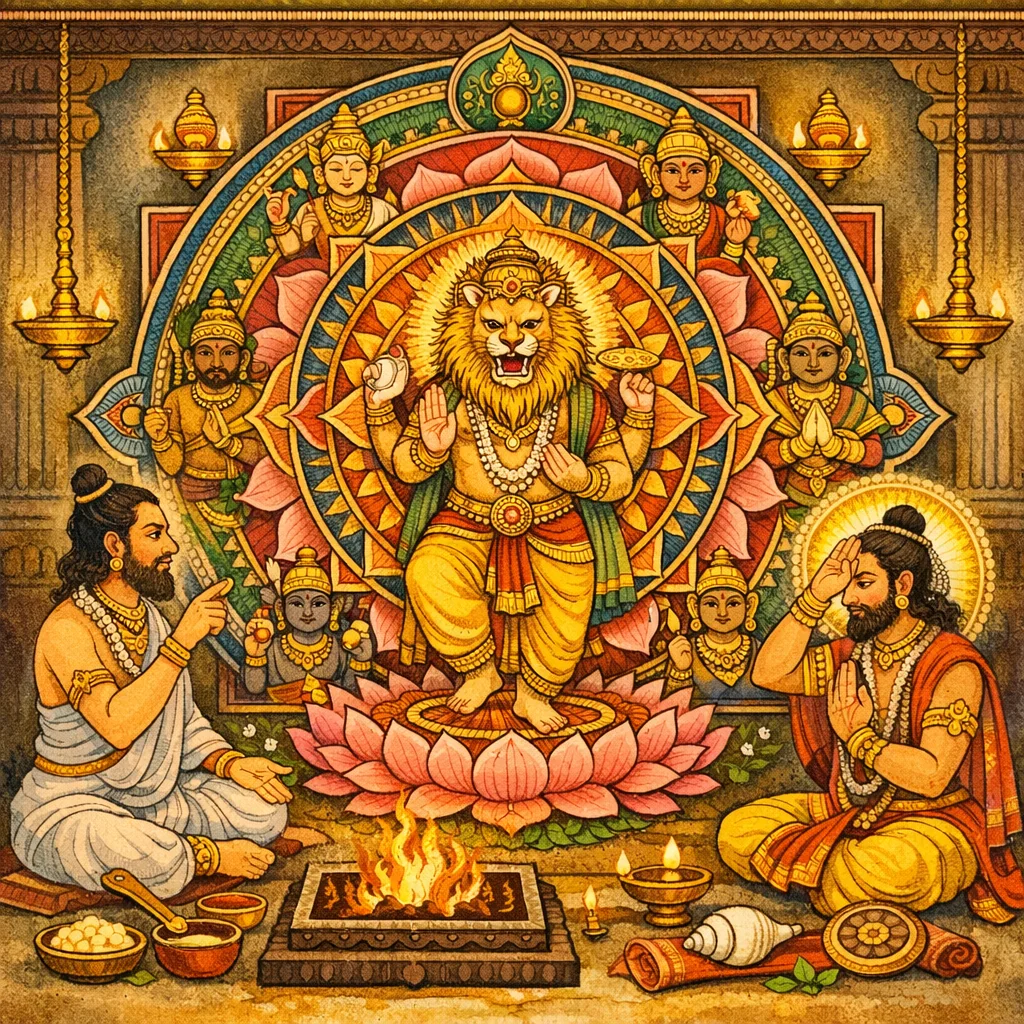
The Exposition of Nṛsiṁha Worship-Mantras, Nyāsa, Mudrās, Yantras, Kavaca, and Nṛsiṁha Gāyatrī
Sanatkumāra teaches Nārada a layered ritual corpus for worship of Narahari/Nṛhari (Nṛsiṁha). It begins with mantra-lakṣaṇa for a one-syllable and related Narasiṁha formulas (ṛṣi Atri; Jagatī; devatā Nṛhari; bīja/śakti; viniyoga “all aims”), then gives dhyāna-iconography and the sādhana measure (100,000 japa; 1/10 homa with ghee and pāyasa). It describes lotus-maṇḍala worship at a Vaiṣṇava pīṭha with directional/attendant deities and 32 fierce epithets. The core systematizes multiple nyāsa schemes (ṣaḍaṅga, tenfold, nine placements, Hari-nyāsa) and inner stations (mūla→nābhi→hṛd→bhrūmadhya→third eye). It prescribes Narasiṁhī, Cakra, Daṃṣṭrā and other mudrās, with śānta/raudra rules for gentle vs fierce works and enemy-neutralization. Therapeutic and royal uses follow (disease removal, graha afflictions, stambhana/victory rites) using ashes, offerings, and timed japa. Several yantras are taught (Trailokya-mohana; eight-spoked; twelve-spoked Kālāntaka; “King of Yantras”), and the chapter culminates in protective kavaca/varmāstra sequences and the Nṛsiṁha Gāyatrī, ending with phalaśruti: siddhi, protection, prosperity, and fearlessness.
Shlokas
Verse 1
सनत्कुमार उवाच । शुणु नारद वक्ष्यामि दिव्यान्नरहरेर्मनून् । यान्समाराध्य ब्रह्माद्याश्चक्रुः सृष्ट्यादि कर्म वै ॥ १ ॥
Sanatkumāra said: Listen, Nārada; I shall declare the divine mantras of Narahari. By worshipfully propitiating them, Brahmā and the other primordial beings indeed accomplished acts such as creation and what followed.
Verse 2
संवर्तकश्चन्द्र मौलिर्मनुर्वह्निविभूषितः । एकाक्षरः स्मृतो मन्त्रो भजतां सुरपादपः ॥ २ ॥
He is Saṃvartaka; he is Candra-mauli, the Lord crowned with the moon; he is Manu, adorned with the sacred fire. For those who worship in devotion, he is remembered as the one-syllabled mantra and as the divine wish-fulfilling tree.
Verse 3
मुनिरत्रिश्च जगती छन्दो बुद्धिमतां वर । देवता नृहरिः प्रोक्तो विनियोगोऽखिलाप्तये ॥ ३ ॥
The seer (ṛṣi) is Atri; the metre is Jagatī, O best among the wise. The presiding deity is declared to be Nṛhari (Narasimha). Its application (vinīyoga) is for the attainment of all aims.
Verse 4
क्षं बीजं शक्तिरी प्रोक्ता षड्दीर्घेण षडङ्गकम् । अर्केन्दुवह्निनयनं शरदिन्दुरुचं करैः ॥ ४ ॥
The seed-syllable (bīja) is “kṣaṃ”, and the power (śakti) is declared to be “ī”. With the six long vowels it becomes the sixfold aṅga (ṣaḍaṅga) for nyāsa. One should meditate on the deity as having eyes like the sun, the moon, and fire, and as shining with the radiance of the autumn moon, with divine hands.
Verse 5
धनुश्चक्राभयवरान्दधतं नृहरिं स्मरेत् । लक्षं जपस्तद्दशांशहोमश्च घृतपायसैः ॥ ५ ॥
One should meditate on Nṛhari (Narasimha), bearing the bow, the discus (cakra), the gesture of fearlessness (abhaya), and the boon-bestowing hand. One should perform one lakh (100,000) mantra-repetitions, and then offer a fire-oblation (homa) equal to one-tenth of that number, with ghee and sweet milk-rice.
Verse 6
यजेत्पीठे वैष्णवे तु केसरेष्वङ्गपूजनम् । खगेशं शंकरं शेषं शतानन्दं दिगालिषु ॥ ६ ॥
One should worship upon the Vaiṣṇava pīṭha, performing the ancillary limb-worship (aṅga-pūjā) upon the lotus-petals. In the surrounding directions, one should worship Khageśa (Garuḍa), Śaṅkara, Śeṣa, and Śatānanda.
Verse 7
श्रियं ह्रियं धृतिं पुष्टिं कोणपत्रेषु पूजयेत् । दन्तच्छदेषु नृहरींस्तावतः पूजयेत्क्रमात् ॥ ७ ॥
One should worship Śrī, Hrī, Dhṛti, and Puṣṭi upon the corner-petals. Upon the outer tooth-like projections, one should then worship the Narasiṃhas in the same number, in due order.
Verse 8
कृष्णो रुद्रो महाघोरो भीमो भीषण उज्ज्वलः । करालो विकरालश्च दैत्यान्तो मधुसूदनः ॥ ८ ॥
He is Kṛṣṇa; He is Rudra—terribly awe-inspiring. He is Bhīma, fearsome yet radiant; the dreadful and the exceedingly dreadful—He is the destroyer of the Daityas, Madhusūdana.
Verse 9
रक्ताक्षः पिगलाक्षश्चाञ्जनो दीप्तरुचिस्तथा । सुघोरकश्च सुहनुर्विश्वको राक्षसान्तकः ॥ ९ ॥
He is Red-eyed; Tawny-eyed; Dark-hued like collyrium (añjana); Radiant in splendour; Terribly awe-inspiring; Strong-jawed; All-pervading; and the Destroyer of rākṣasas (demonic forces).
Verse 10
विशालको धूम्रकेशो हयग्रीवो घनस्वनः । मेघवर्णः कुम्भकर्णः कृतान्ततीव्रतेजसौ ॥ १० ॥
(He is) vast-bodied; smoke-haired; horse-necked; thundering-voiced; cloud-hued; pot-eared; and of brilliance fierce as Time (Death).
Verse 11
अग्निवर्णो महोग्रश्च ततो विश्वविभूषणः । विघ्नक्षमो महासेनः सिंहा द्वात्रिंशदीरिताः ॥ ११ ॥
Then these names are recited: Agnivarṇa, Mahogra, Viśvavibhūṣaṇa, Vighnakṣama, Mahāsena, and Siṁha—thus the thirty-two names have been declared.
Verse 12
तद्बहिः प्रार्चयेद्विद्वाँ ल्लोकपालान्सहेतिकान् । एवं सिद्धे मनौ मन्त्री साधयेदखिलेप्सितान् ॥ १२ ॥
Then, outside that inner rite, the learned practitioner should duly worship the Lokapālas (Guardians of the Directions) together with their insignia and weapons. When the mantra is thus perfected, the mantra-adept accomplishes all desired aims.
Verse 13
विष्णुः प्रद्युम्नयुक् शार्ङ्गी साग्निर्वीरं महांस्ततः । विष्णुं ज्वलन्तं भृग्वीशो जलं पद्मासनं ततः ॥ १३ ॥
Then (he meditates on) Viṣṇu—bearing the Śārṅga bow, united with Pradyumna—together with Agni; next, upon the mighty Hero; then upon Viṣṇu as blazing radiance; then upon the lord of the Bhṛgus; then upon Water; and then upon the Lotus-seated (Brahmā).
Verse 14
हरिस्तु वासुदेवाय वैकुण्ठो विष्णुसंयुतः । गदी सेन्दुनृसिंहं च भीषणं भद्र मेव च ॥ १४ ॥
Hari is also praised as Vāsudeva; as Vaikuṇṭha, united with Viṣṇu; as the mace-bearer (Gadī); as (S)Indu-Nṛsiṃha; and also as Bhīṣaṇa and Bhadra.
Verse 15
मृत्युमृत्युं ततः शौरिर्भानोर्नारायणान्वितः । नृहरेर्द्वाविंशदर्णोऽय मन्त्रः साम्राज्यदायकः ॥ १५ ॥
Next comes the mantra “Mṛtyu-mṛtyu”; then the mantra of Śauri; then that of Bhānu, joined with the Name Nārāyaṇa. This is the twenty-two-syllabled mantra of Nṛhari (Nṛsiṃha), bestower of sovereignty and dominion.
Verse 16
ब्रह्मा मुनिस्तु गायत्री छन्दोऽनुष्टुबुदाहृतम् । देवता नृहरिश्चास्य सर्वेष्टफलदायकः ॥ १६ ॥
For this (mantra/rite), Brahmā is declared to be the seer (ṛṣi); the metre is said to be Anuṣṭubh; the deity is Nṛhari (Viṣṇu as the Man-Lion), who bestows the fruit of all desired aims.
Verse 17
हं बीजं इं तथा शक्तिर्विनियोगोऽखिलाप्तये । वेदैश्चतुर्भिर्वसुभिः षड्भिः षड्भिर्युगाक्षरैः ॥ १७ ॥
The seed-syllable (bīja) is “haṃ”, and the power-syllable (śakti) is “iṃ”; its application (viniyoga) is for the attainment of all aims. (This is taught) through the four Vedas, through the eight Vasus, through the six Vedāṅgas, and through the six-syllabled formula of the Yuga.
Verse 18
षडङ्गानि निधायाथ मूर्ध्नि भाले च नेत्रयोः । मुखबाह्वङिघ्रसन्ध्यग्रेष्वथ कुक्षौ तथा हृदि ॥ १८ ॥
Then, having performed the nyāsa of the six limbs (ṣaḍ-aṅga), one should place them upon the crown of the head, the forehead, and the eyes; then upon the mouth, the arms, and the front junctions of the feet/ankles; and thereafter upon the belly and likewise upon the heart.
Verse 19
गले पार्श्वद्वये पृष्ठे ककुद्यर्णान्मनूद्भवान् । प्रणवान्तरितान् कृत्वा न्यसेत्साधकसत्तमः ॥ १९ ॥
The best of practitioners should perform nyāsa by placing, on the throat, on both sides of the body, and on the back, the syllables that arise from Manu—each separated (prefaced) by the praṇava, “Oṁ”.
Verse 20
नृसिंहसान्निध्यकरो न्यासो दशविधो यथा । कराङ्घ्र्यष्टाद्यङ्गुलीषु पृथगाद्यन्तपर्वणोः ॥ २० ॥
The nyāsa that brings the close presence of Lord Nṛsiṁha is tenfold, as prescribed—performed separately on the eight fingers of the hands and feet, at the first and last joints.
Verse 21
सर्वाङ्गुलीषु विन्यस्यावशिष्टं तलयोर्न्यसेत् । शिरोललाटे भ्रूमध्ये नेत्रयोः कर्णयोस्तथा ॥ २१ ॥
Having placed (the mantra/energy) upon all the fingers, one should place what remains upon the two palms; likewise upon the head and forehead, in the space between the eyebrows, upon the eyes, and also upon the ears.
Verse 22
कपोलकर्णमूले च चिबुकोर्द्ध्वाधरोष्ठके । कण्ठे घोणे च भुजयोर्हृत्तनौ नाभिमण्डले ॥ २२ ॥
At the cheek and the root of the ear; at the chin and the upper and lower lips; at the throat and the nose; at the two arms; in the region of the heart; and at the slender waist and the circle of the navel—these are the indicated points.
Verse 23
दक्षान्पदोस्तले कट्यां मेढ्रोर्वोजानुजङ्घयोः । गुल्फे पादकराङ्गुल्योः सर्वसन्धिषु रोमसु ॥ २३ ॥
One should place the mantra-syllables beginning with ‘da’ on the soles of the feet; then on the hips, the genitals, the thighs, the knees, and the shanks; on the ankles; on the toes and fingers; on all the joints; and upon the hairs of the body.
Verse 24
रक्तास्थिमज्जासु तनौ न्यसेद्वर्णान्विचक्षणः । वर्णान्पदे गुल्फजानुकटिनाभिहृदि स्थले ॥ २४ ॥
A discerning practitioner should place the sacred syllables upon the body—upon the blood, bones, and marrow; and he should place the syllables at the feet, the ankles, the knees, the hips, the navel, and in the region of the heart.
Verse 25
बाह्वोः कण्ठे च चिबुके चौष्ठे गण्डे प्रविन्यसेत् । कर्णयोर्वदने नासापुटे नेत्रे च मूर्द्धनि ॥ २५ ॥
One should place the prescribed marks (nyāsa-contacts) upon the arms, the throat, the chin, the lips, and the cheeks; likewise upon the ears, the mouth, the nostrils, the eyes, and upon the crown of the head.
Verse 26
पदानि तु मुखे मूर्ध्नि नसि चक्षुषि कर्णयोः । आस्ये च हृदये नाभौ पादान्सर्वाङ्गके न्यसेत् ॥ २६ ॥
One should perform nyāsa of the sacred words upon the mouth, the crown of the head, the nose, the eyes, and the ears; likewise upon the face, the heart, and the navel—and then place them upon all the limbs of the body.
Verse 27
अर्द्धद्वयं न्यसेन्मूर्ध्नि आहृत्पादात्तदङ्गकम् । उग्रादीनि पदानीह मृत्युमृत्युं नमाम्यहम् ॥ २७ ॥
One should place the two halves of the mantra upon the head; and, from the heart down to the feet, assign it to the corresponding limbs. Here, with the words beginning with “Ugra…”, I bow to Mṛtyuṃmṛtyu—the Conqueror of death.
Verse 28
इत्यन्तान्यास्यकघ्राणचक्षुः श्रोत्रेषु पक्ष्मसु । हृदि नाभौ च कट्यादिपादान्तं नवसु न्यसेत् ॥ २८ ॥
Thus, having completed the preceding nyāsa, one should place the mantra (or its parts) in the mouth, nose, eyes, ears, and upon the eyelashes; in the heart, in the navel, and from the waist down to the end of the feet—making nine placements in all.
Verse 29
वीराद्यानपि तान्येव यथापूर्वं प्रविन्यसेत् । नृसिंहाद्यानि तान्येव पूर्ववद्विन्यसेत्सुधीः ॥ २९ ॥
The wise practitioner should also place (perform nyāsa of) those mantras or forms beginning with “Vīra” exactly as before; and likewise, those beginning with “Nṛsiṃha” should be placed just as previously prescribed.
Verse 30
चन्द्रा ग्निवेदषड्रामनेत्रदिग्बाहुभूमितान् । विभक्तान्मन्त्रवर्णांश्च क्रमात्स्थानेषु विन्यसेत् ॥ ३० ॥
One should, in due sequence and in their proper places, set the mantra-syllables that have been divided and assigned to the Moon, Fire, the Vedas, the six limbs, Rāma, the eyes, the directions, the arms, and the earth.
Verse 31
मूले मूलाच्च नाभ्यन्तं नाभ्यादि हृदयावधि । हृदयाद्भ्रूयुगान्तं तु नेत्रत्रये च मस्तके ॥ ३१ ॥
From the root (mūla) up to the navel; from the navel to the region of the heart; from the heart to the end-point between the eyebrows; and then to the ‘third eye’ within the head—these are the successive inner stations for contemplation.
Verse 32
बाह्वोरङ्गुलिषु प्राणे मूर्द्धादि चरणावधि । विन्यसेन्नामतो धीमान्हरिन्यासोऽयमीरितः ॥ ३२ ॥
The wise practitioner should perform nyāsa by placing the divine Names—from the arms and fingers upon the prāṇas, the vital airs, and from the head down to the feet. This is taught as Hari-nyāsa.
Verse 33
न्यासस्यास्य तु माहात्म्यं जानात्येको हरिः स्वयम् । एवं न्यासविधिं कृत्वा ध्यायेच्च नृहरिं हृदि ॥ ३३ ॥
The true greatness of this nyāsa is known only to Hari Himself. Therefore, having performed the rite of nyāsa in this manner, one should meditate upon Nṛhari within the heart.
Verse 34
गलासक्तलसद्बाहुस्पृष्टकेशोऽब्जचक्रधृक् । नखाग्रभिन्नदैत्येशो ज्वालामालासमन्वितः ॥ ३४ ॥
With shining arms clasped about the neck, hair dishevelled by the struggle, bearing the lotus and the discus (cakra), He tore open the lord of the Daityas with the tips of His nails, encircled by a garland of flames.
Verse 35
दीप्तजिह्वस्त्रिनयनो दंष्ट्रोग्रं वदनं वहन् । नृसिंहोऽस्मान्सदा पातु स्थलांबुगगनोपगः ॥ ३५ ॥
May Narasiṃha—bearing a blazing tongue, three eyes, and a fearsome face with sharp fangs—ever protect us, moving through land, water, and sky.
Verse 36
ध्यात्वैवं दर्शयेन्मुद्रा ं नृसिंहस्य महात्मनः । जानुमध्यगतौ कृत्वा चिबुकोष्ठौ समावुभौ ॥ ३६ ॥
Having thus meditated, one should display the mudrā of the great-souled Narasiṃha, placing the chin and the lips evenly in the space between the knees.
Verse 37
हस्तौ च भूमिसंलग्नौ कम्पमानः पुनः पुनः । मुखं विजृन्भितं कृत्वा लेलिहानां च जिह्विकाम् ॥ ३७ ॥
With both hands pressed to the ground, he trembled again and again; opening his mouth wide, he repeatedly licked with his tongue.
Verse 38
एषा मुद्रा नारसिंही प्रधानेति प्रकीर्तिता । वामस्याङ्गुष्ठतो बद्ध्वा कनिष्ठामन्गुलीत्रयम् ॥ ३८ ॥
This hand-gesture is proclaimed as the Nārasimhī Mudrā, the foremost among mudrās. It is formed by binding three fingers of the left hand, from the thumb up to the little finger.
Verse 39
त्रिशूलवत् संमुखोर्द्ध्वे कुर्यान्मुद्रा ं नृसिंहगाम् । अङ्गुष्ठाभ्यां च करयोस्तथाऽक्रम्य कनिष्ठके ॥ ३९ ॥
Holding the hands raised in front, shaped like a trident, one should form the Narasiṃha-mudrā; and with the thumbs of both hands, one should likewise press upon the little fingers.
Verse 40
अधोमुखाभिः शिष्टाभिः शेषाभिर्नृहरौ ततः । हस्तावधोमुखौ कृत्वा नाभिदेशे प्रसार्य च ॥ ४० ॥
Then, arranging the remaining fingers properly and turning them downward for Nṛhari, one should keep both hands facing downward and extend them toward the region of the navel.
Verse 41
तर्जनीभ्यां नयेत्स्कन्धौ प्रोक्ता चान्त्रणमुद्रि का । हस्तावूर्द्ध्वमुखौ कृत्वा तले संयोज्य मध्यमे ॥ ४१ ॥
With the two index fingers one should lead (touch/indicate) the shoulders; this is declared to be the Āntraṇa-mudrā. Having turned the hands upward, one should join the palms together at the middle.
Verse 42
अनामायां तु वामायां दक्षिणां तु विनिक्षिपेत् । तर्जन्यौ पृष्ठतो लग्नौ अङ्गुष्ठौ तर्जनीश्रितौ ॥ ४२ ॥
On the left hand’s ring finger, one should place the right (hand/finger). The two index fingers should be joined from behind, and the thumbs should rest supported against the index fingers.
Verse 43
चक्रमुद्रा भवेदेषा नृहरेः सन्निधौ मता । चक्रमुद्रा तथा कृत्वा तर्जनीभ्यां तु मध्यमे ॥ ४३ ॥
This is regarded as the Cakra-mudrā in the presence of Nṛhari (Lord Narasiṃha). Having thus formed the Cakra-mudrā, one should position it at the middle with the two index fingers, as prescribed.
Verse 44
पीडयेद्दंष्ट्रमुद्रै षा सर्वपापप्रणाशिनी । एता मुद्रा नृसिंहस्य सर्वमन्त्रेषु सम्मताः ॥ ४४ ॥
One should perform this Daṃṣṭrā-mudrā; it is the destroyer of all sins. These mudrās of Nṛsiṃha are approved and commended in all mantras.
Verse 45
वर्णलक्षं जपेन्मन्त्रं तद्दशांशं च पायसैः । घृताक्तैर्जुहुयाद्वह्नौ पीठे पूर्वोदितेऽचयेत् ॥ ४५ ॥
One should repeat the mantra for a lakh (one hundred thousand) syllables; then, as a tenth part of that count, offer into the sacred fire oblations of pāyasa (rice-pudding) mixed with ghee, and place the prepared offering upon the previously prescribed altar-seat (pīṭha).
Verse 46
अङ्गा न्यादौ समाराध्यदिक्पत्रेषु यजेत्पुनः । गरुडादीन् श्रीमुखांश्च विदिक्षु लोकपान्बहिः ॥ ४६ ॥
Having duly performed the aṅga-nyāsa and worshipped the Deity, one should again offer worship upon the petals assigned to the directions; in the intermediate directions (vidik-s) one should worship Garuḍa and the auspicious-faced attendants, and outside (the lotus/maṇḍala) the Lokapālas, guardians of the worlds.
Verse 47
एवं संसाधितो मन्त्रः सर्वान्कामान्प्रपूरयेत् । सौम्ये कार्ये स्मरेत्सौम्यं क्रूरं क्रूरे स्मरेद्बुधः ॥ ४७ ॥
Thus properly perfected, the mantra can fulfill all desired aims. In gentle undertakings one should remember the gentle form, and in fierce undertakings the wise should remember the fierce form.
Verse 48
पूर्वमृत्युपदे शत्रोर्नाम कृत्वा स्वयं हरिः । निशितैर्नखदंष्ट्राग्रैः खाद्यमानं च संस्मरेत् ॥ ४८ ॥
At the moment when death draws near, one should first place the enemy’s name in the mind, and then remember Hari Himself—visualizing Him devouring that foe with His sharp nails and the tips of His fangs.
Verse 49
अष्टोत्तरशतं नित्यं जपेन्मन्त्रमतन्द्रि तः । जायते मण्डलादर्वाक् शत्रुर्वै शमनातिथिः ॥ ४९ ॥
One should daily, without negligence, repeat the mantra one hundred and eight times. Then, before the protective circle (maṇḍala), even an enemy becomes indeed a pacified guest.
Verse 50
ध्यानभेदानथो वक्ष्ये सर्वसिद्धिप्रदायकान् । श्रीकामः सततं ध्यायेत्पूर्वोक्तं नृहरिं सितम् ॥ ५० ॥
Now I shall describe the various modes of meditation that bestow every attainment. One who seeks prosperity should constantly meditate upon the previously described Nṛhari, the radiant Lord in white, the Man-Lion.
Verse 51
वामाङ्कस्थितया लक्ष्म्यालिङ्गितं पद्महस्तया । विषमृत्यूपरोगादिसर्वोपद्र वनाशनम् ॥ ५१ ॥
Embraced by Lakṣmī, seated upon His left and holding a lotus in her hand, He becomes the destroyer of every calamity—untimely death, disease, and all other afflictions.
Verse 52
नरसिंहं महाभीमन कालानलसमप्रभम् । आन्त्रमालाधरं रौद्रं कण्ठहारेण भूषितम् ॥ ५२ ॥
I contemplate Narasiṃha—most terrifying, radiant like the fire of Time’s dissolution; fierce, wearing a garland of entrails, and adorned with a necklace upon His throat.
Verse 53
नागयज्ञोपवीतं च पञ्चाननसुशोभितम् । चन्द्र मौलि नीलकण्ठं प्रतिवक्त्रं त्रिनेत्रकम् ॥ ५३ ॥
He is adorned with the sacred thread in the form of a serpent, beautified by five faces; crowned with the moon, blue-throated, and with three eyes upon each face.
Verse 54
भुजैः परिघसङ्काशैर्द्दशभिश्चोपशोभितम् । अक्षस्रूत्रं गदापद्मं शङ्खं गोक्षीरसन्निभम् ॥ ५४ ॥
Adorned with ten arms, each like an iron club, He shone forth—holding an akṣa-sūtra (rosary), a mace, a lotus, and a conch white as cow’s milk.
Verse 55
धनुश्च मुशलं चैव बिभ्राणं चक्रमुत्तमम् । खड्गं शूलं च बाणं च नृहरिं रुद्र रूपिणम् ॥ ५५ ॥
He beheld Nṛhari (Narasimha), assuming a Rudra-like form, bearing a bow and a mace, the supreme discus, a sword, a trident, and an arrow.
Verse 56
इन्द्र गोपाभनीलाभं चन्द्रा भं स्वर्णसन्निभम् । पूर्वादि चोत्तरं यावदूर्ध्वास्यं सर्ववर्णकम् ॥ ५६ ॥
Its hue is like the indragopa (a deep bluish-red insect), radiant like the moon and resembling gold; from the eastern direction onward up to the northern quarter, it is upward-facing and displays all colors.
Verse 57
एवं ध्यात्वा जपेन्मन्त्री सर्वव्याधिविमुक्तये । सर्वमृत्युहरं दिव्यं स्मरणात्सर्वसिद्धिदम् ॥ ५७ ॥
Having thus meditated, the mantra-practitioner should recite the mantra for freedom from all diseases. This divine mantra removes every form of death; by its remembrance it bestows every accomplishment.
Verse 58
ध्यायेद्यदा महत्कर्म तदा षोडशहस्तवान् । नृसिंहः सर्वलोकेशः सर्वाभरणभूषितः ॥ ५८ ॥
Whenever one undertakes a great rite, one should meditate on Narasiṁha—the Lord of all worlds—adorned with every ornament and endowed with sixteen arms.
Verse 59
द्वौ विदारणकर्माप्तौ द्वौ चान्त्रोद्धरणान्वितौ । शङ्खचक्रधरौ द्वौ तु द्वौ च बाणधनुर्द्धरौ ॥ ५९ ॥
Two are skilled in the act of rending asunder; two are endowed with the lifting up of the lunar orb; two bear the conch and discus; and two bear arrows and the bow.
Verse 60
खड्गखेटधरौ द्वौ च द्वौ गदापद्मधारिणौ । पाशाङ्कुशधरौ द्वौ च द्वौ रिपोर्मुकुटार्पितौ ॥ ६० ॥
Two held a sword and a shield; two bore a mace and a lotus; two carried a noose (pāśa) and a goad (aṅkuśa); and two were adorned with the crowns offered by the foe.
Verse 61
इति षोडशदोर्दण्डमण्डितं नृहरिं विभुम् । ध्यायेन्नारद नीलाभमुग्रकर्मण्यनन्यधीः ॥ ६१ ॥
Thus, O Nārada, with single-pointed mind one should meditate upon the all-pervading Lord Nṛhari—adorned with sixteen arms, dark-blue in hue, and fierce in His mighty acts.
Verse 62
ध्येयो महत्तमे कार्ये द्वात्रिंशद्धस्तवान्बुधैः । नृसिंहः सर्वभूतेशः सर्वसिद्धिकरः परः ॥ ६२ ॥
For the most important undertakings, the wise should meditate upon Nṛsiṃha, the thirty-two-armed Lord—Supreme, the sovereign of all beings, and the bestower of every accomplishment.
Verse 63
दक्षिणे चक्रपद्मे च परशुं पाशमेव च । हलं च मुशलं चैव अभयं चाङ्कुशं तथा ॥ ६३ ॥
On His right side are the discus (cakra) and the lotus; also the axe (paraśu) and the noose (pāśa); likewise the plough (hala) and the pestle (muśala); and also the gesture of fearlessness (abhaya), and the goad (aṅkuśa) as well.
Verse 64
पट्टिशं भिन्दिपालं च खड्गमुद्गरतोमरान् । वामभागे करैः शङ्खं खेटं पाशं च शूलकम् ॥ ६४ ॥
He holds the battle-axe (pattisha) and the bhindipāla (javelin), as well as the sword, mace, and spear. In the hands on His left side He bears the sacred conch (śaṅkha), shield, noose (pāśa), and trident (triśūla).
Verse 65
अग्निं च वरदं शक्तिं कुण्डिकां च ततः परम् । कार्मुकं तर्जनीमुद्रा ं गदां डमरुशूर्पकौ ॥ ६५ ॥
Also (He bears) fire; the boon‑granting gesture (varada); the śakti spear; then the water‑pot (kuṇḍikā); the bow; the tarjanī mudrā of admonition (raised index‑finger); the mace (gadā); the ḍamaru drum; and the winnowing basket (śūrpa).
Verse 66
द्वाभ्यां कराभ्यां च रिपोर्जानुमस्तकपीडनम् । ऊर्द्ध्वीकृताभ्यां बाहुभ्यां आन्त्रमालाधरं विभुम् ॥ ६६ ॥
With two hands He crushes the foe—pressing down the enemy’s knees and head; with two arms raised aloft, He upholds the mighty Lord who wears a garland of entrails (antra‑mālā).
Verse 67
अधः स्थिताभ्यां बाहुभ्यां हिरण्यकविदारणम् । प्रियङ्करं च भक्तानां दैत्यानां च भयङ्करम् ॥ ६७ ॥
With His two arms held downward, He tears apart Hiraṇyaka; for devotees He grants what is dear, and for the Daityas He is terrifying.
Verse 68
नृसिंहं तं स्मरेदित्थं महामृत्युभयापहम् । एवं ध्यात्वा जपेन्मन्त्री सर्वकार्यार्थसिद्धये ॥ ६८ ॥
Thus one should remember Narasiṃha, the remover of the fear of great death. Having meditated in this way, the mantra‑practitioner should repeat the mantra (japa) for the accomplishment of the aims of all undertakings.
Verse 69
अथोच्यते ध्यानमन्यन्मुखरोगहरं शुभम् । स्वर्णवर्णसुपर्णस्थं विद्युन्मालासटान्वितम् ॥ ६९ ॥
Now another auspicious meditation is taught, which removes diseases of the mouth: meditate on the Lord of golden hue, seated upon Garuḍa (Suparṇa), adorned with a lightning‑like garland and a radiant mane.
Verse 70
कोटिपूर्णेन्दुवर्णं च सुमुखं त्र् यक्षिवीक्षणम् । पीतवस्त्रोरुभूषाढ्यं नृसिहं शान्तविग्रहम् । चक्रशङ्खाभयवरान्दधतं करपल्लवैः ॥ ७० ॥
Meditate on Lord Narasiṃha, whose hue is like a crore of full moons—fair-faced, with a three-eyed gaze; clad in yellow garments and richly adorned; serene in form, and bearing in lotus-tender hands the discus, conch, the gesture of fearlessness, and the boon-bestowing gesture.
Verse 71
क्ष्वेडरोगादिशमनं स्वैर्ध्यानैः सुरवन्दितम् । शत्रोः सेनानिरोधेन यत्नं कुर्याच्च साधकम् ॥ ७१ ॥
By the prescribed meditations of the Lord, the practitioner should strive to pacify ailments such as kṣveḍa-disease—praised by the gods—and should also make effort to restrain the enemy’s army.
Verse 72
अक्षकाष्ठैरेधितेऽग्नौ विचिन्त्य रिपुमर्दनम् । देवं नृसिंहं सम्पूज्य कुसुमाद्युपचारकैः ॥ ७२ ॥
When the fire has been kindled with akṣa-wood, one should meditate upon Lord Nṛsiṃha, the destroyer of foes, and worship that divine Nṛsiṃha with offerings such as flowers and other ritual services.
Verse 73
समूलमूलैर्जुहुयाच्छरैर्दशशतं पृथक् । रिपुं खादन्निव जपेन्निर्दहन्निव तं क्षिपेत् ॥ ७३ ॥
With arrows (śara) made from the “root-and-all” (samūlamūla) material, he should offer oblations separately—one hundred and ten in number. He should recite the mantra as though devouring the enemy, and then cast (the offering/weapon) as though burning him up.
Verse 74
हुत्वा सप्तदिनं मन्त्री सेनामिष्टां महीपतेः । प्रस्थापयेच्छुभे लग्ने परराष्ट्रजयेच्छया ॥ ७४ ॥
Having performed fire-offerings for seven days, the king’s minister should dispatch the army—dear to the ruler—at an auspicious moment, with the intention of conquering the enemy realm.
Verse 75
तस्याः पुरस्तान्नृहरिं निघ्नन्तं रिपुमण्डलम् । स्मृत्वा जपं प्रकुर्वीत यावदायाति सा पुनः ॥ ७५ ॥
In her presence, one should remember and meditate on Nṛhari (Narasimha) striking down the circle of enemies, and then perform mantra-japa until she returns again.
Verse 76
निर्जित्य निखिलाञ्छत्रून्सह वीरश्रिया सुखात् । प्रीणयेन्मन्त्रिणं राजा विभवैः प्रीतमानसः ॥ ७६ ॥
Having easily conquered all enemies, endowed with the splendor of valor, the king—his mind pleased—should gratify his minister with gifts and resources.
Verse 77
गजाश्वरथररत्नैश्च ग्रामक्षेत्रधनादिभिः । यदि मन्त्री न तुष्येत तदानर्थो महीपतेः ॥ ७७ ॥
Even with gifts of elephants, horses, chariots, jewels, villages, lands, wealth, and the like—if the minister is not satisfied, then misfortune befalls the king.
Verse 78
जायते तस्य राष्ट्रेषु प्राणेभ्योऽपि महाभयम् । अष्टोत्तरशतमूलमन्त्रमन्त्रितभस्मना ॥ ७८ ॥
In his kingdoms there arises a great terror—greater even than the fear of losing one’s life—when the rite is performed with ash consecrated by the root-mantra recited one hundred and eight times.
Verse 79
नाशयेन्मूषिकालूतावृश्चिकाद्युत्थितं विषम् । लिप्ताङ्गः सर्वरोगैश्च मुच्यते नात्र संशयः ॥ ७९ ॥
It destroys the poison arising from a rat, spider, scorpion, and the like. When one’s limbs are anointed with it, one is freed from all diseases—of this there is no doubt.
Verse 80
सेवन्तीकुसुमैर्हुत्वा महतीं श्रियमाप्नुयात् । औदुम्बरसमिद्भिस्तु भवेद्धान्यसमृद्धिमान् ॥ ८० ॥
By offering oblations into the sacred fire with sevantī flowers, one attains great prosperity; and by performing homa with audumbara fuel-sticks, one becomes endowed with abundance of grain.
Verse 81
अपूपलक्षहोमे तु भवेद्वैश्रवणोपमः । क्रुद्धस्य सन्निधौ राज्ञो जपेदष्टोत्तरं शतम् ॥ ८१ ॥
By performing a homa of one lakh offerings of apūpa (sacred cakes), one becomes comparable to Vaiśravaṇa (Kubera) in prosperity. And when in the presence of an angry king, one should recite the mantra one hundred and eight times.
Verse 82
सद्यो नैर्मल्यमाप्नोति प्रसादं चाधिगच्छति । कुन्दप्रसूनैरुदयं मोचाभिर्विघ्ननाशनम् ॥ ८२ ॥
One attains purity at once and also gains divine grace (prasāda). By offering kunda blossoms there is spiritual uplift and prosperity; by offering plantain blossoms there is the destruction of obstacles.
Verse 83
तुलसीपत्रहोमेन महतीं कीर्तिमाप्नुयात् । शाल्युत्थसक्तुहोमेन वशयेदखिलं जगत् ॥ ८३ ॥
By offering oblations of tulasī leaves into the sacred fire, one attains great fame. By offering oblations of parched grain-flour prepared from rice, one brings the entire world under one’s influence.
Verse 84
मधूकपुष्पैरिष्टं स्यात्स्तम्भनं धात्रिखण्डकैः । दधिमध्वाज्यमिश्रां तु गुडूचीं चतुरङ्गुलाम् ॥ ८४ ॥
A fermented preparation (iṣṭa) made with madhūka flowers is said to be beneficial; pieces of dhātrī (āmalakī) produce a stambhana effect (astringent, stabilizing). Further, one should take guḍūcī, measuring four aṅgulas, mixed with curd, honey, and ghee.
Verse 85
जुहुयादयुतं योऽसौ शतं जीवति रोगजित् । शनैश्चरदिनेऽश्वत्थं स्पृष्ट्वा चाष्टोत्तरं शतम् ॥ ८५ ॥
Whoever performs ten thousand fire-oblations (homa) lives for a hundred years, conquering disease. And on Śanaiścara’s day (Saturday), having touched the sacred aśvattha tree, one should perform it one hundred and eight times.
Verse 86
जपेज्जित्वा सोऽपमृत्युं शतवर्षाणि जीवति । अथ ते सम्प्रवक्ष्यामि यन्त्रं त्रैलोक्यमोहनम् ॥ ८६ ॥
By this japa (sacred repetition) he conquers untimely death (apamṛtyu) and lives for a hundred years. Now I shall explain to you in full the yantra called “Trailokya-mohana,” the Enchanter of the Three Worlds.
Verse 87
यस्य सन्धारणादेव भवेयुः सर्वसम्पदः । श्वेतभूर्ज्जे लिखेत्पद्मं द्वात्रिंशत्सिंहसंयुतम् ॥ ८७ ॥
By merely wearing it or keeping it, all prosperities arise. One should draw a lotus upon white birch-bark, furnished with thirty-two lions.
Verse 88
मध्ये सिंहे स्वबीजं च लिखेत्पूर्ववदेव तु । श्रीबीजेन तु संवेद्य वलयत्रयसंयुतम् ॥ ८८ ॥
In the center, within the lion-figure, one should write its own seed-syllable (bīja), exactly as described earlier. Then it should be consecrated with the Śrī-bīja and furnished with three encircling rings.
Verse 89
पाशाङ्कुशैश्च संवेष्ट्य पूजयेद्यन्त्रमुत्तमम् । त्रैलोक्यमोहनं नाम सर्वकामार्थसाधनम् ॥ ८९ ॥
Enclosing it with the noose (pāśa) and the goad (aṅkuśa), one should worship that excellent yantra. It is called “Trailokya-mohana,” and it accomplishes all desired aims and objects.
Verse 90
चक्रराजं महाराजं सर्वचक्रेश्वरेश्वरम् । धारणाज्जयमाप्नोति सत्यं सत्यं न संशयः ॥ ९० ॥
By bearing the Cakra-King—the great sovereign, the Lord over all discus-weapons—one attains victory. This is truth, truth indeed; there is no doubt.
Verse 91
अथ यन्त्रान्तरं वक्ष्ये शुणु नारद सिद्धिदम् । अष्टारं विलिखेद्यन्त्रं श्लक्ष्णं कर्णिकया युतम् ॥ ९१ ॥
Now I shall describe another yantra; listen, O Nārada—this is a means of attainment. One should draw a yantra with eight spokes, smooth and well-finished, furnished with a central hub (karnikā).
Verse 92
मूलमन्त्रं लिखेत्तत्र प्रणवेन समन्वितम् । एकाक्षरं नारसिंहं मध्ये चैव ससाध्यकम् ॥ ९२ ॥
There one should write the root-mantra, joined with the praṇava (Oṁ). And in the middle, one should write the single-syllabled Nārasiṁha mantra, together with the intended objective to be accomplished.
Verse 93
जपेदष्टसहस्रं तु सूत्रेणावेष्ट्य तद्बहिः । स्वर्णरौप्यसुताम्रैश्च वेष्टयेत्क्रमतः सुधीः ॥ ९३ ॥
A wise practitioner should perform eight thousand repetitions, then wrap it externally with a thread; thereafter, in due order, he should further bind it with gold, silver, and copper.
Verse 94
लाक्षया वेष्टितं कृत्वा पुनर्मन्त्रेण मन्त्रयेत् । कण्ठे भुजे शिखायां वा धारयेद्यन्त्रमुत्तमम् ॥ ९४ ॥
After wrapping it with lac, one should consecrate it again with the mantra; and then one should wear that excellent yantra—on the neck, on the arm, or at the crown-lock (śikhā).
Verse 95
नरनारीनरेन्द्रा श्च सर्वे स्युर्वशगा भुवि । दुष्टास्तं नैव बाधन्ते पिशाचोरगराक्षसाः ॥ ९५ ॥
On earth, men, women, and even kings all fall under his influence. The wicked cannot trouble him at all—nor can piśācas, serpents, or rākṣasas.
Verse 96
यन्त्रराजप्रसादेन सर्वत्र जयमाप्नुयात् । अथान्यत्सम्प्रवक्ष्यामि यन्त्रं सर्ववशङ्करम् ॥ ९६ ॥
By the grace and efficacy of the “King of Yantras,” one attains victory everywhere. Now I shall declare yet another yantra—one that brings all beings under control.
Verse 97
द्वादशारं महाचक्रं पूर्ववद्विलिखेत्सुधीः । मात्राद्वादशसम्भिन्नदलेन विलिखेद्बुधः ॥ ९७ ॥
The wise practitioner should draw, as described earlier, a great wheel with twelve spokes; the learned one should sketch it with petals divided into twelve measures, as instructed.
Verse 98
मध्ये मन्त्रं शक्तियुक्तं श्रीबीजेन तु वेष्टयेत् । कालान्तकं नाम चक्रं सुरासुरवशङ्करम् ॥ ९८ ॥
In the center one should place the mantra, endowed with Śakti, and then encircle it with the auspicious seed-syllable “śrī”. This is the cakra called Kālāntaka, which subdues and terrifies both the gods and the asuras.
Verse 99
चक्रमुल्लेखयेद्भूर्जे सर्वशत्रुनिवारणम् । यस्य धारणमात्रेण सर्वत्र विजयी भवेत् ॥ ९९ ॥
One should inscribe a cakra on birch-bark; it wards off all enemies. By merely wearing or holding it, a person becomes victorious everywhere.
Verse 100
अथ सर्वेष्टदं ज्वालामालिसंज्ञं वदाम्यहम् । बीजं हृद्भगवान्ङेन्तो नरसिंहाय तत्परम् ॥ १०० ॥
Now I shall declare the all-fulfilling mantra known as “Jvālāmālī.” Its seed-syllable is the heart-mantra—“bhagavān …”—offered wholly to Lord Narasiṃha.
Verse 101
ज्वालिने मालिने दीप्तदंष्ट्राय अग्निने पदम् । त्राय सर्वादिरक्षोघ्नाय च नः सर्वभूपदम् ॥ १०१ ॥
To the blazing, garlanded Fire with radiant fangs—“jvāline māline dīptadaṃṣṭrāya agnaye”—this sacred formula is offered. Protect us, O slayer of all hostile spirits from the very beginning; be for us the refuge and support of all beings.
Verse 102
हरिर्विनाशनायान्ते सर्वज्वरविनाशनः । नामान्ते दहयुग्मं च पचद्वयमुदीरयेत् ॥ १०२ ॥
At the end one should utter “Hari” for destruction; He is the destroyer of all fevers. And at the end of the Name one should pronounce the pair “daha” (burn, burn) and the double “paca” (cook, cook).
Verse 103
रक्षयुग्मं च वर्मास्त्रठद्वयान्तो ध्रुवादिकः । अष्टषष्ट्यक्षरैः प्रोक्तो ज्वालामाली मनूत्तमः ॥ १०३ ॥
That excellent mantra—beginning with the fixed (dhruva) syllables, containing a pair of protective (rakṣā) terms, and ending with the two ṭha-syllables in the “armor-and-weapon” (varma–astra) formula—is taught as the “Jvālāmālī”, consisting of sixty-eight syllables, O best of sages.
Verse 104
पुण्यादिकं तु पूर्वोक्तं त्रयोदशभिरक्षरैः । पङिक्तभी रुद्र सङ्ख्याकैरष्टादशभिरक्षरैः ॥ १०४ ॥
The earlier-mentioned formula beginning with “puṇya” has thirteen syllables; and the one arranged in lines, measured by the Rudra-number, has eighteen syllables.
Verse 105
भानुभिः करणैर्मन्त्री वरेरंगानि कल्पयेत् । पूर्वोक्तरूपिणं ज्वालामालिनं नृहरिं स्मरेत् ॥ १०५ ॥
Using the mantric “rays” and the ritual hand-gestures, the practitioner should arrange the excellent limbs (of the deity in nyāsa). Then he should meditate on Nṛhari—of the form described earlier—garlanded with flames.
Verse 106
लक्षं जपो दशांशं च जुहुयात्कपिलाधृतैः । रौद्रा पस्मारभूतादिनाशकोऽय मनूत्तमः ॥ १०६ ॥
One should perform one lakh recitations, and then offer a tenth part as oblations into the fire using ghee from a tawny (kapilā) cow. This “Raudrā” rite/mantra, O best of sages, destroys epilepsy and afflictions caused by spirits and the like.
Verse 107
प्राणो माया नृसिहश्च सृष्टिर्ब्रह्मास्त्रमीरितः । षडक्षरो महामन्त्रः सर्वाभीष्टप्रदायकः ॥ १०७ ॥
“(Its syllables signify) Prāṇa (the life-breath), Māyā, Nṛsiṁha, and Sṛṣṭi (creation); it is declared to be the Brahmāstra. This six-syllabled Great Mantra bestows all desired aims.”
Verse 108
मुनिर्ब्रह्मा तथा छन्दः पङिक्तर्देवो नृकेसरी । षड्दीर्घभाजा बीजेन षडङ्गानि समाचरेत् ॥ १०८ ॥
The seer (ṛṣi) is Brahmā; the metre is Paṅkti; the presiding deity is Nṛkeśarī (Nṛsiṁha). With the seed-mantra that contains six long vowels, one should duly perform the six-limbed (ṣaḍ-aṅga) application (nyāsa).
Verse 109
पूर्वोक्तेनैव विधिना ध्यानं पूजां समाचरेत् । सिद्धेन मनुनानेन सर्वसिद्धिर्भवेन्नृणाम् ॥ १०९ ॥
By the very procedure stated earlier, one should duly perform meditation and worship. Through this accomplished mantra, all attainments arise for human beings.
Verse 110
रमाबीजादिकोऽनुष्टुप् त्रयस्त्रिंशार्णवान्मनुः । प्रजापतिर्मुनिश्च्छन्दोऽनुष्टुप् लक्ष्मीनृकेसरी ॥ ११० ॥
Beginning with the seed-syllable of Ramā (Lakṣmī), the metre is Anuṣṭubh. The mantra consists of thirty-three syllabic units; its seer (ṛṣi) is Prajāpati; its chandas is Anuṣṭubh; and its presiding deity is Lakṣmī–Nṛkesarī (Lakṣmī with Narasiṃha).
Verse 111
देवता च पदैः सर्वेणाङ्गकल्पनमीरितम् । विन्यस्यैवं तु पञ्चाङ्गं स्वात्मरक्षां समाचरेत् ॥ १११ ॥
Thus the visualization and placement of the Deity upon all the limbs—through the prescribed words—has been taught. Having performed this fivefold limb-placing (pañcāṅga-nyāsa), one should then undertake one’s own protection (self-guarding rite).
Verse 112
संस्पृशन् दक्षिणं बाहुं शरभस्य मनुं जपेत् । प्रणवो हृच्छिवायेति महते शरभाय च ॥ ११२ ॥
While touching the right arm, one should repeat the mantra of Śarabha: beginning with the Praṇava (Oṃ), followed by “hṛt-śivāya,” and ending with “to the great Śarabha.”
Verse 113
वह्निप्रियान्तो मन्त्रस्तु रक्षार्थे समुदाहृतः । अथवा राममन्त्रान्ते परं क्षद्वितयं पठेत् ॥ ११३ ॥
A mantra ending with the words “vahnipriyā” is prescribed for protection. Alternatively, at the end of the Rāma-mantra one should recite the syllable “kṣa” twice.
Verse 114
अथवा केशवाद्यैस्तु रक्षां कुर्यात्प्रयत्नतः । केशवः पातु पादौ मे जङ्घे नारायणोऽवतु ॥ ११४ ॥
Or else, one should diligently perform protective invocation using the names beginning with Keśava: may Keśava protect my feet, and may Nārāyaṇa guard my shanks (calves).
Verse 115
माधवो मे कटिं पातु गोविन्दो गुह्यमेव च । नाभिं विष्णुश्च मे पातु जठरं मधुसूदनः ॥ ११५ ॥
May Mādhava protect my waist; may Govinda protect my secret parts as well. May Viṣṇu protect my navel, and may Madhusūdana protect my abdomen.
Verse 116
ऊरू त्रिविक्रमः पातु हृदयं पातु मे नरः । श्रीधरः पातु कण्ठं च हृषीकेशो मुखं मम ॥ ११६ ॥
May Trivikrama protect my thighs; may Nara protect my heart. May Śrīdhara protect my throat, and may Hṛṣīkeśa protect my face.
Verse 117
पद्मनाभः स्तनौ पातु शीर्षं दामोदरोऽवतु । एवं विन्यस्य चाङ्गेषु जपकाले तु साधकः ॥ ११७ ॥
“May Padmanābha protect my breasts; may Dāmodara protect my head.” Having thus assigned the Lord’s names upon the limbs, the practitioner should then proceed with japa at the proper time.
Verse 118
निर्भयो जायते भूतवेतालग्रहराक्षसात् । पुनर्न्यसेत्प्रयत्नेन ध्यानं कुर्वन्समाहितः ॥ ११८ ॥
He becomes fearless of spirits, vetālas, grahas, and rākṣasas. Then, with effort, he should perform the nyāsa again, remaining collected and engaged in meditation.
Verse 119
पुरस्तात्केशवः पातु चक्री जांबूनदप्रभः । पश्चान्नारायणः शङ्खी नीलजीमूतसन्निभः ॥ ११९ ॥
May Keśava, the discus-bearer, radiant like refined gold, protect me in the east; and may Nārāyaṇa, the conch-bearer, dark like a blue rain-cloud, protect me from behind (in the west).
Verse 120
ऊर्द्ध्वमिन्दीवरश्यामो माधवस्तु गदाधरः । गोविन्दो दक्षिणे पार्श्वे धन्वी चन्द्र प्रभो महान् ॥ १२० ॥
Above is Mādhava, dark as a blue lotus, bearing the mace. On the right side is Govinda, the Great, radiant like the moon, holding a bow.
Verse 121
उत्तरे हलधृग्विष्णुः पद्मकिञ्जल्कमसन्निभः । आग्नेय्यामरविन्दाक्षो मुसली मधुसूदनः ॥ १२१ ॥
In the northern direction, Viṣṇu is to be contemplated as Haladhṛk, the bearer of the plough, with a hue like lotus pollen. In the south-east (Āgneya) he is the Lotus-eyed Madhusūdana, Musalī, holding the pestle, slayer of Madhu.
Verse 122
त्रिविक्रमः खड्गपाणिर्नैरृत्यां ज्वलनप्रभः । वायव्यां माधवो वज्री तरुणादित्यसन्निभः ॥ १२२ ॥
In the south-west (nairṛtya) is Trivikrama, holding a sword, radiant like blazing fire. In the north-west (vāyavya) is Mādhava, bearing the thunderbolt (vajra), resembling the newly risen sun.
Verse 123
एशान्यां पुण्डरीकाक्षः श्रीधरः पट्टिशायुधः । विद्युत्प्रभो हृषीकेश ऊर्द्ध्वे पातु समुद्गरः ॥ १२३ ॥
In the north-east (Īśāna), may Puṇḍarīkākṣa—Śrīdhara, bearing the paṭṭiśa weapon—protect me. Above, may Hṛṣīkeśa Vidyutprabha, radiant like lightning, armed with a hammer (samudgara), protect me.
Verse 124
अधश्च पद्मनाभो मे सहस्रांशुसमप्रभः । सर्वायुधः सर्वशक्तिः सर्वाद्यःसर्वतोमुखः ॥ १२४ ॥
Below me stands Padmanābha, radiant like a thousand suns—bearing every weapon, possessing every power, the primordial source of all, and facing in all directions.
Verse 125
इन्द्र गोपप्रभः पायात्पाशहस्तोऽपराजितः । स बाह्याभ्यन्तरे देहमव्याद्दामोदरो हरिः ॥ १२५ ॥
May Hari, the unconquered One, radiant like Indragopa and holding the noose in His hand, protect me; may Damodara safeguard my body, both outwardly and inwardly.
Verse 126
एवं सर्वत्र निश्छिद्रं नामद्वादशपञ्जरम् । प्रविष्टोऽह न मे किञ्चिद्भयमस्ति कदाचन ॥ १२६ ॥
Thus, having entered everywhere into the unbroken “cage” of the Twelve Divine Names, I have no fear of anything—at any time.
Verse 127
एवं रक्षां विधायाथ दुर्द्धर्षो जायते नरः । सर्वेषु नृहरेर्मन्त्रवर्गेष्वेवं विधिर्मतः ॥ १२७ ॥
Thus, having performed the protective rite, a man becomes unassailable. This is the approved procedure for all groups of mantras of Nṛhari (Lord Narasiṃha).
Verse 128
पूर्वोक्तविधिना सर्वं ध्यानपूजादिकं चरेत् । जितं ते पुण्डरीकाक्ष नमस्ते विश्वभावन ॥ १२८ ॥
Following the method stated earlier, one should perform everything—meditation, worship, and the rest. “Victory to You, O Lotus‑eyed Lord; salutations to You, O Sustainer of the universe.”
Verse 129
नमस्तेऽस्तु हृषीकेश महापुरुष ते नमः । इत्थं सम्प्रार्थ्य जप्त्वा च पठित्वा विसृजेद्विभुम् ॥ १२९ ॥
Salutations to You, Hṛṣīkeśa; salutations to You, O Mahāpuruṣa. Having thus offered prayer, and having performed japa and recitation, one should formally conclude and dismiss the all-pervading Lord.
Verse 130
एवं सिद्धे मनौ मन्त्री जायते सम्पदां पदम् । जयद्वयं श्रीनृसिंहेत्यष्टार्णोऽय मनूत्तमः ॥ १३० ॥
When this mantra is perfected, the practitioner becomes firmly established in prosperity and attainment. This supreme eight-syllabled mantra is: “jaya-dvayam—śrī-nṛsiṁha.”
Verse 131
मुनिर्ब्रह्माथ गायत्री छन्दः प्रोक्तोऽस्य देवता । श्रीमाञ्जयनृसिंहस्तु सर्वाभीष्टप्रदायकः ॥ १३१ ॥
For this mantra, the sage (ṛṣi) is Brahmā; the metre is Gāyatrī; and the presiding deity is the illustrious Jaya-Nṛsiṁha, bestower of all desired boons.
Verse 132
सेन्दुगोविन्दपूर्वेण वियता सेन्दुनापुनः । षड्दीर्घाढ्ये न कुर्वीत षडंगानि विशालधीः ॥ १३२ ॥
A discerning reciter should not construct the sixfold phonetic units (ṣaḍaṅga) in a passage overburdened with six long vowels; rather, following the earlier rule—marked by the sequence “sendu–govinda”—one should again measure the utterance with the prescribed interval.
Verse 133
ततो ध्यायेद्धृदि विभुं नृसिंहं चन्द्र शेखरम् ॥ १३३ ॥
Then one should meditate within the heart on the all-pervading Lord—Nṛsiṁha—who bears the moon upon his crest.
Verse 134
श्रीमन्नृकेसरितनो जगदेकबन्धो श्रीनीलकण्ठ करुणार्णव सामराज । वह्नीन्दुतीव्रकरनेत्र पिनाकपाणे शीतांशुशेखर रमेश्वर पाहि विष्णो ॥ १३४ ॥
O glorious Lord, whose form is the Man-Lion, the sole kinsman of the universe; O blue-throated one, sovereign over the ocean of compassion; O bearer of the bow Pināka, whose fierce eye blazes like fire and moon; O wearer of the crescent moon; O Lord of Ramā (Lakṣmī)—protect me, O Viṣṇu.
Verse 135
ध्यात्वैवं प्रजपेल्लक्षाष्टकं मन्त्री दशांशतः । साज्येन पायसान्नेन जुहुयात्प्राग्वदर्चनम् ॥ १३५ ॥
Having thus meditated, the mantra-practitioner should recite the mantra one hundred and eight thousand times; then, as a tenth part of that count, he should offer oblations into the fire with ghee and sweet rice (pāyasa), performing the worship in the same manner as described earlier.
Verse 136
तारो माया स्वबीजान्ते कर्णोग्रं वीरमीरयेत् । महाविष्णुं ततो ब्रूयाज्ज्वलन्तं सर्वतोमुखम् ॥ १३६ ॥
With the praṇava (oṃ) and the Māyā (hrīṃ), ending with one’s own seed-syllable, one should softly utter the syllable “vīra” at the tip of the ear; then one should pronounce (invoke) Mahāviṣṇu—blazing and facing in all directions.
Verse 137
स्फुरद्द्वयं प्रस्फुरेति द्वयं घोरपदं ततः । वदेद्घोरतरं ते तु तनुरूपं च ठद्वयम् ॥ १३७ ॥
Next, one should utter the pair “sphurat” and the pair “prasphureti”; thereafter, the syllables forming the word “ghora”. Then one should pronounce “ghoratara”; and finally, the subtle-form syllables, the pair “ṭha”.
Verse 138
प्रचटद्वयमाभाष्य कहयुग्मन च मद्वयम् । बन्धद्वयं घातयेति द्वयं वर्मास्त्रमीरयेत् ॥ १३८ ॥
Having uttered “pracaṭa” twice, then “kaha” as a pair, and “ma” twice; and then pronouncing twice the phrase “strike the two bonds,” one should recite thus the Varmāstra—the protective weapon-mantra.
Verse 139
नृसिंहं भीषणं भद्रं मृत्युमृत्युं नमाम्यहम् । पञ्चाशीत्यक्षरो मन्त्रो भजतामिष्टदायकः ॥ १३९ ॥
I bow to Nṛsiṃha—terrifying to evil, auspicious to devotees, the Death of death itself. This mantra of eighty-five syllables grants the desired aims to those who worship it (recite it and rely upon it).
Verse 140
ऋषी ह्यघोरब्रह्माणौ तथा त्रिष्टुबनुष्टुभौ । छन्दसी च तथा घोरनृसिंहो देवता मतः ॥ १४० ॥
For this mantra/hymn, the seers are Aghora and Brahmā; the metres are Triṣṭubh and Anuṣṭubh. Such are the chandas, and the presiding deity is held to be the fierce Narasiṃha.
Verse 141
ध्यानार्चनादिकं चास्य कुर्यादानुष्टुभं सुधीः । विशेषान्मन्त्रवर्योऽय सर्वरक्षाकरो मतः ॥ १४१ ॥
The wise should also perform for this (mantra/deity) the Anuṣṭubh recitation, together with meditation, worship (arcana), and the like. This excellent mantra is especially regarded as granting protection on all sides.
Verse 142
बीजं जययुगं पश्चान्नृसिंहेत्यष्टवर्णवान् । ऋषिः प्रजापतिश्चास्यानुष्टुप्छन्द उदाहृतम् ॥ १४२ ॥
Its seed-syllable (bīja) is said to be “jayayugam”; thereafter comes the eight-syllabled formula “nṛsiṁha”. For this mantra, Prajāpati is declared to be the seer (ṛṣi), and the metre is stated to be Anuṣṭubh.
Verse 143
विदारणनृसिंहोऽस्य देवता परिकीर्तितः । जं बीजं हं तथा शक्तिर्विनियोगोऽखिलाप्तये ॥ १४३ ॥
For this mantra/rite, Vidāraṇa-Nṛsiṁha is declared to be the presiding deity; “jaṃ” is the seed-syllable (bīja), “haṃ” is the power-syllable (śakti), and its application (viniyoga) is for the attainment of all desired ends.
Verse 144
दीर्घाढ्येन नृसिंहेन षडङ्गन्यासमाचरेत् । रौद्रं ध्यायेन्नृसिंहं तु शत्रुवक्षोविदारणम् ॥ १४४ ॥
Using the Narasiṃha mantra that is extended in syllables and phrasing, one should perform the six-limbed nyāsa (ṣaḍaṅga-nyāsa). Then one should meditate upon fierce, raudra Narasiṃha—the One who rends open the chests of enemies.
Verse 145
नखदंष्ट्रायुधं भक्ताभयदं श्रीनिकेतनम् । तप्तहाटककेशान्तज्वलत्पावकलोचनम् ॥ १४५ ॥
He whose weapons are nails and fangs; the giver of fearlessness to devotees; the abode of Śrī (Lakṣmī); whose hair’s tips shine like heated gold, and whose eyes blaze like fire.
Verse 146
वज्राधिकनखस्पर्श दिव्यसिंह नमोऽस्तु ते । मुनिर्ब्रह्मा समाख्यातोऽनुष्टुप्छन्दः समीरितः ॥ १४६ ॥
O Divine Lion, whose nail-touch is stronger than a thunderbolt (vajra)—obeisance to You. For this mantra/verse, the seer (ṛṣi) is declared to be Brahmā, and the metre is stated to be Anuṣṭubh.
Verse 147
देवतास्य रदार्णस्य दिव्यपूर्वो नृकेसरी । पादैश्चतुर्भिः सर्वेण पञ्चाङ्गानि समाचरेत् ॥ १४७ ॥
The presiding deity of the syllable-group “radārṇa” is Nṛsiṃha, whose first (prefix) is the divine syllable. Using all four quarters (pādas) of the mantra, one should duly perform the five-limbed (pañcāṅga) ritual procedure.
Verse 148
ध्यानपूजादिकं सर्वं प्राग्वत्प्रोक्तं मुनीश्वर । पूर्वोक्तानि च सर्वाणि कार्याण्यायान्ति सिद्धताम् ॥ १४८ ॥
O lord among sages, all the acts beginning with meditation and worship have been explained just as before; and all the procedures previously stated attain their successful completion.
Verse 149
तारो नमो भगवते नरसिंहाय हृच्च ते । जस्तेजसे आविराविर्भव वज्रनखान्ततः ॥ १४९ ॥
Om. Homage to the Blessed Lord Narasiṃha. May You be present in my heart. O victorious radiance, manifest—again and again—through the tips of Your thunderbolt-like claws.
Verse 150
व्रजदंष्ट्रेति कर्मान्ते त्वासयाक्रन्दयद्वयम् । तमो ग्रसद्वयं पश्चात्स्वाहान्ते चाभयं ततः ॥ १५० ॥
At the close of the rite one should utter “Vrajadaṃṣṭra”; then, with “Tvāsā,” cause the pair (of offerings/recitations) to cry out; thereafter, with “Tamo-grasa,” one should ‘swallow’ the pair—ritually neutralizing the darkness; and finally, at the end of the svāhā-formula, pronounce “Abhaya,” bestowing fearlessness.
Verse 151
आत्मन्यन्ते च भूयिष्ठा ध्रुवो बीजान्तिमो मनुः । द्विषष्ट्यर्णोऽस्य मुन्यादि सर्वं पूर्ववदीरितम् ॥ १५१ ॥
Place ‘ā’ at the beginning and ‘ma’ at the end, with the middle filled chiefly by the remaining sounds. ‘Dhruva’ is the fixed core; ‘bīja’ is the seed-syllable; and ‘manu’ is the final closing formula. This vidyā/mantra has sixty-two syllables, and the ṛṣi and the rest are to be understood exactly as stated earlier.
Verse 152
तारो नृसिंहबीजं च नमो भगवते ततः । नरसिंहाय तारश्च बीजमस्य यदा ततः ॥ १५२ ॥
First comes the Tāraka, the syllable Oṃ, then the Narasiṃha seed-mantra; after that, the phrase “namo bhagavate.” Next one says “narasiṃhāya”; and when stating this mantra’s bīja, the Tāraka is again placed thereafter.
Verse 153
रूपाय तारः स्वर्बीजं कूर्मरूपाय तारकम् । बीजं वराहरूपाय तारो बीज नृसिंहतः ॥ १५३ ॥
For the divine Form (Rūpa), the syllable Tāra is the heavenly seed; for the Tortoise-form (Kūrma), the Tāraka is the seed; for the Boar-form (Varāha), a bīja is likewise prescribed; and for Narasiṃha, Tāra itself is the bīja.
Verse 154
रूपाय तार स्वं बीजं वामनान्ते च रूपतः । पापध्रुवत्रयं बीजं रामाय निगमादितः ॥ १५४ ॥
For the deity “Rūpa,” the seed-syllable is Tārā (oṃ), and likewise for “Rūpa” at the conclusion of the Vāmana section. For “Rāma,” the seed-syllable is the triad “pāpa–dhruva,” as taught from the very beginning in the Nigamas (the Vedas).
Verse 155
बीजं कृष्णाय तारान्ते बीजं च कल्किने ततः । जयद्वयं ततः शालग्रामान्ते च निवासिने ॥ १५५ ॥
Add the seed-syllable (bīja) for Kṛṣṇa, ending with “Tārā” (the tāra-praṇava); then add the bīja for Kalkin. After that append the twofold acclamation “jaya, jaya”; and finally add: “to the Indweller at Śālagrāma.”
Verse 156
दिव्यसिंहाय डेन्तः स्यात्स्वयम्भूः पुरुषाय हृत् । तारः स्वं बीजमित्येष महासाम्राज्यदायकः ॥ १५६ ॥
For the Divine Lion, the assigned syllable is “ḍentaḥ”; for Svayambhū (Brahmā) and for Puruṣa (the Cosmic Person), it is to be placed in the heart. “Tārā” is declared to be its own seed-mantra (bīja). This mantric arrangement bestows great imperial sovereignty.
Verse 157
नृसिंहमन्त्रः खाङ्कार्णो मुनिरत्रिः प्रकीर्तितः । छन्दोऽतिजगती प्रोक्तं देवता कथिता मनोः ॥ १५७ ॥
The Nṛsiṁha-mantra is declared to be the one beginning with the syllable “khāṅ”; its seer (ṛṣi) is said to be Sage Atri. Its metre is taught as Atijagatī, and its presiding deity is stated to be the Mind (Manas).
Verse 158
दशावतारो नृहरिं बीजं खं शक्तिरव्ययः । षड्दीर्घाढ्येन बीजेन कृत्वाङ्गानि च भावयेत् ॥ १५८ ॥
Meditating on Nṛhari (Narasimha) as the seed-mantra (bīja) and on “kha” as the imperishable power (śakti), one should perform the limb-nyāsa (aṅga-nyāsa) and contemplate the divine limbs using the seed-syllable endowed with six long vowels.
Verse 159
अनेकचन्द्र प्रतिमो लक्ष्मीमुखकृतेक्षणः । दशावतारैः सहितस्तनोतु नृहरिः सुखम् ॥ १५९ ॥
May Nṛhari, the Man-Lion Lord—radiant like many moons, his loving gaze fixed upon Lakṣmī’s face, and accompanied by the ten avatāras—bestow happiness.
Verse 160
जपोऽयुतं दशांशेन होमः स्यात्पायसेन तु । प्रागुक्ते पूजयेत्पीठे मूर्तिं सङ्कल्प्य मूलतः ॥ १६० ॥
One should perform japa ten thousand times; then, as one-tenth of that, perform homa with sweet rice (pāyasa). Thereafter, upon the previously described altar-seat (pīṭha), one should worship the mūrti, first establishing the deity’s form by saṅkalpa from the very root—namely, from the mūla-mantra and the foundational intention.
Verse 161
अंगान्यादौ च मत्स्याद्यान्दिग्दलेषु ततोऽचयेत् । इन्द्रा द्यानपि वज्राद्यान्सम्पूज्येष्टमवाप्नुयात् ॥ १६१ ॥
First one should arrange the aṅgas (limbs/parts), and then place the emblems beginning with the Fish (Matsya) and the rest in the directional petals. Thereafter, by duly worshipping Indra and the other deities together with their insignia such as the vajra (thunderbolt), one attains the desired result.
Verse 162
सहस्रार्णं महामन्त्रं वक्ष्ये तन्त्रेषु गोपितम् । तारो माया रमा कामो बीजं क्रोधपदं ततः ॥ १६२ ॥
I shall declare the great mantra of a thousand syllables, kept secret within the Tantras. Its seed-syllables (bīja) are: Tāra, Māyā, Ramā, Kāma, and thereafter the word denoting Krodha (wrath).
Verse 163
मूर्ते नृसिंहशब्दान्ते महापुरुष ईरयेत् । प्रधानधर्माधर्मान्ते निगडेतिपदं वदेत् ॥ १६३ ॥
At the end of the word “mūrti” one should utter “nṛsiṃha”; at the end of “nṛsiṃha” one should pronounce “mahāpuruṣa”. And at the end of the sequence “pradhāna–dharma–adharma”, one should say the word “nigaḍeti”.
Verse 164
निर्मोचनान्ते कालेति ततः पुरुष ईरयेत् । कालान्तकसदृक्तोयं स्वेश्वरान्ते सदृग्जलम् ॥ १६४ ॥
Then, at the conclusion of the rite of release (nirmocana), one should utter the word “kāla” (Time). For this water is like Kālāntaka, the Ender of Time; and at the final limit set by one’s own presiding Lord, the water likewise becomes the agent that brings the rite to its close.
Verse 165
श्रान्तान्ते तु निविष्टेति चैतन्यचित्सदा ततः । भासकान्ते तु कालाद्यतीतनित्योदितेति च ॥ १६५ ॥
At the close of a metrical unit, the term is taken as “niviṣṭa” (settled, placed). Then it is understood as “caitanya-cit-sadā” (ever-conscious, pure awareness). At the end of the luminous (bhāsaka) unit, it is further named “kālādi-atīta-nitya-udita” (ever-risen, eternal, beyond time and its beginnings).
Verse 166
उदयास्तमयाक्रान्तमहाकारुणिकेति च । हृदयाब्जचतुश्चोक्ता दलान्ते तु निविष्टितः ॥ १६६ ॥
“Overcome by sunrise and sunset” and “the Great Compassionate”—these too are spoken of as four designations within the lotus of the heart; and He is established at the very end of its petal.
Verse 167
चैतन्यात्मन्श्चतुरात्मन्द्वादशात्मन्स्ततः परम् । चतुर्विंशात्मन्नन्ते तु पञ्चविंशात्मन्नित्यपि ॥ १६७ ॥
The Self is spoken of as Consciousness (caitanya); as the fourfold self; then as the twelvefold self; thereafter as the twenty-fourfold self; and finally also as the eternal twenty-fifth self.
Verse 168
बको हरिः सहस्रान्ते मूर्ते एह्येहि शब्दतः । भगवन्नृसिंहपुरुष क्रोधेश्वर रसा सह ॥ १६८ ॥
At the end of the thousand count, Hari—manifest in the form of Baka—was invoked by the very utterance “Come, come!”: “O Bhagavān, O Narasiṃha-Puruṣa, O Lord of wrath—come together with rasa, the vital essence.”
Verse 169
स्रवन्दितान्ते पादेति कल्पान्ताग्निसहस्र च । कोट्याभान्ते महादेव निकायदशशब्दतः ॥ १६९ ॥
O Mahādeva, by the tenfold classification of words it is described as “pāda” at the end of the flowing recitation; and at the end of a kalpa it shines with the radiance of a thousand fires—indeed with a brilliance of crores (koṭi).
Verse 170
शतयज्ञातलं ज्ञेयं ततश्चामलयुग्मकम् । पिङ्गलेक्षणसटादंष्ट्रा दंष्ट्रायुध नखायुध ॥ १७० ॥
Know the region called Śatayajñātala; and after it comes the pair of Amalas. There dwell beings with tawny eyes, with manes and fangs—bearing fangs as weapons and claws as weapons.
Verse 171
दानवेन्द्रा न्तकावह्निणशोणितपदं ततः । संसक्तिविग्रहान्ते तु भूतापस्मारयातुधान् ॥ १७१ ॥
Then this is understood as the blood-marked track of the fire that brings the lord of the Dānavas to his end; and at the close of a clinging conflict it denotes beings such as bhūtas, apasmāra-like afflictions, and yātudhānas (hostile spirits).
Verse 172
सुरासुरवन्द्यमानपादपङ्कजशब्दतः । भगवन्व्योमचक्रेश्चरान्ते तु प्रभावप्यय ॥ १७२ ॥
By that sound which proclaims the lotus-feet worshipped by gods and demons alike, the Blessed Lord—ruler of the celestial wheel—at the end of the course brings about the dissolution of all manifested power.
Verse 173
रूपेणोत्तिष्ठ चोत्तिष्ठ अविद्यानिचयं दह । दहज्ञानैश्वर्यमन्ते प्रकाशययुगं ततः ॥ १७३ ॥
Rise up in your true form—rise, arise! Burn away the amassed heap of ignorance. Then, by the fire of knowledge, blaze forth in mastery; and thereafter illumine the age (the world) with that light.
Verse 174
ॐ सर्वज्ञ अरोषान्ते जम्भाजृम्भ्यवतारकम् । सत्यपुरुषशब्दान्ते सदसन्मध्य ईरयेत् ॥ १७४ ॥
One should utter the syllable “Oṃ”: after the word “Sarvajña”, at the end of “Aroṣa”, together with “Jambha–Ājṛmbhya–avatāraka”; and after the word “Satya-puruṣa”, it is to be pronounced in the middle between the terms “sat” and “asat”.
Verse 175
निविष्टं मम दुःस्वप्नभयं निगडशब्दतः । भयं कान्तारशब्दान्ते भयं विषपदात्ततः ॥ १७५ ॥
Because of the sound of fetters, the fear born of an evil dream has seized me. At the very end of the forest’s sound fear arises; and from uttering the word “poison” fear arises as well.
Verse 176
ज्वरान्ते डाकिनी कृत्याध्वरेवतीभयं ततः । अशन्यन्ते भयं दुर्भिक्षभयं मारीशब्दतः ॥ १७६ ॥
At the close of a fever there arises fear of the Ḍākinīs, of malignant rites (kṛtyā), and of Adhvarevatī. Then, when thunder and lightning subside, fear arises; and from the ominous cry of a mārī there arises fear of famine.
Verse 177
भयं मारीचशब्दान्ते भयं छायापदं ततः । स्कन्दापस्मारशब्दान्ते भयं चौरभयं ततः ॥ १७७ ॥
At the end of the word “mārīca” there is an indication of fear; and then, at the word “chāyā” likewise, there is fear. At the end of the expression “skanda–apasmāra” there is fear; and after that arises fear of thieves.
Verse 178
जलस्वप्नाग्निभयं गजसिंहभुजङ्गतः । भयं जन्मजरान्ते मरणादिशब्दमीरयेत् ॥ १७८ ॥
Fear arises from water, from dreams, and from fire; likewise from elephants, lions, and serpents. And at the end of birth and old age, in fear one utters words such as “death,” that is, ominous expressions.
Verse 179
भयं निर्मोचययुगं प्रशमययुगं ततः । ज्ञेयरूपधारणान्ते नृसिंहबृहत्सामतः ॥ १७९ ॥
Then, by means of the Nṛsiṁha Br̥hat-sāman, one should perform the paired rite that releases fear and the paired rite that pacifies it. And at the conclusion of assuming the contemplated (knowable) form, this is to be applied accordingly.
Verse 180
पुरुषान्ते सर्वभयनिवारणपदं ततः । अष्टाष्टकं चतुःषष्टिः चेटिकाभयमीरयेत् ॥ १८० ॥
At the close of the Puruṣa mantra, one should utter the word that removes all fear; thereafter one should recite the “eight-eights” and the “sixty-four,” and proclaim the formula that wards off the fear of the malevolent attendant spirits (ceṭikās).
Verse 181
विद्यावृतस्त्रयस्त्रिंशद्देवताकोटिशब्दतः । नमितान्ते पदपदात्पङ्कजान्वित ईरयेत् ॥ १८१ ॥
Enveloped in sacred knowledge, one should utter it in words that invoke the thirty-three koṭis of deities; and at the end—after bowing in reverence—one should recite it word by word, adorned with the imagery of the lotus.
Verse 182
सहस्रवदनान्ते तु सहस्रोदर संवदेत् । सहस्रेक्षणशब्दान्ते सहस्रपादमीरयेत् ॥ १८२ ॥
At the end of the expression “thousand-faced,” one should utter “thousand-bellied.” And at the end of the word “thousand-eyed,” one should pronounce “thousand-footed.”
Verse 183
सहस्रभुज सम्प्रोच्य सहस्रजिह्व संवदेत् । सहस्रान्ते ललाटेति सहस्रायुधतोधरात् ॥ १८३ ॥
Having first pronounced “the Thousand-armed,” one should then utter “the Thousand-tongued.” At the end, one should say “whose forehead is thousandfold,” thus contemplating Him as the bearer of a thousand weapons.
Verse 184
तमःप्रकाशक पुरमथनान्ते तु सर्व च । मन्त्रे राजेश्वरपदाद्विहायसगतिप्रद ॥ १८४ ॥
This teaching/mantra is the illuminator that dispels darkness; and at the conclusion of the “destroyer of the city” rite it is to be applied in every respect. In the mantra, the portion beginning with the word “rājeśvara” bestows the heavenly course—an exalted, celestial attainment.
Verse 185
पातालगतिप्रदान्ते यन्त्रमर्द्दन ईरयेत् । घोराट्टहासहसितविश्वावासपदं ततः ॥ १८५ ॥
At the close of the formula that grants passage to Pātāla, one should then utter the mantra called “Yantra-mardana.” After that, one should recite the pada (mantric phrase) known as “Ghōrāṭṭahāsa-hasita–Viśvā-vāsa.”
Verse 186
वासुदेव ततोऽक्रूर ततो हयमुखेति च । परमहंसविश्वेश विश्वान्ते तु विडम्बन ॥ १८६ ॥
Then (He is praised as) Vāsudeva; then as Akrūra; then as Hayamukha. (He is) the Supreme Swan (Paramahaṃsa), the Lord of the universe (Viśveśa); and at the end of the cosmos, (He appears as) Viḍambana, the One who confounds through wondrous, paradoxical display.
Verse 187
निविष्टान्ते ततः प्रादुर्भावकारक ईरयेत् । हृषीकेश च स्वच्छन्द निःशेषजीव विन्यसेत् ॥ १८७ ॥
Then, at the conclusion of the seated rite, one should utter the invocation that brings about manifestation. One should then perform the prescribed placement (nyāsa), invoking Hṛṣīkeśa and the freely-willed Lord, and install the mantra-power in all living beings without remainder.
Verse 188
ग्रासकान्ते महापश्चात्पिशितासृगितीरयेत् । लंपटान्ते खेचरीति सिद्ध्य्न्ते तु प्रदायक ॥ १८८ ॥
At the end of the prescribed morsel, one should utter the great mantra “piśitāsṛk.” At the end of the rite called “laṃpaṭa,” one should utter “khecarī.” These are said to bestow success (siddhi).
Verse 189
अजेयाव्यय अव्यक्त ब्रह्माण्डोदर इत्यपि । ततो ब्रह्मसहस्रान्ते कोटिस्रग्रुण्डशब्दतः ॥ १८९ ॥
“Unconquerable” (Ajeya), “Imperishable” (Avyaya), “Unmanifest” (Avyakta), and also “Brahmāṇḍodara,” the Interior—womb of the Cosmic Egg. Then, at the end of a thousand Brahmā-cycles, there arises the sound called “koṭi-sragruṇḍa”.
Verse 190
माल पण्डितमुण्डेति मत्स्य कूर्म ततः परम् । वराहान्ते नृसिंहेति वामनान्ते समीरयेत् ॥ १९० ॥
One should utter the sacred names in due sequence—“Māla, Paṇḍita, Muṇḍa”; then the avatāra-names “Matsya” and “Kūrma.” Thereafter, at the close of “Varāha” one should say “Nṛsiṃha,” and at the close of “Vāmana” one should recite the next name according to the rule.
Verse 191
त्रैलोक्याक्रमणान्ते तु पादशालिक ईरयेत् । रामत्रय ततो विष्णुरूपान्ते धर एव च ॥ १९१ ॥
At the conclusion of the unit called “the stride over the three worlds,” one should utter the marker “pādaśālika.” Then, after the indication of the “three Rāmas,” and at the end of the “Viṣṇu-form” unit, one should also pronounce “dhara.”
Verse 192
तत्त्वत्रयान्ते प्रणवाधारतस्तच्छिखां पदम् । निविष्टवह्निजायान्ते स्वधा चैव ततो वषट् ॥ १९२ ॥
At the end of the “three tattvas,” supported by the syllable Oṃ, one should place the word designated as the “śikhā.” At the point where the fire-born element is duly set in place, one should add “svadhā,” and thereafter “vaṣaṭ.”
Verse 193
नेत्र वर्मास्त्रमुच्चार्य्यप्राणाधार इतीरयेत् । आदिदेवपदात्प्राणापानपश्चान्निविष्टितः ॥ १९३ ॥
Having uttered the mantras of “netra” (eye-protection), “varman” (armour), and “astra” (weapon), one should then pronounce the formula “prāṇādhāra,” the support of the vital breath. Thereafter, from the station of the Ādi-deva, prāṇa and apāna are to be placed within the body in the prescribed sequence.
Verse 194
पाञ्चरात्रिक दितिज विनिधनान्ते करेति च । महामाया अमोघान्ते दर्यं दैत्येन्द्र शब्दतः ॥ १९४ ॥
In the Pāñcarātra usage, the form “kareti” is derived by adding the suffix “-vinidhana” after “ditija.” Likewise, after “mahāmāyā” the suffix “-amogha” is applied; and after “daryaṃ” the word “daityendra” is obtained—thus these forms are taught on the authority of śabda, the testimony of language and grammar.
Verse 195
दर्यान्ते दलनेत्युक्ता तेजोराशिन् ध्रुवं स्मरः । तेजस्वरान्ते पुरुष्पंङेन्ते सत्यपूरुष ॥ १९५ ॥
At the end of “daryā,” it is said to take the form “dalana.” In the compound “tejo-rāśi,” the fixed rule is “smara.” At the end of “tejasvara,” it becomes “puruṣpaṃṅa”; and in conclusion it is affirmed as “satya-pūruṣa,” the True Person.
Verse 196
अस्त्रतारोऽच्युतास्त्रं च तारो वाचा सुदेव फट् । तारमायामूर्तेः फट् वः कामः स्वरादिमः ॥ १९६ ॥
The syllable “tāra,” when joined to Acyuta’s weapon-mantra, becomes the missile (astra) mantra. Joined to speech (vācā), it is “Sudeva phaṭ.” Joined to the Māyā-form, it is “(tāra)… phaṭ.” And “vaḥ” is declared to be Kāma, beginning with the vowels.
Verse 197
मूर्तेस्त्रमव्ययोबीजं विश्वमूर्तेस्त्रिमव्ययः । मायाविश्वात्मने षट् च तारः सौचं तुरात्मने ॥ १९७ ॥
For the Deity in embodied form (mūrti), the imperishable seed-syllable is “tram”; for the Lord of the Universal Form (Viśva-mūrti), the imperishable seed is “trim.” For Him who, through Māyā, is the Self of the universe, there are six syllables. The “tāra” (Oṃ) is for the inner Self; and “sauca” (purity) is for the fourth, transcendent Self.
Verse 198
फट् तारोहं विश्वरूपिन्नस्त्रं च तदनन्तरम् । तारौह्रैपरमान्ते तु ह्रंसफट्प्रणवस्ततः ॥ १९८ ॥
One should utter “phaṭ,” then the syllable “tārohaṁ,” and next the weapon-mantra of the “viśvarūpin,” the Lord of universal form. After that, at the end of the supreme “tāra-uhrai,” one should recite “hraṁsa,” “phaṭ,” and then the praṇava (Oṁ).
Verse 199
ह्रः हिरण्यगर्भरूप धारणान्ते च फट् ध्रुवः । ह्रौं अनौपम्यरूपधारिणास्त्रं ध्रुवस्ततः ॥ १९९ ॥
The syllable “hraḥ” is firmly fixed to be used at the end of the dhāraṇā for the form of Hiraṇyagarbha, together with the exclamation “phaṭ.” Then likewise, “hrauṁ” is fixed as the astra, the weapon-mantra that assumes the incomparable form.
Verse 200
क्षौं नृसिंहरूपधारिन् ॐ क्लं श्लश्च स्वरादिकः । ष्टाङ्गविन्यासविन्यस्तमूर्तिधारिंस्ततश्च फट् ॥ २०० ॥
“kṣauṁ—O bearer of the form of Nṛsiṃha; oṁ; klaṁ; śla”—beginning with the vowels. Thus invoke the deity whose form is established through the six-limbed nyāsa; and then utter “phaṭ”.
Frequently Asked Questions
Nyāsa is presented as the mechanism by which the mantra’s devatā-bhāva is ‘installed’ in the practitioner’s body and subtle centers, making worship protective and efficacious. The text enumerates multiple nyāsa taxonomies (ṣaḍaṅga, tenfold, ninefold, Hari-nyāsa) to cover both external limb-guarding and internal station contemplation.
Repeatedly, the chapter uses a classical benchmark: one lakh japa (100,000 recitations) followed by homa offerings equal to one-tenth of the japa count, commonly with ghee and sweet pāyasa (milk-rice), plus the associated aṅga-nyāsa and maṇḍala worship.
It instructs that in gentle undertakings one should remember the gentle (śānta) form, while in fierce undertakings one should invoke the fierce (raudra) form—linking iconography, mudrā, and mantra deployment to dharmic context and prayoga (application).
Key yantras include Trailokya-mohana (lotus with 32 lions on birch bark, ringed and consecrated), an eight-spoked wheel yantra (worn on neck/arm/śikhā for influence and protection), and the twelve-spoked Kālāntaka chakra (subduing/terrifying enemies). They are framed as wearable supports for victory, protection, and control.
The chapter culminates in the Nṛsiṁha Gāyatrī (“We know the One with thunderbolt-like claws… may Narasiṁha impel us”), presented as a purifier and bestower of desired aims, integrating Purāṇic devotion with a recognizable Vedic metrical paradigm.