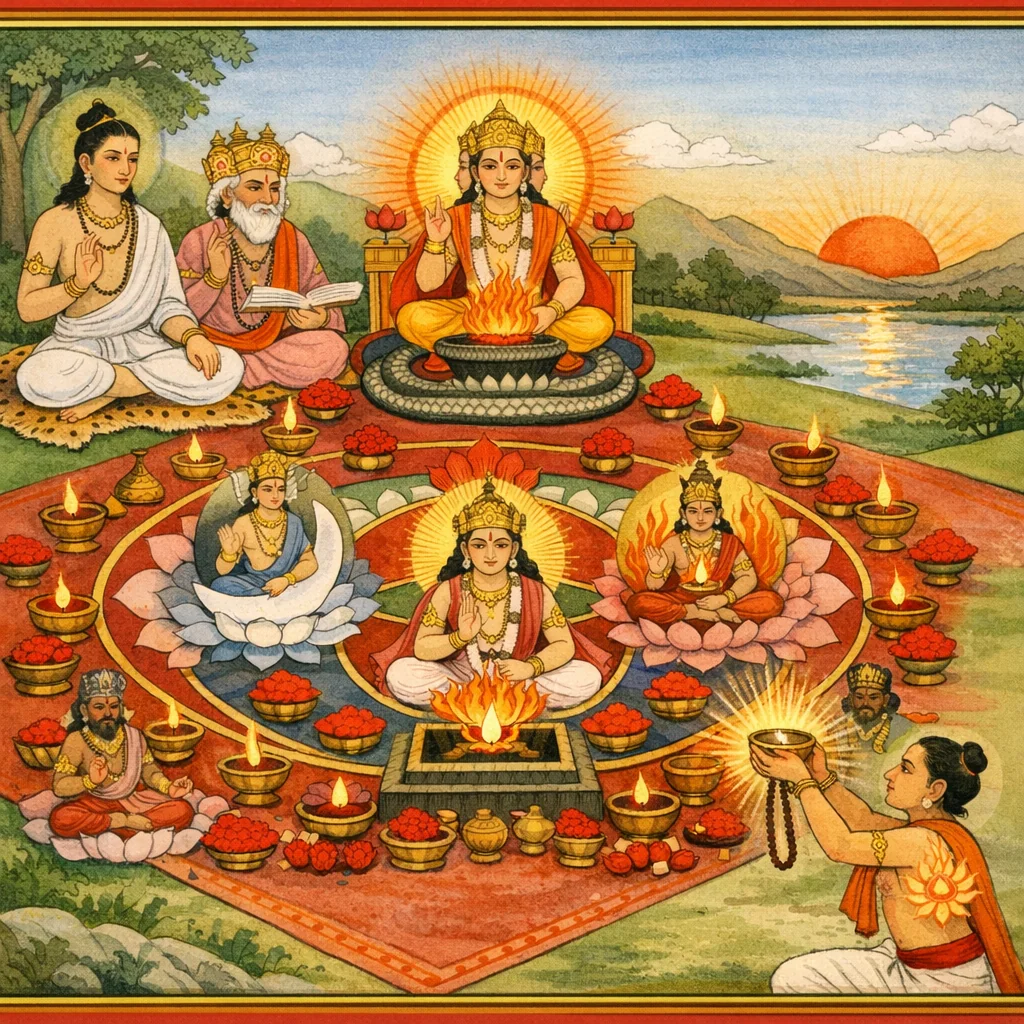
Śeṣoditya-Sūrya-nyāsa, Soma-sādhana, Graha-pūjā, and Bhauma-vrata-vidhi
Sanatkumāra instructs Brahmā in the “Threefold Form” (tri-rūpa) ritual system centered on Sūrya (Śeṣoditya) and extended to Soma and the Grahas. The chapter lists mantra lineages and identifiers (ṛṣi/chandas/devatā): Devabhāga–Gāyatrī–Ravi for the solar vidyā; Bhṛgu–Paṅkti–Soma for the lunar mantra; Virūpākṣa–Gāyatrī–Kuja for Mars. It then prescribes ṣaḍaṅga-nyāsa, maṇḍala-nyāsa (Soma–Sūrya–Agni), vyāpaka recitation, heart-lotus dhyāna of Ravi, extensive japa, and daśāṁśa homa. It details pīṭha worship, āvaraṇa deities and śaktis, placements by directions and inter-directions, and daily arghya as a simplified yet potent practice. The latter portion gives monthly Soma arghya rites and a full Bhauma-vrata (Tuesday vow) for progeny and debt relief, with red ritual materials, 21-fold arrangements, praises, circumambulations, and concluding gifts/dakṣiṇā. It closes with outlines for Budha, Guru, and Śukra mantra worship and norms of secrecy and eligibility for transmission.
Shlokas
Verse 1
सनत्कुमार उवाच । अथ वक्ष्ये त्रयीमूर्तेर्विधानं त्वब्जिनीपतेः । मन्त्राणां यत्समाराध्य सर्वेष्टं प्राप्नुयाद्भुवि ॥ १ ॥
Sanatkumāra said: Now I shall explain to you, O lord of the lotus, the prescribed procedure concerning the Threefold Form (Trayī-mūrti). By duly worshipping with those mantras, one may obtain on earth all that one desires.
Verse 2
तारो रेचिकया युक्तो मेधानेत्रयुता रतिः । ससर्गा वामकर्णोढ्यो भृगुर्वढ्यासनो मरुत् ॥ २ ॥
Tāra is joined with Recikā; Rati is endowed with Medhā and Netra. Sasargā is characterized by the “left ear”; Bhṛgu is seated upon Vaḍhyā; and Marut is also mentioned in this sequence.
Verse 3
शेषोदित्य इति प्रोक्तो वस्वर्णो भुक्तिमुक्तिदः । देवभागो मुनिश्छन्दो गायत्री देवता रविः ॥ ३ ॥
He is proclaimed as “Śeṣoditya,” radiant with golden splendor, the bestower of both worldly enjoyment and liberation. The seer is Devabhāga, the metre is Gāyatrī, and the presiding deity is Ravi, the Sun.
Verse 4
माया बीजं रमा शक्तिर्दृष्टादृष्टे नियोगकः । सत्याय हृदयं पश्चाद्ब्रह्मणे शिर ईरितम् ॥ ४ ॥
Māyā is declared to be the seed; Ramā (Lakṣmī) is the Śakti, the power; and He is the director of both the seen and the unseen. Thereafter, the Heart is said for Satya, and the Head is proclaimed for Brahmā.
Verse 5
विष्णवे तु शिखावर्म रुद्राय परिकीर्तितम् । नेत्रं स्यादग्रये पश्चात्शर्वायास्रमुदाहृतम् ॥ ५ ॥
The “śikhā-armor” (śikhā-varma) is to be assigned to Viṣṇu, and is also declared for Rudra. The “netra” (eye) is to be placed in front, and thereafter the “astra” (mantric missile) is proclaimed for Śarva.
Verse 6
नेत्रो ज्वाला मनो हुं फट्स्वाहांता मनवो गणाः । पुनः षडर्णैर्ह्री लक्ष्म्याः कृत्वांतः स्थैः षडंगकम् ॥ ६ ॥
“Netra,” “Jvālā,” and “Mano,” together with the mantras ending in “huṃ,” “phaṭ,” and “svāhā,” are the mantra-groups. Then again, using Lakṣmī’s six-syllabled (ṣaḍarṇa) “Hrīṃ,” one should perform the sixfold ancillary rite (ṣaḍaṅga), establishing it inwardly within oneself.
Verse 7
शिष्टारौजठरे पृष्टे तयोर्ङेंताख्यया न्यसेत् । आदित्यं च रविं पश्चाद्भानुं भास्करमेव च ॥ ७ ॥
On the back, at the region of the lower abdomen (jaṭhara), one should perform nyāsa, placing the formula called “ṅeṃtā” for those two positions. Thereafter, one should place the Sun’s names—Āditya, Ravi, then Bhānu, and also Bhāskara.
Verse 8
सूर्यं च मूर्ध्नि वदने हृदि गुह्ये च पादयोः । सद्यादिपञ्च ह्रस्वाद्यान् न्यसेन्ङे हृदयोंऽतिमान् ॥ ८ ॥
He should perform nyāsa, placing Sūrya, the Sun, upon the crown of the head, the mouth, the heart, the secret region, and the feet; and he should also install the five mantras beginning with “sadya…”, together with the short vowels and the remaining sounds, thus completing the hṛdaya-nyāsa in proper order.
Verse 9
ह्रीं रमामध्यगामष्टौ वर्णांस्तारादिकान्न्यसेत् । मूर्द्धास्यकंठहृत्कुक्षिनाभिलिंगगुदेषु च ॥ ९ ॥
Placing by nyāsa the eight syllables—beginning with the Tārā (oṁ) and having Ramā (Śrī/Lakṣmī) in their midst—one should install them upon the head, the mouth, the throat, the heart, the abdomen, the navel, the generative organ, and the anus.
Verse 10
सचंद्रस्वरपूर्वं तु ङेतं शीतांशुमण्डलम् । मूर्द्धादिकंठपर्यंतं न्यसेञ्चांद्रिमनुस्प्ररन् ॥ १० ॥
Then, having first taken up the lunar phoneme (candra), one should perform nyāsa, placing the cool-rayed moon-disc from the crown of the head down to the throat, while inwardly remembering the lunar radiance.
Verse 11
स्पर्शान्सेंदून्समुञ्चार्य ङेंतं भास्करमण्डलम् । न्यसेत्कंठादिनाभ्यंतं ध्यायन्प्रद्योतनं हृदि ॥ ११ ॥
Having properly articulated the touch-consonants (sparśa) together with the vowels, one should perform nyāsa, placing the radiant solar-disc (bhāskara-maṇḍala) from the throat down to the region of the navel, while contemplating within the heart its illuminating splendor.
Verse 12
यादीन्सचंद्रानुञ्चार्य ङेतं च वह्निमंडलम् । नाभ्यादिपादपर्यंतं न्यसेद्वह्निमनुस्मरन् ॥ १२ ॥
Having uttered the syllables beginning with “ya” together with the lunar adjunct (candra), and also the syllable “ṅe”, one should visualize Agni’s circle—the fire-maṇḍala (vahni-maṇḍala)—and perform nyāsa from the navel down to the feet, continually meditating on the fire principle.
Verse 13
प्रोक्तोऽयं मण्डलन्यासो महातेजोविधायकः । आदिठांतार्णपूर्वं ङेंनमोंतं सोममण्डलम् ॥ १३ ॥
Thus has this maṇḍala-nyāsa been taught, a practice that bestows great spiritual radiance. The Soma-maṇḍala is to be arranged beginning with the initial seed-sound, preceded by the indicated syllabic sequence, and concluded with the mantra ending in “namo”.
Verse 14
मूर्द्धादिहृदयांतं तु विन्यसेत्साधकोत्तमः । डकारादिक्षकारांतवर्णाद्यं वह्निमण्डलम् ॥ १४ ॥
The foremost practitioner should perform nyāsa from the crown of the head down to the heart, placing the Fire-circle (Vahni-maṇḍala) beginning with the syllables from ḍa and ending with kṣa.
Verse 15
ङेंतं हृदादिपादान्तं विन्यसेत्सुसमाहितः । अग्रीषोमात्मको न्यासः कथितः सर्वसिद्धिदः ॥ १५ ॥
With full concentration, one should place the mantra-syllables from the heart onward down to the feet. This nyāsa, whose nature is Agni and Soma, is declared to bestow all attainments.
Verse 16
न्यसेत्सेंदून्मातृकार्णाञ्जयांतपुरुषात्मने । नमोंते व्यापकं मंत्री हंस्नयासोऽयमीरितः ॥ १६ ॥
One should perform nyāsa with the seed-syllables (bīja) and the letters of the Mātṛkā for the inner Self who is the Jayanta-Puruṣa. The mantra-reciter should then say, “Salutations to You, O all-pervading One.” This is declared to be the Haṃsa-nyāsa.
Verse 17
अष्टावष्टौ स्वराञ्शेषान्पंचपञ्च मितान्पुनः । उक्तादित्यमुखानेतान्विन्यसेञ्च नवग्रहान् ॥ १७ ॥
Next, place the remaining vowels—eight and eight again—and then the measured groups of five and five. Having arranged these beginning with Āditya (the Sun), one should also set in order the nine Grahas (planetary deities).
Verse 18
आधारलिंगयोर्नाभौ हृदि कंठे मुखांतरे । भ्रूमध्ये च तथा भाले ब्रह्मरंघ्रे न्यसेत्क्रमात् ॥ १८ ॥
One should perform nyāsa in due sequence—at the navel (between the ādhāra and the liṅga), then in the heart, in the throat, within the mouth, in the space between the eyebrows, upon the forehead, and finally at the brahma-randhra (the cranial aperture).
Verse 19
हंसाख्यमग्नीषोमाख्यं मंडलत्रयमेव च । पुनर्न्यासत्रयं कुर्यान्मूलेन व्यापकं चरेत् ॥ १९ ॥
He should first establish the three maṇḍalas—known as the Haṃsa and the Agnīṣoma (maṇḍalas)—then perform the threefold nyāsa again; thereafter, with the root-mantra, he should practice the all-pervading (vyāpaka) placement/recitation.
Verse 20
एवं न्यासविधिं कृत्वा ध्यायेत्सूर्यं हृदबुजे । दानाभयाब्जयुगलं धारयंतं करै रविम् ॥ २० ॥
Thus, having performed the prescribed nyāsa, one should meditate upon Sūrya in the lotus of the heart—upon Ravi, who with his hands bears a pair of lotus-emblems granting charity (boon-giving) and fearlessness.
Verse 21
कुंडलां गदकेयूरहारिणं च त्रयीतनुम् । ध्यात्वैवं प्रजपेन्मंत्री वसुलक्षं दशांशतः ॥ २१ ॥
Meditating thus upon the Lord—adorned with earrings, bearing the mace, wearing armlets and a necklace, and whose very body embodies the Three Vedas—the mantra-practitioner should then perform japa of the mantra for eight hundred thousand repetitions, and offer one-tenth of that as the prescribed oblation (daśāṁśa).
Verse 22
रक्तांभोजैस्तिलैर्वापि जुहुयाद्विधिवद्वसौ । प्रथमं पीठयजने धर्मादीनां स्थले यजेत् ॥ २२ ॥
He should duly offer oblations into the fire using red lotuses or sesame seeds. In the pīṭha-worship, he should first perform the worship at the seats of Dharma and the other attendant deities.
Verse 23
प्रभूतं विमलं शारं समाराध्यमनंतरम् । परमादिमुखं मध्ये खबिंबांतं प्रपूजयेत् ॥ २३ ॥
Then one should worship that abundant, stainless, essential Principle—immediately approachable—whose supreme, primordial Face is established in the middle and extends up to the orb of the sky (the celestial sphere).
Verse 24
सोमाग्निमंडलं पूज्यरविमंडलमर्चयेत् । दीप्ता सूक्ष्मा जया भद्रा विभूतिर्विमला तथा ॥ २४ ॥
Having worshipped the lunar-and-fire maṇḍala, one should then worship the solar maṇḍala. (The divine powers are named) Dīptā, Sūkṣmā, Jayā, Bhadrā, Vibhūti, and likewise Vimalā.
Verse 25
अमोघा विद्युता सर्वतोमुखी पीठशक्तयः । ह्रस्वत्रयोक्तिजाः क्लीबही ना वह्नींदुसंयुताः ॥ २५ ॥
The Piṭha-Śaktis are called Amoghā, Vidyutā, and Sarvatomukhī. They are produced/indicated by the utterance of three short syllables, and are joined with the syllables klīṃ, hīṃ, nā, together with the vahni (fire) and indu (moon) elements.
Verse 26
स्वरा बीजानि शक्तीनां तदाद्याः पूजयेत्तुः ताः । ब्रह्मविष्णुशिवात्मा ते सृष्टिः शेषान्विताप्यसौ ॥ २६ ॥
The tonal accents (svaras) are the seed-syllables (bījas) of the mantra-powers (śaktis); therefore one should worship them at the very outset. They embody Brahmā, Viṣṇu, and Śiva; and through them this entire manifestation—together with what remains (śeṣa)—is also sustained.
Verse 27
एवं चान्ते योग पीठात्मने हृदयमीरयेत् । ताराद्योऽयं पीठमंत्रस्त्वनेनासनमादिशेत् ॥ २७ ॥
Thus, at the conclusion, one should utter (invoke) the heart-formula addressed to the Yoga-Pīṭha Self. This is the Pīṭha-mantra beginning with “tārā”; by means of it, one should prescribe/establish the ritual seat (āsana).
Verse 28
ध्रुवो वियद्बिंदुयुतं खं खखोल्काय दृन्मनुः । नवार्णाय च मनवे मूर्तिं संकल्पयेत्सुधीः ॥ २८ ॥
A discerning practitioner should, within the mind, visualize the sacred form (mūrti) of the nine-syllabled mantra: the syllable “kha” joined with “viyat” (the sky) and the bindu, made steadfast (dhruva) in contemplation; and he should perform, as prescribed, the mantra-formation of “kha-kholkā” and the dṛn-mantra.
Verse 29
साक्षिणं जगतां तस्यामावाह्य विधिवद्यजेत् । ततः षडंगामाराध्य द्विक्ष्वष्टांगं प्रपूजयेत् ॥ २९ ॥
Having invoked into that (altar or diagram) the Witness of the worlds, one should worship Him according to proper rule. Then, after reverently performing the six-limbed rite (ṣaḍaṅga), one should duly worship the eight-limbed form (aṣṭāṅga) in the two places or sets.
Verse 30
संपूज्य मध्ये वादित्यं रविं भानुं च भास्करम् । सूर्यं दिशासु सद्यादिपंच ह्रस्वादिकानिमान् ॥ ३० ॥
After duly worshipping Āditya in the center—as Ravi, Bhānu, Bhāskara, and Sūrya—one should then place in the directions these sets beginning with “sad-” (the fivefold group), and also these short (hrasva) and related vowel-forms.
Verse 31
स्वस्वनामादिवर्णाद्याः शक्तयोऽर्च्या विदिक्षु च । उषां प्रज्ञां प्रभां संध्यां ततो ब्रह्मादिकान्यजेत् ॥ ३१ ॥
In the intermediate directions (vidik) as well, one should worship the Śaktis beginning with the initial syllables of their respective names. Then one should offer worship to Uṣā (Dawn), Prajñā (Wisdom), Prabhā (Radiance), and Sandhyā (Twilight); thereafter, one should worship Brahmā and the other deities in due order.
Verse 32
पुरतोऽरुणमभ्यर्च्य सोमं ज्ञं च गुरुं भृगुम् । दिक्ष्वर्यमादिकानिष्ट्वा भूमिजं च शनैश्चरम् ॥ ३२ ॥
First, having worshipped Aruṇa in front, one should propitiate Soma (the Moon), Jña (Mercury), Guru (Jupiter), and Bhṛgu (Venus). Then, after performing the prescribed offerings to the remaining deities in their respective directions, one should also worship Bhūmija (Mars) and Śanaiścara (Saturn).
Verse 33
राहुं केतुं च कोणेषु पूर्ववत्परिपूजयेत् । इंद्राद्यानपि वज्राद्यान्पूजयेत्पूर्ववत्सुधीः ॥ ३३ ॥
Likewise, he should worship Rāhu and Ketu in the corner directions, as previously enjoined. In the same manner, the wise should also worship Indra and the other deities—bearers of the vajra and other emblems—just as prescribed earlier.
Verse 34
इत्थं संपूज्य विधिवद्भास्करं भक्तवत्सलम् । समाहितो दिनेशाय दद्यादर्ध्यं दिने दिने ॥ ३४ ॥
Having thus worshipped Bhāskara, the Sun who is tender to devotees, in due accordance with the rite, one should—mind collected—offer arghya, the reverential water-offering, to Dineśa, Lord of the day, day after day.
Verse 35
प्राणानायम्य सद्भूमौ न्यासान्कृत्वा पुरोदितान् । विधाय मंडलं भानोः पीठं पूर्ववदर्चयेत् ॥ ३५ ॥
Having regulated the breath by prāṇāyāma upon a pure spot of ground, and having performed the nyāsas taught earlier, one should draw the Sun’s maṇḍala and then worship Bhānu’s pīṭha, his sacred seat, in the same manner as before.
Verse 36
ध्यात्वार्कं प्रयजेद्द्विव्यैर्मानसैरुपचारकैः । पात्रं ताम्रमयं प्रस्थतोयग्राहि सुशोभनम् ॥ ३६ ॥
Having meditated upon Arka, the Sun, one should worship Him with divine offerings made in the mind. One should use a beautiful copper vessel, fit to hold one prastha of water.
Verse 37
निधाय मंडले रक्तचंदनादिविनिर्मिते । विलोममातृकामूलमुञ्चरन्पूरयेज्जलैः ॥ ३७ ॥
Having placed the vessel within a maṇḍala made of red sandalwood and the like, one should fill it with water while uttering the root bīja of the Mātr̥kās in reverse order.
Verse 38
सूर्यबिंबविनिर्गच्छत्सुधांबुधिविभावितैः । कुंकुमं रोजनां राजीं चंदनं रक्तचंदनम् ॥ ३८ ॥
Perfumed substances—made potent as though infused by the ocean of nectar streaming forth from the Sun’s orb—are: saffron, rocanā, fragrant pigments or stripes, sandalwood, and red sandalwood.
Verse 39
करवीरं जपाशालिकुशश्यामाकतंडुलान् । तिलवेणुयवांश्चैव निक्षिपेत्सलिले शुभे ॥ ३९ ॥
Into auspicious water one should place: oleander (karavīra), hibiscus (japā), rice, kuśa grass, grains of śyāmāka millet, sesame, bamboo, and barley as well.
Verse 40
सांगं सावरणं तत्रावाह्यार्कं पूर्ववद्यजेत् । गंधपुष्पधूपदीपनैवेद्याद्यै र्विधानतः ॥ ४० ॥
There, having invoked (āvāhya) the Sun, Arka, one should worship him as before—together with his limbs and attendants (sāṅga) and with his surrounding retinue (sāvaraṇa)—according to rule, using fragrance, flowers, incense, lamps, food-offerings (naivedya), and the rest.
Verse 41
प्राणायामत्रयं कृत्वा कुर्यादंगानि पूर्ववत् । सुधाबीजं चंदनेन दक्षे करतले लिखेत् ॥ ४१ ॥
Having performed the threefold prāṇāyāma, one should then carry out the limb-rites (aṅga-nyāsa and related acts) as before; and with sandal-paste one should write the ‘sudhā-bīja’ upon the palm of the right hand.
Verse 42
तेनाच्छाद्यार्ध्यपात्रं च जपेन्मनुमनन्यधीः । अष्टोत्तरशतावृत्त्या पुनः संपूज्य भास्करम् ॥ ४२ ॥
Then, covering the arghya-vessel (arghya-pātra) with that, the practitioner—of undivided attention—should recite the mantra in japa; and after repeating it one hundred and eight times, he should again duly worship Bhāskara, the Sun.
Verse 43
हस्ताभ्यां पात्रमादाय जानुभ्यामवनीं गतः । आमूर्ध्नि पात्रमुद्धृत्यांबरेण वरणे रवेः ॥ ४३ ॥
Taking the vessel in both hands, he should kneel down to the earth. Then, raising the vessel to the crown of his head, at the time when the Sun is to be veiled (during an eclipse), he should perform the rite of screening it with a cloth.
Verse 44
दृष्टिं चाधाय मनसा पूजयित्वा रविं पुनः । साधकेन स्वकैक्येन मूलमंत्रं धिया जपन् ॥ ४४ ॥
Then, fixing the gaze and steadying the mind, having again worshipped the Sun, the practitioner—abiding in inner oneness with his own Ātman—should mentally repeat the root-mantra with focused understanding.
Verse 45
अर्ध्यं दद्याद्रविं ध्यायव्रक्तचंदनमंडले । दत्त्वा पुष्पांजलिं भूयो जपेदष्टोत्तरं शतम् ॥ ४५ ॥
Meditating on Ravi (the Sun) as abiding within a circle of red sandalwood paste, one should offer arghya, the reverential water-libation. Then, offering a handful of flowers again, one should recite the mantra one hundred and eight times.
Verse 46
नित्यं वा तद्विनेऽप्येवमर्ध्यं दद्याद्विवस्वते । तेन तुष्टो दिनेशोऽस्मै दद्याद्वित्तं यशः सुखम् ॥ ४६ ॥
Or, even without that full rite, one should daily offer arghya to Vivasvān, the Sun, in this manner. Pleased thereby, the Lord of the day grants him wealth, fame, and happiness.
Verse 47
पुत्रान्पौत्रानभीष्टं च यद्यत्सर्वं प्रयच्छति । अर्ध्यदानमिदं प्रोक्तमायुरारोग्यवर्द्धनम् ॥ ४७ ॥
This offering of arghya is said to bestow sons and grandsons and to grant whatever one desires; it also increases longevity and health.
Verse 48
धनधान्यपशुक्षेमक्षेत्रमित्रकलत्रदम् । तेजोवीर्ययशःकीर्तिविद्याविभवभोगदम् ॥ ४८ ॥
It bestows wealth and grain, livestock and security; land, friends, and a spouse. It grants radiance and strength, fame and renown, learning, prosperity, and the enjoyments of life.
Verse 49
गायत्र्याराधनासक्तः संध्यावंदनतत्परः । एवं मनुं जपन्विप्रो दुःखं नैवाप्नुयात्क्वचित् ॥ ४९ ॥
A brāhmaṇa devoted to the worship of Gāyatrī and intent on performing the Sandhyā-vandana—reciting this mantra in such a manner—does not incur suffering anywhere at any time.
Verse 50
विकर्तनाय निर्माल्यमेवं संपूज्य दापयेत् । वियद्वह्निमरुत्साद्यांतार्वीसेंदुसमन्वितम् ॥ ५० ॥
Thus, after duly worshipping Vikartana (the Sun), one should offer the consecrated remnants (nirmālya). One should then bestow a gift set accompanied by representations of the sky, fire, wind and the rest—together with the earth, the ocean/river, and the moon.
Verse 51
मार्तंडभैरवाख्यं हि बीजं त्रैलोक्यमोहनम् । बिंबबीजेन पुटितं सर्वकामफलप्रदम् ॥ ५१ ॥
Indeed, the seed-mantra called “Mārtaṇḍa-bhairava” enchants the three worlds; when it is encased (reinforced) with the “Biṃba” seed, it becomes a bestower of the fruits of all desires.
Verse 52
पूर्ववत्सकलं चान्यदत्र ज्ञेयं मनीषिभिः । भृगुर्जलेंदुमन्वाढ्यः सोमाय हृदयांतिमः ॥ ५२ ॥
Here too, the rest should be understood by the wise in the same manner as previously stated: (the sage) Bhṛgu is to be associated with Jalendu; Anvāḍhya with Soma; and Hṛdayāntima likewise with Soma.
Verse 53
षडक्षरो मंत्रराजो मुनिरस्य भृगुर्मतः । छंदः पंक्तिस्तु सोमोऽस्य देवता परिकीर्तिता ॥ ५३ ॥
For this six-syllabled sovereign mantra, the seer (ṛṣi) is held to be Bhṛgu; its metre is Paṅkti, and its presiding deity is proclaimed to be Soma.
Verse 54
आद्यं बीजं नमः शक्तिर्विनियोगोऽखिलाप्तये । षड्दीर्घेण स्वबीजेन षडंगानि समाचरेत् ॥ ५४ ॥
The primary seed-syllable is to be prefaced with “namaḥ”; thereby its power (śakti) is invoked, and its ritual application (viniyoga) is for the attainment of all aims. Using one’s own seed-mantra with the six long vowels, one should perform the six-limbed (ṣaḍ-aṅga) nyāsa rites.
Verse 55
पूर्णेद्वास्यं स्फटिकभं नीलालकलसन्मुखम् । विभ्राणमिष्टं कुमुदं ध्यायेन्मुक्तास्रजं विधुम् ॥ ५५ ॥
One should meditate upon the Moon: his face like a full-blown lotus, radiant as crystal, his countenance beautified by dark curls—bearing a beloved white lotus and adorned with a garland of pearls.
Verse 56
ऋतुलक्षं जपेन्मंत्रं पायसेन ससर्पिषा । जुहुयात्तद्दशांशेन पीठे सोमांतपूजिते ॥ ५६ ॥
One should repeat the mantra in japa for the prescribed measure of a “seasonal lakh,” and then offer homa oblations of pāyasa (rice-pudding) mixed with ghee—making the homa one-tenth of that japa-count—upon a consecrated seat/altar that has been worshipped through the Soma rite.
Verse 57
मूर्तिमूलेन संकल्प्य पूजयेद्विधिवद्विधुम् । केसरेष्वंगपूजा स्यात्पत्रेष्वेताश्च शक्तयः ॥ ५७ ॥
Having first formed the saṅkalpa by means of the root-mantra of the deity’s form, one should worship Vidhū, the Moon, according to the prescribed rite. On the lotus filaments (kesara) the aṅga-pūjā is to be performed, and upon the petals these very śaktis are to be placed and invoked.
Verse 58
रोहिणी कृत्तिका चैव रेवती भरणी पुरः । रात्रिरार्द्रा ततो ज्योत्स्ना कला हारसमप्रभा ॥ ५८ ॥
Rohiṇī and Kṛttikā, and likewise Revatī—while Bharaṇī is set before them. Then come Rātri and Ārdrā; thereafter (appear) Jyotsnā and Kalā, radiant like the string of a necklace.
Verse 59
सुशुक्लमाल्यवसनामुक्ताहारविभूषिताः । सर्वास्स्तनभराक्रांता रचितांजलयः शुभाः ॥ ५९ ॥
Adorned with garments and garlands of purest white, and embellished with pearl necklaces, all of them—heavy with full breasts—stood auspiciously, palms joined in reverent añjali.
Verse 60
स्वप्रियासक्तमनसो मदविभ्रममंथराः । समभ्यर्च्याः सरोजाक्ष्यः पूर्णेंदुसदृशाननाः ॥ ६० ॥
Those lotus-eyed women—minds clinging to their beloveds, moving languidly with the sway of love’s intoxication, their faces like the full moon—are to be duly honored and worshipfully revered.
Verse 61
दलाग्रेषु समभ्यर्च्यास्त्वष्टौ सूर्यादिका ग्रहाः । आदित्यभूसुतबुधमंददेवेज्यराहवः ॥ ६१ ॥
Upon the tips of the ritual leaves, the eight grahas beginning with the Sun should be duly worshipped—namely: the Sun, Mars (Earth’s son), Mercury, Saturn (the slow-moving), Jupiter (preceptor of the gods), and Rahu (the eclipse-causer).
Verse 62
शुक्रकेतुयुता ह्येते पूज्याः पत्रग्रगाग्रहाः । रक्तारुणश्वेतनीलपीतधूम्रसिताऽसिताः ॥ ६२ ॥
These grahas, together with Śukra (Venus) and Ketu, are indeed to be worshipped—grahas that move along their appointed paths; their hues are red, tawny, white, blue, yellow, smoky, pale, and dark.
Verse 63
वामोरुन्यस्ततद्धस्ता दक्षिणेन धृताभयाः । सोकपालांस्तदस्त्राणि तद्वाह्ये पूजयेत्सुधीः ॥ ६३ ॥
Placing the corresponding hand upon the left thigh, and holding the right hand in the fear-dispelling gesture of abhaya-mudrā, the wise practitioner should worship the guardians of the quarters (lokapālas), together with their ritual vessels (pātras) and weapons, and also the deity’s mount (vāhana).
Verse 64
एव संसाधितो मंत्रः प्रयच्छेदिष्टमात्मनः । पौर्णमास्यां जिताहारो दद्यादर्ध्यं विधूदये ॥ ६४ ॥
Thus perfected, the mantra bestows upon the practitioner the desired fruit. On the full-moon day, having restrained one’s diet, one should offer arghya—a reverential water-offering—to Chandra, the Moon, at its rising.
Verse 65
मंडलत्रितर्यं कुर्यात्प्राक्प्रत्यगायतं भुवि । पश्चिमे मंडले स्थित्वा पूजाद्रव्यं च मध्यमे ॥ ६५ ॥
One should draw three maṇḍalas upon the ground, arranged lengthwise from east to west. Standing in the western maṇḍala, one should place the articles of worship in the central maṇḍala.
Verse 66
संस्थाप्य सोममन्यस्मिन्मंडलेऽब्जसमन्विते । समभ्यर्च्यं विधानेन पीठपूजनपूर्वकम् ॥ ६६ ॥
Having installed Soma in another maṇḍala adorned with a lotus, one should worship him properly according to the prescribed rite, beginning with the worship of the pīṭha—the sacred pedestal.
Verse 67
स्थापयेद्राजतं पात्रं पुरतस्तत्र मंत्रवित् । सुरभीपयसापूर्य्य तं स्पृशन्प्रजपेन्मनुम् ॥ ६७ ॥
There, the knower of mantras should place a silver vessel in front; filling it with the milk of the sacred cow Surabhī, and touching it, he should recite the prescribed manu—the mantra formula.
Verse 68
अष्टोत्तरशतं पश्चाद्विद्या मंत्रेण मंत्रवित् । दद्यान्निशाकरायार्ध्यं सर्वाभीष्टार्थसिद्धये ॥ ६८ ॥
Afterwards, the knower of mantras should recite one hundred and eight times with the Vidyā-mantra, and then offer arghya to Niśākara, the Moon, for the accomplishment of all desired aims.
Verse 69
कुर्यादनेन विधिना प्रतिमासमतंद्रितः । वर्षांतरेण सवष्टं प्राप्नोति भुविमानवः ॥ ६९ ॥
A man should perform this observance every month according to this procedure, without negligence; within a year he attains complete fulfillment and prosperity here on earth.
Verse 70
विद्ये विद्यामालिनि स्यादंत चंद्रिणि कतवदेत् । चंद्रमुखि द्विठांतोऽयं विद्यामंत्र उदाहृतः ॥ ७० ॥
“(One should address her as:) ‘O Vidyā, O Garlanded-with-Knowledge, O Endowed with moonlike lustre, O Moon-faced One.’ Thus, with the ending formed by the two syllables ‘ṭha’, this is declared to be the Vidyā-mantra.”
Verse 71
एवं कुमुदिनीनाथमंत्रं यो जपति ध्रुवम् । धनं धान्यं सुतान्पौत्रान्सौभाग्यं लभतेऽचिरात् ॥ ७१ ॥
Thus, whoever steadily recites this Kumudinīnātha mantra soon obtains wealth, grain and provisions, sons and grandsons, and good fortune.
Verse 72
अथांगारकमंत्रं तु वक्ष्ये धनसुतप्रदम् । तारो दीर्घेंदुयुग्व्योम तदेवेंदुयुतः पुनः ॥ ७२ ॥
Now I shall declare the mantra of Aṅgāraka (Mars), which bestows wealth and sons: it is formed by ‘tāra’ (the syllable oṃ), then the long vowel ‘ī’, then ‘indu’ (ṃ), then ‘yug’ (ga), then ‘vyoma’ (ha); and again that same sequence joined with ‘indu’ (ṃ).
Verse 73
षांतः सर्गी च चंडीशौ क्रमार्दिदुविसर्गिणै । षडर्णोऽयं महामंत्रो मंगलस्याखिलेष्टदः ॥ ७३ ॥
The syllables “ṣāṃ”, “taḥ”, “sar”, “gī”, “ca”, and “caṇḍīśa”, set in due order and ending with the visarga, form this six-syllabled Great Mantra, bestowing auspiciousness and fulfilling every desired aim.
Verse 74
विरूपाक्षो मुनिश्छंदोगायत्रं देवता कुजः । मंत्रार्णैः षड्भिरंगानि क्रुर्वन्ध्यायेद्धरात्मजम् ॥ ७४ ॥
The seer (ṛṣi) is Virūpākṣa; the metre is Gāyatrī; the presiding deity is Kuja (Mars). Having performed the sixfold aṅga-nyāsa with the mantra’s syllables, one should meditate upon the Son of the Earth (Mars).
Verse 75
मेषस्थं रक्तवस्रांगं शूलशक्तिगदावरान् । करैर्बिभ्राणमीशानस्वेदजं भूंसुतं स्मरेत् ॥ ७५ ॥
One should meditate on the Son of the Earth (Mars) as stationed in Aries—red in garments and body—bearing in his hands a trident, a spear (śakti), and a mace; born from the sweat of Īśāna (Śiva).
Verse 76
रसलक्षं जपेन्मंत्रं दशांशं खदिरोद्भवैः । समिद्भिर्जुहुयादग्नौ शैवे पीठे यजेत्कुजम् ॥ ७६ ॥
One should repeat the mantra one hundred thousand times; then, offering a tenth part as oblations into the fire with khadira (acacia) fuel-sticks, one should worship Kuja (Mars) upon a Śaiva sacred seat (pīṭha).
Verse 77
प्रागंगानि समाराध्य ह्येकविंशतिकोष्टकम् । मंगलोभूमिपुत्रश्च ऋणहर्ता धनप्रदः ॥ ७७ ॥
Having first duly propitiated the preliminary limbs of the rite, one should worship the sacred arrangement in twenty-onefold form; then Maṅgala (Mars), the Son of the Earth, becomes the remover of debts and the giver of wealth.
Verse 78
स्थिरासनो महाकायः सर्वकर्मावरोधकः । लोहितो लोहिताक्षश्च सामगानां कृपाकरः ॥ ७८ ॥
He is firm-seated and vast-bodied, restraining all wrongful deeds. He is the Red One, with reddish eyes, compassionate to the chanters of the Sāma hymns.
Verse 79
धरात्मजः कुजो भौमो भूमिदो भूमिनंदनः । अंगारको महीसूनुः सर्वरोगापहारकः ॥ ७९ ॥
“Son of the Earth—Kuja, Bhauma; giver of land, delight of the Earth; Aṅgāraka, son of Mahī—(Mars), remover of all diseases.”
Verse 80
वृष्टिकर्ता वृष्टिहर्ता सर्वकार्यार्थसिद्धिदः । इत्येक र्विशतिः प्रोक्ता मूर्तयो भूसुतस्य वै ॥ ८० ॥
“He makes the rain, He withdraws the rain, and He grants success in all undertakings and aims.” Thus are declared indeed the twenty-one manifestations (mūrtis) of Bhūsuta.
Verse 81
मंगलादीन्यजेन्मंत्री स्वस्वस्थानस्थितान्क्रमात् । इंद्राद्यानपि वज्रादीनेवं सिद्धो भवेन्मनुः ॥ ८१ ॥
The mantra-practitioner should worship Maṅgala and the others in due order, each established in their own proper place. He should likewise worship Indra and the rest, together with the Vajra and the divine weapons. Thus the mantra becomes accomplished (siddha).
Verse 82
सुतकामा कुरंगाक्षी भौमव्रतमुपाचरेत् । मार्गशीर्षेऽथ वैशाखे व्रतारंभः प्रशस्यते ॥ ८२ ॥
A woman who longs for a son, O doe-eyed one, should observe the Bhauma-vrata (the Tuesday vow). The commencement of this vow is especially praised in the months of Mārgaśīrṣa and Vaiśākha.
Verse 83
अरुणोदयवेलायामुत्थायावश्यकं पुनः । विनिर्वर्त्य रदान्धावेदपामार्गेण वाग्यता ॥ ८३ ॥
At the time of dawn (aruṇodaya), one should rise and again perform the obligatory acts of purification; having properly cleaned the teeth with the “Veda-pāmārga” twig, one should then observe restraint of speech.
Verse 84
स्नात्वा रक्तांबरधरा रक्तमाल्यविलेपना । नैवेद्यादींश्च संभारान्रक्तान्सर्वान्प्रकल्पयेत् ॥ ८४ ॥
After bathing, she should wear red garments, adorn herself with red garlands and red unguents, and arrange all ritual articles—beginning with the naivedya, the food-offering—so that everything is red in color.
Verse 85
योग्यं विप्रं समाहूय कुजमर्चेत्तदाज्ञया । रक्तगोगोमयालिप्तभूमौ रक्तासने विशेत् ॥ ८५ ॥
Having summoned a qualified brāhmaṇa, one should worship Kuja (Mars) according to his instructions. One should sit on a red seat upon ground that has been smeared with red cow-dung (from a reddish cow).
Verse 86
आचम्य देशकालौ च स्मृत्वा काम्य समुच्चरन् । मङ्गलादीनि नामानि स्वकीयांगेषु विन्यसेत् ॥ ८६ ॥
Having performed ācamana and recollected the place and time, while uttering the desired saṅkalpa (intention), one should place upon one’s own limbs—through aṅga-nyāsa—the auspicious names beginning with “Maṅgala”.
Verse 87
मुखे प्रविन्यसेत्साध्वी सामगानां कृपाकरम् । धरात्मजं नसोरक्ष्णोः कुजं भौमं ललाटके ॥ ८७ ॥
The virtuous woman should perform nyāsa: placing in the mouth the compassionate lord of the Sāma-chanters; placing the Earth’s son (Mars) at the nostrils and the eyes; and placing Kuja, the son of Bhūmi, upon the forehead.
Verse 88
भूमिदं तु भ्रुवोर्मध्ये मस्तके भूमिनन्दनम् । अङ्गारकं शिखायां च सर्वांगे च महीसुतम् ॥ ८८ ॥
Place (the mantra/name) “Bhūmida” in the space between the eyebrows; “Bhūminandana” upon the crown of the head; “Aṅgāraka” upon the topknot; and “Mahīsuta” throughout the entire body.
Verse 89
बाहुद्वये न्यसेत्पश्चात्सर्वरोगापहारकम् । मूर्द्धादि वृष्टिकर्तारमापादांतं न्यसेत्सुधीः ॥ ८९ ॥
Then place (the mantra-power) upon both arms as the remover of all diseases. The wise practitioner should place it from the head down to the feet as the maker of rain, the bestower of life-giving showers.
Verse 90
विन्यसेद्रृष्टिहर्तारं मूर्द्धांतं चरणादितः । न्यसेदंते ततो दिक्षु सर्वकार्यार्थसिद्धिदम् ॥ ९० ॥
Beginning from the feet and proceeding upward to the crown of the head, perform nyāsa of the deity who removes harmful glances. Then, at the conclusion, place that mantra-power in the directions; it bestows the accomplishment of all intended aims and ritual undertakings.
Verse 91
नाभौ हृदि शिरस्यारं वक्रे भूमिजमेव च । विन्यस्यैवं निजे देहे ध्यायेत्प्राग्वद्धरात्मजम् ॥ ९१ ॥
Place the mystic “spoke” in the navel, in the heart, and in the head; and likewise fix the Earth-born one (Dharā-putra) in the curved region. Thus arranging these within one’s own body, meditate on Dharā’s son as taught earlier.
Verse 92
मानसैरुपचारैश्च संपूज्यार्ध्यं निधापयेत् । एकविंशतिकोष्ठाढ्ये त्रिकोणे ताम्रपत्रगे ॥ ९२ ॥
Having fully worshipped, including with mental offerings, place the arghya (honor-water) in a triangular diagram on a copper plate marked with twenty-one compartments.
Verse 93
आवाह्याङ्गारकं तत्र रक्तपुष्पादिभिर्यजेत् । अङ्गानि पूर्वमाराध्य मङ्गलादीन्प्रपूजयेत् ॥ ९३ ॥
There, having invoked Aṅgāraka (Mars), one should worship him with red flowers and the like. First propitiating the subsidiary parts of the rite, one should then duly worship Maṅgala and the other grahas.
Verse 94
एकविंशतिकोष्ठेषु चक्रमारं च भूमिजम् । त्रिकोणेषु च सम्पूज्य बहिरष्टौ च मातृकाः ॥ ९४ ॥
In the twenty-one compartments, one should place the Cakramāra and the Bhūmija (earth-born element). Having duly worshipped the deities in the triangles, one should also worship the eight Mātr̥kās on the outer side.
Verse 95
इंद्रादीनथ वज्रादीन्बाह्ये संपूजयेत्पुनः । धूपदीपौ समर्प्याथ गोधूमान्नं निवेदयेत् ॥ ९५ ॥
Then, outside the main altar, one should again worship Indra and the other deities, as well as the Vajra and the other divine weapons. After offering incense and a lamp, one should present a food-offering prepared from wheat.
Verse 96
ताम्रपात्रे शुद्धतोयपूरिते रक्तचंदनम् । रक्तपुष्पाक्षतफलान्याक्षिप्यार्ध्यं समर्पयेत् । मंगलाय ततो मंत्री इदं मंत्रद्वयं पठेत् ॥ ९६ ॥
In a copper vessel filled with pure water, one should place red sandalpaste, red flowers, akṣata (unbroken rice grains), and fruits, and then offer this as an ārghya. Thereafter, for auspiciousness, the mantrin (ritual officiant) should recite this pair of mantras.
Verse 97
भूमिपुत्र महातेजः स्वेदोद्भवपिनाकिनः । सुतार्थिनी प्रपन्ना त्वां गृहाणार्ध्यं नमोऽस्तु ते ॥ ९७ ॥
O son of the Earth, O one of great splendor—O Pinākin, bearer of the bow Pināka, who arose from sweat—seeking a son, I have taken refuge in you. Please accept this ārghya. Homage to you.
Verse 98
रक्तप्रवालसंकाश जपाकुसुमसन्निभ । महीसुत महाभाग गृहाणार्ध्यं नमोऽस्तु ते ॥ ९८ ॥
O you who shine like red coral, resembling the hibiscus flower—O illustrious son of the Earth—please accept this arghya (ritual offering of water). Salutations to you.
Verse 99
एकविंशतिपूर्वोक्तैर्ङेनमोंतैंश्च नामभिः । ताराद्यैः प्रणमेत्पश्चात्तावत्यश्च प्रदक्षिणाः ॥ ९९ ॥
With the twenty-one names previously taught—beginning with the syllable ṅe and including ‘namoṁ’ and ‘taiṁ’—one should then bow down, starting with the mantra ‘tārā…’; and one should perform the same number of circumambulations.
Verse 100
धरणीगर्भसंभूतं विद्युत्तेजः समप्रभम् । कुमारं शक्तिहस्तं च मङ्गलं प्रणमाम्यहम् ॥ १०० ॥
I bow to Maṅgala—born from the womb of the Earth, radiant like the brilliance of lightning, youthful in form, and bearing a spear in his hand.
Verse 101
ततो रेखात्रयं कुर्यात्खदिरांगारकेण च । मार्जयेद्वामपादेन मंत्राभ्यां च समाहिता ॥ १०१ ॥
Then she should draw three lines using charcoal from khadira-wood; and, composed in mind, she should wipe (or smooth) it with the left foot while reciting the two mantras.
Verse 102
दुःखदौर्भाग्यनाशाय पुत्रसंतानहेतवे । कृतरेखात्रयं वामपादेनैतत्प्रमार्ज्म्यहम् ॥ १०२ ॥
To destroy sorrow and ill-fortune, and to obtain a line of sons and descendants, I now wipe away these three drawn lines with my left foot.
Verse 103
ऋणदुः खविनाशाय मनोभीष्टार्थसिद्धिये । मार्जयाम्यसिता रेखास्तिस्रो जन्मत्रयोद्भवाः ॥ १०३ ॥
To destroy the sorrow born of debt and to fulfill the mind’s desired aims, I wipe away the three dark lines that have arisen from three births.
Verse 104
स्तुवीत धरणीपुत्रं पुष्पांजलिकरा ततः । ध्यायंती तत्पदांभोजं पूजासांगत्वसिद्धये ॥ १०४ ॥
Then, with hands joined and holding a flower-offering, she should praise the Son of the Earth; meditating on the lotus of His feet, so that the worship may be performed in full and attain completeness.
Verse 105
ऋणहर्त्रे नमस्तुभ्यं दुःखदारिद्र्यनाशिने । सौभाग्यसुखदो नित्यं भव मे धरणीसुत ॥ १०५ ॥
Salutations to You, O remover of debts, destroyer of sorrow and poverty. O Son of the Earth, ever be the giver of good fortune and happiness to me.
Verse 106
तप्तकांचनसंकाश तरुणार्कसमप्रभ । सुखसौभाग्यधनद ऋणदारिद्य्रनाशक ॥ १०६ ॥
O Deity whose radiance is like molten gold and whose splendor is like the newly risen sun—bestower of happiness, good fortune, and wealth; destroyer of debt and poverty.
Verse 107
ग्रहराज नमस्तेऽस्तु सर्वकल्याणकारक । प्रसादं कुरु देवेश सर्वकल्याणभाजन ॥ १०७ ॥
O King of planets, salutations to You—the maker of every auspicious good. O Lord of the gods, be gracious to me, You who are the very abode of all welfare.
Verse 108
देवदानवगंधर्वयक्षराक्षसपन्नगाः । आप्नुवन्ति शिवं सर्वे सदा पूर्णमनोरथाः ॥ १०८ ॥
Devas, Dānavas, Gandharvas, Yakṣas, Rākṣasas, and Nāgas—all of them attain Śiva, the auspicious good, and ever remain with their desires fulfilled.
Verse 109
आचिरादेव लोकेऽस्मिन्यस्याराधनतो जनाः । प्राप्नुवन्ति सुखं तस्मै नमो धरणिसूनवे ॥ १०९ ॥
To Him—the son of the Earth—by whose worship people in this world swiftly attain happiness, to that One I bow in reverence.
Verse 110
यो वक्रगतिमापन्नो नृणां दुःखं प्रयच्छति । पूजितः सुखसौभाग्यं तस्मै क्ष्मासूनवे नमः ॥ ११० ॥
Salutations to the son of the Earth: when he assumes a crooked, retrograde course he brings sorrow to people, yet when duly worshipped he bestows happiness and good fortune.
Verse 111
नभसि द्योतमानाय सर्वकल्याणहेतवे । मङ्गलाय नमस्तुभ्यं धनसंतानहेतवे ॥ १११ ॥
Salutations to you, Maṅgala (Mars), who shines in the sky, who is the cause of all auspiciousness, and who bestows wealth and progeny.
Verse 112
प्रसादं कुरु मे भौममंगलप्रद मंगल । मेषवाहन रुद्रात्मन्देहि पुत्रान्धनं यशः ॥ ११२ ॥
O Bhauma (Mars), auspicious one who bestows auspiciousness—be gracious to me. O Ram-rider, O Rudra-souled one, grant me sons, wealth, and good repute.
Verse 113
एवं स्तुत्वा प्रणम्याथ विसृज्य धरणीसुतम् । यथाशक्त्या प्रदाय स्वं गृह्णीयाद्ब्रणाशिषः ॥ ११३ ॥
Thus, after offering praise, bowing down, and respectfully dismissing the son of the Earth, one should give one’s gift according to one’s capacity and receive the brāhmaṇa’s blessings.
Verse 114
गुरवे दक्षिणां दत्त्वा भुञ्जीयात्तन्निवेदितम् ॥ ११४ ॥
After offering the prescribed honorarium (dakṣiṇā) to one’s teacher, one should partake of the food that has been offered and sanctioned by him.
Verse 115
एवमावत्सरं कुर्यात्प्रतिमंगलवासरम् । तिलैर्होमं विधायाथ शतार्द्धं भोजयोद्द्विजान् ॥ ११५ ॥
In this manner one should observe this rite for a full year, on each Tuesday. Then, having performed a fire-offering with sesame seeds, one should feed twice fifty—one hundred—brāhmaṇas.
Verse 116
भौममूर्तिं स्वर्णमयीमाचार्याय समर्पयेत् । मंडलस्थे घटेऽभ्यर्च्येत्सुतसौभाग्यसिद्धये ॥ ११६ ॥
One should present to the teacher a golden image of Bhauma (Mars). Having worshipped Bhauma in a pot (ghaṭa) placed within the ritual maṇḍala, one attains the fulfillment of a son’s good fortune and well-being.
Verse 117
एवं व्रतपरा नारी प्राप्नुयात्सुभगान्सुतान् । ऋणनाशाय वित्तार्थं व्रतं कुर्यात्पुमानपि ॥ ११७ ॥
Thus, a woman devoted to this vow attains fortunate and auspicious sons. A man too should undertake the vow for the destruction of debts and for the sake of acquiring wealth.
Verse 118
ब्राह्मणः प्रजपेन्मन्त्रंमग्निर्मूर्द्धेति वैदिकम् । अंगारकस्य गायत्रीं वक्ष्ये यजनसिद्धये ॥ ११८ ॥
A brāhmaṇa should recite the Vedic mantra that begins, “Agni is upon the crown of the head (mūrdhan).” Now, for the successful accomplishment of the yajña, I shall declare the Gāyatrī-mantra of Aṅgāraka (Mars).
Verse 119
अंगारकाय शब्दांते विद्महे पदमीरयेत् । शक्तिहस्ताय वर्णांते धीमहीति समुञ्चरेत् ॥ ११९ ॥
At the end of the name “Aṅgāraka,” one should utter the pada “vidmahe”; and at the end of the syllables for “Śaktihasta,” one should properly recite “dhīmahi.”
Verse 120
तन्नो भौमः प्रचोवर्णान्दयांदिति च संवदेत् । भौमस्यैषा तु गायत्री जप्तुः सर्वेष्टसिद्धिदा ॥ १२० ॥
One should recite: “May Bhauma (Mars) impel our letters (our speech), and may he grant compassion.” This indeed is the Gāyatrī of Bhauma; when repeated in japa, it bestows the accomplishment of all desired aims.
Verse 121
भौमोपासनमेतद्धि बुधमन्त्रमथोच्यते । फांतः कर्णेंदुसंयुक्तो बुधो ङेंते हदंतिमः ॥ १२१ ॥
This indeed is the method of worship for Bhauma (Mars). Now the mantra of Budha (Mercury) is stated: it is formed with “phāṃ”, joined with the ear-and-moon signs, together with “Budha”; ending with “ṅeṃte”, and with “ha” as the final consonant.
Verse 122
रसाणों बुधमन्त्रोऽयं मुनिब्रह्मास्य कीर्तितः । पंक्तिश्छैदो देवता तु बुधः सर्वेष्टदो नृणाम् ॥ १२२ ॥
This is the mantra of Budha (Mercury); it is said that its seer (ṛṣi) among the sages is Brahmā. Its metre is Paṅkti, and its presiding deity is Budha, who grants all desired aims to human beings.
Verse 123
आद्यं बीजं नमः शक्तिर्विनियोगोऽखिलाप्तये । वंदे बुधं सदा भक्त्या पीताम्बरविभूषणम् ॥ १२३ ॥
The primordial seed-syllable is proclaimed; its śakti is “namaḥ”; its application is for the attainment of all aims. Ever with bhakti I bow to Budha (Mercury), adorned with yellow garments and ornaments.
Verse 124
जानुस्थवामहस्ताढ्यं साभयेतरपाणिकम् । ध्यात्वेवं प्रजपेसहस्रं विजितेंद्रियः ॥ १२४ ॥
Having thus meditated on the deity—complete in form, with the left hand resting upon the knee and the other hand showing the gesture that removes fear—one who has conquered the senses should repeat the mantra a thousand times.
Verse 125
दशांशं जुहुयादाज्यैः पीठे पूर्वोदितेऽर्चयेत् । अङ्गमातृदिशापालहेतिभिर्बुधमर्चयेत् ॥ १२५ ॥
One should offer a tenth portion as oblations with ghee in the homa, and worship upon the previously prescribed altar-seat (pīṭha). One should worship Budha together with his aṅga powers, the Mother-deities, the guardians of the directions, and the divine weapons as associated energies.
Verse 126
एवं सिद्धे मनौ मंत्री साधयेत्स्वमनोरथान् । सहस्रं प्रजपेन्मंत्रं नित्यं दशदिनावधि ॥ १२६ ॥
When the mantra has thus been perfected, the practitioner should accomplish his intended aims. He should then regularly repeat the mantra a thousand times each day, continuing this practice for a period of ten days.
Verse 127
तस्याशु ग्रहजा पीडा नश्यत्येव न संशयः । बुधस्याराधनं प्रोक्तं गुरोराराधनं श्रृणु ॥ १२७ ॥
For him, the affliction arising from the grahas (planets) quickly perishes—there is no doubt. The worship of Budha has been taught; now listen to the worship of Guru (Jupiter).
Verse 128
बृंहस्पतिपदं ङेंऽतं सेंद्वाद्यर्णाघमंडितम् । नमोंतो वसुवर्णोऽयं मुनिर्ब्रह्मास्य संमतः ॥ १२८ ॥
This sage—approved by Brahmā—shines with a golden luster. His name is formed from the word “Bṛhaspati,” ending in the syllable “ṅeṃ,” adorned with the initial letters “seṃ” and “dvā,” and concluded with “namoṃ.”
Verse 129
छन्दोऽनुष्टुप्सुराचार्यो देवता बीजमादिमम् । हृच्छक्तिर्दीर्घवह्नींदुयुगलेनांगकल्पना ॥ १२९ ॥
The metre is Anuṣṭubh; Surācārya, the divine preceptor, is the presiding deity; and the primordial seed-syllable is the bīja. The heart-power (hṛcchakti) is specified, and aṅga-nyāsa is to be performed with the paired syllables “vahnī” and “indu” in their long (dīrgha) form.
Verse 130
न्यस्तवामकरं राशौ रत्नानां दक्षिणात्करात् । किरंतं पीतपुष्पालंकारालेपांशुकार्चितम् ॥ १३० ॥
With his left hand placed upon a heap of jewels and his right hand scattering them forth, he was honored with yellow flowers, ornaments, unguents, and fine garments.
Verse 131
सर्वविद्यानिधिं देवगुरुं स्वर्णद्युतिं स्मरेत् । लक्षं जपो दशांशेन घृतेनान्नेन वा हुनेत् ॥ १३१ ॥
One should meditate upon the divine Guru—the treasury of all knowledges—radiant like gold. One should perform a hundred thousand recitations, and then offer a fire-oblation equal to one-tenth of that number, using ghee or cooked food as the offering.
Verse 132
धर्मादिपीठे प्रयजेदंगदिक्पालहेतिभिः । एवं सिद्धे मनौ मंत्री साधयेदिष्टमात्मनः ॥ १३२ ॥
Upon the altar-seat beginning with Dharma, one should perform worship with the ritual limbs, the guardians of the directions (dikpāla), and their weapons. When the mantra is thus perfected, the mantra-practitioner should accomplish for himself the desired aim.
Verse 133
विपरोगादिपीडासु कलहे स्वजनोद्भवे । पिप्पलोत्थसमिद्भिश्च जुहुयात्तन्निवृत्तये ॥ १३३ ॥
When one is afflicted by severe disease and related troubles, or when quarrels arise within one’s own family, one should offer āhuti into the fire with kindling sticks taken from the pippala (sacred fig) tree, for the cessation of those afflictions.
Verse 134
हुत्वा दिनत्रयं मन्त्री निशापुष्पैर्घृतप्लुतैः । स विंशतिशतं शीघ्रं वासांसि लभते महीम् ॥ १३४ ॥
Having performed the fire-offerings for three days, the mantra-practitioner—using night-blooming flowers drenched in ghee—quickly obtains two thousand garments and also land.
Verse 135
गुरोराराधनं प्रोक्तं श्रृणु शुक्रस्य सांप्रतम् । वस्रं मे देहि शुक्राय ठद्वयांतो ध्रुवादिकः ॥ १३५ ॥
The worship and proper honoring of the guru has been explained. Now listen to the procedure concerning Śukra (Venus): one should say, “Grant me a garment for Śukra,” beginning with Dhruvā and the rest, up to the ending marked by the two ṭha-s (ṭhadvaya).
Verse 136
रुद्रार्णोऽयं मनुर्ब्रह्मा मुनिश्छन्दो विराहुत । दैत्येज्यो देवता बीजं ध्रुवः शक्तिर्वसुप्रिया ॥ १३६ ॥
In this mantra-vidyā, the presiding sound is Rudra; the seer (ṛṣi) is Manu; Brahmā is declared the lord; the sage is Muni; the metre is Chandas; the oblation-form is Virāhuta; the deity is Daityejya; the seed-syllable is Bīja; Dhruva is the power (śakti); and Vasupriyā is the especially beloved, the associated consort-energy.
Verse 137
भूनेत्र चन्द्रनेत्राग्निनेत्रार्णैः स्यात्षडंगकम् । शुक्लांबरालेपभूषं करेण ददतं धनम् ॥ १३७ ॥
With the bīja-syllables ‘bhū’, ‘netra’, ‘candra’, ‘netra’, ‘agni’, and ‘netra’, it becomes a six-limbed (ṣaḍaṅga) formula. Meditate upon the deity as clad in white garments, anointed and adorned, and with one hand bestowing wealth.
Verse 138
वामेन शुक्रं व्याख्यानमुद्रादोषं स्मरेत्सुधीः । अयुतं प्रजपेन्मन्त्रं दशांशं जुहुयाद् घृतैः ॥ १३८ ॥
The wise practitioner should recall and set right the fault that arises from an improper explanatory mudrā connected with Śukra when done with the left hand. As expiation, he should japa the mantra ten thousand times and offer one-tenth of that number as ghee oblations into the sacred fire.
Verse 139
धर्मादिपीठे प्रयजेदंगेंद्रादितदायुधैः । श्वेतपुष्पैः सुगंधैश्च जुहुयाद् भृगुवासरे ॥ १३९ ॥
On Bhṛgu’s day (Friday), one should worship upon the altar-seat beginning with Dharma, offering the weapons of Aṅgendra and the others; and one should make fire-offerings with white, fragrant flowers.
Verse 140
एकविंशतिवारं यो लभतेसोंऽशुकं मणीन् । मनवोऽमो सदा गोप्या न देया यस्य कस्यचित् ॥ १४० ॥
Whoever obtains this (rite/mantra) twenty-one times gains garments and jewels. This mantra is always to be kept secret and must not be given to just anyone.
Verse 141
भक्तियुक्ताय शिष्याय देया वा निजसूनवे ॥ १४१ ॥
It should be given to a disciple endowed with devotion (bhakti), or else to one’s own son.
Frequently Asked Questions
Nyāsa is presented as the mechanism that internalizes the deity and the mantra-grid by installing phonemes, bījas, and maṇḍala principles (Soma–Sūrya–Agni) onto bodily loci and ritual space. In Śāstric terms, it converts recitation into embodied worship (arcana) and prepares the practitioner for vyāpaka-japa and fruit-bearing homa.
It explicitly allows a simplified regimen: daily arghya to Vivasvān/Sūrya even without the full mandala and homa. This is framed as sufficient to yield prosperity, fame, happiness, longevity, and health when performed consistently.
It gives a full vow-architecture: timing (Tuesday; favored months), color-coded materials (red garments, red flowers, red seat), body-nyāsa with Mars epithets, a 21-compartment ritual diagram, arghya mantras, circumambulations, symbolic wiping of three lines for debt/sorrow, year-long observance, final homa, feeding brāhmaṇas, and gifting a gold icon—typical of Purāṇic vrata manuals.