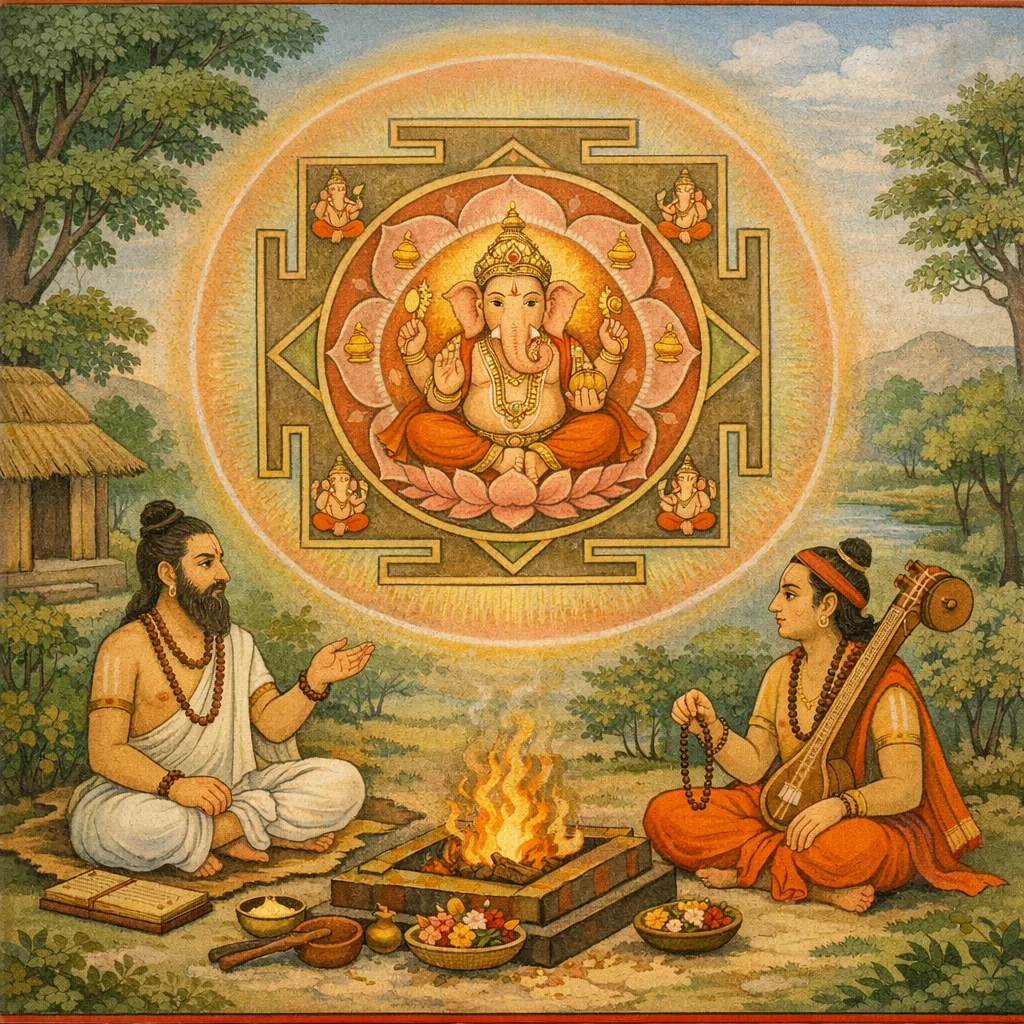
Gaṇeśa Mantra-vidhi: Mahāgaṇapati Gāyatrī, Vakratuṇḍa Mantra, Nyāsa, Homa, Āvaraṇa-pūjā, and Caturthī Vrata
Sanatkumāra teaches Nārada a complete Gaṇeśa sādhana. He begins with Gaṇeśa mantras that grant bhoga and mokṣa, explains a control-oriented mantra construction and a 28-syllable mantra profile (ṛṣi, chandas, devatā), and then details exact nyāsa placements: ṣaḍaṅga-nyāsa, bhuvana-nyāsa across Bhūr/Bhuvar/Svar, and varṇa/pada-nyāsa using traditional numerical codes. The chapter gives the Mahāgaṇapati Gāyatrī (vidmahe/dhīmahi/pracodayāt), dhyāna iconography, japa counts, and homa with eight substances. It describes a yantra/maṇḍala (hexagon–triangle–eight-petalled lotus–bhūpura), pīṭha worship, āvaraṇa deities and śaktis, and the directional placement of Gaṇeśa forms with consorts. It lists practical fruits and specializations by offerings (flowers, samidh, ghee, honey, etc.), adds the monthly Caturthī vow, eclipse worship, and protective rules, and introduces a separate Vakratuṇḍa mantra with its metadata and āvaraṇa scheme. It concludes with initiation prerequisites, prosperity observances, fertility and divination-like rites, injunctions of secrecy, and the assurance of siddhi and liberation through faithful worship.
Shlokas
Verse 1
श्रीसनत्कुमार उवाच । अथ वक्ष्ये गणेशस्य मंत्रान्सर्वेष्टदायकान् । यान्समाराध्य विप्रेंद्र साधको भुक्तिमुक्तिमान् ॥ १ ॥
Śrī Sanatkumāra said: Now I shall declare the mantras of Gaṇeśa, bestowers of every desired aim. O foremost of brāhmaṇas, by duly worshipping them, the sādhaka attains both worldly enjoyment and liberation.
Verse 2
अव्ययो विष्णुवनिता शंभुस्त्री मीनकेतनः । स्मृतिर्मांसेंदुमन्वाढ्या सा पुनश्चंद्रशेखरा ॥ २ ॥
He is the Imperishable (Avyaya); the beloved of Viṣṇu; the consort of Śambhu; the one marked by the fish-banner; the very embodiment of sacred Smṛti, holy remembrance; adorned with flesh and the moon; and again, she is the one crowned with the crescent moon.
Verse 3
ङेतो गणपतिस्तोयं भुजंगो वरदेति च । सर्वांते जनमुञ्चार्य ततो मे वशमानय ॥ ३ ॥
“Use the words ‘ṅeto’, ‘Gaṇapati’, ‘toyaṃ’, ‘bhujaṅga’, and ‘varada’; and at the end of them all, utter the person’s name; then recite, ‘bring (him/her) under my control.’”
Verse 4
वह्निः प्रियांतो मंत्रोऽयष्टाविंशतिवर्णवान् । गणकोऽस्य मुनिश्छंदो गायत्री वियुदादिका ॥ ४ ॥
This mantra begins with the word “Vahni” and ends with “Priyā”; it consists of twenty-eight syllables. Its seer (ṛṣi) is Gaṇaka; its metre (chandas) is Gāyatrī; and its presiding deity begins with Viyut, the lightning principle.
Verse 5
गणेशो देवता बीजं षष्टशक्तिस्तदादिका । श्रीमन्महागणपतिप्रीतये विनियोगकः ॥ ५ ॥
Gaṇeśa is the presiding deity; the seed-syllable (bīja) is declared along with the “sixty-fold power” (ṣaṣṭi-śakti) and its related components. This is the ritual application (viniyoga) meant to please the auspicious Mahāgaṇapati.
Verse 6
ऋषिं शिरसि वक्रे तु छन्दश्च हृदि देवताम् । गुह्ये बीजं पदोः शक्तिं न्यसेत्साधकसत्तमः ॥ ६ ॥
The finest practitioner should perform nyāsa: placing the ṛṣi upon the head; the metre (chandas) at the mouth; the deity in the heart; the seed-syllable (bīja) in the secret region; and the mantra’s power (śakti) upon the feet.
Verse 7
षड्दीर्घाढ्येन बीजेन यं च बीजादिना पुनः । षङंगानि न्यसेदस्य जातियुक्तानि मंत्रवित् ॥ ७ ॥
A knower of mantras should perform nyāsa of the six limbs with the seed‑syllable endowed with six long vowels, and again with the bīja beginning with “yaṃ”; thus he installs the six aṅgas, each joined to its proper jāti (class or intonational form).
Verse 8
शैवी षडंगमुद्राय न्यस्तव्या हि षडंगके । गामाद्यं चैव भूर्लोकं नाभ्यंतं पादयोर्न्यसेत् ॥ ८ ॥
Indeed, the Śaiva “six‑limbed” mudrā is to be placed by nyāsa upon the six parts of the body. And Bhūrloka—beginning with “gām”—should be installed from the navel region down to the feet.
Verse 9
गीमाद्यं च भुवर्लोकं कंठांतं नाभितो न्यसेत् । स्वर्लोकं चैव गूमाद्यं कंठदिमस्तकावधि ॥ ९ ॥
One should place by nyāsa the Bhuvar‑loka, beginning with “gī”, from the navel up to the end of the throat; and likewise the Svar‑loka, beginning with “gū”, from the throat up to the crown of the head.
Verse 10
व्यापकं मूलमन्त्रेण न्यासोऽयं भुवनाभिधः । मूलमंत्रं समुञ्चार्य मातृकावर्णमीरयेत् ॥ १० ॥
This is the all‑pervading (vyāpaka) nyāsa performed with the root‑mantra, known as the “Bhuvana” nyāsa. Having first uttered the root‑mantra, one should then recite the letters of the Mātṛkā, the sacred alphabet.
Verse 11
तदंतेऽपि च मूलं स्यान्नमोंऽतं मातृकास्थले । क्षांतं विन्यस्य मूलेन व्यापकं रचयेत्सुधीः ॥ ११ ॥
At the end of that as well, the root bīja should be placed; and in the seat of the Mātṛkās one should place the ending “namoṃ”. Having installed “kṣāṃ” together with the root, the wise practitioner should then perform the all‑pervading (vyāpaka) arrangement of nyāsa.
Verse 12
वर्णन्या सोऽयमाख्यातः पदन्यासस्तथोच्यते । पञ्चत्रिबाणवह्नींदुचंद्राक्षिनिगमैः क्रमात् ॥ १२ ॥
This is called varṇa-nyāsa, the placement of syllables; it is also termed pada-nyāsa, the placement of words. It should be performed in proper sequence, according to the traditional numerical codes—five, three, arrows, fire, moon, “candra,” eyes, and the Nigamas (Vedic/Āgamic authorities)—in due order.
Verse 13
विभक्तैर्मूलगायत्र्या हृदंतैरष्टभिः पदैः । भालदेशे मुखे कण्ठे हृदि नाभ्यूरुजानुषु ॥ १३ ॥
With the eight divisions (padas) of the root Gāyatrī, each ending in the syllable “hṛt,” one should perform nyāsa by placing them upon the forehead-region, the face, the throat, the heart, the navel, the thighs, and the knees.
Verse 14
पादयोश्चैव विन्यस्य मूलने व्यापकं चरेत् । वदेत्तत्पुरुषायांते विद्महेति पदं ततः ॥ १४ ॥
Having performed nyāsa upon the feet as well, one should then carry out the all-pervading (vyāpaka) placement at the root (mūla). At the end of the Tatpuruṣa mantra, one should then utter the word “vidmahe.”
Verse 15
वक्रतुंडाय शब्दांते धीमहीति समीरयेत् । तन्नो दंतिः प्रचोवर्णा दयादिति वदेत्पुनः ॥ १५ ॥
At the end of the word “vakratuṇḍāya,” one should utter “dhīmahi” (we meditate). Then again one should say, “May that tusked one (Dantī), radiant in hue, impel us,” concluding with “dayāt” (may he bestow compassion).
Verse 16
एषोक्ता मूलगायत्री सर्वसिद्धिप्रदायिनी । एवं न्यासविधिं कृत्वा ध्यायेदेवं हृदंबुजे ॥ १६ ॥
This is the proclaimed root Gāyatrī, bestowing every attainment (siddhi). Having thus performed the rite of nyāsa, one should meditate in this manner upon the lotus of the heart.
Verse 17
उद्यन्मार्तण्डसदृशं लोकस्थित्यंतकारणम् । सशक्तिकं भूषितांगं दंत चक्राद्युदायुधम् ॥ १७ ॥
He is like the rising Sun, the cause of the world’s continuance and its end; accompanied by His Śakti, His limbs adorned, He bears uplifted weapons such as the tusk and the discus (cakra) and others.
Verse 18
एवं ध्यात्वा चतुश्चत्वारिंशत्साहस्रसंयुतम् । चतुर्लक्षं जपेन्मंत्रं अष्टद्रव्यैर्दशांशतः ॥ १८ ॥
Having thus meditated, one should repeat the mantra four hundred thousand times, together with the prescribed count of forty-four thousand; and one should offer the tenth part of that total as oblations in homa, using eight ritual substances.
Verse 19
जुहुयाद्विधिवन्मंत्री संस्कृते हव्यवाहने । इक्षवः सक्तवो मोचाफलानि चिपिटास्तिलाः ॥ १९ ॥
The officiating priest, reciting the mantras, should offer oblations according to rule into the duly prepared sacred fire—such as sugarcane, flour-preparations, bananas, flattened rice, and sesame seeds.
Verse 20
मोदका नारिकेलानि लाजा द्रव्याष्टकं स्मृतम् । पीठमाधारशक्त्यादिपरतत्वांतमर्चयेत् ॥ २० ॥
Modakas (sweet dumplings), coconuts, and parched rice (lājā) are remembered as part of the set of eight ritual substances. One should worship the sacred pīṭha (pedestal), beginning with Ādhāra-Śakti and proceeding up to Paratattva, the Supreme Principle.
Verse 21
षट्कोणांतस्त्रिकोणं च बहिरष्टदलं लिखेत् । भूपुरं तद्बहिः कृत्वा गमेशं तत्र पूजयेत् ॥ २१ ॥
Inside a hexagon, one should draw a triangle; outside it, one should draw an eight-petalled lotus. Then, making a bhūpura (enclosing square) around it, one should worship Gameśa there.
Verse 22
तीव्राख्या ज्वालिनी नंदा भोगदा कामरूपाणी । अग्रा तेजोवती सत्या नवमी विध्ननाशिनी ॥ २२ ॥
She is called Tīvrā; she is the Blazing Flame (Jvālinī); she is Nandā, the giver of joy. She bestows enjoyment (Bhogadā) and assumes forms at will (Kāmarūpāṇī). She is the foremost (Agrā), radiant with spiritual splendor (Tejovatī), Truth itself (Satyā), the Ninth (Navamī), and the destroyer of obstacles (Vidhnanāśinī).
Verse 23
सर्वादिशक्तिकमलासनाय हृदयांतिकः । पीठमंत्रोऽयमेतेन दद्यादासनमुत्तमम् ॥ २३ ॥
This is the pīṭha-mantra: offer the supreme seat to the Lotus-Seated Lord (Kamala-āsana), endowed with all primordial powers, who abides within the heart.
Verse 24
तत्रावाह्य गणाधीशं मध्ये सम्पूज्य यत्नतः । विकोणबाह्ये पूर्वादिचतुर्दिक्ष्वर्चयेत्क्रमात् ॥ २४ ॥
There, having invoked Gaṇeśa—the Lord of the Gaṇas—one should carefully worship him in the center; then, in the outer enclosure, one should worship in due order in the four directions beginning with the east.
Verse 25
श्रियं श्रियः पतिं चैव गौरीं गौरी पतिं तथा । रतिं रतिपतिं पाश्चान्महीपूर्व च पोत्रिणम् ॥ २५ ॥
One should also reverently invoke Śrī (Lakṣmī) and the Lord of Śrī (Viṣṇu), Gaurī and the Lord of Gaurī (Śiva), Rati and the Lord of Rati (Kāma), and likewise the Earth (Mahī) as the primordial support, together with Varāha, the Boar who raised her up.
Verse 26
क्रमादिल्ववटाश्वत्थप्रियगूनामधोऽर्चयेत् । रमा पद्मद्वयकरा शंखचक्रधरो हरिः ॥ २६ ॥
One should worship in due order beneath the ilva, banyan, aśvattha, and priyagu trees. There, Śrī (Ramā) is to be envisioned holding two lotuses, and Hari is to be envisioned bearing the conch (śaṅkha) and discus (cakra).
Verse 27
गौरी पाशांकुशधरा टंकशूलधरो हरः । रतिः पद्मकरा पुष्पबाणचापधरः स्मरः ॥ २७ ॥
Gaurī bears the noose and the goad; Hara bears the battle‑axe and the trident. Rati holds the lotus; Smara (Kāma) bears the flower‑arrows and the bow.
Verse 28
शूकव्रीह्यग्रहस्ता भूः पोत्री चक्रगदाधरः । देवाग्रे पूजयेल्लक्ष्मीसहितं तु विनायकम् ॥ २८ ॥
Bhū (Earth) is to be depicted with hands holding ears of grain and rice; the sacred ritual ladle (potrī) is also to be shown; and the Lord bearing the discus and mace (Viṣṇu) is to be placed. Before the gods, one should worship Vināyaka together with Lakṣmī.
Verse 29
पूजयेत्षट्सु कोणेषु ह्यामोदाद्यान्प्रियायुतान् । आमोदं सिद्धिसंयुक्तमग्रतः परिपूजयेत् ॥ २९ ॥
In the six corners, one should worship the deities beginning with Āmoda, together with their beloved consorts. Then, in front, one should especially worship Āmoda, united with Siddhi.
Verse 30
प्रमोदं चाग्निकोणे तु समृद्धिसहितं यजेत् । ईशकोणे यजेत्कीर्तिसंयुतं सुमुखं तथा ॥ ३० ॥
In the Agni corner (south‑east), one should worship Pramoda together with Samṛddhi. In the Īśāna corner (north‑east), one should likewise worship Sumukha together with Kīrti.
Verse 31
वारुणे मदनावत्या संयुतं दुर्मुखं यजेत् । यजेन्नैर्ऋत्यकोणे तु विघ्नं मदद्रवायुतम् ॥ ३१ ॥
In the Varuṇa quarter, one should worship Durmukha together with Madanāvatī. And in the Nairṛta corner (south‑west), one should worship Vighna along with Madadravā.
Verse 32
द्राविण्या विघ्नकर्तारं वायुकोणे समर्चयेत् । पाशांकुशाभयकरांस्तरुणार्कसमप्रभान् ॥ ३२ ॥
With the (mantra or offering called) Drāviṇī, one should duly worship the Remover of obstacles in the north‑west, the Vāyu corner—radiant like the rising sun, bearing in his hands the noose (pāśa), the goad (aṅkuśa), and the gesture of fearlessness (abhaya).
Verse 33
कपोलविगलद्दानगंधलुब्धा लिशोभितान् । षट्कोणोभयपार्श्वे तु शंखपद्मनिभौ क्रमात् ॥ ३३ ॥
Adorned with bees greedy for the fragrance of the ichor (dāna) streaming from the cheeks; and on the two sides of the hexagon, in due order, one should place forms resembling a conch (śaṅkha) and a lotus (padma).
Verse 34
सहितौ निजशक्तिभ्यां ध्यात्वा पूर्ववदर्चयेत् । केशरेषु षडंगानि पत्रेष्वष्टौ तु मातरः ॥ ३४ ॥
After meditating on the two Deities together, along with their own intrinsic Śaktis, one should worship them as prescribed before. Upon the filaments (keśara) one should install the six auxiliaries (ṣaḍaṅga), and upon the petals one should install the eight Mother‑powers (aṣṭa‑mātṛkāḥ).
Verse 35
इन्द्राद्यानपि वज्ज्रादीन्पूजयेद्धरणीगृहे । एवमाराध्य विघ्नेशं साधयेत्स्वमनोरथान् ॥ ३५ ॥
In the earthen shrine (or sanctified ground‑space), one should worship Indra and the other deities, together with the Vajra and related divine emblems. Thus, having duly propitiated Vighneśa (Gaṇeśa), one accomplishes one’s desired aims.
Verse 36
चतुश्चत्वारिंशताढ्यं चतुः शतमतंद्रितः । तर्पयेदंबुभिः शुद्धैर्गजास्यं दिनशः सुधीः ॥ ३६ ॥
A wise man, ever diligent, should daily satisfy Gajāsya (Gaṇeśa) by offering tarpaṇa with pure water—continuing for forty‑four days and completing four hundred offerings.
Verse 37
पद्मैस्तु वशयेद्भूपांस्तत्पत्नीश्चोत्पलैस्तथा । कुमुदैर्मंत्रिणोऽश्वत्थसमिद्भिर्वाडवाञ्शुभैः ॥ ३७ ॥
By lotus-flowers one brings kings under influence; likewise, by blue lotuses one influences their queens. By white water-lilies (kumuda) one influences ministers; and by auspicious aśvattha (sacred fig) kindling-sticks (samidh) one influences noble women.
Verse 38
उदुंम्बरोत्थैर्नृपतीन्वैश्यान्प्लक्षसमुद्भवैः । वटोद्भवैः समिद्भिश्च वशयेदंतिमान्बुधः ॥ ३८ ॥
Using fuel-sticks (samidh) from the udumbara tree, a wise practitioner may bring kings under control; with those born of the plakṣa tree, the vaiśyas; and with samidh from the vaṭa (banyan) tree, he may subdue those of the lowest rank.
Verse 39
आज्येन श्रियमाप्नोति स्वर्णाप्तिर्मधुना भवेत् । गोदुग्धेन गवां लाभो दध्ना सर्वसमृद्धिमान् ॥ ३९ ॥
By offering clarified butter (ghee) one attains prosperity (Śrī); by offering honey one obtains gold. By offering cow’s milk one gains cattle, and by offering curd (dadhi) one becomes endowed with every kind of abundance.
Verse 40
अन्नाप्तिरन्नहोमेन समिद्भिर्वेतसां जलम् । वासांसि लभते हुत्वा कुसुंभकुसुमैः शुभैः ॥ ४० ॥
By offering a food-oblation in the fire (anna-homa) one gains food; by offering vetasa (willow) twigs as fuel (samidh) one obtains water; and by offering auspicious kusumbha (safflower) blossoms one gains garments.
Verse 41
अथ सर्वेष्टदं वक्ष्ये चतुरावृत्तितर्पणम् । मूलेनादौ चतुर्वारं प्रत्येकं च प्रतर्पयेत् ॥ ४१ ॥
Now I shall explain the fourfold-cycle tarpaṇa that grants all desired results: in the beginning, with the root-mantra (mūla-mantra), one should perform the offering four times, and likewise satisfy each invoked being individually.
Verse 42
पूर्वमंत्राक्षरैर्मंत्रैः स्वाहांतैश्च चतुश्चतुः । मूलमंत्रैश्चतुर्वारपूर्वकं संप्रतर्प्य च ॥ ४२ ॥
Then, using mantras formed from the syllables of the preceding mantra—each ending with “svāhā”—one should offer propitiatory libations four times each; and thereafter, with the root (mūla) mantra, one should again perform the santarpya, preceded by four repetitions.
Verse 43
मिथुनादींस्ततः पश्चात्पूर्ववत्संप्रतर्पयेत् । देवेन सहितां शक्तिं शक्त्या च सहितं तु तम् ॥ ४३ ॥
Thereafter, one should duly perform the santarpya for the divine pairs and the rest, in the same manner as before—worshipping the Śakti together with the Deva, and likewise that Deva together with his Śakti.
Verse 44
एवंच षड्विंशतिधा मिथुनानि भवंति हि । स्वनामाद्यर्णबीजानि तानि सन्तर्पयेत्क्रमात् ॥ ४४ ॥
Thus, indeed, there are pairs in twenty-sixfold form. Beginning with the seed-syllables (bīja) that start with their own names, one should ritually satisfy and nourish them in due order.
Verse 45
भवेत्संभूय सचतुश्चत्वारिंशञ्चतुः शतम् । एवं संतप्य तत्पश्चात्पूर्ववत्सोपचारकैः ॥ ४५ ॥
When combined together, it becomes one hundred and forty-four. Having thus performed the santarpya and duly prepared it, thereafter one should proceed, as before, with the prescribed upacāras—the attendant rites and services.
Verse 46
सर्वाभीष्टं च संप्रार्थ्य प्रणम्योद्वासयेत्सुधीः । भाद्रकृष्णचतुर्थ्यादिप्रतिमासमतंद्रितः ॥ ४६ ॥
Having prayed for the fulfillment of all desired aims and having bowed down, the wise person should formally conclude the worship by performing the udvāsana (ritual dismissal). And beginning from the fourth lunar day of the dark fortnight in Bhādrapada and so on, he should observe it every month without negligence.
Verse 47
आरभ्यार्कोदयं मंत्री यावच्चंद्रोदयो भवेत् । तावन्नोपविशेद्भूमौ जितवाविस्थरमानसः ॥ ४७ ॥
From sunrise until the Moon rises, the mantra-practitioner should not sit upon the bare ground, having subdued the mind’s outward wandering and dispersion.
Verse 48
ततश्चंद्रोदये मन्त्री पूजयेद्गणनायकम् । पूर्वोक्तविधिना सम्यङ्नानापुष्पोपहारकैः ॥ ४८ ॥
Then, at the rise of the Moon, the ritual officiant should duly worship Gaṇanāyaka (Gaṇeśa), following the method stated earlier, with offerings of various flowers and other devotional gifts.
Verse 49
एकविंशतिसंख्याकान्मोदकांश्च निवेदयेत् । तदग्रे प्रजपेन्मन्त्रमष्टोत्तरसहस्रकम् ॥ ४९ ॥
One should offer, as naivedya, twenty-one modakas; then, before that offering, one should recite the mantra one thousand and eight times (1008).
Verse 50
ततः कर्पूरकाश्मीररक्तपुष्पैः सचन्दनैः । अर्ध्यं दद्यात्तु मूलांते ङेते गणपतिं ततः ॥ ५० ॥
Then, with camphor, saffron, red flowers, and sandalwood, one should offer the arghya (respectful water-oblation) at the base; thereafter, having bowed, one should worship Gaṇapati.
Verse 51
इदमर्ध्यं कल्पयामि हृदंतोऽर्ध्यमनुर्मतः । स्तुत्वा नत्वा विसृज्याथ यजेच्चंद्रमसं पुनः ॥ ५१ ॥
“With heartfelt intent, I prepare this arghya, in accordance with what is approved by tradition.” Having praised and bowed, one should then release the arghya and again worship the Moon.
Verse 52
अर्ध्यं दद्याञ्चतुर्वारं पूजयित्वा गुरुं ततः । निवेदितेषु विप्राय दद्यादर्धांश्च मोदकान् ॥ ५२ ॥
After honoring and worshiping the guru, one should offer arghya four times; and once the food-offering (naivedya) has been presented, one should give the brāhmaṇa portions—half-shares—of the sweet modakas.
Verse 53
स्वयमर्द्धान्प्रभुंजीत ब्रह्मचारी जितेंद्रियः । एवं व्रतं यः कुरुते सम्यक्संवत्सरावधि ॥ ५३ ॥
Let him, by his own restraint, eat only half (the usual measure)—living as a brahmacārī and with the senses conquered. Whoever performs this vow in this manner, correctly, for the full period of one year, attains the intended religious fruit.
Verse 54
पुत्रान्पौत्रान्सुखं वित्तमारोग्यं लभते नरः । सूर्योदयादशक्तश्चेदस्तमारभ्य मंत्रवित् ॥ ५४ ॥
A man gains sons and grandsons, happiness, wealth, and good health. And if a knower of mantra is unable (to begin) from sunrise, he should begin from sunset.
Verse 55
चंद्रोदयांतं पूर्वोक्तविधिना व्रतमाचरेत् । एवं कृतेऽपि पूर्वोक्तं फलमाप्नोति निश्चितम् ॥ ५५ ॥
One should observe the vow, following the previously stated procedure, until the rise of the moon. Even when it is performed in this way, one certainly attains the very fruit that was described earlier.
Verse 56
गणिशप्रतिमां दंतिदंतेन कपिनापि वा । गजभग्रेन निंबेन सितार्केंणाथवा पुनः ॥ ५६ ॥
A Gaṇeśa image may be fashioned from an elephant’s tusk, or even by a monkey; or from a piece broken off an elephant; or again from neem-wood, or from a pale, whitish sun-stone.
Verse 57
कृत्वा तस्यां समावाह्य प्राणस्थापनपूर्वकम् । अभ्यर्च्य विधिवन्मन्त्री राहुग्रस्ते निशाकरे ॥ ५७ ॥
Having prepared it, the priest skilled in mantra should invoke the deity into it, first performing the rite of establishing the prāṇa (life-breath); then, when the moon is seized by Rāhu (during an eclipse), he should worship according to the prescribed vidhi.
Verse 58
स्पृष्ट्रा चैव निरहारस्तां शिखायां समुद्वहन् । द्यूते विवादे समरे व्यवहारे जयं लभेत् ॥ ५८ ॥
After touching it and fasting without food, while duly bearing that śikhā (ritual tuft), one gains victory in gambling, in disputes, in battle, and in worldly dealings.
Verse 59
बीजं वराहो बिंद्धाढ्यौ मन्विंद्वान्नौ कलौ ततः । स्मृतिर्मांसेंदुमन्वाग्रा कर्णोच्छिष्टगणे वदेत् ॥ ५९ ॥
In the so-called “ear-remnant” (karnocchiṣṭa) group, one should recite this mnemonic sequence: “seed (bīja); boar (Varāha); Bindha and Āḍhya; Manu, Indu, and food; then, in Kali; Smṛti; flesh; moon; Manu; the foremost (agra).”
Verse 60
बकः सदीर्घपवनो महायक्षाय यं बलिः । बलिमंत्रोऽयमाख्यातो न चेद्वर्णोऽखिलेष्टदः ॥ ६० ॥
“Baka, the long-breathed one”—this is the bali (ritual offering) meant for the Great Yakṣa. This has been declared as the bali-mantra; and if the syllables and their proper phonetic form are not correctly made, it does not bestow the desired results.
Verse 61
प्रणवो भुवनेशानीस्वबीजांते नवार्णकः । हस्तीति च पिशाचीति लिखेञ्चैवाग्रिंसुंदरी ॥ ६१ ॥
The nine-syllabled mantra is formed with the Praṇava “Oṁ” and ends with the bīja of Bhuvaneśānī. One should write it together with the words “hastī” and “piśācī,” and also with “Agriṃ-sundarī.”
Verse 62
नवार्णोऽयं समुद्दिष्टो भजतां सर्वसिद्धिदः । पदैः सर्वेण मंत्रेण पञ्चांगानि प्रकल्पयेत् ॥ ६२ ॥
This nine-syllabled Navārṇa mantra has been duly taught; for devotees it bestows every attainment. Using all the words of the mantra, one should construct its five ritual limbs (pañcāṅgas).
Verse 63
अन्यत्सर्वं समानं स्यात्पूर्वमंत्रेण नारद । अथाभिधास्ये विधिवद्वक्रतुंडमनुत्तमम् ॥ ६३ ॥
O Nārada, everything else should be done in the same manner as with the earlier mantra. Now I shall describe, according to proper rule, the unsurpassed Vakratuṇḍa, the Curved-trunked Lord.
Verse 64
तोयं विधिर्वह्नियुक्तकर्णेंद्वाढ्यो हरिस्तथा । सदीर्घो दारको वायुर्वर्मांतोऽयं रसार्णकः ॥ ६४ ॥
“Toya” (water) is also called “Vidhi” (Brahmā/ordinance). “Vahni” is that which, joined with “karṇa” and “indu,” becomes enriched; “Hari” is likewise so designated. “Vāyu” is the extended (long) form; “Dāraka” is the child. This ends with “varma,” and it is the “ocean of rasa” (essence).
Verse 65
भार्गवोऽस्य मुनिश्छन्दोऽनुष्टुब्देवो गणाधिपः । वक्रतुण्डाभिधो बीजं वं शक्तिः कवचं पुनः ॥ ६५ ॥
For this mantra, Bhārgava is the seer (ṛṣi); the metre is Anuṣṭubh; the presiding deity is Gaṇādhipa (Gaṇeśa). “Vakratunḍa” is declared as its seed-syllable (bīja); “vaṃ” is its power (śakti); and there is also its protective armour (kavaca).
Verse 66
तारदृन्मध्यगैर्मंत्रवर्णैश्चंद्रविभूषितैः । कृत्वा षडंगमन्त्रार्णान्भ्रूमध्ये च गले हृदि ॥ ६६ ॥
Using the mantra-syllables placed in the middle (between the “tāra” and the “dṛt”), and adorned with the lunar (candra) element, one should perform the six-limbed (ṣaḍaṅga) nyāsa of those syllables—placing them at the space between the eyebrows, at the throat, and in the heart.
Verse 67
नामौ लिंगे पदे न्यस्याखिलेन व्यापकं चरेत् । उद्यदर्कद्युतिं हस्तैः पाशांकुशवराभयान् ॥ ६७ ॥
Having placed (performed nyāsa of) the two Names upon the liṅga and upon the feet, one should then practice meditation on the All-pervading Lord. One should contemplate the Deity as radiant like the rising sun, with hands bearing the noose (pāśa), the goad (aṅkuśa), the boon-bestowing gesture, and the gesture of fearlessness (abhaya).
Verse 68
दधतं गजवक्त्रं च रक्तभूषांबरं भजेत् । ध्यात्वैवं प्रजपेत्तर्कलक्षं द्रव्यैर्दशांशतः ॥ ६८ ॥
One should worship the Deity bearing the elephant face, adorned with red ornaments and red garments. Having meditated in this manner, one should perform japa for a hundred thousand recitations, and then offer a tenth part as an oblation (homa) with suitable substances.
Verse 69
अष्टभिर्जुहुयात्पीठे तीव्रादिसहितेऽर्चयेत् । मूर्तिं मूर्तेन संकल्प्य तस्यामावाह्य पूजयेत् ॥ ६९ ॥
One should offer oblations eight times upon the altar-seat (pīṭha) and perform worship together with the rites/mantras beginning with Tīvra. Having mentally formed the Deity’s icon in a concrete form, one should invoke (āvāhana) the Lord into it and then worship.
Verse 70
षट्कोणेषु षडंगानि पत्रेष्वष्टौ तु शक्तयः । यजेद्विद्यां विधात्रीं च भोगदां विप्रघातिनीम् ॥ ७० ॥
In the six triangles one should place the six auxiliaries (ṣaḍaṅga), and upon the lotus-petals the eight powers (śakti). One should worship Vidyā—also called Vidhātrī—who bestows sacred enjoyments and strikes down hostile forces.
Verse 71
निधिप्रदीपां पापघ्नीं पुण्यां पश्चाच्छशिप्रभाम् । दलाग्रेषु वक्रतुंड एकदंष्ट्रमहोदरौ ॥ ७१ ॥
Then one should place/meditate upon Nidhipradīpā, the destroyer of sins and bestower of merit; after that, Śaśiprabhā, radiant like the moon. Upon the tips of the petals one should visualize Vakratuṇḍa (Curved-trunked), Ekadaṃṣṭra (Single-tusked), and Mahodara (Pot-bellied).
Verse 72
गजास्यलंबोदरकौ विकटौ विध्नराट् तथा । धूम्रवर्णस्ततो बाह्ये लोकेशान्हेतिसंयुतान् ॥ ७२ ॥
He is known as Elephant-faced (Gajāsya), Pot-bellied (Lambodara), the Formidable (Vikaṭa), and the Sovereign over obstacles (Vidhnarāṭ). Then, in the outer realm, he is the Smoke-hued one (Dhūmravarṇa), joined with the world-guardians (Lokapālas) and their weapons.
Verse 73
एवमावरणैरिष्ट्वा पञ्चभिर्गणनायकम् । साधंयेदखिलान्कामान्वक्रतुंड प्रंसादतः ॥ ७३ ॥
Thus, having worshipped Gaṇanāyaka (Gaṇeśa) with the five protective āvaraṇas, one accomplishes all desired aims by the grace of the Curved-trunked Lord (Vakratūṇḍa).
Verse 74
लब्ध्वा गुरुमुखान्मंत्रं दीक्षासंस्कारपूर्वकम् । ब्रह्मचारी हविष्याशी सत्यवाक् च जितेंद्रियः ॥ ७४ ॥
Having received the mantra from the guru’s mouth, preceded by initiation (dīkṣā) and consecratory purifications, one should live as a brahmacārin—subsisting on havis (sanctified oblation-food), speaking truth, and keeping the senses conquered.
Verse 75
जपेदर्कसहस्रं तु षण्मासं होमसंयुतम् । दारिद्य्रं तु पराभूय जायते धनदोपमः ॥ ७५ ॥
If one recites the Arka-sahasra (the “thousand” names/mantra-set of Arka, the Sun) for six months, together with homa (fire-oblations), then overcoming poverty one becomes comparable to Kubera, lord of wealth.
Verse 76
चतुर्थ्यादि चतुर्थ्यंतं जपेदयुतमादरात् । अष्टोत्तरशतं नित्यं हुत्वा प्राग्वत्फलं लभेत् ॥ ७६ ॥
Beginning on the fourth lunar day and continuing until the next fourth day, one should reverently perform ten thousand repetitions (japa). And, offering one hundred and eight oblations daily, one obtains the same result as described earlier.
Verse 77
पक्षयोरुभयोर्मंत्री चतुर्थ्यां जुहुयाच्छतम् । अपूपैर्वत्सरे स स्यात्समृद्धेः परमं पदम् ॥ ७७ ॥
In both fortnights (waxing and waning), the mantra-practitioner should offer a hundred oblations on the Caturthī day, using apūpa cakes; within a year he attains the supreme station of prosperity and abundance.
Verse 78
अङ्गारकचतुर्थ्यां तु देवमिष्ट्वा विधानतः । हविषा पा यसान्नेन नैवेद्यं परिकल्पयेत् ॥ ७८ ॥
On Aṅgāraka Caturthī, having worshipped the deity according to the prescribed rite, one should prepare naivedya—a food-offering—made of havis and pāyasa (sweet rice).
Verse 79
ततो गुरुं समभ्यंर्त्य भोजयेद्विधिवत्सुधीः । निवेदितेन जुहुयात्सहरस्रं विधिवद्वसौ ॥ ७९ ॥
Then, having respectfully approached the guru, the wise person should feed him according to proper rule; and with the offering duly presented, he should perform a thousand oblations into the fire, in the prescribed manner.
Verse 80
एवं संवत्सरं कृत्वा महतीं श्रियमाप्नुयात् । अथान्यत्साधनं वक्ष्ये लोकानां हितकाम्यया ॥ ८० ॥
Having practiced thus for a full year, one may attain great prosperity. Now, desiring the welfare of all people, I shall explain another spiritual means (practice).
Verse 81
इष्ट्वा गणेशं पृथुकैः पायसापूपमोदकः । नानाफलैस्ततोमंत्री हरिद्रामथ सैन्धवम् ॥ ८१ ॥
After worshipping Gaṇeśa with pṛthuka (flattened rice), pāyasa, apūpa cakes, and sweet modakas, and with various fruits, the mantra-knowing priest then offers/uses turmeric and rock-salt (saindhava).
Verse 82
वचां निष्कार्द्धभागं च तदर्द्धं वा मनुं जपेत् । विशोध्य चूर्णं प्रसृतौ गवां मूत्रे विनिक्षिपेत् ॥ ८२ ॥
One should take vacā (sweet flag) in the measure of half a niṣka, or half of that, and recite the mantra; then, having purified it and ground it into a fine powder, one should place two prasṛti-measures of that powder into cow’s urine.
Verse 83
सहस्रकृत्वो मनुना मंत्रयित्वा प्रयत्नतः । स्नातामृतुदिने शुद्धां शुक्लांबरधरां शुभाम् ॥ ८३ ॥
After carefully consecrating her with the prescribed mantra a thousand times, one should prepare the auspicious lady—bathed on the appointed day, purified, and clad in white garments.
Verse 84
देवस्य पुरतः स्थाप्य पाययेदौषधं सुधीः । सर्वलक्षणसंपन्नं वंध्यापि लभते सुतम् ॥ ८४ ॥
Placing her before the deity, the wise person should have her drink the medicinal preparation; even a barren woman then obtains a son endowed with all auspicious marks.
Verse 85
अथान्यत्संप्रवक्ष्यामि रहस्यं परमाद्भुतम् । गोचर्ममात्रां धरणीमुपलिप्य प्रयत्नतः ॥ ८५ ॥
Now I shall explain another secret, supremely wondrous: with careful effort, one should plaster and prepare a piece of ground no larger than a cowhide.
Verse 86
विकीर्य धान्यप्रकरैस्तत्र संस्थापयेद्धटम् । शुद्धोदकेन संपूर्य तस्योपरि निधापयेत् ॥ ८६ ॥
After scattering heaps of grains there, one should place a pot; filling it with pure water, one should then set the prescribed item upon it.
Verse 87
कपिलाज्येन संपूर्णं शरावं नूतनं शुभम् । षडष्टाक्षरमंत्राभ्यां दीपमारोपयेच्छुभम् ॥ ८७ ॥
With a new and auspicious dish (śarāva) filled completely with ghee (kapilājyā), one should auspiciously install a lamp while reciting the six-syllabled and the eight-syllabled mantras.
Verse 88
दीपे देवं समावाह्य गंधपुष्पादिभिर्यजेत् । स्नातां कुमारीमथवा कुमारं पूजयेत्सुधीः ॥ ८८ ॥
Having invoked the deity into the lamp, one should worship with sandal paste, flowers, and the like. Then the wise should honor a bathed maiden—or a young boy—by offering reverence.
Verse 89
दीपस्य पुरतः स्थाप्यध्यात्वा देवं जपेन्मनुम् । प्रदीपे स्थापिते पश्येद्द्विजरूपं गणेश्वरम् ॥ ८९ ॥
Placing (the sacred offering) before the lamp, one should meditate upon the deity and repeat the mantra. When the lamp has been set, one should behold Gaṇeśvara in the form of a twice-born (brāhmaṇa).
Verse 90
पृष्टस्ततः संपदि वा नष्टं चैवाप्यनागतम् । सकलं प्रवदेदेवं कुमारी वा कुमारकः ॥ ९० ॥
Then, when questioned about prosperity, about what has been lost, or even about what is yet to come, a maiden or a young boy should speak it all in this manner, giving the full account.
Verse 91
षडक्षरो हृदंतश्चेद्भवेदष्टाक्षरो मनुः । अन्येऽपि मंत्रा देवर्षे सन्ति तंत्रे गणेशितुः ॥ ९१ ॥
If the six-syllabled mantra is concluded with the seed ‘hṛd’, it becomes an eight-syllabled mantra. And, O divine sage, there are also other mantras in the tantra of Gaṇeśa.
Verse 92
किंत्वत्र यन्न साध्यं स्यात्र्रिषु लोकेषु साधकैः । अष्टविंशरसार्णाभ्यां तन्न पश्येदपि क्वचित् ॥ ९२ ॥
But here, what goal would be unattainable for accomplished sādhakas in the three worlds? Indeed, by these twenty-eight mantra-elements called “rasa” and “arṇa,” one would find nowhere anything that cannot be attained.
Verse 93
एतद्गणेशमंत्राणां विधानं ते मयोदितम् । शठेभ्यः परशिष्येभ्यो वंचकेभ्योऽपि मा वद ॥ ९३ ॥
Thus have I declared to you the vidhāna, the prescribed procedure for the Gaṇeśa mantras. Do not disclose it to the deceitful, to those who are disciples of others, or even to impostors.
Verse 94
एवं यो भजते देवं गणेशंसर्वसिद्धिदम् । प्राप्येह सकलान्भोगनिंते मुक्तिपदं व्रजेत् ॥ ९४ ॥
Thus, whoever worships the deity Gaṇeśa, the giver of every siddhi, gains all enjoyments here in this world and, in the end, proceeds to the state of mukti, liberation.
Frequently Asked Questions
Nyāsa is presented as the ritual “installation protocol” that aligns mantra, body, and cosmos: ṣaḍaṅga nyāsa stabilizes the mantra’s limbs, bhuvana-nyāsa maps Bhūr–Bhuvar–Svar onto the practitioner, and varṇa/pada-nyāsa installs phonemic and semantic power (mātṛkā) so that japa and homa operate as an integrated consecration rather than mere recitation.
It specifies a center-and-enclosure logic: a geometrically defined yantra (hexagon/triangle/lotus/bhūpura), pīṭha worship from Ādhāra-Śakti to Paratattva, directional placements, corner deities with consorts, mātṛkā and ṣaḍaṅga installations on petals/filaments, and lokapāla associations—hallmarks of layered protective “coverings” (āvaraṇas).
It openly promises siddhis (prosperity, influence, victory, fertility, protection) through calibrated offerings and vows, while framing Gaṇeśa-mantra worship as also yielding liberation when performed with proper initiation, restraint (brahmacarya), truthfulness, and disciplined observance—thus placing pragmatic results within a soteriological horizon.