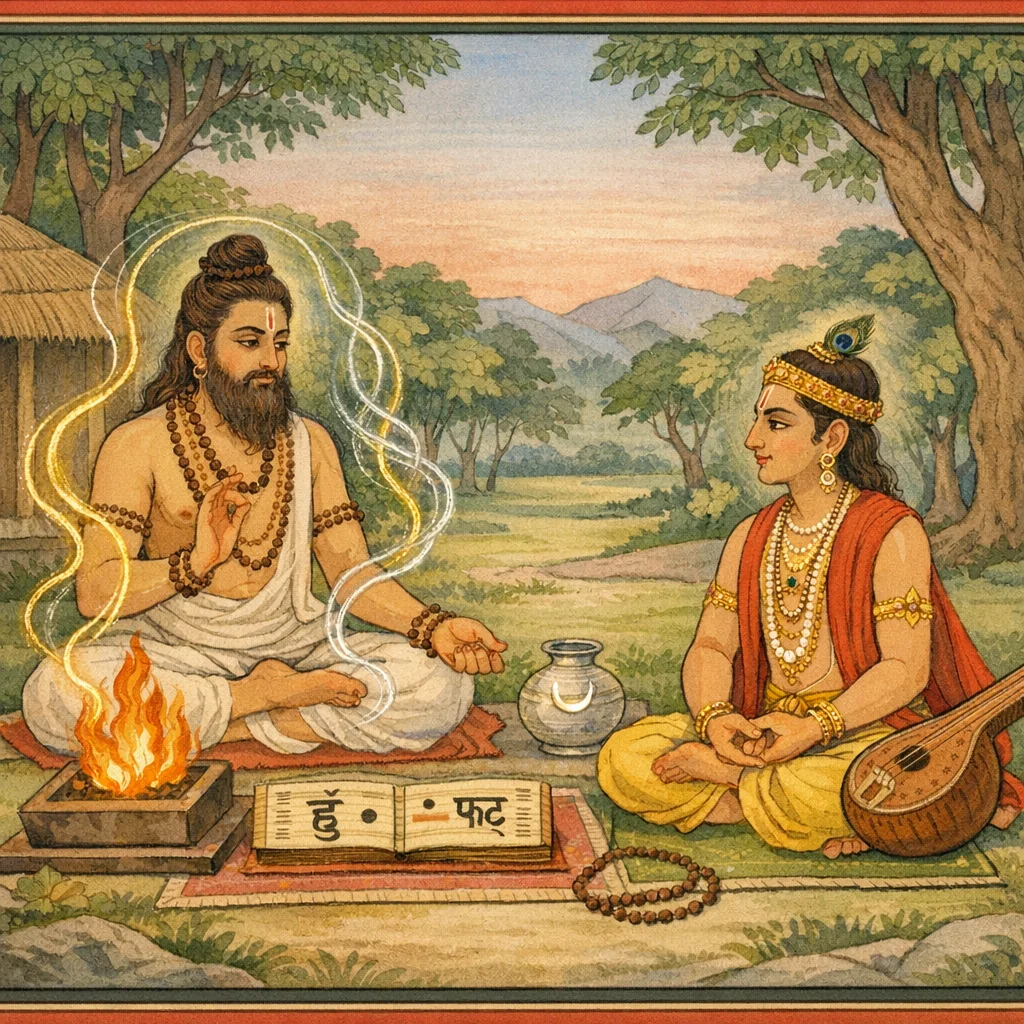
Dīkṣā, Mantra-Types, Mantra-Doṣas, and Qualifications of Ācārya–Śiṣya
Sanatkumāra instructs Nārada that dīkṣā is the initiatory rite that destroys sin, bestows a divine inner orientation, and empowers mantra. “Mantra” is explained through manana (reflective contemplation) and trāṇa (protection). Mantras are classified by linguistic markers (feminine/masculine/neuter endings; namo-anta; mantra versus vidyā with male or female presiding powers) and by ritual-energetic streams (āgneya and saumya), correlated with prāṇa’s movement in piṅgalā and the left channel. Rules for sequencing and combining mantras, conditions for japa, and the strengthening of rites through huṃ/phaṭ are taught. The chapter’s core is an extensive catalogue of mantra-doṣas—structural, phonetic, and syllable-count defects—such as chinna, dagdha, bhīta, aśuddha, nirbīja, and sthāna-bhraṣṭa, which obstruct siddhi and may even harm the practitioner. Rectification is directed to disciplined japa in yoni-mudrā/āsana and to the strict ethical, ritual, and pedagogical qualifications of the ācārya and the ideal disciple.
Shlokas
Verse 1
सनत्कुमार उवाच । अथ जीवस्य पाशौघच्छेदनायेष्टसिद्धिदम् । दीक्षाविधिं प्रवक्ष्यामि मन्त्रसामर्थ्यदायकम् ॥ १ ॥
Sanatkumāra said: Now, to cut asunder the multitude of bonds that bind the jīva and to grant the fulfillment of desired aims, I shall explain the rite of dīkṣā, which bestows potency and efficacy upon mantras.
Verse 2
दिव्यं भावं यतो दद्यात्क्षिणुयाद्दुरितानि च । अतो दीक्षेति सा प्रोक्ता सर्वागमविशारदैः ॥ २ ॥
Because it bestows a divine inner disposition and also destroys sins, it is therefore called “dīkṣā,” as declared by those well-versed in all the Āgamas.
Verse 3
मननं सर्ववेदित्वं त्राणं संखार्यनुग्रहः । मननात्त्राणधर्मत्त्वान्मंत्र इत्यभिधीयते ॥ ३ ॥
Because it is to be reflected upon (manana) and because it possesses the nature of protection (trāṇa), it is called a “mantra”: through contemplation it grants comprehensive knowledge of the Vedas, and through its protective power it bestows grace upon the practitioner.
Verse 4
स्त्रीपुंनपुंसकात्मानस्ते मंत्रास्तु त्रिधा मताः । स्त्रीमंत्रास्तु द्विठांताः स्युः पुंमंत्रा हुंफडंतकाः ॥ ४ ॥
Mantras are considered of three kinds according to their nature—feminine, masculine, and neuter. Feminine mantras are said to end with the two ṭha-s, while masculine mantras end with “huṃ” and “phaḍ.”
Verse 5
क्लीबाश्चैव नमोंऽताः स्युर्मंन्त्राणां जातयः स्मृताः । पुंदैवतास्तु मन्त्रा स्युर्विद्याः स्त्रीदैवता मताः ॥ ५ ॥
Mantras are traditionally said to have distinct “classes” (jātis): some are neuter (klība), and some are those that end with the formula of obeisance (namo-anta). Mantras are regarded as having male deities as their presiding divinities, whereas the vidyās (esoteric formulae) are held to have female deities as their presiding powers.
Verse 6
षट् क्रमसु प्रशस्तास्ते मनवस्त्रिविधाः पुनः । तारांत्यरेफः स्वाहास्तु तत्राग्नेयाः समीरिताः ॥ ६ ॥
Among the six ritual sequences (kramas), those Mantra/Manu-formulas are praised; again, they are said to be of three kinds. In that context, the Agneya (fire-related) ones are declared as: “tārā”, “antya”, “repha”, and “svāhā”.
Verse 7
सौम्यास्तु भृगुपीयूषबीजढ्याः कथिता मुने । अग्नीषोमात्मका ह्येवं मंत्रा ज्ञेया मनीषिभिः ॥ ७ ॥
O sage, the Saumya mantras are declared to abound in Bhṛgu’s seed-syllables and in the essence of ambrosia; therefore the wise should know these mantras to be of the combined nature of Agni and Soma.
Verse 8
बोधमायांति चाग्नेयाः श्वसने पिंगलाश्रिते । सौम्याश्चैव प्रबुध्यंते वामे वहति मारुतेः ॥ ८ ॥
When the breath moves through the Piṅgalā nāḍī, the fiery (āgneya) currents awaken; and when prāṇa flows on the left, the gentle, lunar (saumya) currents are roused.
Verse 9
सर्वे मंत्राः प्रबुध्यंते वायौ नाडिद्वयाश्रिते । स्वापकाले तु मन्त्रस्य जपोऽनर्थफलप्रदः ॥ ९ ॥
All mantras become fully effective when prāṇa is established in the two nāḍīs; but repeating a mantra during sleep yields a fruit that is harmful or meaningless.
Verse 10
प्रत्येकं मन्त्रमुञ्चार्य नाव्यानां तान्समुञ्चरेत् । अनुलोमे बिंदुयुक्तान्विलोमे सर्गसंयुतान् ॥ १० ॥
Having pronounced each mantra individually, one should then recite them in combination: in the forward order with bindu/anusvāra, and in the reverse order with visarga (sarga).
Verse 11
जप्तो यदि स वै देवं प्रबुद्धः क्षिप्रसिद्धिदः । अनया मालया जप्तो दुष्टमन्त्रोऽपि सिद्ध्यति ॥ ११ ॥
If that deity is invoked by japa, the mantra—fully awakened in power—swiftly grants accomplishment; and when recited with this mālā, even a defective mantra attains siddhi.
Verse 12
क्रूरे कर्माणि चाग्नेयाः सौम्याः सौम्य फलप्रदाः । शांतज्ञानेतिरौद्रेयशांतिजाति समन्वितः ॥ १२ ॥
Fierce and cruel rites belong to the Agni-type, while gentle rites bestow gentle fruits. This classification is also spoken of as “Śānta” (pacific) and “Jñāna” (knowledge), and it is further linked with the Raudra (wrathful) and Śānti (appeasing) kinds of ritual.
Verse 13
शांतोऽपि रौद्रतामेति हुंफट्पल्लवयोजनात् । छिन्नादिदोषयुक्तास्ते नैव रक्षंति साधकम् ॥ १३ ॥
Even a “Śānti” rite turns Raudra when the syllables “huṃ” and “phaṭ” are appended; and mantras tainted by faults such as truncation do not protect the sādhaka at all.
Verse 14
छिन्नो रुद्धः शक्तिहीनस्ततश्चैव पराङ्मुखः । कर्महीनो नेत्रहीनः कीलितः स्तंभितस्तथा ॥ १४ ॥
He becomes cut off, obstructed, and bereft of power; then he turns away. Deprived of the capacity to act and deprived of sight, he is pinned down and likewise rendered motionless.
Verse 15
दग्धः स्रस्तश्च भीतश्च मलिनश्च तिरस्कृतः । भेदितश्च सुषुप्तश्च मदोन्मत्तश्च मूर्च्छितः ॥ १५ ॥
“Scorched, enfeebled, frightened, defiled, dishonored, wounded, asleep, intoxicated into frenzy, and fainted”—these are the conditions that are stated.
Verse 16
हतवीर्यो भ्रांतसंज्ञः प्रध्वस्तो बालकस्तथा । कुमारोऽथ युवा प्रौढो वृद्धो निस्त्रिंशकस्तथा ॥ १६ ॥
He is described as bereft of vigor, with awareness confused, and brought to ruin; then as a child; then as a youth; then as mature; then as aged; and likewise as one “unsheathed”—exposed and stripped of covering.
Verse 17
निर्बीजः सिद्विहीनश्च मंदः कूटो निरंशकः । सत्त्वहीनः केकरश्च बीजहीनश्च धूमितः ॥ १७ ॥
(Such a specimen) is without seed, bereft of proper accomplishment, dull, crooked, lacking due parts, devoid of vitality (sattva), misshapen; again seedless, and smoke-stained, darkened.
Verse 18
आलिंगितो मोहितश्च क्षुधार्तश्चातिदीप्तकः । अंगहीनोऽतिक्रुद्धश्चातिक्रूरो व्रीडितस्तथा ॥ १८ ॥
One may be found tightly embraced (or held fast), deluded, tormented by hunger, excessively inflamed or overexcited; likewise, one may be maimed, exceedingly enraged, extremely cruel, or overcome with shame.
Verse 19
प्रशांतमानसः स्थानभ्रष्टश्च विकलस्तथा । अतिवृद्धोऽतिनिःस्नेहः पीडितश्च तथा पुनः ॥ १९ ॥
One whose mind has grown subdued to dullness, one fallen from his proper station, one infirm; one exceedingly aged, one overly lacking in affection and warmth, and again one who is afflicted—such persons are described as being in these debilitated conditions.
Verse 20
दोषा ह्येते समाख्याता वक्ष्याम्येषां च लक्षणम् । संयुक्तं वा वियुक्तं वा त्रिधा वा स्वरसंयुतम् ॥ २० ॥
These faults have indeed been enumerated; now I shall explain their distinguishing marks—whether they arise in conjunction, in separation, or in a threefold manner connected with the tonal accents (svara).
Verse 21
मनोर्यस्यादिमध्यांते वह्निबीजं तथोच्यते । चतुर्द्धा पञ्चधा वापि स मन्त्रश्छिन्नसंज्ञकः ॥ २१ ॥
A mantra in which the Fire seed-syllable (vahni-bīja) is placed at the beginning, in the middle, and at the end of the prescribed formula, and which is then divided into four parts or even five, is known as a “chinna” (split/segmented) mantra.
Verse 22
मनोर्यस्यादिमध्यांते भूबीजद्वयमुच्यते । स तु रुद्धो मनुज्ञेयो ह्यतिक्लेशेन सिद्धिदः ॥ २२ ॥
That mantra in which the two seed-syllables “bhū” are said to stand at the beginning, the middle, and the end—when it is guarded and restrained—is to be known as “manu”; it bestows accomplishment, though only through intense effort.
Verse 23
तारवर्मत्रया लक्ष्मीरेवं हीनस्तु यो मनुः । शक्तिहीनः स विज्ञेयश्चिरकालफलप्रदः ॥ २३ ॥
Thus, the manu that is lacking the threefold protective covering is to be known as bereft of power; it does not bring the presence of Lakṣmī, and its fruits are obtained only after a long time.
Verse 24
कामबीजं मुखे मायाह्यंते चैवाङ्कुशं तथा । असौ पराङ्मुखो ज्ञेयो भजतां चिरसिद्धिदः ॥ २४ ॥
Place the Kāma-bīja at the mouth (the opening); at the end add the Māyā-bīja and also the “aṅkuśa”. Know this mantra-form to be “parāṅmukha” (turned outward); for those who worship it, it bestows accomplishments that endure for a long time.
Verse 25
आदिमध्यावसानेषु सकारो दृश्यते यदि । स मन्त्रो बधिरः प्रोक्तः कष्टेनाल्पफलप्रदः ॥ २५ ॥
If the syllable “sa” is found at the beginning, in the middle, or at the end of a mantra, that mantra is declared “deaf”; it yields only a small result, and that too with difficulty.
Verse 26
पञ्चार्णो यदि रेफर्कबिंदुवर्जितविग्रहः । नेत्रहीनस्तु विज्ञेयः क्लेशेनापि न सिद्धिदः ॥ २६ ॥
If the five-syllabled mantra-form is rendered without the letter repha (r), without arka (ra), and without the bindu (nasal dot), it should be understood as “eyeless”; even with great effort it does not grant success.
Verse 27
आदिमध्यावसानेषु हंसः प्रासादवाग्भवौ । हंसेंदुर्वा सकारो वा फकारो वर्म वा पुन ॥ २७ ॥
At the beginning, in the middle, and at the end of the prescribed formula, one may place the bīja “haṃsa”; or one may employ “prāsāda” and “vāgbhava”. Alternatively, one may use “haṃsa–indu”, or the syllable “sa”, or the syllable “pha”, or again the protective bīja called “varma”.
Verse 28
माप्रा नमामि च पदं नास्ति यस्मिन्स कीलितः । एवं मध्ये द्वयं मूर्ध्नि यस्मिन्नस्त्रलकारकौ ॥ २८ ॥
In the word “māprā”, and likewise in “namāmi”, there is no letter that is ‘nailed down’ (i.e., marked as immovable). Thus, in the middle there are two, and at the head are those letters that function as technical markers (lakāra).
Verse 29
न विद्येते स मंत्रस्तु स्तंभितः सिद्धिरोधकृत् । अग्निः पवनसंयुक्तो मनोर्यस्य तु मूर्द्धनि ॥ २९ ॥
That mantra does not truly ‘exist’—that is, it does not function; it becomes obstructed and brings about the blockage of siddhis (spiritual attainments). For one in whose head the fire (inner heat) is joined with the wind (breath), the mind is thereby disturbed and hindered.
Verse 30
स सार्णो दृश्यते यस्तु स मंत्रो दग्धसंज्ञकः । अस्रं द्वाभ्यां त्रिभिः षड्भिरष्टाभिर्दृश्यतेऽक्षरेः ॥ ३० ॥
A mantra in which a “sārṇa” (a nasal/visarga-like appended phonetic mark) is observed is called a “dagdha” (burnt, defective) mantra. A mantric figure or configuration termed “asra” is seen when it is formed by two, three, six, or eight syllables (akṣaras).
Verse 31
त्रस्तः स मंत्रो विज्ञेयो मुखे तारविवर्जितः । हकारः शक्तिरथवा भीतो मंत्रः स एव हि ॥ ३१ ॥
A mantra is to be understood as “frightened” when, in recitation, it is deprived of the tāra—the praṇava “Oṃ”. Then the syllable “ha” is its śakti; indeed, that very mantra is called “afraid” when uttered without its tāra.
Verse 32
मनोर्यस्यादिमध्यांते स्यान्मकारचतुष्टयम् । मलिनस्तु स विज्ञेयो ह्यतिक्लेशेन सिद्धिदः ॥ ३२ ॥
A mantra in which the syllable “ma” occurs four times—at the beginning, in the middle, and at the end—should be known as “impure”; it grants success only through excessive hardship.
Verse 33
दार्णो यस्य मनोर्मध्ये मूर्ध्नि क्रोधयुगं तथा । अस्त्रं चास्ति स मंत्रस्तु तिरस्कृत उदीरितः ॥ ३३ ॥
A mantra that has the syllable “dārṇa” in the middle, bears the pair of “krodha” syllables at its head, and also includes the “astra” formula is declared to be a “tiraskṛta”—a repelling, warding mantra.
Verse 34
म्योद्वयं हृदयं शीर्षे वषड्वौषट्कमध्यमः । यस्य स्याद्भेदितो मंत्रस्त्याज्यः क्लिष्टफलप्रदः ॥ ३४ ॥
If a mantra places the two syllables “myo” at the end, sets the “hṛdaya” (heart-seed) at the head, and inserts the vaṣaṭ/vauṣaṭ formula in the middle, then that mantra—broken and wrongly arranged—should be rejected, for it yields only troubled and difficult results.
Verse 35
त्र्यक्षरो हंसहीनो यः सुषुप्तः कीर्तितस्तु सः । विद्या वाप्यथवा मंत्रो भवेत्सप्तदशाक्षरः ॥ ३५ ॥
That which is three-syllabled and devoid of the (mystic) “haṃsa” is declared to be the state of deep sleep (suṣupti). But a true vidyā or mantra is said to consist of seventeen syllables.
Verse 36
षट्कारपंचकादिर्यो मदोन्मत्तस्तु स स्मृतः । यस्य मध्ये स्थितं चास्रं स मंत्रो मूर्च्छितः स्मृतः ॥ ३६ ॥
A mantra that begins with a cluster of the “ṣaṭkāra” and “pañcaka” sounds is remembered as “madonmatta”—as if intoxicated and unsteady. And a mantra that places a harsh, cutting sound (asra) in its middle is known as “mūrcchita”—as though fainted, its power eclipsed.
Verse 37
विरामस्थानगं चास्रं हतवीर्यः स उच्यते । मंत्रस्यादौ च मध्ये च मूर्ध्नि चास्रचतुष्टयम् ॥ ३७ ॥
A mantra-syllable that falls upon a place of pause is said to have its potency diminished. In a mantra there are four such ‘asra’ points: at the beginning, in the middle, at the end, and at the head—the crest, the principal part.
Verse 38
ज्ञातव्यो भ्रांत इत्येष यः स्यादष्टा दशाक्षरः । पुनर्विशतिवर्णो वा यो मंत्रः स्मरसंयुतः ॥ ३८ ॥
Know this as a ‘bhrānta’—a confused, errant mantra: one of eighteen syllables, or again one of twenty letters, when it is conjoined with words pertaining to Smara (Kāma, erotic passion).
Verse 39
हृल्लेखाकुंशबीजाढ्यः प्रध्वस्तः स कथ्यते । सप्तार्णो बालमंत्रस्तु कुमारो वसुवर्णवान् ॥ ३९ ॥
That mantra which is furnished with the seed-syllables “hṛl”, “lekhā”, and “kuṃśa” is called the ‘Pradhvasta’. The seven-syllabled ‘Bāla-mantra’ is named the ‘Kumāra’, and it is endowed with eight varṇas (phonemic units).
Verse 40
षोडशार्णो युवा प्रौढश्चत्वारिंशतिवर्णकः । त्रिंशद्वर्णश्चतुःषष्टिवर्णश्चापि शताक्षरः ॥ ४० ॥
A mantra of sixteen syllables is called “youthful”; one of forty syllables is “mature.” Likewise, there are mantras of thirty syllables, of sixty-four syllables, and also those consisting of a hundred syllables.
Verse 41
चतुःशताक्षरो मंत्रो वृद्ध इत्यभिधीयते । नवार्णस्तारसंयुक्तो मंत्रो निस्त्रिंश उच्यते ॥ ४१ ॥
A mantra consisting of four hundred syllables is called a “vṛddha” (expanded) mantra. And a nine-syllabled mantra, when joined with the Tārā—the syllable “oṃ”—is called a “nistriṃśa” mantra.
Verse 42
यस्यांते हृदयं प्रोक्तं शिरोमंत्रोऽथ मध्यगः । शिखा वर्म च यस्यांते नेत्रमस्रं च दृश्यते ॥ ४२ ॥
In that mantra’s nyāsa sequence, the Heart-mantra (Hṛdaya) is prescribed at the end, while the Head-mantra (Śiro) is placed in the middle. At the close are also the Topknot (Śikhā) and Armor (Varma) mantras, and likewise the Eye (Netra) and Weapon (Astra) mantras are to be applied.
Verse 43
शिव शक्त्यार्णहीनो वा निर्बीजः स मनुः स्मृतः । आद्यंतमध्ये फट्कारः षोढा यस्मिन्प्रदृश्यते ॥ ४३ ॥
A mantra lacking the syllables of Śiva and Śakti is remembered as “nirbīja,” without seed. It is that mantra in which the utterance “phaṭ” is seen in sixfold form—at the beginning, at the end, and in the middle.
Verse 44
स मनुः सिद्धिहीनः स्यान्मंदः पंक्त्यक्षरो मनुः । कूट एकाक्षरो मंत्रः स एवोक्तो निरंशकः ॥ ४४ ॥
A manu (mantra) devoid of siddhi is deemed weak. A mantra made of a continuous line of syllables is called a manu; but a kūṭa is a one-syllabled mantra—this alone is said to be niraṃśaka, “without parts.”
Verse 45
द्विवर्णः सत्त्वहीनः स्यात्केकरश्चतुरक्षरः । षड्वर्णो बीजहीनो वा सार्द्धसप्ताक्षरोऽपि वा ॥ ४५ ॥
A two-syllabled mantra is said to be without efficacy, and a four-syllabled one that is “kekara” is likewise faulty. So too, a six-syllabled mantra lacking its bīja, or even one of seven and a half syllables, is regarded as defective.
Verse 46
सार्द्धद्वादशवर्णो वा धूमितो र्निदितस्तु सः । सार्द्धबीजत्रययुतो मंत्रो विंशतिवर्णवान् ॥ ४६ ॥
That mantra, if it consists of twelve and a half syllables, is called “Dhūmita” and is censured. But when it is furnished with three and a half bījas, the mantra becomes one of twenty syllables.
Verse 47
त्रिंशद्वर्णश्चैकविंशद्वर्णश्चार्लिंगितस्तु सः । यो मंत्रो दंतवर्णस्तु मोहितः स तु कीर्तितः ॥ ४७ ॥
That mantra which bears the mark of thirty syllabic sounds, and likewise of twenty‑one, and is distinguished by the dental class of letters—this is proclaimed to be the “Mohita” (deluding) mantra.
Verse 48
चतुर्विशतिवर्णो वा सप्तविंशतिवर्णवान् । क्षुधार्तः स तु विज्ञेयो मंत्रसिद्धिविवर्जितः ॥ ४८ ॥
Whether a mantra consists of twenty‑four syllables or of twenty‑seven—if the practitioner is afflicted by hunger, he is to be understood as bereft of mantra‑accomplishment (mantra‑siddhi).
Verse 49
एकादशाक्षरो वापि पंचविंशतिवर्णकः । त्रयोर्विंशतिवर्णो वा स मनुर्दृप्तसंज्ञकः ॥ ४९ ॥
A mantra may have eleven syllables, or consist of twenty‑five letters, or even twenty‑three letters; such a mantra is known by the designation “Dṛpta.”
Verse 50
षड्विंशत्यक्षरो वापि षट्त्रिंशद्वर्णंकोऽपि वा । एकोन त्रिंशदर्णो वा मंत्रो हीनांगकः स्मृतः ॥ ५० ॥
A mantra consisting of twenty‑six syllables, or even one having thirty‑six letters, or one having twenty‑nine letters, is remembered as a “hīnāṅgaka” mantra—defective in its limbs.
Verse 51
अष्टाविंशतिवर्णो वा तथैकत्रिंशदर्णकः । अतिक्रूरः स विज्ञेयोऽखिलकर्मसु गर्हितः ॥ ५१ ॥
Whether an utterance/mantra consists of twenty‑eight syllables or likewise of thirty‑one syllables, it should be known as exceedingly fierce and is censured for use in all rites and actions.
Verse 52
चत्वारिंशत्समारभ्य त्रिषष्ट्यंतस्तु यो मनुः । व्रीडितः स तु विज्ञेयः सर्वकर्मसु न क्षमः ॥ ५२ ॥
From the age of forty up to sixty-three, one whose mind is overcome by timidity and self-conscious shame should be known as unfit to undertake any work.
Verse 53
पञ्चषष्ट्यक्षरा मन्त्रा ज्ञेया वै शांतमानसाः । पञ्चषष्ट्यर्णमारभ्य नवनन्दाक्षरावधि ॥ ५३ ॥
Those of tranquil mind should understand the mantras of sixty-five syllables—beginning from the count of sixty-five and extending up to the syllabic measure called nava-nanda.
Verse 54
ये मंत्रास्ते तु विज्ञेयाः स्थानभ्रष्टा मुनीश्वर । त्रयोदशार्णा ये मन्त्रास्तिथ्यर्णाश्च तथा पुनः ॥ ५४ ॥
O lord among sages, those mantras should be understood as sthāna-bhraṣṭa—displaced from their proper position. Likewise, mantras of thirteen syllables, and again those whose syllables are arranged according to the lunar day (tithi), are to be recognized in this same technical sense.
Verse 55
विकसास्तें समाख्याताः सर्वतंत्रविशारदैः । शतं सार्द्धशतं वापि शतद्वयमथापि वा ॥ ५५ ॥
These vikāsas have been described by those proficient in all tantras and śāstras: they are said to be a hundred, or a hundred and fifty, or even two hundred.
Verse 56
द्विनवत्येकहीनो वा शतत्रयमथापि वा । ये मंत्रा वर्णसंख्याका निःस्नेहास्ते प्रकीर्तिताः ॥ ५६ ॥
Mantras measured merely by a count of syllables—whether ninety-one (one less than ninety-two) or even three hundred—are declared to be “without unction”, lacking inner potency and devotional efficacy.
Verse 57
चतुःशतं समारभ्य सहस्रार्णावधि द्विज । अतिवृद्धाः प्रयोगेषु शिथिलास्ते समीरिताः ॥ ५७ ॥
O twice-born one, from the measure of four hundred up to the limit of a thousand syllables, such texts are said to be excessively long and, in ritual practice, become slack and ineffective.
Verse 58
सहस्रवर्णदधिका मंत्रास्ते पीडिताह्वयाः । तद्वर्द्ध्वं चैव ये मंत्राः स्तोत्ररूपास्तु ते स्मृताः ॥ ५८ ॥
Mantras containing more than a thousand syllables are called pīḍitāhvaya. And those that extend beyond that measure are remembered as stotras—hymns of praise.
Verse 59
एवं विधाः समाख्याता मनवो दोष संयुताः । दोषानेतानविज्ञाय मंत्रानेताञ्जपन्ति ये ॥ ५९ ॥
Thus have these kinds of mantra-faults been described. People become bound up with defects; and those who, without knowing these defects, repeat such mantras, likewise incur the resulting fault.
Verse 60
सिद्धिर्न जायते तेषां कल्पकोटिशतैरपि । छिन्नादिदोषदुष्टानां मंत्राणां साधनं ब्रुवे ॥ ६० ॥
For mantras spoiled by defects such as being broken or truncated, success does not arise even through hundreds of crores of aeons. Now I shall explain the proper method of sādhana for accomplishing (rectifying and successfully employing) those mantras.
Verse 61
योनिमुद्रासने स्थित्वा प्रजपेद्यः समाहितः । यं कंचिदपि वा मंत्रं तस्य स्युः सर्वसिद्धयः ॥ ६१ ॥
Seated in the posture called Yoni-mudrā, whoever—his mind fully collected—repeats any mantra whatsoever, for him all siddhis (attainments) come to be.
Verse 62
सव्यपाष्णि गुदे स्थाप्य दक्षिणं च ध्वजोपरि । योनिमुद्राबंध एवं भवेदासनमुत्तमम् ॥ ६२ ॥
Placing the left heel at the anus and the right heel upon the liṅga, one should apply the lock called Yoni-mudrā; thus an excellent āsana is formed.
Verse 63
अन्योऽप्यत्र प्रकारोऽस्ति योनिमुद्रानिबंधने । तदग्रे सरहस्यं ते कथयिष्यामि नारद ॥ ६३ ॥
Here there is also another method for applying the Yoni-mudrā. After this, O Nārada, I shall explain it to you together with its secret, inner meaning.
Verse 64
पारंपर्यक्रमप्राप्तो नित्यानुष्टानतत्परः । गुर्वनुज्ञारतः श्रीमानभिषेकसमन्वितः ॥ ६४ ॥
Having attained (his learning and station) through the proper succession of tradition, devoted to daily obligatory observances, ever acting with his teacher’s permission, and endowed with auspicious prosperity—he is duly invested through consecration (abhiṣeka).
Verse 65
सुंदरः सुमुखः शांतः कुलीनः सुलभो वशी । मंत्रतंत्रार्थतत्त्वज्ञो निग्रहानुग्रहक्षमः ॥ ६५ ॥
He is handsome, pleasant-faced, and tranquil; well-born, easily approachable, and self-controlled. He knows the true principles and meanings of mantra and tantra, and is capable both of restraining (when needed) and of bestowing grace.
Verse 66
निरपेक्षो मुनिर्दांतो हितवादी विचक्षणः । तत्त्वनिष्कासने दक्षो विनयी च सुवेषवान् ॥ ६६ ॥
A sage should be free from dependence, self-restrained, and one who speaks what is beneficial; discerning, skilled at bringing forth the essential truth, humble, and of proper and clean appearance.
Verse 67
आश्रमी ध्याननिरतः संशयच्छित्सुवुद्धिमान् । नित्यानुष्टानसंयुक्तस्त्वाचार्यः परिकीर्तितः ॥ ६७ ॥
One who lives by the disciplines of the āśrama, is devoted to meditation, is wise and able to cut through doubts, and is steadfast in daily obligatory observances—such a one is proclaimed an Ācārya, a true teacher.
Verse 68
शांतो विनीतः शुद्धात्मा सर्वलक्षणसंयुतः । शमादिसाधनोपेतः श्रद्धावान् सुस्थिराशयः ॥ ६८ ॥
He is peaceful, humble, pure in heart, and endowed with all auspicious marks; furnished with disciplines beginning with self-restraint (śama), full of faith (śraddhā), and steady in his resolve.
Verse 69
शुद्धदेहोऽन्नपानद्यैर्द्धार्मिकः शुद्धमानसः । दृढव्रतसमाचारः कृतज्ञः पापभीरुकः ॥ ६९ ॥
He keeps his body pure through proper food, drink, and the like; he is righteous in dharma and of a purified mind. Steadfast in the observance of his vows (vrata), he is grateful and fears sin, carefully avoiding wrongdoing.
Verse 70
गुरुध्यानस्तुतिकथासेवनासक्तमानसः । एवंविधो भवेच्छिष्यस्त्वन्यथा गुरुदुःखदः ॥ ७० ॥
A disciple should keep his mind devoted to meditating on the Guru, praising him, hearing accounts of him, and serving him. Such is the proper disciple; otherwise he becomes a cause of sorrow to the Guru.
Verse 71
इति श्रीबृहन्नारदीयपुराणे पूर्वभागे बृहदुपाख्याने तृतीयपादे चतुष्षष्टितमोऽध्यायः ॥ ६४ ॥
Thus ends the sixty-fourth chapter in the Third Section (Third Pāda) of the Great Narrative (Bṛhad-upākhyāna) in the Pūrva-bhāga of the Śrī Bṛhannāradīya Purāṇa.
Frequently Asked Questions
Because dīkṣā is framed as the rite that both purifies (sin-destruction) and installs an inner divine disposition, thereby conferring śakti/adhikāra so that mantra-japa becomes potent and goal-fulfilling rather than merely phonetic repetition.
Āgneya and saumya are treated as ritual-energetic streams: āgneya aligns with fiery activation (linked to piṅgalā flow), while saumya aligns with lunar/gentle activation (linked to left-side flow). The classification also maps onto fierce vs. pacific ritual outcomes.
The chapter states that japa performed during sleep yields fruit that is harmful or meaningless, implying that mantra efficacy requires conscious prāṇa establishment and intentional recitation rather than unconscious utterance.
Mantra-doṣa refers to defects in structure, phonetics, bīja placement, sequencing, or syllable-count that weaken or invert the mantra’s protective power, delaying or preventing siddhi and potentially causing obstruction or adverse effects.
The ācārya is described as tradition-grounded, ethically disciplined, pure, discerning, and capable of both restraint and grace; the disciple is defined by devotion expressed through guru-meditation, praise, attentive listening, and service—otherwise becoming a burden and sorrow to the teacher.