Gaṅgā-māhātmya: Bāhu’s Envy, Defeat, Forest Exile, and Aurva’s Dharmic Consolation
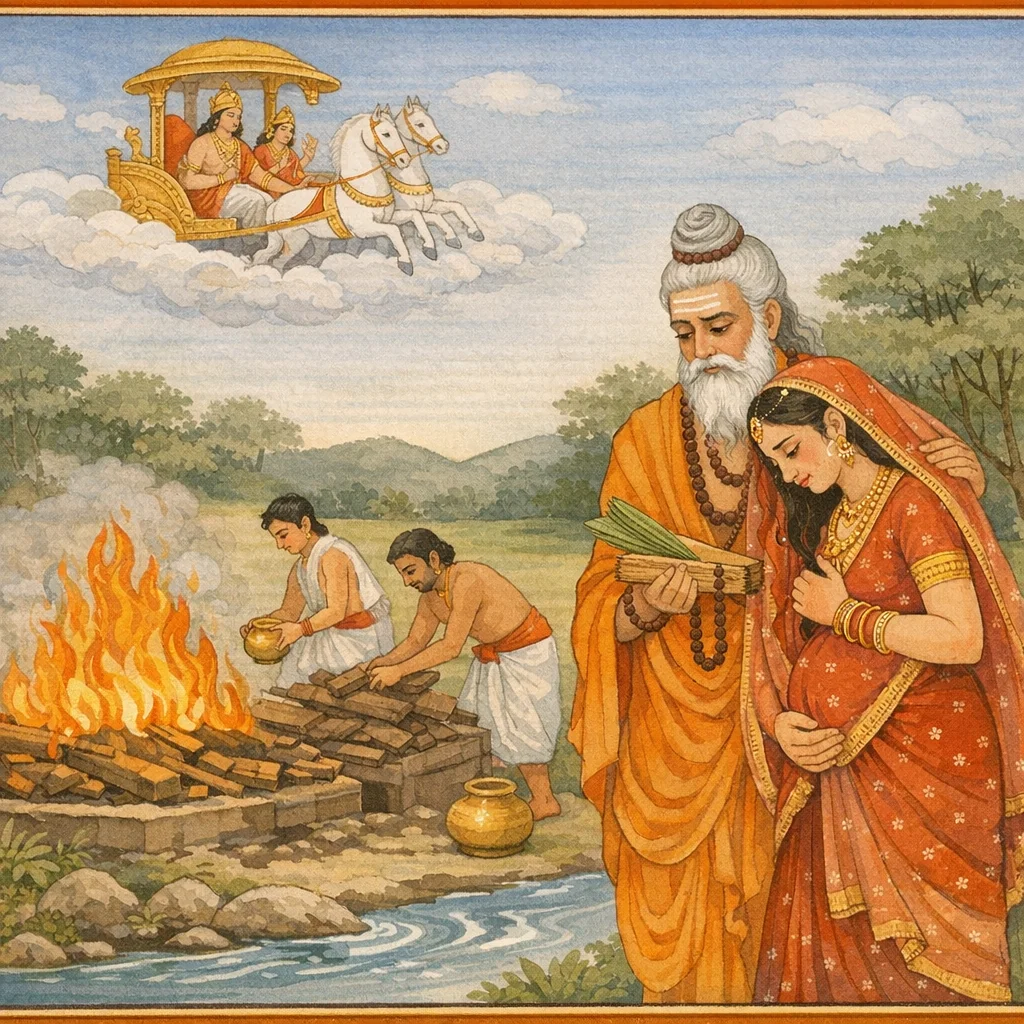
Nārada asks Sanaka about Sagara’s lineage and the one freed from a demonic disposition. Sanaka first extols the Gaṅgā’s supreme power to purify: by her touch Sagara’s line is cleansed and attains Viṣṇu’s abode. He then recounts King Bāhu of the Viku line—once a dharmic ruler who performs seven Aśvamedhas and establishes varṇa-duties—whose prosperity breeds ego and envy. An ethical teaching follows: envy, harsh speech, desire, and hypocrisy ruin discernment and fortune, turning even kin into foes. As Viṣṇu’s favor withdraws, enemies (Haihayas and Tālajaṅghas) defeat Bāhu; he flees to the forest with his pregnant queens, falls into disgrace, and dies near Sage Aurva’s hermitage. The grieving queen Bāhupriyā seeks to mount the pyre, but Aurva restrains her by dharma, revealing a future universal monarch in her womb, teaching the inevitability of death under karma, and urging proper rites. After the cremation Bāhu ascends in a celestial chariot; the queen serves Aurva thereafter, and the chapter ends praising compassionate, welfare-giving speech as truly Viṣṇu-like.
Shlokas
Verse 1
नारद उवाच । कोऽसौ राक्षसभावाद्धि मोचितः सगरान्वये । सगरः को मुनिश्रेष्ठ तन्ममाख्यातुमर्हसि 1. ॥ १ ॥
Narada said: “Who is that person in the Sagara lineage who was indeed freed from a demonic disposition? And who is Sagara, O best of sages? Please explain that to me.”
Verse 2
सनक उवाच । शृणुष्व मुनिशार्दूल गंगामाहात्म्यमुत्तमम् । यज्जलस्पर्शमात्रेण पावितं सागरं कुलम् । गतं विष्णुपदं विप्र सर्वलोकोत्तमोत्तमम् ॥ २ ॥
Sanaka said: “O tiger among sages, listen to the supreme greatness of the Gaṅgā. By the mere touch of her water, the lineage of Sagara was purified and attained Viṣṇu’s abode—most excellent beyond all worlds, O brāhmaṇa.”
Verse 3
आसीद्र विकुले जातो बाहुर्नाम वृकात्मजः । बुभुजे पृथिवीं सर्वां धर्मतो धर्मतत्परः ॥ ३ ॥
In the lineage of Viku there was born a son of Vṛka named Bāhu; devoted to Dharma, he ruled and enjoyed the entire earth in accordance with righteousness.
Verse 4
ब्राह्मणाः क्षत्रिया वैश्याः शूद्रा श्चान्ये च जन्तवः । स्थापिताःस्वस्वधर्मेषु तेन बाहुर्विशांपतिः ॥ ४ ॥
He, the mighty-armed lord of the people, established Brahmins, Kshatriyas, Vaishyas, and Shudras—and other beings as well—in their own respective dharmas (sacred duties).
Verse 5
अश्वमेधैरियाजासौ सप्तद्वीपेषु सप्तभिः । अतर्प्पयद्भूमिदेवान् गोभूस्वर्णांशुकादिभिः ॥ ५ ॥
He performed seven Aśvamedha sacrifices across the seven continents, and satisfied the “gods on earth”—the Brāhmaṇas—by gifts of cows, land, gold, garments, and the like.
Verse 6
अशासन्नीतिशास्त्रेण यथेष्टं परिपन्थिनः । मेने कृतार्थमात्मानमन्यातपनिवारणम् ॥ ६ ॥
By means of a coercive treatise on nīti (statecraft), he guided wayfarers as he pleased, and deemed himself accomplished—imagining that he had become the remover of others’ hardships.
Verse 7
चन्दनानि मनोज्ञानि बलि यत्सर्वदा जनाः । भूषिता भूषणैर्दिव्यैस्तद्रा ष्ट्रे सुखिनो मुने ॥ ७ ॥
O Sage, in that kingdom the people ever offer pleasing sandalwood and tribute (bali); adorned with divine ornaments, they live in happiness.
Verse 8
अकृष्टपच्या पृथिवी फलपुष्पसमन्विता ॥ ८ ॥
The earth yielded ripe produce without being ploughed, and it was richly endowed with fruits and flowers.
Verse 9
ववर्ष भूमौ देवेन्द्र ः काले काले मुनीश्वर । अधर्मनिरतापाये प्रजा धर्मेण रक्षिताः ॥ ९ ॥
O best of sages, Indra sent rains upon the earth in due season; and when those devoted to adharma were removed, the people were safeguarded through Dharma.
Verse 10
एकदा तस्य भूपस्य सर्वसम्पद्विनाशकृत् । अहंकारो महाञ्जज्ञे सासूयो लोपहेतुकः ॥ १० ॥
Once, in that king, a mighty ego (ahaṃkāra) arose—together with envy—becoming the cause of decline and the destroyer of all prosperity.
Verse 11
अहं राजा समस्तानां लोकानां पालको बली । कर्त्ता महाक्रतूनां च मत्तः पूज्योऽस्ति कोऽपरः ॥ ११ ॥
“I am the king of all worlds, their mighty protector; I am also the performer of great sacrifices. Who else, besides me, is worthy of worship?”
Verse 12
अहं विचक्षणः श्रीमाञ्जिताः सर्वे मयारयः । वेदवेदाङ्गतत्त्वज्ञो नीतिशास्त्रविशारदः ॥ १२ ॥
“I am discerning and prosperous; all my enemies have been conquered by me. I know the true principles of the Vedas and the Vedāṅgas, and I am well-versed in nīti-śāstra, the science of polity and ethics.”
Verse 13
अजेयोऽव्याहतैश्वर्यो मत्तः कोऽन्योऽधिको भुवि । अहंकारपरस्यैवं जातासूया परेष्वपि ॥ १३ ॥
“I am unconquerable; my lordly power is unimpeded. Who on earth is superior to me?” Thus, for one devoted to egoism, envy toward others also arises.
Verse 14
असूयातोऽभवत्कामस्तस्य राज्ञो मुनीश्वर । एषु स्थितेषु तु नरो विनाशं यात्यसंशयम् ॥ १४ ॥
O lord among sages, from that king’s envy there arose desire; and when these faults take hold, a man undoubtedly goes to ruin.
Verse 15
यौवनं धनसंपत्तिः प्रभुत्वमविवेकिता । एकैकमप्यनर्थाय किमु यत्र चतुष्टयम् ॥ १५ ॥
Youth, wealth, authority, and lack of discernment—each one by itself can lead to ruin; what then when all four are present together?
Verse 16
तस्यासूया नु महती जाता लोकविरोधिनी । स्वदेहनाशिनी विप्र सर्वसम्पद्विनाशिनी ॥ १६ ॥
From that, a great jealousy arose—one that turns the world against a person; O brāhmaṇa, it destroys one’s own body and brings about the ruin of all prosperity.
Verse 17
असूयाविष्टमनसि यदि संपत्प्रवर्त्तते । तुषाग्निं वायुसंयोगमिव जानीहि सुव्रत ॥ १७ ॥
If prosperity arises in a mind possessed by envy, know it to be like fire hidden in chaff when joined with wind—quick to flare up and bring ruin.
Verse 18
असूयोपेतमनसां दम्भाचारवतां तथा । परुषोक्तिरतानां च सुखं नेह परत्र च ॥ १८ ॥
For those whose minds are filled with envy, who live by hypocrisy and pretence, and who delight in harsh speech—there is happiness neither in this world nor in the world beyond.
Verse 19
असूयाविष्टचित्तानां सदा निष्ठुरभाषिणाम् । प्रिया वा तनया वापि बान्धवा अप्यरातयः ॥ १९ ॥
For those whose minds are seized by envy and who ever speak harshly, even a beloved wife, even a son, and even their own kin become as enemies.
Verse 20
मनोभिलाषं कुरुते यः समीक्ष्य परस्त्रियम् । स स्वसंपद्विनाशाय कुठारो नात्र संशयः ॥ २० ॥
He who, after looking upon another man’s wife, entertains desire in his mind—he is an axe to the destruction of his own prosperity; of this there is no doubt.
Verse 21
यः स्वश्रेयोविनाशाय कुर्याद्यत्नं नरो मुने । सर्वेषां श्रेयसं दृष्ट्वा स कुर्यान्मत्सरं कुधीः ॥ २१ ॥
O sage, the person who strives for the ruin of his own true welfare—seeing the prosperity and well-being of others—becomes envious; such a one is of perverted understanding.
Verse 22
मित्रापत्यगृहक्षेत्रधनधान्यपशुष्वपि । हानिमिच्छन्नरः कुर्यादसूयां सततं द्विज ॥ २२ ॥
O twice-born one, a man who desires loss for another will constantly indulge in envy—directed even toward friends, children, house, land, wealth, grain, and cattle.
Verse 23
अथ तस्याविनीतस्य ह्यसूयाविष्टचेतसः । हैहयास्तालजङ्घाश्च बलिनोऽरातयोऽभवन् ॥ २३ ॥
Then, because he was undisciplined and his mind was seized by envy, the mighty Haihayas and the Tālajaṅghas became his enemies.
Verse 24
यस्यानुकूलो लक्ष्मीशः सौभाग्यं तस्य वर्द्धते । सएव विमुखो यस्य सौभाग्यं तस्य हीयते ॥ २४ ॥
For one whom the Lord of Lakṣmī, Viṣṇu, favors, good fortune ever increases. But for one from whom that very Lord turns away, good fortune surely wanes.
Verse 25
तावत्पुत्राश्च पौत्राश्च धनधान्यगृहादयः । यावदीक्षेत लक्ष्मीशः कृपापाङ्गेन नारद ॥ २५ ॥
O Nārada, sons and grandsons, wealth, grain, houses, and all else endure only so long as Lakṣmī’s Lord, Viṣṇu, casts upon one His gracious sidelong glance.
Verse 26
अपि मूर्खान्धबधिरजडाः शूरा विवेकिनः । श्लाघ्या भवन्ति विप्रेन्द्र प्रेक्षिता माधवेन ये ॥ २६ ॥
O best of brāhmaṇas, even the foolish, the blind, the deaf, and the dull become worthy of praise—indeed, heroic and discerning—when Mādhava (Viṣṇu) has cast His gaze upon them.
Verse 27
सौभाग्यं तस्य हीयेत यस्यासूयादिलाञ्छनम् । जायते नात्र संदेहो जन्तुद्वेषो विशेषतः ॥ २७ ॥
The good fortune of one in whom the mark of envy and kindred faults arises surely declines. Of this there is no doubt—especially when there is hatred toward living beings.
Verse 28
सततं यस्य कस्यापि यो द्वेषं कुरुते नरः । तस्य सर्वाणि नश्यन्ति श्रेयांसि मुनिसत्तम ॥ २८ ॥
O best of sages, the man who continually harbors hatred toward anyone—whoever it may be—finds all his auspicious gains and higher welfare destroyed.
Verse 29
असूया वर्द्धते यस्य तस्य विष्णुः पराङ्मुखः । धनं धान्यं मही संपद्विनश्यति ततो ध्रुवम् ॥ २९ ॥
In one whose envy (asūyā) keeps increasing, Lord Viṣṇu turns away. Thereafter, surely, his wealth, grain, and the prosperity of his land are destroyed.
Verse 30
विवेकं हन्त्यहंकारस्त्वविवेकात्तु जीविनाम् । आपदः संभवन्त्येवेत्यहंकारं त्यजेत्ततः ॥ ३० ॥
Ego (ahaṅkāra) destroys discernment (viveka). From the lack of discernment in living beings, calamities inevitably arise; therefore one should abandon ego.
Verse 31
अहंकारो भवेद्यस्य तस्य नाशोऽतिवेगतः । असूयाविष्टमनसस्तस्य राज्ञः परैः सह ॥ ३१ ॥
For the king in whom ego (ahaṅkāra) arises, ruin comes with great speed; and for the king whose mind is seized by envy, destruction comes along with his enemies as well.
Verse 32
आयोधनमभूद् घोरं मासमेकं निरन्तरम् । हैहयैस्तालजङ्घैश्च रिपुभिः स पराजितः ॥ ३२ ॥
A dreadful battle raged on unceasingly for a full month; and he was defeated by the hostile Haihayas and the Tālajaṅghas.
Verse 33
वनं गतस्ततो बाहुरन्तर्वत्न्या स्वभार्यया । अवाप परमां तुष्टिं तत्र दृष्ट्वा महत्सरः ॥ ३३ ॥
Then Bāhu went to the forest with his own wife, who was pregnant; and on seeing the great lake there, he attained supreme contentment.
Verse 34
असूयोपेतमनसस्तस्य भावं निरीक्ष्य च । सरोगतविहंगास्ते लीनाश्चित्रमिदं महत् ॥ ३४ ॥
Seeing the disposition of his mind, filled with jealousy, the birds dwelling in the lake vanished—an astonishing and extraordinary sight indeed.
Verse 35
अहो कष्टमहो रूपं घोरमत्र समागतम् । विशन्तस्त्वरया वासमित्यूचुस्ते विहंगमाः ॥ ३५ ॥
“Alas—how dreadful! How terrifying a form has appeared here!” Thus cried those birds, and in haste they entered their dwelling-place.
Verse 36
सोऽवगाह्य सरो भूपः पत्नीभ्यां सहितो मुदा । पीत्वा जलं च सुखदं वृक्षमूलमुपाश्रिताः ॥ ३६ ॥
Having bathed in the lake, the king—joyfully accompanied by his two wives—drank the delightful water and then rested at the foot of a tree.
Verse 37
तस्मिन्बाहौ वनं याते तेनैव परिरक्षिताः । दुर्गुणान्विगणय्यास्य धिग्धिगित्यब्रुवन्प्रजाः ॥ ३७ ॥
When that mighty-armed one had gone to the forest, the people—still protected by him alone—began to recount his faults and exclaimed, again and again, “Shame! Shame!”
Verse 38
यो वा को या गुणी मर्त्यः सर्वश्लाघ्यतरो द्विज । सर्वसंपत्समायुक्तोऽप्यगुणी निन्दितो जनैः ॥ ३८ ॥
O twice-born one, whoever a person may be, one endowed with virtue is most worthy of praise; but even if possessed of every prosperity, one without virtue is censured by people.
Verse 39
अपकीर्तिसमो मृत्युर्लोकेष्वन्यो न विद्यते । यदा बाहुर्वनं यातस्तदा तद्रा ज्यगा जनाः । सन्तुष्टिं परमां याता दवथौ विगते यथा ॥ ३९ ॥
In all the worlds there is no death equal to disgrace. When Bāhu went to the forest, the people of that kingdom attained supreme contentment—like one whose burning fever has subsided.
Verse 40
निन्दितो बहुशो बाहुर्मृतवत्कानने स्थितः । निहत्य कर्म च यशो लोके द्विजवरोत्तम ॥ ४० ॥
Often reviled, Bāhu remained in the forest like one dead; and, having ruined his own deeds (merit) and his fame in the world, O best of the twice-born.
Verse 41
नास्त्यकीर्तिसमो मृत्युर्नास्ति क्रोधसमो रिपुः । नास्ति निंदासमं पापं नास्ति मोहसमासवः ॥ ४१ ॥
There is no death like disgrace; there is no enemy like anger. There is no sin like slander; there is no intoxicant like delusion.
Verse 42
नास्त्यसूयासमाकीर्तिर्नास्ति कामसमोऽनलः । नास्ति रागसमः पाशो नास्ति संगसमं विषम् ॥ ४२ ॥
There is no defamation equal to envy; there is no fire like desire. There is no noose like attachment (passion), and there is no poison equal to worldly association (clinging company).
Verse 43
एवं विलप्य बहुधा बाहुरत्यन्तदुःखितः । जीर्णाङ्गो मनसस्तापाद् वृद्धभावादभूदसौ ॥ ४३ ॥
Lamenting thus in many ways, Bāhu was overwhelmed with sorrow; and, from the burning anguish of his mind, his body grew worn, and he entered the state of old age.
Verse 44
गते बहुतिथे काले और्वाश्रमसमीपतः । स बाहुर्व्याधिना ग्रस्तो ममार मुनिसत्तम ॥ ४४ ॥
After a long time had passed, near the hermitage of Aurva, King Bāhu—stricken by illness—departed this life, O best of sages.
Verse 45
तस्य भार्या च दुःखार्ता कनिष्ठा गर्भिणी तदा । चिरं विलप्य बहुधा सह गन्तुं मनो दधे ॥ ४५ ॥
His younger wife, then pregnant and overwhelmed by sorrow, lamented for a long time in many ways and resolved within her heart to go with him.
Verse 46
समानीय च सैधांसि चितां कृत्वातिदुःखिता । समारोप्य तमारूढं स्वयं समुपचक्रमे ॥ ४६ ॥
Gathering the firewood, she built a funeral pyre; overwhelmed with grief, she placed him upon it and then mounted it herself, beginning the act of entering the pyre.
Verse 47
एतस्मिन्नन्तरे धीमानौर्वस्तेजोनिधिर्मुनिः । एतद्विज्ञातवान्सर्वं परमेण समाधिना ॥ ४७ ॥
Meanwhile, the wise sage Aurva—an abode of spiritual radiance—came to know all this through supreme samādhi.
Verse 48
भूतं भव्यं वर्त्तमानं त्रिकालज्ञा मुनीश्वराः । गतासूया महात्मानः पश्यन्ति ज्ञानचक्षुषा ॥ ४८ ॥
The lordly sages, knowers of the three times, behold past, future, and present with the eye of wisdom; those great souls are free from envy.
Verse 49
तपोभिस्तेजसां राशिरौर्वपुण्यसमो मुनिः । संप्राप्तस्तत्र साध्वी च यत्र बाहुप्रिया स्थिता ॥ ४९ ॥
That sage—an amassed blaze of spiritual radiance born of austerities, and equal in merit to Aurva—arrived at the very place where the virtuous lady Bāhupriyā was staying.
Verse 50
चितामारोढुमुद्युक्तां तां दृष्ट्वा मुनिसत्तमः । प्रोवाच धर्ममूलानि वाक्यानि मुनिसत्तमः ॥ ५० ॥
Seeing her prepared to mount the funeral pyre, the foremost of sages spoke words that reach to the very roots of dharma.
Verse 51
और्व उवाच । राजवर्यप्रिये साध्वि मा कुरुष्वातिसाहसम् । तवोदरे चक्रवर्ती शत्रुहन्ता हि तिष्ठति ॥ ५१ ॥
Aurva said: “O virtuous lady, beloved of the best of kings, do not commit an act of rash daring. For within your womb abides a future universal monarch (cakravartin), a slayer of enemies.”
Verse 52
बालापत्याश्च गर्भिण्यो ह्यदृष्टऋतवस्तथा । रजस्वला राजसुते नारोहन्ति चितां शुभे ॥ ५२ ॥
O auspicious princess, women with young children, pregnant women, those who have not yet begun menstruating, and women who are menstruating do not ascend the funeral pyre.
Verse 53
ब्रह्महत्यादिपापानां प्रोक्ता निष्कृतिरुत्तमैः । दम्भिनो निंदकस्यापि भ्रूणघ्नस्य न निष्कृतिः ॥ ५३ ॥
For sins such as brahmin-slaying and the like, the highest authorities have taught expiations; but for the hypocrite, the reviler, and even the slayer of an embryo, there is no expiation.
Verse 54
नास्तिकस्य कृतघ्नस्य धर्मोपेक्षाकरस्य च । विश्वासघातकस्यापि निष्कृतिर्नास्ति स्रुवते ॥ ५४ ॥
O Sruvate, there is no expiation for the nāstika (atheist), for the ungrateful, for one who neglects Dharma, and even for one who betrays trust.
Verse 55
तस्मादेतन्महत्पापं कर्त्तुं नार्हसि शोभने । यदेतद्दुःखमुत्पन्नं तत्सर्वं शांतिमेष्यति ॥ ५५ ॥
Therefore, O fair one, you should not commit this great sin. Whatever sorrow has arisen here will wholly subside into peace.
Verse 56
इत्युक्ता मुनिना साध्वी विश्वस्य तदनुग्रहम् । विललापातिदुःखार्ता समुह्यधवपत्कजौ ॥ ५६ ॥
Thus addressed by the sage—who spoke for the welfare of the whole world—that virtuous lady, overwhelmed by intense sorrow, began to lament and, losing composure, fell down in distress.
Verse 57
और्वोऽपि तां पुनः प्राह सर्वशास्त्रार्थकोविदः । मा रोदी राजतनये श्रियमग्र्ये गमिष्यसि ॥ ५७ ॥
Aurva too addressed her again—the knower of the purport of all scriptures: “Do not weep, O princess; you shall attain the highest prosperity.”
Verse 58
मा मुंचास्रं महाभागे प्रेतो दाह्योऽद्य सज्जनैः । तस्माच्छोकं परित्यज्य कुरु कालोचितां क्रियाम् ॥ ५८ ॥
O noble lady, do not shed tears. Today this departed one should be cremated by the virtuous. Therefore, abandoning grief, perform the rite appropriate to the proper time.
Verse 59
पंडिते वापि मूर्खे वा दरिद्रे वा श्रियान्विते । दुर्वृत्ते वा सुवृत्ते वा मृत्योः सर्वत्र तुल्यता ॥ ५९ ॥
Whether learned or foolish, poor or prosperous, of bad conduct or good—death is equal toward all, everywhere.
Verse 60
नगरे वा तथारण्ये दैवमत्रातिरिच्यते ॥ ६० ॥
Whether in a city or likewise in a forest, in this matter fate (daiva) is said to be predominant.
Verse 61
यद्यत्पुरातनं कर्म तत्तदेवेह युज्यते । कारणं दैवमेवात्र मन्ये सोपाधिका जनाः ॥ ६१ ॥
Whatever deed was done in the past, that very fruit is experienced here. In this matter, I hold destiny (daiva) alone to be the cause—while ordinary people, bound by limiting conditions, think otherwise.
Verse 62
गर्भे वा बाल्यभावे वा यौवने वापि वार्द्धके । मृत्योर्वशं प्रयातव्यं जन्तुभिः कमलानने ॥ ६२ ॥
Whether in the womb, in childhood, in youth, or even in old age—O lotus-faced one—living beings must inevitably pass under the dominion of Death.
Verse 63
हन्ति पाति च गोविन्दो जन्तून्कर्मवशे स्थितान् । प्रवादं रोपयन्त्यज्ञा हेतुमात्रेषु जन्तुषु ॥ ६३ ॥
Govinda both strikes down and protects living beings who stand under the dominion of their own karma. Yet the ignorant plant blame and slander upon mere secondary causes—upon the creatures and instruments alone.
Verse 64
तस्माद्दुःखं परित्यज्य सुखिनी भव सुव्रते । कुरु पत्युश्च कर्माणि विवेकेन स्थिरा भव ॥ ६४ ॥
Therefore, cast away sorrow and become joyful, O woman of noble vows. Perform the duties connected with your husband, and with discerning wisdom remain steady and composed.
Verse 65
एतच्छरीरं दुःखानां व्याधीनामयुतैर्वृतम् । सुखाभासं बहुक्लेशं कर्मपाशेन यन्त्रितम् ॥ ६५ ॥
This body is encompassed by countless sufferings and diseases; it grants only the semblance of happiness, is laden with many afflictions, and is bound fast by the noose of karma.
Verse 66
इत्याश्वास्य महाबुद्धिस्तया कार्याण्यकारयत् । त्यक्तशोका च सा तन्वी नता प्राह मुनीश्वरम् ॥ ६६ ॥
Thus having consoled her, the sage of great wisdom had the required rites and duties carried out through her. Freed from grief, that slender lady bowed in reverence and then spoke to the lordly sage.
Verse 67
किमत्र चित्रं यत्सन्तः परार्थफलकांक्षिणः । नहि द्रुमाश्च भोगार्थं फलन्ति जगतीतले ॥ ६७ ॥
What is surprising in this—that the virtuous seek the fruit of their deeds for the good of others? For trees upon the earth do not bear fruit for their own enjoyment.
Verse 68
योऽन्यदुःखानि विज्ञाय साधुवाक्यैः प्रबोधयेत् । स एव विष्णुस्तत्त्वस्थो यतः परहिते स्थितः ॥ ६८ ॥
One who, understanding the sufferings of others, awakens them with noble words—he alone is truly Viṣṇu, established in truth, for he stands devoted to the welfare of others.
Verse 69
अन्यदुःखेन यो दुःखी योऽन्य हर्षेण हर्षितः । स एव जगतामीशो नररूपधरो हरिः ॥ ६९ ॥
He who sorrows at another’s sorrow and rejoices in another’s joy—he alone is Hari, Lord of the worlds, who has assumed a human form.
Verse 70
सद्भिः श्रुतानि शास्त्राणि परदुःखविमुक्तये । सर्वेषां दुःखनाशाय इति सन्तो वदन्ति हि ॥ ७० ॥
The virtuous hear and study the śāstras to be freed from the suffering of others; indeed, the good declare that the true purpose of śāstra is the removal of sorrow for all beings.
Verse 71
यत्र सन्तः प्रवर्त्तन्ते तत्र दुःखं न बाधते । वर्तते यत्र मार्तण्डः कथं तत्र तमो भवेत् ॥ ७१ ॥
Where the holy dwell and act in righteousness, sorrow cannot afflict. Where Mārtaṇḍa, the Sun, shines, how could darkness exist there?
Verse 72
इत्येवं वादिनी सा तु स्वपत्युश्चापराः क्रियाः । चकार तत्सरस्तीरे मुनिप्रोक्तविधानतः ॥ ७२ ॥
Having spoken thus, she then performed the rites for her own husband and the other prescribed observances on the bank of that lake, exactly in accordance with the procedure laid down by the sage.
Verse 73
स्थिते तत्र मुनौ राजा देवराडिव संज्वलन् । चितामध्याद्विनिष्क्रम्य विमानवरमास्थितः ॥ ७३ ॥
While the sage stood there, the king—blazing like the lord of the gods—emerged from the midst of the funeral pyre and took his seat upon a splendid celestial chariot.
Verse 74
प्रपेदे परमं धाम नत्वा चौर्वं मुनीश्वरम् । महापातकयुक्ता वा युक्ता वा चोपपातकैः । परं पदं प्रयान्त्येव महद्भिरवलोकिताः ॥ ७४ ॥
Having bowed to that lord among sages, Caurva attained the supreme abode. Even those burdened with great sins, or entangled in lesser transgressions, surely reach the highest state when they are graced by the gaze of the great ones.
Verse 75
कलेवरं वा तद्भस्म तद्धूमं वापि सत्तम । यदि पश्यति पुण्यात्मा स प्रयाति परां गतिम् ॥ ७५ ॥
O best of the virtuous, if a righteous soul beholds that body—or its ashes, or even its smoke—he attains the supreme state.
Verse 76
पत्युः कृतक्रिया सा तु गत्वाश्रमपदं मुनेः । चकार तस्य शुश्रूषां सपत्न्या सह नारद ॥ ७६ ॥
After performing the funeral rites for her husband, she went to the sage’s hermitage; and there, O Nārada, she devoted herself to serving him, together with her co-wife.
Verse 77
इति श्रीबृहन्नारदीयपुराणे पूर्वभागे प्रथमपादे गङ्गामाहात्म्यं नाम सप्तमोऽध्यायः ॥ ७ ॥
Thus ends the seventh chapter, called “The Greatness of the Gaṅgā,” in the First Part (Pūrva-bhāga), First Section (Prathama-pāda) of the sacred Bṛhannāradīya Purāṇa.
Frequently Asked Questions
Sanaka frames the Gaṅgā as a liberative tīrtha whose mere contact purifies inherited impurity and reorients a lineage toward Viṣṇu’s abode. The chapter uses this as a theological premise: sacred waters and saintly association can transform karmic trajectories, making tīrtha-mahātmya a vehicle for mokṣa-dharma.
Prosperity joined with ego and envy destroys viveka, invites hostility, and leads to rapid ruin—socially (disgrace), politically (defeat by enemies), and spiritually (loss of divine favor). The text repeatedly ties decline to mātsarya and harsh speech, presenting humility and dharma as the true protectors of prosperity.
Aurva’s intervention is grounded in dharma: pregnancy is explicitly cited as a condition barring ascent to the pyre, and the unborn child is identified as a future universal monarch. The episode reframes grief into duty—proper cremation rites, steadiness of mind, and acceptance of karma and daiva—thereby prioritizing śāstric order and the welfare of descendants.