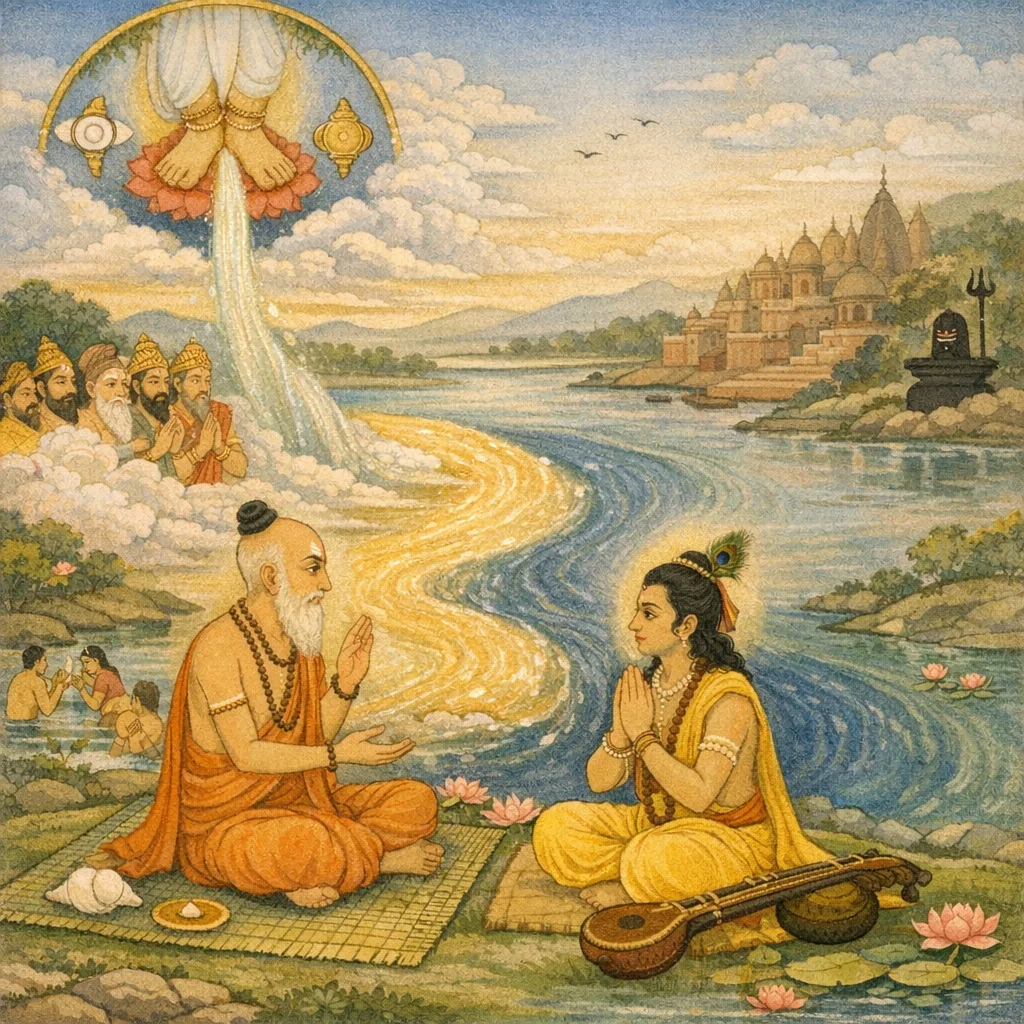
The Greatness of the Gaṅgā (Gaṅgāmāhātmya)
Sūta introduces Nārada—joyful in bhakti—questioning Sanaka, knower of the scriptures’ purport, about which kṣetra and tīrtha are supreme. Sanaka replies with a “secret” teaching on Brahman while practically praising pilgrimage: the Gaṅgā–Yamunā confluence at Prayāga is declared highest among all kṣetras and tīrthas, visited by gods, sages, and Manus. The chapter magnifies Gaṅgā’s holiness (born from Viṣṇu’s feet), saying that remembering her, uttering her name, seeing, touching, bathing, even a single drop, destroys sin and grants higher states. It then extols Kāśī/Vārāṇasī (Avimukta) and remembrance at death leading to Śiva’s state, yet still ranks Prayāga’s confluence as more exalted. A major doctrinal passage teaches the non-difference of Hari and Śaṅkara (and Brahmā), warning against sectarian division. The chapter ends by equating Purāṇa-recitation and honoring the Purāṇa-speaker with Gaṅgā/Prayāga merit, and by pairing Gaṅgā with Gāyatrī and Tulasī as rare supports for liberation.
Shlokas
Verse 1
सूत उवाच । भगवद्भक्तिमाहात्म्यं श्रुत्वा प्रीतस्तु नारदः । पुनः पप्रच्छ सनकं ज्ञानविज्ञानपारगम् ॥ १ ॥
Sūta said: Having heard of the greatness of devotion (bhakti) to the Blessed Lord, Nārada—filled with joy—again questioned Sanaka, who had reached the far shore of knowledge and realized wisdom.
Verse 2
नारद उवाच । क्षेत्राणामुत्तमं क्षेत्रं तीर्थानां च तथोत्तमम् । परया दयया तथवं ब्रूहिं शास्त्रार्थपारग ॥ २ ॥
Nārada said: O master of the true purport of the scriptures, with supreme compassion please tell me—among sacred regions (kṣetras) which is the best kṣetra, and among pilgrimage-fords (tīrthas) which is likewise the most excellent?
Verse 3
सनक उवाच । शुणु ब्रह्मन्तरं गुह्यं सर्वसंपत्करं परम् । दुःस्वन्पनाशनं पुण्यं धर्म्यं पापहरं शुभम् ॥ ३ ॥
Sanaka said: Listen to the secret inner teaching of Brahman—supreme and bestowing every prosperity; it destroys evil dreams, is meritorious and righteous, removes sins, and is auspicious.
Verse 4
श्रोतव्यं मुनिभिर्नित्यं दुष्टग्रहनिवारणम् । सर्वरोगप्रशमनमायुर्वर्ध्दनकारणम् ॥ ४ ॥
This is to be heard regularly by sages: it wards off malignant planetary influences (grahas), pacifies all diseases, and becomes a cause for the increase of lifespan.
Verse 5
क्षेत्राणामुत्तमं क्षेत्रं तीर्थानां च तथोत्तमम् । गङ्गायमुनयोर्योगं वदन्ति परमर्षयः ॥ ५ ॥
Among all kṣetras, this is the most excellent sacred field; and among all tīrthas it is likewise the highest—so declare the supreme ṛṣis: the holy confluence of the Gaṅgā and the Yamunā.
Verse 6
सितासितोदकं तीर्थं ब्रह्माद्याः सर्वदेवताः । मुनयो मनवश्चैव सेवन्ते पुण्यकाङ्क्षिणः ॥ ६ ॥
At the tīrtha called Sitāsitodaka, Brahmā and the other gods—indeed all the devatās—together with the munis and the Manus, resort there in worship, longing for merit.
Verse 7
गङ्गा पुण्यनदी ज्ञेया यतो विष्णुपदोद्भवा । रविजा यमुना ब्रह्मंस्तयोर्योगः शुभावहः ॥ ७ ॥
Know the Gaṅgā as a supremely holy river, for she arises from the feet of Viṣṇu. And the Yamunā is born of the Sun, O brāhmaṇa; the confluence of the two bestows auspicious good.
Verse 8
स्मृतार्तिनाशिनी गङ्गा नदीनां प्रवरा मुने । सर्वपापक्षयकरी सर्वोपद्रवनाशिनी ॥ ८ ॥
O sage, the Gaṅgā—foremost among rivers—destroys suffering when remembered; she brings the ending of all sins and removes every calamity.
Verse 9
यानि क्षेत्राणि पुण्यानि समुद्रान्ते महीतले । तेषां पुण्यतमं ज्ञेयं प्रयागाख्यं महामुने ॥ ९ ॥
O great sage, among all holy and meritorious regions upon the earth, bounded by the ocean, know that the most supremely meritorious is the place called Prayāga.
Verse 10
इयाज वेधा यज्ञेन यत्र देवं रमापतिम् । तथैव मुनयः सर्वे चक्रश्च विविधान्मखान् ॥ १० ॥
There the Creator (Vedhā) worshipped the Lord, the consort of Ramā (Lakṣmī), by means of sacrifice; likewise all the sages too performed various kinds of sacrificial rites.
Verse 11
सर्वतीर्थाभिषेकाणि यानि पुण्यानि तानि वै । गङ्गाबिन्द्वभिषेकस्य कलां नार्हन्ति षोडशीम् ॥ ११ ॥
All the merits gained from bathing (or being anointed) at every sacred ford are real indeed; yet they do not equal even a sixteenth part of the merit obtained by being anointed with a single drop of the Gaṅgā.
Verse 12
गङ्गा गङ्गेति यो ब्रूयाद्योजनानां शते स्थितः । सोऽपि मुच्येत पापेभ्यः किमु गङ्गाभिषेकवान् ॥ १२ ॥
Even a person who is a hundred yojanas away—if he merely utters “Gaṅgā, Gaṅgā”—is freed from sins; how much more so one who has actually bathed in (been anointed by) the waters of the Gaṅgā.
Verse 13
विष्णुपादोद्भवा देवी विश्वेश्वरशिरः स्थिता । संसेव्या मुनिभिर्देवः किं पुनः पामरैर्जनै ॥ १३ ॥
O Goddess, she who sprang from Viṣṇu’s feet and abides upon the head of the Lord of the universe is revered and served even by sages—how much more, then, should she be venerated by ordinary people.
Verse 14
यत्सैकतं ललाटे तु ध्रियते मनुजोत्तमैः । तत्रैव नेत्रं विज्ञेयं विध्यर्द्धाधः समुज्ज्वलत् ॥ १४ ॥
That tilaka mark (of sacred clay/sand) which the best of men wear upon the forehead—right there one should understand the divine eye to be, shining brilliantly, placed half a measure above the eyebrow-line.
Verse 15
यन्मज्जनं महापुण्यं दुर्लभं त्रिदिवौकसाम् । सारूप्यदायकं विष्णोः किमस्मात्कथ्यते परम ॥ १५ ॥
That immersion in that sacred place is supremely meritorious—rare even for the dwellers of heaven—and it bestows sārūpya, likeness to Lord Viṣṇu. What higher thing than this could be spoken of?
Verse 16
यत्र स्नाताः पापिनोऽपि सर्वपापविवर्जिताः । महद्विमानमारूढाः प्रयान्ति परमं पदम् ॥ १६ ॥
There, even sinful people, having bathed, become completely free from all sins; mounting a great celestial chariot, they depart to the supreme abode.
Verse 17
यत्र स्नाता महात्मानः पितृमातृकुलानि वै । सहस्राणि समुद्धृत्य विष्णुलोके व्रजन्ति वै ॥ १७ ॥
Wherever great-souled devotees bathe, they uplift thousands of families on both the father’s and the mother’s side, and indeed proceed to the realm of Viṣṇu.
Verse 18
स स्नातः सर्वतीर्थेषु यो गङ्गां स्मरति द्विज । पुण्यक्षेत्रेषु सर्वेषु स्थितवान्नात्र संशयः ॥ १८ ॥
O twice-born one, whoever remembers the Gaṅgā has, in effect, bathed at all sacred fords; he has truly stood in every holy pilgrimage-field—of this there is no doubt.
Verse 19
यत्र स्नातं नरं दृष्ट्वा पापोऽपि स्वर्गभूमिभाक् । मदङ्गस्पर्शेमात्रेण देवानामाधिपो भवेत् ॥ १९ ॥
In that sacred place, even a sinner—merely by seeing a man who has bathed there—becomes worthy of heaven; and by the mere touch of my body, one may become the lord of the gods.
Verse 20
तुलसीमूलसंभूता द्विजपादोद्भवा तथा । गङ्गोद्भवा तु मृल्लोकान्नयत्यच्युतरूपताम् ॥ २० ॥
Sacred earth arisen from the root of Tulasī, likewise earth that has come from the feet of a brāhmaṇa, and above all earth born of the Gaṅgā—such holy clay leads people in this world to the state of becoming like Acyuta (Lord Viṣṇu).
Verse 21
गङ्गा च तुलसी चैव हरिभक्तिरचञ्चला । अत्यन्तदुर्ल्लभा नॄणां भक्तिर्द्धर्मप्रवक्तरि ॥ २१ ॥
The Gaṅgā, Tulasī, and unwavering devotion to Hari—these are exceedingly rare for human beings; and devotion to the Teacher who proclaims Dharma is also extremely difficult to obtain.
Verse 22
सद्धर्मवक्तुः पदसंभवां मृदं गङ्गोद्भवां चैव तथा तुलस्याः । मूलोद्भवां भक्तियुतो मनुष्यो धृत्वा शिरस्येति पदं च विष्णोः ॥ २२ ॥
A person endowed with devotion should place upon the head the sacred earth from the footprints of a preacher of true dharma, the earth brought forth from the Gaṅgā, and the earth from the root of the tulasī plant—thus attaining the state (abode) of Viṣṇu.
Verse 23
कदा यास्याम्यहं गङ्गां कदा पश्यामि तामहम् । वाञ्च्छत्यपि च यो ह्येवं सोऽपि विष्णुपदं व्रजेत् ॥ २३ ॥
“When will I go to the Gaṅgā? When will I behold her?” Even one who merely longs in this way attains the abode of Viṣṇu.
Verse 24
गङ्गाया महिमा ब्रह्मन्वक्तुं वर्षशतैरपि । न शक्यते विष्णुनापि किमन्यैर्बहुभाषितैः ॥ २४ ॥
O Brahman, the greatness of the Gaṅgā cannot be fully described even in hundreds of years—even by Viṣṇu Himself; what then could be done by others, however much they may speak?
Verse 25
अहो माया जगत्सर्वं मोहयत्येतदद्भुतम् । यतो वै नरकं यान्ति गङ्गानाम्नि स्थितेऽपि हि ॥ २५ ॥
Ah! How astonishing—Māyā deludes this entire world, so that people still go to hell even while dwelling in a place that bears the name “Gaṅgā.”
Verse 26
संसारदुःख विच्छेदि गङ्गानाम प्रकीर्तितम् । तथा तुलस्या भक्तिश्च हरिकीर्तिप्रवक्तरि ॥ २६ ॥
The name of Gaṅgā is proclaimed as that which cuts off the sorrow of worldly existence; likewise, devotion to Tulasī—and to the one who proclaims the glory of Hari—(is declared supremely purifying).
Verse 27
सकृदप्युच्चरेद्यस्तु गङ्गेत्येवाक्षरद्वयम् । सर्वपापविनिर्मुक्तो विष्णुलोकं स गच्छति ॥ २७ ॥
Even if a person utters just once the two-syllabled name “Gaṅgā,” they become freed from all sins and attain the world of Viṣṇu.
Verse 28
योजनत्रितयं यस्तु गङ्गायामधिगच्छति । सर्वपापविनिर्मुक्तः सूर्यलोकं समेति हि ॥ २८ ॥
Whoever traverses a stretch of three yojanas along the Gaṅgā becomes freed from all sins and indeed attains the world of the Sun (Sūryaloka).
Verse 29
सेयं गङ्गा महापुण्या नदी भक्त्या निषेविता । मेषतौलिमृगार्केषु पावयत्यखिलं जगत् ॥ २९ ॥
This is the Gaṅgā—an exceedingly meritorious river—reverently frequented with devotion; when the Sun is in Meṣa (Aries), Taulī (Libra), and Mṛga (Mṛgaśīrṣa season/solar passage), she purifies the entire world.
Verse 30
गोदावरी भीमरथी कृष्णा रेवा सरस्वती । तुङ्गभद्रा च कावेरी कालिन्दी बाहुदा तथा ॥ ३० ॥
The sacred rivers—Godāvarī, Bhīmarathī, Kṛṣṇā, Revā (Narmadā), Sarasvatī, Tuṅgabhadrā, Kāverī, Kālindī (Yamunā), and likewise Bāhudā—are to be remembered and revered.
Verse 31
वेत्रवती ताम्रपर्णी सरयूश्च द्विजोत्तम । एवमादिषु तीर्थेषु गङ्गा मुख्यतमा स्मृता ॥ ३१ ॥
“Vetravatī, Tāmraparṇī, and Sarayū as well, O best of the twice-born—among these and other tīrthas, the Gaṅgā is remembered as the foremost.”
Verse 32
यथा सर्वगतो विष्णुर्जगव्द्याप्य प्रतिष्टितः । तथेयं व्यापिनी गङ्गा सर्वपापप्रणाशिनी ॥ ३२ ॥
Just as all-pervading Viṣṇu is established everywhere, permeating the entire universe, so too this Gaṅgā is all-pervading—she destroys every sin.
Verse 33
अहो गङ्गा जगद्धात्री स्नानपानादिभिर्जगत् । पुनाति पावनीत्येषा न कथं सेव्यते नृभिः ॥ ३३ ॥
Ah! The Gaṅgā, sustainer of the world—by bathing, drinking, and the like she purifies the world. Since she is renowned as the Purifier, how is it that people do not serve and frequent her?
Verse 34
तीर्थानामुत्तमं तीर्थं क्षेत्राणां क्षेत्रमुत्तमम् । वाराणसीति विख्यातं सर्वदेवनिषेवितम् ॥ ३४ ॥
Among all sacred fords, this is the supreme tīrtha; among all holy regions, this is the supreme kṣetra. It is renowned as Vārāṇasī, attended and revered by all the gods.
Verse 35
ते एव श्रवणे धन्ये संविदाते बहुश्रुतम् । इह श्रुतिमतां पुंसां काशी याभ्यां श्रुताऽसकृत् ॥ ३५ ॥
Blessed indeed are those two ears that listen, for they bestow vast learning. In this world, for men endowed with sacred śruti, Kāśī is that which is heard of again and again as supremely praised.
Verse 36
ये यं स्मरन्ति संस्थानमविमुक्तं द्विजोत्तमम् । निर्धूतसर्वपापास्ते शिवलोकं व्रजन्ति वै ॥ ३६ ॥
O best of the twice-born, those who remember this sacred abode called Avimukta are cleansed of all sins, and indeed they go to Śiva’s world.
Verse 37
योजनानां शतस्थोऽपि अविमुक्तं स्मरेद्यदि । बहुपातकपूर्णोऽपि पदं गच्छत्यनामयम् ॥ ३७ ॥
Even if one is a hundred yojanas away, if one remembers Avimukta, then—even if burdened with many sins—one attains the sorrowless, disease-free state, the supreme abode.
Verse 38
प्राणप्रयाणसमये योऽविमुक्तं स्मरेद्द्विज । सोऽपि पापविनिर्मुक्तः शैवं पदमवाप्नुयात् ॥ ३८ ॥
O twice-born one, whoever remembers Avimukta at the time of life’s departure—he too, freed from sins, attains the supreme state of Śiva.
Verse 39
काशीस्मरणजं पुण्यं भुक्त्वा स्वर्गे तदन्ततः । पृथिव्यामेकराड् भूत्वा काशीं प्राप्य च मुक्तिभाक् ॥ ३९ ॥
Having enjoyed in heaven the merit born of remembering Kāśī, and when that merit is spent, one is born on earth as a sole sovereign; then, reaching Kāśī again, one becomes a partaker of liberation (mukti).
Verse 40
बहुनात्र किमुक्तेन वाराणस्या गुणान्प्रति । नामापि गृह्णातां काश्याश्चतुर्वर्गो न दूरतः ॥ ४० ॥
What need is there to speak at length of the virtues of Vārāṇasī? Even for those who merely utter the name of Kāśī, the four aims of life are not far away.
Verse 41
गङ्गायमुनयोर्योगोऽधिकः काश्या अपि द्विज । यस्य दर्शनमात्रेण नरा यान्ति परां गतिम् ॥ ४१ ॥
O twice-born one, the sacred confluence of the Gaṅgā and the Yamunā is even more exalted than Kāśī; merely by beholding it, people attain the highest state.
Verse 42
मकरस्थे रवौ गङ्गा यत्र कुत्रावगाहिता । पुनाति स्नानपानाद्यैर्नयन्तीन्द्रपुरं जगत् ॥ ४२ ॥
When the Sun enters Makara (Capricorn), the Gaṅgā—wherever one bathes in her—purifies the world through acts such as bathing and drinking her waters, and leads beings toward Indra’s heavenly abode.
Verse 43
यो गङ्गां भजते नित्यं शंकरो लोकशंकरः । लिङ्गरूपीं कथं तस्या महिमा परिकीर्त्यते ॥ ४३ ॥
Even Śaṅkara, the benefactor of the worlds, reveres the Gaṅgā daily. Since she is present in the very form of the Liṅga, how could her greatness ever be adequately described?
Verse 44
हरिरूपधरं लिङ्गं लिङ्गरूपधरो हरिः । ईषदप्यन्तरं नास्ति भेदकृच्चानयोः कुधीः ॥ ४४ ॥
The Liṅga bears the form of Hari, and Hari bears the form of the Liṅga. There is not even the slightest difference between them; one who makes a distinction between the two is of misguided understanding.
Verse 45
अनादिनिधने देवे हरिशंकरसंज्ञिते । अज्ञानसागरे मग्ना भेदं कुर्वन्ति पापिनः ॥ ४५ ॥
In the beginningless and endless Lord—known as Hari and as Śaṅkara—sinful people, sunk in the ocean of ignorance, create divisions, seeing difference where none exists.
Verse 46
यो देवो जगतामीशः कारणानां च कारणम् । युगान्ते निगदन्त्येतद्रुद्ररूपधरो हरिः ॥ ४६ ॥
That Deity is the Lord of the worlds and the cause of all causes; at the end of an age they declare Him to be Hari, who bears the form of Rudra.
Verse 47
रुद्रो वै विष्णुरुपेण पालयत्यखिलंजगत् । ब्रह्मरुपेण सृजति प्रान्तेः ह्येतत्त्रयं हरः ॥ ४७ ॥
Indeed, Rudra, assuming the form of Viṣṇu, protects the entire universe; assuming the form of Brahmā, He creates. Thus, in the cosmic cycle and at its end, this triad belongs to Hara (Śiva) alone.
Verse 48
हरिशंकरयोर्मध्ये ब्रह्मणश्चापि यो नरः । भेदं करोति सोऽभ्येति नरकं भृशदारुणम् ॥ ४८ ॥
Whoever makes a distinction between Hari and Śaṅkara, and also between them and Brahmā, goes to a most dreadful hell.
Verse 49
हरं हरिं विधातारं यः पश्यत्येकरूपिणम् । स याति परमानन्दं शास्त्राणामेष निश्चयः ॥ ४९ ॥
Whoever sees Hara (Śiva), Hari (Viṣṇu), and Vidhātṛ (Brahmā) as one in form and in essence attains the supreme bliss; this is the settled conclusion of the scriptures.
Verse 50
योऽसावनादिः सर्वज्ञो जगतामादिकृद्विभुः । नित्यं संनिहितस्तत्र लिङ्गरूपी जनार्दनः ॥ ५० ॥
That Janārdana—beginningless, all-knowing, the omnipresent originator of the worlds—abides there eternally, present in the form of the liṅga.
Verse 51
काशीविश्वेश्वरं लिङ्गं ज्योतिर्लिङ्गं तदुच्यते । तं दृष्ट्वा परमं ज्योतिराप्नोति मनुजोत्तमः ॥ ५१ ॥
The Viśveśvara Liṅga in Kāśī is called a Jyotirliṅga. Having beheld it, the best among men attains the Supreme Light.
Verse 52
काशीप्रदक्षिणा येन कृता त्रैलोक्यपावनी । सप्तद्वीपासाब्धिशैला भूः परिक्रमितामुना ॥ ५२ ॥
By him was performed the circumambulation of Kāśī, which purifies the three worlds; indeed, by that sage the entire earth—together with its seven continents, oceans, and mountains—was as though circumambulated.
Verse 53
धातुमृद्दारपाषाणलेख्याद्या मूर्तयोऽमलाः । शिवस्य वाच्युतस्यापि तासु संनिहितो हरिः ॥ ५३ ॥
Images made of metal, clay, wood, stone, or even drawn and the like are pure; whether they are of Śiva or of Acyuta (Viṣṇu), Hari is present within them.
Verse 54
तुलसीकाननं यत्र यत्र पह्मवनं द्विजा । पुराणपठनं यत्र यत्र संनिहितो हरिः ॥ ५४ ॥
O twice-born ones, wherever there is a grove of Tulasī, wherever there is a lotus-grove, and wherever the Purāṇas are recited—there, there indeed Hari is present.
Verse 55
पुराणसंहितावक्ता हरिरित्यभिधीयते । तद्भक्तिं कुर्वतां नॄणां गङ्गास्नानं दिने दिने ॥ ५५ ॥
He who expounds the compendium of the Purāṇas is said to be Hari Himself; for those who cultivate devotion to Him, it is as though they bathe in the Gaṅgā day after day.
Verse 56
पुराणश्रवणे भक्तिर्गङ्गास्नानसमा द्विज । तद्वक्तरि च या भक्तिः सा प्रयागोपमा स्मृता ॥ ५६ ॥
O twice-born one, devotion expressed through listening to the Purāṇas is considered equal to bathing in the Gaṅgā; and devotion toward the speaker of that Purāṇa is remembered as comparable to the sanctity of Prayāga.
Verse 57
पुराणधर्मकथनैर्यः समुद्धरते जगत् । संसारसागरे मग्नं स हरिः परिकीर्तितः ॥ ५७ ॥
He who, through the narrations of Purāṇa and Dharma, lifts up the world that has sunk into the ocean of saṁsāra—He is proclaimed to be Hari (Vishnu).
Verse 58
नास्ति गङ्गासमं तीर्थं नास्ति मातृसमो गुरुः । नास्ति विष्णुसमं दैवं नास्ति तत्त्वं गुरोः परम् ॥ ५८ ॥
There is no sacred ford (tīrtha) equal to the Gaṅgā; no teacher equal to one’s mother; no deity equal to Viṣṇu; and no spiritual principle higher than the truth imparted by the Guru.
Verse 59
वर्णानां ब्राह्मणः श्रेष्टस्तारकाणां यथा शशी । यथा पयोधिः सिन्धूनां तथा गङ्गा परा स्मृता ॥ ५९ ॥
Among the social orders, the Brāhmaṇa is held to be the foremost—just as the Moon is foremost among the stars. And just as the ocean is greatest among rivers, so the Gaṅgā is remembered as supreme.
Verse 60
नास्ति शान्तिसमो बन्धुर्नास्ति सत्यात्परं तपः । नास्ति मोक्षात्परो लाभो नास्ति गङ्गासमा नदी ॥ ६० ॥
There is no friend equal to peace; no austerity higher than truth. There is no gain greater than liberation (mokṣa); and no river equal to the Gaṅgā.
Verse 61
गङ्गायाः परमं नाम पापारण्यदवानलः । भवव्याधिहरा गङ्गा तस्मात्सेव्या प्रयत्नतः ॥ ६१ ॥
The supreme name of the Gaṅgā is “the wildfire that burns the forest of sins.” Gaṅgā removes the disease of saṃsāra; therefore she should be revered and served with earnest effort.
Verse 62
गायत्री जाह्नवी चोभे सर्वपापहरे स्मृते । एतयोर्भक्तिहीनो यस्तं विद्यात्पतितं द्विज ॥ ६२ ॥
Gāyatrī and Jāhnavī (the Gaṅgā) are both remembered as removers of all sins. That dvija (twice-born) who is devoid of bhakti to these two should be known as fallen.
Verse 63
गायत्री छन्दसां माता माता लोकस्य जाह्नवी । उभे ते सर्वपापानां नाशकारणतां गते ॥ ६३ ॥
Gāyatrī is the mother of all Vedic metres, and Jāhnavī (the Gaṅgā) is the mother of the world; both have become the cause for the destruction of all sins.
Verse 64
यस्य प्रसन्ना गायत्री तस्य गङ्गा प्रसीदति । विष्णुशक्तियुते ते द्वे समकामप्रसिद्धेदे ॥ ६४ ॥
For one to whom Gāyatrī is gracious, the Gaṅgā too becomes gracious. These two—endowed with Viṣṇu’s śakti—are alike in granting the fulfillment of desired aims.
Verse 65
धर्मार्थकामरूपाणां फलरुपे निरञ्जने । सर्वलोकानुग्रहार्थं प्रवर्तेते महोत्तमे ॥ ६५ ॥
O spotless Supreme One—though the fruits appear in the forms of dharma, artha, and kāma, they arise ultimately for the grace and uplift of all worlds, O Most Excellent.
Verse 66
अतीव दुर्ल्लभा नॄणां गायत्री जाह्नवी तथा । तथैव तुलसीभक्तिर्हरिभक्तिश्च सात्त्विकी ॥ ६६ ॥
For human beings, exceedingly rare indeed are: devotion to Gāyatrī and reverence for Jāhnavī (Gaṅgā). Likewise rare are devotion to Tulasī and pure (sāttvika) devotion to Hari.
Verse 67
अहो गङ्गा महाभागा स्मृता पापप्रणाशिनी । हरिलोकप्रदा दृष्टा पीता सारूप्यदायिनी । यत्र स्नाता नरा यान्ति विष्णोः पदमनुत्तमम् ॥ ६७ ॥
Ah! Blessed is the great Gaṅgā: merely remembered, she destroys sins; when beheld, she grants the world of Hari; when drunk, she bestows sārūpya—likeness to the Lord. Those who bathe in her go to the unsurpassed abode of Viṣṇu.
Verse 68
नारायणो जगद्धाता वासुदेवः सनातनः । गङ्गास्नानपराणां तु वाञ्छितार्थफलप्रदः ॥ ६८ ॥
Nārāyaṇa—the Sustainer of the world, Vāsudeva, the Eternal—indeed grants the fruits of the desired aims to those devoted to bathing in the Gaṅgā.
Verse 69
गङ्गाजलकणेनापि यः सिक्तो मनुजोत्तमः । सर्वपापविनिर्मुक्तः प्रयाति परमं पदम् ॥ ६९ ॥
Even the best among humans who is merely sprinkled with a single drop of Gaṅgā-water becomes freed from all sins and attains the supreme state.
Verse 70
यद्बिन्दुसेवनादेव सगरान्वयसम्भवः । विसृज्य राक्षसं भावं संप्राप्तः परमं पदम् ॥ ७० ॥
By merely partaking of that sacred drop, the one born in the lineage of Sagara cast off his demonic disposition and attained the supreme state.
Verse 71
इति श्रीबृहन्नारदीयपुराणे पूर्वभागे प्रथमपादे गङ्गामाहात्म्यं नाम षष्टोऽध्यायः ॥ ६ ॥
Thus ends the Sixth Chapter, called “The Greatness of the Gaṅgā,” in the First Pada of the Pūrva-bhāga of the Śrī Bṛhannāradīya Purāṇa.
Frequently Asked Questions
Sanaka states that the saṅgama is affirmed by ‘supreme sages’ as highest among kṣetras and tīrthas, being a divine resort for gods and sages and a concentrated locus where bathing/seeing/remembrance yields exceptional sin-destruction and auspicious results.
It asserts abheda: the liṅga bears Hari’s form and Hari bears the liṅga’s form; distinguishing Hari and Śaṅkara (and Brahmā) is condemned. Thus Kāśī’s Viśveśvara Jyotirliṅga is presented as a locus of the Supreme Light while remaining consistent with Vaiṣṇava devotion.