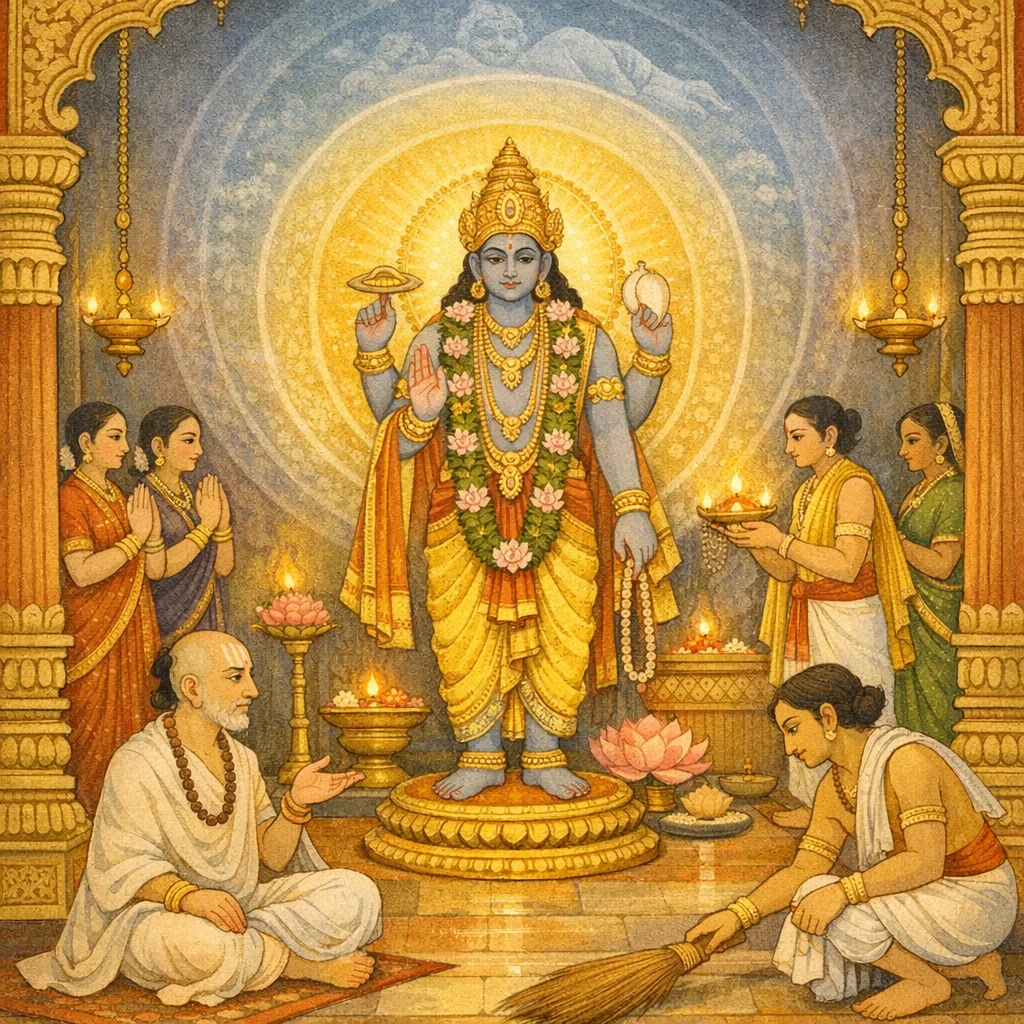
The Characteristics of Devotion to Hari
Nārada asks Sanaka how the Lord is pleased even after the limbs of yoga have been taught. Sanaka replies that liberation comes from whole-hearted worship of Nārāyaṇa: devotees are guarded from enmity and misfortune, and the senses become “fruitful” when used for Viṣṇu’s darśana, pūjā, and nāma-japa. He repeatedly proclaims the supremacy of Guru and Keśava, insisting that in the insubstantial saṃsāra, Hari-upāsanā alone is the stable reality. The chapter weaves ethical foundations (ahiṃsā, satya, asteya, brahmacarya, aparigraha), humility, compassion, satsanga, and constant name-repetition with a Vedāntic reflection on waking–dream–deep sleep, pointing to the Lord as the inner ruler beyond limiting conditions. Urging haste because life is brief, it condemns pride, envy, anger, and desire; praises service in Viṣṇu’s temple (even cleaning); affirms bhakti’s superiority beyond social status; and concludes that remembrance, worship, and surrender to Janārdana cut saṃsāra’s bonds and lead to the supreme abode.
Shlokas
Verse 1
नारद उवाच । समाख्यातानि सर्वाणि योगाङ्गानि महामुने । इदानीमपि सर्वज्ञ यत्पृच्छामि तदुच्यताम् 1. ॥ १ ॥
Nārada said: “O great sage, all the limbs of Yoga have been explained. Now also, O all-knowing one, please tell me what I ask.”
Verse 2
योगो भक्तिमतामेव सिध्यतीति त्वयोदितम् । यस्य तुष्यति सर्वेशस्तस्य भक्तिश्च शाश्वतम् ॥ २ ॥
You have declared that yoga succeeds only for the devoted. For the one with whom the Lord of all is pleased, that person’s devotion becomes everlasting.
Verse 3
यथा तुष्यति सर्वेशो देवदेवो जनार्दनः । तन्ममाख्याहि सर्वज्ञ मुने कारुण्यवारिधे ॥ ३ ॥
Tell me, O all-knowing sage—an ocean of compassion—by what means Janārdana, the Lord of all and God of gods, becomes pleased.
Verse 4
सनक उवाच । नारायणं परं देवं सच्चिदानन्दविग्रहम् । भज सर्वात्मना विप्र यदि मुक्तिमभीप्ससि ॥ ४ ॥
Sanaka said: “O brāhmaṇa, worship Nārāyaṇa—the supreme Lord, whose very form is existence, consciousness, and bliss—with your whole being, if you desire liberation.”
Verse 5
रिपवस्तं न हिंसन्ति न बाधन्ते ग्रहाश्च तम् । राक्षसाश्च न चेक्षन्ते नरं विष्णुपरायणम् ॥ ५ ॥
Enemies do not harm him, nor do the planets afflict him; and even rākṣasas do not so much as look upon that man who is wholly devoted to Viṣṇu.
Verse 6
भक्तिर्दृढा भवेद्यस्य देवदेवे जनार्दने । श्रैयांसि तस्य सिध्यन्ति भक्तिमन्तोऽधिकास्ततः ॥ ६ ॥
For one whose bhakti becomes steadfast toward Janārdana, the God of gods, all higher blessings and auspicious attainments come to fulfillment; for devotees indeed are superior to all others.
Verse 7
पादौ तौ सफलौ पुंसां यौ विष्णुगृहगामिनौ । तौ करौ सफलौ ज्ञेयौ विष्णुपूजापरौ तु यौ ॥ ७ ॥
Truly fruitful are those two feet of a person that go to the house (temple) of Viṣṇu; and truly fruitful are those two hands—know them to be so—that are devoted to the worship of Viṣṇu.
Verse 8
ते नेत्रे सुफले पुंसां पश्यतो ये जनार्दनम् । सा जिह्वा प्रोच्यते सद्भिर्हरिनामपरा तु या ॥ ८ ॥
Truly fruitful are those eyes of a person which behold Janārdana. And that tongue is declared by the righteous to be the true tongue—one that is devoted to the Name of Hari.
Verse 9
सत्यं सत्यं पुनः सत्यमुद्धृत्य भुजमुच्यते । तत्त्वं गुरुसमं नास्ति न देवः केशवात्परः ॥ ९ ॥
Truth—truth—again, truth: raising my arm, I declare it aloud. There is no principle higher than the Guru, and there is no God higher than Keśava (Viṣṇu).
Verse 10
सत्यं वच्मि हितं वच्मि सारं वच्मि पुनःपुनः । असारेऽस्मिस्तु संसारे सत्यं हरिसमर्चनम् ॥ १० ॥
I speak the truth; I speak what is beneficial; I declare the essential point again and again: in this insubstantial world of transmigration, the true reality is the worship of Hari.
Verse 11
संसारपाशं सुदृढं महामोहप्रदायकम् । हरिभक्तिकुठारेण च्छित्त्वात्यन्तसुखी भव ॥ ११ ॥
Cut through the tightly bound noose of saṃsāra—source of great delusion—with the axe of devotion to Hari; then become supremely happy.
Verse 12
तन्मनः संयुतं विष्णौ सा वाणी यत्परायणा । ते श्रोत्रे तत्कथासारपूरिते लोकवन्दिते ॥ १२ ॥
Blessed is the mind yoked to Vishnu; blessed is the speech wholly devoted to Him. Blessed are those ears—praised by the world—filled with the essence of His sacred narratives.
Verse 13
आनन्दमक्षरं शून्यमवस्थात्रितयैरपि । आकाशमध्यगं देवं भज नारद सन्ततम् ॥ १३ ॥
Worship continually, O Nārada, that Deity who is bliss itself—imperishable, void of limiting attributes, untouched even by the three states (waking, dream, and deep sleep), and abiding in the midst of space as the all-pervading Reality.
Verse 14
स्थानं न शक्यते यस्य स्वरूपं वा कदाचन । निर्देष्टुं मुनिशार्दूल द्र ष्टुं वाप्यकृतात्मभिः ॥ १४ ॥
O tiger among sages, His abode—or even His true form—can never be precisely pointed out; nor can He be seen by those whose inner self is not yet purified and perfected.
Verse 15
समस्तैः करणैर्युक्तो वर्त्ततेऽसौ यदा तदा । जाग्रदित्युच्यते सद्भिरन्तर्यामी सनातनः ॥ १५ ॥
When the Eternal Inner Ruler (antaryāmin) operates while endowed with all the faculties of perception and action, the wise call that condition the waking state (jāgrat).
Verse 16
यदान्तःकरणैर्युक्तः स्वेच्छया विचरत्यसौ । स्वपन्नित्युच्यते ह्यात्मा यदा स्वापविवर्जितः ॥ १६ ॥
When the Self, joined to the inner instruments—mind, intellect, ego, and memory—moves according to its own will, it is indeed called “the ever-dreaming one”; but when it is free from sleep, it is the Self beyond sleep.
Verse 17
न बाह्यकरणैर्युक्तो न चान्तः करणैस्तथा । अस्वरूपो यदात्मासौ पुण्यापुण्यविवर्जितः ॥ १७ ॥
That Self is not connected with the external organs, nor likewise with the inner instrument (mind). When the Self is not confined to any particular form, it remains free from both merit and demerit.
Verse 18
सर्वोपाधिविनिर्मुक्तो ह्यानन्दो निर्गुणो विभुः । परब्रह्ममयो देवः सुषुप्त इति गीयते ॥ १८ ॥
Freed from all limiting adjuncts, He is bliss itself—attributeless and all-pervading. That divine Reality, constituted of the Supreme Brahman, is spoken of as the ‘suṣupti’ (deep-sleep) state.
Verse 19
भावनामयमेतद्वै जगत्स्थावरजङ्गमम् । विद्युद्विलोलं विप्रेन्द्र भज तस्माज्जनार्दनम् ॥ १९ ॥
This whole world—of moving and unmoving beings—is indeed fashioned by mental formations. Unsteady like a flash of lightning, O best of brāhmaṇas, therefore worship Janārdana.
Verse 20
अहिंसा सत्यमस्तेयं ब्रह्मचर्यापरिग्रहौ । वर्तन्ते यस्य तस्यैव तुष्यते जगतां पतिः ॥ २० ॥
For the one in whom non-violence, truthfulness, non-stealing, chastity, and non-possessiveness are firmly established—upon that person alone the Lord of the worlds is pleased.
Verse 21
सर्वभूतदयायुक्तो विप्रपूजा परायणः । तस्य तुष्टो जगन्नाथो मधुकैटभमर्दनः ॥ २१ ॥
Endowed with compassion for all beings and devoted to worship and honor of the Brahmanas, such a person pleases Jagannātha—the Lord of the universe, the slayer of Madhu and Kaiṭabha.
Verse 22
सत्कथायां च रमते सत्कथां च करोति यः । सत्सङ्गो निरहङ्कारस्तस्य प्रीतो रमापतिः ॥ २२ ॥
He who delights in sacred discourse and also causes sacred discourse to be spoken—who keeps holy company and is free from ego—upon him Ramāpati (Viṣṇu, the Lord of Lakṣmī) is pleased.
Verse 23
नामसङ्कीर्त्तनं विष्णोः क्षुत्तृट्प्रस्खलितादिषु । करोति सततं यस्तु तस्य प्रीतो ह्यधोक्षजः ॥ २३ ॥
Even amid hunger, thirst, stumbling, and other such moments, the one who continually chants the names of Viṣṇu—upon that person Adhokṣaja (the Lord beyond the senses) becomes pleased.
Verse 24
या तु नारी पतिप्राणा पतिपूजापरायणा । तस्यास्तुष्टो जगन्नाथो ददाति स्वपदं मुने ॥ २४ ॥
But that woman whose very life is her husband, and who is wholly devoted to the worship and service of her husband—being pleased with her, the Lord of the universe grants her His own supreme abode, O sage.
Verse 25
असूयारहिता ये तु ह्यहङ्कारविवर्जिताः । देवपूजापराश्चैव तेषां तुष्यति केशवः ॥ २५ ॥
But those who are free from envy and devoid of ego, and who are devoted to the worship of the Devas—Keśava becomes pleased with them.
Verse 26
तस्माच्छृणुष्व देवर्षे भजस्व सततं हरिम् । मा कुरुष्व ह्यहङ्कारं विद्युल्लोलश्रिया वृथा ॥ २६ ॥
Therefore, O divine sage, listen well and worship Hari constantly. Do not indulge in ego, for worldly prosperity is fickle—wavering like lightning—and striving for it in vanity is futile.
Verse 27
शरीरं मृत्युसंयुक्तं जीवनं चाति चञ्चलम् । राजादिभिर्धनं बाध्यं सम्पदः क्षणभङ्गुराः ॥ २७ ॥
The body is bound up with death, and life is exceedingly unsteady. Wealth is vulnerable to seizure by kings and the like, and all prosperities are shattered in a moment.
Verse 28
किं न पश्यसि देवर्षे ह्यायुषार्द्धं तु निद्र या । हतं च भोजनाद्यैश्च कियदायुः समाहृतम् ॥ २८ ॥
Do you not see, O divine seer, that fully half of one’s lifespan is destroyed by sleep? And by eating and other indulgences as well—how little life, then, is actually gathered for higher purpose!
Verse 29
कियदायुर्बालभावाद् वृद्धभावात्कियद् बृथा । कियद्विषयभोगैश्च कदा धर्मान्करिष्यति ॥ २९ ॥
How much of one’s lifespan is lost in childhood, how much in old age, and how much is wasted in vain? And how much is spent in the enjoyment of sense-objects—then when will one ever practice dharma?
Verse 30
बालभावे च वार्द्धक्ये न घटेताच्युतार्चनम् । वयस्येव ततो धर्मान्कुरु त्वमनहङ्कृतः ॥ ३० ॥
In childhood and in old age, the worship of Acyuta (Vishnu) does not properly take place with full capacity. Therefore, while you are in youth, perform your religious duties—free from ego.
Verse 31
मा विनाशं व्रज मुने मग्नः संसारगह्वरे । वपुर्विनाशनिलयमापदां परमं पदम् ॥ ३१ ॥
O sage, do not go to ruin, though you are sunk in the deep ravine of saṃsāra. This body is an abode of decay and the supreme seat of calamities.
Verse 32
शरीरं भोगनिलयं मलाद्यैः परिदूषितम् । किमर्थं शाश्वतधिया कुर्यात्पापं नरो वृथा ॥ ३२ ॥
This body is a dwelling of enjoyments, thoroughly tainted by filth and the like. Why should a man, endowed with understanding of the Eternal, commit sin in vain?
Verse 33
असारभूते संसारे नानादुःखसमन्विते । विश्वासो नात्र कर्त्तव्यो निश्चितं मृत्युसङ्कुले ॥ ३३ ॥
In this insubstantial saṃsāra, filled with many kinds of sorrow, place no trust at all—for it is certainly crowded with death.
Verse 34
तस्माच्छृणुष्व विप्रेन्द्र सत्यमेतद् ब्रवीम्यहम् । देहयोगनिवृत्यर्थं सद्य एव जनार्दनम् ॥ ३४ ॥
Therefore, O best of brāhmaṇas, listen: I speak this truth—if you seek immediate cessation of bondage to the body, take refuge in Janārdana at once.
Verse 35
मानं त्यक्त्वा तथा लोभं कामक्रोधविवर्जितः । भजस्व सततं विष्णुं मानुष्यमतिदुर्लभम् ॥ ३५ ॥
Abandon pride and greed, and be free from lust and anger. Worship Viṣṇu constantly, for human birth is exceedingly difficult to obtain.
Verse 36
कोटिजन्मसहस्रेषु स्थावरादिषु सत्तम । सम्भ्रान्तस्य तु मानुष्यं कथञ्चित्परिलभ्यते ॥ ३६ ॥
O best of the virtuous, after thousands of births—indeed, across millions—among immovable beings and other forms of life, human birth is attained only with great difficulty, and only by one whose spirit has been stirred and awakened in dharma.
Verse 37
तत्रापि देवताबुद्धिर्दानबुद्धिश्च सत्तम । भोगबुद्धिस्तथा नॄणां जन्मान्तरतपः फलम् ॥ ३७ ॥
Even then, O best of the virtuous, one’s inclination to honor the deities, the impulse toward charity (dāna), and likewise the tendency among men to seek enjoyment—these are the fruits of austerities (tapas) performed in former births.
Verse 38
मानुष्यं दुर्लभं प्राप्य यो हरिं नार्चयेत्सकृत् । मूर्खः कोऽस्ति परस्तस्माज्जडबुद्धिरचेतनः ॥ ३८ ॥
Having attained the rare human state, whoever does not worship Hari even once—who could be more foolish than that person, dull-minded and devoid of discernment?
Verse 39
दुर्लभं प्राप्य मानुष्यं नार्चयन्ति च ये हरिम् । तेषामतीव मूर्खाणां विवेकः कुत्र तिष्ठति ॥ ३९ ॥
Having attained the rare human birth, those who still do not worship Hari—where, indeed, does discernment reside in such exceedingly foolish people?
Verse 40
आराधितो जगन्नाथो ददात्यभिमतं फलम् । कस्तं न पूजयेद्विप्र संसाराग्निप्रदीपितः ॥ ४० ॥
When worshipped, Jagannātha, the Lord of the universe, grants the desired fruit. O brāhmaṇa, who—burned by the fire of saṃsāra—would not worship Him?
Verse 41
चण्डालोऽपि मुनिश्रेष्ठ विष्णुभक्तो द्विजाधिकः । विष्णुभक्तिविहीनश्च द्विजोऽपि श्वपचाधमः ॥ ४१ ॥
O best of sages, even a caṇḍāla—if devoted to Viṣṇu—is superior to a twice-born; but a twice-born who lacks devotion to Viṣṇu is truly the lowest, like a dog-cooker.
Verse 42
तस्मात्कामादिकं त्यक्त्वा भजेत हरिमव्ययम् । यस्मिंस्तुष्टेऽखिलं तुष्येद्यतः सर्वगतो हरिः ॥ ४२ ॥
Therefore, abandoning desire and its attendant faults, one should worship Hari, the Imperishable; for when He is pleased, all is pleased, since Hari pervades all.
Verse 43
यथा हस्तिपदे सर्वं पदमात्रं प्रलीयते । तथा चराचरं विश्वं विष्णावेव प्रलीयते ॥ ४३ ॥
Just as all other footprints are encompassed within the footprint of an elephant, so too the entire universe—moving and unmoving—ultimately dissolves into Viṣṇu alone.
Verse 44
आकाशेन यथा व्याप्तं जगत्स्थावरजङ्गमम् । तथैव हरिणा व्याप्तं विश्वमेतच्चराचरम् ॥ ४४ ॥
Just as space pervades the entire world of the immobile and the mobile, so too is this whole universe—moving and unmoving—pervaded by Hari.
Verse 45
जन्मनो मरणं नॄणां जन्म वै मृत्युसाधनम् । उभे ते निकटे विद्धि तन्नाशो हरिसेवया ॥ ४५ ॥
For human beings, death follows upon birth, and birth itself is indeed the cause that leads to death. Know that these two stand very close together; their destruction is achieved through service to Hari (Viṣṇu).
Verse 46
ध्यातः स्मृतः पूजितो वा प्रणतो वा जनार्दनः । संसारपाशविच्छेदी कस्तं न प्रतिपूजयेत् ॥ ४६ ॥
Whether contemplated, remembered, worshiped, or bowed to—Janārdana severs the bonds of saṃsāra; who, then, would not worship Him in return?
Verse 47
यन्नामोच्चारणादेव महापातकनाशनम् । यं समभ्यर्च्य विप्रर्षे मोक्षभागी भवेन्नरः ॥ ४७ ॥
O best of brāhmaṇa-sages, merely by uttering His Name the gravest sins are destroyed; and by worshiping Him a person becomes a sharer in liberation.
Verse 48
अहो चित्रमहो चित्रमहो चित्रमिदं द्विज । हरिनाम्नि स्थिते लोकः संसारे परिवर्त्तते ॥ ४८ ॥
How astonishing—how truly astonishing, O twice-born! When the Name of Hari is present, the world itself is transformed within the whirl of saṃsāra.
Verse 49
भूयो भूयोऽपि वक्ष्यामि सत्यमेतत्तपोधन । नीयमानो यमभटैरशक्तो धर्मसाधनैः ॥ ४९ ॥
Again and again I will proclaim this—this is the truth, O treasure of austerity: when a man is being dragged away by Yama’s attendants, he is powerless to undertake the means of dharma.
Verse 50
यावन्नेन्द्रि यवैकल्यं यावद्व्याधिर्न बाधते । तावदेवार्चयेद्विष्णुं यदि मुक्तिमभीप्सति ॥ ५० ॥
So long as one’s senses have not grown impaired and so long as illness does not afflict one, one should worship Viṣṇu without delay—if one truly longs for liberation.
Verse 51
मातुर्गर्भाद्विनिष्क्रान्तो यदा जन्तुस्तदैव हि । मृत्युः संनिहितो भूयात्तस्माद्धर्मपरो भवेत् ॥ ५१ ॥
From the very moment a being emerges from the mother’s womb, death stands close at hand; therefore one should become devoted to Dharma.
Verse 52
अहो कष्टमहो कष्टमहोकष्टमिदं वपुः । विनश्वरं समाज्ञाय धर्मं नैवाचरत्ययम् ॥ ५२ ॥
Alas—how pitiable, how pitiable is this body! Even after clearly knowing it to be perishable, a person still does not practice dharma.
Verse 53
सत्यं सत्यं पुनःसत्यमुद्धृत्य भुजमुच्यते । दम्भाचारं परित्यज्य वासुदेवं समर्चयेत् ॥ ५३ ॥
Truth—truth—again, truth: raising his arm, one proclaims this. Abandoning hypocritical conduct, one should worship Vāsudeva with full reverence.
Verse 54
भूयो भूयो हितं वच्मि भुजमुद्धृत्य नारद । विष्णुः सर्वात्मना पूज्यस्त्याज्यासूया तथानृतम् ॥ ५४ ॥
Again and again I speak what is truly beneficial—raising my arm (in emphasis), O Nārada: Viṣṇu should be worshipped with one’s whole being; and jealousy and untruth should be abandoned.
Verse 55
क्रोधमूलो मनस्तापः क्रोधः संसारबन्धनम् । धर्मक्षयकरः क्रोधस्तस्मात्तं परिवर्जयेत् ॥ ५५ ॥
Mental torment has anger as its root; anger itself is a bondage to saṃsāra. Anger destroys dharma—therefore one should completely abandon it.
Verse 56
काममूलमिदं जन्म कामः पापस्य कारणम् । यशःक्षयकरः कामस्तस्मात्तं परिवर्जयेत् ॥ ५६ ॥
This embodied birth is rooted in desire. Desire is the cause of sin and the ruin of good fame; therefore one should abandon it.
Verse 57
समस्तदुःखजालानां मात्सर्यं कारणं स्मृतम् । नरकाणां साधनं च तस्मात्तदपि सन्त्यजेत् ॥ ५७ ॥
Envy (mātsarya) is said to be the cause of the entire web of sorrows, and a means that leads to the hells; therefore one should abandon it completely.
Verse 58
मन एव मनुष्याणां कारणं बन्धमोक्षयोः । तस्मात्तदभिसंयोज्य परात्मनि सुखी भवेत् ॥ ५८ ॥
The mind alone is the cause of human bondage and liberation. Therefore, by yoking that mind in union with the Supreme Self (Paramātman), one becomes happy.
Verse 59
अहो धैर्यमहो धैर्यमहो धैर्यमहो नृणाम् । विष्णौ स्थिते जगन्नाथे न भजन्ति मदोद्धताः ॥ ५९ ॥
Oh, what astonishing audacity—what audacity—what audacity of human beings! Even while Viṣṇu, Jagannātha, the Lord of the universe, is present, those intoxicated by pride do not worship Him.
Verse 60
अनाराध्य जगन्नाथं सर्वधातारमच्युतम् । संसारसागरे मग्नाः कथं पारं प्रयान्ति हि ॥ ६० ॥
Without worshipping Jagannātha—Acyuta the infallible, the sustainer of all—how can those sunk in the ocean of saṁsāra ever reach the far shore?
Verse 61
अच्युतानन्तगोविन्दनामोच्चारणभेषजात् । नश्यन्ति सकला रोगाः सत्यं सत्यं वदाम्यहम् ॥ ६१ ॥
By the medicine of uttering the Names Acyuta, Ananta, and Govinda, all diseases are destroyed. This is truth—truth indeed—I declare.
Verse 62
नारायण जगन्नाथ वासुदेव जनार्दन । इतीरयन्ति ये नित्यं ते वै सर्वत्र वन्दिताः ॥ ६२ ॥
Those who daily and constantly utter the names “Nārāyaṇa, Jagannātha, Vāsudeva, Janārdana” are indeed honored everywhere.
Verse 63
अद्यापि च मुनिश्रेष्ठ ब्रह्माद्या अपि देवताः । यत्प्रभावं न जानन्ति तं याहि शरणं मुने ॥ ६३ ॥
Even today, O best of sages, even the gods beginning with Brahmā do not fully know His power. Therefore, O sage, go and take refuge in Him.
Verse 64
अहो मौर्ख्यमहो मौर्ख्यमहो मौर्ख्यं दुरात्मनाम् । हृत्पद्मसंस्थितं विष्णुं न विजानन्ति नारद ॥ ६४ ॥
Alas—what folly, what folly, what utter folly of the wicked-minded! Though Vishnu abides within the lotus of the heart, they do not recognize Him, O Narada.
Verse 65
शृणुष्व मुनिशार्दूल भूयो भूयो वदाम्यहम् । हरिः श्रद्धावतां तुष्येन्न धनैर्न च बान्धवैः ॥ ६५ ॥
Listen, O tiger among sages; I tell you again and again: Hari is pleased with those who possess faith—not by wealth, nor by (mere) relatives and connections.
Verse 66
बन्धुमत्वं धनाढ्यत्वं पुत्रवत्त्वं च सत्तम । विष्णुभक्तिमतां नॄणां भवेज्जन्मनि जन्मनि ॥ ६६ ॥
O best of the virtuous, for men devoted in bhakti to Vishnu there arise—birth after birth—abundance of kin, great wealth, and the blessing of children.
Verse 67
पापमूलमयं देहः पापकर्मरतस्तथा । एतद्विदित्वा सततं पूजनीयो जनार्दनः ॥ ६७ ॥
The body is rooted in sin, and one is likewise inclined toward sinful deeds. Knowing this, Janārdana should be worshipped continually.
Verse 68
पुत्रमित्रकलत्राद्या बहवः स्युश्च संपदः । हरिपूजारतानां तु भवन्त्येव न संशयः ॥ ६८ ॥
Sons, friends, spouses, and many kinds of prosperity may arise; yet for those devoted to the worship of Hari, these surely come—there is no doubt.
Verse 69
इहामुत्र सुखप्रेप्सुः पूजयेत्सततं हरिम् । इहामुत्रासुखप्रेप्सुः परनिन्दापरो भवेत् ॥ ६९ ॥
One who seeks happiness in this world and the next should constantly worship Hari. But one who seeks suffering here and hereafter becomes devoted to censuring others.
Verse 70
धिग्जन्म भक्तिहीनानां देवदेवे जनार्दने । सत्पात्रदानशून्यं यत्तद्धनं धिक्पुनः पुनः ॥ ७० ॥
Cursed is the birth of those devoid of bhakti to Janārdana, the God of gods. And cursed again and again is that wealth which is not used in gifts to worthy recipients.
Verse 71
न नमेद्विष्णवे यस्य शरीरं कर्मभेदिने । पापानामाकरं तद्वै विज्ञेयं मुनिसत्तम ॥ ७१ ॥
He who does not bow to Viṣṇu—who apportions beings according to their karmas—should indeed be known, O best of sages, as a very mine, a source of sins.
Verse 72
सत्पात्रदानरहितं यद्द्र व्यं येन रक्षितम् । चौर्येण रक्षितमिव विद्धि लोकेषु निश्चितम् ॥ ७२ ॥
Know for certain among the worlds: wealth that is guarded yet not given in charity to a worthy recipient (satpātra) is as though it were guarded through theft.
Verse 73
तडिल्लोलश्रिया मत्ताः क्षणभङ्गुरशालिनः । नाराधयन्ति विश्वेशं पशुपाशविमोचकम् ॥ ७३ ॥
Intoxicated by prosperity that flickers like lightning, and bearing wealth that perishes in a moment, they do not worship the Lord of the universe—the Liberator who frees beings from the bonds of worldly attachment.
Verse 74
सृष्टिस्तु विविधा प्रोक्ता देवासुरविभेदतः । हरिभक्तियुता दैवी तद्धीना ह्यासुरी महा ॥ ७४ ॥
Creation is said to be of various kinds, distinguished as divine and demonic. That which is endowed with devotion (bhakti) to Hari is divine; that which is devoid of it is greatly demonic.
Verse 75
तस्माच्छृणुष्व विप्रेन्द्र हरिभक्तिपरायणाः । श्रेष्ठाः सर्वत्र विख्याता यतो भक्तिः सुदुर्लभा ॥ ७५ ॥
Therefore, O best of Brahmins, listen: those wholly devoted to bhakti to Hari are the foremost and are renowned everywhere, because true devotion is exceedingly difficult to attain.
Verse 76
असूयारहिता ये च विप्रत्राणपरायणाः । कामादिरहिता ये च तेषां तुष्यति केशवः ॥ ७६ ॥
Those who are free from envy, devoted to the protection of the brāhmaṇas, and free from desire and other passions—Keśava is pleased with them.
Verse 77
सम्मार्जनादिना ये तु विष्णुशुश्रूषणे रताः । सत्पात्रदाननिरताः प्रयान्ति परमं पदम् ॥ ७७ ॥
But those who delight in serving Lord Viṣṇu through acts such as sweeping and cleaning, and who are devoted to giving gifts to worthy recipients, attain the supreme abode.
Verse 78
इति श्रीबृहन्नारदीयपुराणे पूर्वभागे प्रथमपादे हरिभक्ति लक्षणं नामचतुस्त्रिंशोऽध्यायः ॥ ३४ ॥
Thus ends the thirty-fourth chapter, entitled “The Characteristics of Devotion to Hari,” in the First Pāda of the Pūrva-bhāga of the Śrī Bṛhan-Nāradīya Purāṇa.
Frequently Asked Questions
The chapter treats the Name of Hari as immediately efficacious in saṃsāra: utterance destroys grave sins, sustains devotion even amid bodily hardship, and functions as a ‘medicine’ (Acyuta–Ananta–Govinda) that removes inner and outer afflictions, thereby preparing the mind for liberation.
They are presented as stabilizing prerequisites that make the person a fit vessel for bhakti: when these restraints are firmly established, the Lord is said to be pleased, indicating ethical purity as supportive groundwork rather than a separate final goal.
It provides a Vedāntic frame for devotion by identifying the Lord/Self as the inner ruler beyond the changing states and adjuncts; this elevates worship from merely external ritual to recognition of Hari as the all-pervading Reality, strengthening surrender and non-attachment.
Yes. It explicitly praises acts like sweeping and cleaning done in service to Viṣṇu, presenting such seva—along with charity to worthy recipients—as a direct path to the supreme abode when performed with devotion.