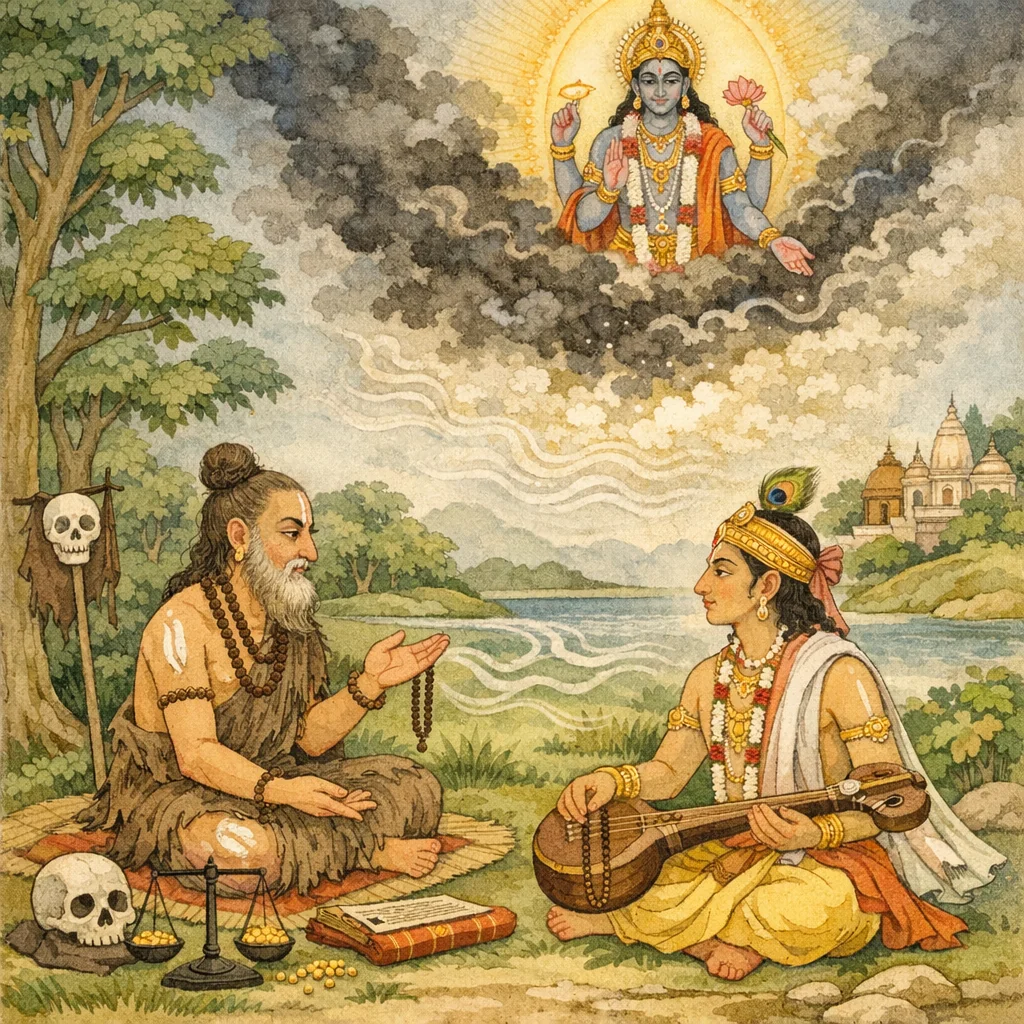
Prāyaścitta for Mahāpātakas and the Sin-destroying Power of Viṣṇu-smaraṇa
Sanaka teaches Nārada that prāyaścitta is the indispensable completion of all rites: deeds without atonement bear no fruit, and true purity comes only by turning oneself toward Nārāyaṇa. The chapter defines the four mahāpātakas—brahmahatyā, surā-pāna, suvarṇa-steya, and guru-talpa-gamana—adds association with such offenders as a fifth, and grades “fall” by the length of cohabitation. It then prescribes expiations for killing (of a Brāhmaṇa and others), including skull-bearing ascetic discipline, residence at tīrthas, alms, sandhyā observance, and multi-year vows, along with norms for royal punishment and mitigations for women, children, and the sick. A major portion regulates surā—its kinds, vessels, medicinal exceptions—and re-initiation through Cāndrāyaṇa. Theft expiation is set out technically by gold/silver valuation and micro-measures (from trasareṇu to suvarṇa), with thresholds of prāṇāyāma and Gāyatrī-japa. Further sections address illicit sex, animal-killing, impure contacts, and food and speech taboos. The close turns to mokṣa-dharma: bhakti to Hari, and even a single remembrance of Viṣṇu destroys heaps of sin and fulfills dharma-artha-kāma-mokṣa.
Shlokas
Verse 1
सनक उवाच । प्रायश्चित्तविधिं वक्ष्ये श्रृणु नारद सांप्रतम् । प्रायश्चित्तविशुद्धात्मा सर्वकर्मफलं लभेत् ॥ १ ॥
Sanaka said: Now listen, O Nārada—I shall explain the method of prāyaścitta (expiation). One whose inner self is purified through prāyaścitta attains the fruits of all actions.
Verse 2
प्रायश्चित्तविहीनैस्तु यत्कर्म क्रियते मुने । तत्सर्वं निष्फलं प्रोक्तं राक्षसैः परिसेवितम् ॥ २ ॥
O sage, any rite or action performed without the prescribed prāyaścitta is declared entirely fruitless; it is said to be something frequented by rākṣasas (demonic influences).
Verse 3
कामक्रोधविहीनैश्च धर्मशास्त्रविशारदैः । प्रष्टव्या ब्राह्मणा धर्मं सर्वधर्मफलेच्छुभिः ॥ ३ ॥
Those who are free from desire and anger, and who are well-versed in the scriptures of Dharma—such Brahmanas should be approached and questioned about Dharma by anyone who seeks the fruits of all righteous duties.
Verse 4
प्रायश्चित्तानि चीर्णानि नारायणपराङ्मुखैः । न निष्पुनंति विप्रेंद्र सुराभांडमिवापगाः ॥ ४ ॥
O best of Brāhmaṇas, expiations performed by those who have turned away from Nārāyaṇa do not purify them—just as a river cannot cleanse a vessel filled with liquor.
Verse 5
ब्रह्महा च सुरापी च स्तेयी च गुरुतल्पगः । महापातकिननस्त्वेते तत्संसर्गी च पंचमः ॥ ५ ॥
A slayer of a Brāhmaṇa, a drinker of intoxicating liquor, a thief, and one who violates the teacher’s bed—these are declared to be great sinners (mahāpātakins); and as the fifth is counted the person who associates with them.
Verse 6
यस्तु संवत्सरं ह्यतैः शयनासनभोजनैः । संवसेत्सह तं विद्यात्पतितं सर्वकर्मसु ॥ ६ ॥
But whoever, for a full year, lives together with such a person—sharing bed, seat, and food—know him to be fallen (patita) with regard to all religious rites and duties.
Verse 7
अज्ञानाद्वाह्मणं हत्वा चीरवासा जटी भवेत् । स्वेनैव हतविप्रस्य कपालमपि धारयेत् ॥ ७ ॥
If, through ignorance, one has killed a Brāhmaṇa, one should wear garments of bark and keep matted hair; and one should even carry the skull of that very Brāhmaṇa who was slain by oneself.
Verse 8
तदभावे मुनिश्रष्ट कपालं वान्यमेव वा । तद्द्रव्यं ध्वजदंडे तु धृत्वा वनचरो भवेत् ॥ ८ ॥
O best of sages, if that is not available, one may take a skull-bowl—or else any other suitable vessel; placing that requisite substance on a banner-staff, one should live as a forest-dweller (wandering ascetic).
Verse 9
वन्याहारो वसेतत्र वारमेकं मिताशनः । सम्यक्संध्यामुपासीत त्रिकालं स्नानमाचरेत् ॥ ९ ॥
Dwelling there for a time, let him live on forest fare and eat in moderation. Let him duly perform the Sandhyā worship and observe bathing three times each day.
Verse 10
अध्ययनाध्यापनादून्वर्जयेत्संस्मरेद्धरिम् । ब्रह्मचारी भवेन्नित्यं गंधमाल्यादि वर्जयेत् ॥ १० ॥
Let him avoid whatever diminishes study and teaching, and let him constantly remember Hari. Let him ever live as a brahmacārin, refraining from perfumes, garlands, and like sensual adornments.
Verse 11
तीर्थान्यनुवसेच्चैव पुण्याश्चावाश्रमांस्तथा । यदि वन्यैर्न जीवेत ग्रामे भिक्षां समाचरेत् ॥ ११ ॥
Let him dwell in sacred tīrthas and likewise in holy āśramas. If he cannot live on forest produce, then let him go to a village and properly sustain himself by alms (bhikṣā).
Verse 12
द्वादशाब्दं व्रतं कुर्यादेवं हरिपरायणः । ब्रह्महा शुद्धिमाप्नोति कर्मार्हश्चैव जायते ॥ १२ ॥
Thus, one devoted solely to Hari should undertake this vow for twelve years; by it even a slayer of a brāhmaṇa attains purification and becomes fit once more to perform Vedic rites.
Verse 13
व्रतमध्ये मृगैर्वापि रोगैर्वापि निषूदितः । गोनिमित्तं द्विजार्थं वा प्राणान्वापि परित्यजेत् ॥ १३ ॥
If, in the midst of observing the vow, one is slain by wild beasts or overcome by disease, or even relinquishes life for the sake of a cow or for the welfare of a brāhmaṇa—such a death is upheld as righteous, in accord with dharma.
Verse 14
यद्वा दद्याद्द्विजेंद्राणां गवामयुतमुत्तसम् । एतेष्वन्यतमं कृत्वा ब्रह्महा शुद्धिमान्पुयात् ॥ १४ ॥
Or else, one may bestow upon the foremost among the twice-born a supreme gift—ten thousand excellent cows. Having performed any one of these expiations, even a slayer of a brāhmaṇa becomes purified.
Verse 15
दीक्षितं क्षत्रियं हत्वा चरेद्धि ब्रह्महव्रतम् । अग्निप्रवेशनं वापि मरुत्प्रपतनं तथा ॥ १५ ॥
Having slain a consecrated Kṣatriya, one should indeed undertake the expiatory vow prescribed for brahmahatyā (brahma-slaying). Alternatively, one may enter into fire, or fall from a height, as acts of atonement.
Verse 16
दीक्षीतं ब्राह्मणं हत्वा द्विगुणं व्रतमाचरेत् । आचार्यादिवधे चैव व्रतमुक्तं चतुर्गुणम् ॥ १६ ॥
Having killed an initiated Brāhmaṇa, one should perform the prescribed expiatory vow in double measure. And in the case of killing one’s teacher (ācārya) and the like, the vow is declared to be fourfold.
Verse 17
हत्वा तु विप्रमात्रं च चरेत्संवत्सरं व्रतम् । एवं विप्रस्य गदितः प्रायश्चित्तविधिर्द्विज ॥ १७ ॥
But if one has slain only a single Brāhmaṇa, one should undertake an expiatory vow for one year. Thus, O twice-born, the procedure of atonement for the killing of a Brāhmaṇa has been stated.
Verse 18
द्विगुणं क्षत्रियस्योक्तं त्रिगुणं तु विशः स्मृतम् । ब्राह्मणं हंति यः शूद्रस्तं मुशल्यं विर्दुर्बुधाः ॥ १८ ॥
It is said that the penalty is double for a Kṣatriya, and it is remembered as triple for a Vaiśya. But the wise declare that the Śūdra who kills a brāhmaṇa is to be punished with death by the club (muśala).
Verse 19
राज्ञैव शिक्षा कर्तव्या इति शास्तेषु निश्चयः । ब्राह्मणीनां वधे त्वर्द्धं पादः स्यात्कन्यकावधे ॥ १९ ॥
The śāstras declare with certainty that punishment is to be administered by the king alone. For killing a brāhmaṇī, the penalty is reduced by half; for killing an unmarried maiden, it is reduced to a quarter.
Verse 20
हत्वा त्वनुपनीतांश्च तथा पादव्रतं चरेत् । हत्वा तु क्षत्रियं विप्रः षडब्दं कुच्छ्रमाचरेत् ॥ २० ॥
Having killed those who have not yet received the initiation (upanayana), one should undertake the pāda-vrata as expiation. But if a brāhmaṇa has killed a kṣatriya, he should perform the kṛcchra penance for six years.
Verse 21
संवत्सरं त्रयं वेश्यं शूर्द्रं हत्वा तु वत्सरम् । दीक्षितस्य स्त्रियं हत्वा ब्राह्मणी चाष्टवत्सरान् ॥ २१ ॥
For killing a Vaiśya, the prescribed penance is three years; for killing a Śūdra, one year. For killing the wife of a consecrated man (dīkṣita), the penance is eight years; likewise, for killing a Brāhmaṇī, it is eight years.
Verse 22
ब्रह्महत्याव्रतं कृत्वा शुद्धो भवति निश्चितम् । प्रायश्चित्तं विधानं तु सर्वत्र मुनिसत्तम ॥ २२ ॥
Having performed the vow prescribed for expiating brahma-hatyā (the killing of a brāhmaṇa), one certainly becomes purified. O best of sages, the proper ordinance of prāyaścitta is applicable everywhere, in all cases where it is prescribed.
Verse 23
वृद्धातुरस्त्रीबालानामर्द्धमुक्तं मनीषिभिः । गौडी पैष्टी च माध्वी च विज्ञेया त्रिविधा सुरा ॥ २३ ॥
For the aged, the sick, women, and children, the wise have prescribed only half of the usual measure. Know that surā, intoxicating liquor, is of three kinds: gauḍī made from molasses, paiṣṭī made from grain, and mādhvī made from honey.
Verse 24
चातुर्वर्ण्यारपेया स्यात्तथा स्त्रीभिश्च नारद । क्षीरं घृतं वा गोमूत्रमेतेष्वन्यतमं मुने ॥ २४ ॥
O Nārada, the libation may be performed by all four varṇas, and likewise by women. O sage, it may be done with any one of these: milk, ghee, or cow’s urine.
Verse 25
स्नात्वर्द्रवासा नियतो नारायणमनुस्मरन् । पक्वायसनिभं कृत्वा पिबेज्चैवोदकं ततः ॥ २५ ॥
After bathing, wearing a damp garment, and remaining self-controlled, one should remember Nārāyaṇa; then, having made (the preparation) resemble cooked iron, one should thereafter drink water.
Verse 26
तत्तु लौहेन पात्रेण ह्यायसेनाथवा पिबेत् । ताम्रेण वाथं पात्रेण तत्पीत्वा मरणं व्रजेत् ॥ २६ ॥
One should drink that only from a vessel of iron—or else from one made of steel. But if one drinks it from a copper vessel, having drunk it, one goes to death.
Verse 27
सुरापी शुद्धिमाप्नोति नान्यथा शुद्धिरिष्यते । अज्ञानादात्मबुद्द्या तु सुरां पीत्वा द्विजश्चरेत् ॥ २७ ॥
A drinker of surā (liquor) attains purification—there is no other purification prescribed. But if a twice-born man has drunk surā out of ignorance, mistaking it for something else, he should then observe the prescribed course of expiation.
Verse 28
ब्रह्महत्याव्रतं सम्यक्तच्चिह्नपरिवर्जितः । यदि रोगानिवृत्त्यर्थमौषधार्थं सुरां पिबेत् ॥ २८ ॥
If a person is properly observing the expiatory vow for brahma-hatyā (the sin of slaying a brāhmaṇa), and avoids all the outward marks and indulgences associated with it, yet drinks liquor only as a medicine for curing disease, then (it is treated) as being for medicinal purpose.
Verse 29
तस्योपनयनं भूयस्तथा चांद्रायणद्वयम् । सुरासंस्पृष्टपात्रं तु सुराभांडोदकं तथा ॥ २९ ॥
For him, the rite of initiation (upanayana) should be performed again, and likewise two Cāndrāyaṇa observances. The same applies to a vessel touched by liquor, and also to water contained in a liquor-jar.
Verse 30
सुरापानसमं प्राहुस्तथा चन्द्रस्य भक्षणम् । तालं च पानसं चैव द्राक्षं खार्जूरसंभवम् ॥ ३० ॥
They declare that “eating candra (a certain substance/food)” is on a par with drinking liquor; likewise, products made from tāla (palm), pānasa (jackfruit), drākṣā (grapes), and those derived from khārjūra (dates) are to be understood in the same prohibited category.
Verse 31
माधुक शैलमारिष्टं मैरेयं नालिकेरजम् । गौडी माध्वी सुरा मद्यमेवमेकादश स्मृताः ॥ ३१ ॥
Mādhuka, Śaila, Āriṣṭa, Maireya, and that prepared from coconut; likewise Gauḍī, Mādhvī, Surā, and Madya—thus these are remembered as eleven types of intoxicating drinks.
Verse 32
एतेष्वन्यतमं विप्रो न पिबेद्वै कदाचन । एतेष्वन्यतमं यस्तु पिबेदज्ञानतो द्विजः ॥ ३२ ॥
A brāhmaṇa should never drink any one of these. But if a twice-born man (dvija) drinks any one of them unknowingly, through ignorance, then the atonement is to be stated next.
Verse 33
तस्योपनयनं भूयस्तप्तकृच्छ्रं चरेत्तथा । समक्षं वा परोक्षं वा बलाच्चौयण वा तथा ॥ ३३ ॥
For him, the rite of initiation (upanayana) should be performed again, and he should also undertake the penance called taptakṛcchra—whether the act occurred openly or in secret, and even if it happened under compulsion or through theft as well.
Verse 34
परस्वानामुपादानं स्तेयमित्युच्यते बुधैः । सुवर्णस्य प्रमाणं तु मन्वाद्यैः परिभाषितम् ॥ ३४ ॥
The wise declare that taking another’s property is called theft. Yet the proper standards for measuring gold have been set forth by Manu and the other lawgivers.
Verse 35
वक्ष्ये श्रृणुष्व विप्रेंद्र प्रायश्चजितोक्तिसाधनम् । गवाक्षागतमार्तण्डरश्मिमध्ये प्रदृश्यते ॥ ३५ ॥
I shall explain—listen, O best of Brahmins—the means that confirms the teaching on prāyaścitta, sacred atonement. It is seen plainly, as sunlight is seen amid the beams that enter through a window.
Verse 36
त्रसरेणुप्रमाणं तु रज इत्युच्यते बुधैः । त्रसरेण्वष्टकं निष्कस्तत्रयं राजसर्षपः ॥ ३६ ॥
The learned declare that the amount measured by a trasareṇu is called “rajas,” a minute particle of dust. Eight trasareṇus make one niṣka, and three niṣkas constitute a rāja-sarṣapa, the measure of a “royal” mustard seed.
Verse 37
गौरसर्षपस्तर्त्रयं स्यात्तत्षट्कं यव उच्यते । यवत्रयं कृष्णलः स्यान्माषस्तत्पंचकं स्मृतः ॥ ३७ ॥
Three white mustard seeds make one unit; six such units are called a yava, the measure of a barley grain. Three yavas make a kṛṣṇala, and five kṛṣṇalas are remembered as one māṣa.
Verse 38
माषषोडषमानं स्यात्सुवर्णमिति नारद । हत्वा ब्रह्मस्वमज्ञानाद्द्वादशांब्दं तु पूर्ववत् ॥ ३८ ॥
O Nārada, a suvarṇa, the standard unit of gold, is said to equal sixteen māṣas. If, out of ignorance, one kills a person connected with Brahmin property, or brings about the destruction of Brahmin-owned property, one should undertake the same expiatory discipline as before—for twelve years.
Verse 39
कपालध्वजहीनं तु ब्रह्महत्याव्रतं चरेत् । गुरुणां यज्ञकतॄणां धार्मिष्टानां तथैव च ॥ ३९ ॥
But one should undertake the expiatory vow for brahmaṇa-slaughter without bearing the skull-banner; likewise, in matters involving one’s teachers, the performers of yajña, and other righteous persons, one should observe the fitting discipline of atonement.
Verse 40
श्रोत्रियाणां द्विजानां तु हृत्वा हेमैवमाचरेत् । कृतानुतापो देहे च संपूर्णे लेपयेद् धृतम् ॥ ४० ॥
But if one has stolen gold from learned brāhmaṇas who are masters of the Veda, then—having performed the prescribed expiation and felt sincere remorse—one should smear clarified butter (ghee) over the entire body.
Verse 41
करीषच्छादितो दग्धः स्तेयपापाद्विमुच्यते । ब्रह्मस्वं क्षत्रियो हृत्वा पश्चात्तापमवाप्य च ॥ ४१ ॥
One who is covered with cow-dung and then burned is released from the sin of theft. Likewise, a kṣatriya who has taken a brāhmaṇa’s property becomes purified after undergoing remorse (repentance).
Verse 42
पुनर्ददाति तत्रैव तद्विधानं श्रृणुष्व मे । तत्र सांतपनं कृत्वा द्वादशाहोपवासतः ॥ ४२ ॥
He should then give it back again, in that very place. Hear from me the proper procedure: there, having performed the Sāntapana expiation, one should undertake a twelve-day fast.
Verse 43
शुद्धिमाप्नोति देवर्षे ह्यन्यथा पतितो भवेत् । रत्नासनमनुष्यस्त्रीधेनुभूम्यादिकेषु च ॥ ४३ ॥
O divine sage, by following this one attains purification; otherwise one becomes fallen—especially in matters involving jeweled seats, human beings, women, cows, land, and the like.
Verse 44
सुवर्णसहृशेष्वेषु प्रायश्चितार्द्धमुच्यते । त्रसरेणुसमं हेम हृत्वा कुर्यात्समाहितः ॥ ४४ ॥
In matters involving objects comparable in value to gold, the prescribed expiation is declared to be half (of that for stealing gold). Even if one has stolen gold only equal to a “trasareṇu,” a minute speck, one should perform the ordained penance with a composed and attentive mind.
Verse 45
प्राणायामद्वयं सम्यक् तेन शुद्धच्चति मानवः । प्राणायामत्रयं कुर्याद्धृत्वा निष्कप्रमाणकम् ॥ ४५ ॥
By properly performing two rounds of prāṇāyāma, a person becomes purified. If one has stolen gold to the measure of a niṣka, one should perform three prāṇāyāmas, retaining the breath according to that measure.
Verse 46
प्राणायामाश्च चत्वारो राजसर्षपमात्रके । गौरसर्षपमानं तु हृत्वा हेम विचक्षणः ॥ ४६ ॥
The four forms of prāṇāyāma are to be measured by the unit of a royal mustard-seed; and the discerning practitioner should also take into account the measure of a white mustard-seed, O wise one.
Verse 47
स्नात्वा च विधिवज्जप्याद्गायत्र्यष्टसहस्त्रकम् । यवमात्रसुवर्णस्य स्तेयाच्छुद्धो भवेद्दिजः ॥ ४७ ॥
After bathing according to rule and then duly reciting the Gāyatrī in japa—eight thousand repetitions—a twice-born man becomes purified from the theft of gold equal in weight to a single barley-grain.
Verse 48
आसायं प्रातरारभ्य जप्त्वा वै वेदमातरम् । हेम कृष्णलमात्रं तु हृत्वा सांतपनं चरेत् ॥ ४८ ॥
Beginning in the evening and continuing from the next morning, having duly recited in japa the “Mother of the Vedas,” the Gāyatrī, if one has stolen gold to the measure of a single kṛṣṇala, one should undertake the expiatory observance called Sāṃtapana.
Verse 49
माषप्रमाणे हेम्नस्तु प्रायश्चित्तं निगद्यते । गोमूत्रपक्वयवभुग्वर्षेणैकेन शुद्ध्यति ॥ ४९ ॥
For gold taken in the measure of a māṣa, an expiation is declared: by living for one year on barley cooked in cow’s urine, one becomes purified.
Verse 50
संपूर्णस्य सुवर्णस्य स्तेयं कृत्वा मुनीश्वर । ब्रह्महत्याव्रतं कुर्याद्द्वादशाब्दं समाहितः ॥ ५० ॥
O great sage, having stolen a complete measure of gold, one should, with concentrated mind, undertake for twelve years the vow prescribed for expiation of brahmin-slaying.
Verse 51
सुवर्णमानान्न्यूने तु रजतस्तेयकर्मणि । कुर्यात्सांतपनं सम्यगन्यथा पतितो भवेत् ॥ ५१ ॥
But when the theft involves silver in an amount less than the (standard) measure for gold, one should properly perform the Sāṃtapana expiation; otherwise, one becomes fallen.
Verse 52
दशनिष्कांतपर्यंतमूर्द्धूं निष्कचतुष्टयात् । हत्वा च रजतं विद्वान्कुर्याच्चांद्रायणं मुने ॥ ५२ ॥
O sage, if a learned man steals silver—up to the value of four niṣkas, and in higher amounts up to ten niṣkas—he should perform the Cāndrāyaṇa vow as expiation.
Verse 53
दशादिशतिष्कांतं यः स्तेयी रजतस्य तु । चांद्रायणद्वयं तस्य प्रोक्तं पापविशोधकम् ॥ ५३ ॥
For one who steals silver of the measure called “daśādiśatiṣkānta,” a double Cāndrāyaṇa observance is prescribed; it is declared to be a purifier of the sin.
Verse 54
शतादूर्द्धूं सहस्त्रांतं प्रोक्तं चांद्रायणत्रयम् । सहस्त्रादधिकस्तेये ब्रह्महत्याव्रतं चरेत् ॥ ५४ ॥
For theft valued above a hundred and up to a thousand, a threefold Cāndrāyaṇa observance is prescribed. But when the theft exceeds a thousand, one should undertake the vow prescribed for expiating brahmahatyā.
Verse 55
कांस्यपित्तलमुख्येषु ह्ययस्कांते तथैव च । सहस्रनिष्कमाने तु पराकं परिकीर्तितम् ॥ ५५ ॥
In vessels made chiefly of bell-metal and brass, and likewise in those of magnetite, the measure called ‘parāka’ is declared to be one thousand niṣkas in quantity.
Verse 56
प्रायश्चित्तं तु रत्नानां स्तेये राजतवत्स्मृतम् । गुरुतल्पगतानां च प्रायश्चित्तमुदीर्यते ॥ ५६ ॥
For the theft of gems, the expiation is declared to be the same as that prescribed for stealing silver. And the expiation for those who have committed the grave offense of violating the guru’s bed is also set forth.
Verse 57
अज्ञानान्मातरं गत्वा तत्सपत्नीमथापि वा । स्वयमेव स्वमुष्कं तु च्छिंद्यात्पापमुदीरयन् ॥ ५७ ॥
If, out of ignorance, a man approaches his mother—or even his father’s other wife—then, while confessing his sin, he should himself cut off his own testicles.
Verse 58
हस्ते गृहीत्वा मुष्कं तु गच्छंद्वै नैऋतीं दिशम् । गच्छन्मार्गै सुखं दुःखं न कदाचिद्विचारयेत् ॥ ५८ ॥
Holding the (testicle/scrotum) in one’s hand, one should indeed proceed toward the south‑western direction; and while moving along the path, one should never reflect upon (or be swayed by) pleasure or pain.
Verse 59
अपश्यन्गच्छतो गच्छेत्पाणान्तं यः स शुद्ध्यति । मरुत्प्रपतनं वापि कुर्यात्पापमुदाहरन् ॥ ५९ ॥
One who, without looking, passes by another and brushes against them becomes purified. Or, declaring the sin, he should perform the 'marut-prapatana' expiation.
Verse 60
स्ववर्णोत्तमवर्णस्त्रीगमने त्वविचारतः । ब्राह्महत्याव्रतं कुर्याद्वादशाब्दं समाहितः ॥ ६० ॥
If a man of his own caste has intercourse with a woman of a higher caste without consideration, he should undertake the vow for expiating brahmin-slaughter for twelve years.
Verse 61
अमत्याभ्यासतो गच्छेत्सवर्णां चोत्तमां तथा । कारीषवह्निना दग्धः शुद्धिं याति द्विजोत्तम ॥ ६१ ॥
Through habitual association, he may approach a woman of his own or higher class. But burned in a fire of dried cow-dung, he attains purification, O best of the twice-born.
Verse 62
रेतःसेकात्पूर्वमेव निवृत्तो यदि मातरि । ब्रह्महत्याव्रतं कुर्याद्रेतः सेकेऽग्निदाहनम् ॥ ६२ ॥
If, regarding one's mother, one stops before discharging semen, he should perform the vow for brahma-hatya; if semen is discharged, he must burn himself in fire.
Verse 63
सवर्णोत्तमवर्णासु निवृत्तो वीर्यसेचनात् । ब्रह्महत्याव्रतं कुर्यान्नवाब्दान्विष्णुतत्परः ॥ ६३ ॥
Having refrained from emitting semen with women of one's own or higher caste, and being devoted to Vishnu, one should perform the brahma-hatya vow for nine years.
Verse 64
वैश्यायां पितृपत्न्यां तु षडब्दं व्रतमाचरेत् । गत्वा शूद्वां गुरोर्भार्यां त्रिवर्षं व्रतमाचरेत् ॥ ६४ ॥
If (the offence concerns) a Vaiśya woman—especially one who is the wife of one’s father—one should observe a vow of expiation for six years. If (it concerns) a Śūdra woman—particularly the wife of one’s guru—one should observe a vow for three years.
Verse 65
मातृष्वसारं च पितृष्वसारमाचार्यभार्यां श्वशुरस्य पत्नीम् । पितृव्यभार्यामथ मातुलानीं पुत्रीं च गच्छेद्यदि काममुग्धः ॥ ६५ ॥
If a man, deluded by lust, has sexual relations with his mother’s sister, his father’s sister, his teacher’s wife, his father-in-law’s wife, his paternal uncle’s wife, his maternal uncle’s wife, or even his own daughter—(he commits a grievous transgression).
Verse 66
दिनद्वये ब्रह्महत्याव्रतं कुर्याद्यथाविधि । एकस्मिन्नेव दिवसे बहुवारं त्रिवार्षिकम् ॥ ६६ ॥
He should perform the expiatory vow for brahmahatyā (the sin of slaying a brāhmaṇa) in the prescribed manner over two days; and, in a single day, he should repeat many times the rite that is otherwise to be observed for three years.
Verse 67
एकवारं गते ह्यब्दंव्रतं कृत्वा विशुद्ध्यति । दिनत्रये गते वह्निदग्धः शुध्येत नान्यथा ॥ ६७ ॥
Indeed, by performing the vow for a year, even if undertaken only once, one becomes purified. But one who has been burned by fire becomes pure only after three days have passed—there is no other way.
Verse 68
चांजालीं पुष्कसीं चैव स्नुषां च भगिनीं तथा । मित्रस्त्रियं शिष्यपत्नीं यस्तु वै कामतो व्रजेत् ॥ ६८ ॥
Whoever, driven by lust, has sexual relations with a Caṇḍāla woman, a Puṣkasa woman, his daughter-in-law, his sister, his friend’s wife, or his disciple’s wife—(commits a grave transgression).
Verse 69
ब्रह्महत्याव्रतं कुर्यात्स षडब्दं मुनीश्वर । अकामतो व्रजेद्यस्तु सोऽब्दकृच्छ्रं समाचरेत् ॥ ६९ ॥
O lord of sages, one should undertake the expiatory vow for the sin of brahma-hatyā for six years. But if one falls into that transgression unintentionally, one should duly perform the one-year kṛcchra penance.
Verse 70
महापातकिसंसर्गे प्रायश्चित्तं निगद्यते । प्रायश्चित्तविशुद्धात्मा सर्वकर्मफलं लभेत् ॥ ७० ॥
For association with a great sinner (mahāpātakin), an atonement (prāyaścitta) is prescribed. One whose inner being is purified by that atonement attains the full fruit of all righteous deeds.
Verse 71
यस्य येन भवेत्संगो ब्रह्महांदिचतुर्ष्वपि । तत्तद्व्रतं स निव्रर्त्य शुद्धिमान्पोत्यसंशयम् ॥ ७१ ॥
Whatever association one has with any of the four grave offenders—such as a slayer of a brāhmaṇa—by completing the expiatory vow appropriate to that specific contact, one becomes purified without doubt.
Verse 72
अज्ञानात्पंचरात्रं तु संगमेभिः करोतियः । कायकृच्छ्रं चरेत्सम्यगन्यथा पतितो भवेत् ॥ ७२ ॥
If, out of ignorance, a person performs the Pañcarātra observance while engaging in sexual intercourse, one should properly undertake the expiation called Kāya-kṛcchra; otherwise one becomes fallen.
Verse 73
द्वादशाहेतु संसर्गे महासांतपनं स्मृतम् । संगंकृत्वार्द्धमासं तु द्वादशाहमुपावसेत् ॥ ७३ ॥
For contact that lasts twelve days, the expiation known as Mahā-sāntapana is taught. Having followed the prescribed regimen for half a month, one should then observe a fast for twelve days.
Verse 74
पराको माससंसर्गे चांद्रमासत्रयेस्मृतम् । कृत्वा संगं तु षण्मासं चरेच्चांद्रायणद्वयम् ॥ ७४ ॥
If unlawful intercourse persists for one month, the prescribed expiation is the Parāka penance for three lunar months. But if it continues for six months, one should undertake two Cāndrāyaṇa observances.
Verse 75
किंचिन्न्यूनाब्दसंगे तु षण्मासव्रतमाचरेत् । एतच्च त्रिगुणं प्रोक्तं ज्ञानात्संगे यथाक्रमम् ॥ ७५ ॥
But if one’s adherence (to the discipline) falls short of a full year, one should undertake a six‑month vow. This is declared to be threefold in due order, according to one’s level of knowledge and association.
Verse 76
मंडूकं नकुलं काकं वराहं मूषकं तथा । मार्जाराजाविकं श्वानं हत्वा कुक्कुटकं तथा ॥ ७६ ॥
Having killed a frog, a mongoose, a crow, a boar, and a mouse; likewise a cat, a goat, a dog, and also a cock—one incurs sin requiring expiation.
Verse 77
कृच्छ्रार्द्धमाचरेद्विप्रोऽतिकृच्छ्रं चाश्वह चरेत् । जतप्तकृच्छ्रं करिवधे पराकं गोवधे स्मृतम् ॥ ७७ ॥
A brāhmaṇa should perform a half‑kṛcchra penance; and for killing a horse he should observe the atikṛcchra. For killing an elephant, the prescribed expiation is the “heated” (ja‑tapta) kṛcchra; and for killing a cow, the Parāka is declared.
Verse 78
कामतो गोवधे नैव शुद्धिर्द्दष्टा मनीषिभिः । पानशय्यासनाद्येषु पुष्पमूलफलेषु च ॥ ७८ ॥
For the intentional killing of a cow, the wise have recognized no purification at all. Likewise, there is no purity in matters such as drink, bed, seat, and the like, and also regarding flowers, roots, and fruits when tainted by such grave sin.
Verse 79
भक्ष्यभोज्यापहारेषु पंचगव्यविशोधनम् । शुष्ककाष्टतृणानां च द्रुमाणां च गुडस्य च ॥ ७९ ॥
When edible food or cooked fare has been taken away or defiled, purification is to be done with pañcagavya. The same rule of purification applies to dry wood and grass, to trees, and also to jaggery (guḍa).
Verse 80
चर्मवस्त्रामिषाणां च त्रिरात्रं स्यादभोजनम् । टिट्टिभं चक्रवाकं च हंसं कारंडवं तथा ॥ ८० ॥
For (improper use or consumption of) leather, garments, and meat, one should observe complete fasting for three nights. Likewise, the same rule applies in connection with the birds—ṭiṭṭibha, cakravāka, haṃsa, and kāraṇḍava.
Verse 81
उलूकं सारसं चैव पकोतं जलपादकम् । शुकं चाषं बलाकं च शिशुमारं च कच्छपम् ॥ ८१ ॥
Also mentioned are the owl (ulūka), the crane (sārasa), the pigeon (pakota), the waterfowl (jalapādaka), the parrot (śuka), the cāṣa-bird, the heron (balāka), the dolphin-like aquatic creature (śiśumāra), and the tortoise (kacchapa).
Verse 82
एतेष्वन्यतमं हत्वा द्वादशाहमभोजनम् । प्राजापत्यव्रतं कुर्याद्रेतोविण्मूत्रभोजने ॥ ८२ ॥
Having killed any one among these, one should observe twelve days of fasting; and in cases involving the consumption of semen, feces, or urine, one should perform the Prājāpatya expiatory vow.
Verse 83
चांद्रायणत्रयं प्रोक्तं शूद्रोच्छिष्टस्य भोजने । रजस्वलां च चांडालं महापातकिनं तथा ॥ ८३ ॥
It is declared that three Cāndrāyaṇa observances are the expiation for eating the leftover food of a Śūdra; likewise, the same expiation applies in the case of (contact with) a menstruating woman, a Cāṇḍāla, and a great sinner (mahāpātakin).
Verse 84
सूतिकां पतितं चैव उच्छिष्टं रजकादिकम् । स्पृष्ट्वा सचैलं स्नायीत घृतं संप्राशेयत्तथा ॥ ८४ ॥
If one touches a woman in the post‑partum state, a fallen (impure) person, leftover/contaminated food, or a washerman and the like, one should bathe while still wearing one’s clothes, and then likewise partake of ghee (ghṛta) as a purificatory act.
Verse 85
गायत्रीं च विशुद्धात्मा जपेदष्टशतं द्विज । एतेष्वन्यतमं स्पृष्ट्वा अज्ञानाधद्यदि भोजने ॥ ८५ ॥
O twice‑born one, with a purified mind he should repeat the Gāyatrī eight hundred times. If, through ignorance, during a meal he happens to touch any one of these, this japa is the expiation.
Verse 86
त्रिरात्रो पोषणाच्छुद्ध्ये त्पंचगव्याशनाद्विज । स्नानदानजपादौ च भोजनादौ च नारद ॥ ८६ ॥
O twice‑born one, purification is attained by a three‑night observance sustained with light nourishment, or by consuming pañcagavya. Likewise, O Nārada, in matters such as bathing, charity (dāna), and japa—and also in rules concerning eating and related conduct—these are prescribed as means of purification.
Verse 87
एषामन्यतमस्यापि शब्दं यः श्रृणुयाद्वदेत् । उद्वमेद्धुक्तमंन्नतत्स्त्रात्वा चोपवसेत्तथा ॥ ८७ ॥
If a person hears or utters even a single word of any of these (impure/forbidden utterances), he should immediately vomit the food he has eaten; then, after bathing, he should likewise observe a fast.
Verse 88
द्वितीयेऽह्नि घृतं प्राश्य शुद्धिमाप्नोति नारद । व्रतादिमध्ये यद्येषा श्रृणुयाद्धूनिमप्युत ॥ ८८ ॥
O Nārada, on the second day, by partaking of ghee (ghṛta) one attains purification. Moreover, at the commencement and during the observance of a vrata (sacred vow), if one listens to this recitation, even a mere sound heard in passing becomes spiritually efficacious.
Verse 89
अष्टोत्तरसहस्रं तु जपेद्वै वेदमातरम् । पापानामधिकं पापं द्विजदैवतनिंदनम् ॥ ८९ ॥
One should indeed repeat in japa the “Mother of the Vedas” a thousand and eight times. Yet a sin greater than other sins is to revile the Brāhmaṇas, who are to be regarded as divine.
Verse 90
न दृष्ट्वा निष्कृतिस्तस्य सर्वशास्त्रेषु नारद । महापातकतुल्यानि यानि प्रोक्तानि सूरिभिः ॥ ९० ॥
O Nārada, in all the śāstras no expiation is found for that; therefore the wise have declared such acts to be on par with the great sins (mahāpātakas).
Verse 91
प्रायश्चित्तं तु तेषां च कुर्यादेवं यथाविधि । प्रायश्चित्तानि यः कुर्यान्नारायणपरायणः ॥ ९१ ॥
For them too, one should perform the prescribed expiatory rites in this very manner, according to rule. Whoever undertakes these expiations should do so as one wholly devoted to Nārāyaṇa.
Verse 92
तस्य पापानि नश्यंतिह्यन्यथा पतितो भवेत् । यस्तु रागादिनिर्मुक्तो ह्यनुतापसमन्वितः ॥ ९२ ॥
His sins are destroyed; otherwise he would become fallen. But one who is free from attachment and the like, and who is endowed with remorse, truly attains this purification.
Verse 93
सर्वभूतययायुक्तो विष्णुस्मरणतत्परः । महापातकयुक्तो वा युक्तो वा सर्वपातकैः ॥ ९३ ॥
Even if a person is entangled in the multitude of beings and worldly ties, if he is devoted to the remembrance of Viṣṇu—whether stained by a great sin or by all sins—such Viṣṇu-smaraṇa uplifts him.
Verse 94
विमुक्त एव पापेभ्यो ज्ञेयो विष्णुपरो यतः । नारायणमनांद्यंतं विश्वाकारमनामयम् ॥ ९४ ॥
He alone should be known as truly freed from sins, for he is devoted to Viṣṇu—Nārāyaṇa, without beginning or end, whose form is the universe, and who is free from all affliction.
Verse 95
यस्तु संस्मरते मर्त्यः स मुक्तः पापकोटिभिः । स्मृतो वा पूजितो वापि ध्यातः प्रणमितोऽपि वा ॥ ९५ ॥
Any mortal who truly remembers Him is freed from crores of sins—whether He is merely recalled, or worshiped, or meditated upon, or even bowed to.
Verse 96
नाशयत्येव पापानि विष्णुर्हृद्गमनः सताम् । संपर्काद्यदि वा मोहाद्यस्तु पूजयते हरिम् ॥ ९६ ॥
Viṣṇu—who abides in the hearts of the virtuous—surely destroys sins. Even if someone worships Hari merely due to association, or even out of delusion, that worship still becomes sin-destroying.
Verse 97
सर्वपापविनिर्मुक्तः स प्रयाति हरेः पदम् । सकृत्संस्मरणाद्विष्णोर्नश्यंति क्लेशसंचयाः ॥ ९७ ॥
Freed from all sins, he attains the abode of Hari. By remembering Viṣṇu even once, accumulated heaps of afflictions are destroyed.
Verse 98
स्वर्गादिभोगप्रात्पिस्तु तस्य विप्रानुमीयते । मानुषं दुर्लभं जन्म प्राप्यते यैर्मुनीश्वर ॥ ९८ ॥
From this, O lord among sages, the learned infer that he attains the enjoyments of heaven and the like; for it is by such meritorious means that the rare human birth is obtained.
Verse 99
तत्रापि हरिभक्तिस्तु दुर्लभा परिकीर्त्तिता । तस्मात्तडिल्लतालोलं मानुष्यं प्राप्य दुर्लभम् ॥ ९९ ॥
Even among those rare attainments, devotion to Hari is declared to be rare indeed. Therefore, having obtained this hard-to-get human birth—fickle as a flash of lightning—do not squander it in vain.
Verse 100
हरिं संपूजयेद्भक्त्या पशुपाशविमोचनम् । सर्वेऽन्तराया नश्यंति मनःशुद्धिश्च जायते ॥ १०० ॥
Worship Hari with devotion—Hari, the liberator from the bonds that bind the soul. Then all obstacles are destroyed, and purity of mind arises.
Verse 101
परं मोक्षं लभेश्चैव पूजिते तु जनार्दने । धर्मार्थकामोक्षाख्याः पुरुषार्थाः सनातनाः ॥ १०१ ॥
When Janārdana (Viṣṇu) is worshipped, one certainly attains the supreme liberation; and the eternal human goals—Dharma, Artha, Kāma, and Mokṣa—are fulfilled.
Verse 102
हरिपूजापराणां तु सिध्यन्ति नात्र संशयः । पुत्रदारगृहक्षेत्रधनधान्याभिधावतीम् ॥ १०२ ॥
For those devoted to the worship of Hari, their aims are fulfilled—of this there is no doubt. Even the restless pursuit that runs after sons, wife, house, land, wealth, and grain comes to successful completion.
Verse 103
लब्ध्वेमां मानुषीं वृत्तिं रेरे दर्पं तु मा कृथाः । संत्यज्य कामं क्रोधं च लोभं मोहं मदं तथा ॥ १०३ ॥
Having obtained this human mode of life, O man, do not become arrogant. Renounce desire, anger, greed, delusion, and pride as well.
Verse 104
परापवादं निंदां च भजध्वं भक्तितो हरिम् । व्यापारान्सकलांसत्यक्तवा पूजयध्वं जनार्दनम् ॥ १०४ ॥
Abandon slander and all fault‑finding; with devotion worship Hari. Casting aside every worldly preoccupation, worship Janārdana.
Verse 105
निकटा एव दृश्यंते कृतांतनगरद्रुमाः । यावन्नायाति मरणं यावन्नायाति वै जरा ॥ १०५ ॥
The trees of Kṛtānta’s city—Death’s realm—are seen as already very near. Therefore, while death has not come and while old age has not come, one should act for the highest good.
Verse 106
यावन्नेन्द्रियवैकल्यं तावदेवाचर्येद्धरिम् । धीमान्नकुर्याद्विश्वासं शरीरेऽस्मिन्विनश्वरे ॥ १०६ ॥
So long as the senses have not yet fallen into impairment, one should practice devotion to Hari. The wise should place no trust in this perishable body.
Verse 107
नित्यं सन्निहितो मृत्युः संपदत्यंतचंचला । आसन्नमरणो देहस्तस्माद्दर्प्पं विमुचत ॥ १०७ ॥
Death is ever close at hand, and prosperity is exceedingly fickle. The body is ever nearing its end; therefore, give up pride.
Verse 108
संयोगा विप्रयोगांताः सर्वं च क्षणभंगुरम् । एतज्ज्ञात्वा महाभाग पूजयस्व जनार्दनम् ॥ १०८ ॥
All associations end in separation, and everything is momentary and perishable. Knowing this, O fortunate one, worship Janārdana (Lord Viṣṇu).
Verse 109
आशया व्यथते चैव मोक्षस्त्वत्यंतदुर्लभः । भक्त्या यजति यो विष्णुं महापातकवानपि ॥ १०९ ॥
One is tormented by longing, and mokṣa is exceedingly hard to attain; yet even one burdened with great sins gains holy merit by worshiping Viṣṇu with bhakti.
Verse 110
सोऽपि याति परं स्थानं यत्र गत्वा न शोचति । सर्वतीर्थानि यज्ञाश्च सांगा वेदाश्च सत्तम ॥ ११० ॥
He too attains the supreme abode—having reached it, one does not grieve. For him, all tīrthas, all sacrifices, and even the Vedas with their auxiliary disciplines are as though already fulfilled, O best of the virtuous.
Verse 111
नारायणार्चनस्यैते कलां नार्हंति षोडशीम् । किं वै वेदैर्मखैः शास्त्रैः किंवा तीर्थनिषेवणैः ॥ १११ ॥
These other practices do not merit even a sixteenth part of the fruit of worship of Nārāyaṇa. What use are the Vedas, sacrifices, śāstras, or even resort to sacred tīrthas, when set beside it?
Verse 112
विष्णुभक्तिविहीनानां किं तपोभिर्व्रतैरपि ॥ ११२ ॥
For those devoid of bhakti to Viṣṇu, what use are austerities and vows, even if they are performed?
Verse 113
यजंति ये विष्णुमनंतमूर्तिं निरीक्ष्य चाकारगतं वरेण्यम् । वेदांतवेद्यं भवरोगवैद्यं ते यांति मर्त्याः पदमच्युतस्य ॥ ११३ ॥
Those mortals who worship Viṣṇu of infinite forms—contemplating the supremely worthy Lord established in the sacred syllable ‘A’, known through Vedānta and the physician who cures the disease of saṃsāra—attain the abode of the Imperishable, Acyuta.
Verse 114
अनादिमात्मानमनंतशक्तिमाधारभूतं जगतः सुरेड्यम् । ज्योतिः स्वरुपं परमच्युताख्यं स्मृत्वा समभ्येति नरः सखायम् ॥ ११४ ॥
Remembering the beginningless Self—of infinite power, the support of the universe, praised by the gods—whose very nature is pure Light, the Supreme called Acyuta, a person draws near to that divine Friend.
Frequently Asked Questions
Sanaka frames prāyaścitta as the purificatory completion (saṃskāra) of karma: without it, actions are declared fruitless and spiritually ‘tainted.’ The chapter also adds a theological condition—atonement purifies only when one is oriented toward Nārāyaṇa—making expiation both procedural (vrata) and devotional (bhakti).
The four grave sins are brahmahatyā (killing a Brāhmaṇa), surā-pāna (drinking intoxicants), suvarṇa-steya (stealing gold), and guru-talpa-gamana (violating the teacher’s bed). Association is treated as a fifth because sustained sharing of food, seat, and bed transmits impurity and complicity (saṅga-doṣa), rendering one unfit for rites unless a corresponding expiation is performed.
It grades penalties by varṇa and circumstance, specifies named penances and durations, and introduces metrological units to quantify theft (from trasareṇu up to suvarṇa and niṣka-based scales). This converts moral fault into adjudicable categories, resembling Dharmaśāstra jurisprudence while remaining within Purāṇic discourse.
After enumerating penances, the text asserts that remembrance and worship of Viṣṇu/Hari destroy heaps of sins—even when devotion arises from mere association—and that worship of Janārdana fulfills dharma, artha, kāma, and mokṣa, culminating in attainment of Hari’s abode.