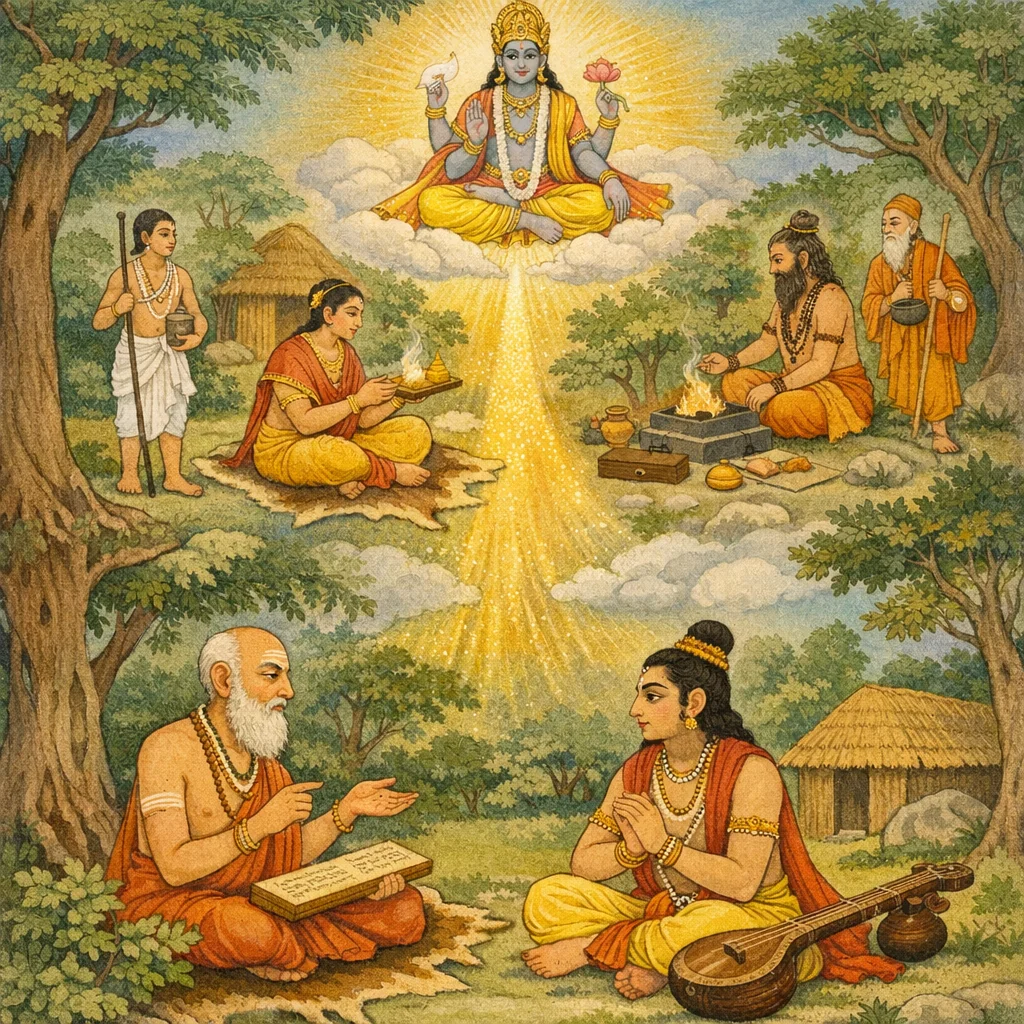
Varṇāśrama-ācāra: Common Virtues, Varṇa Duties, and the Four Āśramas
Sūta relates that after Sanaka’s earlier teaching on Hari’s sacred observance-day, Nārada asks for a well-ordered account of the most meritorious vow and then inquires into varṇa regulations, āśrama duties, and prāyaścitta (expiation). Sanaka replies that the imperishable Hari is worshipped through conduct aligned with varṇāśrama. He defines the four varṇas and the three dvija groups established by upanayana, urges fidelity to one’s svadharma and household rites (gṛhya), and allows regional custom only when it does not oppose smṛti. He notes practices to be avoided or restricted in Kali-yuga (including certain sacrifices and exceptional rites) and warns that abandoning svadharma leads to heterodoxy. Sanaka then summarizes the duties of brāhmaṇa, kṣatriya, vaiśya, and śūdra, teaches universal virtues (simplicity, gladness, forbearance, humility), and explains āśrama progression as the means to highest dharma. The chapter ends by praising karma-yoga joined with bhakti to Viṣṇu as the path to the supreme, non-returning abode.
Shlokas
Verse 1
सूत उवाच । एतन्निशम्य सनकोदितमप्रमेयं पुण्यं हरेर्दिनभवं निखिलोत्तमं च । पापौघशांतिकरणं व्रतसारमेवं ब्रह्मात्मजः पुनरभाषत हर्षयुक्तः ॥ १ ॥
Sūta said: Having heard this immeasurable and supremely auspicious teaching spoken by Sanaka—concerning Hari’s sacred observance-day, the best of all, the very essence of vows that brings peace by quelling torrents of sin—Brahmā’s son spoke again, filled with joy.
Verse 2
नारद उवाच । कथितं भवता सर्वं मुने तत्त्वार्थकोविद । व्रताख्यानं महापुण्यं यथावद्धरिभक्तिदम् ॥ २ ॥
Narada said: O sage, knower of the true meaning of tattva, you have explained everything. Now tell, properly, the account of the vow—most meritorious—for it bestows devotion (bhakti) to Hari (Viṣṇu).
Verse 3
इदानीं श्रोतुमिच्छामि वर्णाचचारविधिं मुने । तथा सर्वाश्रमाचारं प्रायश्चित्तविधिं तथा ॥ ३ ॥
Now, O sage, I wish to hear the prescribed rules of conduct for the varṇas, as well as the duties of all āśramas, and also the procedures for prāyaścitta (expiation).
Verse 4
एतत्सर्वं महाभाग सर्वतत्त्वार्थकोविद । कृपया परया मह्यं यथावद्वक्तुमर्हसि ॥ ४ ॥
O greatly fortunate one, knower of the meaning of all principles—out of supreme compassion, please explain all this to me properly, in due order.
Verse 5
सनक उवाच । श्रृणुष्व मुनिशार्दूल यथा भक्तप्रियंकरः । वर्णाश्रमाचारपरैः पूज्यते हरिरव्ययः ॥ ५ ॥
Sanaka said: “Listen, O tiger among sages, to how the imperishable Hari—who delights in His devotees—is worshipped by those devoted to the proper conduct of varṇa and āśrama.”
Verse 6
मन्वाद्यैरुदितं यच्च वर्णाश्रमनिबन्धनम् । तत्ते वक्ष्यामि विधिवद्भक्तोऽसि त्वमधोक्षजे ॥ ६ ॥
That code of conduct for varṇa and āśrama, as taught by Manu and other sages, I shall explain to you properly; for you are devoted to Adhokṣaja, the Supreme Lord beyond the senses.
Verse 7
ब्राह्मणाः क्षत्रिया वैश्याः शूद्राश्चत्वार एव ते । वर्णा इति समाख्याता एतेषु ब्राह्मणोऽधिकः ॥ ७ ॥
Brahmins, Kshatriyas, Vaishyas, and Shudras—these indeed are the four. They are collectively called the varṇas; among them, the Brahmin is regarded as foremost.
Verse 8
ब्राह्मणाः क्षत्रिया वैश्या द्विजाः प्रोक्तास्त्रयस्तथा । मातृतश्चोपनयनाद्दिजत्वं प्राप्यते त्रिभिः ॥ ८ ॥
Brahmins, Kshatriyas, and Vaishyas—these three are declared to be ‘twice-born’ (dvija). For these three, the state of being twice-born is attained through the rite of upanayana (sacred initiation), in accordance with the prescriptions connected with the mother.
Verse 9
एतैर्वर्णैः सर्वधर्माः कार्या वर्णानुरुपतः । स्ववर्णधर्मत्यागेन पाषंडः प्रोच्यते बुधैः ॥ ९ ॥
By these varṇas, all duties are to be carried out in a manner befitting one’s own varṇa. He who abandons the dharma of his own varṇa is called a pāṣaṇḍa (deviant/heterodox), say the wise.
Verse 10
स्वगृह्यचोदितं कर्मद्विजः कुर्वन्कृती भवेत् । अन्यथा पतितो भूयात्सर्वधर्मबहिष्कृतः ॥ १० ॥
A twice-born (dvija), performing the rites enjoined by his own Gṛhya tradition, becomes accomplished; otherwise he becomes fallen (patita) and is excluded from all dharmic observances.
Verse 11
युगधर्मः परिग्राह्यो वेर्णैरेतैर्यथोचितम् । देशाचारास्तथाग्राह्याः स्मृतिधर्माविरोधतः ॥ ११ ॥
The dharma of each age (yuga-dharma) should be adopted by these varṇas in the manner fitting to them. Likewise, local customs should be accepted, so long as they do not conflict with the dharma taught in the Smṛtis.
Verse 12
कर्मणा मनसा वाचा यत्नाद्धर्म्मं समाचरेत् । अस्वर्ग्यं लोकविद्विष्टं धर्म्यमप्याचरेन्नतु ॥ १२ ॥
With one’s actions, mind, and speech, one should diligently practice dharma. Yet one should not do—even if it seems ‘righteous’—what does not lead to heaven and is condemned by the world (for it violates the accepted moral order).
Verse 13
समुद्रयात्रास्वीकारः कमंडलुविधारणम् । द्विजानामसवर्णासु कन्यासूपयमस्तथा ॥ १३ ॥
Avoiding sea-voyages, carrying the mendicant’s water-pot (kamaṇḍalu), and likewise the marriage (upayama) of twice-born men with girls of a different varṇa—these are specified here.
Verse 14
देवराच्च सुतोत्पत्तिर्मधुपर्के पशोर्वधः । मांसादनं तथा श्राद्धे वानप्रस्थाश्रमस्तथा ॥ १४ ॥
Begetting a son through the devara (the husband’s brother), the slaughter of an animal for the madhuparka offering, the eating of meat in a śrāddha rite, and likewise the discipline of the vānaprastha (forest-dweller) stage—these are to be understood only within their prescribed ritual contexts.
Verse 15
दत्ताक्षतायाः कन्यायाः पुनर्दानं वराय च । नैष्टिकं ब्रह्मचर्यं च नरमेधाश्चमेधकौ ॥ १५ ॥
To give again in marriage a maiden already formally bestowed (by the akṣata rite), and to bestow her anew upon another groom; also the rigid vow of lifelong brahmacarya; and the sacrifices called naramedha and medha—here these are cited as grave improprieties, worthy of condemnation in this context.
Verse 16
महाप्रस्थानगमनं गोमेधश्च तथा मखः । एतान्धर्मान्कलियुके वर्ज्यानाहुर्मनीषिणः ॥ १६ ॥
The great rite of mahāprasthāna—walking forth to one’s final departure—the cow-sacrifice called gomedha, and certain sacrificial rites (makha): the wise declare that such forms of dharma are to be avoided in the age of Kali.
Verse 17
देशाचाराः परिग्राह्यास्तत्तद्देशगतैर्नरैः । अन्यथा पतितो ज्ञेयः सर्वधर्मबहिष्कृतः ॥ १७ ॥
People should adopt the customary practices of the region in which they dwell, as observed by those of that land. Otherwise one is to be known as fallen (patita), excluded from all dharmic observances.
Verse 18
ब्राह्मणक्षत्रियविशां शूद्राणां च द्विजोत्तमा । क्रियाः सामान्यतो वक्ष्ये तच्छृणुष्व समाहितः ॥ १८ ॥
O best of the twice-born, I shall now set forth, in a general way, the common duties and prescribed practices for Brāhmaṇas, Kṣatriyas, Vaiśyas, and Śūdras. Listen with a mind made steady and collected.
Verse 19
दानं दद्याद्ब्राह्मणेभ्यस्तथा यज्ञैर्यजेत्सुरान् । वृत्त्यर्थं याचयेच्चैव अन्यानध्यापयेत्तथा ॥ १९ ॥
One should give gifts to the Brāhmaṇas, and likewise worship the gods through sacrifices (yajñas). For the sake of livelihood, one may also beg, and likewise teach others.
Verse 20
याजयेद्यजने योग्यान्विप्रो नित्योदकी भवेत् । कुर्य्याच्च वेदग्रहणं तथाग्रेश्च परिग्रहम् ॥ २० ॥
A brāhmaṇa should officiate sacrifices for those who are fit to perform them; he should be ever purified with water (observant of daily ablutions). He should also undertake the study and retention of the Veda, and accept the proper honorarium (dakṣiṇā) in accordance with established custom.
Verse 21
ग्राह्ये द्र्व्ये च पारक्ये समबुद्धिर्भवेत्तथा । सर्वलोकहितं कृर्यान्मृदुवाक्यमुदीरयेत् ॥ २१ ॥
Whether dealing with what is to be accepted or with another’s property, one should maintain an even-minded attitude. One should act for the welfare of all beings and speak gentle words.
Verse 22
ऋतावभिगमः पत्न्यां शस्यते ब्राह्मणस्य वै । न कस्याप्यहितं ब्रूयाद्विष्णुपूजापरो भवेत् ॥ २२ ॥
For a brāhmaṇa, approaching one’s wife only in the proper season is indeed commended. One should not speak what is harmful to anyone, and should be devoted to the worship of Viṣṇu.
Verse 23
दद्याद्दानानि विप्रेभ्यः क्षत्रियोऽपि द्विजोत्तम । कुर्य्याच्च वेदग्रहणं यज्ञैर्द्देवान्यजेत्तथा ॥ २३ ॥
O best of the twice-born, a kṣatriya too should give gifts to the brāhmaṇas; he should also undertake the study of the Veda, and likewise worship the gods through sacrificial rites (yajñas).
Verse 24
शस्त्राजीवी भवेच्चैव पालयेद्धर्मतो महीम् । दुष्टानां शासनं कुर्य्याच्छिष्टानां पालनं तथा ॥ २४ ॥
He should live by the calling of arms and, in accord with dharma, protect the earth. He should punish the wicked and likewise safeguard the disciplined and virtuous.
Verse 25
पाशुपाल्यं च वाणिज्यं कृंषिश्च द्विजसत्तम । वेदस्याध्ययनं चैव वैश्यस्यापि प्रकीर्त्तितम् ॥ २५ ॥
O best among the twice-born, tending cattle, trade, and agriculture are declared as duties; and the study of the Veda too is prescribed for the Vaiśya.
Verse 26
कुर्याच्च दारग्रहणं धर्माश्चैव समाचरेत् । क्रयविक्रयजर्वापि धनैः कारुक्रियोद्भवैः ॥ २६ ॥
He should also marry and duly practice the duties of dharma; and he may engage in buying and selling as well, using wealth that arises from honest artisan work.
Verse 27
दद्याद्दानानि शूद्रोऽपि पाकयज्ञैर्यजेन्न च । ब्राह्मणक्षत्रियविशां शुश्रूषानि रतो भवेत् ॥ २७ ॥
Even a Śūdra should give charitable gifts; but he should not perform sacrifices that require the Vedic cooking-offering rites. Rather, he should be devoted to rendering service to Brāhmaṇas, Kṣatriyas, and Vaiśyas.
Verse 28
ऋतुकालाभिगामीच स्वदारेषु भवेत्तथा । सर्वलोकहितोषित्वं मंगलं प्रियवादिता ॥ २८ ॥
He should approach his own wife only in the proper season; and he should delight in the welfare of all people—auspicious in conduct and sweet in speech.
Verse 29
अनायासो मनोहर्षस्तितिक्षा नातिमानिता । सामान्यं सर्ववर्णानां मुनिभिः परिकीर्तितम् ॥ २९ ॥
Effortless simplicity, inner gladness, forbearance, and freedom from excessive pride—these, the sages declare, are the common virtues of all the varṇas.
Verse 30
सर्वे च मुनितां यांति स्वाश्रमोचितकर्मणा । ब्राह्मणः क्षत्रियाचारमाश्रयेदापदि द्विज ॥ ३० ॥
All attain the state of sages by performing the duties proper to their own āśrama. Yet in times of distress, O twice-born, a brāhmaṇa may adopt the conduct of a kṣatriya.
Verse 31
क्षत्रियोऽपि च विड्वृत्तिमत्यापदि समाश्रयेत् । नाश्रयेच्छूद्रवृत्तिं तु अत्यापद्यपि वै द्विजः ॥ ३१ ॥
Even a kṣatriya, in extreme hardship, may take up the livelihood proper to a vaiśya; but a dvija should not adopt the livelihood of a śūdra, even in the most severe distress.
Verse 32
यद्याश्रयेद्दिजो मूढस्तदा चांडासतां व्रजेत् । ब्राह्मणक्षत्रियविशां त्रयाणां मुनिसत्तम ॥ ३२ ॥
If a deluded dvija takes shelter in an unworthy support, he then falls into the state of a caṇḍāla. O best of sages, this is said with reference to the three varṇas—brāhmaṇas, kṣatriyas, and vaiśyas.
Verse 33
चत्वार आश्रमाः प्रोक्ताः पंचमो नोपपद्यते । ब्रह्मचारी गृही वानप्रस्थो भिक्षुश्च सत्तम ॥ ३३ ॥
Four āśramas are taught; a fifth does not properly apply. They are: the brahmacārin (celibate student), the gṛhastha (householder), the vānaprastha (forest-dweller), and the bhikṣu (mendicant renunciant), O best of the virtuous.
Verse 34
चतुर्भिराश्रमैरेभिः साध्यते धर्म उत्तमः । विष्णुस्तुष्यति विप्रेंद्र कर्मयोगरतात्मनः ॥ ३४ ॥
Through these four āśramas the highest dharma is fulfilled; O best of brāhmaṇas, Viṣṇu is pleased with one whose mind is devoted to Karma-yoga.
Verse 35
निःस्पृहाशांतमनसः स्वकर्मनिरतस्य च । ततो याति परं स्थानं यतो नावर्त्तते पुनः ॥ ३५ ॥
One who is free from craving, tranquil in mind, and steadfast in one’s own rightful duty attains the supreme abode, from which one never returns again.
Frequently Asked Questions
Because the text frames svadharma and one’s inherited ritual discipline (gṛhya) as the stabilizing basis of dharmic identity; abandoning them is treated as pāṣaṇḍa-like deviation that disrupts both social order and the devotional aim of worshipping Hari through regulated karma.
It presents a yuga-sensitive dharma: certain severe, exceptional, or archaic rites (especially those involving extreme vows or sacrificial categories) are declared avoidable in Kali, while dharma is redirected toward attainable conduct—ethical speech, restraint, service, gifts, and Viṣṇu-centered karma-yoga.
The four āśramas are taught as the complete framework by which highest dharma is fulfilled; when performed without craving and with tranquility, they culminate in karma-yoga that pleases Viṣṇu and leads to the supreme abode (non-return).