Dhvaja-Dhāraṇa Mahātmyam: Sumati–Satyamatī, Humility, and Deliverance by Hari’s Messengers
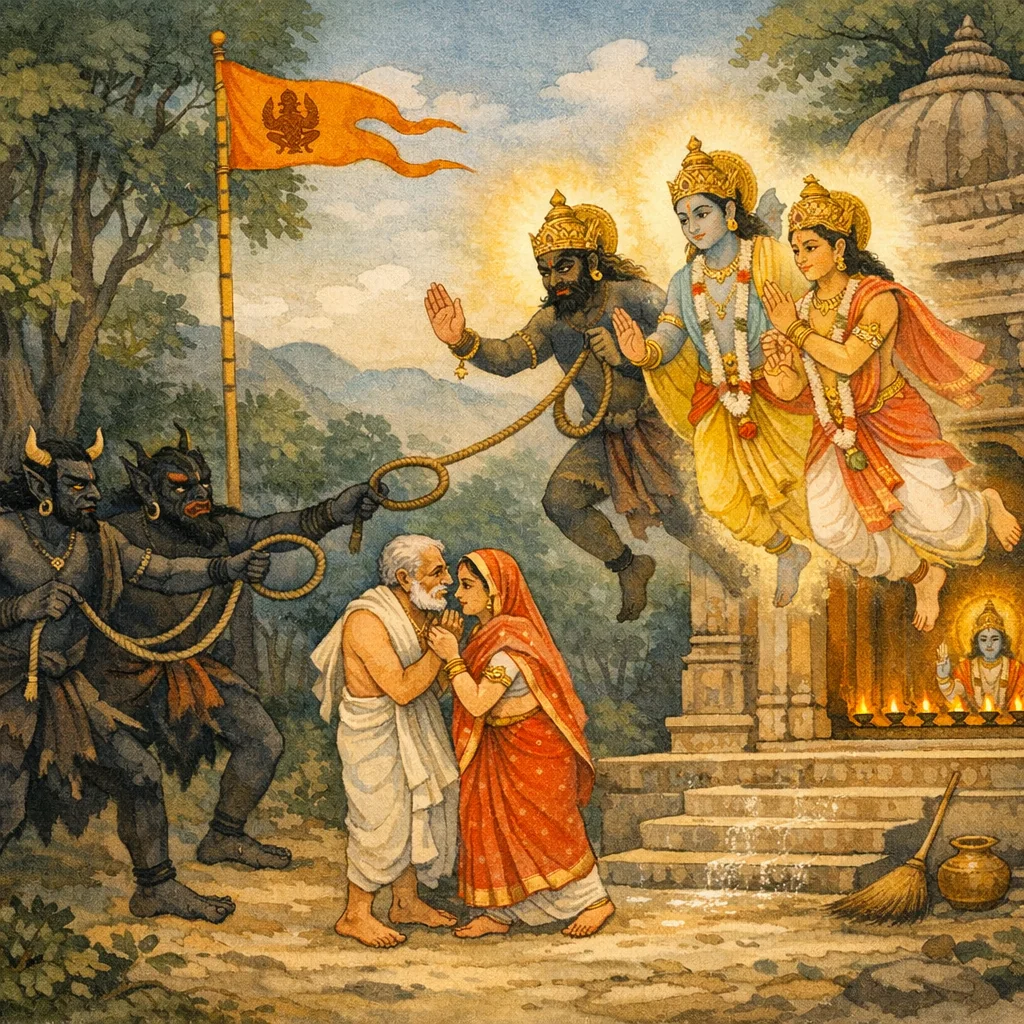
Nārada asks Sanaka to explain Sumati, famed as the foremost practitioner of dhvaja-dhāraṇa (raising a sacred banner). Sanaka recounts a Kṛta-yuga tale: King Sumati of Satpadvīpa and Queen Satyamatī are ideal Vaiṣṇava rulers—truthful, hospitable, free of ego, devoted to Hari-kathā, generous with food and water, and builders of public works (ponds, gardens, wells). On Dvādaśī the king regularly raises a pleasing banner in Viṣṇu’s honor. Sage Vibhaṇḍaka visits and praises vinaya (humility) as the means to attain dharma, artha, kāma, and mokṣa. Asked why the couple is specially linked to banner-raising and temple-dance, Sumati reveals a former birth of grave sin and forest life near a ruined Viṣṇu shrine. Through unintended yet sustained temple-service (repairing, cleaning, sprinkling water, lighting lamps) and a final act of dancing in the sacred precinct, Viṣṇu’s messengers stop Yama’s agents, declaring that Hari-sevā and even accidental bhakti burn away sin. The couple is taken to Viṣṇu’s abode, later returns with prosperity, and the chapter ends by praising the merit of hearing or reciting this sin-destroying narrative.
Shlokas
Verse 1
नारद उवाच । भगवन्सर्वधर्मज्ञ सर्वशास्त्रार्थपारग । सर्वकर्मवरिष्टं च त्वयोक्तं ध्वजधारणम् ॥ १ ॥
Nārada said: “O revered one, knower of all dharmas and master of the meanings of all śāstras—among all sacred acts, you have declared the bearing of the holy banner (dhvaja-dhāraṇa) to be the highest.”
Verse 2
यस्तु वै सुमतिर्नाम ध्वजारोपपरो मुने । त्वयोक्तस्तस्य चरितं विस्तरेण ममादिश ॥ २ ॥
O sage, please instruct me in detail about the life and conduct of the man named Sumati, devoted to raising the sacred flag, whom you have mentioned.
Verse 3
सनक उवाच । श्रृणुष्वैकमनाः पुण्यमितिहासं पुरातनम् । ब्रह्मणा कथितं मह्यं सर्वपापप्रणाशनम् ॥ ३ ॥
Sanaka said: Listen with a single-pointed mind to this ancient and sacred narrative, told to me by Brahmā—one that destroys all sins.
Verse 4
आसीत्पुरा कृतयुगे सुमतिर्नाम भूपतिः । सोमवंशोद्भवः श्रीमान्सत्पद्वीपैकनायकः ॥ ४ ॥
In ancient times, in the Kṛta Yuga, there was a king named Sumati—illustrious, born in the Lunar dynasty (Somavaṃśa), and the sole ruler of the noble island-continent called Satpadvīpa.
Verse 5
धर्मात्मा सत्यसंपन्नः शुचिवंश्योऽतिथिप्रियः । सर्वलक्षणसंपन्नः सर्वसंपद्विभूषितः ॥ ५ ॥
He was righteous by nature, endowed with truthfulness, born of a pure lineage, and fond of honoring guests. Possessing every auspicious mark, he was adorned with all prosperities.
Verse 6
सदा हरिकथासेवी हरिपूजापरायणः । हरिभक्तिपराणां च शुश्रूषुर्निरहंकृतिः ॥ ६ ॥
He ever serves Hari-kathā, is devoted to the worship of Hari, eagerly ministers to those established in Hari-bhakti, and remains free from ego.
Verse 7
पूज्यपूजारतो नित्यं समदर्शी गुणान्वितः । सर्वभूतहितः शान्तः कृतज्ञः कीर्तिमांस्तथा ॥ ७ ॥
Ever engaged in honoring the worthy, he beholds all with equal vision; endowed with virtues, intent on the welfare of all beings, peaceful, grateful, and possessed of good repute.
Verse 8
तस्य भार्या महाभागा सर्वलक्षणसंयुता । पतिव्रता पतिप्राणा नाम्रा सत्यमतिर्मुने ॥ ८ ॥
His wife was most blessed, endowed with every auspicious mark; steadfast as a pativratā, she held her husband as her very life-breath—O sage, she was named Satyamatī.
Verse 9
तावुभौ दम्पती नित्यं हरिपूजापरायणौ । जातिस्मरौ महाभागौ सत्यज्ञौ सत्परायणौ ॥ ९ ॥
Both spouses were ever devoted to the worship of Hari. They remembered former births (jāti-smara), were greatly blessed, knew the truth, and stood firm upon the righteous path.
Verse 10
अन्नदानरतौ नित्यं जलदानपरायणौ । तडागारामवप्रादौ नसंख्यातान्वितेनतुः ॥ १० ॥
They ever delighted in anna-dāna, the gift of food, and were wholly devoted to jala-dāna, the gift of water; and they performed countless meritorious deeds, providing ponds, gardens, and wells for the public good.
Verse 11
सा तु सत्यमतिर्नित्यं शुचिर्विष्णुगृहे सती । नृत्यत्यत्यन्तसन्तुष्टा मनोज्ञा मञ्जुवादिनी ॥ ११ ॥
She—Satyamatī—ever true-minded and pure, dwelt as a virtuous woman in the house (temple) of Viṣṇu. With her heart wholly content, she would dance, lovely to behold and sweet of speech.
Verse 12
सोऽपि राजा महाभागो द्वादशीद्धादशीदिने । ध्वजमारोपयत्येव मनोज्ञं बहुविस्तरम् ॥ १२ ॥
That fortunate king too, on the day of Dvādaśī (the twelfth lunar day), had a pleasing banner—broad and expansive—raised aloft.
Verse 13
एवं हरिपरं नित्यं राजानं धर्मकोविदम् । प्रियां सत्यमतिं चास्य देवा अपि सदास्तुवन् ॥ १३ ॥
Thus, even the gods continually praised that king—ever devoted to Hari and well-versed in dharma—and also his beloved queen Satyamatī.
Verse 14
त्रिलोके विश्रुतौ ज्ञात्वा दम्पती धर्मको विदौ । आययौ बहुभिः शिष्यैर्द्रष्टुकामो विभाण्डकः ॥ १४ ॥
Hearing that the couple were renowned throughout the three worlds as knowers of Dharma, the sage Vibhāṇḍaka came—accompanied by many disciples—wishing to see them.
Verse 15
तमायांतं मुनिं श्रुत्वा स तु राजा विभाण्डकम् । प्रत्युद्ययौ सपत्नीकः प्रजाभि र्बहुविस्तरम् ॥ १५ ॥
Hearing that the sage Vibhāṇḍaka was approaching, the king went forth to welcome him—together with his queen and a great multitude of his subjects.
Verse 16
कृतातिथ्यक्रियं शान्तं कृतासनपरिग्रहम् । नीचासनस्थितो भूयः प्राञ्जलिर्मुनिमब्रवीत् ॥ १६ ॥
Having completed the rites of hospitality and arranged a seat for the guest, he sat upon a lower seat; then, with palms joined in reverence, he addressed the sage once more.
Verse 17
राजो वाच । भगवन्कृतकृत्योऽस्मिं त्वदभ्यागमनेन वै । सतामायमनं सन्तं प्रशंसन्ति सुरवावहम् ॥ १७ ॥
The King said: “O Blessed One, by your very arrival I feel my life’s purpose fulfilled. The good praise the coming of saints, for it brings divine favor and welfare.”},{
Verse 18
यत्र स्यान्महतां प्रेम तत्र स्युः सर्वसम्पदः । तेजः कीर्तिर्धनं पुत्रा इति प्राहुर्विपश्चितः ॥ १८ ॥
Where loving regard abides among the great and noble, there all prosperities arise—splendour, fame, wealth, and worthy offspring—so declare the wise.
Verse 19
तत्र वृद्धिमुपायान्ति श्रेयांस्यनुदिनं मुने । यत्र सन्तः प्रकुर्वन्ति महतीं करुणां प्रभो ॥ १९ ॥
O sage, day by day auspiciousness and true welfare increase in that place where the virtuous continually act with great compassion, O Lord.
Verse 20
यो मृर्ध्नि धारयेदूह्यन्महत्पादजलं रजः । स स्नातः सर्वतीर्थेषु पुण्यात्मा नात्र संशयः ॥ २० ॥
Whoever, with reverent intent, bears upon the crown of the head the dust sanctified by the water that has washed the feet of a great saint—such a one is as though bathed in all sacred tīrthas; truly meritorious is that soul, of this there is no doubt.
Verse 21
मम पुत्राश्च दाराश्च संपत्त्वयि समर्पिताः । मामाज्ञापय विप्रेन्द्र किं प्रियं करवाणि ते ॥ २१ ॥
My sons, my wife, and all my wealth have been entrusted to you. O best of brāhmaṇas, command me—what may I do that will be pleasing to you?
Verse 22
विनञ्चवनतं भूपं स निरीक्ष्य मुनीश्वरः । स्पृशन्करेण तं प्रीत्युवाचातिहर्षितः ॥ २२ ॥
Seeing the king bowed down in humility, the great sage looked upon him; then, touching him with his hand in affection, he spoke, filled with great joy.
Verse 23
ऋषिरुवाच । गजन्यदुक्तं भवता तत्सर्वं त्वत्कुलोचितम् । विनयावनतः सर्वो बहुश्रेयो लभेदिह ॥ २३ ॥
The sage said: “O Gajanya, all that you have spoken is wholly worthy of your noble lineage. Indeed, one who bows down in humility gains great spiritual benefit here, in this very life.”
Verse 24
धर्मश्चार्थश्च कामश्च मोक्षश्च नृपसत्तम । विनयाल्लभते मर्त्यो दुर्लभं किं महात्मनाम् ॥ २४ ॥
O best of kings, through humility and disciplined conduct (vinaya) a mortal attains dharma, artha, kāma, and even mokṣa. For the great-souled, what indeed is difficult to obtain?
Verse 25
प्रीतोऽस्मि तव भूपाल सन्मार्गपरिवर्त्तिनः । स्वस्ति ते सततं भूयाद्यत्पृच्छामि तदुच्यताम् ॥ २५ ॥
O king, I am pleased with you, for you have turned toward the righteous path. May auspiciousness ever attend you. Now, answer what I ask.
Verse 26
पूजा बहुविधाः सन्ति हरितुष्टिविधायिकाः । तासु नित्यं ध्वजारोपे वर्त्त्से त्वं सदोद्यतः ॥ २६ ॥
Worship is of many kinds, and all of them gladden Hari. Yet among them, you are ever diligent, raising each day the sacred banner (dhvaja) in His honor.
Verse 27
भार्यापि तव साध्वीयं नित्यं नृत्यपरायणा । किमर्थमेतद्वृत्तान्तं यथावद्वक्तुमर्हसि ॥ २७ ॥
Even your wife is a virtuous lady, ever devoted to dance. For what reason has this episode occurred? You ought to explain this account properly.
Verse 28
राजोवाच । श्रृणुष्व भगवन्सर्वं यत्पृच्छसि वदामि तत् । आश्चर्यभूतं लोकानामावयोश्चरितं त्विह ॥ २८ ॥
The King said: “O Blessed One, listen—whatever you ask, I shall tell you in full. Here I will relate the wondrous account of our deeds, which has become a marvel to the people.”
Verse 29
अहमासं पुरा शूद्रो मालिनिर्नाम सत्तम । कुमार्गनिरतो नित्यं सर्वलोकाहिते रतः ॥ २९ ॥
O best of men, formerly I was a Śūdra woman named Mālinī—ever devoted to a wrongful path, yet engaged in what I believed to be for the welfare of all people.
Verse 30
पिशुनो धर्मविद्वेषी देवद्रव्यापहारकः । गोध्नश्च ब्रह्महा चौरः सर्वप्राणिवधे रतः ॥ ३० ॥
A slanderer, one who hates dharma, one who steals property dedicated to the gods; a killer of cows, a slayer of a brāhmaṇa, a thief, and one who delights in killing all living beings—such a person is counted among grievous sinners.
Verse 31
नित्यं निष्ठुरवक्ता च पापी वेश्यापरायणः । एवं स्थितः कियत्कालमनाहत्यं महदृचः ॥ ३१ ॥
He is ever harsh of speech, sinful, and devoted to harlots. Remaining in such a state, how long can he go on without being struck by the great ordinance of karmic retribution?
Verse 32
सर्वबन्धुपरित्यक्तो दुःखी वनमुपागतः । मृगमांसाशनो नित्यं तथा पान्थाविलुम्पकः ॥ ३२ ॥
Abandoned by all his kinsmen and afflicted with sorrow, he went into the forest. Living constantly on the flesh of wild animals, he also became a plunderer of travellers on the road.
Verse 33
एकाकी दुःखबहुलो न्यवसन्निर्जने वने । एकदा क्षुत्परिश्रान्तो निदाघार्त्तः पिपासितः ॥ ३३ ॥
Alone, overwhelmed by sorrow, he dwelt in a deserted forest. Once, worn out by hunger and tormented by the heat of summer, he became thirsty.
Verse 34
जीर्णं देवालयं विष्णोरपश्यं विजने वने । हंसकारण्डवाकीर्णं तत्समीपे महत्सरः ॥ ३४ ॥
In a lonely forest I saw a dilapidated temple of Viṣṇu; and near it there was a great lake, filled with swans and kāraṇḍava birds.
Verse 35
पर्यन्तवनपुष्पौघच्छादितं तन्मुनीश्वर । अपिबं तत्र पानीयं तत्तीरे विगतश्रमः ॥ ३५ ॥
O best of sages, that place was covered all around with masses of forest-flowers. There I drank water, and, resting on its bank, my fatigue was relieved.
Verse 36
फलानि जग्ध्वा शीर्णानि स्वयं क्षुच्च निवारिता । तस्मिञ्जीर्णीलये विष्णोनर्निवासं कृतकवानहम् ॥ ३६ ॥
Eating fallen, overripe fruits, I myself stilled my hunger; and in that dilapidated dwelling I made my abode, living like a man, yet devoted in bhakti to Viṣṇu.
Verse 37
जीर्णस्फुटितसंधानं तस्य नित्यमकारिषम् । पर्णैस्तृणैश्च काष्ठैघै र्गृहं सम्यक् प्रकल्पितम् ॥ ३७ ॥
I regularly repaired and rejoined whatever in that dwelling had grown worn or cracked; and with leaves, grass, and bundles of wood I properly set the hut in order.
Verse 38
स्वसुऱार्थं तु तद्भमिर्मया लिप्ता मुनीश्वर । तत्राहं व्याधवृत्तिस्थो हत्वा बहुविधान्मृगान् ॥ ३८ ॥
But, O lord among sages, for my father-in-law’s sake I smeared and prepared that ground; and there, living by a hunter’s livelihood, I killed many kinds of deer.
Verse 39
आजीवं वर्तय न्नित्यं वर्षाणां विंशतिः स्थितः । अथेयमागता साध्वी विन्ध्यदेशसमुद्भवा ॥ ३९ ॥
Living by that means and sustaining his livelihood day by day, he remained so for twenty years. Then there arrived a virtuous woman, born in the Vindhya region.
Verse 40
निषादकुलजा विप्रा नान्मा ख्याताऽवकोकिला । बन्धुवर्गपरित्यक्ता दुःखिता जीर्णविग्रहा ॥ ४० ॥
She was a brāhmaṇa woman born in a Niṣāda clan, renowned by the name Avakokilā; forsaken by her kin, sorrowful, and worn down in body.
Verse 41
क्षुत्तृड्घर्मपरिश्रान्ता शोचन्ती स्वकृतं ह्यघम् । दैवयोगाकत्समायाताभ्रमन्ती विजने वने ॥ ४१ ॥
Worn down by hunger, thirst, and scorching heat, she bewailed the sin she herself had wrought; and by the force of destiny she had come there, wandering in a lonely, desolate forest.
Verse 42
ग्रीष्मतापार्द्दिता बाह्ये स्वान्ते चाधिनिपूडिता । इमां दुःखार्दितां दृष्ट्वा जाता मे विपुला दया ॥ ४२ ॥
Scorched outwardly by the summer’s blaze and inwardly oppressed at heart, seeing her thus stricken by sorrow, a great compassion arose within me.
Verse 43
दत्तं मया जलं चास्यै मांसं वन्यफलानि च । गतश्रमात्वियं ब्रह्मन्मया पृष्टा यथा तथम् ॥ ४३ ॥
I gave her water, and also meat and wild fruits. When her weariness had passed, O Brahmin, I questioned her as the occasion demanded.
Verse 44
अवेदयत्स्ववृत्तान्तं तच्छृणुष्व महामुने । नान्मावकोकिला चाहं निषादकुलसम्भवा ॥ ४४ ॥
She then told her own tale: “Listen, O great sage. I am not a cuckoo; I was born in a Niṣāda clan, dwellers of the forest.”
Verse 45
दारुकस्य सुता चाहं विन्ध्यपर्वतवासिनी । परस्वहारिणी नित्यं सदा पैशुन्यवादिनी ॥ ४५ ॥
“I am the daughter of Dāruka, dwelling in the Vindhya mountains—ever stealing what belongs to others, and ever speaking malicious slander.”
Verse 46
पुंश्चलूत्येवमुक्त्वा तु बन्धुवर्गैः समुज्झिता । कियत्कालं ततः पत्या भृताहं लोकनिन्दिता ॥ ४६ ॥
Thus addressed as “a wanton woman,” I was cast off by my own kinsfolk. For some time thereafter my husband maintained me—yet I lived beneath the world’s reproach.
Verse 47
दैवात्सोऽपि गतो लोकं यमस्यात्र विहाय माम् । कान्तारे विजने चैका भ्रमन्ती दुःखपीडिता ॥ ४७ ॥
By fate, he too has gone to Yama’s realm, leaving me here. Alone I wander in a desolate wilderness, tormented by sorrow.
Verse 48
दैवात्त्वत्सविधं प्राप्ता जीविताहं त्वयाधुना । इत्येवं स्वकृतं कर्म मह्यं सर्वं न्यवेदयत् ॥ ४८ ॥
“By fate I have come into your presence, and now I am alive because of you.” Saying so, she disclosed to me in full the entire course of deeds she herself had done.
Verse 49
ततो देवालये तस्मिन्दम्पतीभावमाश्रितौ । स्थितौ वर्षाणि दश च आवां मांसफलाशिनौ ॥ ४९ ॥
Then, in that very temple, we assumed the state of husband and wife and lived there for ten years, sustaining ourselves on meat and fruits.
Verse 50
एकदा मद्यपानेन प्रमत्तौ निर्भरैमुने । तत्र देवालये रात्रौ मुदितौ मांसभोजनात् ॥ ५० ॥
Once, O sage, the two of them—made reckless and uninhibited by drinking liquor—spent the night there in the temple, delighted because they had eaten meat.
Verse 51
तनुवस्त्रापरिज्ञानौ नृत्यं चकृव मोहितौ । प्रारब्धकर्म भोगान्तमावां युगपदागतौ ॥ ५१ ॥
Deluded, we lost awareness of our own bodies and garments and began to dance. And, having come together at the same time, we reached the end of the enjoyment of our already-begun (prārabdha) karma.
Verse 52
यमदूतास्तदायाताः पाशहस्ता भयंकराः । नेतुमावां नृत्यरतौ सुधोरां यमयातनाम् ॥ ५२ ॥
Then Yama’s messengers arrived—terrifying, with nooses in their hands—to take us, who were absorbed in dancing, to Sudhorā, the place of Yama’s torments.
Verse 53
ततः प्रसन्नो भगवान्कर्मणा मम मानद । देवावसथसंस्कारसंज्ञितेन कृतेन नः ॥ ५३ ॥
Then the Blessed Lord became pleased with my act, O bestower of honor, when we performed what is called the ‘consecration of the gods’ dwelling’ (devāvasatha-saṃskāra).
Verse 54
स्वदूतान्प्रेषयामास स्वभक्तावनतत्परः । ते दूता देवदेवस्य शङ्खचक्र गदाधराः ॥ ५४ ॥
Ever intent on protecting His own devotees, the Lord dispatched His own messengers. Those messengers of the God of gods bore the conch, discus, and mace.
Verse 55
सहस्रसूर्यासंकाशाः सर्वे चारुचतुर्भुजाः । किरीटकुण्डलधरा हारिणो वनमालिनः ॥ ५५ ॥
All of them shone with the brilliance of a thousand suns; each was beautiful and four-armed, wearing crowns and earrings—charming in appearance and adorned with forest-garlands.
Verse 56
दिशो वितिमिरा विप्र कुर्वन्तः स्वेन तेजसा । भयंकरान्याशहस्तान्दंष्ट्रिणो यमकिङ्करान् ॥ ५६ ॥
O brāhmaṇa, by their own radiance they made the directions free of darkness—those fearsome, swift-handed, fanged attendants of Yama.
Verse 57
आवयोग्राहणे यत्तानृचुः कृष्णपरायणाः ॥ ५७ ॥
At the time of learning and receiving the sacred recitation, those devotees—fully devoted to Kṛṣṇa—chanted those Ṛk-verses accordingly.
Verse 58
विष्णुदूता ऊचुः । भो भो क्रूरा दूराचारा विवेकपरिवर्जिताः । मुञ्चध्वमेतौ निष्पापौ दम्पती हरिवल्लभौ ॥ ५८ ॥
The messengers of Viṣṇu said: “Ho! Ho! You cruel ones, of vile conduct, devoid of discernment—release this blameless couple; they are beloved of Hari.”
Verse 59
विवेकस्त्रिषु लोकेषु संपदामादिकारणम् । अपापे पापधीर्यस्तु तं विद्यात्पुरुषाधमम् ॥ ५९ ॥
Discrimination (viveka) is, in the three worlds, the first and foremost cause of all true prosperity. But the one who suspects sin where there is no sin—him one should know as the lowest of men.
Verse 60
पापे त्वपापधीर्यस्तु तं विद्यादधमाधमम् ॥ ६० ॥
But the one who, in the midst of sin, still thinks himself sinless—know him to be the lowest of the low.
Verse 61
यमदूता ऊचुः । युष्माभिः सत्यमेवोक्तं किं त्वेतौ पापिसत्तमौ । यमेन पापिनो दण्ड्यास्तन्नेष्यामो वयं त्विमौ ॥ ६१ ॥
The messengers of Yama said: “What you have spoken is indeed true; yet these two are the vilest of sinners. Sinners are to be punished by Yama—therefore we shall take these two away.”
Verse 62
श्रुतिप्रणिहितो धर्मो ह्यधर्मस्तद्विपर्ययः । धर्माधर्मविवेकोऽयं तन्नेष्यामो यमान्तिकम् ॥ ६२ ॥
“Dharma is what is enjoined by the Śruti (the Vedas); adharma is its opposite. This is the discernment between dharma and adharma—therefore we shall take him to Yama’s presence.”
Verse 63
एतच्त्छुवातिकुपिता विष्णुदूता महौजसः । प्रत्यूचूस्तान्यमभटानधर्मे धर्ममानिनः ॥ ६३ ॥
Hearing this, the mighty attendants of Viṣṇu became exceedingly angry, and they replied to Yama’s servants—who, though acting unrighteously, imagined themselves to be righteous.
Verse 64
विष्णदूता ऊचुः । अहो कष्टं धर्मदृशामधर्मः स्पृशते सभाम् । सम्यग्विवेकशून्यानां निदानं ह्यापदां महत् ॥ ६४ ॥
The messengers of Viṣṇu said: “Alas, how grievous! In the very assembly of those who claim to see and uphold dharma, adharma has gained entry. Indeed, for those devoid of right discernment, this becomes a great cause of calamity.”
Verse 65
तर्काणाद्यविशेषेण नरकाध्यक्षतां गताः । यूयं किमर्थमद्यापि कर्त्तुं पापानि सोद्यमाः ॥ ६५ ॥
Through sophistical disputation and the like—without any true discernment—you have ended up as overseers of hell. Why, even now, are you still eager to commit sinful acts?
Verse 66
स्वकर्मक्षयपर्यन्तं महापातकिनोऽपि च । तिष्टन्ति नरके घोरे यावच्चन्द्रार्कतारकम् ॥ ६६ ॥
Even great sinners (mahāpātakins) remain in a dreadful hell until the fruits of their own karma are exhausted—so long as the moon, the sun, and the stars endure.
Verse 67
पूर्वसंचितपापानामदृष्ट्वा निष्कृतिं वृथा । किमर्थं पापकर्माणि करिष्येऽथ पुनः पुनः ॥ ६७ ॥
If I do not behold a true expiation (niṣkṛti) for sins amassed from the past, then all is futile. Why, then, should I commit sinful deeds again and again?
Verse 68
श्रुतिप्रणिहितो धर्मः सत्यं सत्यं न संशयः । किन्त्वाभ्यां चरितान्धर्मान्प्रवक्ष्यामो यथातथम् ॥ ६८ ॥
Dharma is indeed established by the Śruti (the Vedas)—true, true, without doubt. Yet we shall now describe, just as they were, the dharmas that those two actually practiced.
Verse 69
एतौ पापविनिर्मुक्तौ हरिशुश्रूषणे रतौ । हरिणात्रायमाणौ च मुञ्चध्वमविलम्बितम् ॥ ६९ ॥
These two are freed from sin, devoted to the service of Hari, and are protected by Hari Himself—release them at once, without delay.
Verse 70
एषा च नर्तनं चक्रे तथैव ध्वजरोषणम् । अन्तकाले विष्णुगृहे तेन निष्पापतां गतौ ॥ ७० ॥
She performed a sacred dance, and likewise caused the banner to be raised (or the flagstaff to resound). At life’s end, by that act, she attained the abode of Viṣṇu and became free from sin.
Verse 71
अन्तकाले तु यन्नाम श्रुत्वोक्त्वापि च वै सकृत् । लभते परमं स्थानं किमु शूश्रूषणे रताः ॥ ७१ ॥
If, at life’s final hour, merely hearing—and even once uttering—that Holy Name grants the supreme abode, how much more will those attain who delight in constant seva, in attentive service to the Lord and to His devotees?
Verse 72
महापातकयुक्तो वा युक्तो वाप्युपपातकैः । कृष्णसेवी नरोऽन्तेऽपि लभते परमां गतिम् ॥ ७२ ॥
Whether burdened with great sins or tainted by lesser faults, one who serves Kṛṣṇa attains the supreme destination—even at life’s end.
Verse 73
यतीनां विष्णुभक्तानां परिचर्या परायणाः । ते दूताः सहसा यान्ति पापिनोऽपि परां गतिम् ॥ ७३ ॥
Those devoted to serving the yatis—renunciant devotees of Viṣṇu—go swiftly to the supreme destination, as though they were the Lord’s own messengers, even if they are sinners.
Verse 74
मुहुर्तं वा मुहुर्तार्द्धं यस्तिष्टोद्धरिमन्दिरे । सोऽपि याति परं स्थानं किमुद्वात्रघिंशवत्सरान् ॥ ७४ ॥
Even one who stays in Hari’s temple for a single muhūrta—or even half a muhūrta—reaches the supreme abode; what then need be said of one who dwells there for years?
Verse 75
उपलेपनकर्त्तारौ संमार्जनपरायणौ । एतौ हरिगृहे नित्यं जीर्णशीर्णाधिरोपकौ ॥ ७५ ॥
They are devoted to plastering and to sweeping; in Hari’s temple each day they diligently repair and restore whatever has grown old, worn, and broken.
Verse 76
जलसेचनकर्त्तारौ दीपदौ हरिमन्दिरे । कथमेतौ महाभागौ यातनाभोगमर्हथ ॥ ७६ ॥
They are the ones who sprinkle sacred water and offer lamps in Hari’s temple—how could these two greatly blessed devotees ever deserve to undergo the torments of the realms of punishment?
Verse 77
इत्युक्ता विष्णुदूतास्ते च्छित्वा पाशांस्तदैव हि । आरोप्यावां विमानाग्रयं ययुर्विष्णोः परं पदम् ॥ ७७ ॥
Thus addressed, the messengers of Viṣṇu immediately cut apart the nooses and, placing the two upon the foremost celestial chariot (vimāna), departed to Viṣṇu’s supreme abode.
Verse 78
तत्र सामीप्यमापन्नौ देवदेवस्य चक्रिणः । दिव्यान्भोगान्भुक्तवन्तौ तावत्कालं मुनीश्वर ॥ ७८ ॥
There, having attained close proximity to the Lord of lords, the Wheel-bearer, the two enjoyed divine delights for that very span of time, O best of sages.
Verse 79
दिव्यान्भोगांस्तु तत्रापि भुक्त्वा यातौ महीमिमाम् । अत्रापि संपदतुला हरिसेवाप्रसादतः ॥ ७९ ॥
Having enjoyed the divine delights even there, they returned to this earth; and here too, by the grace born of service to Hari, they attained prosperity comparable to that divine state.
Verse 80
अनिच्छया कृतेनापि सेवनेन हरेर्मुने । प्राप्तमीदृक् फलं विप्र देवानामपि दुर्लभम् ॥ ८० ॥
O sage, even service to Hari performed without desire yields such a reward—O brāhmaṇa—one that is difficult to obtain even for the gods.
Verse 81
इच्छयाराध्य विश्वेशं भक्तिभावेन माधवम् । प्राप्स्यावः परमं श्रेय इति हेतुर्निरुपितः ॥ ८१ ॥
By worshipping Mādhava, the Lord of the universe, of our own free will and with heartfelt bhakti, we shall attain the highest good—thus the true cause has been clearly established.
Verse 82
अवशेनापि यत्कर्म कृतं स्यात्सुमहत्फलम् । जायते भूमिदेवेन्द्र किं पुनः श्रद्धया कृतम् ॥ ८२ ॥
O lord of the earth, even a deed done unintentionally may yield exceedingly great fruit; how much more, then, when it is performed with śraddhā—faith and reverent devotion?
Verse 83
एतदुक्तं निशम्यासौ स मुनीन्द्रो विभण्डकः । प्रशस्य दम्पती तौ तु प्रययौ स्वतपोवनम् ॥ ८३ ॥
Having heard these words, the eminent sage Vibhaṇḍaka praised that husband and wife, and then departed for his own forest hermitage of austerities.
Verse 84
तस्माज्जानीहि देवर्षे देवदेवस्य चक्रिणः । परिचर्या तु सर्वेषां कामधेनूपमा स्मृता ॥ ८४ ॥
Therefore, O divine seer, know this: service (paricaryā) to the God of gods, the Discus-bearing Lord, is remembered as like Kāmadhenu for all—granting every desired good.
Verse 85
हरिपूजापराणां तु हरिरेव सनातनः । ददाति परमं श्रेयः सर्वकामफलमप्रदः ॥ ८५ ॥
For those devoted to the worship of Hari, the Eternal Hari alone bestows the highest good; He never withholds the fruits of all rightful desires.
Verse 86
य इदं पुण्यमाख्यानं सर्वपापप्रणाशनम् । पठेच्च श्रृणुयाद्वापि सोऽपि याति परां रातिम् ॥ ८६ ॥
Whoever recites this holy, meritorious narrative that destroys all sins—or even merely listens to it—he too attains the supreme state.
Frequently Asked Questions
Dhvaja-dhāraṇa is presented as a concentrated act of Hari-bhakti that publicly marks Viṣṇu’s sovereignty and the devotee’s allegiance; joined to Dvādaśī observance and sustained temple-service, it becomes a powerful means of sin-destruction and a support for mokṣa-dharma.
The debate argues that mere juridical punishment is not the final word when Hari-sevā is present: devotion, temple-maintenance, and even unintended pious contact with the Lord’s abode can neutralize sin, and right discernment (viveka) must recognize genuine expiation and transformation.
It explicitly teaches that even acts performed without full ritual intention—such as repairing or dwelling in a Viṣṇu temple, participating in temple-associated actions like dance, or raising the banner—can yield extraordinary fruit when they connect a person to Hari and His service.