Dvādaśī-vrata: Month-by-month Viṣṇu Worship and the Year-End Udyāpana
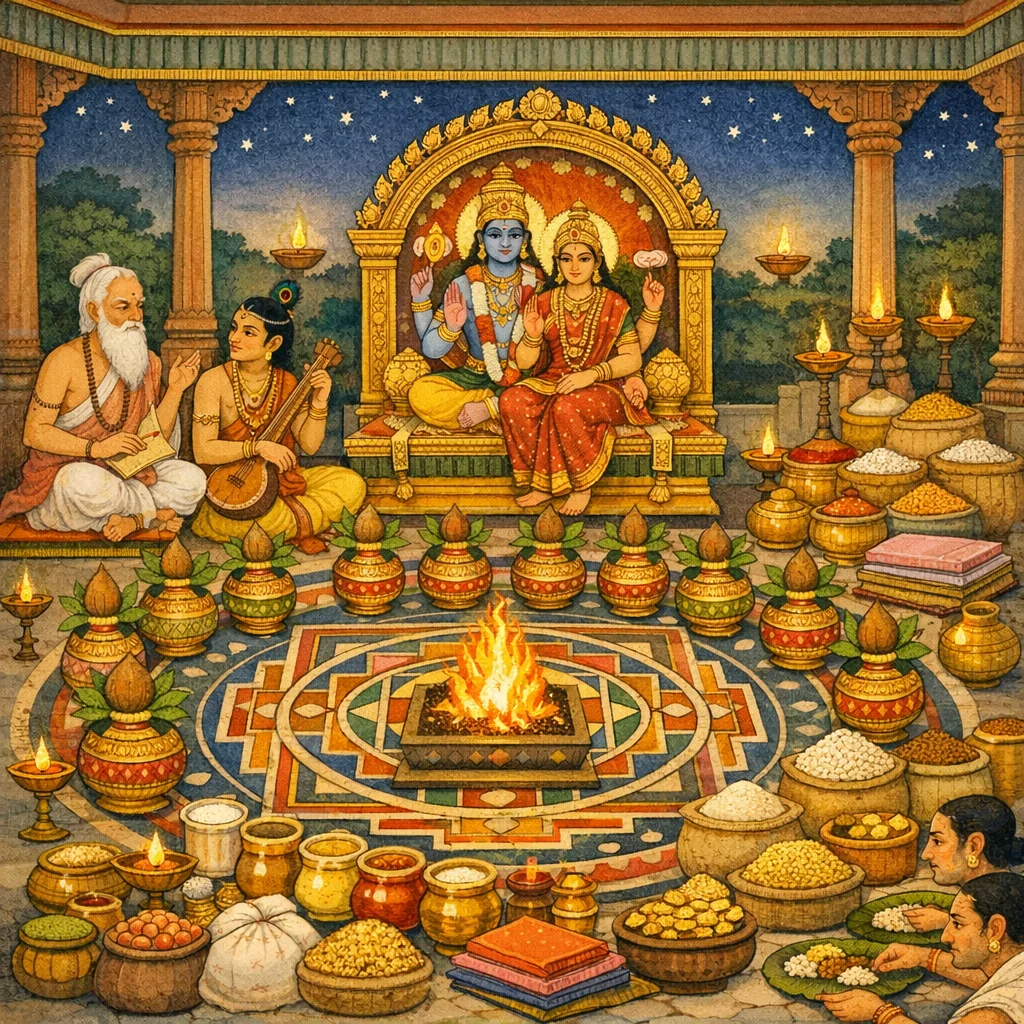
After Sūta sets the stage for the discourse to continue, Nārada—moved by the earlier Gaṅgā-māhātmya—asks Sanaka to teach the vows of Hari that please Viṣṇu and harmonize pravṛtti and nivṛtti. Sanaka lays out a systematic Dvādaśī-vrata cycle observed on the bright fortnight’s twelfth day, month by month from Mārgaśīrṣa through Kārtika, prescribing fasting and purity rules, abhiṣeka (often with specified measures of milk), mantra-invocation of particular Viṣṇu names (Keśava, Nārāyaṇa, Mādhava, Govinda, Trivikrama, Vāmana, Śrīdhara, Hṛṣīkeśa, Padmanābha, Dāmodara), homa counts (notably 108), night vigil (jāgaraṇa), and focused dāna (sesame, kṛśarā, rice, wheat, honey, apūpas, garments, gold). The chapter culminates in the annual completion rite (udyāpana) on Kṛṣṇa Dvādaśī of Mārgaśīrṣa: building a maṇḍapa, drawing the sarvatobhadra diagram, setting twelve kumbhas, offering a Lakṣmī-Nārāyaṇa pratimā or equivalent value, pañcāmṛta abhiṣeka, Purāṇa-śravaṇa, a large sesame homa, feeding twelve brāhmaṇas, and gifting the ācārya. The phala-śruti promises sin-removal, uplift of lineages, fulfillment of aims, and Viṣṇu’s abode; even hearing or reciting grants Vājapeya-level merit.
Shlokas
Verse 1
ऋषय ऊचुः । साधु सूत महाभाग त्वयातिकरुणात्मना । श्रावितं सर्वपापघ्नं गङ्गामाहात्म्यमुत्तमम् ॥ १ ॥
The sages said: “Well done, O Sūta, O greatly fortunate one. With a heart of exceptional compassion, you have recited to us the supreme glory of the Gaṅgā, destroyer of all sins.”
Verse 2
श्रुत्वा तु गङ्गामाहात्म्यं नारदो देवदर्शनः । किं पप्रच्छ पुनः सूत सनकं मुनिसत्तमम् ॥ २ ॥
After hearing the greatness of the Gaṅgā, Nārada—he who beholds the gods—again questioned Sanaka, foremost among sages: “O Sūta, what did he ask?”
Verse 3
सूत उवाच । श्रृणुध्वमृषयः सर्वे नारदेन सुरर्षिणा । पृष्टं पुनर्यथा प्राह प्रवक्ष्यामि तथैव तत् ॥ ३ ॥
Sūta said: “Hear, O sages, all of you. I shall recount it just as it was spoken—the reply that the divine seer Nārada gave when he was questioned again.”
Verse 4
नानाख्यानेतिहासाड्यं गङ्गामाहात्म्यमुत्तमम् । श्रुत्वा ब्रह्मसुतो भूयः पृष्टवानिदमादरात् ॥ ४ ॥
After hearing the supremely excellent glory of the Gaṅgā—rich with many narratives and ancient histories—the son of Brahmā once again respectfully asked this question.
Verse 5
नारद उवाच । अहोऽतिधन्यं सुकृतैकसारं श्रुतं मया पुण्यमसंवृतार्थम् । गाङ्गेयमाहात्म्यमघप्रणाशि त्वत्तो मुने कारुणिकादभीष्टम् ॥ ५ ॥
Nārada said: “Ah! Most blessed am I—having heard from you, O sage compassionate by nature, the very essence of meritorious deeds: the holy greatness of the Gaṅgā, clear in meaning, which destroys sin and grants what is desired.”
Verse 6
ये साधवः साधु भजन्ति विष्णुं स्वार्थं परार्थं च यतन्त एव । नानोपदेशैः सुविमुग्धचित्तं प्रबोधयन्ति प्रसभं प्रसन्नम् ॥ ६ ॥
Those true saints who rightly worship Viṣṇu strive unceasingly for both their own good and the good of others; through many kinds of instructions, they vigorously awaken the deeply deluded mind and make it serene and joyful.
Verse 7
ततः समाख्याहि हरेर्व्रतानि कृतैश्च यैः प्रीतिमुपैति विष्णुः । ददाति भक्तिं भजतां दयालुर्मुक्तिस्तु तस्या विदिता हि दासी ॥ ७ ॥
Therefore, please recount the vows of Hari—by performing which Viṣṇu is pleased. The compassionate Lord grants bhakti to those who worship Him, and liberation (mukti) is well known to be the handmaid of that devotion.
Verse 8
ददाति मुक्तिं भजतां मुकुन्दो व्रतार्चनध्यानपरायणानाम् । भक्तानुसेवासु महाप्रयासं विमृश्य कस्यापि न भक्तियोगम् ॥ ८ ॥
Mukunda grants liberation to those who worship Him—those steadfast in sacred vows (vrata), ritual adoration (arcana), and meditation (dhyāna). Considering the great effort required in serving the devotees, one should not dismiss bhakti-yoga as “for someone else” or as inferior.
Verse 9
प्रवृत्तं च निवृत्तं च यत्कर्म हरितो षणम् । तदाख्याहि मुनिश्रेष्ठ विष्णुभक्तोऽसि मानद ॥ ९ ॥
O best of sages, please explain to me the conduct (karma) enjoined for Hari—both the path of worldly engagement (pravṛtti) and the path of renunciation (nivṛtti). You are a devotee of Viṣṇu, O giver of honor.
Verse 10
सनक उवाच । साधु साधु मुनिश्रेष्ट भक्तस्त्वं पुरुषोत्तमेः । भूयो भूयो यतः पुच्छेश्चरित्रं शार्ङ्गधन्वनः ॥ १० ॥
Sanaka said: “Well said, well said, O best of sages! You are truly devoted to the Supreme Person, Puruṣottama. Since you ask again and again about the deeds of the Bearer of the Śārṅga bow, I shall speak.”
Verse 11
व्रतानि ते प्रवक्ष्यामि लोकोपकृतिमन्ति च । प्रसीदति हरिर्यैस्तु प्रयच्छत्यभयं तथा ॥ ११ ॥
I shall declare to you those sacred vows (vratas) that are beneficial to the world; by practicing them, Hari becomes pleased and likewise bestows fearlessness (abhaya).
Verse 12
यस्य प्रसन्नो भगवान्यज्ञलिङ्गो जनार्दनः । इहामुत्र सुखं तस्य तपोवृद्धिश्च जायते ॥ १२ ॥
For one with whom the Blessed Lord Janārdana—whose very mark is yajña, sacrificial worship—is pleased, happiness arises both here and hereafter, and his tapas, spiritual austerity, also increases.
Verse 13
येन केनाप्युपायेन हरिपूजापरायणाः । प्रयान्ति परमं स्थानमिति प्राहुर्महर्षयः ॥ १३ ॥
By whatever means may be available, those wholly devoted to the worship of Hari attain the supreme abode—so have the great sages declared.
Verse 14
मार्गशीर्षे सिते पक्षे द्वादश्यां जलशायिनम् । उपोषितोऽर्चयेत्सम्यङ् नरः श्रद्धासमन्वितः ॥ १४ ॥
In the month of Mārgaśīrṣa, on the bright fortnight’s twelfth lunar day (Dvādaśī), one who has observed a fast should duly worship Lord Viṣṇu, the One who reclines upon the waters, with steadfast faith.
Verse 15
स्नात्वा शुक्लाम्बरधरो दन्तधावनपूर्वकम् । गन्धपुष्पाक्षतैर्धूपै र्दीपैर्नैवेद्यपूर्वकैः ॥ १५ ॥
After bathing, wearing clean white garments and first cleansing the teeth, one should perform worship with fragrant substances, flowers, unbroken grains of rice (akṣata), incense, lamps, and food-offerings (naivedya).
Verse 16
वाग्यतो भक्तिभावेन मुनिश्रेष्टार्चयेद्धरिम् । केशवाय नमस्तुभ्यमिति विष्णुं च पूजयेत् ॥ १६ ॥
With restrained speech and a mood of devotion, the best of sages should worship Hari. Saying, “Salutations to you, O Keśava,” he should duly honor and adore Viṣṇu.
Verse 17
अष्टोत्तरशतं हुत्वा वन्हौ घृततिलाहुतीः । रात्रौ जागरणं कुर्याच्छालग्रामसमीपतः ॥ १७ ॥
Having offered one hundred and eight oblations of ghee and sesame into the sacred fire, one should keep vigil through the night in the proximity of the Śālagrāma (stone).
Verse 18
स्नापयेत्प्रस्थपयसा नारायणमनामयम् । गीतैर्वाद्यैश्च नैवेद्यैर्भक्ष्यैर्भोज्यैश्च केशवम् ॥ १८ ॥
One should bathe Nārāyaṇa—the flawless, disease-free Lord—with a prastha-measure of milk, and worship Keśava with devotional songs and musical instruments, and with naivedya offerings of snacks and prepared foods.
Verse 19
त्रिकालं पूजयेद्भक्त्या महालक्ष्म्या समन्वितम् । पुनः कल्ये समुत्थाय कृत्वा कर्म यथोचितम् ॥ १९ ॥
With devotion, one should worship (the Lord) at the three junctions of the day, together with Mahālakṣmī. Then again, rising at dawn, one should perform one’s duties in the proper manner.
Verse 20
पूर्ववत्पूजयेद्वेवं वाग्यतो नियतः शुचिः । पायसं घृतसंमिश्रं नालिकेरफलान्वितम् ॥ २० ॥
In the same manner as before, the worshipper—restrained in speech, disciplined, and pure—should perform the worship, offering sweet rice (pāyasa) mixed with ghee and accompanied by coconut fruit.
Verse 21
मन्त्रेणानेन विप्राय दद्याद्भक्त्या सदक्षिणम् । केशवः केशिहा देवः सर्वसंपत्प्रदायकः ॥ २१ ॥
With this very mantra, one should, in devotion, give a proper offering along with dakṣiṇā to a brāhmaṇa; for Keśava—the divine slayer of Keśin—is the bestower of all prosperity.
Verse 22
परमान्नप्रदानेन मम स्यादिष्टदायकः । ब्राह्मणान्भोजयेत्पश्चाच्छक्तितो बन्धुभिः सह ॥ २२ ॥
By offering the finest cooked food (paramānna), he becomes one who grants what is desired to me. Thereafter, according to his capacity, he should feed brāhmaṇas, together with his relatives.
Verse 23
नारायण परो भूत्वा स्वयं भुञ्जीत वाग्यतः । इति यः कुरुते भक्त्या केशवार्चनमुत्तमम् ॥ २३ ॥
Becoming wholly devoted to Nārāyaṇa and restraining one’s speech, one should partake of food with disciplined self-control. Whoever, in this manner, performs the supreme worship of Keśava with bhakti—his worship is truly excellent.
Verse 24
स पौंडरीकयज्ञस्य फलमष्टगुणं लभेत् । पौषमासे सिते पक्षे द्वादश्यां समुपोषितः ॥ २४ ॥
One who observes a complete fast on Dvādaśī, in the bright fortnight of the month of Pauṣa, attains eightfold the merit of the Pauṇḍarīka sacrifice.
Verse 25
नमो नारायणायेति पूजयेत्प्रयतो हरिम् । पयसा स्नाप्य नैवेद्यं पायसं च समर्पयेत् ॥ २५ ॥
With focused devotion, one should worship Hari, uttering “Namo Nārāyaṇāya.” After bathing Him with milk, one should offer naivedya—especially pāyasa, sweet rice pudding.
Verse 26
रात्रौ जागरणं कुर्यात्र्रिकालार्चनतत्परः । धूपैर्दीपैश्च नैवेद्यैर्गन्धैः पुष्पैर्मनोरमैः ॥ २६ ॥
He should keep vigil at night, devoted to worship at the three daily junctions, offering incense and lamps, food-offerings (naivedya), fragrances, and delightful flowers.
Verse 27
तृणैश्च गीतवाद्याद्यैः स्तोत्रैश्चाप्यर्ययेद्धरिम् । कृशरान्नं च विप्राय दद्यात्सघृतदक्षिणम् ॥ २७ ॥
With sacred grasses, and with singing and musical instruments—along with hymns—one should worship Hari. One should also give a brāhmaṇa kṛśarā (a rice-and-pulse preparation) as food, together with ghee and an honorarium (dakṣiṇā).
Verse 28
सर्वात्मा सर्वलोकेशः सर्वव्यापी सनातनः । नारायणः प्रसन्नः स्यात्कृशरान्नप्रदानतः ॥ २८ ॥
Nārāyaṇa—the Self of all, the Lord of all worlds, all-pervading and eternal—becomes pleased through the offering of kṛśarā food as a sacred gift.
Verse 29
मंत्रेणानेन विप्राय दत्त्वा वै दानमुत्तमम् । द्विजांश्च भोजेयच्छक्त्या स्वयमद्यात्सबान्धवः ॥ २९ ॥
Having offered this excellent gift to a brāhmaṇa with this very mantra, one should, according to one’s capacity, feed the dvijas (the twice-born); and then partake of the meal oneself together with one’s relatives.
Verse 30
एवं संपूजयेद्भक्त्या देवं नारायणं प्रभुम् । अग्निष्टोमाष्टकफलं स संपूर्णमवाप्नुयात् ॥ ३० ॥
Thus, by worshipping the Lord Nārāyaṇa with devotion (bhakti), one fully attains merit equal to the eightfold fruit of the Agniṣṭoma sacrifice.
Verse 31
माघस्य शुक्लद्वादश्यां पूर्ववत्समुपोषितः । नमस्ते माधवायेति हुत्वाष्टौ च घृताहुतीः ॥ ३१ ॥
On the bright twelfth day (Dvādaśī) of Māgha, having fasted as before, one should offer eight oblations of ghee into the fire, uttering: “Salutations to Mādhava.”
Verse 32
पूर्वमानेन पयसा स्नापयेन्माधवं तदा । पुष्पगन्धाक्षतैरर्चेत्सावधानेन चेतसा ॥ ३२ ॥
Then one should bathe Mādhava with milk in the same prescribed measure as before, and, with an attentive and reverent mind, worship Him with flowers, fragrance, and akṣata—unbroken grains of rice.
Verse 33
रात्रौ जागरणं कुर्यात्पूर्ववद्भक्तिसंयुतः । कल्यकर्म च निर्वर्त्य माधवं पुनरर्चयेत् ॥ ३३ ॥
At night, devoted as before and filled with bhakti, one should keep vigil; and after duly completing the auspicious rites, one should again worship Mādhava (Viṣṇu).
Verse 34
प्रस्थं तिलानां विप्राय दद्याद्वै मन्त्रपूर्वकम् । सदक्षिणं सवस्त्रंच सर्वपापविमुक्तये ॥ ३४ ॥
For complete release from all sins, one should ritually offer to a brāhmaṇa a prastha-measure of sesame seeds, preceded by the proper mantras, together with dakṣiṇā and clothing.
Verse 35
माधवः सर्वभूतात्मा सर्वकर्मफलप्रदः । तिलदानेन महता सर्वान्कामान्प्रयच्छतु ॥ ३५ ॥
May Mādhava—who is the inner Self of all beings and the giver of the fruits of every action—through this great gift of sesame, bestow all desired aims.
Verse 36
मन्त्रेणानेन विप्राय दत्त्वा भक्तिसमन्वितः । ब्रह्मणान्भोजयेच्छक्त्या संस्मरन्माधवं प्रभुम् ॥ ३६ ॥
Having given the offering to a brāhmaṇa with devotion using this very mantra, one should then, according to one’s capacity, feed the brāhmaṇas—while remembering Mādhava, the Supreme Lord.
Verse 37
एवं यः कुरुते भक्त्या तिलदाने व्रतं मुने । वाजपेय शतस्यासौ संपूर्णं फलमाप्नुयात् ॥ ३७ ॥
O sage, whoever performs this tiladāna (sesame-gift) vow with devotion attains the complete merit equal to that of a hundred Vājapeya sacrifices.
Verse 38
फाल्गुनस्य सिते पक्षे द्वादश्यां समुपोषितः । गोविन्दाय नमस्तुभ्यमिति संपूजयेद्व्रती ॥ ३८ ॥
In the bright fortnight of Phālguna, having duly observed the fast on the twelfth lunar day (Dvādaśī), the vow‑keeper should worship the Lord in full, saying: “Salutations to You, O Govinda.”
Verse 39
अष्टोत्तगरशतं दृत्वा घृतमिश्रतिलाहुतीः । पूर्वमानेन पयसा गोविन्दं स्नापयेच्छुचिः ॥ ३९ ॥
Having offered one hundred and eight oblations of sesame mixed with ghee, the purified devotee should then bathe Govinda (perform abhiṣeka) with milk measured according to the prescribed standard.
Verse 40
रात्रौ जागरणं कुर्यात्र्रिकालं पूजयेत्तथा । प्रातः कृत्यं समाप्याथ गोविन्दं पूजयेत्पुनः ॥ ४० ॥
At night one should keep vigil (jāgaraṇa) and likewise worship the Lord at the three daily junctures. Then, after completing the morning duties, one should again worship Govinda.
Verse 41
व्रीह्याढकं च विप्राय दद्याद्वस्त्रं सदक्षिणम् । नमो गोविन्द सर्वेश गोपिकाजनवल्लभ ॥ ४१ ॥
One should give a brāhmaṇa an āḍhaka-measure of rice, and also a garment together with dakṣiṇā. (Then one should pray:) “Salutations to Govinda, Lord of all, beloved of the community of the gopīs.”
Verse 42
अनेन धान्य दानेन प्रीतो भव जगद्गुरो । एवं कृत्वा व्रतं सम्यक् सर्वपापविवर्जितः ॥ ४२ ॥
O Teacher of the world, be pleased by this gift of grain. Having thus duly performed the vow in the proper manner, one becomes free from all sins.
Verse 43
गोमेधमखजं पुण्यं सम्पूर्णं लभते नरः । चैत्रमासे सिते पक्षे द्वादश्यां समुपोषितः ॥ ४३ ॥
Whoever duly observes a fast on Dvādaśī, in the bright fortnight of the month of Caitra, attains in full the sacred merit that arises from the Go-medha sacrifice.
Verse 44
नमोऽस्तु विष्णवे तुभ्यमिति पूर्ववदर्चयेत् । क्षीरेण स्नापयेद्विष्णुं पूर्वमानेन शक्तितः ॥ ४४ ॥
One should worship as before, reciting, “Salutations to You, O Viṣṇu.” Then, according to one’s capacity and in the same prescribed measure as earlier, one should bathe Lord Viṣṇu with milk.
Verse 45
तथैव स्नापयेद्विप्र घृतप्रस्थेन सादरम् । कृत्वा जागरणं रात्रौ पूजयेत्पूर्ववद्व्रती ॥ ४५ ॥
In the same manner, O brāhmaṇa, one should reverently bathe (the deity) with a prastha-measure of ghee. Having kept a night-long vigil, the votary should worship again, just as before.
Verse 46
ततः कल्ये समुत्थाय प्रातः कृत्यं समाप्य च । अष्टोत्तरशतं हुत्वा मध्वाज्यतिलमिश्रितम् ॥ ४६ ॥
Then, rising at dawn and completing the prescribed morning duties, one should offer one hundred and eight oblations (āhuti), using a mixture of honey, ghee, and sesame seeds.
Verse 47
सदक्षिणं च विप्राय दद्याद्वै तण्डुलाढकम् । प्राणरुपी महाविष्णुः प्राणदः सर्ववल्लभः ॥ ४७ ॥
One should indeed give to a brāhmaṇa a measure (āḍhaka) of rice together with the prescribed fee (dakṣiṇā). Mahāviṣṇu, who abides in the form of the life-breath (prāṇa), is the giver of life and the beloved of all.
Verse 48
तण्डुलाढकदानेन प्रीयतां मे जनार्दनः । एवं कृत्वा नरो भक्त्या सर्वपापविवर्जितः ॥ ४८ ॥
By donating an āḍhaka-measure of rice, may Janārdana be pleased with me. Having done so with bhakti, a person becomes free from all sins.
Verse 49
अत्यन्गिष्टोमयज्ञस्य फलमष्टगुणं लभेत् । वैशाखशुक्लद्वादश्यामुपोष्य मधुसूदनम् ॥ ४९ ॥
By fasting (upavāsa) for Madhusūdana on the bright Dvādaśī (Śukla Dvādaśī) of Vaiśākha, one gains a reward eightfold greater than the fruit of the Aṅgiṣṭoma sacrifice.
Verse 50
द्रोणक्षीरेण देवेशं स्नापयेद्भक्तिंसंयुतः । जागरं तत्र कर्त्तव्यं त्रिकालार्चनसंयुतम् ॥ ५० ॥
With bhakti, one should bathe Devēśa, the Lord of the gods, with a droṇa-measure of milk. There one must also keep vigil (jāgara), together with worship performed at the three daily times.
Verse 51
नमस्ते मधुहन्त्रे च जुहुयाच्छक्तितो घृतम् । अष्टोत्तरशतं प्रोर्च्य विधिवन्मधुसूदनम् ॥ ५१ ॥
Saying, “Obeisance to You, O slayer of Madhu,” one should offer ghee into the fire according to one’s capacity; and, having duly recited the Name “Madhusūdana” one hundred and eight times, one should perform the rite in the prescribed manner.
Verse 52
विपापो ह्यश्वमेधानामष्टानां फलमाप्नुयात् । ज्येष्टमासे सिते पक्षे द्वादश्यामुपवासकृत् ॥ ५२ ॥
One who fasts on Dvādaśī in the bright fortnight of Jyeṣṭha becomes free from sin and attains merit equal to that of eight Aśvamedha sacrifices.
Verse 53
क्षीरेणाढकमानेन स्नापयेद्यस्त्रिविक्तमम् । नमस्त्रिविक्तमायेति पूजयेद्भक्तिसंयुतः ॥ ५३ ॥
Whoever bathes Trivikrama with one āḍhaka measure of milk and, endowed with devotion, worships Him while uttering the mantra “Namah Trivikrāmāya” (“Obeisance to Trivikrama”), becomes spiritually fulfilled.
Verse 54
जुहुयात्पायसेनैव ह्यष्टोत्तरशताहुतीः । कृत्वा जागरणं रात्रौ पुनः पूजां प्रकल्पयेत् ॥ ५४ ॥
One should offer oblations into the fire with sweet milk-rice (pāyasa) alone—one hundred and eight offerings. Having kept vigil through the night (jāgaraṇa), one should again arrange and perform worship.
Verse 55
अपूपविंशतिं दत्त्वा ब्राह्मणाय सदक्षिणम् । देवदेव जगन्नात प्रसीद परमेश्वर ॥ ५५ ॥
Having given twenty apūpas (sacrificial cakes) to a brāhmaṇa, along with a proper honorarium (dakṣiṇā), one should pray: “O God of gods, O Jagannātha, Lord of the universe—be gracious; O Supreme Lord, be pleased.”
Verse 56
उपायनं च संगृह्य ममाभीष्टप्रदो भव । ब्राह्मणान्भोजयेच्छक्त्या स्वयं भुञ्जीत वाग्यतः ॥ ५६ ॥
Having accepted this offering (upāyana), become the bestower who fulfills my cherished aim. Feed the brāhmaṇas according to your capacity, and then eat yourself with restrained speech.
Verse 57
एवं यः कुरुते विप्र व्रतं त्रैविक्रमं परम् । सोऽष्टानां नरमेधानां विपापः फलमाप्नुयात् ॥ ५७ ॥
Thus, O brāhmaṇa, whoever performs this supreme Traivikrama vow (Traivikrama-vrata) attains—free from sin—the merit that is said to arise from eight naramedha sacrifices.
Verse 58
आषाढशुक्लद्वादश्यामुपवासी जितेन्द्रियः । वामनं पूर्वमानेन स्नापयेत्पयसा व्रती ॥ ५८ ॥
On the Dvādaśī of the bright fortnight in the month of Āṣāḍha, the vow-observer—fasting and restraining the senses—should bathe Lord Vāmana with milk, according to the measure and rite taught earlier.
Verse 59
नमस्ते वामनायेति दूर्वाज्याष्टोत्तरं शतम् । हुत्वा च जागरं कुर्याद्वामनं चार्चयेत्पुनः ॥ ५९ ॥
Reciting “Namaste Vāmanāya—salutations to Vāmana,” one should offer into the sacred fire one hundred and eight oblations of dūrvā grass mixed with ghee; then keep a vigil (jāgara) and worship Vāmana again.
Verse 60
सदाक्षिणं च दध्यन्नं नालिकेरफलान्वितम् । भक्त्या प्रदद्याद्विप्राय वामनार्चनशीलिने ॥ ६० ॥
With devotion, one should give to a brāhmaṇa devoted to Vāmana’s worship a meal of rice mixed with curd, accompanied by coconuts, together with the prescribed dakṣiṇā (honorarium).
Verse 61
वामनो वुद्धिदो होता द्रव्यस्थो वामनः सदा । वामनस्तारकोऽस्माच्च वामनाय नमो नमः ॥ ६१ ॥
Again and again, salutations to Lord Vāmana—bestower of understanding, the hotṛ who invokes in sacrifice, ever abiding in the offered oblation, and moreover our deliverer who carries us across saṃsāra.
Verse 62
अनेन दत्त्वा दध्यन्नं शक्तितो भोजयेद्दिजान् । कृत्वैवमग्रिष्टोमानां शतस्य फलमाप्नुयात् ॥ ६२ ॥
By giving this offering and distributing rice mixed with curd, one should, according to one’s capacity, feed the dvija, the twice-born. Acting thus, one gains merit equal to the fruit of performing a hundred Agniṣṭoma sacrifices.
Verse 63
श्रावणस्य सिते पक्षे द्वादश्यामुपवासकृत् । क्षीरेण मधुमिश्रेण स्नापयेच्छ्रीधरं व्रती ॥ ६३ ॥
In the bright fortnight of Śrāvaṇa, on Dvādaśī, the vow-keeper should fast and bathe Śrīdhara (Lord Viṣṇu) with milk mixed with honey.
Verse 64
नमोऽस्तु श्रीधरायेति गन्धाद्यैः पूजयेत्क्रमात् । जुहुयात्पृषदाज्येन शतमष्टोत्तरं मुने ॥ ६४ ॥
Reciting, “Salutations to Śrīdhara,” one should worship in proper order with perfumes and the like; and, O sage, offer oblations with pṛṣadājya (ghee mixed with curds) one hundred and eight times.
Verse 65
कृत्वा च जागरं रात्रौ पुनः पूजां प्रकल्पयेत् । दातव्यं चैव विप्राय क्षीराढकमनुत्तमम् ॥ ६५ ॥
Having kept a night-long vigil, one should again arrange worship; and one should also give to a brāhmaṇa an excellent āḍhaka-measure of milk.
Verse 66
दक्षिणां च सवस्त्रां वै प्रदद्याद्धेमकुण्डले । मन्त्रेणानेन विप्रेन्द्रु सर्वकामाश्रसिद्धये ॥ ६६ ॥
And indeed one should offer dakṣiṇā together with garments, and also golden earrings. By this mantra, O best of brahmins, one attains success—the securing of support for all desired aims.
Verse 67
क्षीराब्धिशायिन्देवेश रमाकान्त जगत्पते । क्षीरदानेन सुप्रीतो भव सर्वसुखप्रदः ॥ ६७ ॥
O Lord who reclines upon the Ocean of Milk, Lord of the gods, beloved of Ramā (Lakṣmī), Lord of the universe—being well pleased by the gift of milk, become the bestower of every happiness.
Verse 68
सुखप्रदत्त्वाद्विप्रांश्च भोजयेच्छक्तितो व्रती । एव कृत्वाश्वमेधानां सहस्त्रस्य फलं लभेत् ॥ ६८ ॥
Because this act bestows happiness, the vow-observing devotee should, according to his means, feed the Brāhmaṇas. Having done so, he gains merit equal to that of a thousand Aśvamedha sacrifices.
Verse 69
मासि भाद्रपदे शुक्ले द्वादश्यां समुपोषितः । स्नापयेद्द्रोणपयसा हृषीकेशं जगद्गुरुम् ॥ ६९ ॥
In the bright fortnight of Bhādrapada, having duly fasted on the twelfth lunar day (Dvādaśī), one should bathe Hṛṣīkeśa—the Guru of the world—with a droṇa-measure of milk.
Verse 70
हृषीकेश नमस्तुभ्यमिति संपूजयेन्नरः । चरुणा मधुयुक्तेन शतमष्टोत्तरं हुनेत् ॥ ७० ॥
Saying, “Obeisance to You, O Hṛṣīkeśa,” one should worship the Lord. With sacrificial rice-porridge (caru) mixed with honey, one should offer oblations one hundred and eight times.
Verse 71
जागरादीनिनि निर्वर्त्य दद्यादात्मविदे ततः । सार्धाढकं च गोधूमान्दक्षिणां हेम शक्तितः ॥ ७१ ॥
Having duly completed the vigil and the other prescribed observances, one should then give the offering to a knower of the Self. As dakṣiṇā, one should give one and a half āḍhakas of wheat, and gold according to one’s capacity.
Verse 72
हृषीकेश नमस्तुभ्यं सर्वलोकैकहेतवे । मह्यं सर्वसुखं देहि गोधूमस्य प्रदानतः ॥ ७२ ॥
O Hṛṣīkeśa, obeisance to You—the sole cause of all the worlds. By this act of gifting wheat, grant me every kind of happiness.
Verse 73
भोजयेद्ब्राह्माञ्शक्त्या स्वयं चाश्रीतवाग्यतः । सर्वपापविनिर्मुक्तो ब्रह्ममेधफलं लभेत् ॥ ७३ ॥
One should feed the Brāhmaṇas according to one’s capacity, and oneself as well—restraining speech and disciplining the senses. Freed from all sins, one attains the fruit of the supreme meritorious rite called Brahma-medha.
Verse 74
आश्विने मासिशुक्लायां द्वादश्यांसमुपोषितः । पद्मनाभं चपयसा स्नापयेद्भक्तितः शुचिः ॥ ७४ ॥
In the bright fortnight of Āśvina, having fasted on the twelfth lunar day (Dvādaśī), a pure devotee should, with devotion, bathe Padmanābha (Viṣṇu) with milk.
Verse 75
नमस्ते पद्मनाभाय होमं कुयार्त्स्वशक्तितः । तिलब्रीहियवाज्यैश्च पूजयेच्च विधानतः ॥ ७५ ॥
Salutations to Padmanābha (Viṣṇu). One should perform the homa, the fire-offering, according to one’s capacity, and worship Him as prescribed with sesame, rice, barley, and ghee.
Verse 76
जामरं निशि निर्वर्त्य पुनः पूजां समाचरेत् । दद्याद्विप्राय कुडवं मधुनस्तु सदक्षिणम् ॥ ७६ ॥
Having completed the night-rite (jāmara) at night, one should again perform worship. One should give a brāhmaṇa a kuḍava-measure of honey as dakṣiṇā, the priestly offering.
Verse 77
पद्मनाभ नमस्तुभ्यं सर्वलोकपितामह । मधुदानेन सुप्रीतो भवसर्वसुखप्रदः ॥ ७७ ॥
O Padmanābha, salutations to You, the grandsire of all the worlds. Pleased by the offering of honey, may You become the bestower of every happiness.
Verse 78
एवं यः कुरुते भक्त्या पद्मनाभव्रतं सुधीः । ब्रह्ममेधसहस्त्रस्य फलमाप्नोति निश्चितम् ॥ ७८ ॥
Thus, the wise one who performs the Padmanābha-vrata with devotion surely attains merit equal to that of a thousand Brahma-medha sacrifices.
Verse 79
द्वादश्यां कार्तिके शुक्ले उपवासी जितेन्द्रियः । क्षीरेणाकढकमानेन दन्धा वाज्येन तावता ॥ ७९ ॥
On Dvādaśī in the bright fortnight of Kārtika, one should fast with the senses restrained, and for the rite offer milk in the measure of one ḍhaka, together with curd—or else ghee—in the same measure.
Verse 80
नमो दामोदरायेति स्नापयेद्भक्तिभावतः । अष्टोत्तरशतं हुत्वा मघ्वाज्याक्ततिलाहुतीः ॥ ८० ॥
Uttering the mantra “Namo Dāmodarāya,” one should bathe the Lord’s image with a devotional heart; and, having offered one hundred and eight oblations of sesame anointed with ghee into the fire, the rite is fulfilled.
Verse 81
जागरं नियतः कुर्यात्त्रिकालार्चनतत्परः । प्रातः संपूजयेद्देवं पद्मपुष्पैर्मनोरमैः ॥ ८१ ॥
With self-restraint, one should keep vigil and remain intent on worship at the three daily times; in the morning, one should duly worship the Lord with delightful lotus-flowers.
Verse 82
पुनरष्टोत्तरशतं जुहुयात्सघृतै स्तिलैः । पञ्चभक्ष्ययुतं चान्नं दद्याद्विप्राय भक्तितः ॥ ८२ ॥
Again, one should offer one hundred and eight oblations with sesame seeds mixed with ghee; and with devotion, one should give a learned brāhmaṇa a meal of cooked food accompanied by the five delicacies.
Verse 83
दामोदर जगन्नाथ सर्वकारणकारण । त्राहिमां कृपया देव शारणागतपालकः ॥ ८३ ॥
O Dāmodara, O Lord of the universe, the cause of all causes—out of compassion, please protect me, O God, for You are the guardian of those who take refuge in You.
Verse 84
अनेन दत्त्वा दानं च श्रोत्रियाय कुटुम्बिने । दक्षिणांच यथाशक्त्या ब्राह्मणांचापि भोजयेत् ॥ ८४ ॥
Having done this, one should give a charitable gift to a śrotriya—a learned Vedic scholar who maintains a household—and, according to one’s capacity, offer dakṣiṇā and feed the brāhmaṇas as well.
Verse 85
एवंकृत्वा व्रतं सम्यगश्रीयाद्बन्धुभिः सह । अश्वमेघ सहस्राणां द्विगुणं फलमश्नुते ॥ ८५ ॥
Thus, having properly performed the vow, one should conclude it together with one’s relatives; thereby one attains a reward twice as great as that of thousands of Aśvamedha sacrifices.
Verse 86
एवं कुर्याद्व्रती यस्तु द्वादशीव्रतमुत्तमम् । संवत्सरं मुनिश्रेष्ठ स याति परमं पदम् ॥ ८६ ॥
O best of sages, the vowed practitioner who thus performs the excellent Dvādaśī vow for a full year attains the supreme abode.
Verse 87
एकमासे द्विमासे वायः कुर्याद्भक्तितत्परः । तत्तत्फलमवाप्नोति प्राप्नोति च हरेः पदम् ॥ ८७ ॥
Whether for one month or for two months, a devotee devoted to bhakti should undertake the Vāyu-vrata; he attains the corresponding fruits and also reaches the abode of Hari.
Verse 88
पूर्णँ संवत्सरं कृत्वा कुर्यादुद्यापनं व्रती । मार्गशीर्षासिते पक्षे द्वादश्यां च मुनीश्वर ॥ ८८ ॥
After completing a full year, the keeper of the vow should perform its concluding rite (udyāpana). O best of sages, it should be done on Dvādāśī, the twelfth lunar day of the dark fortnight in the month of Mārgaśīrṣa.
Verse 89
स्नात्वा प्रातर्यथाचारं दन्तधावनपूर्वकम् । शुक्लमाल्याम्बरधरः शुक्लगन्धानुलेपनः ॥ ८९ ॥
Having bathed in the morning according to proper conduct, beginning with the cleansing of the teeth, one should wear white garlands and white garments, and anoint oneself with pure white fragrance.
Verse 90
मण्डपं कारयेद्दिव्यं चतुरस्त्रं सुशोभनम् । घण्टाचामरसंयुक्तं किङ्किणीरवशोभितम् ॥ ९० ॥
One should have a divine maṇḍapa constructed—square in form and beautifully adorned—furnished with bells and ceremonial cāmara fly-whisks, and made splendid by the tinkling resonance of small bells.
Verse 91
अलंकृतं पुष्पमाल्यैर्वितानघ्वजराजितान् । छादितं शुक्लवस्त्रेण दीपमालाविभूषितम् ॥ ९१ ॥
That maṇḍapa was adorned with garlands of flowers, beautified with canopies and fluttering banners; it was draped in white cloth and embellished with rows of lamps.
Verse 92
तन्मध्ये सर्वतोभद्रं कुर्यात्सम्यगलंकृतम् । तस्योपरिन्यसेत्कुम्भान्द्वादशाम्बुप्रपूरितान् ॥ ९२ ॥
In the middle of that ritual space, one should prepare the Sarvatobhadra—an auspicious diagram—and adorn it properly. Upon it, one should place twelve kumbhas, water-pots filled completely with water.
Verse 93
एकेन शुक्लवस्त्रेण सम्यक्संशोधितेन च । सर्वानाच्छादयेत्कुम्भान्पञ्चरत्नसमन्वितान् ॥ ९३ ॥
With a single white cloth—properly purified—one should cover all the ritual kumbhas furnished with the five gems.
Verse 94
लक्ष्मीनारायणं देवं कारयेद्भक्तिमान्व्रती । हेम्ना वा रजतेनापि तथा ताम्रेण वा द्विज ॥ ९४ ॥
O twice-born one, the devotee who has undertaken the vow should have an image of Lord Lakṣmī-Nārāyaṇa made—whether of gold, or of silver, or likewise of copper.
Verse 95
स्थापयेत्प्रतिमां तां च कुम्भोपरि सुसंयमी । तन्मूल्यं वा द्विजश्रेष्ट काञ्चनं च स्वशक्तितः ॥ ९५ ॥
The self-controlled practitioner should place that deity-image upon the consecrated pot. Or else, O best of twice-born ones, he should offer its value—gold according to his capacity.
Verse 96
सर्वव्रतेषु मतिमान्वित्तशाठ्यं विवर्जयेत् । यदि कुर्यात्क्षयं यान्ति तस्यायुर्द्धनसंपदः ॥ ९६ ॥
In observing all vows, a wise person should avoid deceit regarding wealth. If one practices such cheating, that person’s lifespan and prosperity decline.
Verse 97
अनन्तशायिनं देवं नारायणमनामयम् । पञ्चामृतेन प्रथमं स्नापयेद्भक्तिसंयुतः ॥ ९७ ॥
Endowed with devotion, one should first bathe (perform abhiṣeka for) Lord Nārāyaṇa—the divine Anantaśāyin, faultless and free from disease—using pañcāmṛta.
Verse 98
नांमभिः केशवाद्यैश्च ह्युपचाराप्रकल्पयेत् । रात्रौ जागरणं कुर्यात्पुराणश्रवणादिभिः ॥ ९८ ॥
One should arrange the acts of worship by invoking the Lord with names such as Keśava and the like; and at night one should keep vigil through listening to the Purāṇas and related devotional observances.
Verse 99
जितनिद्रो भवेत्सम्यक्सोपवासो जितेन्द्रियः । त्रिकालमर्चयेद्देवं यथाविभवविस्तरम् ॥ ९९ ॥
One should conquer sleep, observe fasting properly, and keep the senses restrained. Three times a day one should worship the Lord, expanding the worship according to one’s means and capacity.
Verse 100
ततः प्रातः समुत्थाय प्रातः कृत्यं समाप्य च । तिलहोमान्व्याहृतिभिः सहस्रं कार्येद्द्विजैः ॥ १०० ॥
Then, rising in the early morning and completing the prescribed morning duties, the twice-born should perform a thousand oblations of sesame into the fire, accompanied by the sacred vyāhṛtis.
Verse 101
ततः संपूजयेद्देवं गन्धपुष्पादिभिः क्रमात् । देवस्य पुरतः कुर्यात्पुराणश्रवणं ततः ॥ १०१ ॥
Then one should duly worship the Lord in proper order with fragrance, flowers, and the like; thereafter, in the very presence of the deity, one should proceed to the listening/recitation of the Purāṇa.
Verse 102
दद्याद्द्वादशविप्रेभ्यो दध्यन्नं पायसं तथा । अपूपैर्दशभिर्युक्तं सघृतं च सदक्षिणम् ॥ १०२ ॥
One should give to twelve brāhmaṇas curd-rice and also sweet milk-pudding, accompanied by ten cakes, together with ghee, and with an appropriate honorarium (dakṣiṇā).
Verse 103
देवदेवजगन्नाथ भक्तानुग्रहविग्रह । गृहाणोपायनं कृष्ण सर्वाभीष्टप्रदो भव ॥ १०३ ॥
O God of gods, Lord of the universe—whose very form is mercy to the devotees—O Kṛṣṇa, accept this offering and become the bestower of all desired blessings.
Verse 104
अनेनोपायनं दत्त्वा प्रार्थयेमाञ्जलिः स्थितः । आधाय जानुनी भूमौ विनयावननतो व्रती ॥ १०४ ॥
Having offered this gift (upāyana), the observer of the vow should then make his request, standing with folded palms; placing both knees on the ground, he should bow in humility and supplicate.
Verse 105
नमो नमस्ते सुरराजराज नमोऽस्तुते देवं जगन्निवास । कुरुष्व संपृर्णफलं ममाद्य नमोऽस्तु तुभ्यं पुरुषोत्तमाय ॥ १०५ ॥
Salutations, salutations to You, O King of the kings of the gods. Salutations to You, O God, the abode of the universe. Make my endeavour today bear its complete fruit. Salutations to You, O Supreme Person, Puruṣottama.
Verse 106
इति संप्रार्थयेद्विप्रान्देवं च पुरुषोत्तमम् । दद्यादर्घ्यं च देवाय महालक्ष्मीयुताय वै ॥ १०६ ॥
Thus, one should earnestly pray to the brāhmaṇas and also to the Supreme Lord Puruṣottama; and one should offer arghya, a respectful water-offering, to that God who is accompanied by Mahālakṣmī.
Verse 107
लक्ष्मीपते नमस्तुभ्यं क्षीरार्णवनिवासिने । अर्घ्यं गृहाण देवेश लक्ष्म्या च सहितः प्रक्षो ॥ १०७ ॥
O Lord of Lakṣmī, salutations to You, who dwell in the Ocean of Milk. O Lord of the gods, please accept this arghya-offering; may You be honoured by this sacred sprinkling together with Lakṣmī.
Verse 108
यस्य स्मृत्या च नामोक्त्या तपोयज्ञक्रियादिषु । न्यूनं संपूर्णतां याति सद्यो वन्दे तमच्युतम् ॥ १०८ ॥
I bow at once to Acyuta, the Unfailing Lord; by whose remembrance and by the utterance of His Name, whatever is lacking in austerities, sacrifices, and other sacred rites is immediately made complete.
Verse 109
इति विज्ञाप्य देवेशं तत्सर्वं संयमी व्रते । प्रतिमां दक्षिणायुक्तामाचार्याय निवेदयेत् ॥ १०९ ॥
Having thus informed the Lord of the gods of all that has been done, the vow-observing practitioner—self-restrained in the vrata—should present to the ācārya a pratimā (sacred icon) together with the prescribed dakṣiṇā.
Verse 110
ब्राह्मणान्भोजयेत्पश्चाच्छक्त्या दद्याच्च दक्षिणाम् । भुञ्जीत वाग्यतः पश्चात्स्वयं बन्धुजनैर्वृतः ॥ ११० ॥
Afterwards, one should feed the brāhmaṇas and, according to one’s capacity, also give dakṣiṇā. Then, restraining one’s speech, one should eat oneself, surrounded by one’s kinsmen.
Verse 111
आसायं श्रृदुयाद्विष्णोः कथां विद्वज्जनैः सह । इत्येवं कुरुते यस्तु मनुजो द्वादशीव्रतम् ॥ १११ ॥
In the evening, he should listen—together with the learned—to the sacred narrative of Viṣṇu. The person who performs the Dvādaśī vow in this manner truly observes it.
Verse 112
सर्वान्कामान्स आन्पोति परत्रेह च नारद । त्रिसतकुलसंयुक्तः सर्वपापविवर्जितः । तपाति विष्णुभवनं यत्र यत्त्वा न शोचति ॥ ११२ ॥
O Nārada, he attains all desired aims, both here and hereafter. Endowed with merit that uplifts three hundred generations and freed from all sins, he reaches Viṣṇu-bhavana, the abode of Viṣṇu; having gone there, one does not grieve.
Verse 113
य इदं श्रृणुयाद्विप्र द्वादशीव्रतमुत्तमम् । वाचयेद्वापि स नरो वाजपेयफलं लभेत् ॥ ११३ ॥
O brāhmaṇa, whoever hears this supreme vow of Dvādaśī—or even recites it—attains the merit, the fruit, of the Vājapeya sacrifice.
Frequently Asked Questions
It is presented as a repeatable, year-structured bhakti discipline where ritual exactness (fasting, abhiṣeka, homa, jāgaraṇa, dāna) is explicitly linked to Viṣṇu’s pleasure and to mokṣa; the text reinforces authority through phala-śruti by equating each observance with major Vedic sacrifices.
It formalizes completion through a public-ritual architecture (maṇḍapa, sarvatobhadra diagram, twelve kumbhas), iconography (Lakṣmī-Nārāyaṇa pratimā or equivalent value), intensified offerings (notably a thousand sesame homas with vyāhṛtis), Purāṇa-śravaṇa, and structured brāhmaṇa-feeding and ācārya-gifting—turning private devotion into a socially ratified dharma act.