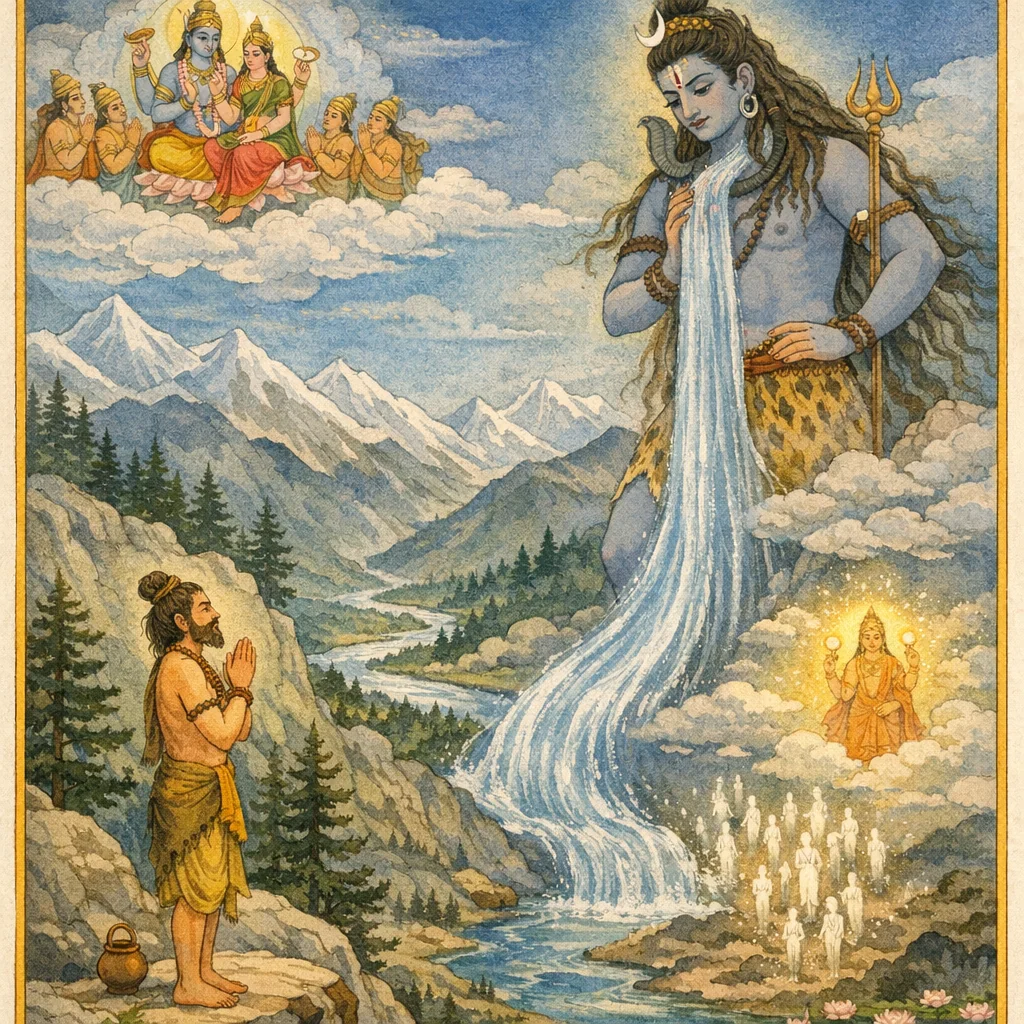
Bhāgīratha’s Bringing of the Gaṅgā
Nārada asks how Bhāgīratha acted in the Himālaya and how Gaṅgā was brought down. Sanaka relates: Bhāgīratha, an ascetic-king, reaches Bhṛgu’s hermitage and seeks the true cause of human uplift and the deeds that please Bhagavān. Bhṛgu defines satya as dharma-aligned speech that benefits beings, praises ahiṃsā, warns against wicked company, and teaches Vaiṣṇava remembrance through worship and japa of the eight-syllabled “Oṁ Namo Nārāyaṇāya” and the twelve-syllabled “Oṁ Namo Bhagavate Vāsudevāya,” along with meditative visualization of Nārāyaṇa. Bhāgīratha performs severe tapas at Himavat; its intensity alarms the devas, who praise Mahāviṣṇu at the Milk Ocean. Viṣṇu appears, promises ancestral uplift, and directs him to worship Śambhu (Śiva). Bhāgīratha hymns Īśāna; Śiva appears, grants the boon, and Gaṅgā issues from Śiva’s matted locks, follows Bhāgīratha, sanctifies the place where Sagara’s sons perished, and liberates them to Viṣṇu’s realm. The chapter ends with a phalaśruti: hearing or reciting this account yields the merit of bathing in Gaṅgā and leads the narrator to Viṣṇu’s abode.
Shlokas
Verse 1
नारद उवाच । हिमवद्गिरिमासाद्य किं चकार महीपतिः । कथमानीतवान् गङ्गामेतन्मे वक्तुमर्हसि 1. ॥ १ ॥
Nārada said: “Having reached Mount Himavat, what did the king do? And how did he bring Gaṅgā? Please tell me this.”
Verse 2
सनक उवाच । भगीरथो महाराजो जटाचीरधरो मुने । गच्छन् हिमाद्रिं तपसे प्राप्तो गोदावरीतटम् ॥ २ ॥
Sanaka said: “O sage, King Bhagiratha—wearing matted locks (jaṭā) and clad in bark-garments—set out toward Himādri for austerities, and he reached the bank of the Godāvarī.”
Verse 3
तत्रापश्यत् महारण्ये भृगोराश्रममुत्तमम् । कृष्णसारसमाकीर्णं मातङ्गगणसेवितम् ॥ ३ ॥
There, in the vast forest, he beheld Bhṛgu’s most excellent hermitage, filled with blackbuck deer (kṛṣṇasāra) and frequented by herds of elephants.
Verse 4
भ्रमद्भ्रमरसङ्घुष्टं कूजद्विहगसंकुलम् । व्रजद्वराहनिकरं चमरीपुच्छवीजितम् ॥ ४ ॥
It resounded with the humming of whirling bees, was thronged with birds calling out, had herds of boars roaming about, and was gently fanned by yak-tail whisks (chāmaras).
Verse 5
नृत्यन्मयूरनिकरं सारङ्गादिनिषेवितम् । प्रवर्द्धितमहावृक्षं मुनिकन्याभिरादरात् ॥ ५ ॥
It was filled with flocks of dancing peacocks and visited by deer and other creatures; and there stood a great tree, carefully nurtured with devotion by the daughters of sages.
Verse 6
शालतालतमालाढ्यं नूनहिन्तालमण्डितम् । मालतीयूथिकाकुन्दचम्पकाश्वत्थभूषितम् ॥ ६ ॥
It was rich with śāla, tāla, and tamāla trees, adorned with tall hintāla palms; beautified by mālatī and yūthikā creepers, by kunda and campaka blossoms, and by sacred aśvattha trees.
Verse 7
उत्पुल्लकुसुमोपेतमृषिसङ्घनिषेवितम् । वेदशास्त्रमहाघोषमाश्रमं प्राविशद् भृगोः ॥ ७ ॥
He entered Bhṛgu’s hermitage—adorned with fully blossomed flowers, frequented by hosts of sages, and resounding with the great recitations of the Vedas and sacred treatises.
Verse 8
गृणन्तं परमं ब्रह्म वृतं शिष्यगणैर्मुनिम् । तेजसा सूर्यसदृशं भृगुं तत्र ददर्श सः ॥ ८ ॥
There he saw the sage Bhṛgu—surrounded by groups of disciples—chanting the Supreme Brahman, radiant with a brilliance like the sun.
Verse 9
प्रणनामाथ विप्रेन्द्रं पादसङ्ग्रहणादिना । आतिथ्यं भृगुरप्यस्य चक्रे सन्मानपूर्वकम् ॥ ९ ॥
Then Bhṛgu bowed to that foremost of Brahmins, even taking hold of his feet and the like; and he duly performed hospitality toward him with respectful honor.
Verse 10
कृतातिथ्यक्रियो राजा भृगुणा परमर्षिणा । उवाच प्राञ्जलिर्भूत्वा विनयान्मुनिपुङ्गवम् ॥ १० ॥
After duly performing the rites of hospitality for the supremely great sage Bhṛgu, the king—standing with folded hands—respectfully addressed that foremost of sages with humility.
Verse 11
भगीरथ उवाच । भगवन्सर्वधर्मज्ञ सर्वशास्त्रविशारद । पृच्छामि भवभीतोऽहं नृणामुद्धारकारणम् ॥ ११ ॥
Bhagīratha said: “O Blessed one, knower of all dharma and master of all śāstras, I ask you—being afraid of worldly becoming—what is the true cause of the upliftment and deliverance of human beings?”
Verse 12
भगवांस्तुष्यते येन कर्मणा मुनिसत्तम । तन्ममाख्याहि सर्वज्ञ अनुग्राह्योऽस्मि ते यदि ॥ १२ ॥
O best of sages, tell me—by what act does the Blessed Lord (Bhagavān) become pleased? O all-knowing one, instruct me in that, if I am worthy of your grace.
Verse 13
भृगुरुवाच । राजंस्तवेप्सितं ज्ञातं त्वं हि पुण्यवतां वरः । अन्यथा स्वकुलं सर्वं कथमुद्धर्तुमर्हसि ॥ १३ ॥
Bhṛgu said: “O King, I have understood what you desire; for you are the foremost among the meritorious. Otherwise, how could you be fit to uplift your entire lineage?”
Verse 14
यो वा को वापि भूपाल स्वकुलं शुभकर्मणा । उद्धर्तुकामस्तं विद्यान्नररूपधरं हरिम् ॥ १४ ॥
O king, whoever desires—through auspicious deeds—to uplift and redeem his own lineage should know him to be Hari (Vishnu) Himself, who assumes a human form.
Verse 15
कर्मणा येन देवेशो नृणामिष्टफलप्रदः । तत्प्रवक्ष्यामि राजेन्द्र शृणुष्व सुसमाहितः ॥ १५ ॥
O king of kings, I shall explain that action (karma) by which the Lord of the gods becomes the bestower of people’s desired results; listen with a fully focused mind.
Verse 16
भव सत्यपरो राजन्नहिंसानिरतस्तथा । सर्वभूतहितो नित्यं मानृतं वद वै क्वचित् ॥ १६ ॥
O king, be devoted to truth, and likewise be steadfast in non-violence. Ever be intent on the welfare of all beings; and never speak falsehood—at any time.
Verse 17
त्यज दुर्जनसंसर्गं भज साधुसमागमम् । कुरु पुण्यमहोरात्रं स्मर विष्णुं सनातनम् ॥ १७ ॥
Abandon the company of the wicked; seek the association of the virtuous sādhus. Perform meritorious deeds day and night, and remember the eternal Vishnu.
Verse 18
कुरु पूजां महाविष्णोर्याहि शान्तिमनुत्तमाम् । द्वादशाष्टाक्षरं मन्त्रं जप श्रेयो भविष्यति ॥ १८ ॥
Worship Mahāviṣṇu and attain unsurpassed peace. Recite in japa the twelve-syllabled and eight-syllabled mantras; your highest good will surely arise.
Verse 19
भगीरथ उवाच । सत्यं तु कीदृशं प्रोक्तं सर्वभूतहितं मुने । अनृतं कीदृशं प्रोक्तं दुर्जनाश्चापि कीदृशाः ॥ १९ ॥
Bhagīratha said: “O sage, what kind of truth is taught as beneficial to all beings? What kind of untruth is spoken of? And what, too, are the marks of the wicked?”
Verse 20
साधवः कीदृशाः प्रोक्तास्तथा पुण्यं च कीदृशम् । स्मर्तव्यश्च कथं विष्णुस्तस्य पूजा च कीदृशी ॥ २० ॥
“What kind of people are declared to be true sādhus, the virtuous? And what is said to be real merit (puṇya)? In what manner should Lord Viṣṇu be remembered, and what is the proper form of His worship?”
Verse 21
शान्तिश्च कीदृशी प्रोक्ता को मन्त्रोऽष्टाक्षरो मुने । को वा द्वादशवर्णश्च मुने तत्त्वार्थकोविद ॥ २१ ॥
“O sage, what kind of Śānti (rite of pacification) has been taught? Which is the eight-syllabled mantra (aṣṭākṣara), O muni? And which, indeed, is the twelve-syllabled mantra (dvādaśavarṇa), O sage skilled in the true meaning of the principles?”
Verse 22
कृपां कृत्वा मयि परां सर्वं व्याख्यातुमर्हसि । भृगुरुवाच । साधु साधु महाप्राज्ञ तव बुद्धिरनुत्तमा ॥ २२ ॥
“Show me your highest compassion and explain everything in full.” Bhṛgu said: “Excellent, excellent, O greatly wise one—your understanding is unsurpassed.”
Verse 23
यत्पृष्टोऽहं त्वया भूप तत्सर्वं प्रवदामि ते । यथार्थकथनं यत्तत्सत्यमाहुर्विपश्चितः ॥ २३ ॥
“O king, I shall tell you everything that you have asked of me. The wise declare that truth is that speech which states things exactly as they really are.”
Verse 24
धर्माविरोधतो वाच्यं तद्धि धर्मपरायणैः । देशकालादि विज्ञाय स्वयमस्याविरोधतः ॥ २४ ॥
Those devoted to Dharma should speak only in ways that do not oppose Dharma; having discerned place, time, and other circumstances, one should oneself ensure that one’s words are not contrary to it.
Verse 25
यद्वचः प्रोच्यते सद्भिस्तत्सत्यमभिधीयते । सर्वेषामेव जन्तूनामक्लेशजननं हि तत् ॥ २५ ॥
That speech which is uttered by the virtuous is called “truth,” for it indeed brings forth freedom from distress for all living beings.
Verse 26
अहिंसा सा नृप प्रोक्ता सर्वकामप्रदायिनी । कर्मकार्यसहायत्वमकार्यपरिपन्थिता ॥ २६ ॥
O King, ahiṃsā (non-violence) is declared to grant all desired ends. It aids the performance of righteous duties and stands as a barrier against forbidden or unrighteous acts.
Verse 27
सर्वलोकहितत्वं वै प्रोच्यते धर्मकोविदैः । इच्छानुवृत्तकथनं धर्माधर्माविवेकिनः ॥ २७ ॥
The wise who know Dharma declare that true Dharma is what promotes the welfare of all worlds. But speech spoken merely to suit one’s desires is the mark of one who cannot discern Dharma from Adharma.
Verse 28
अनृतं तद्धि विज्ञेयं सर्वश्रेयोविरोधि तत् । ये लोके द्वेषिणो मूर्खाः कुमार्गरतबुद्धयः ॥ २८ ॥
Know as falsehood that which obstructs every form of true welfare. In this world, those who are hateful, deluded, and whose minds delight in the wrong path are the very ones rooted in such untruth.
Verse 29
ते राजन्दुर्ज्जना ज्ञेयाः सर्वधर्मबहिष्कृताः । धर्माधर्मविवेकेन वेदमार्गानुसारिणः ॥ २९ ॥
O King, know them to be wicked—cast outside all dharma; though they speak of discerning dharma from adharma, they merely claim to follow the Vedic path.
Verse 30
सर्वलोकहितासक्ता साधवः परिकीर्तिताः । हरिभक्तिकरं यत्तत्सद्भिश्च परिरञ्जितम् ॥ ३० ॥
The righteous (sādhu) are proclaimed as those devoted to the welfare of all worlds. Whatever awakens bhakti to Hari is cherished and approved by the good.
Verse 31
आत्मनः प्रीतिजनकं तत्पुण्यं परिकीर्तितम् । सर्वं जगदिदं विष्णुर्विष्णुः सर्वस्य कारणम् ॥ ३१ ॥
That which brings pure inner gladness within oneself is declared merit (puṇya). This entire universe is Viṣṇu; Viṣṇu is the cause of everything.
Verse 32
अहं च विष्णुर्यज्ज्ञानं तद्विष्णुस्मरणं विदुः । सर्वदेवमयो विष्णुर्विधिना पूजयामि तम् ॥ ३२ ॥
“I too am Viṣṇu; and what is called ‘knowledge’ is known to be the remembrance of Viṣṇu.” Viṣṇu is the embodiment of all the gods; therefore I worship Him according to the prescribed rite.
Verse 33
इति या भवति श्रद्धा सा तद्भक्तिः प्रकीर्त्तिता । सर्वभूतमयो विष्णुः परिपूर्णः सनातनः ॥ ३३ ॥
Such faith (śraddhā) as described is proclaimed to be bhakti to Him. Viṣṇu, present as the essence of all beings, is the eternal Lord—complete and all-fulfilled.
Verse 34
इत्यभेदेन या बुद्धिः समता सा प्रकीर्तिता । समता शत्रुमित्रेषु वशित्वं च तथा नृप ॥ ३४ ॥
That understanding which sees no difference (among beings) is proclaimed as equanimity (samatā). Such equanimity toward both enemy and friend is also called self-mastery, O king.
Verse 35
यदृच्छालाभसंतुष्टिः सा शान्तिः परिकीर्त्तिता । एते सर्वे समाख्यातास्तपः सिद्धिप्रदा नृणाम् ॥ ३५ ॥
Contentment with whatever gain comes of its own accord is declared to be true peace (śānti). All these have been described as forms of tapas (austerity) that grant siddhi, spiritual accomplishment, to human beings.
Verse 36
समस्तपापराशीनां तरसा नाशहेतवः । अष्टाक्षरं महामन्त्रं सर्वपापप्रणाशनम् ॥ ३६ ॥
The great eight-syllabled mantra is the swift cause for the destruction of the entire mass of sins; it is the destroyer of all sins.
Verse 37
वक्ष्यामि तव राजेन्द्र पुरुषार्थैकसाधनम् । विष्णोः प्रियकरं चैव सर्वसिद्धिप्रदायकम् ॥ ३७ ॥
O king of kings, I shall tell you the single means that accomplishes the aims of human life (puruṣārtha)—something dear to Lord Viṣṇu and a bestower of every success and attainment.
Verse 38
नमो नारायणायेति जपेत्प्रणवपूर्वकम् । नमो भगवते प्रोच्य वासुदेवाय तत्परम् ॥ ३८ ॥
One should perform japa of the mantra “Namo Nārāyaṇāya,” preceded by the Praṇava (Oṁ). Having uttered “Namo Bhagavate,” one should then devotedly say “Vāsudevāya.”
Verse 39
प्रणवाद्यं महाराज द्वादशार्णमुदाहृतम् । द्वयोः समं फलं राजन्नष्टद्वादशवर्णयोः ॥ ३९ ॥
O great king, the twelve-syllabled mantra that begins with the Praṇava (Oṁ) has been proclaimed. O king, its fruit is said to be equal to that of the eight- and the twelve-lettered mantras.
Verse 40
प्रवृत्तौ च निवृत्तौ च साम्यमुद्दिष्टमेतयोः । शङ्खचक्रधरं शान्तं नारायणमनामयम् ॥ ४० ॥
In both pravṛtti (engagement in action) and nivṛtti (withdrawal from action), an essential sameness has been taught. That sameness is Nārāyaṇa—peaceful, free from affliction—who bears the conch and the discus.
Verse 41
लक्ष्मीसंश्रितवामाङ्कं तथाभयकरं प्रभुम् । किरीटकुण्डलधरं नानामण्डनशोभितम् ॥ ४१ ॥
I behold the Supreme Lord: upon His left side Lakṣmī rests in loving refuge; He bestows fearlessness; He wears crown and earrings, and shines adorned with many ornaments.
Verse 42
भ्राजत्कौस्तुभमालाढ्यं श्रीवत्साङ्कितवक्षसम् । पीताम्बरधरं देवं सुरासुरनमस्कृतम् ॥ ४२ ॥
They beheld the divine Lord—adorned with the radiant Kaustubha jewel and garlands, His chest marked with the sacred Śrīvatsa, clad in yellow garments—revered by both the gods and the asuras.
Verse 43
ध्यायेदनादिनिधनं सर्वकामफलप्रदम् । अन्तर्यामी ज्ञानरूपी परिपूर्णः सनातनः ॥ ४३ ॥
One should meditate upon the One who is without beginning and without end, the bestower of the fruits of all rightful desires—He who is the Inner Ruler (Antaryāmin), whose very form is Knowledge, perfectly complete, and eternal.
Verse 44
एतत्सर्वं समाख्यातं यत्तु पृष्टं त्वया नृप । स्वस्ति तेऽस्तु तपः सिद्धिं गच्छ लब्धुं यथासुखम् ॥ ४४ ॥
O King, I have fully explained all that you asked. May auspiciousness be yours; go now and, at your own ease, attain the fruit of your austerities.
Verse 45
एवमुक्तो महीपालो भृगुणा परमर्षिणा । परमां प्रीतिमापन्नः प्रपेदे तपसे वनम् ॥ ४५ ॥
Thus addressed by Bhṛgu, the supreme sage, the king was filled with the highest joy and set out for the forest to undertake austerities.
Verse 46
हिमवद्गिरिमासाद्य पुण्यदेशे मनोहरे । नादेश्वरे महाक्षेत्रे तपस्तेपेऽतिदुश्चरम् ॥ ४६ ॥
Having reached the Himavat mountain, in a beautiful and holy region—at the great sacred field of Nādeśvara—he performed austerities that were exceedingly difficult to undertake.
Verse 47
राजा त्रिषवणस्नायी कन्दमूलफलाशनः । कृतातिथ्यर्हणश्चापि नित्यं होमपरायणः ॥ ४७ ॥
The king bathed at the three daily sandhyās, lived on roots, tubers, and fruits, duly honored guests, and was ever devoted to the daily homa, the fire-offerings.
Verse 48
सर्वभूतहितः शान्तो नारायणपरायणः । पत्रैः पुष्पैः फलैस्तोयैस्त्रिकालं हरिपूजकः ॥ ४८ ॥
He sought the welfare of all beings, was tranquil by nature, and wholly surrendered to Nārāyaṇa; with leaves, flowers, fruits, and water he worshiped Hari three times a day.
Verse 49
एवं बहुतिथं कालं नीत्वा यात्यन्तधैर्यवान् । ध्यायन्नारायणं देवं शीर्णपर्णाशनोऽभवत् ॥ ४९ ॥
Thus, after passing a very long time, he—steadfast in supreme fortitude—went on, meditating upon Lord Nārāyaṇa, and came to live on withered leaves as his food.
Verse 50
प्राणायामपरो भूत्वा राजा परमधार्मिकः । निरुच्छ्वासस्तपस्तप्तुं ततः समुपचक्रमे ॥ ५० ॥
Then the king—supremely righteous—became devoted to prāṇāyāma, and, restraining his breath, he began to undertake austerity (tapas).
Verse 51
ध्यायन्नारायणं देवमनन्तमपराजितम् । षष्टिवर्षसहस्राणि निरुच्छ्वासपरोऽभवत् ॥ ५१ ॥
Meditating on Nārāyaṇa—the divine Lord, infinite and unconquered—he remained wholly absorbed, without drawing a breath, for sixty thousand years.
Verse 52
तस्य नासापुटाद्रा ज्ञो वह्निर्जज्ञे भयङ्करः । तं दृष्ट्वा देवताः सर्वो वित्रस्ता वह्नितापिताः ॥ ५२ ॥
O King, from his nostrils a terrifying fire was born. Seeing it, all the gods were struck with fear and scorched by that fire’s heat.
Verse 53
अभिजग्मुर्महाविष्णुं यत्रास्ते जगतां पतिः । क्षीरोदस्योत्तरं तीरं सम्प्राप्य त्रिदशेश्वराः । अस्तुवन्देवदेवेशं शरणागतपालकम् ॥ ५३ ॥
The lords of the gods went to Mahāviṣṇu, where the Lord of the worlds resides. Reaching the northern shore of the Ocean of Milk, they praised the God of gods—the protector of those who seek refuge.
Verse 54
देवा ऊचुः । नताःस्म विष्णुं जगदेकनाथं स्मरत्समस्तार्तिहरं परेशम् । स्वभावशुद्धं परिपूर्णभावं वदन्ति यज्ज्ञानतनुं च तज्ज्ञाः ॥ ५४ ॥
The gods said: We bow to Viṣṇu, the sole Lord of the universe—the Supreme Lord who, when remembered, removes all afflictions. His very nature is pure and His being is complete; the wise declare Him to be of the very form of knowledge itself.
Verse 55
ध्येयः सदा योगिवरैर्महात्मा स्वेच्छाशरीरैः कृतदेवकार्यः । जगत्स्वरूपो जगदादिनाथस्तस्मै नताः स्मः पुरुषोत्तमाय ॥ ५५ ॥
That Great-Souled One is ever to be meditated upon by the foremost of yogins—He who, by bodies assumed at His own will, has accomplished the work of the gods. He whose very form is the universe, the primordial Lord of the world—to that Supreme Person (Puruṣottama) we bow.
Verse 56
यन्नामसङ्कीर्त्तनतो खलानां समस्तपापानि लयं प्रयान्ति । तमीशमीड्यं पुरुषं पुराणं नताःस्म विष्णुं पुरुषार्थसिद्ध्यै ॥ ५६ ॥
By the very singing of whose Name even the sins of the wicked dissolve and come to an end—we bow to that Lord Viṣṇu, the ancient, primeval Person, worthy of praise, for the attainment of the aims of human life.
Verse 57
यत्तेजसा भान्ति दिवाकराद्या नातिक्रमन्त्यस्य कदापि शिक्षाः । कालात्मकं तं त्रिदशाधिनाथं नमामहेवै पुरुषार्थरूपम् ॥ ५७ ॥
By whose radiance the Sun and other luminaries shine, and whose ordinances even the disciplines like Śikṣā never transgress—him, whose very nature is Time, the Lord of the gods, the very embodiment of the aims of human life, we indeed bow to.
Verse 58
जगत्करोऽत्यब्जभवोऽत्ति रुद्र ः पुनाति लोकाञ्छ्रुतिभिश्च विप्राः । तमादिदेवं गुणसन्निधानं सर्वोपदेष्टारमिताः शरण्यम् ॥ ५८ ॥
The Maker of the worlds is beyond; the Lotus-born (Brahmā) is consumed; Rudra devours; and the learned brāhmaṇas purify the worlds through the Śrutis (Vedas). To that Primordial Lord—the abode of all qualities and the universal Teacher—have we come for refuge, as the supreme shelter.
Verse 59
वरं वरेण्यं मधुकैटभारिं सुरासुराभ्यर्चितपादपीठम् । सद्भक्तसङ्कल्पितसिद्धिहेतुं ज्ञानैकवेद्यं प्रणताःस्म देवम् ॥ ५९ ॥
We bow to that Divine Lord—supremely excellent and most worthy of choice—who slew Madhu and Kaiṭabha; whose footstool is worshipped by gods and asuras alike; who becomes the cause of the fulfilment of the holy resolve of true devotees; and who is knowable only through spiritual knowledge.
Verse 60
अनादिमध्यान्तमजं परेशमनाद्यविद्याख्यतमोविनाशम् । सच्चित्परानन्दघनस्वरूपं रूपादिहीनं प्रणताःस्म देवम् ॥ ६० ॥
We bow to that Deity—unborn, the Supreme Lord—who is without beginning, middle, or end; who destroys the darkness called beginningless ignorance; whose very nature is a dense fullness of Existence, Consciousness, and Supreme Bliss; and who is free from form and all limiting attributes.
Verse 61
नारायणं विष्णुमनन्तमीशं पीताम्बरं पद्मभवादिसेव्यम् । यज्ञप्रियं यज्ञकरं विशुद्धं नताःस्म सर्वोत्तममव्ययं तम् ॥ ६१ ॥
We bow to that Narayana—Vishnu, the infinite Lord—clad in yellow garments, worshipped by Brahmā and the other gods; the beloved of sacrifice and the very accomplisher of sacrifice; the perfectly pure, the supreme, and the imperishable.
Verse 62
इति स्तुतो महाविष्णुर्देवैरिन्द्रा दिभिस्तदा । चरितं तस्य राजर्षेर्देवानां संन्यवेदयत् ॥ ६२ ॥
Thus praised at that time by the gods—Indra and the others—Mahāviṣṇu then fully related to the devas the life‑account of that royal sage.
Verse 63
ततो देवान्समाश्वास्य दत्त्वाभयमनञ्जनः । जगाम यत्र राजर्षिस्तपस्तपति नारद ॥ ६३ ॥
Then, having consoled the gods and granted them fearlessness, the stainless one went to the place where the royal sage Nārada was practicing austerities.
Verse 64
शङ्खचक्रधरो देवः सच्चिदानन्दविग्रहः । प्रत्यक्षतामगात्तस्य राज्ञः सर्वजगद्गुरुः ॥ ६४ ॥
The Lord who bears the conch and discus—whose very form is Existence, Consciousness, and Bliss (Sat-Cit-Ānanda)—became directly visible to that king: the Guru of the entire world.
Verse 65
तं दृष्ट्वा पुण्डरीकाक्षं भाभासितदिगन्तरम् । अतसीपुष्पसंकाशं स्फुरत्कुण्डलमण्डितम् ॥ ६५ ॥
Seeing Him—the lotus-eyed Lord—who illumined the far horizons in every direction, radiant like the blue atasi flower and adorned with shining earrings, they were filled with reverent awe.
Verse 66
स्निग्धकुन्तलवक्त्राब्जं विभ्राजन्मुकुटोज्ज्वलम् । श्रीवत्सकौस्तुभधरं वनमालाविभूषितम् ॥ ६६ ॥
With glossy curling locks and a lotus-like face, radiant with a shining crown; bearing the Śrīvatsa mark and the Kaustubha gem, and adorned with the forest-garland (vanamālā)—that Lord I contemplate in devotion.
Verse 67
दीर्घबाहुमुदाराङ्गं लोकेशार्चितपङ्कजम् । नाम दण्डवद् भूमौ भूपतिर्नम्रकन्धरः ॥ ६७ ॥
The king, his neck bowed in humility, prostrated like a staff upon the ground before that long-armed, noble-limbed Lord whose lotus-feet are worshipped even by the rulers of the worlds.
Verse 68
अत्यन्तहर्षसम्पूर्णः सरोमाञ्चः सगद्गदः । कृष्ण कृष्णेति कृष्णेति श्रीकृष्णेति समुच्चरन् ॥ ६८ ॥
Overwhelmed with supreme joy—his body thrilled with horripilation and his voice choked with emotion—he kept crying aloud, “Krishna, Krishna,” and again “Krishna,” and “Śrī Krishna.”
Verse 69
तस्य विष्णुः प्रसन्नात्मा ह्यन्तर्यामी जगद्गुरुः । उवाच कृपयाविष्टो भगवान्भूतभावनः ॥ ६९ ॥
Then Viṣṇu—serene at heart, the Inner Ruler (Antaryāmin) and Teacher of the worlds—moved by compassion, spoke to him; that Blessed Lord, the nurturer and sustainer of all beings.
Verse 70
श्री भगवानुवाच । भगीरथ महाभाग तवाभीष्टं भविष्यति । आगमिष्यन्ति मल्लोकं तव पूर्वपितामहाः ॥ ७० ॥
The Blessed Lord said: “O most fortunate Bhagiratha, what you desire shall surely come to pass. Your forefathers of earlier generations will come to My realm.”
Verse 71
मम मूर्त्यन्तरं शम्भुं राजन्स्तोत्रैः स्वशक्तितः । स्तुहि ते सकलं कामं स वै सद्यः करिष्यति ॥ ७१ ॥
O King, praise Śambhu—another manifestation of Me—with hymns according to your ability; he will indeed fulfill your every desire at once.
Verse 72
यस्तु जग्राह शशिनं शरणं समुपागतम् । तस्मादाराधयेशानं स्तोत्रैः स्तुत्यं सुखप्रदम् ॥ ७२ ॥
He who received the Moon (Śaśin) when the Moon came seeking refuge—therefore worship Īśāna, the Lord worthy of praise through hymns, the giver of happiness.
Verse 73
अनादिनिधनो देवः सर्वकामफलप्रदः । त्वया संपूजितो राजन्सद्यः श्रेयो विधास्यति ॥ ७३ ॥
That Lord is without beginning or end and bestows the fruits of all rightful desires. O King, when He is duly worshipped by you, He will at once bring about your highest welfare.
Verse 74
इत्युक्त्वा देवदेवेशो जगतां पतिरच्युतः । अन्तर्दधे मुनिश्रेष्ठ उत्तस्थौ सोऽपि भूपतिः ॥ ७४ ॥
Having spoken thus, the Lord of lords—Acyuta, sovereign of all the worlds—vanished from sight. O best of sages, that king too then rose up.
Verse 75
किमिदं स्वप्न आहोस्वित्सत्यं साक्षाद् द्विजोत्तम । भूपतिर्विंस्मयं प्राप्तः किं करोमीति विस्मितः ॥ ७५ ॥
“Is this a dream, or is it truly real, O best of the twice-born?” The king, struck with astonishment, stood bewildered, thinking, “What should I do?”
Verse 76
अथान्तरिक्षे वागुच्चैः प्राह तं भ्रान्तचेतसम् । सत्यमेतदिति व्यक्तं न चिन्तां कर्तुमर्हसि ॥ ७६ ॥
Then, from the mid-sky, a voice spoke aloud to him whose mind was bewildered: “This is indeed true and unmistakable—there is no need for you to fall into anxiety.”
Verse 77
तन्निशम्यावनीपाल ईशानं सर्वकारणम् । समस्त देवताराजमस्तौषीद्भक्तितत्परः ॥ ७७ ॥
Hearing that, the king—devoted to bhakti—praised Īśāna, the cause of all, the sovereign Lord of all the deities.
Verse 78
भगीरथ उवाच । प्रणमामि जगन्नाथं प्रणतार्त्रिपणाशनम् । प्रमाणागोचरं देवमीशानं प्रणवात्मकम् ॥ ७८ ॥
Bhagīratha said: I bow to Jagannātha, the Lord of the universe, who removes the suffering of those who take refuge and prostrate. I bow to the divine Lord beyond the reach of ordinary means of proof—Īśāna, whose very nature is the sacred syllable Oṁ (Praṇava).
Verse 79
जगद्रू पमजं नित्यं सर्गस्थित्यन्तकारणम् । विश्वरूपं विरूपाक्षं प्रणतोऽस्म्युग्ररेतसम् ॥ ७९ ॥
I bow to the Unborn, the Eternal, who is the very form of the universe—the cause of creation, preservation, and dissolution; the Cosmic Being of all forms, the Lord of wondrous eyes, whose mighty creative potency is awe-inspiring.
Verse 80
आदिमध्यान्तरहितमनन्तमजमव्ययम् । समामनन्ति योगीन्द्रा स्तं वन्दे पुष्टिवर्धनम् ॥ ८० ॥
I bow to the Nourisher who increases all well-being—without beginning, middle, or end; infinite, unborn, and imperishable—whom the foremost yogins ever recite and praise.
Verse 81
नमो लोकाधिनाथाय वञ्चते परिवञ्चते । नमोऽस्तु नीलग्रीवाय पशूनां पतये नमः ॥ ८१ ॥
Salutations to the Lord of the worlds—who (by His māyā) deludes, and is also spoken of as deluded. Salutations to the Blue-necked One; salutations to Paśupati, Lord of beings.
Verse 82
नमश्चैतन्यरूपाय पुष्टानां पतये नमः । नमोऽकल्पप्रकल्पाय भूतानां पतये नमः ॥ ८२ ॥
Salutations to Him whose very form is pure consciousness; salutations to the Lord and Protector of the nourished and the flourishing. Salutations to Him who transcends all fixed arrangements and yet ordains anew; salutations to the Lord and Protector of all beings.
Verse 83
नमः पिनाकहस्ताय शूलहस्ताय ते नमः । नमः कपालहस्ताय पाशमुद्गरधारिणे ॥ ८३ ॥
Salutations to You who hold the Pināka bow; salutations to You who bear the trident. Salutations to You who carry a skull; to You who wield the noose and the mace.
Verse 84
नमस्ते सर्वभूताय घण्टाहस्ताय ते नमः । नमः पञ्चास्यदेवाय क्षेत्राणां पतये नमः ॥ ८४ ॥
Salutations to You who abide in all beings; salutations to You who hold the bell in Your hand. Salutations to the five-faced Lord; salutations to the Lord of the sacred kṣetras—holy sites and temples.
Verse 85
नमः समस्तभूतानामादिभूताय भूभृते । अनेकरूपरूपाय निर्गुणाय परात्मने ॥ ८५ ॥
Salutations to the Supreme Self, the primal source of all beings and the sustainer of the earth. Though manifesting countless forms, You remain beyond all qualities—nirguṇa Paramātman.
Verse 86
नमो गणाधिदेवाय गणानां पतये नमः । नमो हिरण्यगर्भाय हिरण्यपतये नमः ॥ ८६ ॥
Homage to the presiding Deity of the gaṇas; homage to the Lord of the gaṇas. Homage to Hiraṇyagarbha; homage to the Lord of Hiraṇya—the golden, radiant principle.
Verse 87
हिरण्यरेतसे तुभ्यं नमो हिरण्यवाहवे । नमो ध्यानस्वरूपाय नमस्ते ध्यानसाक्षिणे ॥ ८७ ॥
Salutations to You whose generative essence is golden; salutations to You who bear and convey the golden radiance. Salutations to You who are the very form of meditation; salutations to You, the witness of all meditation.
Verse 88
नमस्ते ध्यानसंस्थाय ध्यानगम्याय ते नमः । येनेदं विश्वमखिलं चराचरविराजितम् ॥ ८८ ॥
Salutations to You who abide in meditation; salutations to You who are attainable through meditation. By You this entire universe—of moving and unmoving beings—is made resplendent.
Verse 89
वर्षेवाभ्रेण जनितं प्रधानपुरुषात्मना ॥ ८९ ॥
Born in essence from Pradhāna and Puruṣa, it is brought forth—like rain from a cloud.
Verse 90
स्वप्रकाशं महात्मानं परं ज्योतिः सनातनम् । यमामनन्ति तत्त्वज्ञाः सवितारं नृचक्षुषाम् ॥ ९० ॥
The knowers of truth declare Him—the self-luminous Great Soul, the supreme and eternal Light—as Savitṛ, the Sun who is the eye of humankind.
Verse 91
उमाकान्तं नन्दिकेशं नीलकण्ठं सदाशिवम् । मृत्युञ्जयं महादेवं परात्परतरं विभुम् ॥ ९१ ॥
I bow to Śiva—beloved of Umā, lord of Nandi’s hosts, the Blue-throated, the ever-auspicious Sadāśiva; the Conqueror of death, the Great God, the transcendent One beyond even the beyond, the all-pervading Lord.
Verse 92
परं शब्दब्रह्मरूपं तं वन्देऽखिलकारणम् । कपर्द्दिने नमस्तुभ्यं सद्योजाताय वै नमः ॥ ९२ ॥
I bow to that Supreme One whose form is the Brahman of sacred sound, the cause of all. Salutations to you, O Kapardin (the matted-haired Lord); salutations indeed to Sadyōjāta.
Verse 93
भवोद्भवाय शुद्धाय ज्येष्ठाय च कनीयसे । मन्यवे त इषे त्रय्याः पतये यज्ञतन्तवे ॥ ९३ ॥
Salutations to You—the source from whom all becoming arises; the Pure One; the eldest and also the youngest; the awe-inspiring Lord; the giver of nourishment; the Master of the threefold Veda; and the very framework of sacrifice.
Verse 94
ऊर्जे दिशां च पतये कालायाघोररूपिणे । कृशानुरेतसे तुभ्यं नमोऽस्तु सुमहात्मने ॥ ९४ ॥
Salutations to You—You who are Ūrjā, the vital power; the Lord of the directions; Time itself in a formidable form; and the fiery seed, the energy of Agni. O great-souled One, to You be my homage.
Verse 95
यतः समुद्रा ः सरितोऽद्र यश्च गन्धर्वयक्षासुरसिद्धसङ्घाः । स्थाणुश्चरिष्णुर्महदल्पकं च असच्च सज्जीवमजीवमास ॥ ९५ ॥
From Him arise the oceans, the rivers, and the mountains; and the hosts of Gandharvas, Yakṣas, Asuras, and Siddhas. From Him come the immovable and the moving, the great and the minute—indeed, the unreal and the real, the living and the non-living—He brought all this into being.
Verse 96
नतोऽस्मि तं योगिनताङ्घ्रिपद्मं सर्वान्तरात्मानमरूपमीशम् । स्वतन्त्रमेकं गुणिनां गुणं च नमामि भूयः प्रणमामि भूयः ॥ ९६ ॥
I bow to that Lord whose lotus-feet are the very refuge of yogins—He who is the Inner Self of all, formless, and sovereign; the one, self-dependent Reality, and the very excellence within all who possess qualities. Again and again I salute Him; again and again I prostrate.
Verse 97
इत्थं स्तुतो महादेवः शङ्करो लोकशङ्करः । आविर्बभूव भूपस्य संतप्ततपसोग्रतः ॥ ९७ ॥
Thus praised, Mahādeva Śaṅkara—the benefactor of the worlds—manifested before the king, who was blazing with intense austerities.
Verse 98
पञ्चवक्त्रं दशभुजं चन्द्रा र्द्धकृतशेखरम् । त्रिलोचनमुदाराङ्गं नागयज्ञोपवीतिनम् ॥ ९८ ॥
Five-faced and ten-armed, with the crescent moon forming part of his crown; three-eyed, noble-limbed, and wearing a sacred thread (yajñopavīta) made of serpents.
Verse 99
विशालवक्षसं देवं तुहिनाद्रि समप्रभम् । गजचर्माम्बरधरं सुरार्चितपदाम्बुजम् ॥ ९९ ॥
He beheld the divine Lord, broad-chested and radiant like the snow-clad Himalaya, clad in an elephant-hide garment, whose lotus-feet are worshipped by the gods.
Verse 100
दृष्ट्वा पपात पादाग्रे दण्डवद्भुवि नारद । तत उत्थाय सहसा शिवाग्रे विहिताञ्जलि ॥ १०० ॥
On seeing Him, Nārada fell at His feet upon the ground like a staff, in full prostration. Then, rising at once, he stood before Śiva with palms joined in reverence.
Verse 101
प्रणनाम महादेवं कीर्तयञ्शङ्कराह्वयम् । विज्ञाय भक्तिं भूपस्य शङ्करः शशिशेखरः ॥ १०१ ॥
He bowed to Mahādeva, praising Him by the name “Śaṅkara.” Recognizing the king’s devotion, Śaṅkara—the moon-crested Lord—was pleased and responded.
Verse 102
उवाच राज्ञे तुष्टोऽस्मि वरं वरय वाञ्छितम् । तोषितोस्मि त्वया सम्यक् स्तोत्रेण तपसा तथा ॥ १०२ ॥
Pleased, He said to the king: “I am satisfied. Choose a boon—whatever you desire. You have fully pleased Me by your hymn of praise and by your austerity as well.”
Verse 103
एवमुक्तः स देवेन राजा सन्तुष्टमानसः । उवाच प्राञ्जलिर्भूत्वा जगतामीश्वरेश्वरम् ॥ १०३ ॥
Thus addressed by the Lord, the king—his mind fully satisfied—spoke with folded hands to the Supreme Lord, the sovereign ruler of the worlds.
Verse 104
भगीरथ उवाच । अनुग्राह्योस्मि यदि ते वरदानान्महेश्वर । तदा गङ्गां प्रयच्छास्मत्पितॄणां मुक्तिहेतवे ॥ १०४ ॥
Bhagīratha said: “O Maheśvara, if I am worthy of Your grace and of receiving boons from You, then grant the descent of the Gaṅgā, that my forefathers may attain liberation.”
Verse 105
श्रीशिव उवाच । दत्ता गङ्गा मया तुभ्यं पितॄणां ते गतिः परा । तुभ्यं मोक्षः परश्चेति तमुक्त्वान्तर्दधे शिवः ॥ १०५ ॥
Śrī Śiva said: “I have bestowed the Gaṅgā upon you. For your forefathers, her waters shall be the supreme passage; and for you there shall be the highest liberation.” Having spoken thus, Śiva vanished from sight.
Verse 106
कपर्दिनो जटास्रस्ता गङ्गा लोकैकपाविनी । पावयन्ती जगत्सर्वमन्वगच्छद्भगीरथम् ॥ १०६ ॥
From the matted locks of Kapardin (Śiva), the Gaṅgā—sole purifier of the worlds—flowed forth; sanctifying the entire universe, she followed Bhagīratha.
Verse 107
ततः प्रभृति सा देवी निर्मला मलहारिणी । भागीरथीति विख्याता त्रिषु लोकेष्वभून्मुने ॥ १०७ ॥
From that time onward, that Goddess—pure and the remover of impurity—became renowned as Bhāgīrathī, O sage, throughout the three worlds.
Verse 108
सगरस्यात्मजाः पूर्वं यत्र दग्धाः स्वपाप्मना । तं देशं प्लावयामास गङ्गा सर्वसरिद्वरा ॥ १०८ ॥
The place where Sagara’s sons had formerly been burnt by their own sin—there Gaṅgā, the best of all rivers, flooded and sanctified that land.
Verse 109
यदा सम्प्लावितं भस्म सागराणां तु गङ्गया । तदैव नरके मग्ना उद्धृताश्च गतैनसः ॥ १०९ ॥
When the ashes of Sagara’s sons were flooded, washed, and sanctified by the waters of the Gaṅgā, at that very moment those sunk in hell were lifted out and became free from sin.
Verse 110
पुरा सङ्क्रुश्यमानेन ये यमेनातिपीडिताः । त एव पूजितास्तेन गङ्गाजलपरिप्लुताः ॥ ११० ॥
Those who were once dragged about and sorely tormented by Yama now become honored by him—once they are bathed and drenched in the waters of the Gaṅgā.
Verse 111
गतपापान्स विज्ञाय यमः सगरसम्भवान् । प्रणम्याभ्यर्च्य विधिवत्प्राह तान्प्रीतमानसः ॥ ११२ ॥
Recognizing that Sagara’s sons had become free from sin, Yama, with a delighted heart, duly bowed to them, worshipped them according to proper rite, and then addressed them.
Verse 112
इत्युक्तास्ते महात्मानो यमेन गतकल्मषाः । दिव्यदेहधरा भूत्वा विष्णुलोकं प्रपेदिरे ॥ ११३ ॥
Thus addressed by Yama, those great souls—freed from all taint—assumed divine bodies and attained Viṣṇu’s realm.
Verse 113
एवंप्रभावा सा गङ्गा विष्णुपादाग्रसम्भवा । सर्वलोकेषु विख्याता महापातकनाशिनी ॥ ११४ ॥
Such is the power of that Gaṅgā—born from the forepart of Lord Viṣṇu’s foot—renowned in all the worlds as the destroyer of even the gravest sins.
Verse 114
य इदं पुण्यमाख्यानं महापातकनाशनम् । पठेच्च शृणुयाद्वापि गङ्गास्नानफलं लभेत् ॥ ११५ ॥
Whoever reads this holy, meritorious narrative that destroys the great sins—or even merely hears it—obtains the same fruit as bathing in the sacred Gaṅgā.
Verse 115
यस्त्वेतत्पुण्यमाख्यानं कथयेद्ब्राह्मणाग्रतः । स याति विष्णुभवनं पुनरावृत्तिवर्जितम् ॥ ११६ ॥
But whoever narrates this meritorious account in the presence of Brahmins attains Viṣṇu’s abode, free from return—beyond rebirth.
Verse 116
इति श्रीबृहन्नारदीयपुराणे पूर्वभागे प्रथमपादे गङ्गामाहात्म्ये भागीरथगङ्गानयनंनाम षोडशोऽध्यायः ॥ १६ ॥
Thus ends the sixteenth chapter, entitled “Bhāgīratha’s Bringing of the Gaṅgā,” in the Gaṅgā-māhātmya section of the First Pāda of the Pūrva-bhāga of the Śrī Bṛhannāradīya Purāṇa.
Frequently Asked Questions
It is presented as both a cosmological tīrtha-event and a mokṣa mechanism: Gaṅgā, issuing through Śiva’s jaṭā by divine sanction, purifies the site of Sagara’s sons, releases them from naraka, and carries them to Viṣṇu’s realm—demonstrating the Purāṇic doctrine that sacred waters, devotion, and divine grace together effect ancestral deliverance.
Satya is speech that states things as they are, is aligned with Dharma after considering time/place/circumstance, and—crucially—produces freedom from distress and welfare for living beings; speech driven merely by personal desire is marked as adharma-adjacent.
The eight-syllabled mantra is “Oṁ Namo Nārāyaṇāya,” taught as a rapid destroyer of sins. The twelve-syllabled is “Oṁ Namo Bhagavate Vāsudevāya,” presented as a principal means dear to Viṣṇu for accomplishing the aims of life, supported by worship (pūjā) and meditation (dhyāna).
Viṣṇu explicitly identifies Śambhu as a manifestation of Himself and instructs Bhagiratha to worship Īśāna for the boon, expressing a hari-hara integrative theology while keeping Vaiṣṇava remembrance and mantra-japa central.