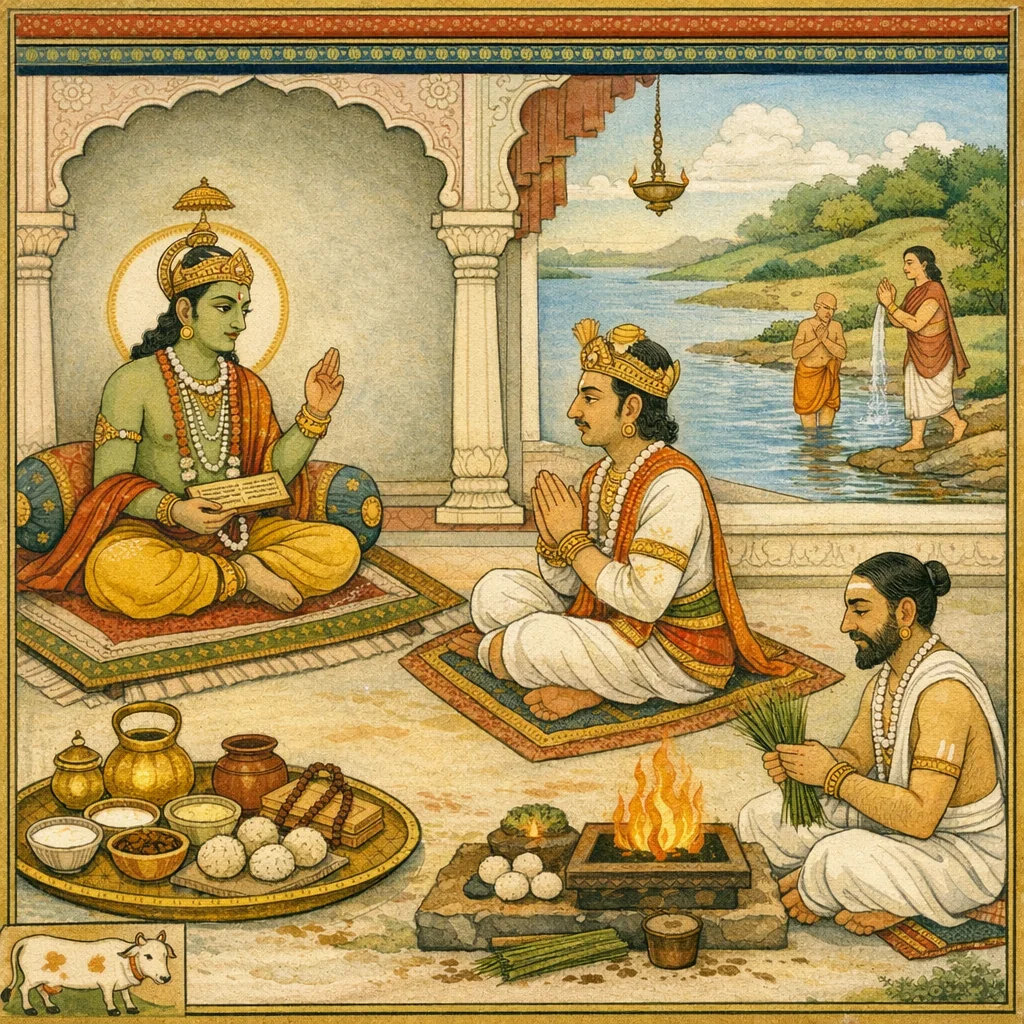
Dharmopadeśa-Śānti: Rules of Impurity, Expiations, and Ancestor Rites
Dharmarāja instructs the king in Śruti–Smṛti-based rules of śauca (purity) and niṣkṛti/prāyaścitta (expiation). He begins with defilement during eating—contact with caṇḍālas or fallen persons, ucchiṣṭa taint, bodily discharges, urination, vomiting—and prescribes graded remedies: tri-sandhyā bathing, pañcagavya, fasting, ghee-offerings, and extensive Gāyatrī-japa. He then explains touch-impurity involving antyajas, menstruation, and childbirth, stressing that bathing is indispensable even after strict rites (such as Brahma-kūrca). Sexual conduct is regulated by season/non-season and proper/improper unions, with certain gravest cases said to have fire-entry as the sole expiation. Suicide and accidental deaths are discussed, yet such persons are not forever outcast if they undertake Cāndrāyaṇa/Kṛcchra. A major section treats the ethics of cow-injury and weapon-based gradations of penance, followed by norms for shaving and śikhā and guidance on royal justice. The chapter concludes with iṣṭa–pūrta merits, details for preparing pañcagavya, impurity periods for sūtaka and miscarriage, gotra transfer at marriage, and the procedures and types of śrāddha/tarpaṇa.
Shlokas
Verse 1
धर्मराज उवाच । श्रुतिस्मृत्युदितं धर्मं वर्णानामनुपूर्वशः । प्रब्रवीमि नृपश्रेष्ट तं श्रृणुष्व समाहितः ॥ १ ॥
Dharmarāja said: “O best of kings, I shall now declare, in proper order, the dharma of the social classes (varṇas) as taught in Śruti and Smṛti. Listen with a collected, attentive mind.”},{
Verse 2
यो भुञ्जानोऽशुचिं वापि चाण्डालं पतितं स्पृशेत् । क्रोधादज्ञानतो वापिं तस्य वक्ष्यामि निष्कृतिम् ॥ २ ॥
If, while eating, a person touches one who is impure, or a Caṇḍāla, or a fallen person—whether out of anger or out of ignorance—then I shall declare the expiation and purification (niṣkṛti) for that act.
Verse 3
त्रिरात्रं वाथ षड्रात्रं यथासंख्यं समाचरेत् । स्नानं त्रिषवणं विप्रपञ्चगव्येन शुध्यति ॥ ३ ॥
One should observe the prescribed expiation for three nights, or else for six nights, according to the proper order. By bathing at the three sandhyā times—morning, noon, and evening—a brāhmaṇa is purified through pañcagavya.
Verse 4
भुञ्जानस्य तु विप्रस्य कदाचिजत्स्त्रवते गुदम् । उच्छिष्टत्वेऽशुचित्वे च तस्य शुद्धिं वदामि ते ॥ ४ ॥
But if, while a brāhmaṇa is eating, there is at some time a discharge from the anus, he becomes both ‘ucchiṣṭa’ (tainted by remnants) and ‘aśuci’ (impure). I shall tell you the means of his purification.
Verse 5
पूर्वं कृत्वा द्विजः शौचं पश्चादप उपस्पृशेत् । अहोरात्रोषितो भूत्वा पञ्चगव्येन शुध्यति ॥ ५ ॥
First, the twice-born should perform śauca, personal cleansing; then he should touch water for ācamana. If he has remained impure for a full day and night, he is purified by pañcagavya.
Verse 6
निगिरन्यदि मेहेत भुक्त्वा वा मेहने कृते । अहोरात्रोषितो भूत्वा जुहुयात्सर्पिषाऽनलम् ॥ ६ ॥
If one urinates while swallowing food, or urinates after having eaten, then—having fasted for a full day and night—one should offer ghee into the sacred fire as an expiatory rite.
Verse 7
यदा भोजनकाले स्यादशुचिर्ब्राह्मणः क्वचित् । भूमौ निधाय तं ग्रासं स्नात्वा शुद्धिमवान्पुयात् ॥ ७ ॥
If, at the time of eating, a brāhmaṇa happens to become impure for some reason, he should set that morsel down on the ground. Then, after bathing and becoming purified, he may return and eat.
Verse 8
भक्षयित्वा तु तद् आसमुपवालेन शुद्ध्यति । अशित्वा चैव तत्सर्वं त्रिरात्रमशुचिर्भवेत् ॥ ८ ॥
If one partakes of that food, one is purified by fasting; but if one has eaten it all, one remains impure for three nights.
Verse 9
अश्रतश्चेद्वमिः स्याद्वै ह्यस्वस्थस्त्रिश्रतं जपेत् । स्वस्थस्त्रीणि सहस्त्राणि गायत्र्याः शोधनं परम् ॥ ९ ॥
If, after eating, vomiting occurs, then when one is unwell one should recite the Gāyatrī three hundred times. If one is healthy, one should recite it three thousand times; this is said to be the supreme purification through the Gāyatrī.
Verse 10
चाण्डालैः श्वपर्चैः स्पृष्टो विण्मूत्रे च कृते द्विजः ॥ १० ॥
A dvija (twice-born man) becomes ritually impure if touched by a caṇḍāla or a dog-cooker, and likewise if he comes into contact with feces or urine.
Verse 11
त्रिरात्रं तु प्रकुर्वीत भुक्तोच्छिष्टः षडाचरेत् । उदक्यां सूतिकांवापि संस्पृशेदन्त्यजो यदि ॥ ११ ॥
If an antyaja touches a menstruating woman or a woman in childbirth, he should observe impurity for three nights; but if he touches one who has eaten and remains in the state of ucchiṣṭa (food-remnants), he should observe it for six nights.
Verse 12
त्रिरात्रेण विशुद्धिः स्यादिति शातातपोऽब्रवीत् । रजस्वला तु संस्पृष्टा श्वभिर्मातङ्गवायसैः ॥ १२ ॥
Śātātapa declared: “Purification is attained in three nights.” Yet a woman in her menstrual period, if touched by dogs, by a mātanga/caṇḍāla, or by crows, incurs impurity requiring such purification.
Verse 13
निराहारा शुचिस्तिष्टेत्काले स्नानेन शुद्ध्यति । रजस्वले यदा नार्यावन्योन्यं स्पृशतः क्वचित् ॥ १३ ॥
Abstaining from food, one should remain in a state of purity; at the proper time one is cleansed by bathing. If at any time women touch one another when one is menstruating, the appropriate purification should be observed according to rule.
Verse 14
शुद्धेते ब्रह्मकूर्चेन ब्रह्मकूर्चेन चोपरि । उच्छिष्टेन च संस्पृष्टो यो न स्नानं समाचरेत् ॥ १४ ॥
Even if one has been purified by the rite called Brahma-kūrca (and again by Brahma-kūrca upon that), a person who has been touched by another’s impure leftovers and yet does not duly perform the bath should not be regarded as properly purified.
Verse 15
ऋतौ तु गर्भं शङ्कित्वा स्नानं मैथुनिनः स्मृतम् । अनॄतौ तु स्त्रियं गत्वा शौचं मूत्रपुरीषवत् ॥ १५ ॥
When intercourse occurs during the woman’s fertile season, one should bathe afterward, considering the possibility of conception—this is the rule taught for those who have had union. But if one approaches a woman outside her season, the required purification is like that prescribed after urination and defecation.
Verse 16
उभावप्यशुची स्यातां दम्पती याभसंगतौ । शयनादुत्थिता नारी शुचिः स्यादशुचिः पुमान् ॥ १६ ॥
If husband and wife unite in improper intercourse, both become impure. But after rising from sleep, the woman is considered pure, while the man is considered impure.
Verse 17
भर्त्तुः शरीरशुश्रूषां दौरात्म्यादप्रकुर्वती । दण्ड्या द्वादशकं नारी वर्षं त्याज्या धनं विना ॥ १७ ॥
A woman who, out of wicked intent, does not render due personal service to her husband’s body is to be fined twelve (units). If she persists, she should be abandoned for a year—without any monetary provision.
Verse 18
त्यजन्तो पतितान्बन्धून्दण्ड्यानुत्तमसाहसम् । पिता हि पतितः कामं न तु माता कदाचन ॥ १८ ॥
Those who abandon their fallen (sinful/outcaste) relatives—though they deserve punishment—commit the gravest wrongdoing. For a father may, by circumstance, become fallen; but a mother never does.
Verse 19
आत्मानं घातयेद्यस्तु रज्ज्वादिभिरुपक्रमैः । मृते मेध्येन लेत्पव्यो जीवतो द्विशतं दमः ॥ १९ ॥
But whoever kills himself by means such as a rope and the like—if he has died, his body should be disposed of after being smeared with a purifying substance; if he is still alive, he should be fined two hundred (paṇas/damas).
Verse 20
दण्ड्यास्तत्पुत्रमित्राणि प्रत्येकं पाणिकं दमम् । प्रायश्चित्तं ततः कुर्युर्यथाशास्त्रप्रचोदितम् ॥ २० ॥
His sons and friends, too, should each be punished with a fine of one pāṇika; thereafter they should perform the prescribed expiation (prāyaścitta), exactly as enjoined by the śāstras.
Verse 21
जलाग्न्युद्वन्धनभ्रष्टाः प्रव्रज्यानाशकच्युताः । विषप्रपतनध्वस्ताः शस्त्रघातहताश्च ये ॥ २१ ॥
Those who have perished through water or fire; those who have died from hanging by a noose; those who have deviated through the ruin of their renunciant discipline; those destroyed by poison or by falling from a height; and those slain by blows of weapons—whoever they may be.
Verse 22
न चैते प्रव्रत्यवसिताः सर्वलोकबहिष्कृताः । चान्द्रायणेन शुद्ध्यंन्ति तत्पकृच्छ्रद्वयेन वा ॥ २२ ॥
And these persons are not to be regarded as permanently fallen from their religious observances, nor are they to be treated as outcast from all society; they become purified either by performing the Cāndrāyaṇa vow, or by undertaking the two Pakṛcchra penances prescribed for that offence.
Verse 23
उभयावसितः पापश्यामच्छबलकाच्च्युतः । चान्द्रायणाभ्यां शुद्ध्येत दत्त्वा धेनुं तथा वृषम् ॥ २३ ॥
One who has fallen into the offence called “ubhayāvasita,” and has lapsed into the sinful acts termed “pāpaśyāma” and “cchabala,” is purified by performing two Cāndrāyaṇa observances and by gifting a cow and likewise a bull.
Verse 24
स्वश्रृगालप्लवङ्गाद्यैर्मानुषैश्च रतिं विना । स्पृष्टः स्त्रात्वा शुचिः सद्यो दिवा संध्यासु रात्रिषु ॥ २४ ॥
If one is touched by a dog, a jackal, a monkey and the like, or by a human being (in a non-sexual context), then—having bathed—one becomes pure immediately, whether by day, at the twilight junctions, or at night.
Verse 25
अज्ञानाद्वा तु यो भुक्त्वा चाण्डालान्नं कथंचन । गोमूत्रयावकाहारो मासार्द्धेन विशुद्ध्यति ॥ २५ ॥
But if someone, out of ignorance, somehow eats the food of a caṇḍāla, he becomes purified in half a month by living on a diet of cow’s urine and yāvaka (barley food or barley gruel).
Verse 26
गोब्राह्मणगृहं दग्ध्वा मृतं चोद्वन्धनादिना । पाशं छित्वा तथा तस्य कृच्छ्रमेकं चरेद्दिजः ॥ २६ ॥
Having burned the house (or enclosure) of a cow or of a brāhmaṇa, or having caused death by hanging and the like, and likewise having cut the noose used for such killing, a twice-born man should perform one Kṛcchra penance.
Verse 27
चाण्डालपुल्पसानां च भुक्त्वा हत्वा च योषितम् । कृच्छ्रार्ध्दमाचरेज्ज्ञानादज्ञानादैन्दवद्वयम् ॥ २७ ॥
Having eaten the food of a Caṇḍāla or of the Pulpasa people, or having killed a woman—whether knowingly or unknowingly—one should perform half of the Kṛcchra penance; and one should also observe the two “Aindava” (moon-related) fasts.
Verse 28
कोपालिकान्नभोक्तॄणां तन्नारीगामिनां तथा । अगम्यागमने विप्रो मद्यगो मांसभक्षणे ॥ २८ ॥
A brāhmaṇa becomes grievously fallen by eating the food of the Kāpālikas, by consorting with their women, by union with forbidden women, by drinking intoxicants, and by eating meat.
Verse 29
तपत्कृच्छ्रपरिक्षिप्तो मौर्वीहोमेन शुद्ध्यति । महापातककर्त्तारश्चत्वारोऽथ विशेषतः ॥ २९ ॥
One who has undertaken the severe penance called Tapat-kṛcchra is purified through the Maurvī-homa. And, in particular, there are four kinds of persons designated as doers of the great sins (mahāpātakas).
Verse 30
अग्निं प्रविश्य शुद्ध्यन्तिस्थित्वा वा महति क्रतौ । रहस्यकरणोऽप्येवं मासमभ्यस्य पूरुषः ॥ ३० ॥
By entering the sacred fire one becomes purified; or likewise by remaining engaged in a great Vedic sacrifice. In the same way, even one who has committed a hidden transgression becomes purified when he practices the prescribed discipline for a month.
Verse 31
अघमर्षणसूक्तं वा शुद्ध्येदन्तर्जले जपन् । रजकश्चर्मकारश्च नटो बुरुड एव च ॥ ३१ ॥
Or, by reciting the Aghamarṣaṇa Sūkta while standing in water, one becomes purified—even persons such as a washerman, a leather-worker, a dancer/actor, and likewise a buruḍa.
Verse 32
कैवर्त्तमेदभिल्लाश्व सत्पैते ह्यन्त्यजाः स्मृताः । भुक्त्वा चैषां स्त्रियो गत्वा पीत्वा यः प्रतिगृह्यते ॥ ३२ ॥
Kaivartas, Medas, Bhillas, Aśvas, and Satpaitas are indeed regarded as antyajas (outside the orthodox social order). One who eats their food, who goes to their women, or who accepts hospitality or gifts after drinking with them incurs impurity and transgression of prescribed conduct.
Verse 33
कृच्छ्रार्द्धमाचरेज्ज्ञानादैन्दवद्वयम् । मातरं गुरुपत्नीं च दुहितृभगिनीस्नुषाः ॥ ३३ ॥
If, knowingly, one has transgressed against one’s mother, the teacher’s wife, one’s daughter, sister, or daughter-in-law, one should undertake the half-Kṛcchra penance together with the two-day Aindava fast.
Verse 34
संगम्य प्रविशेदग्निं नान्याशुद्धिर्विधीयते । राज्ञीं प्रव्रजितां धात्रीं तथावर्णोत्तमामपि ॥ ३४ ॥
Having had sexual intercourse with such a woman, one should enter the fire; no other purification is prescribed—even if she be a queen, a renunciant woman, a wet-nurse, or one of an eminent varṇa.
Verse 35
गत्वाकृच्छ्रद्वयं कुर्यात्सगोत्रामभिगम्य च । अमूषु पितृगोत्रासु मातृगोत्रगतासु च ॥ ३५ ॥
Having gone to a proper place for expiation, one should perform a double Kṛcchra penance after sexual union with a woman of the same gotra—whether she belongs to the paternal lineages or to those falling under the maternal gotra-line.
Verse 36
परदारेषु सर्वेषु कृच्छ्रार्द्धं तपनं चरेत् । वेश्याभिगमने पापं व्यपोहन्ति द्विजास्तथा ॥ ३६ ॥
For intercourse with another man’s wife in any case, one should perform the expiation called the half-Kṛcchra and the penance known as Tapana. Likewise, for visiting a prostitute, the twice-born remove the sin by the prescribed expiations.
Verse 37
पीत्वा सकृत्सुतत्पं च पञ्चरात्रं कुशोदकम् । गुरुतल्पगतो कुर्याद्रबाह्मणो विधिवद्रूतम् ॥ ३७ ॥
The Brahmin who has fallen into the sin of violating the teacher’s bed, having once drunk the concoction prepared by heating it together with his son, and then for five nights drinking water sanctified with kuśa grass, should duly perform the prescribed expiatory vow.
Verse 38
गोन्घस्य केचिदिच्छन्ति केचिच्चैवावकीर्णिनः । दण्डादूर्ध्वं प्रहारेण यस्तु गां विनिपातयेत् ॥ ३८ ॥
Some prescribe for the slayer of a cow the expiation called goṅghā; others prescribe the expiation of an avakīrṇin. But whoever strikes a cow beyond the permitted measure, so that she falls to the ground, incurs that grave offence and must undertake the stated expiation.
Verse 39
द्विगुणं गोव्रतं तस्य प्रायश्चितं विशोधयेत् । अङ्गुष्टमात्रस्थूलस्तु बाहुमात्रप्रमाणकः ॥ ३९ ॥
For that offence, one should purify the expiation by observing the Govrata in double measure. The prescribed implement/measure should be as thick as a thumb and as long as a forearm.
Verse 40
सार्द्रकस्सपालाश्च गोदण्डः परिकीर्त्तितः । गवां निपातने चैव गर्भोऽपि संभवेद्यदि ॥ ४० ॥
A staff made of moist wood together with palāśa-wood is declared to be a “go-daṇḍa” (a cattle-driving staff). And if, in striking cattle so as to bring them down, a miscarriage should also occur, that too is included in the fault.
Verse 41
एकैकशश्वरेत्कृच्छ्रं एषा गोन्घस्य निष्कृतिः । बन्धने रोधने चैव पोषणे वा गवां रुजाम् ॥ ४१ ॥
For each cow so harmed, one should perform the Kṛcchra penance; this is the expiation for the sin of injuring a cow—whether by tying her up, confining her, or by neglecting to nourish and tend her ailments.
Verse 42
संपद्यते चेन्मरणं निमित्तेनैव लिप्यते । मूर्च्छितः पतितो वापि दण्डेनाभिहतस्ततः ॥ ४२ ॥
If death occurs, culpability is recorded only according to the immediate cause. Even if the person was merely unconscious, had fallen down, or was later struck with a staff, liability is entered in terms of that specific precipitating circumstance.
Verse 43
उत्थाय षट्पदं गच्छेत्सप्त पञ्चदशापि वा । ग्रासं वा यदि गृह्णीयात्तोयं वापि पिबेद्यदि ॥ ४३ ॥
If one rises and walks even six steps—or seven, or even fifteen—or if one takes a mouthful of food, or even drinks water, then the vrata (observance) is deemed interrupted and must be resumed according to rule.
Verse 44
सर्वव्याधिप्रनष्टानां प्रायश्चित्तं न विद्यते । कष्टलोष्टाश्मभिर्गावः शस्त्रैर्वा निहता यदि ॥ ४४ ॥
For those ruined by every kind of grave affliction, no prāyaścitta (expiation) is prescribed—especially if cows have been killed, whether with wood, clods of earth, stones, or with weapons.
Verse 45
प्रायश्चित्तं स्मृतं तत्र शस्त्रे शस्त्रे निगद्यते । काष्टे सान्तपनं प्रोक्तं प्राजापत्यं तु लोष्टके ॥ ४५ ॥
In that context, the prāyaścitta (expiation) is declared separately for each kind of instrument. For harm caused by wood, the Sāntapana penance is prescribed; and for harm caused by a clod of earth, the Prājāpatya penance is prescribed.
Verse 46
तप्तकृच्छ्रं तु पाषाणे शस्त्रे चाप्यतिकृच्छ्रकम् । औषधं स्नेहमाहारं दद्याद्गोब्राह्मणेषु च ॥ ४६ ॥
For an offence involving a stone, one should perform the Taptakṛcchra penance; and for an offence involving a weapon, the more severe Atikṛcchra. One should also give medicines, ghee, and food as gifts—especially to cows and Brāhmaṇas.
Verse 47
दीयमाने विपत्तिः स्यात्प्रायश्चित्तं तदा नहि । तैलभेषजपाने च भेषजानां च भक्षणे ॥ ४७ ॥
If, while something is being given (as a prescribed offering or charity), some mishap occurs, then no prāyaścitta is required. Likewise, no expiation is prescribed in the drinking of oil or medicinal preparations, or in the eating of medicines.
Verse 48
निशल्यकरणे चैव प्रायश्चित्तं न विद्यते । वत्सानां कण्ठबन्धेन क्रिययाभेषजेन तु ॥ ४८ ॥
For removing an embedded foreign body (a splinter or arrowhead), no expiatory rite is prescribed; for calves, it should be handled by practical means—such as tying at the throat—and by medicine.
Verse 49
सायं संगोपनार्थं च त्वदोषो रोषबन्धयोः । पादे चैवास्य रोमाणि द्विपादे श्मश्रु केवलम् ॥ ४९ ॥
In the evening, concealment is for protection; yet your fault lies in anger and in being bound by resentment. And as for his body: hair is on the feet, while on the two-footed (man) there is only the beard.
Verse 50
त्रिपादे तु शिखावर्तं मूले सर्वं समाचरेत् । सर्वान्केशान्समुद्धृत्य छेदयेदङ्गुलद्वयम् ॥ ५० ॥
In the third quarter of the head, one should properly arrange the śikhā-whorl at its root. Gathering up all the hair, one should cut it to the measure of two fingers, leaving the prescribed length.
Verse 51
एवमेव तु नारीणां मुण्डनं शिरसः स्मृतम् । न स्त्रिया वपनं कार्यं न च वीरासनं स्मृतम् ॥ ५१ ॥
Likewise, for women, the shaving of the head (muṇḍana) is remembered as prescribed. Yet a woman should not take up complete shaving as a regular practice, nor is the vīrāsana posture held to be prescribed for her.
Verse 52
न च गोष्टे निवासोऽस्ति न गच्छन्तीमनुव्रजेत् । राजा वा राजपुत्रो वा ब्राह्मणो वा बहुश्रुतः ॥ ५२ ॥
One should not reside in a cowshed, and one should not follow after a woman who is going somewhere—whether one is a king, a prince, or even a learned, well-versed brāhmaṇa.
Verse 53
अकृत्वा वपनं तेषां प्रायश्चित्तं विनिर्द्दिशेत् । केशानां रक्षणार्थं च द्विगुणं व्रतमादिशेत् ॥ ५३ ॥
If they have not performed the shaving (tonsure), one should prescribe for them a prāyaścitta, an expiation; and, for the protection of the hair, one should enjoin a vow (vrata) to be observed in double measure.
Verse 54
द्विगुणे गतु व्रते चीर्णे द्विगुणा व्रतदक्षिणा ॥ ५४ ॥
When a vow (vrata) is undertaken in a doubled manner and duly performed, the dakṣiṇā—the gift associated with that vow—should likewise be given in double.
Verse 55
पापं न क्षीयते हन्तुर्दाता च नरकं व्रजेत् । अश्रौतस्मार्तविहितं प्रायश्चित्तं वदन्ति ये ॥ ५५ ॥
The killer’s sin is not diminished, and the one who authorizes or commissions the act goes to hell—so say those who prescribe expiations (prāyaścitta) not sanctioned by Śruti and Smṛti.
Verse 56
तान्धर्मविन्घकर्तॄंश्च राजा दण्डेन पीडयेत् । न चैतान्पीडयेद्राजा कथंचित्काममोहितः ॥ ५६ ॥
The king should chastise with punishment those who obstruct Dharma. Yet the king must never punish these people in any way when deluded by desire (kāma), by personal passion.
Verse 57
तत्पापं शतधाभूत्वा तमेव परिसर्पति । प्रायश्चित्ते ततश्चीर्णे कुर्याद्ब्राह्मणभोजनम् ॥ ५७ ॥
That sin, becoming a hundredfold, creeps back onto that very person. Therefore, after performing the prescribed prāyaścitta, one should arrange a feeding of Brāhmaṇas.
Verse 58
विंशतिर्गा वृषं चैकं दद्यात्तेषां च दक्षिणाम् । क्रिमिभिस्तृण संभूतैर्मक्षिकादिनिपातितैः ॥ ५८ ॥
One should donate twenty cows and one bull, together with the proper dakṣiṇā (priestly fee). This is prescribed as prāyaścitta for harm or defilement caused by worms arising in grass and by creatures such as flies and the like that fall upon food or offerings.
Verse 59
कृच्छ्रार्द्धं स प्रकुर्वीत शक्त्या दद्याच्च दक्षिणाम् । प्रायश्चित्तं च कृत्वा वै भोजयित्वा द्विजोत्तमान् ॥ ५९ ॥
He should undertake half of the Kṛcchra penance, and according to his capacity he should also give the prescribed dakṣiṇā. Having duly performed the prāyaścitta, he should then feed the foremost of the twice-born, the learned brāhmaṇas.
Verse 60
सुवर्णमानिकं दद्यात्ततः शुद्धिर्विधीयते । चाण्डालश्वपचैः स्पृष्टे निशि स्नानं विधीयते ॥ ६० ॥
One should give a measured gift of gold; then purification is enjoined. If one has been touched by a caṇḍāla or a dog-cooker (outcaste), bathing at night is prescribed.
Verse 61
न वसेत्तत्र रात्रौ तु सद्यः स्नानेन शुद्ध्यति । वसेदथ यदा रात्रावज्ञानादविचक्षणः ॥ ६१ ॥
One should not stay there at night; purity is regained immediately by bathing. But if an undiscerning person, out of ignorance, does stay there at night, he should purify himself at once by bathing.
Verse 62
तदा तस्य तु तत्पापं शतधा परिवर्तते । उद्गच्छन्ति च नक्षत्राण्युपरिष्टाच्च ये ग्रहाः ॥ ६२ ॥
Then indeed that sin of his multiplies a hundredfold; and the nakṣatras (lunar mansions) and the grahas (planets) moving above rise up as signs and witnesses.
Verse 63
संस्पृष्टे रश्मिभिस्तेषामुदकस्नानमाचरेत् । याश्चान्तर्जलवल्मीकमूषिकोषरवर्त्मसु ॥ ६३ ॥
When those waters have been touched by the (sun’s) rays, one should perform a purifying bath with water. Likewise, for waters lying within water-courses—such as in ant-hills, mouse-holes, saline tracts, and pathways—one should do the same.
Verse 64
श्मशाने शौचशेषे च न ग्राह्याः सत्प मृत्तिकाः । इष्टापूर्तं तु कर्त्तव्यं ब्राह्मणेन प्रयत्नतः ॥ ६४ ॥
In a cremation ground, and while impurity still remains after a rite of purification, the sacred clay meant for pure use should not be taken. Rather, a brāhmaṇa should diligently perform iṣṭa and pūrta—meritorious acts of sacrifice and public benefaction.
Verse 65
इष्टेन लभते स्वर्गं मोक्षं पूर्त्तेन चान्पुयात् । वित्तक्षेपो भवेदिष्टं तडागं पूर्त्तमुच्यते ॥ ६५ ॥
By iṣṭa one attains heaven; by pūrta one may also attain liberation. The spending of wealth for ritual is called iṣṭa, while the building of a pond (tadāga) is declared to be pūrta.
Verse 66
आरामश्च विशेषेण देवद्रोण्यस्तथैव च । वापीकूपतडागानि देवतायतनानि च ॥ ६६ ॥
And especially meritorious are the laying out of groves and gardens, as well as sacred water-troughs; also the building of stepwells, wells, and ponds, and the construction of temples and shrines for the deities.
Verse 67
पतितान्युद्धरेद्यस्तु स पूर्वफलमश्नुते । शुक्लाया आहरेन्मूत्रं कृष्णाया गोः शकृत्तथा ॥ ६७ ॥
But whoever lifts up and reforms those who have fallen from right conduct, he attains that former excellent reward. One should procure the urine of a white cow, and likewise the dung of a black cow.
Verse 68
ताम्रायाश्च पयो ग्राह्यं श्वेतायाश्च दधि स्मृतम् । कपिलाया घृतं ग्राह्यं महापातकनाशनम् ॥ ६८ ॥
From the reddish (tāmra) cow one should take milk; from the white cow, curd (dadhi) is prescribed. From the tawny Kapilā cow one should take ghee (ghṛta)—a destroyer of great sins (mahāpātakas).
Verse 69
कुशैस्तीर्थनदीतौयैः सर्वद्रव्यं पृथक् पृथक् । आहृत्य प्रणवेनैव उत्थाप्य प्रणवेन च ॥ ६९ ॥
Using kuśa grass and water from sacred fords (tīrthas) and rivers, bring each ritual item separately. Then, with the Praṇava (Oṁ) alone, lift up and consecrate the entire set, and likewise raise it again with the Praṇava.
Verse 70
प्रणवेन समालोड्य प्रणवेनैव संपिबेत् । पालाशे मध्यमे पर्णे भाण्डे ताम्रमये शुभे ॥ ७० ॥
Having stirred it while reciting the Praṇava (Oṁ), one should drink it while again reciting the Praṇava—served in an auspicious copper vessel, with a palāśa leaf placed as the middle lining.
Verse 71
पिबेत्पुष्करपर्णे वा मृन्मये वा कुशोदकम् । सूतके तु समुत्पन्ने द्वितीये समुपस्थिते ॥ ७१ ॥
When sūtaka (ritual impurity after birth or death) has arisen and the second day has arrived, one should drink kuśa-water—either from a lotus leaf or from an earthen vessel.
Verse 72
द्वितीये नास्ति दोषस्तु प्रथमेनैव शुध्यति । जातेन शुध्यते जातं मृतेन मृतकं तथा ॥ ७२ ॥
In the second instance there is no fault; by the very first it becomes purified. By a birth, what pertains to birth is purified; likewise, by a death, what pertains to death is purified.
Verse 73
गर्भसंस्त्रवणे मासे त्रीण्यहानि विनिर्दिशेत् ॥ ७३ ॥
If a miscarriage occurs in the (specified) month, a period of three days of impurity/observance should be prescribed.
Verse 74
रात्रिभिर्मासतुल्याभिर्गर्भस्त्रावे विशुद्ध्यति । रजस्युपरते साध्वी स्नानेन स्त्री रजस्वला ॥ ७४ ॥
In the case of a miscarriage, purification is attained after as many nights as the number of months of pregnancy. When her menstrual flow has ceased, a menstruating woman becomes pure by bathing.
Verse 75
स्वगोत्राद्भृश्यते नारी विवाहात्सप्तमे पदे । स्वामिगोत्रेण कर्त्तव्यास्तस्याः पिण्डोदकक्रियाः ॥ ७५ ॥
A woman is held to have departed from her own gotra at the seventh step of marriage; thereafter, the piṇḍa and water-offering rites for her are to be performed under her husband’s gotra.
Verse 76
उद्देश्यं पिण्डदाने स्यात्पिण्डे पिण्डे द्विनामतः । षण्णां देयास्त्रयः पिण्डा एवं दाता न मुह्यति ॥ ७६ ॥
In offering piṇḍa-dāna, the intended recipients should be specified: for each piṇḍa, two names are to be spoken. For six recipients, three piṇḍas should be offered; thus the giver is not confused.
Verse 77
स्वेन भर्त्रा सहस्त्राब्दं माताभुक्ता सुदैवतम् । पितामह्यपि स्वेनैव स्वेनैव प्रपितामही ॥ ७७ ॥
For a thousand years the mother, blessed with good fortune and divine favor, enjoyed conjugal life with her own husband; likewise the grandmother with her own husband, and likewise the great-grandmother with her own husband.
Verse 78
वर्षे तु कुर्वीत मातापित्रोस्तु सत्कृतिम् । अदैवं भोजयेच्छ्राद्धं पिण्डमेकं तु निर्वपेत् ॥ ७८ ॥
Once each year, one should duly honor one’s mother and father; in a śrāddha performed without offerings to the gods, one should feed the invited guests and also place a single piṇḍa (rice-ball offering).
Verse 79
नित्यं नैमित्तिकं काम्यं वृद्धिश्राद्धमथापरम् । पार्वणं चेति विज्ञेयं श्राद्धं प़ञ्चविधं बुधैः ॥ ७९ ॥
The wise understand Śrāddha to be of five kinds: the regular (nitya), the occasional (naimittika), the desire-motivated (kāmya), the prosperity-increasing (vṛddhi-śrāddha), and the Pārvaṇa Śrāddha.
Verse 80
ग्रहोपरागे संक्रान्तौ पर्वोत्सवमलालये । निर्वपेत्र्रीन्नरः पिण्डानेकमेव मृतेऽहनि ॥ ८० ॥
During an eclipse, at a saṅkrānti (solar ingress), on festival occasions, and in times of calamity, one should offer three piṇḍas; but on the day of death, one should offer only a single piṇḍa.
Verse 81
अनूढ न पृथक्कन्या पिण्डे गोत्रे च सूतके । पाणिग्रहणमन्त्राभ्यां स्वगोत्राद्भ्रश्यते ततः ॥ ८१ ॥
An unmarried girl is not regarded as separate from her father’s family with respect to the piṇḍa, the gotra, and the sūtaka (ritual impurity). But once the marriage rite is completed through the pāṇigrahaṇa (hand-taking) mantras, she then falls away from her own (paternal) gotra.
Verse 82
येन येन तु वर्णेन या कान्या परिणीयते । तत्समं सूतकं याति तथापिण्डोदकेऽपि च ॥ ८२ ॥
Whichever varṇa a maiden is married into, she incurs the same sūtaka (birth-impurity) as that varṇa; and the same rule applies also in matters of the piṇḍa and the udaka (water-libation).
Verse 83
विवाहे चैव संवृत्ते चतुर्थेऽहनिरात्रिषु । एकत्वं सा व्रजेद्भर्तुः पिण्डे गोत्रे च सूतके ॥ ८३ ॥
When the marriage has been duly completed, on the fourth day and night she becomes one with her husband—sharing his piṇḍa (funeral-oblation lineage), his gotra, and also his sūtaka (ritual impurity) when it arises.
Verse 84
प्रथमेऽह्नि द्वितीये वा तृतीये वा चतुर्थके । अस्थिसंचयनं कार्यं बन्धुभिर्हितबुद्धिभिः ॥ ८४ ॥
On the first day, or the second, or the third, or the fourth—on any of these days—the gathering of the bones after cremation should be performed by relatives guided by wholesome and proper intention.
Verse 85
चतुर्थे पञ्चमे चैव सत्पमे नवमे तथा । अस्थिसंचयनं प्रोक्तं वर्णानामनुपूर्वशः ॥ ८५ ॥
The collection of the bones after cremation is prescribed on the fourth, fifth, seventh, and ninth day—respectively in due order for the four varṇas.
Verse 86
एकादशाहे प्रेतस्य यस्य चोत्सृज्यते वृषः । मुच्यते प्रेतलोकात्स स्वर्गलोके महीयते ॥ ८६ ॥
If, on the eleventh day after death, a bull is ritually released on behalf of the departed, that deceased is freed from the preta-loka and is honored in heaven.
Verse 87
नाभिमात्रे जले स्थित्वा हृदयेन तु चिन्तयेत् । आगच्छन्तु मे पितरो गृह्णन्त्वेताञ्जाञ्जलीन् ॥ ८७ ॥
Standing in water up to the navel, one should meditate with the heart: “May my pitṛs, my forefathers, come and accept these añjali—handful-offerings—from me.”
Verse 88
हस्तौ कृत्वा तु संयुक्तौ पूरचित्वा जलेन च । गोश्रृङ्गमात्रमुद्धृत्य जलमध्ये विनिः क्षिपेत् ॥ ८८ ॥
Joining both hands and filling them with water, one should lift only as much as would fit within a cow’s horn, and cast that water back into the midst of the water.
Verse 89
आकाशे च क्षिपेद्वारि वारिस्थो दक्षघिणामुखः । पितॄणां स्थानमाकाशं दक्षिणादिक् तथैव च ॥ ८९ ॥
Standing in water and facing south, one should cast the offered water upward into the sky; for the realm of the Pitṛs is the sky, and their direction indeed is the south.
Verse 90
आपो देवगणाः प्रोक्ता आपः पितृगणास्तथा । तस्मादस्य जलं देयं पितॄणां हितमिच्छता ॥ ९० ॥
Waters are proclaimed to be hosts of the gods, and likewise waters are hosts of the Pitṛs. Therefore, one who seeks the welfare of the Pitṛs should offer water to them.
Verse 91
दिवासूर्यांशुसंतत्पं रात्रौ नक्षत्रमारुतैः । मध्ययोरप्युभाभ्यां च पवित्रं सर्वदा जलम् ॥ ९१ ॥
By day, water is warmed by the sun’s rays; by night, it is influenced by the winds beneath the stars. And in the intervals between these two as well—water remains ever pure.
Verse 92
स्वभावयुक्तमव्यक्तममेध्येन सदा शुचिः । भाण्डस्थं धरणीस्थं वा पवित्रं सर्वदा जलम् ॥ ९२ ॥
Water, by its very nature, is inherently pure and does not manifest impurity; even when it touches what is unclean, it remains ever stainless. Whether kept in a vessel or upon the earth, water is always purifying.
Verse 93
देवतानां पितॄणां च जलं दद्याज्जलाञ्जलीन् । असंस्कृतप्रमीतानां स्थले दद्याद्विचक्षणः ॥ ९३ ॥
One should offer water as añjali-libations to the deities and to the Pitṛs (ancestors). A discerning person should offer it at the proper place even for those who have died without the prescribed saṃskāras.
Verse 94
श्राद्धे हवनकाले च दद्यादेकेन पाणिना । उभाभ्यां तर्पणे दद्यादेष धर्मो व्यवस्थितः ॥ ९४ ॥
At the śrāddha and at the time of homa (fire-offering), one should give with a single hand; but in tarpaṇa (libations to satisfy the Pitṛs and the deities), one should give with both hands—this is the duly established rule of dharma.
Verse 95
इति श्रीबृहन्नारदीयपुराणे पूर्वभागे प्रथमपादे धर्मशान्तिनिर्देशो नाम चतुर्दशोऽध्यायः ॥ १४ ॥
Thus ends the fourteenth chapter, called “Instruction on Dharma and Śānti (Peace),” in the First Part (Pūrva-bhāga), First Pāda of the Śrī Bṛhan-Nāradīya Purāṇa.
Frequently Asked Questions
The chapter prescribes graded remedies such as setting the morsel aside, bathing, ācamana, fasting for set durations, pañcagavya for certain day-night impurity cases, and—where specified—homa with ghee; vomiting is addressed through extensive Gāyatrī-japa (hundreds to thousands, depending on health).
It first details technical śauca and prāyaścitta procedures (baths, japa, homa, named penances), then broadens into merit-making dharma through iṣṭa (ritual expenditure) and pūrta (public works like wells, ponds, temples), presenting both as complementary paths toward śānti and higher aims.
It outlines piṇḍa specification rules, lists five śrāddha types, prescribes contexts for one vs three piṇḍas, and gives tarpaṇa method (standing in water, facing south, offering water with both hands), grounding ancestor rites in the purifying theology of water.