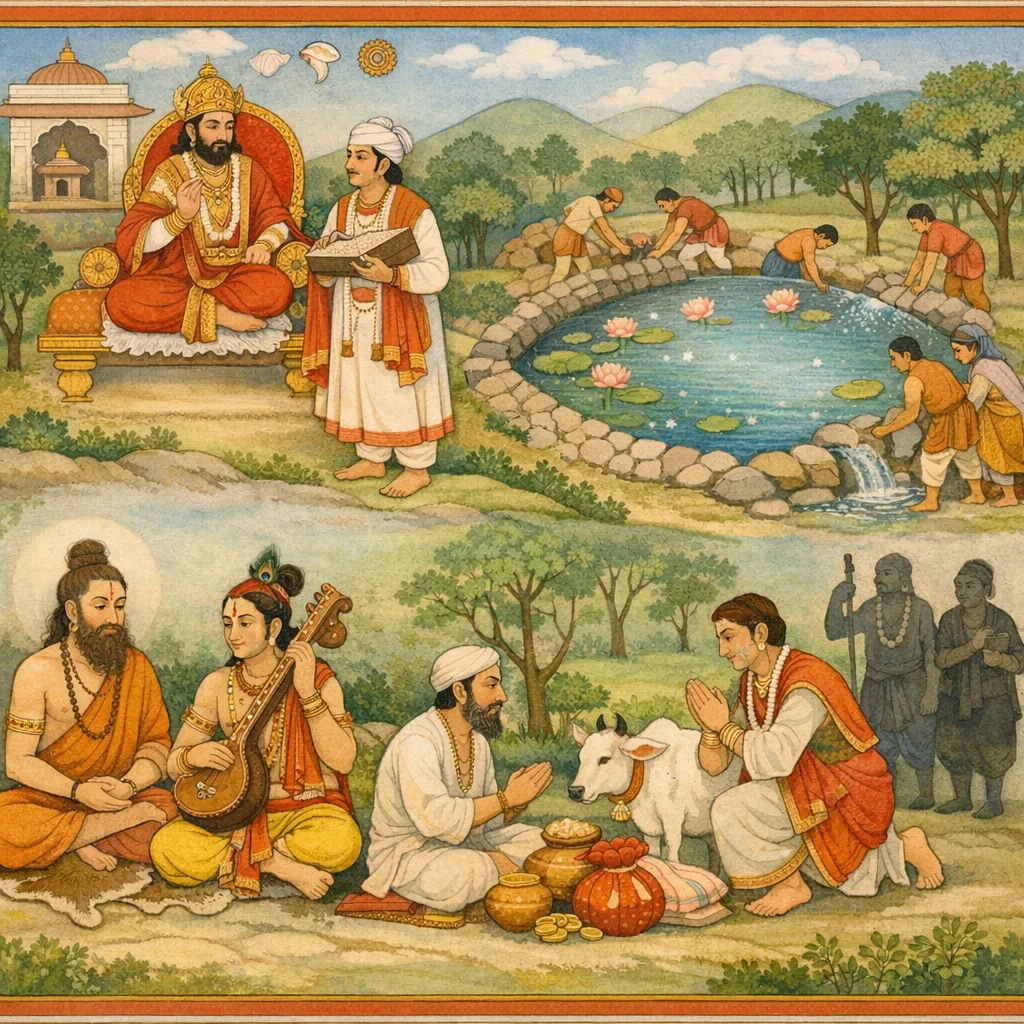
Dharma-ākhyāna (Discourse on Dharma): Worthy Charity, Fruitless Gifts, and the Merit of Building Ponds
After hearing of the Gaṅgā’s sin-destroying greatness, Nārada asks Sanaka to define the marks of a worthy recipient of dāna. Sanaka teaches that gifts meant for imperishable fruit should be given to qualified brāhmaṇas, and he sets limits on accepting gifts (pratigraha). A long list follows of recipients whose moral, ritual, or livelihood faults make charity “fruitless” (niṣphala)—hypocrisy, jealousy, sexual misconduct, harmful trades, improper ritual service, and trafficking in sacred acts. Dāna is then graded by motive: highest is given with faith as worship of Viṣṇu; lower forms are desire-driven, given with insult or anger, or offered to the unworthy. Wealth is praised as best used in charity, and living for others is called the sign of true life. The chapter turns to sacred history: Dharmarāja praises Bhagīratha and briefly teaches on dharma and adharma, extolling the vast merit of supporting brāhmaṇas and building ponds. A detailed account declares that public waterworks—digging ponds, clearing mud, inspiring others, damming, and planting trees—destroy sins and lead to heavenly reward, ending with the chapter colophon.
Shlokas
Verse 1
नातद उवाच । श्रुतं तु गङ्गामाहात्म्यं वाञ्छितं पापनाशनम् । अधुना लक्षणं ब्रूहि भ्रातर्मे दानपात्रघयोः ॥ १ ॥
Nātada said: “I have indeed heard the wished-for, sin-destroying greatness of Gaṅgā. Now, O brother, tell me the defining marks of those who are fit recipients of charity (dāna).”
Verse 2
सनक उवाच । सर्वेषामेव वर्णानां ब्रह्मणः परमो गुरुः । तस्मै दानानि देयानि दत्तस्यानन्त्यमिच्छता ॥ २ ॥
Sanaka said: For all the social orders (varṇas), Brahminhood is the supreme teacher. Therefore, one who desires the imperishable fruit of giving should offer gifts to a brāhmaṇa.
Verse 3
ब्राह्मणः प्रतिगृह्णीयात्सर्वतो भयवर्जितः । न कदापि क्षत्रविशो गृह्णीयातां प्रतिग्रहम् ॥ ३ ॥
A brāhmaṇa may accept gifts (pratigraha) without fear from any quarter; but a kṣatriya or a vaiśya should never accept gifts.
Verse 4
चण्डस्य पुत्रहीनस्य दम्भाचाररतस्य च । स्वकर्मत्यागिनश्चापि दत्तं भवति निष्फलम् ॥ ४ ॥
A gift becomes fruitless when given to a cruel man, to one without a son (thus lacking household responsibility and lineage continuity), to one devoted to hypocritical conduct, and also to one who has abandoned his prescribed duties.
Verse 5
परदाररतस्यापि परद्रव्याभिलिषिणः । नक्षत्रसूचकस्यापि दत्तं भवति निष्फलम् ॥ ५ ॥
A gift becomes fruitless when given to one who delights in another’s wife, who covets another’s wealth, or who merely points out the stars—practicing astrology without dharma.
Verse 6
असूयाविष्टमनसः कृतन्घस्य च मायिनः । अयाज्ययाजकस्यापि दत्तं भवति निष्फलम् ॥ ६ ॥
A gift becomes fruitless when given to one whose mind is seized by jealousy, to the ungrateful, to the deceitful, or to one who performs sacrifices for those unfit to receive sacrifice.
Verse 7
नित्यं याच्ञापरस्यापि हिंसकस्य खलस्य च । रसविक्रयिणश्वैव दत्तं भवति निष्फलम् ॥ ७ ॥ नामैका द । वेदविक्रयिणश्चापि स्मृतिविक्रयिणस्तथा । धर्मविक्रयिणो विप्र दत्तं भवति निष्फलम् ॥ ८ ॥
A gift becomes fruitless when given to one who is constantly begging, to a violent person, to a wicked man, or to one who sells objects of pleasure and enjoyment.
Verse 8
गानेन जीविका यस्य यस्य भार्या च पुश्चली । परोपतापिनश्चापि दत्तं भवति निष्फलम् ॥ ९ ॥
A gift becomes fruitless when given to a man who earns his livelihood by singing as a mere trade, whose wife is unchaste, and who also causes suffering to others.
Verse 9
असिजीवी मषीजीवी देवलो ग्रामयाजकः । धावको वा भवेत्तेषां दत्तं भवति निष्फलम् ॥ १० ॥
One who lives by the sword, one who lives by the pen (scribal work), a temple-priest (devala), a village sacrificer who performs rites for the whole village, or a runner-messenger—when a gift is given to such persons, that donation becomes fruitless.
Verse 10
पाककर्तुः परस्यार्थे कवये गदहारिणे । अभक्ष्य भक्षकस्यापि दत्तं भवति निष्फलम् ॥ ११ ॥
A gift becomes fruitless when given to one who cooks for another’s benefit, to a mercenary poet, to a club-bearing ruffian, or even to one who eats what is forbidden.
Verse 11
शूद्रान्नभोजिनश्चैव शूद्राणां शवदाहिनः । पौंश्वलान्नभुजश्चापि दत्तं भवति निष्फलम् ॥ १२ ॥
A gift becomes fruitless when given to one who eats a Śūdra’s food, to one who cremates the corpses of Śūdras, or to one who eats the food of a promiscuous woman.
Verse 12
नामविक्रयिणो विष्णोः संध्याकर्म्मोर्ज्झितस्य च । दुष्प्रतिग्रहदग्धस्य दत्तं भवति निष्फलम् ॥ १३ ॥
A gift becomes fruitless when given to one who sells the holy name of Viṣṇu, to one who has abandoned the Sandhyā rites, or to one who is ‘burnt’ by accepting improper gifts (duṣ-pratigraha).
Verse 13
दिवाशयनशीलस्य तथा मैथुनकारिणः । सध्याभोजिन एवापिदत्तं भवति निष्फलम् ॥ १४ ॥
A gift becomes fruitless when given to one who habitually sleeps in the daytime, who indulges in sexual misconduct, or who regularly eats during the Sandhyā hours (dawn or twilight).
Verse 14
महापातकयुक्तस्य त्यक्तस्य ज्ञातिबान्धवैः । कुण्डस्य चापि गोलस्य दत्तं भवति निष्फलम् ॥ १५ ॥
A gift offered to one stained by a great sin and forsaken by his own kinsmen—whether he be called a ‘kuṇḍa’ or a ‘gola’—becomes fruitless.
Verse 15
परिवित्तेः शठस्यापि परिवत्तुः प्रमादिनः । स्त्रीजितस्यातिदुष्टस्य दत्तं भवित निष्फलम् ॥ १६ ॥
Even a gift given to a parivitta (one superseded), to a deceitful man, to a parivattṛ (one who supersedes another), to the negligent, to one conquered by women, or to one exceedingly wicked, turns out fruitless.
Verse 16
मद्यमांसाशिनश्चापि स्त्रीविटस्यातिलोभिनः । चौरस्य पिशुनस्यापि दत्तं भवति निष्फलम् ॥ १७ ॥
Even when a gift is given, it becomes fruitless if offered to one who drinks liquor and eats meat, to a womanizer, to the excessively greedy, to a thief, or to a slanderer.
Verse 17
ये केचित्पापनिरता निन्दिताः सुजनैः सदा । न तेभ्यः प्रतिगृह्णीयान्न च वद्याद्दिजोत्तम । सत्कर्मनिरतायापि देयं यत्नेन नारद ॥ १८ ॥
Those devoted to sin and ever censured by the virtuous—one should not accept gifts from them, nor should the best of the twice-born even speak with them. But to one devoted to righteous deeds, one should give with care and earnest effort, O Nārada.
Verse 18
यद्दानं श्रद्धया दत्तं तथा विष्णुसमर्पणम् । याचितं वापि पात्रेण भवेत्तद्दानमुत्तमम् ॥ १९ ॥
That gift which is given with faith and dedicated as an offering to Lord Viṣṇu—even when given upon the request of a worthy recipient—becomes the highest form of charity.
Verse 19
परलोकं समुद्दश्य ह्यैहिकं वापि नारद । यद्दानं दीयते पात्रे तत्काम्यं मध्यमं स्मृतम् ॥ २० ॥
O Nārada, the gift given to a worthy recipient with an eye to results—whether in the next world or even in this— is remembered as a desire-motivated (kāmya) gift of the middle grade.
Verse 20
दग्भेन चापि हिंसार्थं परस्याविधिनापि च । क्रुद्धेनाश्रद्धयापात्रे तद्दानं मध्यमं स्मृतम् ॥ २१ ॥
A gift is remembered as middling when it is given with insult, with intent to harm, or by following another’s improper procedure; likewise when it is offered in anger, without faith, and to an unworthy recipient.
Verse 21
अधमं बलितोषायमध्यमं स्वार्थसिद्धये । उत्तमं हरिप्रीत्यर्थं प्राहुर्वेदविदां वराः ॥ २२ ॥
The sages, foremost among the knowers of the Veda, declare: the lowest is worship done to appease forces through offerings; the middling is to accomplish one’s own aims; and the highest is that performed solely for the pleasure of Hari (Viṣṇu).
Verse 22
दानभोगविनाशाश्च रायः स्युर्गतयस्त्रिधा ॥ २३ ॥
Wealth has three possible courses: it is spent in charity, consumed in enjoyment, or lost through destruction.
Verse 23
यो ददाति च नोभुक्ते तद्धनं नाशकारणम् । धनं धर्मफलं विप्र धर्मो माधवतुष्टिकृत् ॥ २४ ॥
He who gives in charity and does not hoard for indulgence—such wealth does not become a cause of ruin. O brāhmaṇa, wealth bears fruit only when aligned with dharma, and dharma is that which brings satisfaction to Mādhava (Viṣṇu).
Verse 24
तरवः किं न जीवन्ति तेऽपि लोके परार्थकाः । यत्र मूलफलैर्वृक्षाः परकार्यं प्रकुर्वते ॥ २५ ॥
Do not trees also live in this world? Trees too exist for the sake of others; by their roots and fruits they perform the work of benefiting all beings.
Verse 25
मनुष्या यदि विप्राग्थ्र न परार्थास्तदा मृताः । परकार्यं न ये मर्त्याः कायेनापि धनेन वा ॥ २६ ॥
O best of brāhmaṇas, if human beings do not live for the sake of others, they are as good as dead. Those mortals who do not serve another’s cause—by bodily effort or by wealth—truly do not live.
Verse 26
मनसा वचसा वापि ते ज्ञेयाः पापकृत्तमाः । अत्रेतिहासं वक्ष्यामि श्रृणु नारद तत्त्वतः ॥ २७ ॥
Whether by mind or by speech, such people are to be known as the most sinful. Now I shall relate an illustrative legend—listen, O Nārada, to its truth.
Verse 27
यत्र दानादिकानां तु लक्षणं परिकीर्तितम् । गङ्गामाहात्म्यसहितं सर्वपापप्रणाशनम् ॥ २८ ॥
In that section, the characteristics of dāna (sacred giving) and allied duties of dharma are described; and, together with the greatness of the Gaṅgā, it becomes a teaching that destroys all sins.
Verse 28
भगीरथस्य धर्मस्य संवादं पुण्यकारणम् । आसीद्भगीरथो राजा सगरान्वयसंभवः ॥ २९ ॥
Now is related a dialogue concerning Bhagīratha’s dharma, a cause of sacred merit. There was a king named Bhagīratha, born in the lineage of Sagara.
Verse 29
शशास पृथिवीं मेतां सत्पद्वीपां ससागराम् । सर्वधर्मरतो नित्यं सत्यसंधः प्रतापवान् ॥ ३० ॥
He ruled this very earth—complete with its noble continents and encircling oceans—ever devoted to every form of dharma, steadfast in truth, and radiant in valor.
Verse 30
कन्दर्पसद्दशो रुपे यायजृको विचक्षणः । प्रालेयाद्रिसमो धैर्ये धर्मे धर्मसमो नृपः ॥ ३१ ॥
In beauty he was like Kāma; in sacrifice he was a discerning patron of yajñas; in steadfastness he was like the Himalaya; and in righteousness that king was equal to Dharma himself.
Verse 31
सर्वलक्षणसंपन्नः सर्वशास्त्रार्थपारगः । सर्वसंपत्समायुक्तः सर्वानन्दकरो मुने ॥ ३२ ॥
O sage, he is endowed with every auspicious mark, fully conversant with the true purport of all the śāstras, possessed of every prosperity, and a bestower of joy upon all.
Verse 32
आतिथ्यप्रयतो नित्यं वासुदेवार्चनेरतः । पराक्रमी गुणनिधिर्मैत्रः कारुणिकः सधीः ॥ ३३ ॥
Ever devoted to hospitality, always engaged in the worship of Vāsudeva, he is valiant, a treasury of virtues, friendly in disposition, compassionate, and endowed with sound understanding.
Verse 33
एतादृशं तं राजानं ज्ञात्वा हृष्टो भगीरथम् । धर्मराजो द्विजश्रेष्ठ कदाचिद्द्रष्टुमागतः ॥ ३४ ॥
Knowing King Bhagīratha to be such a man, Dharma-rāja (Yama) became delighted and, O best of brāhmaṇas, came at one time to see him.
Verse 34
समागतं धर्मराजमर्हयामास भूपतिः । शास्त्रदृष्टेन विधिना धर्मः प्री उवाच तम् ॥ ३५ ॥
When Dharmarāja arrived, the king honored him duly, following the procedure enjoined by the śāstras; then Dharma, well pleased, spoke to him.
Verse 35
धर्मराज उवाच । राजन्धर्मविदां श्रेष्टप्रसिद्धोऽसि जगत्र्रये । धर्मराजोऽथ कीर्तिं ते श्रुत्वा त्वां द्रष्टुमागतः ॥ ३६ ॥
Dharmarāja said: “O King, you are renowned in the three worlds as the foremost among those who know Dharma. Therefore I, Dharmarāja, having heard of your fame, have come to see you.”
Verse 36
सन्मार्गनिरतं सत्यं सर्वभूतहिते रतम् । द्रष्टुमिच्छन्ति विबुधारतवोत्कुष्टगुणप्रियाः ॥ ३७ ॥
The wise—delighting in virtue and loving excellent qualities—desire to behold the truthful one who is devoted to the righteous path and engaged in the welfare of all beings.
Verse 37
कीर्तिर्नीतिश्च संपत्तिर्वर्तते यत्र भूपते । वसन्ति तत्र नियतं गुणास्सन्तश्च देवताः ॥ ३८ ॥
O king, where fame, righteous conduct, and prosperity prevail, there—certainly and unfailingly—virtues abide, and so do the good and the gods.
Verse 38
अहो राजन्महाभाग शोभनीचरितं तव । सर्वभूतहितत्वादि मादृशामपि दुर्लभम् ॥ ३९ ॥
Ah, O king, O greatly fortunate one—your conduct is truly admirable. Such qualities as seeking the welfare of all beings are rare indeed, even among people like us.
Verse 39
इत्युक्तवन्तं तं धर्मं प्रणिपत्य भगीरथः । प्रोवाच विनयाविष्टः संहृष्टः श्लक्ष्णया गिरा ॥ ४० ॥
After Dharma had spoken thus, Bhagiratha bowed down to him; filled with humility and joy, he addressed him in gentle words.
Verse 40
भगीरथ उवाच । भगवन्सर्वधर्मज्ञ समदर्शित् सुरेश्वर । कृपया परयाविष्टो यत्पृच्छामि वदस्व तत् ॥ ४१ ॥
Bhagiratha said: “O Bhagavan, knower of all dharma, impartial in vision, O Lord of the gods—moved by great compassion, please tell me what I ask.”
Verse 41
धर्मा कीदृग्विधाः प्रोक्ताः के लोका धर्मशालिनाम् । कियत्यो यातनाः प्रोक्ताः केषां ताः परिकीर्तिताः ॥ ४२ ॥
What kinds of dharmas have been taught? What worlds are attained by those established in dharma? How many punishments and torments have been described, and for which people are those torments specifically declared?
Verse 42
त्वया संमाननीया ये शासनीयाश्च ये यथा । तत्सर्वं मे महाभाग विस्तराद्वक्तुमर्हसि ॥ ४३ ॥
O noble one, please explain to me in detail all of this—who are to be honored by you, and who are to be disciplined, and in what manner.
Verse 43
धर्मराज उवाच । साधु साधु महाबुद्धे मतिस्ते विमलोर्जिता । धर्माधर्मान्प्रवक्ष्यामितत्त्वतः श्रृणु भक्तितः ॥ ४४ ॥
Dharmarāja said: “Well said, well said, O great-minded one. Your understanding is pure and firmly attained. I shall now explain to you, in accordance with the truth, what is dharma and what is adharma—listen with devotion.”
Verse 44
धर्मा बहुविधाः प्रोक्ताः पुण्यलोकप्रदायकाः । तथैव यातनाः प्रोक्ता असंख्या घोरदर्शताः ॥ ४५ ॥
Many kinds of dharmas have been taught, granting access to meritorious worlds; likewise, countless torments have been described—fearsome to behold.
Verse 45
विस्तराद्गदितुं नालमपि वर्षशतायुतैः । तस्मातंसमासतो वक्ष्ये धर्माधर्मनिदर्शनम् ॥ ४६ ॥
Even with tens of millions of centuries, one would not suffice to describe it in full detail. Therefore, I shall state in brief the distinguishing marks of dharma and adharma.
Verse 46
वृत्तिदानं द्विजानां वै महापुण्यं प्रकीर्ततम् । तथैवाध्यात्मविदुषो दत्तं भवति चाक्षयम् ॥ ४७ ॥
Providing livelihood-support to the twice-born (Brahmanas) is proclaimed to be a very great merit; likewise, whatever is given to one who is learned in the knowledge of the Self becomes imperishable, bearing inexhaustible fruit.
Verse 47
कुटुम्बिनं या शास्त्रज्ञं श्रोत्रियं वा गुणान्वितम् । यो दत्त्वा स्यापयेदृतिं तस्य पुण्यफलं श्रृणु ॥ ४८ ॥
Whether one gives to a householder, to a knower of the śāstras, or to a learned śrotriya endowed with virtues—whoever, after giving, dispels the recipient’s distress: hear the meritorious fruit of that act.
Verse 48
मातृताः पितृतश्चैव द्विजः कोटिकुलन्वितः । निर्विश्य विष्णुभवनं कल्पं तत्रैव मोदते ॥ ४९ ॥
That twice-born person—ennobled through both the maternal and paternal lines by countless families—enters the abode of Vishnu and rejoices there for an entire kalpa.
Verse 49
गण्यन्ते पांसवो भूमेर्गण्यन्ते वृष्टिविन्दवः । न गण्यन्ते विधात्रापि ब्रहह्मवृत्तिफलानि वै ॥ ५० ॥
The grains of dust upon the earth can be counted, and the drops of rain can be counted; but the fruits of merit that arise from living in the conduct of Brahman (brahma-vṛtti) cannot truly be counted—even by the Creator Himself.
Verse 50
समस्तदेवतारुपो ब्राह्मणः परिकीर्तितः । जीवनं ददतस्तस्य कः पुण्यं गदितुं क्षमः ॥ ५१ ॥
A Brāhmaṇa is proclaimed to embody the forms of all the deities. For one who gives him life-sustaining support, who is capable of describing the merit (puṇya) that results?
Verse 51
यो विप्रहितकृन्नित्यं स सर्वान्कृतवान्मखान् । स स्नातः सर्वतीर्थेषु तप्तं तेनाखिलं तपः ॥ ५२ ॥
Whoever continually performs the duties enjoined by scripture has, in effect, performed all sacrifices; he has bathed in all sacred fords (tīrthas), and through him every form of austerity (tapas) has been accomplished.
Verse 52
यो ददस्वेति विप्राणां जीवनं प्रेरयेत्परम् । सोऽपि तत्फलमाप्नोति किमन्यैर्बहुभाषितैः ॥ ५३ ॥
Whoever earnestly urges support for the livelihood of brāhmaṇas by saying, “Give!”—even he attains the very fruit of that charity. What need is there for much more talk?
Verse 53
तडागं कारयेद्यस्तु स्वयमेवापरेण वा । वक्तुं तत्पुण्यसंख्यानं नालं वर्षशतायुषा ॥ ५४ ॥
Whoever causes a pond (reservoir) to be made—whether by his own effort or through another—one who lived for a hundred years would still not be sufficient to fully recount the measure of its merit.
Verse 54
एकश्चेदध्वगो राजंस्तडागस्य जलं पिबेत् । कत्कर्तुः सर्वपापानि नश्यन्त्येव न संशयः ॥ ५५ ॥
O King, if even a single traveler drinks the water of a pond, then all the sins of the one who caused that pond to be made are destroyed—of this there is no doubt.
Verse 55
एकाहमपि यत्कुर्याद्भूमिस्थमुदकं नरः । स मुक्तः सर्वपापेभ्यः शतवर्षं वसेद्दिवि ॥ ५६ ॥
Even if for a single day a person performs the sacred act of placing water upon the ground as an offering, he is freed from all sins and dwells in heaven for a hundred years.
Verse 56
कर्तुं तडागं यो मर्त्यः साह्यकः शक्तितो भवेत् । सोऽपि तत्फलमाप्नोति तुष्टः प्रेरक एव च ॥ ५७ ॥
Any mortal who, according to his ability, becomes a helper in constructing a pond also attains that same merit; likewise, one who gladly inspires others to do it gains that fruit as well.
Verse 57
मृदं सिद्धार्थमात्रां वा तडागाद्यो वहिः क्षिपेत् । तिष्टत्यब्दशतं स्वर्गे विमुक्तः पापकोटिभिः ॥ ५८ ॥
If one removes from a pond and throws out even a small amount of mud—or merely a mustard-seed’s measure—one dwells in heaven for a hundred years, freed from crores of sins.
Verse 58
देवता यस्य तुष्यन्ति गुरवो वा नृपोत्तम । तडागपुण्यभाक्स स्यादित्येषा शाश्वती श्रुतिः ॥ ५९ ॥
O best of kings, he by whom the deities—or the venerable teachers—are pleased becomes a sharer in the merit of the sacred pond; this is the eternal teaching of the sacred tradition.
Verse 59
इतिहासं प्रवक्ष्यामि तवात्र नृपसत्तम । यं श्रृत्वा सर्वपापेभ्यो मुच्यते नात्र संशयः ॥ ६० ॥
O best of kings, I shall now recount to you a sacred history; by hearing it one is freed from all sins—of this there is no doubt.
Verse 60
गौडदेशेऽतिविख्यातो राजासीद्वीरभद्रकः । महाप्रतापी विद्यावान्सदा विप्रप्रपूजकः ॥ ६१ ॥
In the land of Gauḍa there lived a king named Vīrabhadraka, renowned far and wide—mighty in valor, learned, and ever devoted to honoring and worshipping the brāhmaṇas.
Verse 61
वेदशास्त्रकुलाचारयुक्तो मित्रक्विर्धनः । तस्य राज्ञी महाभागा नान्मा चम्पकमञ्जरी ॥ ६२ ॥
He was endowed with knowledge of the Vedas and the śāstras and was established in the proper customs of his lineage; he was a friend to the learned and a man of wealth. His queen, greatly fortunate, was named Campakamañjarī.
Verse 62
तस्य राज्ञो महामात्याः कृत्माकृस्यविचारणाः । धर्माणां धर्मशास्त्रेस्तु सदा कुर्वन्ति निश्चयम् ॥ ६३ ॥
That king’s chief ministers, who investigate what has been done and what remains to be done, continually arrive at firm decisions regarding matters of dharma, in accordance with the Dharmaśāstra.
Verse 63
प्रायश्चित्तं चिकित्त्सां च ज्योतिषे धर्मनिर्णयम् । विनाशास्त्रेण यो ब्रूयात्तमाहुर्ब्रह्यघातकम् ॥ ६४ ॥
One who teaches expiations (prāyaścitta), medical treatment, and the determination of dharma through astrology by resorting to destructive, harm-causing doctrines—him they call a slayer of Brahman, a grievous offender.
Verse 64
इति निश्चित्य मनसा मन्वादीरितधर्मकान् । आचार्येभ्यः सदा भूपः श्रृणोति विधिपूर्वकम् ॥ ६५ ॥
Thus, having resolved in his heart to follow the dharmas taught by Manu and the other lawgivers, the king ever listens to them from his teachers, in the duly prescribed manner.
Verse 65
न कोऽप्यन्यायवर्ती तस्य राज्येऽवरोऽपि च । धर्मेण पाल्यमानस्य तस्य देशस्य भूपतेः ॥ ६६ ॥
In the kingdom of that king who safeguards his land through Dharma, not even the lowest person becomes one who follows injustice.
Verse 66
जातं समत्वं स्वर्गस्य सौराज्यस्य शुभावहम् । स चैकदा तु नृपतिर्मृगयायां महावने ॥ ६७ ॥
Thus there arose an evenness akin to heaven, bringing auspiciousness to that righteous kingship. And once, the king went hunting in a great forest.
Verse 67
मन्त्र्यादिभिः परिवृतो बभ्राम मध्यभास्करम् । दैवादाखेटशून्यस्य ह्यतिश्रान्तस्य तत्र वै ॥ ६८ ॥
Surrounded by his ministers and attendants, he roamed until the sun stood at midday; and by fate—bereft of the diversion of the hunt—he became exceedingly weary there.
Verse 68
नृपरीतस्य संजातं सरसो दर्शनं नृप । ततः शुष्कां तु सरसीं दृष्ट्वा तत्र व्यचिन्तयत् ॥ ६९ ॥
O king, to the afflicted ruler there appeared the sight of a lake. Then, seeing that the lake was in truth dried up, he reflected there in perplexity.
Verse 69
किमयं सरसीश्रृङ्गेभुवः केन विनिर्मिता । कथं जलं भवेदत्र येन जीवेदयं नृपः ॥ ७० ॥
“What is this land that rests upon the peaks of the lake, and by whom was it fashioned? And how can there be water here, by which this king may survive?”
Verse 70
ततो बुद्धिः समभवत्खाते तस्या नृपोत्तम । हस्तमात्रं ततो गर्त्तं खात्वा तोयमवाप्तवान् ॥ ७१ ॥
Then, O best of kings, an idea arose in her: she dug a pit only a hand’s depth and obtained water.
Verse 71
तेन तोयेन पीतेन राज्ञस्तृत्पिरजायत । मन्त्रिणश्चापि भूमिश बुद्धिसागरसंज्ञिनः ॥ ७२ ॥
After the king drank that water, his thirst was fully satisfied; and the ministers too, O lord of the earth—those famed as an “ocean of understanding”—were likewise content.
Verse 72
स बुद्धिसागरो भूपं प्राह धर्मार्थकोविदः । राजन्नियं पुष्करिणी वर्षाजलवती पुरा ॥ ७३ ॥
That “ocean of wisdom,” well-versed in dharma and artha, spoke to the king: “O King, in former times this lotus-pond (puṣkariṇī) was filled with the waters of the rains.”
Verse 73
अद्यैनां बद्धवप्रां च कर्त्तुं जाता मतिर्मम । तद्भवान्मोदतां देव दत्तादाज्ञां च मेऽनघ ॥ ७४ ॥
“Today my resolve has arisen to bind her and also to carry her away. Therefore, O deva—O sinless one—be pleased, and grant me your permission regarding what has been bestowed upon me.”
Verse 74
इति श्रुत्वा वचस्तस्य मन्त्रिणो नृपसत्तमः । मुमुदेऽतितरां भूपः स्वयं कर्तुं समुद्यतः ॥ ७५ ॥
Hearing the words of his minister, that best of kings rejoiced exceedingly; and the ruler rose up, resolved to carry it out himself.
Verse 75
तमेव मन्त्रिणां तत्र युयोज शुभकर्मणि । ततो राजाज्ञया सोऽपि बुद्धिसागरको मुदा ॥ ७६ ॥
There he appointed that very man among the ministers for an auspicious duty. Then, by the king’s command, Buddhi-sāgara too carried it out with joy.
Verse 76
सरसीं सागरं कर्त्तुमुद्यतः पुण्यकृत्तमः । धनुषां चैव पञ्चाशत्सर्वतो विस्तृतायताम् ॥ ७७ ॥
That most meritorious doer set out to turn the lake into a sea, expanding it on every side to a vast extent of fifty bow-lengths.
Verse 77
सरसीं बद्धसु शिलां चकारागाधशम्बराम् । तां विनिर्माय सरसीं राज्ञे सर्वं न्यवेदयत् ॥ ७८ ॥
He built a lake by setting stones as a dam, making it deep and well-contained. Having constructed that lake, he reported everything to the king.
Verse 78
तस्यां ततः प्रभृति वै सर्वेऽपि वनचारिणः । पान्थाः पिपासिता भूप लभन्ते स्म जलं शुभम् ॥ ७९ ॥
From that time onward, O king, all who moved about in the forest—thirsty wayfarers—would indeed obtain auspicious, wholesome water there.
Verse 79
कदाचित्स्वायुषश्चान्ते स मन्त्री बुद्धिसागरः । प्रमृतो गतवाँल्लोकं लोकशास्तुर्मम प्रभो ॥ ८० ॥
Once, at the end of his allotted lifespan, that minister—an ocean of wisdom—passed away and went to the realm of the Lord of all worlds, my Master.
Verse 80
तदर्थं तु मया पृष्टो धर्मो धर्मलिपिंकरः । चित्रगुत्पस्तु तत्कर्म मह्यं सर्वं न्यवेदयत् ॥ ८१ ॥
Therefore, for that very purpose I questioned Dharma—the scribe who records righteousness; and Citragupta then fully reported to me all those deeds.
Verse 81
उपदेष्टा स्वयं चासौ धर्मकार्यस्य भूपतेः । तस्माद्धर्मविमानं तु समारोढुमिहार्हति ॥ ८२ ॥
O king, he himself is the instructor in your righteous undertaking; therefore he is indeed worthy to ascend the celestial chariot of Dharma here.
Verse 82
इत्युक्ते चित्रगुप्तेन समाज्ञप्तो मया नृप । विमानं धर्मसंज्ञं तु आरोढुं बुद्धिसागरः ॥ ८३ ॥
O King, when Chitragupta had spoken thus, I was instructed to have the ocean-like sage of wisdom ascend the celestial chariot named “Dharma.”
Verse 83
अथ कालान्तरे राजन्सराजा वीरभद्रकः । मृतो गतो मम स्थानं नमश्चक्रे मुदान्वितः ॥ ८४ ॥
Then, after some time, O King, that ruler Vīrabhadraka died and came to my abode; filled with joy, he offered his reverent salutations.
Verse 84
मया तु तत्र तस्यापि पृष्टं कर्माखिलं नृप । कथितं चित्रगुत्पेन धर्मं सरसिसंभवम् ॥ ८५ ॥
There, O king, I too questioned him about every kind of action (karma) and its consequence. Then Chitragupta taught me the Dharma that arises from the Lotus-born, Brahmā.
Verse 85
तदा सम्यङ्मया राजा बोधितोऽभूद्यथाश्रृणु । अधित्यकायां भूपाल सैकतस्य गिरेः परा ॥ ८६ ॥
Then, O king, I instructed the ruler properly—listen as it occurred. Upon a lofty plateau beyond the sandy mountain, O protector of the earth, this took place.
Verse 86
लावकेनामुनाचञ्च्वा खातं द्व्यंङ्गुप्रलमबुनि । ततः कालान्तरे तेन वाराहेण नृपोत्तम ॥ ८७ ॥
By that boar named Lāvaka, after rooting and digging, the ground was excavated and spread to a depth of two aṅgulas. Then, after some time, O best of kings, that same boar, Varāha-like, acted there again.
Verse 87
खनितं हस्तमात्रं तु जलं तुण्डेन चात्मनः । ततोऽन्यदाऽमुया काल्याहस्त युग्ममितः कृतः ॥ ८८ ॥
At first he dug only a hand’s depth, and with his own beak he brought water. Then, at another time, that same effort by Kālyā resulted in a measure of two hands (in depth/extent).
Verse 88
खातो जले महाराज तोयं मासद्वयं स्थितम् । पीतं क्षुद्रैर्वनचरैः सत्त्वैस्तृष्णासमाकुलैः ॥ ८९ ॥
O great king, a pool had been dug; the water remained there for two months. It was drunk up by small forest-dwelling creatures, distressed and tormented by thirst.
Verse 89
ततो वर्षत्रायान्ते तु गजतानेन सुव्रत । हस्तत्रयमितः खातः कृतस्तत्राधिकं जलम् ॥ ९० ॥
Then, at the end of three years, O you of noble vows, a pit three hands deep was dug there with an elephant’s trunk, and abundant water manifested in that place.
Verse 90
मासत्रये स्थितं तच्च पयो जीवैर्वनेचरैः । भवांस्तत्र समायातो जलशोषादनन्तरम् ॥ ९१ ॥
That milk remained there for three months, used by the creatures dwelling in the forest; and you arrived there immediately after the water had dried up.
Verse 91
मासे तत्र तु संप्रात्पं हस्तं खात्वा जलं नृप । ततस्तस्योपदेशेन मन्त्रिणो नृपते त्वया ॥ ९२ ॥
After a month had passed there, O king, water was obtained by digging with the hand. Then, by his instruction, O lord of kings, you appointed/consulted ministers.
Verse 92
पञ्चाशद्धनुरुत्खातं जातं तत्र महाजलम् । पुनः शिलाभिः सुदृढं बद्धं जातं महत्सरः । वृक्षाश्च रोपितास्तत्र सर्वलोकोपकारिणः ॥ ९३ ॥
There, an excavation measuring fifty bow-lengths brought forth a great body of water. Then it was firmly reinforced with stones, becoming a vast lake; and trees beneficial to all people were planted there as well.
Verse 93
तेन स्वस्वेन पुण्येन पञ्चैते जगतीपते । विमानं धर्म्यमारुढास्त्वमाण्येनं समारुह ॥ ९४ ॥
By the merit each has earned, these five, O Lord of the world, have mounted this righteous celestial vimāna. You too—come, mount it without delay.
Verse 94
इति वाक्यं समाकर्ण्य मम राजा स भूमिप । आरुरोह विमानं तत्षष्ठो राजा समांशभाक् ॥ ९५ ॥
Hearing these words, O ruler of the earth, my king mounted that celestial vimāna; he became the sixty-sixth king, the rightful inheritor of his share in the royal succession.
Verse 95
इति ते सर्वमाख्यातं तडागजनितं फलम् । श्रुत्वैतन्मुच्यते पापादाजन्ममरणान्तिकात् ॥ ९६ ॥
Thus I have fully explained to you the fruit that arises from constructing a pond. By hearing this, one is freed from sins—from birth up to the very end of life (death).
Verse 96
यो नरः श्रद्धयो युक्तो व्याख्यातं श्रुणुयात्पठेत् । सोऽप्याप्नोत्यखिलं पुण्यं सरोनिर्माणसंभवम् ॥ ९७ ॥
Anyone who is endowed with faith and listens to or recites this exposition also attains the complete merit that arises from building a sacred lake (reservoir).
Verse 97
इति श्रीबृहन्नारदीयपुराणे पूर्वभागे प्रथमपादे धर्माख्याने द्वादशोऽध्यायः ॥ १२ ॥
Thus ends the Twelfth Chapter, titled “Dharma-ākhyāna,” in the First Pada of the Pūrva-bhāga of the Śrī Bṛhannāradīya Purāṇa.
Frequently Asked Questions
Because dāna is evaluated not only by the act but by recipient-qualification and donor-intent; gifts given to persons described as morally compromised, ritually negligent, or engaged in improper livelihoods are said to fail to yield the intended puṇya, especially when given without faith, in anger, or with harm-intent.
A gift given with śraddhā and explicitly dedicated as an offering to Lord Viṣṇu (Hari/Mādhava), oriented to divine pleasure rather than personal gain.
Public waterworks are framed as direct service to beings (travellers and forest creatures), producing large-scale pāpa-kṣaya and puṇya; even assisting, inspiring others, or removing small amounts of mud is praised as highly meritorious.