The Origin of the Gaṅgā and the Gods’ Defeat Caused by Bali
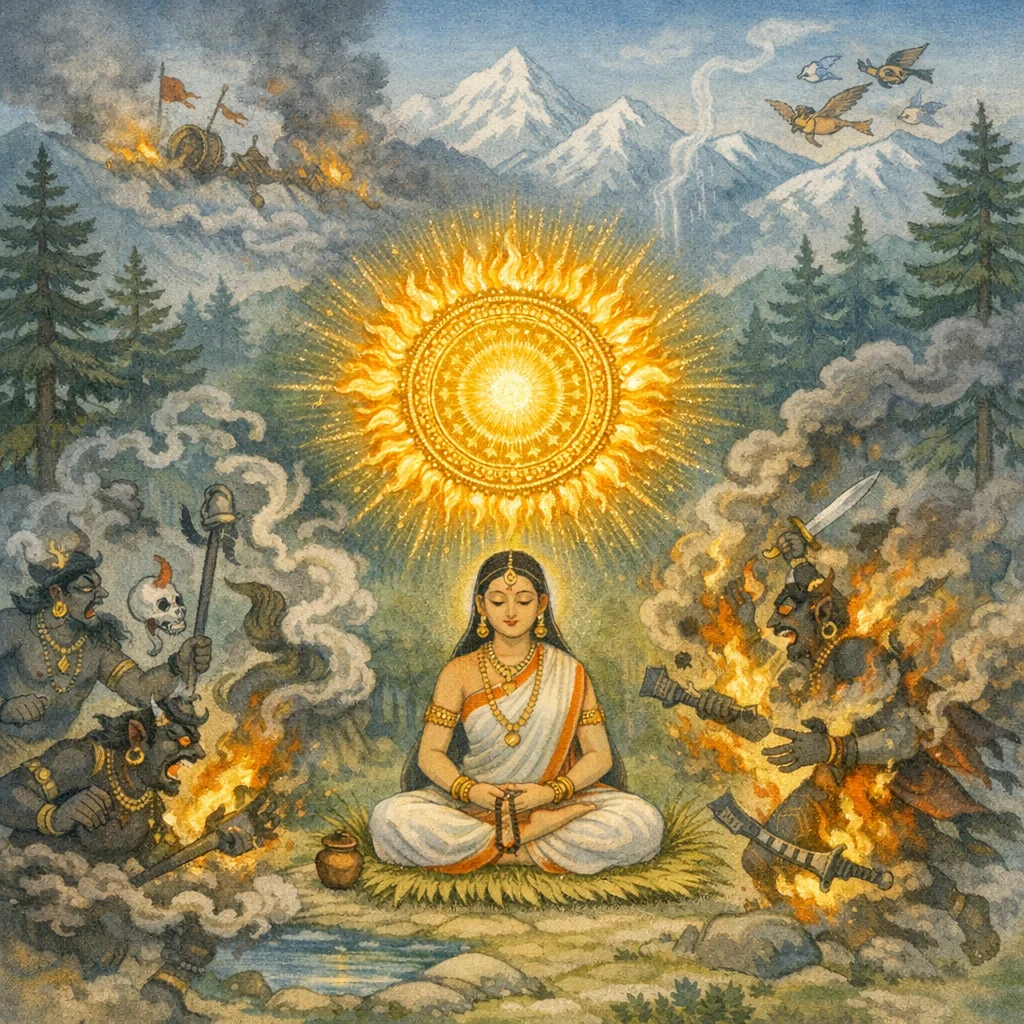
Nārada asks Sanaka about the origin of the Gaṅgā, revered as issuing from the tip of Viṣṇu’s foot and as a destroyer of sin for both reciter and hearer. Sanaka frames the tale within the Deva–Daitya lineage: from Kaśyapa’s wives Aditi and Diti arise devas and daityas, whose enmity culminates in Hiraṇyakaśipu’s line—Prahlāda, Virocana, and the mighty king Bali. Bali advances with vast armies against Indra’s city, unleashing a cataclysmic war of thunderous sound, weapons, and cosmic terror; after 8,000 years the devas are defeated and flee, wandering the earth in disguise. Bali prospers and performs Aśvamedha sacrifices to please Viṣṇu, yet Aditi grieves as her sons lose sovereignty. She withdraws to the Himalayas and undertakes severe tapas, meditating on Hari as sat-cit-ānanda. Daitya illusionists try to dissuade her with arguments about bodily measure and maternal duty; failing, they attack and are burned, while Aditi remains protected for a hundred years by Viṣṇu’s Sudarśana, out of compassion for the devas.
Shlokas
Verse 1
नारद उवाच । विष्णुपादाग्रसंभूता या गङ्गेत्यभिधीयते । तदुत्पत्तिं वद भ्रातरनुग्राह्योऽस्मि ते यदि ॥ १ ॥
Narada said: “That river who is called ‘Gaṅgā’ is said to have arisen from the tip of Lord Vishnu’s foot. O brother, tell me her origin—if I am worthy of your grace.”
Verse 2
सनक उवाच । श्रृणु नारद वक्ष्यामि गङ्गोत्पत्तिं तवानघ । वदतां श्रृण्वतां चैंव पुण्यदां पापनाशिनीम् ॥ २ ॥
Sanaka said: Listen, O Nārada, O sinless one—I shall tell you of the origin of the Gaṅgā, which grants merit to those who speak of it and those who hear it, and which destroys sins.
Verse 3
आसीदिंद्रादिदेवानां जनकः कश्यपो मुनिः । दक्षात्मजे तस्य भार्ये दितिश्चादितिरेव च ॥ ३ ॥
The sage Kaśyapa was the progenitor of Indra and the other gods. His wives were Diti and Aditi—both daughters of Dakṣa.
Verse 4
अदितिर्देवमातास्ति दैत्यानां जननी दितिः । ते तयोरात्मजा विप्र परस्परजयैषिणः ॥ ४ ॥
Aditi is the mother of the Devas, while Diti is the mother of the Daityas. O brāhmaṇa, the sons born of these two are ever intent on conquering one another.
Verse 5
सदा सपूर्वदेवास्तु यतो दैत्याः प्रकीर्तिताः । आदिदैंत्यो दितेः पुत्रो हिरण्यकशिपुर्बली ॥ ५ ॥
Since the Daityas are always described together with the former gods, the first among the Daityas is said to be the mighty Hiraṇyakaśipu, the son of Diti.
Verse 6
प्रह्लादस्तस्य पुत्रो।़भूत्सुमहान्दैत्यसत्तमः । विरोचन स्तस्य सुतो बभूव द्विजभक्तिमान् ॥ ६ ॥
His son was Prahlāda—great indeed, the finest among the Daityas. And Prahlāda’s son was Virocana, who was devoted to the twice-born (brāhmaṇas).
Verse 7
तस्य पुत्रोऽतितेजस्वी बलिरासीत्प्रतापवान् । स एव वाहिनीपालो दैत्यानामभवन्मुनेः ॥ ७ ॥
His son was Bali—exceedingly radiant and mighty. O sage, he indeed became the commander and protector of the Daityas’ army.
Verse 8
बलेन महता युक्तो बुभुजे मेदिनीमिमाम् । विजित्य वसुधां सर्वां स्वर्गं जेतुं मनो दधे ॥ ८ ॥
Endowed with great power, he enjoyed this earth; having conquered the entire world, he set his mind on conquering heaven as well.
Verse 9
गजाश्च यस्यायुतकोटिलक्षास्तावन्त एवाश्वरथा मुनींद्र । गजेगजे पंचशती पदातेः किं वर्ण्यते तस्य चमूर्वरिष्टा ॥ ९ ॥
O lord among sages, he possesses elephants numbering in tens of thousands, crores, and lakhs—and an equal number of horse-drawn chariots. For every elephant there are five hundred foot-soldiers. How could one possibly describe the excellence of such an unrivaled army?
Verse 10
अमात्यकोट्यग्रसरावमात्यौ कुम्भाण्डनामाप्यथ कूपकर्णः । पित्रा समं शौर्यपराक्रमाभ्यां बाणो बलेः पुत्रशतग्रजोऽभूत् ॥ १० ॥
Among the hosts of ministers, two foremost ministers were named Kumbhāṇḍa and Kūpakarṇa. And Bāṇa—equal to his father in valor and prowess—was born as Bali’s great-grandson, in the line of a hundred sons.
Verse 11
बलिः सुराञ्जेतुमनाः प्रवृत्तः सैन्येन युक्तो महता प्रतस्थे । ध्वजातपर्त्रैर्गगनाबुराशेस्तरङ्गविद्युत्स्मरणं प्रकुर्वन् ॥ ११ ॥
Bali, intent on conquering the gods, set out with a vast army; and with the fluttering flag-cloths, he made the sky resemble an ocean—its waves and lightning vividly recalled.
Verse 12
अवाप्य वृत्रारिपुरं सुरारी रुरोघ दैत्यैर्मृगराजगाढैः । सुरश्च युद्धाय पुरात्तथैव विनिर्ययुर्वज्रकरादयश्च ॥ १२ ॥
Having reached the city of Vṛtrāri (Indra), the enemy of the gods blocked it with fierce Daityas, dense as lions. Then the gods too came out from the city for battle—led by Indra, bearer of the vajra, and the others.
Verse 13
ततः प्रववृते युद्धं घोरं गीर्वाणदैत्ययो । कल्पांतमेघानिर्धोषं डिंडिंमध्वनिसंभ्रमम् ॥ १३ ॥
Then a dreadful battle broke out between the gods and the Daityas—its roar like the thunder of end-of-aeon clouds, and its tumult filled with the blare of war-drums.
Verse 14
मुमुचुः शरजालानि दैंत्याः सुमनसां बले । देवाश्च दैत्यसेनासु संग्रामेऽत्यन्तदारुणे ॥ १४ ॥
In that exceedingly dreadful battle, the Daityas loosed volleys of arrows against the host of the Devas; and the Devas, in return, rained showers of shafts upon the Daitya forces.
Verse 15
जहि दारय भिंधीते छिंधि मारय ताडय । इत्येवं सुमहान्घोषो वदतां सेनयोरभूत् ॥ १५ ॥
“Strike! Tear! Pierce! Cut! Kill! Beat!”—with such cries, a tremendous roar arose from the warriors of both armies as they shouted to one another.
Verse 16
शरदुन्दुभिनिध्वानैः सिंहनादैः सिंहनादैः सुरद्विषाम् । भाङ्कारैः स्यन्दनानां च बाणक्रेङ्गारनिःस्वनैः ॥ १६ ॥
The battlefield resounded with the rumbling of war-drums, with repeated lion-roars of the enemies of the Devas, with the clattering of chariots, and with the harsh whirring and ringing of arrows.
Verse 17
अश्वानां हेषितैश्चैव गजानां बृंहितैस्तथा । टङ्गारैर्धनुषां चैव लोकः शब्दत्मयोऽभवत् ॥ १७ ॥
With the neighing of horses, the trumpeting of elephants, and the twang of bows, the whole world became, as it were, made entirely of sound.
Verse 18
सुरासुरविनिर्मुक्तबाणनिष्पेषजानले । अकालप्रलयं मेने निरीक्ष्य सकलं जगत् ॥ १८ ॥
Seeing the entire world ablaze with the fire kindled by the impact and crushing of the arrows discharged by the Devas and the Asuras, he thought that an untimely pralaya—cosmic dissolution—had come.
Verse 19
बभौ देवद्विषां सेना स्फुरच्छस्त्रौघधारिणी । चलद्विद्युन्निभा रात्रिश्छादिता जलदैरिव ॥ १९ ॥
The army of the gods’ foes shone forth, bearing masses of flashing weapons—like a night lit by moving lightning, as though veiled by clouds.
Verse 20
तस्मिन्युद्धे महाधोरैर्गिरीन् क्षित्पान् सुरारिभिः । नाराचैश्चूर्णयामासुर्देवास्ते लघुविक्रमाः ॥ २० ॥
In that most dreadful battle, when the gods’ enemies hurled mountains, those swift-acting devas shattered them to pieces with iron arrows.
Verse 21
केचित्सताडयामासुर्नागैर्नागान्रथान्रथैः । अश्वैरश्वांश्च केचित्तु गदादण्डैरथार्द्दयन् ॥ २१ ॥
Some struck elephants with elephants, and chariots with chariots; some struck horses with horses, and others battered their foes with maces and clubs.
Verse 22
परिधैस्ताडिताः केचित्पेतुः शोणितकर्द्दमे । समुक्त्रांतासवः केचिद्विमानानि समाश्रिताः ॥ २२ ॥
Struck by iron rims, some fell into mire mixed with blood; and some, their life-breath departing, took refuge in aerial chariots (vimanas).
Verse 23
ये दैत्या निहता देवैः प्रसह्य सङ्गरे तदा । ते देवभावमापन्ना दैतेयान्समुपाद्रवन् ॥ २३ ॥
Those Daityas who were then forcefully slain by the gods in battle attained the state of the devas; having become god-natured, they in turn assailed the Daityas.
Verse 24
अथ दैत्यगणाः क्रुद्वास्तड्यमानाः सुर्वैर्भृशम् । शस्त्रैर्बहुविधैर्द्देवान्निजध्नुरतिदारुणाः ॥ २४ ॥
Then the hosts of the Daityas, enraged and sorely struck by the gods, retaliated without mercy, striking down the devas with weapons of many kinds.
Verse 25
दृषद्भिर्भिदिपालैश्च खङ्गैः परशुतोमरैः । परिधैश्छुरिकाभिश्च कुन्तैश्चक्रैश्च शङ्कुभिः ॥ २५ ॥
With stones, with bhindipāla javelins, with swords, with axes and spears; with iron clubs, with daggers; with lances, with the chakra-disc, and with sharp spikes, they assailed.
Verse 26
मुसलैरङ्कुशेश्वैव लाङ्गलैः पट्टिशैस्तथा । शक्त्योपलैः शतघ्रीभिः पाशैश्च तलमुष्टिभिः ॥ २६ ॥
With maces (musala) and goads (aṅkuśa), with plough-blades (lāṅgala) and battle-axes (paṭṭiśa); with śakti-spears and stones, with spiked clubs (śataghrī), with nooses (pāśa), and with fist-weapons (tala-muṣṭi).
Verse 27
शूलैर्नालीकनाराचैः क्षेपणीयैस्समुद्ररैः । रथाश्वनागपदगैः सङ्कुलो ववृधे रणः ॥ २७ ॥
The battle swelled into a dense tumult—filled with tridents (śūla), barbed arrows and reed-shafted darts, with hurled missiles and war-hammers, and crowded with chariots, horses, elephants, and foot-soldiers.
Verse 28
देवाश्च विविधास्त्राणि दैतेयेभ्यः समाक्षिपन् । एवमष्टसहस्त्राणि युद्धमासीत्सुदारुणम् ॥ २८ ॥
And the gods hurled various weapons at the Daityas. Thus, for eight thousand years, there raged a most dreadful war.
Verse 29
अथ दैत्यबले वृद्धे पराभूता दिवौकसः । सुरलोकं परित्यतज्य सर्वे भीताः प्रदुद्रुवुः ॥ २९ ॥
Then, as the might of the Daityas waxed, the dwellers of heaven were defeated; forsaking the realm of the gods, they all fled in fear.
Verse 30
नररुपपरिच्छन्ना विचेरुरवनीतले । वैरोचनिस्त्रिभुवनं नारायणपरायणः ॥ ३० ॥
Disguised in human form, they moved upon the face of the earth; and Virocani, wholly devoted to Nārāyaṇa, traversed the three worlds.
Verse 31
बुभुजेऽव्याहतैश्चर्यप्रवृद्धश्रीर्महाबलः । इत्याज चाश्वमेघैः स विष्णुप्रीणनतत्परः ॥ ३१ ॥
Endowed with great strength, and with prosperity increased by unimpaired righteous conduct, he enjoyed his kingdom. Thus he also performed Aśvamedha sacrifices, wholly intent on pleasing Lord Viṣṇu.
Verse 32
इन्द्रत्वं चाकरोत्स्वर्गे दिक्पालत्वं तथैव च । देवानां प्रीणनार्थाय यैः क्रियन्ते द्विजैर्मखाः ॥ ३२ ॥
In heaven it bestows the rank of Indra, and likewise the office of a guardian of the directions—those sacrifices (makhas) performed by the twice-born for the purpose of pleasing the gods.
Verse 33
तेषु यज्ञेषु सर्वेषु हविर्भुङ्क्ते स दैत्यराट् । अदितिः स्वात्मजान्वीक्ष्य देवमातातिदुःखिता ॥ ३३ ॥
In all those sacrifices, that king of the Daityas consumed the oblation. Seeing her own sons thus, Aditi—the mother of the gods—was overwhelmed with sorrow.
Verse 34
वृथात्र निवसामीति मत्वागाद्धिमवद्गिरम् । शक्रस्यैश्वर्यमिच्छंती दैत्यानां च पराजयम् ॥ २४ ॥
Thinking, “I dwell here in vain,” she went to the Himalaya mountains, longing for Indra’s sovereignty and the downfall of the Daityas.
Verse 35
हरिध्यानपरा भूत्वा तपस्तेपेऽतिदुष्करम् । किंचित्कालं समासीना तिष्टंती च ततः परम् ॥ ३५ ॥
Becoming wholly absorbed in meditation on Hari, she performed exceedingly arduous austerities; for a time she remained seated, and thereafter continued standing in penance.
Verse 36
पादेनैकेन सुचिरं ततः पादाग्रमात्रतः । कंचित्कालं फलाहारा ततः शीर्णदलाशना ॥ ३६ ॥
For a long time she stood on one foot; then only upon the very tip of the foot. For some time she lived on fruits, and thereafter ate only withered, fallen leaves.
Verse 37
ततो जलाशमा वायुभोजनाहारवर्जिता । सच्चिदानन्दसन्दोहं ध्यायत्यात्मानमात्मना ॥ ३७ ॥
Then, freed from thirst and weariness, living on air and abstaining from ordinary food, she meditated—by the Self—upon the Self as the very fullness of Existence, Consciousness, and Bliss (sat-cit-ānanda).
Verse 38
दिव्याब्दानां सहस्त्रं सा तपोऽतप्यत नारद । दुरन्तं तत्तपः श्रुत्वा दैतेया मायिनोऽदितिम् ॥ ३८ ॥
O Nārada, she performed austerities for a thousand divine years. Hearing of that formidable tapas, the Daityas—adept in māyā—set about approaching Aditi with hostile intent.
Verse 39
देवतारुपमास्थाय संप्रोचुर्बलिनोदिताः । किमर्थं तप्यते मातः शरीरपरिशोषणम् ॥ ३९ ॥
Assuming the forms of deities, and urged on by Bali, they addressed her: “For what reason, O Mother, do you perform tapas that dries and wastes away the body?”
Verse 40
यदि जानन्ति दैतेया महदुखं ततो भवेत् । त्यजेदं दुःखबहुलं कायशोषणकारणम् ॥ ४० ॥
If the Daityas were to understand this, great sorrow would arise for them; therefore one should abandon this, so full of suffering and a cause of the body’s wasting away.
Verse 41
प्रयाससाध्यं सुकृतं न प्रशँसन्ति पण्डिताः । शरीरं यन्ततो रक्ष्यं धर्मसाधनतत्परैः ॥ ४१ ॥
The wise do not praise pious acts achieved only through excessive strain. Those devoted to accomplishing Dharma should carefully protect the body, for it is the instrument of righteous practice.
Verse 42
ये शरीरमुपेक्षन्ते ते स्युरात्मविघातिनः । सुखं त्वं तिष्ट सुभगे पुत्रानस्मान्न खेदय ॥ ४२ ॥
Those who neglect the body become destroyers of their own self. Therefore, O fortunate one, remain at ease; do not grieve us, your sons.
Verse 43
मात्रा हीना जना मातर्मृतप्राया न संशयः । गावो वा पशवो वापि यत्र गावो महीरुहाः ॥ ४३ ॥
O Mother, people who are deprived of proper measure and proportion are as good as dead—there is no doubt. Whether cows or other cattle, wherever cows are treated as mere beasts of burden, like trees rooted to the earth, life there becomes inert and degraded.
Verse 44
न लभन्ते सुखं किंचिन्मात्रा हीना मृतोपमाः । दरिद्रो वापि रोगी वा देशान्तरगतोऽपि वा ॥ ४४ ॥
Those deprived of their mother gain not even the slightest happiness; they are as if dead—whether they become poor, or fall ill, or even dwell in a distant land.
Verse 45
मातुर्दर्शनमात्रेण लभते परमां मुदम् । अन्ने वा सलिले वापि धनादौ वा प्रियासु च ॥ ४५ ॥
By the mere sight of one’s mother, a person attains supreme joy—whether in food, in water, in wealth and other possessions, or even among beloved ones.
Verse 46
कदाचिद्विमुखो याति जनो मातरि कोऽपि न । यस्य माता गृहे नास्ति यत्र धर्मपरायणा । साध्वी च स्त्री पतिप्राणा गन्तव्यं तेन वै वनम् ॥ ४६ ॥
No one ever turns away from one’s mother. Yet for the man whose home has no mother devoted to dharma, and no chaste wife whose very life is her husband—truly, for him the forest is the place to go.
Verse 47
धर्मश्च नारायणभक्तिहीनां धनं च सद्भोगविवर्जितं हि । गृहं च मार्यातनयेर्विहीनं यथा तथा मातृविहीनमर्त्यः ॥ ४७ ॥
For those devoid of devotion (bhakti) to Nārāyaṇa, even “dharma” is hollow; and wealth too is truly without noble enjoyment. A home without wife and children is likewise desolate—just as a mortal without a mother.
Verse 48
तस्माद्देवि परित्राहि दुःखार्तानात्मजांस्तव । इत्युक्ताप्यदितिर्दैप्यैर्न चचाल समाधितः ॥ ४८ ॥
“Therefore, O Goddess, protect your sons who are distressed by suffering.” Though thus addressed by the Daityas, Aditi—steadfast in deep samādhi—did not waver.
Verse 49
एवमुक्त्वासुराः सर्वे हरिध्यानपरायणाम् । निरीक्ष्य क्रोधसंयुक्ता हन्तुं चक्रुर्मनोरथम् ॥ ४९ ॥
Having spoken thus, all the asuras, beholding her wholly devoted to meditation upon Hari, were seized with wrath and resolved to slay Manorathā.
Verse 50
कल्पान्तमेघनिर्घोषाः क्रोधसंरक्तलोचनाः । दंष्ट्रग्रैरसृजन्वह्निंम् सोऽदहत्काननं क्षणात् ॥ ५० ॥
Roaring like the clouds at the end of an aeon, with eyes reddened by wrath, he spewed fire from the tips of his fangs and in an instant burned the forest to ashes.
Verse 51
शतयोजनविस्तीर्णं नानाजीवसमाकुलम् । तेनैव दग्धा दैतेया ये प्रधर्षयितुं गताः ॥ ५१ ॥
Spreading across a hundred yojanas and teeming with diverse living beings, by that very fiery power the Daityas who had gone forth to assail it were burned away.
Verse 52
सैवावशिष्टा जननी सुराणामब्दाच्छतादच्युतसक्तचिता । संरक्षिता विष्णुसुदर्शनेन दैत्यान्तकेन स्वजनानुकम्पिना ॥ ५२ ॥
She alone—the mother of the gods—remained, her mind devoted to Acyuta; and for a hundred years she was protected by Viṣṇu’s Sudarśana, slayer of the Daityas, out of compassion for His own.
Verse 53
इति श्रीबृहन्नारदीयपुराणे पूर्वभागे प्रथमपादे गङ्गोत्पत्तौ बलिकृतदेवपराजयवर्णनन्नाम दशमोऽध्यायः ॥ १० ॥
Thus ends the tenth chapter, entitled “The Origin of the Gaṅgā and the Account of the Gods’ Defeat Brought About by Bali,” in the First Pāda of the Pūrva-bhāga of the Śrī Bṛhannāradīya Purāṇa.
Frequently Asked Questions
It establishes Gaṅgā as a Viṣṇu-connected tirtha principle (not merely a river): her mention is framed as intrinsically merit-giving (puṇya) and sin-destroying (pāpa-nāśinī), grounding later historical events in a theology of grace and sacred geography.
They argue a ‘measure-and-body-as-instrument’ ethic—protecting the body as a means for dharma—against Aditi’s uncompromising tapas aimed at restoring cosmic order. The narrative resolves the tension by showing Viṣṇu safeguarding true devotion (bhakti-yukta tapas) without denying the general dharmic concern for proportion.