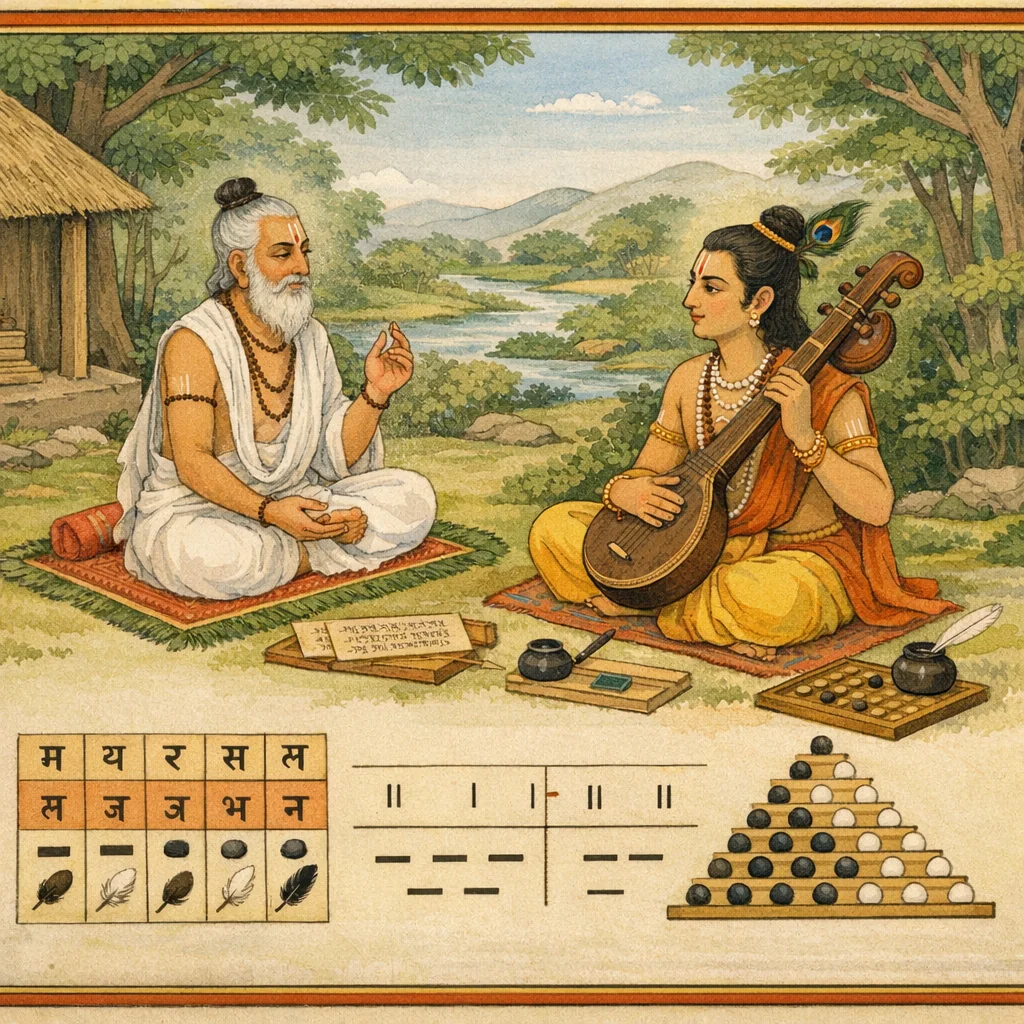
Chandas: Varṇa-gaṇas, Guru-Laghu, Vṛtta-bheda, and Prastāra Procedures
Sanandana instructs Nārada in chandaḥ-śāstra, the sacred science of prosody. He classifies metres as Vedic and laukika, and distinguishes analysis by mātrā (quantity) and by varṇa (syllabic pattern). The chapter defines the gaṇa markers (ma, ya, ra, sa, ta, ja, bha, na) and the guru/laghu rules, explaining how consonant clusters, visarga, and anusvāra affect syllable weight. It explains pāda (quarter-verse) and yati (caesura), and sets out three vṛtta types—sama, ardhasama, and viṣama—based on pāda equivalence. It then describes enumerating pādas from 1 to 26 syllables, notes daṇḍaka varieties, and lists prominent Vedic metres (from Gāyatrī to Atijagatī, etc.). Finally it introduces prastāra (systematic permutation), naṣṭāṅka recovery, uddiṣṭa procedures, and counting notions (saṃkhyā/adhvan), declaring these to be defining marks of Vedic metres and promising further classification names.
Shlokas
Verse 1
सनन्दन उवाच । वैदिकं लौकिकं चापि छन्दो द्विविधमुच्यते । मात्रावर्णविभेदेन तच्चापि द्विविधं पुनः ॥ १ ॥
Sanandana said: Metre (chandas) is spoken of as twofold—Vedic and also worldly (classical). And that, again, is of two kinds, distinguished by mātrā (syllabic quantity) and varṇa (syllabic/phonetic pattern).
Verse 2
मयौ रसौ तजौ भनौ गुरुर्लघुरपिद्विज । कारणं छंदसि प्रोक्ताश्छन्दःशास्त्रविशारदैः ॥ २ ॥
‘Ma’ and ‘ya’, ‘ra’ and ‘sa’, ‘ta’ and ‘ja’, and ‘bha’ and ‘na’—and even “guru” and “laghu,” O twice-born—are the technical terms (kāraṇas) for metre, as declared by those skilled in chandas-śāstra, the science of prosody.
Verse 3
सर्वगो मगणः प्रोक्तो मुखलो यगणः स्मृतः । मध्यलो रगणश्वैव प्रांत्यगः सगणो मतः ॥ ३ ॥
The gaṇa called ‘ma’ is said to occur in all positions; the ‘ya’-gaṇa is remembered as occurring at the beginning; the ‘ra’-gaṇa likewise occurs in the middle; and the ‘sa’-gaṇa is considered to occur at the end.
Verse 4
तगणोंऽतलघुः ख्यातो मध्यगो जो भआदिगः । त्रिलघुर्नगणः प्रोक्तस्त्रिका वर्णगणा मुने ॥ ४ ॥
The ta-gaṇa is known as the group whose last syllable is short; the ja-gaṇa has a short syllable in the middle and begins with ‘bha’. The na-gaṇa is said to be three short syllables. Thus, O sage, these are the triads of syllabic groups (varṇa-gaṇas).
Verse 5
चतुर्लास्तु गणाः पञ्च प्रोक्ता आर्यादिसंमताः । संयोगश्च विसर्गश्चानुस्वारो लघुतः परः ॥ ५ ॥
The learned authorities, beginning with the Āryā tradition, teach that in the four-lā system there are five gaṇas; and that a consonant cluster (saṃyoga), visarga (ḥ), and anusvāra (ṃ) are treated as following upon—thus affecting—a short syllable (laghu).
Verse 6
लघोर्दीर्घत्वमाख्याति दीर्घो गो लो लघुर्मतः । पादश्चतुर्थभागः स्याद्विच्छेदोयतिरुच्यते ॥ ६ ॥
A short syllable is indicated as long by the marker ‘go’; by ‘lo’, a long syllable is understood as short. One quarter of a metrical line is called a pāda, and the break (pause) is termed yati.
Verse 7
सममर्द्धसमं वृत्तं विषमं चापि नारद । तुल्यलक्षणतः पादचतुष्के सममुच्यते ॥ ७ ॥
O Nārada, metres (vṛtta) are of three kinds—sama, ardhasama, and viṣama. When the four quarters (pādas) bear identical metrical marks, it is called “sama”.
Verse 8
आदित्रिके द्विचतुर्थे सममर्द्धसमं ततम् । लक्ष्म भिन्नं यस्य पादचतुष्के विषमं हि तत् ॥ ८ ॥
In a verse, when the first and third pādas are even, and the second and fourth correspond by half-measure, yet the metrical mark (lakṣma) differs across the four pādas, that metre is indeed called “viṣama” (uneven).
Verse 9
एकाक्षरात्समारभ्य वर्णैकैकस्य वृद्धितः । षड्विंशत्यक्षरं यावत्पादस्तावत्पृथक् पृथक् ॥ ९ ॥
Beginning from a single syllable, and increasing one syllable at a time, each possible quarter-verse (pāda) is to be set forth separately, up to the limit of twenty-six syllables.
Verse 10
तत्परं चंडवृष्ट्यादिदंडकाः परिकल्पिताः । त्रिभिः षड्भिः पदैर्गाथाः श्रृणु संज्ञा यथोत्तरम् ॥ १० ॥
Thereafter, the daṇḍaka-type metres—such as Caṇḍavṛṣṭi and others—are set forth. Also, gāthā-verses are formed with three to six pādas; now listen to their names in proper order.
Verse 11
उक्तात्युक्ता तथा मध्या प्रतिष्टान्या सुपूर्विका । गायत्र्युष्णिगनुष्टष्टप्च बृहती पंक्तिरेव च ॥ ११ ॥
They are also named Uktātyuktā, Madhyā, Pratiṣṭhānyā, and Supūrvikā; and among the metres are Gāyatrī, Uṣṇik, Anuṣṭup, Bṛhatī, and Paṅkti as well.
Verse 12
त्रिष्टुप्च जगती चैव तथातिजगती मता । शक्करी सातिपूर्वा च अष्ट्यत्यष्टी ततः स्मृते ॥ १२ ॥
Triṣṭubh and Jagatī, and likewise Atijagatī, are acknowledged as metres. Then Śakkarī together with Sātipūrvā, and thereafter Aṣṭī and Atyaṣṭī, are remembered in the tradition.
Verse 13
धृतिश्च विधृतिश्चैव कृतिः प्रकृतिराकृतिः । विकृतिः संकृतिश्चैव तथातिकृतिरुत्कृतिः ॥ १३ ॥
Steadfastness and sustained steadfastness; purposeful action, innate disposition, and formed appearance; change, well-ordered formation, and likewise excessive doing and elevated excellence—these too are to be understood.
Verse 14
इत्येताश्छन्दसां संज्ञाः प्रस्ताराद्भेदभागिकाः । पादे सर्वगुरौ पूर्वील्लघुं स्थाप्य गुरोरधः ॥ १४ ॥
Thus, these technical designations of the metres arise from the prastāra (systematic metrical expansion) and from their respective divisions. In a metrical foot that is entirely heavy (sarva-guru), one should place a light syllable (laghu) in the earlier position, in place of a heavy (guru).
Verse 15
यथोपरि तथा शेषमग्रे प्रारवन्न्यसेदपि । एष प्रस्तार उदितो यावत्सर्वलघुर्भवेत् ॥ १५ ॥
In the same manner as above, one should place the remaining portion in front, beginning from the first. Thus this prastāra (systematic expansion) is taught, continuing until everything becomes ‘all light’ (sarva-laghu).
Verse 16
नष्टांकार्द्धे समे लः स्याद्विपम् सैव सोर्द्धगः । उद्दिष्टे द्विगुणानाद्यादंगान्संमोल्य लस्थितान् ॥ १६ ॥
When the “lost digit” (naṣṭāṅka) is halved and the result is even, the marker “la” is applied; the same is to be understood for the corresponding vipam case as well, together with the half-step. In the stated operation (uddiṣṭa), one should begin by doubling, then merge the parts (aṅgas) that stand in the “la” position.
Verse 17
कृत्वा सेकान्वदैत्संख्यामिति प्राहुः पुराविदः । वर्णान्सेकान्वृत्तभवानुत्तराधरतः स्थितान् ॥ १७ ॥
The sages learned in antiquity declare: “Having arranged the ‘sekas’, one should state their number.” These ‘sekas’—the classes of letters—are set forth in proper order, from the higher to the lower.
Verse 18
एकादिक्रमतश्चैकानुपर्य्युपरि विन्यसेत् । उपांत्यतो निवर्तेत त्यजन्नेकैकमूर्द्धतः ॥ १८ ॥
Placing them one by one in ascending order, he should arrange them successively higher and higher. Then, beginning from the penultimate, he should withdraw—abandoning each one, stage by stage, from the crown of the head.
Verse 19
उपर्याद्याद्गुरोरेवमेकद्व्यादिलगक्रिया । लगक्रियांकसंदोहे भवेत्संख्याविमिश्रिते ॥ १९ ॥
Thus, proceeding upward from the preceding heavy unit (guru), one applies the light-unit (laghu) operations in single, double, and so on; and when the collection of numerical marks arising from these light-operations becomes intermingled, the resulting count is a mixed (combined) number.
Verse 20
उद्दिष्टांकसमाहारः सैको वा जनयेदिमाम् । संख्यैव द्विगुणैकोना सद्भिरध्वा प्रकीर्तितः ॥ २० ॥
The total obtained by adding up the stated digits—either that total itself, or that total plus one—produces this result. The wise declare that the ‘adhvan’ is precisely the number that is one less than twice the saṃkhyā.
Verse 21
इत्येतत्किंचिदाख्यातं लक्षणं छंदसां नुने । प्रस्तारोक्तप्रभेदानां नामानांस्त्यं प्रगाहते ॥ २१ ॥
Thus, I have now explained, in brief, the defining characteristics of the Vedic metres (chandas). Next, I shall set forth the established names of the various classifications as stated through the prastāra, the systematic permutations of metre.
Frequently Asked Questions
They denote standard varṇa-gaṇas—three-syllable groupings used to encode guru/laghu patterns—allowing metres to be described, compared, and generated systematically in chandas-śāstra.
Sama has identical metrical characteristics across all four pādas; ardhasama has partial equivalence (typically pairing patterns across pādas); viṣama applies when pāda-patterns differ in a defined uneven arrangement, i.e., the metrical marks are not uniform across the four quarters.
Prastāra enumerates all possible guru/laghu permutations for a given length, while naṣṭāṅka procedures recover a specific pattern or index (“lost figure”) from the enumeration—together enabling a computational approach to metrical classification.