Anūcāna (True Learning), the Vedāṅgas, and Śikṣā: Svara, Sāmavedic Chant, and Gandharva Theory
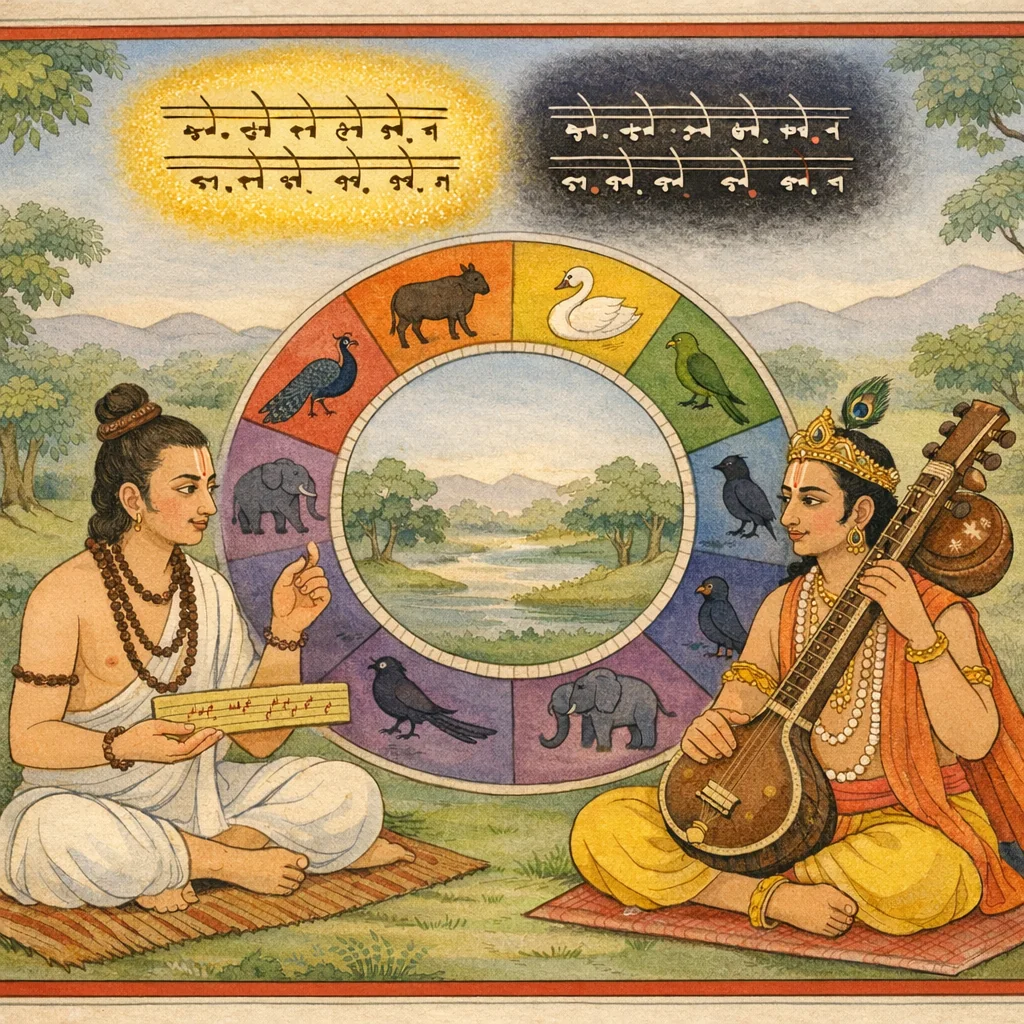
Sūta relates that Nārada remains dissatisfied even after hearing Sanandana, and asks how Śuka attained extraordinary detachment and knowledge with a childlike simplicity, seemingly without the usual prerequisite of serving elders. Sanandana begins by redefining “greatness” as anūcāna—true learning—rather than age or social signs, and explains how one becomes genuinely learned. He lists the six Vedāṅgas and the four Vedas, stressing that authentic learning arises from disciplined study under a teacher, not from reading countless books. The chapter then focuses on Śikṣā: the supremacy of tonal accent (svara), kinds of chant and note-transitions, and the grave danger of wrong accent or syllable-division, illustrated by the Indra-śatru episode. It proceeds into Sāmavedic and Gandharva-music technicalities—notes, grāmas, mūrcchanās, rāgas, vocal qualities and faults, aesthetic preferences, color associations of notes, and correspondences between Sāmaveda tones and music-theory terms—culminating in a natural mapping of notes to animal calls.
Shlokas
Verse 1
सूत उवाच । श्रुत्वा सनंदनस्येत्थं वचनं नारदो मुनिः । असंतुष्ट इव प्राह भ्रातरं तं सनंदनम् ॥ १ ॥
Sūta said: Having heard Sanandana’s words spoken in this manner, the sage Nārada—seeming as though not fully satisfied—addressed that brother Sanandana.
Verse 2
नारद उवाच । भगवन्सर्वमाख्यातं यत्पृष्टं भवतो मया । तथापि नात्मा प्रीयेत श्रृण्वन्हरिकथां मुहुः ॥ २ ॥
Nārada said: “Revered one, you have explained everything that I asked of you. Yet my heart is still not fully satisfied, even though I repeatedly listen to the sacred narrations of Hari.”
Verse 3
श्रूयते व्यासपुत्रस्तु शुकः परमधर्मवित् । सिद्धिं सुमहतीं प्राप्तो निर्विण्णोऽवांतरं बहिः ॥ ३ ॥
It is heard that Śuka, the son of Vyāsa—knower of the highest dharma—attained a very great perfection, remaining detached, inwardly and outwardly, from all intermediate worldly concerns.
Verse 4
ब्रह्मन्पुंसस्तु विज्ञानं महतां सेवनं विना । न जायते कथं प्राप्तो ज्ञानं व्यासात्मजः शिशुः ॥ ४ ॥
O Brahman, true discernment in a person does not arise without serving the great. How, then, did the child Śuka—son of Vyāsa—attain such knowledge?
Verse 5
तस्य जन्मरहस्यं मे कमचाप्यस्य श्रृण्वते । समाख्याहि महाभाग मोक्षशास्त्रार्थविद्भवान् ॥ ५ ॥
Tell me the secret of his birth, and also the reason for it, as I listen. O great and fortunate one—since you know the true purport of the Mokṣa-śāstras—please explain it fully.
Verse 6
सनंदन उवाच । श्रृणु विप्रप्रवक्ष्यामि शुकोत्पत्तिं समासतः । यां श्रुत्वा ब्रह्मतत्त्वज्ञो जायते मानवो मुने ॥ ६ ॥
Sanandana said: Listen, O brāhmaṇa; I shall briefly relate the origin of Śuka. Hearing it, O sage, a human being becomes a knower of the true principle of Brahman.
Verse 7
न हायनैर्न पलितैर्न वित्तेन न बंधुभिः । ऋषयश्चक्रिरे धर्मं योऽनूचानः स नो महान् ॥ ७ ॥
Greatness is not attained by years, nor by grey hair, nor by wealth, nor by relatives. The sages established the standard of dharma: whoever is truly learned is the great one among us.
Verse 8
नारद उवाच । अनूचानः कथंब्रह्मन्पुमान्भवति मानद । तन्मे कर्म समाचक्ष्व श्रोतुं कौतूहलं मम ॥ ८ ॥
Nārada said: “O Brahman, bestower of honor, how does a man become truly learned (anūcāna)? Tell me that discipline and practice; I am eager and curious to hear.”
Verse 9
सनंदन उवाच । श्रृणु नारद वक्ष्यामि ह्यनूचानस्य लक्षणम् । यज्ज्ञात्वा सांगवेदानामभिज्ञो जायते नरः ॥ ९ ॥
Sanandana said: “Hear, O Nārada; I shall explain the characteristics of one who is truly learned in Vedic recitation and study (anūcāna). Knowing these, a person becomes a genuine knower of the Vedas together with the Vedāṅgas.”},{
Verse 10
शिक्षा कल्पो व्याकरणं निरुक्तं ज्योतिषं तथा । छंदःशास्त्रं षडेतानि वेदांगानि विदुर्बुधाः ॥ १० ॥
Śikṣā (phonetics), Kalpa (ritual procedure), Vyākaraṇa (grammar), Nirukta (etymology and explanation of Vedic words), Jyotiṣa (astronomy/astrology), and Chandas (the science of meter)—these six are known by the wise as the Vedāṅgas, the auxiliary limbs of the Veda.
Verse 11
ऋग्वेदोऽथ यजुर्वेदः सामवेदो ह्यथर्वणः । वेदाश्चत्वार एवैते प्रोक्ता धर्मनिरूपणे ॥ ११ ॥
The Ṛgveda, then the Yajurveda, the Sāmaveda, and indeed the Atharvaveda—these are declared to be exactly four Vedas, set forth for the exposition of Dharma.
Verse 12
सांगान्वेदान्गुरोर्यस्तु समधीते द्विजोत्तमः । सोऽनूचानः प्रभवति नान्यथा ग्रंथकोटिभिः ॥ १२ ॥
That best of the twice-born who diligently studies the Vedas together with their Vedāṅgas from a teacher—he alone becomes truly learned (anūcāna); it cannot be attained otherwise, even by reading crores of books.
Verse 13
नारद उवाच । अंगानां लक्षणं ब्रूहि वेदानां चापि विस्तरात् । त्वंमस्मासु महाविज्ञः सांगेष्वेतेषु मानद ॥ १३ ॥
Narada said: “Tell me in detail the defining marks of the Vedāṅgas, the auxiliary limbs of the Veda, and also of the Vedas themselves. Truly, among us you are the great knower of these limbs of the Veda, O bestower of honor.”
Verse 14
सनंदन उवाच । प्रश्नभारोऽयमतुलस्त्वया मम कृतो द्विज । संक्षेपात्कथयिष्यामि सारमेषां सुनिश्चितम् ॥ १४ ॥
Sanandana said: “O twice-born one, you have laid upon me an incomparable burden of questions. Therefore I shall tell you, in brief, the well-ascertained essence of these matters.”
Verse 15
स्वरः प्रधानः शिक्षायां कीर्त्तितो मुनिभिर्दिजैः । वेदानां वेदविद्भिस्तु तच्छृणुष्व वदामि ते ॥ १५ ॥
In Śikṣā, the Vedic science of phonetics, ‘svara’—the tonal accent—is declared by sages and twice-born scholars to be paramount. Therefore listen: I shall explain to you what the knowers of the Vedas teach concerning the Vedas.
Verse 16
आर्चिकं गाथिकं चैव सामिकं च स्वरान्तरम् । कृतांते स्वरशास्त्राणां प्रयोक्तव्य विशेषतः ॥ १६ ॥
In the concluding portion (of a rite or recitation), one should apply—most particularly—the disciplines of tonal science: the Ṛk-style chant (ārcika), the gāthā-style recitation (gāthika), the Sāman-style singing (sāmika), and the proper transitions between notes (svarāntara).
Verse 17
एकांतरः स्वरो ह्यप्सु गाथासुद्व्यंतरः स्वरः । सामसु त्र्यंतरं विद्यादेतावत्स्वरतोऽन्तरम् ॥ १७ ॥
In the Ṛk-verses (apsu), the pitch-interval is of one step; in the gāthās it is of two steps; and in the Sāman chants one should know it as of three steps—this is the extent of the difference with respect to musical pitch (svara).
Verse 18
ऋक्सामयजुरंगानि ये यज्ञेषु प्रयुंजते । अविज्ञानाद्धि शिक्षायास्तेषां भवति विस्वरः ॥ १८ ॥
Those who employ the limbs of the Ṛg, Sāma, and Yajur Vedas in sacrificial rites—through ignorance of Śikṣā, the science of pronunciation—end up with faulty svara and incorrect chanting.
Verse 19
मंत्रो हीनः स्वरतो वर्णतो वा मिथ्याप्रयुक्तो न तमर्थमाह । स वाग्वज्रो यजमानं हिनस्ति यथेंद्रशत्रुः स्वरतोऽपराधात् ॥ १९ ॥
A mantra, if deficient in svara (accent) or in varṇa (letters/syllables), or if wrongly applied, does not convey the intended meaning. Such speech becomes a vajra of words and harms the yajamāna, just as “indra-śatru” brought ruin through a fault of intonation.
Verse 20
उरः कंठः शिरश्चैव स्थानानि त्रीणि वाङ्मये । सवनान्याहुरेतानि साम वाप्यर्द्धतोंऽतरम् ॥ २० ॥
In the discipline of sacred speech there are three places of utterance: the chest, the throat, and the head. These are declared to be the three savanas; and the Sāman, too, is said to abide in the intermediate half between them.
Verse 21
उरः सप्तविवारं स्यात्तथा कंठस्तथा शिरः । न च शक्तोऽसि व्यक्तस्तु तथा प्रावचना विधिः ॥ २१ ॥
The chest has seven openings; likewise the throat, and likewise the head. Yet you are not able to state clearly the proper method of recitation and exposition of sacred teaching.
Verse 22
कठकालापवृत्तेषु तैत्तिराह्वरकेषु च । ऋग्वेदे सामवेदे च वक्तव्यः प्रथमः स्वरः ॥ २२ ॥
In the Kaṭha, Kālāpa, and Vṛtta recensions, and in the Taittirīya and Āhvaraka schools—likewise in the Ṛgveda and the Sāmaveda—the first, primary svara is to be pronounced.
Verse 23
ऋग्वेदस्तु द्वितीयेन तृतीयेन च वर्तते । उच्चमध्यमसंघातः स्वरो भवति पार्थिवः ॥ २३ ॥
The Ṛgveda is recited with the second and the third tones. When the high and the middle pitches unite, the ‘pārthiva’—the earthy musical tone—arises.
Verse 24
तृतीय प्रथमक्रुष्टा कुर्वंत्याह्वरकान् स्वरान् । द्वितीयाद्यास्तु मद्रांतास्तैत्तिरीयाश्चतुःस्वरान् ॥ २४ ॥
The third group, beginning with the Prathama-kruṣṭā, employs the āhvaraka tonal notes. The second set—ending with the Madrā—together with the Taittirīyas, uses four tonal accents in recitation.
Verse 25
प्रथमश्च द्वितीयश्च तृतीयोऽथ चतुर्थकः । मंद्रः क्रुष्टो मुनीश्वर एतान्कुर्वंति सामगाः ॥ २५ ॥
“The first, the second, the third, and then the fourth—also the tones called mandra and kruṣṭa—O lord of sages: these are the tonal divisions employed by the chanters of the Sāma (Veda).”
Verse 26
द्वितीयप्रथमावेतौ नांडिभाल्लविनौ स्वरौ । तथा शातपथावेतौ स्वरौ वाजसनेयिनाम् ॥ २६ ॥
These two accents are known as “dvitīya” and “prathamā” in the Nāṇḍibhālla and Lavina traditions. Likewise, among the Vājasaneyins, these two accents are recognized according to the “Śātapatha” (Śatapatha tradition).
Verse 27
एते विशेषतः प्रोक्ताः स्वरा वै सार्ववैदिकाः । इत्येतच्चरितं सर्वं स्वराणां सार्ववैदिकम् ॥ २७ ॥
These are the Vedic accent-notes specifically taught as common to all the Vedas. Thus the entire account of the universally Vedic accents is brought to its conclusion.
Verse 28
सामवेदे तु वक्ष्यामि स्वराणां चरितं यथा । अल्पग्रंथं प्रभूतार्थं सामवेदांगमुत्तमम् ॥ २८ ॥
Now, with reference to the Sāmaveda, I shall truly explain the course and functioning of the musical tones (svaras)—an excellent auxiliary of the Sāmaveda, concise in compass yet abundant in meaning.
Verse 29
तानरागस्वरग्राममूर्च्छनानां तु लक्षणम् । पवित्रं पावनं पुण्यं यथा तुभ्यं प्रकीर्तितम् ॥ २९ ॥
Thus, the defining characteristics of tāna, rāga, svara, grāma, and mūrcchanā have been declared to you—teachings that are sacred, purifying, and meritorious.
Verse 30
शिक्षामाहुर्द्विजातीनामृग्यजुः सामलक्षणम् । सप्त स्वरास्रयो ग्रामा मृर्छनास्त्वेकविंशतिः ॥ ३० ॥
They declare Śikṣā (the science of phonetics) to be, for the twice-born, the defining knowledge of the Ṛg, Yajus, and Sāman traditions. It rests upon seven notes (svaras); the grāmas are seven, and the mūrcchanās are twenty-one.
Verse 31
ताना एकोनपंचाशदित्येतस्स्वरमंडलम् । षड्जश्च ऋषभश्चैव गांधारो मध्यमस्तथा ॥ ३१ ॥
The tānas are said to be forty-nine; this is the complete sphere of the system of notes. Among them are ṣaḍja, ṛṣabha, gāndhāra, and likewise madhyama.
Verse 32
पंचमो धैवतश्चैवं निषादः सप्तमः स्वरः । षड्जमध्यमगांधारास्त्रयो ग्रामाः प्रकीर्तिताः ॥ ३२ ॥
Likewise, the fifth note is dhaivata, and niṣāda is the seventh note. The three grāmas are declared to be Ṣaḍja, Madhyama, and Gāndhāra.
Verse 33
भूर्ल्लोकाज्जायते षड्जो भुवर्लोकाञ्च मध्यमः । स्वर्गाभ्राच्चैव गांधारो ग्रामस्थानानि त्रीणि हि ॥ ३३ ॥
From Bhūrloka arises the note Ṣaḍja; from Bhuvarloka, Madhyama; and from the higher heaven, Svarga, comes Gāndhāra. Truly, these are the three fundamental seats (sources) of the musical grāma.
Verse 34
स्वराणां च विशेषेण ग्रामरागा इति स्मृताः । विंशतिर्मध्यमग्रामे षड्जग्रामे चतुर्दश ॥ ३४ ॥
In particular, the distinctive arrangements of the notes are remembered as “grāma-rāgas.” In the Madhyama-grāma there are twenty such rāgas, and in the Ṣaḍja-grāma there are fourteen.
Verse 35
तानान्पंचदशेच्छंति गांधारे सामगायिनाम् । नदी विशाला सुमुखी चित्रा चित्रवती मुखा ॥ ३५ ॥
In the land of Gandhāra, the chanters of the Sāma are said to recognize fifteen names or variants. The rivers are: Viśālā, Sumukhī, Citrā, Citravatī, and Mukhā.
Verse 36
बला चाप्यथ विज्ञेया देवानां सप्त मूर्छनाः । आप्यायिनी विश्वभृता चंद्रा हेमा कपर्दिनी ॥ ३६ ॥
One should also understand these as the seven divine mūrchanās (intonational progressions) of the gods: Balā, Āpyāyinī, Viśvabhṛtā, Candrā, Hemā, and Kapardinī—together completing the sacred set of seven.
Verse 37
मैत्री च बार्हती चैव पितॄणां सप्त मूर्छनाः । षड्जे तूत्तरमंद्रा स्यादृषभे चाभिरूहता ॥ ३७ ॥
“Maitrī” and “Bārhatī”—these too are included among the seven mūrchanās associated with the Pitṛs, the venerable ancestors. In the note Ṣaḍja it is said to rest in the higher mandra (lower register), and in Ṛṣabha it rises upward.
Verse 38
अश्वक्रांता तु गांधारे तृतीया मूर्च्छना स्मृता । मध्यमे खलु सौवीरा हृषिका पंचमे स्वरे ॥ ३८ ॥
The third mūrcchanā is remembered as Aśvakrāntā, founded upon the note Gāndhāra. In the Madhyama it is indeed called Sauvīrā, and in the fifth note it is called Hṛṣikā.
Verse 39
धैवते चापि विज्ञेया मूर्छना तूत्तरा मता । निषादे रजनीं विद्यादृषीणां सप्त मूर्छनाः ॥ ३९ ॥
On the note Dhaivata, the mūrcchanā known as Uttarā is to be understood; and on the note Niṣāda, know the mūrcchanā called Rajanī. Thus the sages teach seven mūrcchanās.
Verse 40
उपजीवंति गंधर्वा देवानां सप्त मूर्छनाः । पितॄणां मूर्च्छनाः सप्त तथा यक्षा न संशयः ॥ ४० ॥
The Gandharvas subsist by the seven mūrcchanās of the Devas; likewise, the seven mūrcchanās of the Pitṛs sustain their tradition, and so too the Yakṣas—of this there is no doubt.
Verse 41
ऋषीणां मूर्छनाः सप्त यास्त्विमा लौकिकाः स्मृताः । षङ्जः प्रीणाति वै देवानृषीन्प्रीणाति चर्षभः ॥ ४१ ॥
The seven mūrcchanās of the Ṛṣis are remembered as those employed in common worldly practice. Among the notes, Ṣaḍja truly delights the Devas, while Ṛṣabha delights the sages.
Verse 42
पितॄन् प्रीणाति गांधारो गंधर्वान्मध्यमः स्वरः ॥ देवान्पितॄनृषींश्चैव स्वरः प्रीणाति पंचमः ॥ ४२ ॥
The note Gāndhāra gladdens the Pitṛs (ancestors); the note Madhyama delights the Gandharvas. And the note Pañcama pleases the Devas, the Pitṛs, and the Ṛṣis as well.
Verse 43
यक्षान्निषादः प्रीणाति भूतग्रामं च धैवतः । गानस्य तु दशविधा गुणवृत्तिस्तु तद्यथा ॥ ४३ ॥
The note Niṣāda delights the Yakṣas, and Dhaivata pleases the host of beings (bhūtas). Now the modes of singing are declared, having ten kinds of qualitative functions—just as follows.
Verse 44
रक्तं पूर्णमलंकृतं प्रसन्नं व्यक्तं विक्रुष्टं श्लक्ष्णं समं सुकुमारं मधुरमिति गुणास्तत्र रक्तं नाम वेणुवीणास्वराणामेकीभावं रक्तमित्युच्यते पूर्णं नाम स्वरश्रुतिपूरणाच्छंदः पादाक्षरं संयोगात्पूर्णमित्युच्यते अलंकृतं नामोरसि शिरसि कंठयुक्तमित्यलंकृतं प्रसन्नं नामापगतागद्गदनिर्विशंकं प्रसन्नमित्युच्यते व्यक्तं नाम पदपदार्थप्रकृतिविकारागमनोपकृत्तद्धितसमासधातुनिपातोपसर्गस्वरलिंगं वृत्तिवार्त्तिकविभक्त्यर्थवचनानां सम्यगुपपादनं व्यक्तमित्युच्यते विक्रुष्टं नामोञ्चैरुञ्चारितं व्यक्तपदाक्षरं विक्रुष्टमित्युच्यते श्लेक्ष्णं नाम द्रुतमविलंबितमुच्चनीचप्लुतसमाहारहेलतालोपनयादिभिरुपपादनाभिः श्लक्ष्णमित्युच्यते समं नामावापनिर्वापप्रदेशे प्रत्यंतरस्थानानां समासः सममित्युच्यते सुकुमारं नाम मृदुपदवर्णस्वरकुहगरणयुक्तं सुकुमारमित्युच्यते मधुरं नाम स्वभावोपनीतललितपदाक्षरगुणसमृद्धं मधुरमित्युच्यते एवमेतैर्दशभिर्गुणैर्युक्तं गानं भवति ॥ १ ॥
The qualities of proper singing/recitation are ten: “raktā, pūrṇā, alaṅkṛtā, prasannā, vyaktā, vikruṣṭā, ślakṣṇā, samā, sukumārā, madhurā.” Here, “raktā” is the blending into one of the notes of the flute and the vīṇā. “Pūrṇā” is so called because, by fully filling out the notes and their microtones (śruti), the metrical feet and syllables of the chandas are properly completed. “Alaṅkṛtā” is that which is supported from the chest, head, and throat—well-ornamented by correct vocal placement. “Prasannā” is free from stammering and doubt, clear and serene. “Vyaktā” is that in which words and meanings are correctly established, together with correct grammatical formation—roots (dhātu) and their modifications, augmentations (āgama), derived affixes (taddhita), compounds (samāsa), indeclinables (nipāta), preverbs (upasarga), accent and gender—along with the proper application of vṛtti, vārttika, and the meanings conveyed by case-endings (vibhakti) and expressions. “Vikruṣṭā” is uttered in a high voice with clearly articulated syllables. “Ślakṣṇā” is swift and unhesitating, aptly handled with high, low, and prolonged tones, smooth transitions, rhythm (tāla), and other supportive techniques. “Samā” is that in which the intermediate positions are evenly joined at the points of taking up and releasing the voice. “Sukumārā” is gentle, with soft words, syllables, and notes, properly employing resonant places such as kuha and garaṇa. “Madhurā” is naturally graceful and enriched with pleasing syllables and qualities. Thus singing becomes complete when endowed with these ten qualities.
Verse 45
भवन्ति चात्र श्लोकाः । शंकितं भीषणं भीतमुद्धुष्टमनुनासिकम् । काकस्वरं मूर्द्धगतं तथा स्थानविवर्जितम् ॥ ४४ ॥
And here on this topic there are verses: Recitation that is doubtful and wavering; terrifying and fearful; harshly overforced; nasal; crow-like in tone; produced from the head rather than the proper place; and devoid of proper points of articulation—all these are considered faulty.
Verse 46
विस्तरं विरसं चैव विश्लिष्टं विषमाहतम् । व्याकुलं तालहीनं च गीतिदोषाश्चतुर्दश ॥ ४५ ॥
“Over-extended, devoid of aesthetic relish, disjointed, struck unevenly, agitated, and lacking proper tāla (rhythmic measure)”—these are among the fourteen faults of singing (gīti-doṣas).
Verse 47
आचार्याः सममिच्छंति पदच्छेदं तु पंडिताः । स्त्रियो मधुरमिच्छंति विक्रुष्टमितरे जनाः ॥ ४६ ॥
Teachers (ācāryas) prefer an even, measured delivery; scholars (paṇḍitas) prefer clear word-division; women prefer sweetness of tone; while other people prefer loud, forceful recitation.
Verse 48
पद्मपत्रप्रभः षङ्ज ऋषभः शुकपिंजरः । कनकाभस्तु गांधारो मध्यमः कुंदसन्निभः ॥ ४७ ॥
Ṣaḍja shines like a lotus petal; Ṛṣabha is tawny like a parrot; Gāndhāra gleams golden; and Madhyama is white like the pure kunda blossom.
Verse 49
पंचमस्तु भवेत्कृष्णः पीतकं धैवतं विदुः । निषादः सर्ववर्णः स्यादित्येताः स्वरवर्णताः ॥ ४८ ॥
Pañcama is said to be black; Dhaivata is known to be yellow; Niṣāda is said to bear all colours. Thus are the colour-attributes of the svaras declared.
Verse 50
पंचमो मध्यमः षङ्ज इत्येते ब्राह्मणाः स्मृताः । ऋषभो धैवतश्चापीत्येतौ वै क्षत्रियावुभौ ॥ ४९ ॥
Pañcama, Madhyama, and Ṣaḍja are traditionally remembered as belonging to the Brāhmaṇas; and Ṛṣabha and Dhaivata—these two indeed are said to belong to the Kṣatriyas.
Verse 51
गांधारश्च निषादश्च वैश्यावर्द्धेन वै स्मृतौ । शूद्रत्वं विधिनार्द्धेन पतितत्वान्न संशयः ॥ ५० ॥
The Smṛti teaches that Gāndhāra and Niṣāda are counted as Vaiśyas only by half; by prescribed rule they are counted as Śūdras by half—and there is no doubt that they fall into the state of the ‘patita’, the fallen.
Verse 52
ऋषभो मूर्छितवर्जितो धैवतसहितश्च पंचमो यत्र । निपतति मध्यमरागे स निषादं षाङ्जवं विद्यात् ॥ ५१ ॥
In the Madhyama-rāga, when Pañcama descends accompanied by Dhaivata, leaving aside the mūrchita (ornamented, clustered) movement of Ṛṣabha, one should recognize that Niṣāda as belonging to the Ṣāṅjava class, founded upon Ṣaḍja.
Verse 53
यदि पंचमो विरमते गांधारश्चांतरस्वरो भवति । ऋषभो निषादसहितस्तं पंचममीदृशं विद्यात् ॥ ५२ ॥
If the Pañcama (the fifth note) is not sounded, then Gāndhāra becomes the intervening note; and Ṛṣabha, together with Niṣāda, should be understood as constituting the Pañcama in this manner.
Verse 54
गांधारस्याधिपत्येन निषादस्य गतागतैः । धैवतस्य च दौर्बल्यान्मध्यमग्राम उच्यते ॥ ५३ ॥
Because Gāndhāra holds predominance, because Niṣāda moves back and forth, and because Dhaivata becomes weak, this is called the Madhyama-grāma (the ‘middle’ scale-system).
Verse 55
ईषत्पृष्टो निषादस्तु गांधारश्चाधिको भवेत् । धैवतः कंपितो यत्र स षङ्गयाम ईरितः ॥ ५४ ॥
When the Niṣāda note is touched only slightly, the Gāndhāra is made prominent, and the Dhaivata is rendered with a tremulous (oscillating) intonation—this musical mode is declared to be called Ṣaṅgayāma.
Verse 56
अंतरस्वरसंयुक्तः काकलिर्यत्र दृश्यते । तं तु साधारितं विद्यात्पंचमस्थं तु कैशिकम् ॥ ५५ ॥
Where the kākali tone is heard together with an intervening (inner) note, that should be understood as the sādhārita (variant). And when it is placed on the fifth note, it is called kaiśika.
Verse 57
कैशिकं भावयित्वा तु स्वरैः सर्वैः समंततः । यस्मात्तु मध्यमे न्यासस्तस्मात्कैशिकमध्यमः ॥ ५६ ॥
Having fully developed the Kaiśika mode through the complete range of notes all around, since its resting (nyāsa) is on the middle note (madhyama), it is therefore called “Kaiśika-madhyama.”
Verse 58
काकलिर्दृश्यते यत्र प्राधान्यं पंचमस्य तु । कश्यपः कैशिकं प्राह मध्यमग्रामसंभवम् ॥ ५७ ॥
Where the note called kākalī is perceived and the fifth (pañcama) stands predominant, Kaśyapa declared that mode to be Kaiśika, arising from the madhyama-grāma (the madhyama tonal system).
Verse 59
गेति गेयं विदुः प्राज्ञा धेति कारुप्रवादनम् । वेति वाद्यस्य संज्ञेयं गंधर्वस्य प्ररोचनम् ॥ ५८ ॥
The wise know that ‘geti’ denotes what is to be sung; ‘dheti’ denotes the skilled performance of the arts; and ‘veti’ is understood as the designation of instrumental music—these are the pleasing elements of Gandharva, the sacred science of music and performance.
Verse 60
सामवेदस्य स्वराणां सङ्गीतशास्त्रस्य स्वरेभ्यः तुलना । सामवेदः । सङ्गीतशास्त्रः । क्रुष्ट * । पञ्चमः । प्रथमः ॥ १ ॥
Now follows a comparison of the Sāmaveda’s tonal notes with those taught in the science of music: the corresponding note is called ‘Kruṣṭa’ in the music-theory system; in the Sāmaveda it is ‘Pañcama’, and in the musical system it is termed ‘Prathama’.
Verse 61
मध्यमः । द्वितीयः ॥ २ ॥
“Madhyama is the second.”
Verse 62
गान्धारः । तृतीयः ॥ ३ ॥
“Gāndhāra is the third.”
Verse 63
ऋषभः । चतुर्थः ॥ ४ ॥
“(The name is) Ṛṣabha. (He is) the fourth.”
Verse 64
षड्जः । मन्द्रः ॥ ५ ॥
“Ṣaḍja—(in the) mandra (low, deep) register.”
Verse 65
धैवतः । अतिस्वार्यः ॥ ६ ॥
“(The note) Dhaivata—(when pronounced) with an excessively raised tone.”
Verse 66
निषादः । यः सामगानां प्रथमः स वेणोर्मध्यमः स्वरः । यो द्वितीयः स गांधारस्तृतीयस्त्वृषभः स्मृतः ॥ ५९ ॥
Niṣāda: In the chanting of the Sāman, the first note is the madhyama (middle tone) of the vīṇā; the second is called gāndhāra; and the third is remembered as ṛṣabha.
Verse 67
चतुर्थः षङ्ज इत्याहुः पंचमो धैवतो भवेत् । षष्ठो निषादो विज्ञेयः सप्तमः पंचमः स्मृतः ॥ ६० ॥
They say the fourth note is called Ṣaḍja; the fifth becomes Dhaivata. The sixth should be understood as Niṣāda, and the seventh is remembered as Pañcama.
Verse 68
षङ्जं मयूरो वदति गावो रंभंति चर्षभम् । अजाविके तु गांधारं क्रौंचो वदति मध्यमम् ॥ ६१ ॥
The peacock utters the note Ṣaḍja; cows low in Ṛṣabha. In goats and sheep there is the note Gāndhāra, and the krauñca-bird utters Madhyama.
Frequently Asked Questions
Because mantra is held to be meaning-effective only when its phonemes (varṇa) and accents (svara) are correct; a defective accent can invert or distort meaning and thus harm the yajamāna. The Indra-śatru example is cited as a śāstric warning that pronunciation is not ornamental but causal in ritual speech.
A person becomes anūcāna by diligently studying the Vedas together with the Vedāṅgas under a teacher (ācārya), integrating recitation discipline with auxiliary sciences; mere accumulation of texts (“crores of books”) is explicitly said to be insufficient.
It treats Sāmavedic chant as a structured tonal system and explicates technical categories—notes, grāmas, mūrcchanās, rāgas, and vocal qualities—then compares Sāmavedic tonal nomenclature with music-theory terms, effectively bridging Vedic liturgical sound and classical performance science.