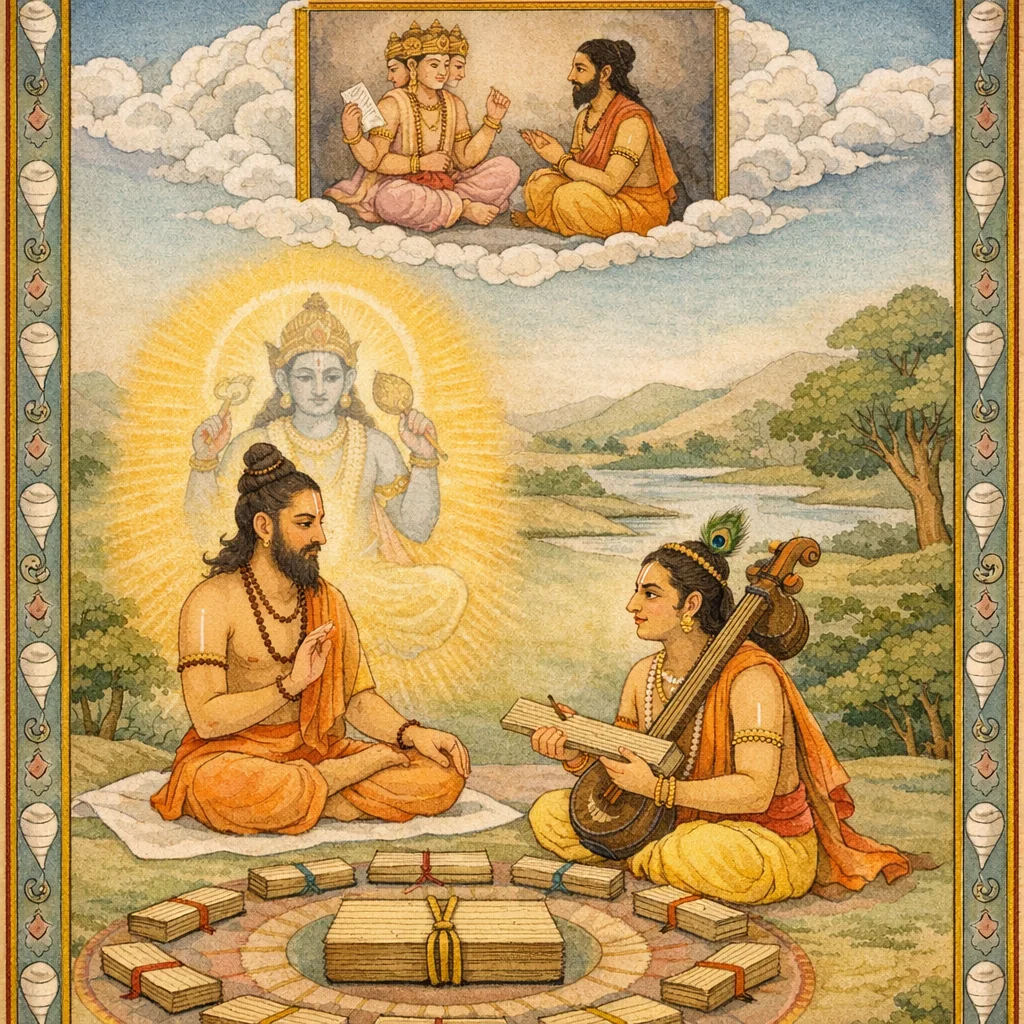
The Narration of the Brāhma Purāṇa’s Account (Brāhma Purāṇānukramaṇikā)
Delighted by the Kumāra’s earlier teaching, Nārada asks for the finest Purāṇic account: a full classification of the Purāṇas—their divisions, verse-measures, varṇāśrama conduct, vows, and dynastic histories. Sanatkumāra says the Purāṇic corpus is vast across many kalpas and sends him to Sanātana. Sanātana, after meditating on Nārāyaṇa, praises Nārada’s one-pointed intent and repeats Brahmā’s ancient instruction to Marīci: in each kalpa there was first one immense Purāṇa from which all śāstras spread; and in every Dvāpara Hari appears as Vyāsa to re-establish the corpus in a four-lakh measure and divide it into eighteen. The chapter then models a Purāṇa Anukramaṇikā by outlining the Brāhma Purāṇa—its two-part form; narratives of the gods, Prajāpatis, Sūrya and dynasties, Rāma and Kṛṣṇa; cosmography (dvīpas, varṣas, svarga, pātāla, hells); tīrtha procedure; śrāddha and Yama’s realm; yuga-dharma, pralaya, Yoga–Sāṅkhya, and brahma-vāda—ending with the merits of copying/gifting and of listening/reciting.
Shlokas
Verse 1
सूत उवाच । एतच्छ्रुत्वा नारदस्तु कुमारस्य वचो मुदा । पुनरप्याह सुप्रीतो जिज्ञासुः श्रेय उत्तमम् ॥ १ ॥
Sūta said: Hearing the words of the Kumāra with joy, Nārada—greatly pleased—spoke again, eager to know the supreme good, the highest spiritual welfare.
Verse 2
नारद उवाच । साधु साधु महाभाग सर्वलोकोपकारकम् । महातंत्रं त्वया प्रोक्तं सर्वतंत्रोत्तमोत्तमम् ॥ २ ॥
Nārada said: “Excellent, excellent, O greatly fortunate one! You have expounded a great Tantra that benefits all worlds—supreme, indeed the most excellent among all Tantras.”
Verse 3
अधुना श्रोतुमिच्छामि पुराणाख्यानमुत्तमम् । यस्मिन्यस्मिन्पुराणे तु यद्यदाख्यानकं मुने । तत्सर्वं मे समाचक्ष्व सर्वज्ञस्त्वं यतो मतः ॥ ३ ॥
Now I wish to hear the finest Purāṇic narrative. O sage, whatever episodes are found in whichever Purāṇa—tell me all of them, for you are regarded as omniscient.
Verse 4
सूत उवाच । तच्छ्रुत्वा वचनं विप्रा नारदस्य शुभावहम् । पुराणाख्यानसंप्रश्नं कुमारः प्रत्युवाच ह ॥ ४ ॥
Sūta said: O brāhmaṇas, having heard Nārada’s auspicious words—his inquiry concerning the narration of the Purāṇas—the Kumāra then replied.
Verse 5
सनत्कुमार उवाच । पाराणाख्यानकं विप्र नानाकल्पसमुद्भवम् । नानाकथासमायुक्तमद्भुतं बहुविस्तरम् ॥ ५ ॥
Sanatkumāra said: O brāhmaṇa, this Purāṇic narrative has arisen from many kalpas; it is filled with many kinds of stories, wondrous in nature, and vast in its expanse.
Verse 6
ऋषिः सनातनश्चायं यथा वेद तथाऽपरः । न वेद तस्मात्पृच्छ त्वं बहुकल्पविदां वरम् ॥ ६ ॥
This sage Sanātana knows as the other sage knows the Veda. Since he does not know this matter, you should ask the foremost among those who know many kalpas.
Verse 7
श्रुत्वेत्थं नारदो वाक्यं कुमारस्य महात्मनः । प्रणम्य विनयोपेतः सनातनमथाब्रवीत् ॥ ७ ॥
Having thus heard the words of the great-souled Kumāra, Nārada—bowing down and filled with humility—then addressed Sanātana.
Verse 8
नारद उवाच । ब्रह्मन्पुराणविच्छ्रेष्ठ ज्ञानविज्ञानतत्पर । पुराणानां विभागं मे साकल्ये नानुकीर्तय ॥ ८ ॥
Nārada said: O Brahmin, foremost knower of the Purāṇas, devoted to spiritual knowledge and realized discernment—please recount to me, in full, the classification and divisions of the Purāṇas.
Verse 9
यस्मिञ् श्रुते श्रुतं सर्वं ज्ञातं कृते कृतम् ॥ ९ ॥
By hearing this, all that is to be heard is as though heard; by knowing this, all that is to be known is as though known; and by accomplishing this, all is as though accomplished.
Verse 10
वर्णाश्रमाचारधर्मं साक्षात्कारमुपैष्यति । कियंति च पुराणानि कियत्संख्यानि मानतः ॥ १० ॥
He will attain direct realization of the dharma of conduct proper to the varṇas and āśramas. And (tell me) how many Purāṇas there are, and what their measure is in number of verses.
Verse 11
किंकिमाख्यानयुक्तानि तद्वदस्व मम प्रभो । चातुर्वर्ण्याश्रया नानाव्रतादीनां कथास्तथा ॥ ११ ॥
O Lord, tell me which teachings are furnished with sacred narratives; and likewise recount the accounts of the various vows (vrata) and observances grounded in the duties of the four varṇas.
Verse 12
सृष्टिक्रमेण वंशानां कथाः सम्यक्प्रकाशय । त्वत्तोऽधिको न चान्योऽस्ति पुराणाख्यानवित्प्रभो ॥ १२ ॥
Please clearly expound, in the order of creation, the narratives of the dynasties. O Lord, none is superior to you in knowledge of Purāṇic accounts.
Verse 13
तस्मादाख्याहि मह्यं त्वं सर्वसन्देहभंजनम् । सूत उवाच । ततः सनातनो विप्राः श्रुत्वा नारदभाषितम् ॥ १३ ॥
“Therefore, please explain to me that teaching which shatters all doubts.” Sūta said: Then Sanātana, O brāhmaṇas, having heard what Nārada had spoken…
Verse 14
नारायणं क्षणं ध्यात्वा प्रोवाचाथ विदां वरः । सनातन उवाच । साधु साधु मुनिश्रेष्ठ सर्वलोकोपकारिका ॥ १४ ॥
Having meditated for a moment on Nārāyaṇa, the foremost among the learned then spoke. Sanātana said: “Well said, well said, O best of sages—this is beneficial to all the worlds.”
Verse 15
पुराणाख्यानविज्ञाने यज्जाता नेष्ठिकी मतिः । तुभ्यं समभिधास्यामि यत्प्रोक्तं ब्रह्मणा पुरा ॥ १५ ॥
Since a steadfast, single-pointed understanding has arisen in you regarding the knowledge of Purāṇic narratives, I shall now explain to you what was spoken long ago by Brahmā.
Verse 16
मरीच्यादिऋषिभ्यस्तु पुत्रस्नेहावृतात्मना । एकदा ब्रह्मणः पुत्रो मरीचिर्नाम विश्रुतः ॥ १६ ॥
But among the sages beginning with Marīci, once the renowned Marīci—son of Brahmā—his mind veiled by affection for his son, (acted/spoke in that state).
Verse 17
स्वाध्यायश्रुतसंपन्नो वेदवेदागपारगः । उपसृत्य स्वपितरं ब्रह्मणं लोकभावनम् ॥ १७ ॥
Endowed with self-study (svādhyāya) and sacred learning, and fully versed in the Vedas and the Vedāṅgas, he approached his own father—Brahmā, the nourisher of the worlds.
Verse 18
प्रणम्य भक्त्या पप्रच्छ इदमेव मुनिश्वर । पुराणाख्यानममलं यत्त्वं पृच्छसि मानद ॥ १८ ॥
Having bowed with devotion, he asked precisely this, O best of sages: “The pure narration of the Purāṇa—this is what you inquire about, O venerable one who honors others.”
Verse 19
मरीचिरुवाच । भगवन्देवदेवेश लोकानां प्रभवाप्यय । सर्वज्ञ सर्वकल्याण सर्वाध्यक्ष नमोऽस्तु ते ॥ १९ ॥
Marīci said: O Bhagavān, Lord of the gods—source and dissolution of the worlds; omniscient, all-auspicious, and overseer of all—salutations to You.
Verse 20
पुराणबीजमाख्यहि मह्यं शुश्रूषवे पितः । लक्षणं च प्रमाणं च चं वक्तारं पृच्छकं तथा ॥ २० ॥
O revered father, please tell me—eager as I am to hear—the seed, the essential core, of a Purāṇa: its defining marks, its authoritative basis (means of validation), and also who is the speaker and who is the questioner.
Verse 21
ब्रह्मोवाच । श्रृणु वत्स प्रवक्ष्यामि पुराणानां समुच्चयम् । यस्मिञ्ज्ञाते भवेज्ज्ञातं वाङ्मयं सचराचरम् ॥ २१ ॥
Brahmā said: Listen, dear child; I shall declare the compendium of the Purāṇas—by knowing which, all that is expressed in words, whether of the moving or the unmoving world, becomes as good as known.
Verse 22
पुराणमेकमेवासीत्सर्वकल्पेषु मानद । चतुर्वर्गस्य बीजं च शतकोटिप्रविस्तरम् ॥ २२ ॥
O bestower of honor, in every kalpa there was originally only one Purāṇa; it was the seed of the four aims of life (dharma, artha, kāma, mokṣa) and was vast—extending to a hundred crores (koṭi).
Verse 23
प्रवृत्तिः सर्वशास्त्राणां पुराणादभवत्ततः । कालेनाग्रहणं दृष्ट्वा पुराणस्य महामतिः ॥ २३ ॥
From the Purāṇa arose the onward flow and dissemination of all śāstras. Then the great-souled sage, seeing that with time the Purāṇa was no longer properly received and retained, took measures to preserve and propagate it.
Verse 24
हरिर्व्यासस्वरूपेण जायते च युगे युगे । चतुर्लक्षप्रमाणेन द्वापरे द्वापरे सदा ॥ २४ ॥
Hari Himself is born age after age in the form of Vyāsa; and in every Dvāpara-yuga the Purāṇa corpus is unfailingly set forth again and again in the measure of four lakhs (four hundred thousand) verses.
Verse 25
तदष्टादशधा कृत्वा भूर्लोके निर्द्दिशत्यपि । अद्यापि देवलोके तु शतकोटिप्रविस्तरम् ॥ २५ ॥
Having divided it into eighteen parts, it is taught and indicated here in Bhūrloka, the human world; yet even now, in Devaloka, the world of the gods, it remains expanded to a vast extent—hundreds of koṭis in measure.
Verse 26
अस्त्येव तस्य सारस्तु चतुर्लक्षेण वर्ण्यते । ब्राह्मं पाद्मं वैष्णवं च वायवीयं तथैव च ॥ २६ ॥
Indeed, there is also its essential summary, described in four lakhs of verses: namely, the Brāhma, the Pādma, the Vaiṣṇava, and likewise the Vāyavīya.
Verse 27
भागवतं नारदीयं मार्कंडेयं च कीर्तितम् । आग्नेयं च भविष्यं च ब्रह्मवैवर्त्तलिंगके ॥ २७ ॥
The Bhāgavata, the Nārada, and the Mārkaṇḍeya have been recounted; likewise the Āgneya and the Bhaviṣya, as well as the Brahma-vaivarta and the Liṅga Purāṇas.
Verse 28
वाराहं च तथा स्कांदं वामनं कूर्मसंज्ञकम् । मात्स्यं च गारुडं तद्वद्ब्रह्मांडाख्यमिति त्रिषट् ॥ २८ ॥
Likewise are: the Vārāha, the Skānda, the Vāmana, the one known as Kūrma, the Mātsya, the Gāruḍa, and similarly the one called the Brahmāṇḍa—thus making up sixty-three in this count.
Verse 29
एकं कथानकं सूत्रं वक्तुः श्रोतुः समाह्वयम् । प्रवक्ष्यामि समासेन निशामय समाहितः ॥ २९ ॥
I shall briefly recount a single thread of narrative—an invocation that summons together the speaker and the listener. Listen with a mind made steady and collected.
Verse 30
ब्रह्मं पुराणं तत्रादौ सर्वलोकहिताय वै । व्यासेन वेदविदुषा समाख्यातं महात्मना ॥ ३० ॥
There, at the very beginning, the Brahma Purāṇa was expounded for the welfare of all worlds by the great-souled Vyāsa, knower of the Vedas.
Verse 31
तद्वै सर्वपुराणाऽग्र्यं धर्मकामार्थमोक्षदम् । नानाख्यानेतिहासाढ्यं दशसाहस्रमुच्यते ॥ ३१ ॥
Indeed, that Purāṇa is foremost among all Purāṇas, bestowing dharma, desire, prosperity, and liberation. Rich with many narratives and sacred histories, it is said to consist of ten thousand verses.
Verse 32
देवानां च सुराणां च यत्रोत्पत्तिः प्रकीर्तिता । प्रजापतीनां च तथा दक्षादीनां मुनीश्वर ॥ ३२ ॥
O lord among sages, in that section the origin of the gods and the celestial beings is proclaimed, and likewise the origin of the Prajāpatis—beginning with Dakṣa—is described.
Verse 33
ततो लोकेश्वरस्यात्र सूर्यस्य परमात्मनः । वंशानुकीर्तनं पुण्यं महापातकनाशनम् ॥ ३३ ॥
Thereafter, the sacred recounting of the lineage of Sūrya—the Lord of the world, the Supreme Self—will be given here; it is meritorious and destroys even the greatest sins.
Verse 34
यत्रावतारः कथितः परमानंदरूपिणः । श्रीमतो रामचंद्रस्य चतुर्व्यूहावतारिणः ॥ ३४ ॥
Therein is narrated the avatāra of the blessed Śrī Rāmacandra, whose very nature is supreme bliss, manifesting as the avatāra of the fourfold divine emanation (catur-vyūha).
Verse 35
ततश्च सोमवंशस्यं कीर्तनं यत्र वर्णितम् । कृष्णस्य जगदीशस्य चरितं कल्मषापहम् ॥ ३५ ॥
Then follows the glorification of the Lunar Dynasty (Somavaṃśa), as described there; and therein are told the life and deeds of Kṛṣṇa, Lord of the universe—a sacred account that removes sin and impurity.
Verse 36
द्वीपानां चैव सर्वेषां वर्षाणां चाप्यशेषतः । वर्णनं यत्र पातालस्वर्गाणां च प्रदृश्यते ॥ ३६ ॥
Therein is seen a complete description of all the dvīpas (continents) and all the varṣas (regions), without remainder, along with an account of Pātāla (the nether realms) and Svarga (the heavenly worlds).
Verse 37
नरकाणां समाख्यानं सूर्यस्तुतिकथानकम् । पार्वत्याश्च तथा जन्म विवाहश्च निगद्यते ॥ ३७ ॥
Here are also recounted: the account of the hells, the narrative of hymns in praise of Sūrya (Sūrya-stuti), and likewise the birth and marriage of Pārvatī.
Verse 38
दक्षाख्यानं ततः प्रोक्तमेकाम्रक्षेत्रवर्णनम् । पूर्वभागोऽयमुदितः पुराणस्यास्य नारद ॥ ३८ ॥
Then the account of Dakṣa was narrated, followed by the description of the sacred Ekāmra-kṣetra. Thus, O Nārada, the Pūrva-bhāga (former section) of this Purāṇa has been set forth.
Verse 39
अस्योत्तरे विभागे तु पुरुषोत्तमवर्णनम् । विस्तरेण समाख्यातं तीर्थयात्राविधानतः ॥ ३९ ॥
And in its later division, the account of Puruṣottama is set forth in detail, in the form of the prescribed procedure for pilgrimage to the sacred tīrthas.
Verse 40
अत्रैव कृष्णचरितं विस्तरात्समुदीरितम् । वर्णनं यमलोकस्य पितृश्राद्धविधिस्तथा ॥ ४० ॥
Here itself, the life and deeds of Kṛṣṇa are narrated in detail; likewise, there is a description of Yama’s realm (Yama-loka) and the prescribed procedure for the ancestral śrāddha rites.
Verse 41
वर्णाश्रमाणां धर्माश्च कीर्तिता यत्र विस्तरात् । विष्णुधर्मयुगाख्यानं प्रलयस्य च वर्णनम् ॥ ४१ ॥
Therein, the duties of varṇa and āśrama (varṇāśrama-dharma) are described in detail; likewise, the account of Viṣṇu’s dharma across the Yugas and a description of cosmic dissolution (Pralaya) are also set forth.
Verse 42
योगानां च समाख्यानं सांख्यानां चापि वर्णनम् । ब्रह्मवादसमुद्देशः पुराणस्य प्रशंसनम् ॥ ४२ ॥
It contains an exposition of the Yogas, a description of the Sāṅkhya doctrines as well, an outline of the teachings concerning Brahman (brahma-vāda), and a eulogy of the Purāṇa itself.
Verse 43
एतद्ब्रह्मपुराणं तु भागद्वयसमन्वितम् । वर्णितं सर्वपापघ्नं सर्वसौख्यप्रदायकम् ॥ ४३ ॥
This Brahma Purāṇa, comprising two parts, has been described as the destroyer of all sins and the bestower of every kind of happiness and well-being.
Verse 44
सूतशौनकसंवादं भुक्तिमुक्तिप्रदायकम् । लिखित्वैतत्पुराणं यो वैशाख्यां हेमसंयुतम् ॥ ४४ ॥
Whoever has this Purāṇa—the dialogue of Sūta and Śaunaka, bestowing both worldly enjoyment and liberation—written out in the month of Vaiśākha, together with gold, attains the promised merit.
Verse 45
जलधेनुयुतं चापि भक्त्या दद्याद्द्विजातये । पौराणिकाय संपूज्य वस्त्रभोज्यविभूषणैः ॥ ४५ ॥
With devotion one should give charity, together with a jaladhenu (water-cow), to a twice-born brāhmaṇa; and, having duly honored a learned Purāṇika, one should worship him with clothing, food, and ornaments.
Verse 46
स वसेद्ब्रह्मणो लोके यावच्चंद्रार्कतारकम् । यः पठेच्छृणुयाद्वापि ब्राह्मानुक्रमणीं द्विज ॥ ४६ ॥
O twice-born one, whoever recites—or even listens to—this Brāhmānukramaṇī dwells in Brahmā’s world for as long as the moon, the sun, and the stars endure.
Verse 47
सोऽपि सर्वपुराणस्य श्रोतुर्वक्तुः फलं लभेत् । श्रृणोति यः पुराणं तु ब्रह्मं सर्वं जितेंद्रियः ॥ ४७ ॥
Even that person—who, having conquered the senses, listens to this Purāṇa which is wholly Brahman (supreme truth)—attains the full merit of all the Purāṇas, the merit of both listener and reciter.
Verse 48
हविष्याशी च नियमात्स लभेद्ब्रह्मणः पदम् । किमत्र बहुनोक्तेन यद्यदिच्छति मानवः । तत्सर्वं लभते वत्स पुराणस्यास्य कीर्तनात् ॥ ४८ ॥
By disciplined observance—living on havis, the consecrated sacrificial food—one attains the station of Brahmā. But what need is there to say much? Dear child, whatever a person desires, all of it is obtained through the recitation and proclamation of this Purāṇa.
Verse 49
इति श्रीबृहन्नारदीयपुराणे पूर्वभागे बृहदुपाख्याने चतुर्थपादे ब्राह्मपुराणेतिहासकथनं नाम द्विनवतितमोऽध्यायः ॥ ९२ ॥
Thus ends the ninety-second chapter, entitled “The narration of the Brāhma Purāṇa’s account,” in the Pūrva-bhāga of the sacred Bṛhannāradīya Purāṇa, within the Great Supplementary Narrative, in the Fourth Pāda.
Frequently Asked Questions
The chapter stresses adhikāra (proper authority): Purāṇic narration is vast across many kalpas, so Nārada is guided to the foremost kalpa-knower. This preserves a disciplined transmission model where specialized encyclopedic classification is taught by the most competent teacher.
By presenting a kalpa-based origin (one primordial mega-Purāṇa), its diffusion into all śāstras, and periodic redaction by Hari as Vyāsa in each Dvāpara-yuga—establishing both divine source and cyclical preservation.
It does not merely praise Purāṇas; it models structured indexing by summarizing the Brāhma Purāṇa’s scope—cosmogony, genealogies, avatāras, cosmography, tirtha-vidhi, śrāddha, ethics, philosophy—showing how a Purāṇa can be navigated as a knowledge-map.