The Exposition of the Dvādaśī Vow for the Twelve Months (Dvādaśī-vrata-nirṇaya and Mahā-dvādaśī Lakṣaṇas)
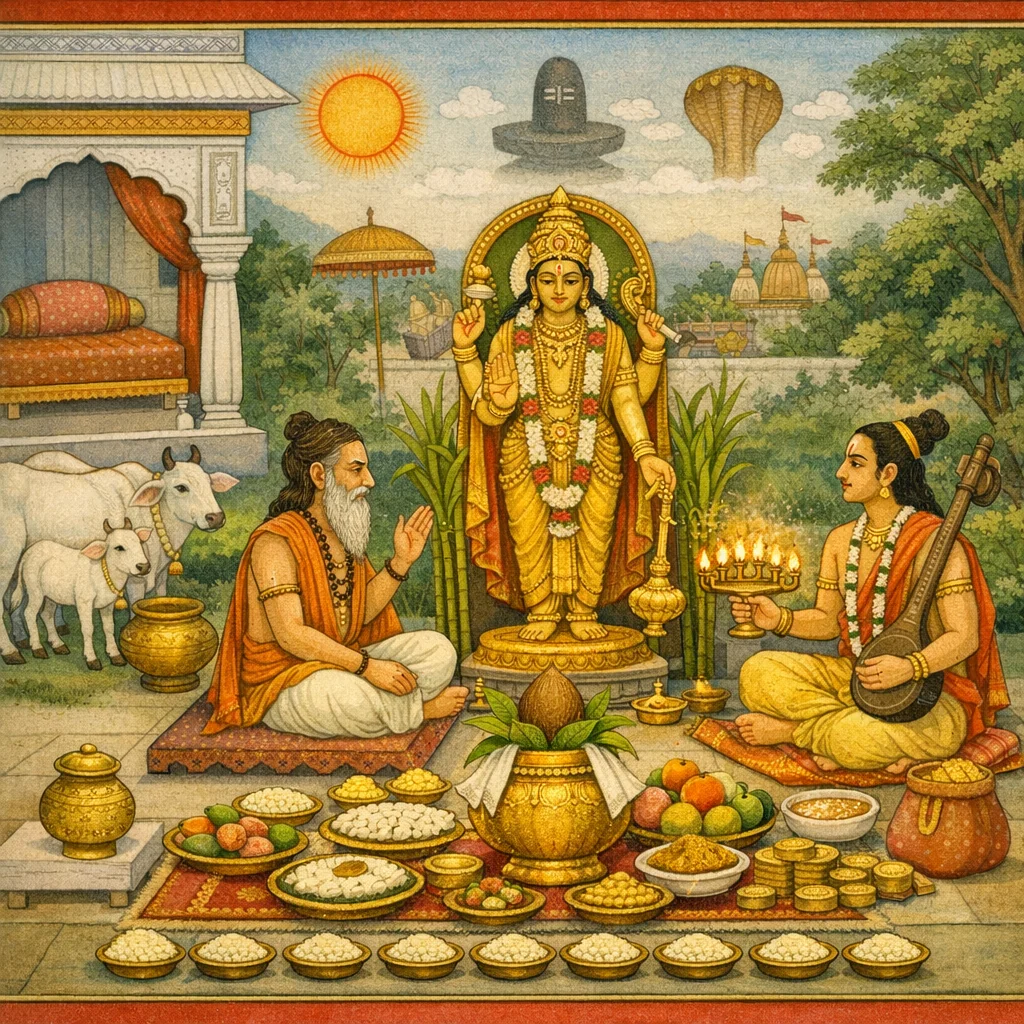
Sanātana instructs Nārada on Dvādaśī-centered vrata rites, beginning with the Madana-vrata on Śukla Dvādaśī in Caitra: setting a purified ghaṭa with rice, fruits, sugarcane, white cloth, and sandal paste, worshipping Acyuta, fasting, then feeding brāhmaṇas with dakṣiṇā the next day, and completing the year with gifts such as a bed, cow, gold, and a Kāmadeva image. He adds the Bhartṛ-dvādaśikā for marital steadiness—Hari with Śrī on a couch, night vigil with music and dance, and gifting a golden Hari image and a bed. The chapter then details month-by-month worship of Viṣṇu’s forms (Mādhava, Trivikrama, Śrīdhara, Vāmana, Padmanābha, Dāmodara), prescribing foods, vessels, garments, the number of brāhmaṇas (often twelve), and gold/silver dakṣiṇā. Govatsa-Dvādaśī in Kārttika features cow-and-calf symbolism, the Surabhī arghya-mantra, and abstention from dairy. Nīrājana-vrata expands into a royal/public Mahāśānti with lamp ārati to Hari and offerings through a cosmic hierarchy (Sun, Śiva, Mothers, Pitṛs, Nāgas), including cattle and royal insignia. Sādhya-vrata and the Twelve Ādityas vow systematize twelve divine names/forms, concluding annually with golden images and brāhmaṇa-feeding, leading from Sūrya-loka enjoyment toward Brahman-realization. Akhaṇḍa-vrata (golden Janārdana image; night-eating for twelve months) and Rūpa-vrata (108 cow-dung pellets, homa with the dvādaśākṣarī mantra, gifting the image to the guru) are described, as is Sujanma-Dvādaśī with monthly charities (ghee, grains, sesame, gold/silver, cloth, sandalwood) ending in a golden Sun image. The chapter closes with Nārada’s query and Sanātana’s technical definitions and fruits of the Mahā-dvādaśīs (Trispṛśā, Unmīlinī, Vaṃjulī, Pakṣavardhinī, Jayā, Vijayā, Jayantī, Aparājitā), including rules for shifting the fast from Ekādaśī to Dvādaśī when tithis overlap, and the note that Ekādaśī–Dvādaśī is a lifelong discipline without separate udyāpana.
Shlokas
Verse 1
सनातन उवाच । अथ व्रतानि द्वादश्याः कथयामि तवानघ । यानि कृत्वा नरो लोके विष्णोः प्रियतरो भवेत् ॥ १ ॥
Sanātana said: Now, O sinless one, I shall tell you of the vows observed on Dvādaśī (the twelfth lunar day); by performing them, a man in this world becomes even more beloved to Viṣṇu.
Verse 2
चैत्रस्य शुक्लद्वादश्यां मदनव्रतमाचरेत् । स्थापयेदव्रणं कुंभं सिततंदुलपूरितम् ॥ २ ॥
On the bright Dvādaśī (Śukla Dvādaśī) of the month of Caitra, one should undertake the Madana-vrata. One should set up an unblemished water-pot (kumbha), filled with white rice.
Verse 3
नानाफलयुतं तद्वदिक्षुदंडसमन्वितम् । सितवस्त्रयुगच्छन्नं सितचंदनचर्च्चितम् ॥ ३ ॥
Likewise, it should be furnished with many kinds of fruits and accompanied by sugarcane stalks; it should be covered with a pair of white cloths and anointed with white sandalwood paste.
Verse 4
नानाभक्ष्यसमोपेतं सहिरण्यं स्वशक्तितः । ताम्रपात्रं गुडोपेतं तस्योपरि निवेशयेत् ॥ ४ ॥
According to one’s means, one should prepare an offering accompanied by various edibles and by gold; and upon it one should place a copper vessel furnished with jaggery.
Verse 5
तत्र संपूजयेद्देवं कामरूपिणमच्युतम् । गंधाद्यैरुपचारैस्तु सोपवासो परेऽहनि ॥ ५ ॥
There one should worship the Lord—Acyuta, who assumes whatever form is desired—by services of devotion beginning with fragrant offerings; and on the following day one should observe a fast.
Verse 6
पुनः प्रातः समभ्यर्च्य ब्राह्मणाय निवेदयेत् । ब्रह्मणान्भोजयेच्चैव तेभ्यो दद्याच्च दक्षिणाम् ॥ ६ ॥
Again in the morning, having duly worshipped, one should offer the consecrated food (prasāda) to a Brāhmaṇa; one should also feed the Brāhmaṇas, and then give them the prescribed honorarium (dakṣiṇā).
Verse 7
वर्षमेवं व्रतं कृत्वा घृतधेनुसमन्विताम् । शय्यां तु दद्याद्गुरवे सर्वोपस्करसंयुताम् ॥ ७ ॥
Having thus observed the vow (vrata) for a full year, one should give to one’s guru a bed furnished with all accessories, along with a ghee-yielding cow.
Verse 8
कांचनं कामदेवं च शुक्तां गां च पयस्विनीम् । वासोभिर्द्विजदांपत्यं पूजयित्वा समर्पयेत् ॥ ८ ॥
One should offer gold, an image of Kāmadeva, a śukti (pearl-oyster shell), and a milch cow; and, after honoring a Brāhmaṇa couple with garments, one should present these gifts to them.
Verse 9
प्रीयतां कामरूपी मे हरिरित्येवमुच्चरन् । यः कुर्याद्विधिनाऽनेन मदनद्वादशीव्रतम् ॥ ९ ॥
Uttering, “May Hari (Viṣṇu), who assumes the form of Kāma, be pleased with me,” whoever performs this Madana-Dvādaśī vow according to the prescribed rule (vidhi) attains the intended sacred fruit.
Verse 10
स सर्वपापनिर्भुक्तः प्राप्नोति हरिसाम्यताम् । अस्यामेव समुद्दिष्टं भर्तृद्वादशिकाव्रतम् ॥ १० ॥
Freed from all sins, he attains likeness to Hari (Viṣṇu). In this very context has been prescribed the vow known as the Bhartṛ-dvādaśikā-vrata.
Verse 11
स्वास्तृतां तत्र शय्यां तु कृत्वात्र श्रीयुतं हरिम् । संस्थाप्य मंडपं पुष्पैस्तदुपर्प्युपकल्पयेत् ॥ ११ ॥
There, one should prepare a well-spread couch; and placing upon it Hari, accompanied by Śrī (Lakṣmī), one should set up a pavilion (maṇḍapa) and arrange flowers above it as an offering.
Verse 12
ततः संपूज्य गंधाद्यैर्व्रती जागरणं निशि । नृत्यवादित्रगीताद्यैस्ततः प्रातः परेऽहनि ॥ १२ ॥
Then, after duly worshipping with fragrances and other offerings, the votary should keep vigil through the night, accompanied by dance, instrumental music, singing, and the like. Then, at dawn on the next day, the rite is continued and fulfilled.
Verse 13
सशय्यं श्रीहरिं हैमं द्विजग्र्याय निवेदयेत् । द्विजान्संभोज्य विसृजद्दक्षिणाभिः प्रतोषितान् ॥ १३ ॥
He should offer to the foremost brāhmaṇa a golden image of Śrī Hari together with a bed; then, having fed the brāhmaṇas, he should send them off well satisfied with gifts of honorarium (dakṣiṇā).
Verse 14
एवं कृतव्रतस्यापि दांपत्यं जायते स्थिरम् । सप्तजन्मसु भुंक्ते च भोगान् लोकद्वयेप्सितान् ॥ १४ ॥
Thus, even for one who has duly observed the vow, married life becomes steadfast; and for seven births one enjoys the desired pleasures in both worlds—here and hereafter.
Verse 15
वैशाखशुक्लद्वादश्यां सोपवासो जितेंद्रियः । संपूज्य माधवं भक्त्या गंधाद्यैरुपचारकैः ॥ १५ ॥
On the bright Dvādaśī (twelfth lunar day) of the month of Vaiśākha, one should fast, having mastered the senses; and with devotion, worship Mādhava fully with fragrant substances and other offerings and services.
Verse 16
पक्कान्नं तृप्तिजनकं मधुरं सोदकुंभकम् । विप्राय दद्याद्विधिवन्माधवः प्रीयतामिति ॥ १६ ॥
According to proper rite, one should give a brāhmaṇa sweet, satisfying cooked food along with a water-pot, praying, “May Mādhava be pleased.”
Verse 17
द्वादश्यां ज्येष्ठशुक्लायां पूजयित्वा त्रिविक्रमम् । गंधाद्यैर्मधुरान्नाढ्यं करक विनिवेदयेत् ॥ १७ ॥
On the Dvādaśī in the bright fortnight of Jyeṣṭha, having worshipped Trivikrama (Viṣṇu) with fragrances and other offerings, one should present a karaka vessel filled with sweet food.
Verse 18
व्रती द्विजाय तत्पश्चादेकभक्तं समाचरेत् । व्रतेनानेन संतुष्टो देवदेवस्त्रिविक्रमः ॥ १८ ॥
Thereafter, the observer of the vow should practice ekabhakta—eating only once a day—and offer what is due to a dvija (brāhmaṇa). By this vow, Trivikrama, the God of gods, is pleased.
Verse 19
ददाति विपुलान्भोगानंते मोक्षं च नारद । आषाढशुक्लद्वादश्यां द्विजान्द्वादश भोजयेत् ॥ १९ ॥
O Nārada, it grants abundant enjoyments and, in the end, liberation as well. On the bright Dvādaśī of Āṣāḍha, one should feed twelve twice-born brāhmaṇas.
Verse 20
मधुरान्नेन तान्पूज्य पृथग्गंधादिकैः क्रमात् । तेभ्यो वासांसि दंडांश्च ब्रह्मसूत्राणि मुद्रिकाः ॥ २० ॥
Having honored them with sweet food, one should then, in due order, offer separately perfumes and the like. One should also give them garments, staffs, sacred threads (brahma-sūtra), and rings.
Verse 21
पात्राणि च ददेद्भक्त्या विष्णुर्मे प्रीयतामिति । द्वादश्यां तु नभःशुक्ले श्रीधरं पूजयेद्व्रती ॥ २१ ॥
With devotion one should give vessels as a gift, praying, “May Viṣṇu be pleased with me.” And on the bright Dvādaśī of the month of Nabhas (Śrāvaṇa), the vow-observer should worship Śrīdhara (Viṣṇu).
Verse 22
गंधाद्यैस्तत्परो भक्त्या दधिभक्तैर्द्विजोत्तमान् । संभोज्य दक्षिणा रौप्यां दत्वा नत्वा विसर्ज्जयेत् ॥ २२ ॥
With devoted focus on Him, one should honor the best of the twice-born with fragrances and the like, feed them with curd and rice, give a silver dakṣiṇā, bow down, and then respectfully dismiss them.
Verse 23
व्रतेनानेन देवेशः श्रीधरः प्रीयतामिति । द्वादश्यां नभस्यशुक्ले व्रती संपूज्य वामनम् ॥ २३ ॥
“May Śrīdhara, Lord of the gods, be pleased by this vow.” Thus, on the bright Dvādaśī of the month of Nabhas, the vow-observer should duly worship Vāmana.
Verse 24
तदग्रे भोजयेद्विप्रान्पायसैर्द्वादशैव च । सौवर्णी दक्षिणां दत्वा विष्णुप्रीतिकरो भवेत् ॥ २४ ॥
Thereafter, one should feed the brāhmaṇas with sweet rice (pāyasa), twelve portions in all; and, having bestowed a golden dakṣiṇā, one becomes a cause of Lord Viṣṇu’s delight.
Verse 25
द्वादश्यामिषशुक्लायां पद्मनाभं समर्चयेत् । गंधाद्यैरुपचारैस्तु तदग्रे भोजयेद्द्विजान् ॥ २५ ॥
On Dvādaśī, in the bright fortnight (Śukla-pakṣa), one should worship Padmanābha (Viṣṇu) with full reverence; and with offerings such as fragrant substances and other ritual services, one should then feed the twice-born (brāhmaṇas) in His presence.
Verse 26
मधुरान्नेन वस्त्राढ्यां सौवर्णीं दक्षिणां ददेत् । व्रतेनैतेन संतुष्टः पद्मनाभो द्विजोत्तम ॥ २६ ॥
He should give a golden dakṣiṇā, accompanied by sweet food and fine garments. By this vow, Padmanābha (Viṣṇu) is pleased, O best of the twice-born.
Verse 27
श्वेतद्वीपगतिं दद्याद्देहभोगांश्च वांछितान् । कार्तिके कृष्णपक्षे तु गोवत्सद्वादशीव्रतम् ॥ २७ ॥
The Govatsa-Dvādaśī vow, observed in the dark fortnight (Kṛṣṇa-pakṣa) of Kārttika, bestows passage to Śvetadvīpa and grants the desired enjoyments and comforts of embodied life.
Verse 28
तत्र वत्सयुतां गां तु समालिख्य सुगंधिभिः । चंदनाद्यैस्तथा पुष्पमालाभिः प्रार्च्य ताम्रके ॥ २८ ॥
There, one should depict a cow together with her calf, and then worship her upon a copper vessel, using fragrant substances—such as sandalwood and the like—and also with garlands of flowers.
Verse 29
पात्रे पुष्पाक्षततिलैरर्घ्यं कृत्वा विधानतः । प्रदद्यात्पादमूलेऽस्या मन्त्रेणानेन नारद ॥ २९ ॥
Having duly prepared an arghya-offering in a vessel with flowers, akṣata (unbroken rice), and sesame according to the prescribed rite, one should offer it at her feet while reciting this mantra, O Nārada.
Verse 30
क्षीरोदार्णवसंभूते सुरासुरनमस्कृते । सर्वदेवमये देवि सर्वदेवैरलंकृते ॥ ३० ॥
O Goddess born from the Ocean of Milk, revered by both gods and asuras—O Devi who embodies all the deities, adorned and honored by all the gods.
Verse 31
मातर्मातर्गवां मातर्गृहाणार्घ्यं नमोऽस्तु ते । ततो माषादिसंसिद्धान्वटकांश्च निवेदयेत् ॥ ३१ ॥
“O Mother—Mother of cows—O Mother, please accept this arghya; salutations to you.” Thereafter, one should offer vada-cakes prepared from black gram (māṣa) and other ingredients.
Verse 32
एवं पञ्च दशैकं वा यथाविभवमात्मनः । सुरभि त्वं जगन्माता नित्यं विष्णुपदे स्थिता ॥ ३२ ॥
Thus, offer five, or ten, or even one—according to your own means. O Surabhi, you are the Mother of the world, eternally abiding in Viṣṇu-pada, the abode of Viṣṇu.
Verse 33
सर्वदेवमये ग्रासं मया दत्तमिमं ग्रस । सर्वदेवमये देवि सर्वदेवैरलंकृते ॥ ३३ ॥
O Devi who embodies all the gods, adorned by all the deities—eat this morsel that I have given; for this morsel too is filled with the presence of all the gods.
Verse 34
मातर्ममाभिलषितं सफलं कुरु नंदिनी । तद्दिने तैलपक्वं च स्थालीपक्वं द्विजोत्तम ॥ ३४ ॥
O Mother Nandinī, make my cherished wish bear fruit. And on that very day, O best of brāhmaṇas, prepare and offer foods cooked in oil and foods cooked in a pot.
Verse 35
गोक्षीरं गोघृतं चैव दधि तक्रं च वर्जयेत् । द्वादश्यामूर्जशुक्लायां देवं दामोदरं द्विज ॥ ३५ ॥
One should abstain from cow’s milk, cow’s ghee, curd, and buttermilk. On the bright (Śukla) Dvādaśī of the month of Ūrja, O brāhmaṇa, one should worship the Lord Dāmodara.
Verse 36
समभ्यर्च्योपचारैस्तु गंधाद्यैः सुसमाहितः । तदग्रे भोजयेद्विप्रान्पक्वान्नेनार्कसंख्यकान् ॥ ३६ ॥
Having duly worshipped with offerings—such as fragrance and the like—while remaining well-composed, one should then, in its presence, feed brāhmaṇas with cooked food, in a number equal to the sun (i.e., twelve).
Verse 37
ततः कुंभानपांपूर्णान्वस्त्राच्छन्नान्समर्चितान् । सपूगमोदकस्वर्णांस्तेभ्यः प्रीत्या समर्पयेत् ॥ ३७ ॥
Then one should, with heartfelt goodwill, present to them water-filled pitchers—covered with cloth and duly honored—along with betel-nuts, sweetmeats, and gold.
Verse 38
एवं कृते प्रियो विष्णोर्जायतेऽखिलभोगभुक् । देहांते विष्णुसायुज्यं लभते नात्र संशयः ॥ ३८ ॥
When this is done in this manner, one becomes dear to Viṣṇu and enjoys every rightful prosperity; and at the end of the body, one attains union with Viṣṇu (viṣṇu-sāyujya)—of this there is no doubt.
Verse 39
नीराजनव्रतं चात्र गदितं तन्निबोध मे । सुप्तोत्थितं जगन्नाथमलंकृत्य निशागमे ॥ ३९ ॥
Here too the Nīrājana-vrata is taught—learn it from me. When night arrives, having adorned Jagannātha as the Lord awakened from sleep, one should perform the rite.
Verse 40
अलंकृतो नवं वह्निमुत्पाद्याभ्यर्च्य मन्त्रतः । हुत्वा तत्र समुद्दीप्ते रौप्य दीपिकया मुने ॥ ४० ॥
Adorned and purified, he kindles a fresh sacred fire, worships it with mantras, and offers oblations into it; and when that fire blazes forth, O sage, he performs the rite with a silver lamp.
Verse 41
गंधपुष्पाद्यर्चितया जनैर्नीराजयेद्धरिम् । तत्रैवानुगतां लक्ष्मीं ब्रह्माणीं चंडिकां तथा ॥ ४१ ॥
Having worshipped Hari with fragrance, flowers, and the like, the people should perform nīrājana (the offering of waving lights) to Hari; and there itself they should also honor Lakṣmī who accompanies him, as well as Brahmāṇī and Caṇḍikā.
Verse 42
आदित्यं शंकरं गौरीं यक्षं गणपतिं ग्रहान् । मातॄः पितॄन्नगान्नागान्सर्वान्नीराजयेत्क्रमात् ॥ ४२ ॥
In due order, one should perform ārati/nīrājana to the Sun, Śaṅkara, Gaurī, the Yakṣas, Gaṇapati, the planetary deities, the Mothers, the Pitṛs (ancestors), the mountains, and the Nāgas—indeed, to all of them, sequentially.
Verse 43
गवां नीराजनं कुर्यान्महिष्यादेश्च मंडलम् । नमो जयेति शब्दैश्च घंटाशंखा दिनिःस्वनैः ॥ ४३ ॥
One should perform nīrājana for the cows, and likewise draw a protective circle for the buffaloes and other cattle, while proclaiming “Namo!” and “Jaya!”, accompanied by the resonant sounds of bells and conches.
Verse 44
सिंदूरालिप्तश्रृङ्गाणां चित्राङ्गाणां च वर्णकैः । गवां कोलाहले वृत्ते नीराजनमहोत्सवे ॥ ४४ ॥
At the great festival of nīrājana, the cattle rose in joyous uproar—some with horns smeared in red sindūra, others with bodies painted in many colors—and festive commotion filled every side.
Verse 45
तुरगांल्लक्षणोपेताम् गजांश्च मदविप्लुतान् । राजचिह्नानि सर्वाणि च्छत्रादीनि च नारद ॥ ४५ ॥
Horses endowed with auspicious marks, and elephants overflowing with musth; and all the royal insignia as well—parasols and the rest—are spoken of, O Nārada.
Verse 46
राजा पुरोधसा सार्धं मंत्रिभृत्यपरः सरः । पूजयित्वा यथान्यायं नीरज्य स्वयमादरात् ॥ ४६ ॥
Then the king—together with his royal priest and attended by ministers and servants—offered worship according to proper rule, and with reverent care performed the nīrājana himself.
Verse 47
शंखतूर्यादिघोषैश्च नानारत्नविनिर्मिते । सिंहासने नवे क्लृप्ते तिष्ठेत्सम्यगलंकृतः ॥ ४७ ॥
Amid the resounding cries of conches and trumpets, he should stand—properly adorned—upon a newly prepared throne fashioned with many kinds of gems.
Verse 48
ततः सुलक्षणैर्युक्ता वेश्या वाथ कुलांगना । शीर्षोपरि नरेंद्रस्य तया नीराजयेच्छनैः ॥ ४८ ॥
Then a courtesan—or else a noble lady—endowed with auspicious marks should gently perform the ārati (nīrājana) over the king’s head.
Verse 49
एवमेषा महासांतिः कर्तव्या प्रतिवत्सरम् । राज्ञा वित्तवतान्येन वर्षमारोग्यमिच्छता ॥ ४९ ॥
Thus, this great rite of pacification (Mahāśānti) should be performed every year by a king—or by any wealthy person—who desires a year of health and freedom from disease.
Verse 50
येषां राष्ट्रे पुरे ग्रामे क्रियते शांतिरुत्तमा । नीराजनाभिधा विप्र तद्रोगा यांति संक्षयम् ॥ ५० ॥
O Brahmin, in whatever kingdom, city, or village the supreme pacificatory rite called Nīrājana is performed, the diseases afflicting that place go to destruction.
Verse 51
द्वादश्यां मार्गशुक्लायां साध्यव्रतमनुत्तमम् । मनोभवस्तथा प्राणो नरो यातश्च वीर्यवान् ॥ ५१ ॥
On the bright twelfth day (Dvādaśī) of Mārgaśīrṣa, the unsurpassed observance known as the Sādhya-vrata is to be undertaken. (By it) Manobhava, Prāṇa, Nara, and the mighty Yāta are propiciated.
Verse 52
चितिर्हयो नृपश्चैव हंसो नारायणस्तथा । विभुश्चापि प्रभुश्चैव साध्या द्वादश कीर्तिताः ॥ ५२ ॥
Citi, Haya, Nṛpa, Haṁsa, Nārāyaṇa, Vibhu, Prabhu, and Sādhya—these twelve (divine appellations/forms) are thus proclaimed.
Verse 53
पूजयेद्गंधपुष्पाद्यैरेतांस्तंदुलकल्पितान् । ततो द्विजाग्र्यान्संभोज्य द्वादशात्र सुदक्षिणाः ॥ ५३ ॥
One should worship these (offerings/figures) that have been fashioned from rice, using fragrance, flowers, and the like. Thereafter, having fed the foremost of the twice-born (brāhmaṇas), one should give twelve generous priestly gifts (dakṣiṇās) here (in this rite).
Verse 54
दत्वा तेभ्यस्तु विसृजेत्प्रीयान्नारयणस्त्विति । एतस्यामेव विदितं द्वादशादित्यसंज्ञितम् ॥ ५४ ॥
Having offered to them the prescribed oblations, one should then dismiss them with reverence, saying, “May Nārāyaṇa be pleased.” In this very context is also taught what is known as the “twelve Ādityas.”
Verse 55
व्रतं तत्रार्चयेद्धीमानादित्यान्द्वादशापि च । धातामित्रोऽर्यमा पूषा शक्रोंऽशो वरुणो भगः ॥ ५५ ॥
There, the wise practitioner should duly observe the vow and worship the twelve Ādityas as well—Dhātā, Mitra, Aryamā, Pūṣā, Śakra, Aṁśa, Varuṇa, and Bhaga.
Verse 56
त्वष्टा विवस्वान्सविता विष्णुर्द्वादश ईरिताः । प्रतिमासं तु शुक्लायां द्वादश्यामर्च्य यत्नतः ॥ ५६ ॥
Thus the twelve (monthly) forms have been declared—Tvaṣṭā, Vivasvān, Savitā, and Viṣṇu among them. Each month, on the bright fortnight’s twelfth lunar day (Śukla Dvādaśī), one should worship them diligently.
Verse 57
वर्षं नयेद्व्रतांते तु प्रतिमा द्वादशापि च । हैमीः संपूज्य विधिना भोजयित्वा द्विजोत्तमान् ॥ ५७ ॥
He should carry the vow through for a full year; and at the conclusion of the observance, he should duly worship twelve golden images and then feed the foremost of the twice-born—excellent brāhmaṇas.
Verse 58
मधुरान्नैः सुसत्कृत्य प्रत्येकं चार्पयेद्व्रती । एव व्रतं नरः कृत्वा द्वादशादित्यसंज्ञकम् ॥ ५८ ॥
Having respectfully honored them with sweet foods, the vow-observer should offer the oblations to each one individually. Thus, when a person performs this observance, it is known as the “Twelve Ādityas” vow.
Verse 59
सूर्यलोकं समासाद्य भुक्त्वा भोगांश्चरं ततः । जायते भुवि धर्मात्मा मानुष्ये रोगवर्जितः ॥ ५९ ॥
Having reached the world of the Sun and enjoyed its pleasures there for a time, one is then born again on earth as a righteous-souled human, free from disease.
Verse 60
ततो व्रतस्य पुण्येन पुनरेव लभेद्व्रतम् । तत्पुण्येन रवेन्भित्वा मंडलं द्विजसत्तम ॥ ६० ॥
Then, by the merit of that vow, one attains the vow again; and by that very merit—O best of the twice-born—one pierces the Sun’s orb (and passes beyond it).
Verse 61
निरंजनं निरा कारं निर्द्वंद्वं ब्रह्म चाप्नुयात् । अत्रैवाखंडसंज्ञं च व्रतमुक्त द्विजोत्तम ॥ ६१ ॥
He attains the stainless, formless, non-dual Brahman. Here itself, O best of the twice-born, the vow known as “Akhaṇḍa” has been declared.
Verse 62
मूर्तिं निर्माय सौवर्णीं जनार्दनसमाह्वयाम् । अभ्यर्च्य गन्धपुष्पाद्यैस्तदग्रे भोजयेद्द्विजान् ॥ ६२ ॥
Having fashioned a golden image and invoking Janārdana into it, one should worship it with fragrance, flowers, and the like, and then, in its presence, feed the twice-born (brāhmaṇas).
Verse 63
द्वादश प्रतिमासं तु नक्ताशीः स्याज्जितेंद्रियः । ततः समांते तां मूर्तिं समभ्यर्च्य विधानतः ॥ ६३ ॥
For twelve months, he should eat only at night, remaining self-controlled. Then, at the completion of the year, he should worship that sacred image in full accordance with the prescribed rites.
Verse 64
गुरवे धेनुसहितां दद्यात्संप्रार्थयेत्तथा । शतजन्मसु यत्किंचिन्मयाखंडव्रतं कृतम् ॥ ६४ ॥
One should offer to one’s guru a cow along with her calf, and then pray with earnestness: “Whatever unbroken vow (akhaṇḍa-vrata) I have performed through a hundred births—may its merit be made complete and truly effective.”
Verse 65
भगवंस्त्वत्प्रसादेन तदखंडमिहास्तु मे । ततः संभोज्य विप्राग्र्यान्सखंडाढ्यैस्तु पायसैः ॥ ६५ ॥
O Bhagavān, by your grace may that fruit remain here for me undiminished. Then, having fed the foremost Brāhmaṇas, let it be done with pāyasa—rice-pudding richly mixed with sugar.
Verse 66
द्वादशैव हि सौवर्णीं दक्षिणां प्रददेन्नमेत् । इति कृत्वा व्रतं विप्र प्रीणयित्वा जनार्दनम् ॥ ६६ ॥
Indeed, one should give precisely twelve gold pieces as dakṣiṇā and then bow down. Thus, O brāhmaṇa, having observed the vow and thereby pleasing Janārdana (Viṣṇu), the rite is completed.
Verse 67
सौवर्णेन विमानेन याति विष्णोः परं पदम् । पौषस्य कृष्णद्वादश्यां रूपव्रतमुदीरितम् ॥ ६७ ॥
He ascends in a golden celestial vimāna and reaches the supreme abode of Viṣṇu. Thus is proclaimed the Rūpa-vrata to be observed on the Kṛṣṇa-dvādaśī of the month of Pauṣa.
Verse 68
दशम्यां विधिवत्स्नात्वा गृह्णीयाद्गोमयं व्रती । श्वेताया वैकवर्णाया अन्तरिक्षगतं द्विज ॥ ६८ ॥
On the tenth lunar day (daśamī), having bathed according to rule, the observer of the vow should take cow-dung—from a white or single-colored cow, O twice-born—regarded as pure, as though it were set in mid-air, untouched by impurity.
Verse 69
अष्टोत्तरशतं तेन पिंडिकाः कल्प्य नारद । शोषयेदातपे धृत्वा पात्रे ताम्रेऽथ मृन्मये ॥ ६९ ॥
O Nārada, with that prepared substance one should fashion one hundred and eight small pellets. Placing them in a copper vessel, or else in an earthen pot, one should dry them in the sun.
Verse 70
एकादश्यां सोपवासः समभ्यर्च्य विधानतः । सौवर्णीं प्रतिमां विष्णोर्निशायां जागरं चरेत् ॥ ७० ॥
On Ekādaśī, observing the fast (upavāsa), one should worship Śrī Viṣṇu according to the prescribed rite; and, having offered or installed a golden image of Viṣṇu, one should keep a night-long vigil (jāgara).
Verse 71
सुमंगलैर्गीतवाद्यैः स्तोत्रपाठैर्जपादिभिः । ततः प्रभाते द्वादश्यां तिलपात्रोपरि स्थिताम् ॥ ७१ ॥
With auspicious songs and instrumental music, with the recitation of hymns (stotra), with japa and related observances—then, at dawn on the Dvādaśī day, one should worship her/that as placed upon a vessel filled with sesame seeds.
Verse 72
अंबुपूर्णे घटे न्यस्य पूजयेदुपचारकैः । ततोऽग्निं नवमुत्पाद्य काष्ठसंघर्षणादिभिः ॥ ७२ ॥
Placing the sacred arrangement in a water-filled pot, one should worship it with the customary offerings. Thereafter, producing a fresh fire—by rubbing pieces of wood and by other prescribed means—one should proceed with the rite.
Verse 73
तं समभ्यर्च्य विधिवदेकैकां पिंडिकां सुधीः । होमयेत्सतिलाज्यां च द्वादशाक्षरविद्यया ॥ ७३ ॥
Having duly worshipped Him according to the prescribed rite, the wise person should offer each pellet one by one into the homa fire, together with ghee mixed with sesame, while reciting the Twelve-syllabled mantra (dvādaśākṣara).
Verse 74
वैष्णव्याथ च पूरणां च शतमष्टोत्तर ततः । भोजयेत्पायसैर्विप्रान्प्रीत्या सुस्निग्धमानसः ॥ ७४ ॥
Then, after the Vaiṣṇava observance and after completing the one hundred and eight Purāṇic portions/acts, with a heart softened by affection, one should joyfully feed the brāhmaṇas with sweet milk-rice (pāyasa).
Verse 75
सहितां च घटेनैव प्रतिमां गुरवऽपेयेत् । विप्रेभ्यो दक्षिणां शक्त्या दत्वा नत्वा विसर्जयेत् । नरो वा यदि वा नारी व्रतं कृत्वैवमादरात् ॥ ७५ ॥
Along with the water-pot (ghaṭa), one should ritually hand over the worship-image to the guru. Then, according to one’s capacity, having given dakṣiṇā to the brāhmaṇas and bowed, one should perform the visarjana, the formal dismissal. Whether man or woman, whoever keeps the vow thus with reverence…
Verse 76
लभते रूपसौभाग्यं नात्र कार्या विचारणा । सहस्ये शुक्लपक्षे तु सुजन्मद्वादशीव्रतम् ॥ ७६ ॥
One attains beauty and good fortune—there is no need for doubt. In the bright fortnight (śukla-pakṣa) of the month of Sahasya, the vow called Sujanma-Dvādaśī is to be observed.
Verse 77
स्नात्वा विधानेन गृह्णोयाद्वार्षिकव्रतम् । पीत्वा गश्रृंगवार्यादौ तां च कृत्वा प्रदक्षिणम् ॥ ७७ ॥
Having bathed according to the prescribed rite, one should undertake the annual vow. Then, after first sipping sacred water—such as the water of Gaśṛṅga—one should reverently circumambulate that holy place (pradakṣiṇa).
Verse 78
प्रतिमासं ततः शुक्लेद्वादश्यां दानमाचरेत् । घृतप्रस्थं तच्चतुष्कं क्रमाद्वीहेर्यवस्य च ॥ ७८ ॥
Thereafter, every month on the bright-fortnight Dvādaśī, one should perform charity. One should give one prastha-measure of ghee (ghṛta), and likewise, in due order, four measures—of rice and of barley as well.
Verse 79
द्विरक्तिकं हेम तिलाढकार्द्धं पयसां घटम् । रौप्यस्य माषमेकं च तृप्तिकृन्मिष्टपक्वकम् ॥ ७९ ॥
One should offer gold worth two raktikās, half an āḍhaka of sesame, a pot filled with milk, and one māṣa of silver—together with a satisfying preparation of cooked sweets.
Verse 80
छत्रं माषार्धहेम्नश्च प्रस्थं फाणितमुत्तमम् । चंदनं पलिकं वस्त्रं पंचहस्तोन्मितं तनुम् ॥ ८० ॥
An umbrella; gold weighing half a māṣa; one prastha of excellent molasses; sandalwood weighing one pala; and a fine cloth measuring five hastas in length—these are to be given as prescribed gifts.
Verse 81
एवं तु मासिकं दानं कृत्वा प्राश्य यथाक्रमम् । गोमूत्रं जलमाज्यं वा पक्त्वा शाकं चतुर्विधम् ॥ ८१ ॥
Thus, after performing the monthly gift, one should eat in the prescribed order; and having cooked vegetables in one of four ways—using cow’s urine, water, or ghee—one should partake accordingly.
Verse 82
दधियुक्तं च यावान्नं तिलाज्यं शर्करान्विताम् । दर्भांबुक्षीरमुदितं प्राशनं प्रतिमासिकम् ॥ ८२ ॥
Each month, one should partake of the prescribed offering-food: barley-rice mixed with curd, sesame with ghee and sugar, and the stated intake of kuśa-grass water and milk—these being the monthly observances.
Verse 83
एवं कृतव्रतो वर्षं सौवर्णीं प्रतिमां रवेः । कृत्वा वै ताम्रपात्रस्थां न्यस्याभ्यर्च्य विधानतः ॥ ८३ ॥
Thus, having observed the vow for a full year, one should fashion a golden image of the Sun, place it upon a copper vessel, and then install and worship it according to the prescribed rite.
Verse 84
गुरवे धेनुसहितां प्रत्यर्प्य प्रणमेत्पुरः । विप्रान्द्रादश संभोज्य तेभ्यो दद्याच्च दक्षिणाम् ॥ ८४ ॥
Having offered a cow, together with its proper accompaniments, to one’s guru, one should bow down before him. Then, after feeding twelve brāhmaṇas, one should also give them the prescribed dakṣiṇā.
Verse 85
एवं कृतव्रतो विप्र जन्माप्नोत्युत्तमे कुले । निरोगो धनधान्याढ्यो भवेच्चाविकलेद्रियः ॥ ८५ ॥
Thus, O brāhmaṇa, one who observes the vow in this manner is born in an excellent family; he becomes free from disease, rich in wealth and grain, and lives with unimpaired senses.
Verse 86
माघस्य शुक्लद्वादश्यां शालग्रामशिलां द्विज । अभ्यच्य विधिवद्भक्त्या सुवर्णं तन्मुखे न्यसेत् ॥ ८६ ॥
O twice-born one, on the bright fortnight’s twelfth day in the month of Māgha, having worshipped the Śālagrāma stone with devotion according to proper rite, one should place gold at its mouth.
Verse 87
तां स्थाप्य रौप्यपात्रे तु सितवस्त्रयुगावृताम् । प्रदद्याद्वेदविदुषे तं हि संभोजयेत्ततः ॥ ८७ ॥
Placing it in a silver vessel and covering it with a pair of white cloths, one should give it to a knower of the Vedas; thereafter, one should duly feed that learned man.
Verse 88
पायसान्नेन खंडाज्यसहितेन हितेन च । एवं कृत्वैकभक्तः सन्विष्णु चिंतनतत्परः ॥ ८८ ॥
He should eat pāyasa (sweet rice) together with sugar and ghee, in a wholesome manner. Having done so, he should take a single meal that day, remaining intent on contemplation of Lord Viṣṇu.
Verse 89
वैष्णवं लभते धाम भुक्त्वा भोगानिहेप्सितान् । अंत्ये सितायां द्वादश्यां सौवर्णीं प्रतिमां हरेः ॥ ८९ ॥
After enjoying here the desired worldly pleasures, one attains the Vaiṣṇava abode. This is gained by the rite of offering a golden image of Hari on the final bright Dvādaśī (the twelfth lunar day of the waxing fortnight).
Verse 90
अभ्यर्च्य गंधपुष्पाद्यैर्दद्याद्वेदविदे द्विज । द्विषट्कसंख्यान्विप्रांश्च भोजयित्वा च दक्षिणाम् ॥ ९० ॥
After worshipping with fragrances, flowers, and the like, one should give a gift to a twice-born Brāhmaṇa learned in the Veda; and after feeding twelve Brāhmaṇas, one should also offer dakṣiṇā, the sacrificial honorarium.
Verse 91
दत्वा विसर्जयेत्पश्चात्स्वयं भुंजीत बांधवैः । त्रिस्पृशोन्मीलिनी पक्षवर्द्धिनी वंजुली तथा ॥ ९१ ॥
After making the prescribed offering, one should then formally conclude the rite (visarjana); thereafter, one should partake of the meal oneself together with one’s relatives. This observance is also known as Trispṛśā, Unmīlinī, Pakṣavardhinī, and likewise Vaṃjulī.
Verse 92
जया च विजया चैव जयंती चापराजिता । एता अष्टौ सदोपोष्या द्वादश्यः पापहारिकाः ॥ ९२ ॥
Jaya, Vijaya, Jayantī, and Aparājitā—these eight Dvādaśī observances should always be duly kept; the Dvādaśīs are removers of sin.
Verse 93
श्रीनारद उवाच । कीदृशं लक्षणं ब्रह्मन्नेतासां किं फलं तथा । तत्सर्वं मे समाचक्ष्व याश्चन्याः पुण्यदायिकाः ॥ ९३ ॥
Śrī Nārada said: “O Brahmin, what are the distinguishing characteristics of these, and what phala—spiritual results—do they yield? Please explain all of that to me, along with any other practices that bestow merit.”
Verse 94
सूत उवाच । इत्थं सनातनः पृष्टो नारदेन द्विजोत्तमः । प्रशस्य भ्रातरं प्राह महाभागवतं मुनिः ॥ ९४ ॥
Sūta said: Thus questioned by Nārada, Sanātana—the foremost among the twice-born, the sage who is a great Bhāgavata—praised his brother and spoke.
Verse 95
सनातन उवाच । साधु पृष्टं त्वया भ्रातः साधूनां संशयच्छिदा । वक्ष्ये महाद्वादशीनां लक्षणं च फलं पृथक् ॥ ९५ ॥
Sanātana said: O brother, you have asked well—this question cuts through the doubts of the virtuous. I shall explain, separately, the marks and the fruits of the Mahā-dvādaśīs.
Verse 96
एकादशी निवृत्ता चेत्सूर्यस्योदयतः पुरा । तदा तु त्रिस्पृशा नाम द्वादशी सा महाफला ॥ ९६ ॥
If the Ekādaśī tithi ends before sunrise, then that Dvādaśī is called Trispṛśā, and it yields great fruit for sacred observances.
Verse 97
अस्यामुपोष्य गोविन्दं यः पूजयति नारद । अश्वमेधसहस्रस्य फलं लभते ध्रुवम् ॥ ९७ ॥
O Nārada, whoever fasts on this sacred day and worships Govinda certainly attains merit equal to that of a thousand Aśvamedha sacrifices.
Verse 98
यदारुणोदये विद्धा दशम्यैकादशी तिथिः । तदा तां संपरित्यज्य द्वादशीं समुपोषयेत् ॥ ९८ ॥
When, at aruṇodaya (dawn), the Ekādaśī tithi is found mixed with Daśamī, one should set that Ekādaśī aside and instead observe the fast on Dvādaśī.
Verse 99
तत्रेष्ट्वा वासुदेवाख्यं सम्यक्पूजाविधानतः । राजसूयसहस्रस्य फलमुन्मीलिते लभेत् ॥ ९९ ॥
There, having duly worshipped the Lord called Vāsudeva according to the proper rites of pūjā, one—when awakening dawns—attains merit equal to a thousand Rājasūya sacrifices.
Verse 100
यदोदये तु सवितुर्याम्या त्वेकादशीं स्पृशेत् । तदा वंजुलिकाख्यां तु तां त्यक्त्वोपोषयेत्सदा ॥ १०० ॥
But if, at sunrise, the ‘southern’ (yāmyā) tithi overlaps the Ekādaśī, then that Ekādaśī—called Vaṃjulikā—should be set aside, and one should always keep the fast on the proper day.
Verse 101
अस्यां संकर्षणं देवं गंधाद्यैरुपचारकैः । पूजयेत्सततं भक्त्या सर्वस्याभयदं परम् ॥ १०१ ॥
In this observance, one should continually worship the god Saṅkarṣaṇa with devotion, offering ritual services such as fragrant offerings and the like—He who is supreme and bestows fearlessness upon all.
Verse 102
एषा महाद्वादशी तु सर्वक्रतुफलप्रदा । सर्वपापहरा प्रोक्ता सर्वसंपत्प्रदायिनी ॥ १०२ ॥
This Mahādvādaśī indeed bestows the fruits of all sacrifices; it is declared to remove all sins and to grant every kind of prosperity.
Verse 103
कुहूराके यदा वृद्धे स्यातां विप्र यदा तदा । पक्षवर्द्धनिका नाम द्वादशी सा महाफला ॥ १०३ ॥
O brāhmaṇa, when both Kuhū and Rākā are in the waxing (increasing) state, then that Dvādaśī is called Pakṣavarddhanikā; it yields very great fruit.
Verse 104
तस्यां संपूजयेद्देवं प्रद्युम्नं जगतां पतिम् । सर्वैश्वर्य्यप्रदं साक्षात्पुत्र पौत्रविवर्धनम् ॥ १०४ ॥
In that sacred occasion, one should duly worship Lord Pradyumna, the Master of the worlds—who directly bestows every prosperity and increases one’s sons and grandsons, making the lineage flourish.
Verse 105
यदा तु धवले पक्षे द्वादशी स्यान्मधान्विता । तदा प्रोक्ता जया नाम सर्वशत्रुविनाशिनी ॥ १०५ ॥
But when, in the bright fortnight, the Dvādaśī (twelfth lunar day) occurs together with Madhu (the month of Caitra), that observance is declared to be called Jayā—destroyer of all enemies.
Verse 106
अस्यां संपूजयेद्देवमनिरुद्धं रमापतिम् । सर्वकामप्रदं नॄणां सर्वसौभाग्यदायकम् ॥ १०६ ॥
On this observance, one should duly worship Lord Aniruddha, the Consort of Ramā (Lakṣmī), who grants people all desired aims and bestows every kind of good fortune.
Verse 107
श्रवणर्क्षयुता चेत्स्याद्द्वादशी धवले दले । तदा सा विजया नाम तस्यामचेद्गदाधरम् ॥ १०७ ॥
If the Dvādaśī in the bright fortnight coincides with the Śravaṇa nakṣatra, then it is called Vijayā. On that day one should worship Gadādhara (Viṣṇu, the bearer of the mace).
Verse 108
सर्वसौख्यप्रदं शश्वत्सर्वभोगपरायणम् । सर्वतीर्थफलं विप्र तां चोपोष्याप्नुयान्नरः ॥ १०८ ॥
O brāhmaṇa, that observance ever bestows all happiness, leads to the enjoyment of every rightful blessing, and yields the merit of all sacred pilgrimages. By fasting for it, a person attains that fruit.
Verse 109
यदा स्याच्च सिते पक्षे प्राजापत्यर्क्षसंयुता । द्वादशी सा महापुण्या जयंती नामतः स्मृता ॥ १०९ ॥
When, in the bright fortnight, the Dvādaśī (twelfth lunar day) occurs in conjunction with the Prājāpatya nakṣatra, that Dvādaśī is supremely meritorious and is remembered by the name “Jayantī.”
Verse 110
यस्यां समर्च्चयेद्देवं वामनं सिद्धिदं नृणाम् । उपोषितैषा विप्रेंद्र सर्वव्रतफलप्रदा ॥ ११० ॥
O best of brāhmaṇas, on that sacred day, if one fasts and worships Lord Vāmana—who grants success and attainment to men—then this vow bestows the fruits of all vows.
Verse 111
सर्वदानफला चापि भुक्तिमुक्तिप्रदायिनी । यदा तु स्यात्सिते पक्षे द्वादशी जीवभान्विता ॥ १११ ॥
This observance bestows the fruits of all charitable gifts and grants both worldly enjoyment and liberation. And when, in the bright fortnight, the Dvādaśī occurs joined with Jupiter (Guru) and the Sun, it becomes especially efficacious.
Verse 112
तदापराजिता प्रोक्ता सर्वज्ञानप्रदायिनी । अस्यां समर्चयेद्देवं नारायणमनामयम् ॥ ११२ ॥
Then that teaching is declared to be “Aparājitā,” the Unconquered, bestowing all knowledge. In it one should duly worship Lord Nārāyaṇa, who is free from all affliction.
Verse 113
संसारपाशविच्छित्तिकारकं ज्ञानसागरम् । अस्यास्तूपोषणादेव मुक्तः स्याद्विप्र भोजनः ॥ ११३ ॥
This is an ocean of knowledge that cuts the bonds of saṃsāra. By merely nourishing and supporting its stūpa (memorial shrine), one who feeds brāhmaṇas becomes liberated.
Verse 114
यदा त्वाषाढशुक्लायां द्वादश्यां मैत्रभं भवेत् । तदा व्रतद्वयं कार्य्यं न दोषोऽत्रैकदैवतम् ॥ ११४ ॥
When, in the bright fortnight of Āṣāḍha, the lunar twelfth (Dvādaśī) falls under the Maitra nakṣatra, then both observances should be performed; in this case there is no fault in having a single presiding deity for the combined rite.
Verse 115
श्रवणर्क्षयुतायां च द्वादश्यां भाद्रशुक्लके । ऊर्ज्जे सितायां द्वादश्यामंत्यभे च व्रतद्वयम् ॥ ११५ ॥
When, in the bright fortnight of Bhādrapada, Dvādaśī is joined with the Śravaṇa nakṣatra, and when, in the bright fortnight of Ūrja (Āśvina), Dvādaśī falls under the final nakṣatra (Revatī), two distinct vows (vratas) are to be observed.
Verse 116
एताभ्योऽन्त्र विप्रेंद्र द्वादश्यामेकभुक्तकम् । निसर्गतः समुद्दिष्टं व्रतं पातकनाशनम् ॥ ११६ ॥
O best of brāhmaṇas, among these observances, the ‘single-meal’ vow on Dvādaśī is declared by its very nature to be a sin-destroying vrata.
Verse 117
एकादश्या व्रतं नित्यं द्वादश्याः सहितं यतः । नोद्यापनमिहोद्दिष्टं कर्त्तव्यं जीविताविधि ॥ ११७ ॥
Since the Ekādaśī vow is to be observed regularly, together with the observances of Dvādaśī, no separate concluding rite (udyāpana) is prescribed here; it is to be practiced as a lifelong discipline.
Verse 118
इति श्रीबृहन्नारदीयपुराणे बृहदुपाख्याने पूर्वभागे चतुर्थपादे द्वादशमासस्य द्वादशीव्रतनिरूपणं नामैकविंशत्यधिकशततमोऽध्यायः ॥ १२१ ॥
Thus ends, in the Śrī Bṛhannāradīya Purāṇa, in the Great Narrative, in the Pūrva-bhāga (Former Section), in the Fourth Pāda, the one-hundred-and-twenty-first chapter entitled “The exposition of the Dvādaśī vow for the twelve months.”
Frequently Asked Questions
The chapter frames Dvādaśī as a bhakti-amplifying tithi where pūjā plus self-restraint (upavāsa/eka-bhukta) is sealed by dāna and brāhmaṇa-bhojana, repeatedly stating Viṣṇu-prīti as the immediate aim and viṣṇu-sāyujya/mokṣa as the culminating fruit.
Mahā-dvādaśī status is defined by tithi/nakṣatra/graha junctions (e.g., Ekādaśī ending before sunrise = Trispṛśā; aruṇodaya mixtures; specific nakṣatra conjunctions like Śravaṇa; and Jupiter–Sun conjunction for Aparājitā). These rules can require shifting the fast from Ekādaśī to Dvādaśī or rejecting an improper Ekādaśī, with worship directed to specific Vyūha/Viṣṇu forms.
It expands private worship into a civic/royal rite: fresh fire, lamp ārati, sequential honoring of a cosmic hierarchy (Hari with Lakṣmī, then Sun, Śiva, Mothers, Pitṛs, Nāgas, etc.), and protective rites for cattle and royal insignia—claimed to avert disease for the locality when performed annually.