The exposition of the Pañcamī vow to be observed in the twelve months
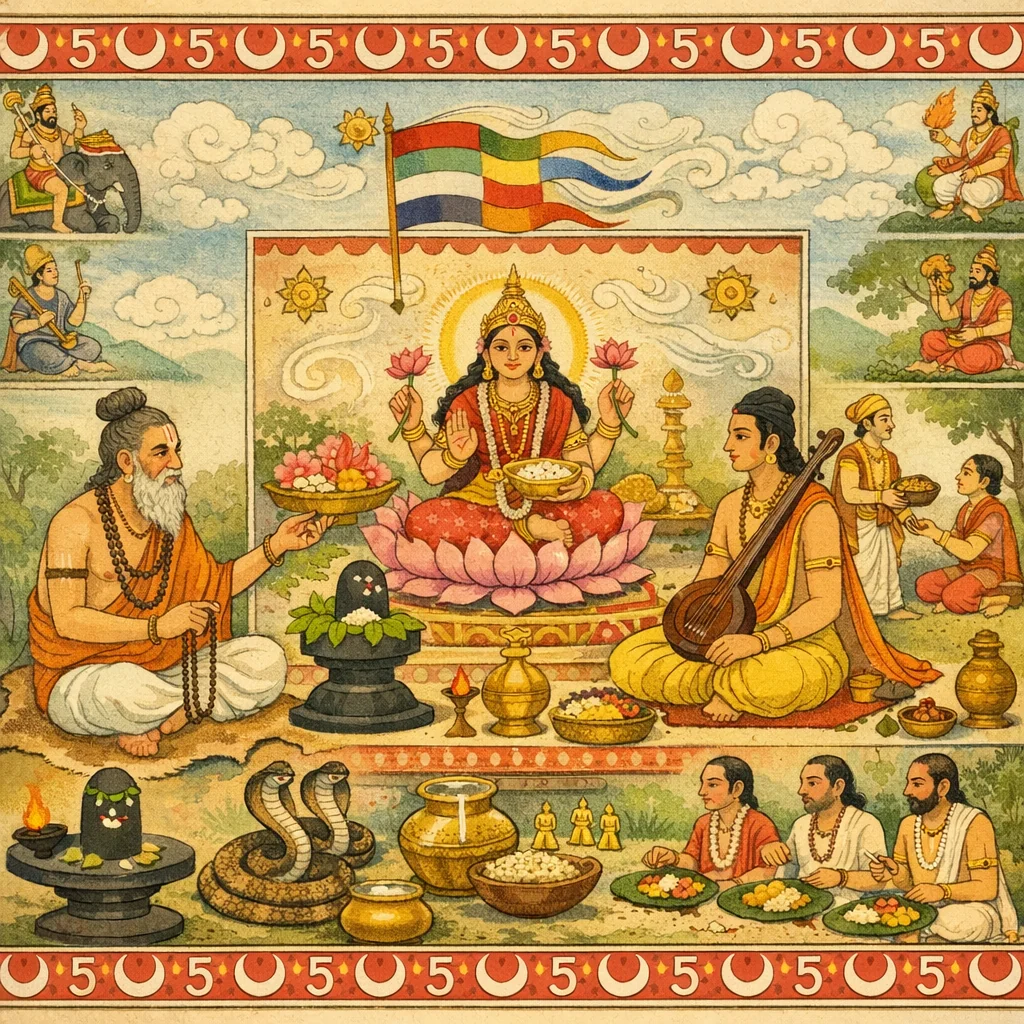
Sanātana instructs Nārada on Pañcamī-day vratas as an ordered yearly cycle. It opens with Caitra Śukla Pañcamī—Matsya Jayantī and Śrīpañcamī—featuring Lakṣmī worship with fragrant offerings and sweet rice, then lists other Pañcamī observances (Pṛthvī-, Cāndra-, Hayagrīva-vratas) and month-specific rites: Śeṣa/Ananta worship in Vaiśākha; Pitṛ worship with brāhmaṇa-feeding in Jyeṣṭha; and a distinctive Āṣāḍha Vāyu rite with a five-colored banner, loka-pāla worship, fasting through yāmas, and dream verification—inauspicious signs require an intensified Śiva-fast and feeding eight brāhmaṇas. Śrāvaṇa Kṛṣṇa Pañcamī details an Annāvrata: preparing and sprinkling food, honoring Pitṛs and Ṛṣis, feeding supplicants, pradoṣa liṅga worship with pañcākṣarī japa, and prayers for grain abundance; Śrāvaṇa Śukla Pañcamī adds Indrāṇī worship and wealth-dāna. Bhādrapada includes milk offerings to Nāgas (Kṛṣṇa Pañcamī) and a seven-year Saptarṣi vow with clay altar, arghya, uncultivated grains, gold images, pañcāmṛta bathing, homa, and honoring guru/brāhmaṇas, culminating in celestial-vimāna merit. Later months prescribe Upāṅga-Lalitā Vrata (Āśvina), Jayā-vrata (Kārttika) with purificatory bath and sin-destruction, Nāga worship for fearlessness (Mārgaśīrṣa), and Viṣṇu worship (Pauṣa). The chapter concludes that on every month’s Pañcamī in both fortnights, Pitṛ and Nāga worship is beneficial.
Shlokas
Verse 1
सनातन उवाच । श्रृणु विप्र प्रवक्ष्यामि पंचम्यास्ते व्रतान्यहम् । यानि भक्त्या समास्थाय सर्वान्कामानवाप्नुयात् ॥ १ ॥
Sanātana said: “Listen, O brāhmaṇa. I shall explain the vows (vratas) of the Pañcamī day—by observing them with devotion, one may obtain all desired aims.”
Verse 2
प्रोक्ता मत्स्यजयंती तु पंचमी मधुशुक्लगा । अस्यां मत्स्यावतारार्चा भक्तैः कार्या महोत्सवा ॥ २ ॥
The Matsya Jayantī is declared to fall on the Pañcamī in the bright fortnight of Madhu (Caitra). On that day, devotees should worship Lord Viṣṇu’s Matsya incarnation as a grand festival.
Verse 3
श्रीपंचमीति चैषोक्ता तत्र कार्यं श्रियोऽर्चनम् । गंधाद्यैरुपचारैस्तु नैवेद्यैः पायसादिभिः ॥ ३ ॥
This observance is called “Śrīpañcamī.” On that occasion one should worship Śrī (Lakṣmī), offering fragrant substances and other ritual services, and presenting food-offerings such as pāyasa (sweet rice cooked in milk) and the like.
Verse 4
यो लक्ष्मीं पूजयेच्चात्र तं वै लक्ष्मीर्न मुंचति । पृथ्वीव्रतं तथा चांद्रं हयग्रीवव्रतं तथा ॥ ४ ॥
Whoever worships Lakṣmī here—Lakṣmī indeed does not forsake that person. Likewise, the Pṛthvī-vrata, the Cāndra-vrata, and the Hayagrīva-vrata are also prescribed.
Verse 5
कार्यं तत्तद्विधानेन तत्तत्सिद्धिमभीप्सुभिः । अथ वैशाखपंचम्यां शेषं चाभ्यर्च्य मानवः ॥ ५ ॥
Those who seek success in each respective undertaking should perform it according to its proper rule. Then, on the fifth lunar day (pañcamī) of Vaiśākha, one should also worship Śeṣa (Ananta).
Verse 6
सर्वैर्नागगणैर्युक्तमभीष्टं लभते फलम् । तथा ज्येष्ठस्य पंचम्यां पितॄनभ्यर्चयेत्सुधीः ॥ ६ ॥
Endowed with the grace of all the hosts of Nāgas, one obtains the desired fruit. Likewise, on the fifth lunar day (pañcamī) of the month Jyeṣṭha, the wise person should worship the Pitṛs (ancestors).
Verse 7
सर्वकामफलावाप्तिर्भवेद्वै विप्रभोजनैः । अथाषाढस्य पंचम्यां वायुं सर्वगतं मुने ॥ ७ ॥
Indeed, by feeding brāhmaṇas one attains the fruits of all desired aims. Then, O sage, on the fifth lunar day (pañcamī) of Āṣāḍha, one should worship Vāyu—the all-pervading Wind.
Verse 8
ग्रामाद्बहिर्विनिर्गत्य धरोपस्थे समास्तितः । ध्वजं च पंचवर्णं तु वंशदंडाग्रसंस्थितम् ॥ ८ ॥
Having gone out beyond the village, he sat upon the ground; and there he set up a five-coloured banner, fixed at the top of a bamboo staff.
Verse 9
समुच्छ्रितं निदध्यात्तु कल्पिताब्जे तु मध्यतः । ततस्तन्मूलदेशे तु दिक्षु सर्वासु नारद ॥ ९ ॥
One should meditate upon it as rising aloft, positioned at the center of the imagined lotus. Then, O Nārada, at the region of its root, in all directions around it, one should further contemplate accordingly.
Verse 10
लोकपालान्समभ्यर्च्य कुर्याद्वायुपरीक्षणम् । प्रथमादिषु यामेषु यो यो वायुः प्रवर्तते ॥ १० ॥
Having duly worshipped the Guardians of the Worlds (Lokapālas), one should perform the examination of the vital winds (vāyu). During the first and subsequent yāmas, one should observe which particular vāyu becomes active.
Verse 11
तस्मै तस्मै दिगीशाय पूजां सम्यक् प्रकल्पयेत् । एवं स्थित्वा निराहारस्तत्र यामचतुष्टयम् ॥ ११ ॥
To each and every Lord of the Directions (Digīśa), one should duly arrange and perform worship. Remaining thus, fasting without food, one should stay there for four yāmas (a full day-and-night cycle).
Verse 12
सायमागत्य गेहं स्वं भुक्त्वा स्वल्पं समाहितः । लोकपालान्नमस्कृत्य स्वप्याद्भूमितले शुचौ ॥ १२ ॥
Returning home in the evening, having eaten a little with a composed mind, he should bow to the Guardians of the Worlds (Lokapālas) and then sleep on the clean ground.
Verse 13
यः स्वप्नो जायते तस्यां रात्रौ यामे चतुर्थके । स एव भविता नूनं स्वप्न इत्याह वै शिवः ॥ १३ ॥
A dream that arises in the fourth watch of the night will surely come to pass—thus indeed Śiva speaks concerning dreams.
Verse 14
अशुभे तु समुत्पन्ने शिवपूजापरायणः । सोपवासो नयेदष्टयामं तद्दिनमेव वा ॥ १४ ॥
But when an inauspicious sign arises, one devoted to the worship of Śiva should observe upavāsa (fasting) and pass in such discipline eight yāmas (a full day), or at least that very day.
Verse 15
भोजयित्वा द्विजानष्टौ ततः शुभफलं लभेत् । व्रतमेतत्समुदितं शुभाशुभनिदर्शनम् ॥ १५ ॥
Having fed eight dvijas (twice-born brāhmaṇas), one then obtains an auspicious result. This vow is proclaimed as one that indicates both auspicious and inauspicious outcomes.
Verse 16
नृणां सौभाग्यजनकमिह लोके परत्र च । श्रावणे कृष्णपंचम्यां व्रतं ह्यन्नसमृद्धिदम् ॥ १६ ॥
For people, this vow brings good fortune in this world and the next. Observed in Śrāvaṇa on kṛṣṇa-pañcamī (the fifth day of the dark fortnight), it bestows abundance of food and grain.
Verse 17
चतुर्थ्यां दिनशेषे तु सर्वाण्यन्नानि नारद । पृथक् पात्रेषु संस्थाप्य जलैराप्लावयेत्सुधीः ॥ १७ ॥
O Nārada, on caturthī, when only the remainder of the day is left, the wise should place all prepared foods in separate vessels and then thoroughly sprinkle them with water.
Verse 18
ततो पात्रांतरे तत्तु निष्कास्यांबु निधापयेत् । प्रातर्भानौ समुदिते पितॄंश्चैव तथा ऋषीन् ॥ १८ ॥
Then, having poured that water into another vessel, one should set it aside. In the morning, when the sun has risen, one should honor the Pitṛs (ancestors) and likewise the Ṛṣis (sages).
Verse 19
देवांश्चाभ्यर्च्य सुस्नातं कृत्वा नैवेद्यमग्रतः । तदन्नं याचकेभ्यस्तु प्रयच्छेत्प्रीतमानसः ॥ १९ ॥
After worshipping the gods, bathing well, and placing the food-offering (naivedya) in front, one should, with a pleased mind, give that food to those who ask.
Verse 20
सर्वं दिनं क्षिपेदेवं प्रदोषे तु शिवालये । गत्वा संपूजयेद्देवं लिंगरूपिणमीश्वरम् ॥ २० ॥
Thus one should pass the entire day; then, at pradoṣa (dusk), going to Śiva’s temple, one should duly worship the Lord—Īśvara—who is in the form of the liṅga.
Verse 21
गंधपुष्पादिभिः सम्यक्पूजयित्वा महेश्वरम् । जपेत्पञ्चाक्षरी विद्यां शतं चापि सहस्रकम् ॥ २१ ॥
After duly worshipping Maheśvara with fragrance, flowers, and the like, one should repeat the five-syllabled sacred mantra (pañcākṣarī) a hundred times, or even a thousand times.
Verse 22
जपं निवेद्य देवाय भवाय भवरूपिणे । स्तुत्वा सर्वैर्वौदिकैश्च पौराणैश्चाप्यनाकुलः ॥ २२ ॥
Having offered his recitation (japa) to the Lord—Bhava, who transcends and yet embodies worldly becoming—he then praised Him, unconfused, with all Vedic and also Purāṇic hymns.
Verse 23
प्रार्थयेद्देवमीशानं शश्वत्सर्वान्नसिद्धये । शारदीयानि चान्नानि तथा वासंतिकान्यपि ॥ २३ ॥
One should ever pray to the Lord, the Sovereign Īśāna, for the unfailing attainment of every kind of grain and food provision—those of autumn as well as those of spring.
Verse 24
यानि स्युस्तैः समृद्धोऽहं भूयां जन्मनि जन्मनि । एवं संप्रार्थ्य देवेशं गृहमागत्य वै स्वकम् ॥ २४ ॥
“May I be endowed with those very blessings and prosper by them, birth after birth.” Thus earnestly praying to the Lord of the gods, he returned to his own home.
Verse 25
दत्वान्नं ब्राह्मणादिभ्यः पक्वं भुञ्जीत वाग्यतः । एतदन्नव्रतं विप्र विधिनाऽचरितं नृभिः ॥ २५ ॥
After giving food to brāhmaṇas and others, one should eat only cooked food, with speech restrained. O brāhmaṇa, this is the Annāvrata, the vow concerning food, to be observed by people according to proper rule.
Verse 26
सर्वान्नसंपज्जनकं परलोके गतिप्रदम् । श्रावणे शुक्लपञ्चजम्यां नृभिरास्तिक्यतत्परैः ॥ २६ ॥
On the bright fifth lunar day (Śukla Pañcamī) in the month of Śrāvaṇa, people devoted to faith should observe that rite which brings abundance of all grains and grants a blessed course in the world beyond.
Verse 27
द्वारस्योभयतो लेख्या गोमयेन विषोल्बणाः । गंधाद्यैः पूजयेत्तांश्च तथेंद्राणीमनंतरम् ॥ २७ ॥
On both sides of the doorway one should draw auspicious protective markings with cow-dung, made potent against poison; worship those markings with fragrance and other offerings, and thereafter worship Indrāṇī.
Verse 28
संपूज्य स्वर्णरूप्यादिदध्यक्षतकुशांबुभिः । गन्धैः पुष्पैस्तथा धूपैर्दीपैर्नैवेद्यसंचयैः ॥ २८ ॥
Having duly worshipped (the Deity) with gold, silver, and the like—with curd, akṣata (unbroken rice), kuśa-grass, and consecrated water—together with fragrances, flowers, incense, lamps, and abundant offerings of food (naivedya).
Verse 29
ततः प्रदक्षिणीकृत्य तद्द्रव्यं संप्रणम्य च । संप्रार्थ्य भक्तिभावेन विप्राग्र्येषु समर्पयेत् ॥ २९ ॥
Then, having performed pradakṣiṇā (reverent circumambulation) and bowed to that offering, one should pray in a mood of bhakti and present it to the foremost Brāhmaṇas.
Verse 30
यदिदं स्वर्णरौप्यादि द्रव्यं वै विप्रसात्कृतम् । तदनंतफलं भूयान्मम जन्मनि जन्मनि ॥ ३० ॥
Whatever wealth—such as gold and silver—has truly been given over to a Brāhmaṇa, may that become for me an endless, merit-bearing fruit, birth after birth.
Verse 31
इत्येवं ददतो द्रव्यं भक्तिभावेन नारद । प्रसन्नः स्याद्धनाध्यक्षः स्वर्णादिकसमृद्धिदः ॥ ३१ ॥
Thus, O Nārada, when a person gives wealth with a spirit of devotion, the Lord who presides over wealth becomes pleased and bestows prosperity in gold and other riches.
Verse 32
एतद्व्रतं नरः कृत्वा विप्रान्संभोज्य भक्तितः । पश्चात्स्वयं च भुञ्जीत दारापत्यसुहृद्दृतः ॥ ३२ ॥
Having performed this vow, a man should, with devotion, feed the Brāhmaṇas; afterwards he may himself eat, accompanied by his wife, children, and friends.
Verse 33
भाद्रे तु कृष्णपंचम्यां नागान् क्षीरेण तर्पयेत् ॥ ३३ ॥
In the month of Bhādrapada, on Kṛṣṇa Pañcamī (the fifth day of the dark fortnight), one should satisfy the Nāgas by offering tarpaṇa with milk.
Verse 34
यस्तस्याऽसप्तमं यावत्कुलं सर्पात्सुनिर्भयम् । भाद्रस्य शुक्लपंचम्यां पूजयेदृषिसत्तमान् ॥ ३४ ॥
Whoever, on Śukla Pañcamī (the fifth day of the bright fortnight) in Bhādrapada, worships the most excellent sages—his lineage, up to the seventh generation, becomes wholly free from fear of serpents.
Verse 35
प्रातर्नद्यादिके स्नात्वा कृत्वा नित्यमतंद्रितः । गृहमागत्य यत्नेन वेदिकां कारयेन्मृदा ॥ ३५ ॥
At dawn, having bathed in a river or similar sacred water and performed his daily duties without sloth, he should return home and carefully have a vedikā—an altar—made of clay.
Verse 36
गोमयेनोपलिप्याथ कृत्वा पुष्पोपशोभिताम् । तत्रास्तीर्य कुशान्विप्रऋषीन्सप्त समर्चयेत् ॥ ३६ ॥
Then, having plastered it with cow-dung and adorned it with flowers, one should spread kuśa grass there and duly worship the seven Brahmin-sages.
Verse 37
गन्धैश्च विविधैः पुष्पैर्धूपैर्दीपैः सुशोभनेः । कश्यपोऽत्रिर्भरद्वाजौ विश्वामित्रोऽथ गौतमः ॥ ३७ ॥
Most beautifully adorned with many fragrances, varied flowers, incense, and lamps—there were Kaśyapa, Atri, Bharadvāja, also Viśvāmitra, and then Gautama.
Verse 38
जमदग्निर्वसिष्ठश्च सप्तैते ऋषयः स्मृताः । एतैभ्योऽघ्य च विधिवत्कल्पयित्वा प्रदाय च ॥ ३८ ॥
Jamadagni and Vasiṣṭha—together with the others—are remembered as the seven ṛṣis. Having duly prepared the arghya, the respectful offering, according to the prescribed rite, one should present it to them.
Verse 39
नैवेद्यं विपचेद्वीमान्श्यामाकाद्यैरकृष्टकैः । तन्निवेद्य विसृज्येमान्स्वयं चाद्यात्तदेव हि ॥ ३९ ॥
He should cook naivedya, the food-offering, for the sacred seat of Viṣṇu using uncultivated grains such as śyāmāka. Having offered it, he should set them free, and he himself should then partake of that very food.
Verse 40
अनेन विधिना सप्त वर्षाणि प्रतिवत्सरम् । कृत्वा व्रतांते वरयेदाचार्यान् सप्त वैदिकान् ॥ ४० ॥
By this prescribed method, one should observe the vow each year for seven years. At the vow’s conclusion, one should honor and reward seven Vedic teachers, the ācāryas.
Verse 41
प्रतिमाः सप्तकुर्वींत सुवर्णेन स्वशक्तितः । जटिलाः साक्षसूत्राश्च कमण्डलुसमन्विताः ॥ ४१ ॥
According to one’s means, one should fashion seven images in gold, depicting them as matted-haired ascetics, wearing the sacred thread and bearing a kamaṇḍalu, the water-pot.
Verse 42
संस्थाप्य कलशेष्वेतांस्ताम्रेषु मृन्मयेषु वा । स्नापयेद्विधिवद्भक्त्या पृथक्पंचामृतैरपि ॥ ४२ ॥
Having installed these in ritual water-pots—whether of copper or of clay—one should, with devotion and according to the prescribed procedure, bathe them. One should also bathe each separately with pañcāmṛta, the five sacred nectars.
Verse 43
उपचारैः षोडशभिस्ततः संपूज्य भक्तितः । अर्घ्यं दत्वा ततो होमं तिलव्रीहियवादिभिः ॥ ४३ ॥
Then, with devotion (bhakti), one should worship fully with the sixteen ritual services; after offering arghya, a respectful oblation, one should perform the fire-offering (homa) using sesame, rice, barley, and similar grains.
Verse 44
। सहस्तोमाइति ऋखा नामनन्त्रैस्तु वा पृथक् । पुण्यैर्मन्त्रैस्तथैवान्यैर्हुत्वा पूर्णाहुतिं चरेत् ॥ ४४ ॥
Reciting the Ṛg-verse called “Sahastomā,” or else making the offering separately with its own mantras, one should offer oblations with auspicious and other prescribed mantras, and then perform the concluding full oblation (pūrṇāhuti).
Verse 45
ततस्तु सप्त गा दद्याद्वस्त्रालंकारसंयुताः । आचार्यं पूजयेज्जैव वस्त्रालंकारभूषणैः ॥ ४५ ॥
Thereafter, one should give seven cows, furnished with garments and ornaments; and one should also honor the teacher (ācārya) with garments, ornaments, and adornments.
Verse 46
अनुज्ञया गुरोः पश्चान्मूर्तीर्विप्रेषु चार्पयेत् । भोजयित्वा तु तान्भक्त्या प्रणिपत्य विसर्जयेत् ॥ ४६ ॥
After obtaining the guru’s permission, one should then offer the sacred images (mūrtis) to the brāhmaṇas. Having fed them with devotion, one should bow down and respectfully send them off.
Verse 47
ततश्चेष्टैः सहासीनः स्वयं ब्राह्मणशेषितम् । भुंक्त्वा वै षड्रसोपेतं प्रमुद्यात्सह बंधुभिः ॥ ४७ ॥
Then, seated together with his attendants, he should himself eat the food left after the brāhmaṇas—endowed with the six tastes—and rejoice along with his relatives.
Verse 48
एतत्कृत्वा व्रतं गांगं भोगान्भुक्त्वाथ वाञ्छितान् । सप्तर्षीणां प्रसादेन विमानवरगो भवेत् ॥ ४८ ॥
Having performed this Gaṅgā-related vow and then enjoyed the desired pleasures, by the grace of the Seven Ṛṣis (Saptarṣi) one becomes a traveler in an excellent celestial chariot (vimāna).
Verse 49
आश्विने शुक्लपञ्चम्यामुपांगललिताव्रतम् ॥ ४९ ॥
On the fifth lunar day (pañcamī) of the bright fortnight in the month of Āśvina, the vow known as the Upāṅga-Lalitā Vrata is to be observed.
Verse 50
तस्याः स्वर्णमयीं मूर्तिं शक्त्या निर्माय नारद । उपचारैः षोडशभिः पूजयेत्तां विधानतः ॥ ५० ॥
O Nārada, having fashioned—according to one’s capacity—a golden image of Her, one should worship Her in the prescribed manner with the sixteen ritual offerings (ṣoḍaśopacāra).
Verse 51
पक्वान्नं फलसंयुक्तं सघृतं दक्षिणान्वितम् । द्विजवर्याय दातव्यं व्रतसंपूर्तिहेतवे ॥ ५१ ॥
Cooked food, accompanied by fruits, with ghee (ghṛta), and along with a gift-fee (dakṣiṇā), should be given to an excellent brāhmaṇa for the purpose of completing the vow (vrata).
Verse 52
सवाहना शक्तियुता वरदा पूजिता मया । मातर्मामनुगृह्याथ गम्यतां निजमंदिरम् ॥ ५२ ॥
O Mother—mounted upon Your vehicle, endowed with divine power and bestowing boons—having been worshipped by me, please show me grace; and then return to Your own abode.
Verse 53
कार्तिके शुक्लपंचम्यां जयाव्रतमनुत्तमम् । कर्तव्यं पापनाशाय श्रद्धया द्विजसत्तम ॥ ५३ ॥
On the bright fifth lunar day (Śukla Pañcamī) of Kārttika, O best of the twice-born, the unsurpassed vow called the Jayā-vrata should be observed with faith, for the destruction of sins.
Verse 54
पूजयित्वा जयां विप्र यथाविधि समाहितः । उपचारैः षोडशभिस्ततः शुचिरलंकृतः ॥ ५४ ॥
O brāhmaṇa, having duly worshipped Jayā in the prescribed manner with a concentrated mind, he should then—purified and well-adorned—offer the sixteen ritual services (ṣoḍaśopacāra).
Verse 55
विप्रैकं भोजयेच्चापि तस्मै दत्त्वा च दक्षिणाम् । विसर्जयेत्ततः पश्चात्स्वयं भुञ्जीत वाग्यतः ॥ ५५ ॥
One should feed a single brāhmaṇa; having given him the prescribed honorarium (dakṣiṇā), one should then respectfully send him off. After that, one may eat oneself, observing restraint of speech.
Verse 56
यस्तु वै भक्तिसंयुक्तः स्नानं कुर्य्याज्जयादिने । नश्यन्ति तस्य पापानि सिंहाक्रांता मृगा यथा ॥ ५६ ॥
Whoever, endowed with devotion, performs a ritual bath on the Jayā day—his sins are destroyed, just as deer vanish when charged by a lion.
Verse 57
यदश्वमेधावभृथे फलं स्नानेन कीर्तितम् । तत्फलं प्राप्यते विप्रस्नानेनापि जयादिने ॥ ५७ ॥
Whatever merit is declared to arise from bathing at the concluding ablution (avabhṛtha) of an Aśvamedha sacrifice—that very merit is obtained, O brāhmaṇa, even by bathing on the Jayā day as well.
Verse 58
अपुत्रो लभते पुत्रं वंध्या गभ च विंदति । रोगी रोगात्प्रमुच्येत बद्धो मुच्येत बंधनात् ॥ ५८ ॥
The childless one obtains a son; the barren woman also conceives. The sick is freed from disease, and the bound is released from bondage.
Verse 59
मार्गशुक्ले च पञ्चम्यां नागानिष्ट्वा विधानतः । नागेभ्यो ह्यभयं लब्ध्वा मोदते सह बांधवैः ॥ ५९ ॥
On the fifth lunar day (Pañcamī) of the bright fortnight in Mārgaśīrṣa, having duly worshipped the Nāgas as prescribed, one receives from the serpent-deities the boon of fearlessness and rejoices with one’s kinsmen.
Verse 60
पौषेऽपि शुक्लपञ्चम्यां सम्पूज्य मधुसूदनम् । लभते बाञ्छितान्कामान्नात्र कार्या विचारणा ॥ ६० ॥
Even in the month of Pauṣa, by duly worshipping Madhusūdana (Viṣṇu) on the bright-fortnight fifth lunar day (Śukla Pañcamī), one attains the desired aims; there is no need for further doubt or deliberation.
Verse 61
पंचम्यां प्रतिमासे तु शुक्ले कृष्णे च नारद । पितॄणां पूजनं शस्तं नागानां चापि सर्वथा ॥ ६१ ॥
O Nārada, on the fifth lunar day (Pañcamī) of every month—both in the bright and the dark fortnight—the worship of the ancestors (Pitṛs) is prescribed as beneficial, and likewise the worship of the Nāgas in every respect.
Verse 62
इति श्रीबृहन्नारदीयपुराणे पूर्वभागे बृहदुपाख्याने चतुर्थपादे द्वादशमासस्थपञ्चमीव्रतनिरूपणं नाम चतुर्दशाधिकशततमोऽध्यायः ॥ ११४ ॥
Thus ends, in the Śrī Bṛhannāradīya Purāṇa—within the Pūrva-bhāga, in the Great Narrative (Bṛhad-upākhyāna), in the Fourth Quarter (Caturtha-pāda)—the one-hundred-and-fourteenth chapter entitled “The exposition of the Pañcamī vow to be observed in the twelve months.”
Frequently Asked Questions
The chapter explicitly places Matsya Jayantī on Caitra (Madhu) bright-fortnight Pañcamī and frames it as a festival worship of Viṣṇu’s Matsya avatāra, making Pañcamī a calendrical anchor for avatāra-smaraṇa and Vaiṣṇava pūjā.
It combines external ritual (going beyond the village, installing a five-colored banner on bamboo, worshipping loka-pālas) with an internal yogic diagnostic (examining which vital wind is active across yāmas) and a oneiric validation rule: dreams in the fourth watch are said to be predictive, with remedial fasting and brāhmaṇa-feeding when inauspicious signs arise.
The Śrāvaṇa Kṛṣṇa Pañcamī discipline structures food as sacred economy: preparing and sprinkling foods, honoring Pitṛs/Ṛṣis, gifting to supplicants, then performing pradoṣa liṅga worship with pañcākṣarī japa and explicit prayers for seasonal grain supplies—linking ethical distribution, mantra, and agrarian well-being.
Milk-offerings and prescribed Nāga worship on Pañcamī are said to confer protection and fearlessness from serpents, extending benefit to one’s lineage (noted up to seven generations in the Bhādrapada Śukla Pañcamī context).