The Explanation of the Twelve-Month Caturthī Vrata
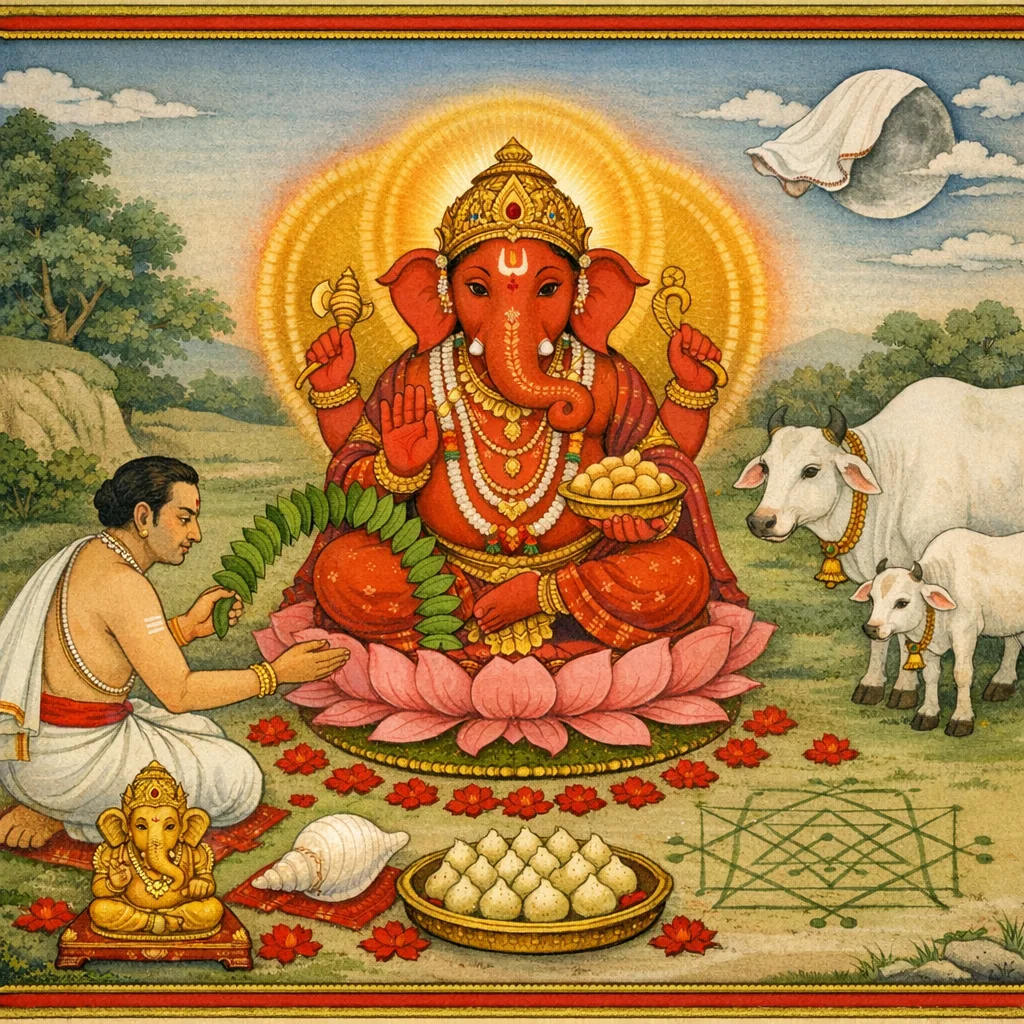
Sanātana teaches a brāhmaṇa the Caturthī observances through all twelve lunar months, praising them as wish-fulfilling vrata-kalpa. Beginning with Caitra Caturthī worship of Gaṇeśa as Vāsudeva, the months are then linked to the Vaiṣṇava vyūhas—Saṅkarṣaṇa (Vaiśākha; gift of a conch), Pradyumna (Jyeṣṭha; fruits and roots), and Aniruddha (Āṣāḍha; gourd-vessels to renunciants)—and completed as a 12-year cycle with udyāpana. The chapter further describes special vows: Satī-vrata (Jyeṣṭha), an Āṣāḍha Caturthī connected with the Rathaṃtara kalpa, Jāti-Candrodaya (Śrāvaṇa) with full iconographic meditation and modaka-only observance, and Dūrvā-Gaṇapati with yantra, red offerings, five sacred leaves, and long service to one’s teacher. Bhādrapada introduces Bahulādhenu (cow-donation leading to Goloka). A major section teaches the Siddha-Vināyaka Vrata with 21 leaf-offerings matched to 21 names, ending with gifting a golden Vināyaka image and a five-year practice. It warns against moon-gazing on Caturthī and gives a Purāṇic expiatory mantra. It also outlines Kaparddīśa (Īṣa) worship, the women-only Karaka-vrata (Kārttika dark fortnight), Nāga-vrata (Ūrja bright fortnight) for protection from poison, a four-year graded discipline with homa and a 16-name Gaṇeśa litany (Vara-vrata equivalence), Pauṣa worship with modaka-dakṣiṇā, Saṅkaṣṭa-vrata (Māgha dark fortnight) with moonrise worship and arghya to the Moon, and Gaurī-vrata (Māgha bright fortnight) under the names Ḍhuṃḍhi/Kuṇḍa/Lalitā/Śānti. It concludes with Phālguna worship of Ḍhuṃḍhirāja, notes special fruits for Sunday/Tuesday Caturthī, and universalizes devotion to Vighneśa on every Caturthī.
Shlokas
Verse 1
सनातन उवाचग । श्रृणु विप्र प्रवक्ष्यामि चतुर्थ्यास्ते व्रतान्यहम् । यानि कृत्वा नरा नार्योऽभीष्टान्कामानवाप्नुयुः ॥ १ ॥
Sanātana said: “Listen, O brāhmaṇa; I shall explain to you the vows observed on Caturthī, the fourth lunar day. By performing them, men and women obtain their desired wishes.”
Verse 2
चैत्रमासचतुर्थ्यां तु वासुदेवस्वरूपिणम् । गणपं सम्यगभ्यर्च्य दत्त्वा कांचनदक्षिणाम् ॥ २ ॥
But on the Caturthī of the month of Caitra, having properly worshipped Gaṇeśa—who embodies the very form of Vāsudeva—and having offered a golden honorarium (dakṣiṇā), one should proceed with the rite.
Verse 3
विप्राय विष्णुलोकं तु गच्छेद्देवनमस्कृतः । वैशाखस्य चतुर्थ्यां तु प्रार्थ्यं संकर्षणाह्वयम् ॥ ३ ॥
Honoured even by the gods, he should go to Viṣṇu’s world for the sake of a brāhmaṇa. On the Caturthī of Vaiśākha, one should pray, invoking the name Saṅkarṣaṇa.
Verse 4
गृहस्थद्विजमुख्येभ्यः शंखं दत्त्वा विधानवित् । प्राप्य संकर्षणं लोकं मोदते बहुकल्पकम् ॥ ४ ॥
One who knows the proper ritual procedure, having given a conch (śaṅkha) to the foremost twice-born householders, attains the world of Saṅkarṣaṇa and rejoices there for many kalpas.
Verse 5
ज्येष्ठमासचतुर्थ्यां तु प्रार्च्य प्रद्युम्नरूपिणम् । फलं मूलं च युथेभ्यो दत्त्वा स्वर्गं लभेन्नरः ॥ ५ ॥
On the Caturthī, the fourth lunar day of Jyeṣṭha, one who duly worships the Lord in the form of Pradyumna and gives fruits and roots to groups of people attains heaven.
Verse 6
आषाढस्य चतुर्थ्यां तु संप्रपूज्यानिरुद्धकम् । यतिभ्योऽलाबुपात्राणि दत्त्वाभीष्टं लभेन्नरः ॥ ६ ॥
On the Caturthī of Āṣāḍha, having duly worshiped Lord Aniruddha, one should give gourd vessels (alābu-pātras) to renunciants; thereby one attains the desired boon.
Verse 7
चतुर्मूर्तिव्रतान्येवं कृत्वा द्वादशवत्सरम् । उद्यापनं विधानेन कर्तव्यं फलमिच्छता ॥ ७ ॥
Thus, having observed these vows dedicated to the Lord’s four forms for twelve years, one who desires the fruit should perform the concluding rite (udyāpana) according to the prescribed rule.
Verse 8
अन्यज्ज्येष्ठचतुर्थ्यां तु सतीव्रतमनुत्तमम् । कृत्वा गणपतेर्मातुर्लोके मोदेत तत्समम् ॥ ८ ॥
Further, on the Caturthī of Jyeṣṭha, one who observes the unsurpassed vow called Satī-vrata rejoices in the world of Gaṇapati’s Mother, enjoying happiness equal to hers.
Verse 9
तथाऽषाढचतुर्थ्यां तु व्रतमन्यच्छुभावहम् । रथंतराह्वकल्पस्य ह्यादिभूतं दिनं यतः ॥ ९ ॥
Likewise, on the Caturthī of Āṣāḍha there is another vow that bestows auspiciousness, for that day is regarded as the inaugural day of the Kalpa called “Rathaṃtara.”
Verse 10
श्रद्धापूतेन मनसा गणेशं विधिना नरः । पूजयित्वा लभेच्चापि फलं देवादिदुर्गमम् ॥ १० ॥
A person who worships Gaṇeśa according to proper ritual, with a mind purified by faith, indeed attains a reward difficult to obtain even for the gods and the rest.
Verse 11
श्रावणस्य चतुर्थ्यां तु जाति चंद्रोदये मुने ॥ ११ ॥
But on the fourth lunar day (caturthī) of the month of Śrāvaṇa, O sage, the observance called “Jāti-Candrodaya” is to be undertaken.
Verse 12
गणेशाय प्रदद्याच्च ह्यर्घ्यं विधिविदांवरः । लम्बोदरं चतुर्बाहुं त्रिनेत्रं रक्तवर्णकम् ॥ १२ ॥
Then the foremost knower of ritual procedure should offer arghya (a respectful water-offering) to Gaṇeśa—who is pot-bellied (Lambodara), four-armed, three-eyed, and of a red complexion.
Verse 13
नानारत्नविभूषाढ्यं प्रसन्नास्यं विचिंतयेत् । आवाहनादिभिः सर्वैरुपचारैः समर्चयेत् ॥ १३ ॥
One should meditate upon the deity as adorned with many jeweled ornaments and with a serene, gracious face; and then worship Him fully with all the ritual services—beginning with invocation (āvāhana) and the rest.
Verse 14
नैवेद्यं मोदकं दद्याद्गणेशप्रीतिदायकम् । एवं व्रतं विधायाथ भुक्त्वा मोदकमेव च ॥ १४ ॥
One should offer a modaka as the food-offering (naivedya), for it bestows delight upon Gaṇeśa. Having thus performed the vow (vrata) properly, one should then partake of modaka alone.
Verse 15
सुखं स्वप्यान्निशायां तु भूमावेव कृतार्चनः । व्रतस्यास्य प्रभावेण कामान्मनसि चिंतितान् ॥ १५ ॥
Having performed worship, he should sleep comfortably at night upon the bare ground; by the power of this vow, the desires contemplated within his mind are fulfilled.
Verse 16
लब्ध्वा लेके परं चापि गणेशपदमाप्नुयात् । नानेन सदृशं चान्यद्व्रतमस्ति जगत्त्रये ॥ १६ ॥
Having obtained the highest realm hereafter, one attains the state (abode) of Gaṇeśa as well. In the three worlds, there is no other vow comparable to this.
Verse 17
तस्मात्कार्यं प्रयत्नेन सर्वान्कामानभीप्सता । अथास्मिन्नेव दिवसे दूर्वागणपति व्रतम् ॥ १७ ॥
Therefore, one who desires to obtain all wished-for aims should undertake this with diligent effort. Moreover, on this very day, the Dūrvā-Gaṇapati vow is to be observed.
Verse 18
केचिदिच्छंति देवर्षे तद्विधानं वदामि ते । हैमं निर्माय गणपं ताम्रपात्रोपरि स्थितम् ॥ १८ ॥
Some people desire this, O divine sage; I shall tell you its proper procedure. Having fashioned a golden image of Gaṇapa (Gaṇeśa), it should be placed upon a copper vessel.
Verse 19
वेष्टितं रक्तवस्त्रेण सर्वतोभद्रमंडले । पूजयेद्रक्तकुसुमैः पत्रिकाभिश्च पंचभिः ॥ १९ ॥
In the auspicious sarvatobhadra diagram, it should be wrapped with a red cloth, and worship should be performed with red flowers and with five leaf-offerings.
Verse 20
बिल्वपत्रमपामार्गं शमी दूर्वा हरिप्रिया । आभिरन्यश्च कुसुमैरभ्यर्च्य फलमोदकैः ॥ २० ॥
With bilva leaves, apāmārga, śamī, and dūrvā—offerings dear to Hari—and with other flowers as well, one should worship the Lord in due rite, presenting fruits and sweet delicacies.
Verse 21
आचार्याय विधिज्ञाय सत्कृत्य विनिवेदयेत् । उपहारं प्रकल्प्याथ दद्यादर्घं समुद्यते । ततः संप्रारथ्य विघ्नेशमूर्तिं सोपस्करां मुने ॥ २१ ॥
Having respectfully approached the ācārya who knows the proper rites, one should formally present the offering to him. Then, arranging a fitting gift, one should rise and offer arghya, the oblation of honor. Thereafter, O sage, one should duly pray to Vighneśa in his embodied form, together with the requisite ritual articles.
Verse 22
आचार्याय विधिज्ञाय सत्कृत्य विनिवेदयेत् । कृत्वैवं पंच वर्षाणि समुपास्य यथाविधि ॥ २२ ॥
Having duly honored the ācārya who is versed in proper rites and procedure, one should formally submit oneself to him. Thus, for five years, one should attend upon and serve the teacher in the prescribed manner.
Verse 23
भुक्त्वेह भोगानखिलान् लोकं गणपतेर्व्रजेत् । अथ भाद्रचतुर्थ्यां तु बहुलाधेनुसंज्ञकम् ॥ २३ ॥
Having enjoyed in this world all pleasures in full, one goes to the realm of Gaṇapati. Then, on the Caturthī—the fourth lunar day—of the month of Bhādrapada, the observance called “Bahulādhenu” is described.
Verse 24
पूजनी योऽत्र यत्नेन स्रग्गंधयवसादिभिः । ततः प्रदक्षिणीकृत्य शक्तश्चेद्दानमाचरेत् ॥ २४ ॥
Here one should worship with care, using garlands, fragrances, barley (yava), and similar offerings. Then, after performing pradakṣiṇā, the reverential circumambulation, if one is able one should also practice charitable giving.
Verse 25
अशक्तः पुरेतां तु नमस्कृत्य विसर्जयेत् । पंचाब्दं वादशाब्दं वा षोडशाब्दमथापि वा ॥ २५ ॥
But if one is unable to maintain the full observance, then—having bowed with reverence—one should duly conclude it and let it go, whether after five years, or ten years, or even sixteen years.
Verse 26
व्रतं कृत्वा समुद्याप्य धेनुं दद्यात्पयस्विनीम् । प्रभावेण व्रतस्यास्य भुक्त्वा भोगान्मनोरमान् ॥ २६ ॥
Having performed the vow and duly concluded it, one should donate a milch cow. By the power of this vow, one enjoys delightful, wish-fulfilling pleasures.
Verse 27
सत्कृतो देवतावृंदैर्गोलोकं समवाप्नुयात् । अथ शुक्ल चतुर्थ्यां तु सिद्धवैनायकव्रतम् ॥ २७ ॥
Honoured by multitudes of deities, he would attain Goloka. Now, on the fourth lunar day (Caturthī) of the bright fortnight, the vow called the Siddha-Vināyaka Vrata is taught.
Verse 28
आवाहनादिभिः सर्वैरुपचारैः समर्चनम् । एकाग्रमानसो भूत्वा ध्यायेत्सिद्धिविनायकम् ॥ २८ ॥
With all ritual services beginning with invocation (āvāhana) and the customary offerings, one should worship in due order; then, becoming single-pointed in mind, one should meditate upon Siddhi-Vināyaka, the bestower of success.
Verse 29
एकदंतं शूर्पकर्णं गजवक्त्रं चतुर्भुजम् । पाशांकुशधरं देवं तप्तकांचनसन्निभम् ॥ २९ ॥
I meditate upon the divine Lord (Gaṇeśa): one-tusked, large-eared, elephant-faced, four-armed, bearing the noose and the goad, radiant like heated gold.
Verse 30
एकविंशति पत्राणि चैकविंशतिनामभिः । समर्पयेद्भक्तियुक्तस्तानि नामानि वै श्रृणु ॥ ३० ॥
With devotion one should offer twenty-one leaves, each accompanied by one of the twenty-one names. Now indeed, listen to those names.
Verse 31
सुमुखाय शमीपत्रं गणाधीशाय भृंगजम् । उमापुत्राय बैल्वं तु दूर्वां गजमुखाय च ॥ ३१ ॥
Offer śamī leaves to Sumukha; offer bhṛṅgarāja to the Lord of the Gaṇas; offer bilva leaves to Umā’s son; and offer dūrvā grass to the Elephant-faced One.
Verse 32
लंबोदराय बदरीं धत्तूरं हरसूनवे । शूर्पकर्णाय तुलसीं वक्रतुंडाय शिंबिजम् ॥ ३२ ॥
Offer badarī (jujube) fruit to Lambodara; offer dhattūra to Hara’s son; offer tulasī to Śūrpakarṇa; and offer śiṃbijam to Vakratunḍa.
Verse 33
गुहाग्रजायापामार्गमेकदंताय बार्हतम् । हेरम्बाय तु सिंदूरं चतिर्होत्रे च पत्रजम् ॥ ३३ ॥
For Guhāgraja, offer apāmārga; for Ekadanta, the bārhata offering; for Heramba, sindūra (vermilion); and for Caturhotra, the leaf-born offering.
Verse 34
सर्वेश्वरायागस्त्यस्य पत्रं प्रीतिविवर्द्धनम् । दूर्वायुग्मं ततो गृह्य गंधपुष्पाक्षतैर्युतम् ॥ ३४ ॥
For Sarveśvara, the Lord of all, the Agastya leaf is said to increase delight. Then take a pair of dūrvā grass, together with fragrance, flowers, and akṣata (unbroken rice grains), and offer it in worship.
Verse 35
पूजां निवेदयेद्भक्तियुक्तो मोदकपंचकम् । आचमय्य नमस्कृत्य संप्रार्थ्य च विसर्ज्जयेत् ॥ ३५ ॥
Endowed with bhakti, one should offer in worship a set of five modakas. Then, after performing ācamana, bowing in reverence, and offering a prayer, one should respectfully conclude the rite with the formal dismissal (visarjana).
Verse 36
विनायकस्य प्रतिमां हैमीं सोपस्करां मुने । निवेदयेच्च गुरवे द्विजेभ्यो दक्षिणां ददेत् ॥ ३६ ॥
O sage, one should present to the guru a golden image of Vināyaka, complete with the requisite accessories for worship, and one should give dakṣiṇā (a priestly honorarium) to the dvijas, the twice-born.
Verse 37
एवं कृतार्चनो भक्त्या पंच वर्षाणि नारद । उपास्य लभते कामानैहिकामुष्मिकान् शुभान् ॥ ३७ ॥
O Nārada, one who thus performs worship with bhakti and continues the observance for five years attains auspicious desired results—both worldly in this life and otherworldly in the next.
Verse 38
अस्यां चतुर्थ्यां शशिनं न पश्येच्च कदाचन । पश्यन् मिथ्याभिशाप तु लभते नात्र संशयः । अथ तद्दोषनाशाय मन्त्रं पौराणिकं पठेत् ॥ ३८ ॥
On this Caturthī, one should never look upon the Moon. If one does look, one surely incurs a false accusation—of this there is no doubt. Therefore, to remove that blemish, one should recite a Purāṇic mantra.
Verse 39
सिंहः प्रसेनममधीत्सिंहो जांबवता हतः । सकुमारक मा रोदीस्तव ह्येष स्यमंतकः ॥ ३९ ॥
A lion devoured Prasena, and that lion was slain by Jāmbavān. O child, do not weep—this Syamantaka jewel is indeed yours.
Verse 40
इषशुक्लचतुर्थ्यां तु कपर्द्दीशं विनायकम् ॥ ४० ॥
But on the fourth lunar day (Caturthī) of the bright fortnight in the month of Īṣa, one should worship Vināyaka, the Lord Kaparddīśa.
Verse 41
पौरुषेण तु सूक्तेन पूजयेदुपचारकैः । अकारणान्मुष्टिगतांस्तंडुलान्सकपर्द्दिकान् ॥ ४१ ॥
With the Pauruṣa Sūkta he should worship with the customary services (upacāras), offering—without any special cause or elaborate requirement—handfuls of rice-grains together with cowries.
Verse 42
विप्राय बटवे दद्याद्गंधपुष्पार्चिताय च । तंडुला वैश्वदैवत्या हरदैवत्यमिश्रिताः ॥ ४२ ॥
One should give rice as a gift to a brāhmaṇa or to a young brahmacārin student, after honoring him with sandal-fragrance and flowers. The rice should be consecrated for the Viśvedevas and mixed with that dedicated to Hara (Śiva).
Verse 43
कपर्दिगणनाथोऽसौ प्रीयतां तैः समर्पितैः । चतुर्थ्यां कार्तिके कृष्णे करकाख्यं व्रतं स्मृतम् ॥ ४३ ॥
May the Lord of the Gaṇas, Kapardī (Śiva), be pleased by these offerings presented to him. The vow known as the Karaka-vrata is remembered to be observed on the fourth lunar day (Caturthī) in the dark fortnight of the month of Kārttika.
Verse 44
स्त्रीणामेवाधिकारोऽत्र तद्विधानमुदीर्यते । पूजयेच्च गणाधीशं स्नाता स्त्रीसमलंकृता ॥ ४४ ॥
Here, eligibility (adhikāra) belongs only to women; therefore its prescribed procedure is stated. Having bathed, a woman—adorned and prepared—should worship Gaṇādhiśa (Gaṇeśa), the Lord of the Gaṇas.
Verse 45
तदग्रे पूर्णपक्वान्नं विन्यसेत्करकान्दश । समर्प्य देवदेवाय भक्त्या प्रयतमानसा ॥ ४५ ॥
Then, in front of it, one should set ten vessels filled with fully cooked food; and, with a disciplined and purified mind, offer it in devotion to the God of gods.
Verse 46
देवो मे प्रीयतामेवमुच्चार्य्याथ समर्पयेत् । सुवासिनीभ्यो विप्रेभ्यो यथाकामं च सादरम् ॥ ४६ ॥
Uttering, “May the Lord be pleased with me,” one should then make the offering. Thereafter, with reverence, one should give as desired to married women and to brāhmaṇas.
Verse 47
ततश्चंद्रोदये रात्रौ दत्त्वार्घं विधिपूर्वकम् । भुञ्जीत मिष्टमन्नं च व्रतस्य परिपूर्तये ॥ ४७ ॥
Then, at moonrise in the night, having offered the arghya in the prescribed manner, one should partake of sweet food, for the proper completion of the vow.
Verse 48
यद्वा क्षीरेण करकं पूर्णं तोयेन वा मुने । सपूगाक्षतरत्नाढ्यं द्विजाय प्रतिपादयेत् ॥ ४८ ॥
Or else, O sage, one should present to a twice-born (brāhmaṇa) a water-pot filled with milk—or with water—together with betel-nuts, unbroken rice grains (akṣata), and adorned with gems.
Verse 49
एतत्कृत्वा व्रतं नारी षोडशद्वादशाब्दकम् । उपायनं विधायाथ व्रतमेतद्विसर्ज्जयेत् ॥ ४९ ॥
Having performed this vow for the prescribed term—either sixteen or twelve years—a woman should then make the concluding offering (upāyana), and thereafter formally conclude (release) this vow.
Verse 50
यावज्जीवं तु वा नार्या कार्य्यं सौभाग्यवांछया । व्रतेनानेन सदृशं स्त्रीणां सौभाग्यदायकम् ॥ ५० ॥
A woman who longs for auspicious fortune should observe this vow throughout her life; for women, no vow equals this one in granting blessed prosperity in marriage.
Verse 51
विद्यते भुवनेष्वन्यत्तस्मान्नित्यमिति स्थितिः । ऊर्ज्जशुक्लचतुर्थ्यां तु नागव्रतमुदाहृतम् ॥ ५१ ॥
Nothing else in the worlds is truly enduring; therefore one should remain established in what is eternal. Hence the vow called Nāga-vrata is enjoined for the bright-fortnight Caturthī, the fourth lunar day of the month of Ūrja.
Verse 52
प्रातर्व्रतं तु संकल्प्य धेनुशृंजगलं शुचि । पीत्वा स्नात्वाथ मध्याह्ने शंखपालादिपन्नगान् ॥ ५२ ॥
In the morning, having resolved upon the vow and remaining pure, one should drink the sanctified water called “Dhenuśṛṅgagala”; then, after bathing, at midday one should ritually propitiate the serpent-beings such as Śaṅkhapāla and the others.
Verse 53
शेषं चाह्वामपूर्वैस्तु पूजयेदुपचारकैः । क्षीरेणाप्यायनं कुर्यादेतन्नागव्रतं स्मृतम् ॥ ५३ ॥
Having first invoked Śeṣa, one should worship him with the customary offerings and services; one should also perform his nourishing rite with milk. This is remembered as the Nāga-vrata.
Verse 54
एवंकृते तु विप्रेंद्र नृभिर्नागव्रते शुभे । विषाणि नश्यंत्यचिरान्न दशंति च पन्नगाः ॥ ५४ ॥
O best of Brahmins, when people duly perform this auspicious Nāga-vrata, poisons quickly lose their power, and serpents do not bite.
Verse 55
मार्गशुक्लचतुर्थ्यां तु वर्षं यावन्मुनीश्वरा । क्षपयेदेकभक्तेन नक्तेनाथ द्वितीयकम् ॥ ५५ ॥
O best of sages, beginning on the Caturthī (fourth lunar day) of the bright fortnight in Mārgaśīrṣa, one should keep this vow for a full year—taking only one meal by day (ekabhakta), and performing the second observance as nakta, fasting by day and eating at night.
Verse 56
अयाचितोपवासाभ्यां तृतीयकचतुर्थके । एवं क्रमेण विधिवच्चत्वार्यब्दानि मानवः ॥ ५६ ॥
In the third and the fourth year, one should practice the disciplines of living on unsolicited food (ayācita) and of fasting (upavāsa). Thus, in proper sequence and according to the prescribed rule, a person completes the four years (of the vow).
Verse 57
समाप्य च ततोऽस्यांते व्रतस्नातो महाव्रती । कारयेद्धेमघटितं भूगणेर्मूषकं रथम् ॥ ५७ ॥
Then, when it is completed, at the close of this observance, the great votary—having performed the concluding bath of the vow (vrata-snāna)—should have made for Bhūgaṇa a mouse-shaped chariot fashioned of gold.
Verse 58
अशक्तो वर्णकैरेव शुभ्रं चाब्जं सुपत्रकम् । तस्योपरि घटं स्थाप्य ताम्रपात्रेण संयुतम् ॥ ५८ ॥
If one is unable (to perform the rite in full), one should instead fashion with pigments a white lotus with fine petals; upon it one should set a water-pot (ghaṭa), together with a copper vessel (tāmra-pātra).
Verse 59
पूरयेत्तंडलैः शुभ्रैस्तस्योपरि गणेश्वरम् । न्यसेद्वस्त्रयुगाच्छन्नं गंधाद्यैः पूजयेच्च तम् ॥ ५९ ॥
One should fill it with pure white rice-grains; upon that one should place Lord Gaṇeśa, covered with a pair of cloths, and worship Him with fragrance and other offerings.
Verse 60
नैवेद्यं मोदकं कल्प्यं गणेशः प्रीयतामिति । जागरैर्शीतवाद्याद्यैः पुराणाख्यानकैश्चरेत् ॥ ६० ॥
Preparing naivedya—an offering of food, especially sweet modakas—one should pray, “May Gaṇeśa be pleased.” One should also keep a night vigil, accompanied by cool, soothing music and by recitation of Purāṇic sacred narratives.
Verse 61
प्रभाते विमले स्नात्वा होमं कृत्वा विधानतः । तिलव्रीहियवश्वेतसुर्षपाज्यैः सखंडकैः ॥ ६१ ॥
At the pure dawn, having bathed and become clean, one should perform the homa according to the prescribed rite, using sesame, rice, barley, white mustard, and ghee, together with offerings formed into small pieces.
Verse 62
गणो गणाधिपश्चैव कूष्मांडस्त्रिपुरांतकः । लंबोदरैकदंतौ च रुक्मदंष्ट्रश्च विघ्नपः ॥ ६२ ॥
“(He is) Gaṇa; Gaṇādhipa, Lord of the Gaṇas; Kūṣmāṇḍa; Tripurāntaka, the destroyer of Tripura; Lambodara, the pot-bellied; Ekadanta, the one-tusked; Rukmadaṃṣṭra, the golden-tusked; and Vighnapa, the remover and warder of obstacles.”
Verse 63
ब्रह्मा यमोऽथ वरुणः सोमसूर्यहुताशनाः । गन्धमादी परमेष्ठीत्येवं षोडशनामभिः ॥ ६३ ॥
“(He is invoked as) Brahmā, Yama, and Varuṇa; as Soma, Sūrya, and Hutāśana (Agni); as Gandhamādī, and as Parameṣṭhī—thus is He praised by these sixteen names.”
Verse 64
प्रणवाद्यैर्ङेंनमोंऽतैः प्रत्येकं दहने हुनेत् । वक्रतुंडेति ङेंतेन बर्मांतेनाष्टयुक्छतम् ॥ ६४ ॥
Each oblation should be offered into the fire with mantras that begin with Oṃ and end with “namaḥ.” Then, with the mantra beginning “vakratuṇḍa-” and ending with the protective formula (barman), one should perform one hundred and eight oblations.
Verse 65
ततो व्याहृतिभिः शक्त्या हुत्वा पूर्णाहुतिं चरेत् । दिक्पालान्पूजयित्वा च ब्राह्मणान्भोजयेत्ततः ॥ ६५ ॥
Then, according to one’s capacity, having offered oblations with the sacred utterances (vyāhṛtis), one should perform the final full oblation (pūrṇāhuti). After worshipping the guardians of the directions (Dikpālas), one should then feed the brāhmaṇas.
Verse 66
चतुत्विंशतिसंख्याकान् मोदकैः पायसैस्तथा । सवत्सां गां ततो दद्यादाचार्याय सदक्षिणाम् ॥ ६६ ॥
One should offer twenty-four sweet dumplings (modakas) and rice-pudding (pāyasa) as well; then one should give the teacher (ācārya) a cow with her calf, together with an appropriate honorarium (dakṣiṇā).
Verse 67
अन्योभ्योऽपि यथाशक्ति भूयसीं च ततो ददेत् । प्रणम्य दक्षिणीकृत्य प्रविसृज्य द्विजोत्तमाम् ॥ ६७ ॥
Then, according to one’s capacity, one should give gifts to others as well—more generously thereafter; and having bowed, having duly offered the honorarium (dakṣiṇā), one should respectfully dismiss the excellent brāhmaṇa.
Verse 68
बन्धुभिः सह भुंजीत स्वयं च प्रीतमानसः । एतद्व्रतं नरः कृत्वा भुक्त्वा भोगानिहोत्तमान् ॥ ६८ ॥
Let him eat together with his relatives, and he himself should do so with a joyful mind. Having performed this vow (vrata), a man enjoys the finest pleasures here in this world.
Verse 69
सायुज्यं लभते विष्णोर्गणेशस्य प्रसादतः । केचिद्वरव्रतं नाम प्राहुरेतस्य नारद ॥ ६९ ॥
By the grace of Gaṇeśa, one attains sāyujya—intimate union—with Viṣṇu. O Nārada, some declare that this observance is called the Vara-vrata.
Verse 70
विधानमेतदेवापि फलं चापीह तत्समम् । पौषमासचतुर्थ्यां तु विघ्नेशं प्रार्थ्य भक्तितः ॥ ७० ॥
This indeed is the prescribed procedure, and the fruit obtained here is correspondingly the same. But on the Caturthī day in the month of Pauṣa, one should, with bhakti, pray to Vighneśa (Gaṇeśa), the remover of obstacles.
Verse 71
विप्रैकं भोजयेच्चैवं मोदकैर्दक्षिणां ददेत् । एवं कृते मुने भूयाद्व्रती संपत्तिभाजनम् ॥ ७१ ॥
Thus one should feed a single brāhmaṇa and give the dakṣiṇā as modakas (sweet offerings). When this is done, O sage, the observer of the vow thereafter becomes a vessel fit to receive prosperity.
Verse 72
माघकृष्णचतुर्थ्यां तु संकष्टव्रतमुच्यते । तत्रोपवासं संकल्प्य व्रती नियमपूर्वकम् ॥ ७२ ॥
On the Caturthī of the dark fortnight in the month of Māgha, the vow called Saṅkaṣṭa-vrata is prescribed. On that day, the observer should solemnly resolve to fast and then keep the vow with proper disciplines and restraints.
Verse 73
चंद्रोदयमभिव्याप्य तिष्ठेत्प्रयतमानसः । ततश्चंद्रोदये प्राप्ते मृन्मयं गणनायकम् ॥ ७३ ॥
With a disciplined mind, one should remain attentive until moonrise. Then, when the moon has risen, one should worship a clay-made Gaṇanāyaka (Gaṇeśa).
Verse 74
विधाय विन्यसेत्पीठे सायुधं च सवाहनम् । उपचारैः षोडशभिः समभ्यर्च्य विधानतः ॥ ७४ ॥
After making the proper arrangement, one should install the deity upon the pedestal, together with the divine weapons and the vehicle, and then worship correctly according to rule with the sixteen ritual services (ṣoḍaśopacāra).
Verse 75
मोदकं चापि नैवेद्यं सगुडं तिलकुट्टकम् । ततोऽर्घ्यं ताम्रजे पात्रे रक्तचंदनमिश्रितम् ॥ ७५ ॥
One should also offer as naivedya sweet modakas and sesame sweets mixed with jaggery; thereafter, one should offer arghya in a copper vessel, mixed with red sandalwood.
Verse 76
सकुशं च सदूर्वं च पुष्पाक्षतसमन्वितम् । सशमीपत्रदधि च कृत्वा चंद्राय दापयेत् ॥ ७६ ॥
Having prepared an offering with kuśa grass and dūrvā grass, along with flowers and unbroken rice-grains, and also with śamī leaves and curd, one should have it offered to (the deity of) the Moon.
Verse 77
गगनार्णवमाणिक्य चंद्र दाक्षायणीपते । गृहाणार्घ्यं मया दत्तं गणेशप्रतिरूपक ॥ ७७ ॥
O Moon—jewel of the ocean of the sky, lord of Dākṣāyaṇī—accept this arghya that I have presented, O one who bears the likeness of Gaṇeśa.
Verse 78
एवं दत्त्वा गणेशाय दिव्यार्घ्यं पापनाशनम् । शक्त्या संभोज्य विप्राग्र्यान्स्वयं भुंजीत चाज्ञया ॥ ७८ ॥
Thus, having offered to Gaṇeśa the divine arghya that destroys sin, one should, according to one’s capacity, feed the foremost brāhmaṇas; and then, with due permission, one should eat oneself.
Verse 79
एवं कृत्वा व्रतं विप्र संकष्टाख्यं शूभावहम् । समृद्धो धनधान्यैः स्यान्न च संकष्टमाप्नुयात् ॥ ७९ ॥
O brāhmaṇa, having thus performed the auspicious vow called “Saṅkaṣṭa,” one becomes prosperous in wealth and grain, and does not fall into distress.
Verse 80
माघशुक्लचतुर्थ्यां तु गौरीव्रतमनुत्तमम् । तस्यां तु गौरी संपूज्या संयुक्ता योगिनीगणैः ॥ ८० ॥
On the Caturthī, the fourth lunar day of the bright fortnight in Māgha, is the unsurpassed vow called the Gaurī-vrata. On that day, Goddess Gaurī should be duly worshipped, accompanied by hosts of Yoginīs.
Verse 81
नरैः स्त्रीभिर्विशेषेण कुंदपुष्पैः सकुंकुमैः । रक्तसूत्रे रक्तपुष्पैस्तथैवालक्तकेन च ॥ ८१ ॥
Men—and especially women—should perform the rite with kunda flowers mixed with kumkuma (saffron), with red threads and red flowers, and likewise with red lac-dye (alta).
Verse 82
धूपैर्दीपंश्च बलिभिः सगुडैनार्द्रकेण च । पयसा पायसेनापि लवणेन च पालकैः ॥ ८२ ॥
With incense and lamps, with offerings (bali), with jaggery and fresh ginger, with milk and also with sweet rice (pāyasa), with salt, and with leafy greens (such as spinach)—with these the worship is performed.
Verse 83
पूज्याश्चाविधवा नार्यस्तथा विप्राः सुशोभनाः । सौभाग्यवृद्धये देयो भोक्तव्यं बंधुभिः सह ॥ ८३ ॥
Non-widowed women are to be honored, and likewise worthy, excellent brāhmaṇas. For the increase of good fortune, gifts should be given, and the consecrated food should be eaten together with one’s relatives.
Verse 84
इदं गौरीव्रतं विप्र सौभाग्यारोग्यवर्द्धनम् । प्रतिवर्षं प्रकर्त्तव्यं नारीभिश्च नरैस्तथा ॥ ८४ ॥
O brāhmaṇa, this vow of Gaurī increases good fortune and health. It should be performed every year—by women, and likewise by men.
Verse 85
ढुंढिव्रतं परैः प्रोक्तं कैश्चित्कुंडव्रतं स्मृतम् । ललिताव्रतमित्यन्यैः शांतिव्रतमथापरैः ॥ ८५ ॥
Some have described it as the Ḍhuṃḍhi-vrata; some remember it as the Kuṇḍa-vrata. Others call it the Lalitā-vrata, and still others (refer to it as) the Śānti-vrata.
Verse 86
स्नानं दानं जपो होमः सर्वमस्यां कृतं मुने । भवेत्सह स्रगुणितं प्रसादाद्दंतिनः सदा ॥ ८६ ॥
O sage, bathing, charity, recitation (japa), and fire-offerings (homa)—everything performed on this occasion becomes multiplied a thousandfold always, by the grace of Dantī (Lord Gaṇeśa).
Verse 87
चतुर्थ्यां फाल्गुने मासि ढुंढिराजव्रतं शुभम् । तिलषिष्टैर्द्विजान् भोज्य स्वयं चाश्नीत मानवः ॥ ८७ ॥
On the fourth lunar day (Caturthī) in the month of Phālguna, one should observe the auspicious vow of Ḍhuṃḍhirāja. With sesame preparations one should feed the twice-born (brāhmaṇas), and the practitioner himself should also partake of the meal.
Verse 88
गणेशाराधनपरो दानहोमप्रपूजनैः । तिलैरेव कृतैः सिद्धिं प्राप्नुयात्तत्प्रसादतः ॥ ८८ ॥
One devoted to the worship of Gaṇeśa—performing charity, fire-offerings, and reverential pūjā using sesame seeds alone—attains siddhi (success) by his grace.
Verse 89
सौवर्णं गजवक्त्रं च कृत्वा संपूज्य यत्नतः । द्विजाग्र्याय प्रदातव्यं सर्वसंपत्समृद्धये ॥ ८९ ॥
Having made a golden image of the Elephant-faced (Lord Gaṇeśa) and worshipped it carefully, one should give it to an excellent brāhmaṇa, for the complete flourishing of all prosperity and wealth.
Verse 90
यस्मिन्कस्मिन्भवेन्मासि चतुर्थी रविवारयुक् । सांगारका वा विप्रेंद्र सा विशेषफलप्रदा ॥ ९० ॥
O best of brāhmaṇas, in whatever month it may occur, a Caturthī that falls on a Sunday—or a Sāṅgārakā (a Caturthī joined with Tuesday)—bestows a specially distinguished fruit.
Verse 91
सर्वासु च चतुर्थीषु शुक्लास्वप्यसितासु च । विघ्नेश एव देवेशः संपूज्यो भक्तितत्परैः ॥ ९१ ॥
On every Caturthī—whether in the bright fortnight or the dark fortnight—Vighneśa alone, the Lord of the gods, should be worshipped with full devotion by those devoted to bhakti.
Verse 92
इति श्रीबृहन्नारदीयपुराणे पूर्वभागे बृहदुपाख्याने चतुर्थपादे द्वाद्शमास चतुर्थीव्रतनिरूपणं नाम त्रयोदशाधिकसततमोऽध्यायः ॥ ११३ ॥
Thus ends, in the venerable Bṛhannāradīya Purāṇa—within the Pūrvabhāga, in the Great Narrative (Bṛhad-upākhyāna), in the Fourth Pada—the one-hundred-and-thirteenth chapter, entitled “The Explanation of the Twelve-Month Caturthī Vrata.”
Frequently Asked Questions
The chapter frames Caturthī as a calendrical template for worshiping the Lord’s fourfold emanations, assigning specific months, gifts, and fruits to each. This embeds Vaiṣṇava theology into repeatable household ritual, while allowing Gaṇeśa devotion to function as a gateway and integrator within the same vrata-kalpa system.
It prescribes a structured pūjā with meditation on Siddhi-Vināyaka, followed by 21 leaf-offerings paired with 21 divine names, concluding with modaka offerings, formal dismissal, and gifting a golden Vināyaka image with dakṣiṇā. Continued for five years, it promises both worldly success and otherworldly auspicious results.
The text states that moon-gazing on Caturthī leads to false accusation (apavāda). As expiation, it prescribes recitation of a Purāṇic mantra referencing the Syamantaka-jewel episode: the lion devouring Prasena and Jāmbavān slaying the lion, affirming rightful ownership of the jewel.
Saṅkaṣṭa-vrata (Māgha dark fortnight) centers on fasting until moonrise, worshiping a clay Gaṇeśa with ṣoḍaśopacāra, and offering arghya not only to Gaṇeśa but also to the Moon with a dedicated prayer, after which feeding brāhmaṇas and then eating is permitted.