The Account of the Third-day Vow Observed through the Twelve Months (Tṛtīyā-vrata)
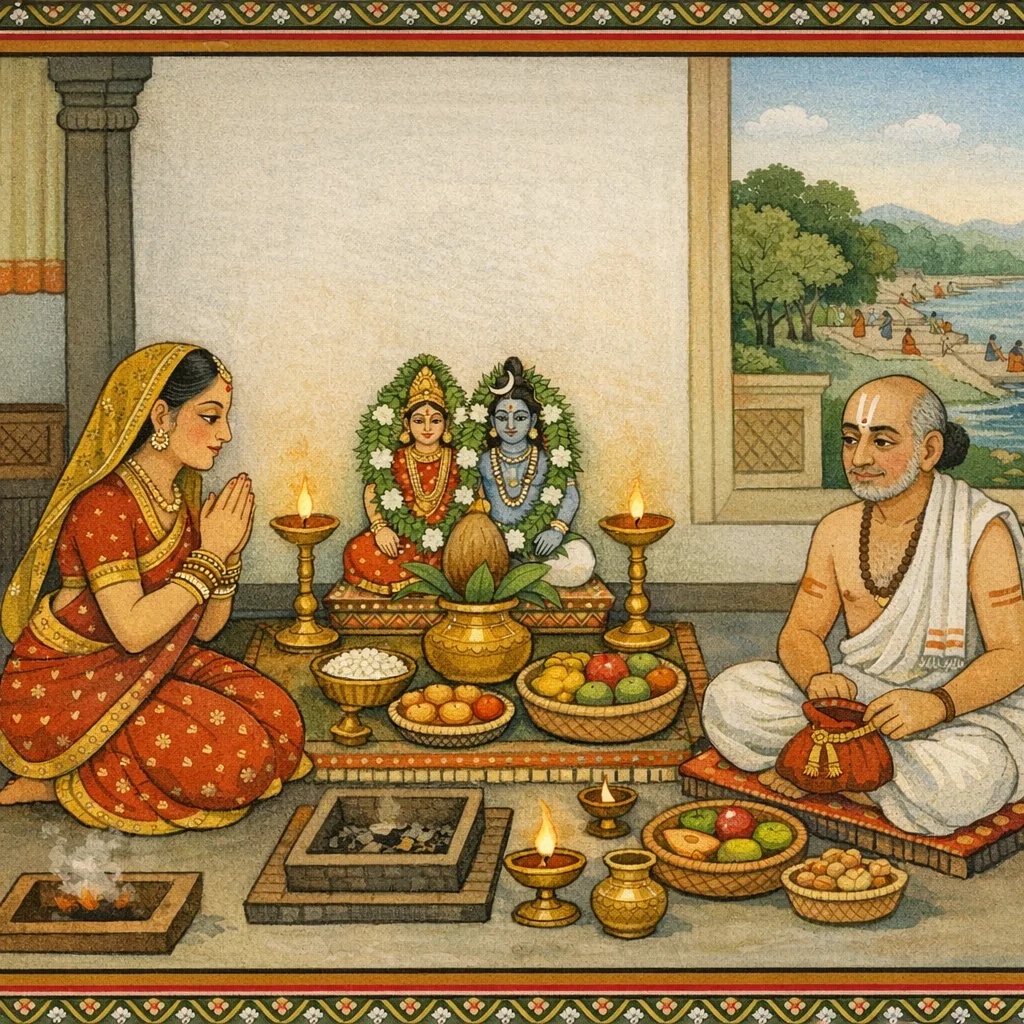
Sanātana instructs Nārada on vows connected with the lunar third day (Tṛtīyā), emphasizing women’s rites for saubhāgya (marital auspiciousness), progeny, and household welfare. It begins with the Caitra śukla-tṛtīyā Gaurī-vrata: making a paired image of Gaurī with her husband (metal or clay), worship with dūrvā and ornaments, fasting, night vigil, gifting to the teacher, and immersion. It then describes long observance for 12 years with concluding dāna (dhenudvādaśa-saṅkalpa). Next is Akṣayā (Rādhā) Tṛtīyā, when merit becomes inexhaustible; the tithi is linked to yuga-beginnings, and worship of Viṣṇu–Śrī, bathing in the Gaṅgā, use of akṣata, and feeding brāhmaṇas are prescribed. Month-wise forms follow: Rambhā-vrata (Jyeṣṭha), Keśava–Lakṣmī worship (Āṣāḍha), Svarṇa-Gaurī (Bhādrapada) with a 16-year cycle and udyāpana with homa and vāyana distribution, Hāritālaka, Hasta-Gaurī (with Hasta nakṣatra), Koṭīśvarī/Lakṣeśvarī (4-year vow with one-lakh grains and a milk-based icon), a Great Gaurī-vrata (Īṣa, 5 years) honoring five suvāsinīs and ritual vessels, and other paired vows (Viṣṇu-Gaurī, Hara–Gaurī, Brahma-Gaurī, Saubhāgya-sundarī). The chapter ends by standardizing the Tṛtīyā pattern: Devī worship, honoring brāhmaṇas, charity, homa, and visarjana.
Shlokas
Verse 1
सनातन उवाच । श्रृणु नारद वक्ष्यामि तृतीयाया व्रतानि ते । यानि सम्यग्विधायाशु नारी सौभाग्यमाप्नुयात् ॥ १ ॥
Sanātana said: Listen, O Nārada; I shall tell you the vows of the third lunar day (Tṛtīyā). By performing them correctly, a woman quickly attains auspicious married fortune (saubhāgya) and well-being.
Verse 2
चैत्रशुक्लतृतीयायां गौरीं कृत्वा सभर्तृकाम् । सौवर्णा राजतीं वापि ताम्नीं वा मृण्ययीं द्विज ॥ २ ॥
O twice-born one, on the Tṛtīyā of the bright fortnight of Caitra, one should fashion an image of Gaurī together with her husband—made of gold, or of silver, or of copper, or else of clay.
Verse 3
अभ्यर्च्य गन्धपुष्पाद्यैर्वस्त्रैराभरणैः शुभैः । दूर्वाकांडैश्च विधिवत्सोपवासा तु कन्यका ॥ ३ ॥
After duly worshipping with fragrances, flowers and the like, with auspicious garments and ornaments, and with blades of dūrvā grass as prescribed, the young maiden should then observe a fast (upavāsa).
Verse 4
वरार्थिनी च सौभाग्यपुत्रभर्त्रर्थिनी तथा । द्विजभार्या भर्तृमतीः कन्यकां वा सुलक्षणाः ॥ ४ ॥
A maiden seeking a worthy husband; a woman desiring auspicious fortune; one yearning for a son or for her husband’s welfare; likewise the wife of a twice-born (brāhmaṇa) who lives united with her husband, or a young girl marked with auspicious signs—all these are fit to be included here.
Verse 5
सिंदूरांजनवस्त्राद्यैः प्रतोष्य प्रीतमानसा । रात्रौ जागरणं कुर्याद्व्रतसंपूर्तिकाम्यया ॥ ५ ॥
With a delighted mind, one should please the deity by offering sindūra (vermilion), añjana (collyrium), garments, and the like; and, desiring the vow’s successful completion, one should keep vigil through the night.
Verse 6
ततस्तां प्रतिमां विप्र गुरवे प्रतिपादयेत् । धातुजां मृन्मयीं वा तु निक्षिपेच्च जलाशये ॥ ६ ॥
Then, O brāhmaṇa, one should present that image to one’s teacher (guru); and whether it is made of metal or of clay, one should thereafter immerse it in a reservoir of water.
Verse 7
एवं द्वादशवर्षाणि कृत्वा गौरीव्रतं शुभम् । धेनुद्वादशसंकल्पं दद्यादुत्सर्गसिद्धये ॥ ७ ॥
Thus, having observed the auspicious Gaurī-vrata for twelve years, one should give the vow-gift known as the “dhenudvādaśa-saṅkalpa” (the resolve of twelve cows), so that the rite of final dedication (utsarga) may be successfully fulfilled.
Verse 8
किमत्र बहुनोक्तेन गौरी सौभाग्यदायिनी । स्त्रीणां यथा तथा नान्या विद्यते भुवनत्रये ॥ ८ ॥
What need is there to say much? Gaurī is the bestower of auspicious fortune; for women, in all the three worlds there is no other deity like her.
Verse 9
धनं पुत्रान्पतिं विद्यामाज्ञासिद्धिं यशः सुखम् । लभते सर्वमेवेष्टं गौरीमभ्यर्च्य भक्तितः ॥ ९ ॥
By worshipping Gaurī with devotion, one gains wealth, children, a worthy husband, learning, success in one’s commands, fame, and happiness—indeed, all that one desires.
Verse 10
राधशुक्लतृतीया या साक्षया परिकीर्तिता । तिथिस्त्रोतायुगाद्या सा कृतस्याक्षयकारिणी ॥ १० ॥
That bright-third lunar day (śukla-tṛtīyā) known as Rādhā is praised as “Akṣayā”; it is foremost among the pair of sacred tithis, and whatever is done on it yields inexhaustible merit and fruit.
Verse 11
द्वे शुक्ले द्वे तथा कृष्णे युगादी कवयो विदुः । शुक्ले पूर्वाह्णिके ग्राह्ये कृष्णे चैव तपस्यथ ॥ ११ ॥
The sages know that the yuga-beginnings are fourfold—two in the bright fortnight and two in the dark. When it falls in the bright fortnight, it should be observed in the forenoon; when in the dark fortnight, one should undertake tapas accordingly.
Verse 12
द्वापरं हि कलिर्भाद्रे प्रवृत्तानि युगानि वै । तत्र राधतृतीयायां श्रीसमेतं जगद्गुरुम् ॥ १२ ॥
Indeed, the Dvāpara and Kali ages commence in the month of Bhādrapada. At that time—on the third lunar day called Rādhā-tṛtīyā—one should worship the Guru of the world, together with Śrī (Lakṣmī).
Verse 13
नारायणं समभ्यर्चेत्पुष्पधूपविलेपनैः । यद्वा गंगांभसि स्नातो मुच्यते सर्वकिल्बिषैः ॥ १३ ॥
One should duly worship Nārāyaṇa with flowers, incense, and unguents; or else, by bathing in the waters of the Gaṅgā, one is freed from all sins.
Verse 14
अक्षतैः पूजयेद्विष्णुं स्नायादप्यक्षतैर्नरः । सक्तून्संभोजयेद्विप्रान्स्वयमभ्यवहरेच्च तान् ॥ १४ ॥
A man should worship Viṣṇu with akṣata, unbroken grains, and he should bathe using akṣata as well. He should feed the brāhmaṇas with saktū, barley-flour, and he himself should partake of the same.
Verse 15
एवं कृतविधिर्विप्र नरो विष्णुपरायणः । विष्णुलोकमवाप्नोति सर्वदेवनमस्कृतः ॥ १५ ॥
Thus, O brāhmaṇa, a person who has duly performed the prescribed rite and is wholly devoted to Viṣṇu attains the world of Viṣṇu, revered by all the gods.
Verse 16
अथ ज्येष्ठतृतीया तु शुक्ला रंभेति नामतः । तस्यां सभार्यं विधिवत्पूजयेद्वाह्मणोत्तमम् ॥ १६ ॥
Now, the third lunar day (tṛtīyā) of the bright fortnight in the month of Jyeṣṭha is known by the name Rambhā. On that day one should, according to the prescribed rites, properly worship an excellent brāhmaṇa together with his wife.
Verse 17
गन्धपुष्पांशुकाद्यैस्तु नारी सौभाग्यकाम्यया । रंभाव्रतमिदं विप्र विधिवत्समुपाश्रितम् ॥ १७ ॥
Desiring good fortune in married life, a woman should duly undertake this Rambhā-vrata, O brāhmaṇa, employing fragrances, flowers, garments, and the like, in accordance with the prescribed rite.
Verse 18
ददाति वित्तं पुत्रांश्च मतिं धर्मे शुभावहाम् । अथाषाढतृतीयायां शुक्लायां शुक्लवाससा ॥ १८ ॥
It bestows wealth and sons, and also a wholesome, auspicious inclination toward dharma. Then, on the third lunar day of the bright fortnight of Āṣāḍha, one should wear white garments.
Verse 19
केशवं तु सलक्ष्मीकं सस्त्रीके तु द्विजेऽर्चयेत् । भोजनैः सुरभीदानैर्वस्त्रैश्चापि विभूषणैः ॥ १९ ॥
One should worship Keśava together with Lakṣmī by honoring a brāhmaṇa along with his wife, offering food, the gift of a milch cow, garments, and also ornaments.
Verse 20
प्रियेर्वाक्यैर्भृशं प्रीता नारी सौभाग्यवांछया । समुपास्य व्रतं चैतद्धनधान्यसमन्विता ॥ २० ॥
Delighted greatly by her beloved’s words, a woman—desiring good fortune—should duly observe this vow; then she becomes endowed with wealth and abundant grain.
Verse 21
देवदेवप्रसादेन विष्णुलोकमवाप्नुयात् । नभः शुक्लतृतीयायां स्वर्णगौरीव्रतं चरेत् ॥ २१ ॥
By the grace of the God of gods, one may attain Viṣṇu’s realm. Therefore, on the third lunar day (tṛtīyā) of the bright fortnight in the month of Nabhas (Bhādrapada), one should observe the vow known as the Svarṇa-Gaurī Vrata.
Verse 22
उपचारैः षोडशभिर्भवानीमभिपूजयेत् । पुत्रान्देहि धनं देहि सौभाग्यं देहि सुव्रते ॥ २२ ॥
One should worship Bhavānī with the sixteen ritual offerings, praying: “O Goddess of noble vow, grant me sons; grant me wealth; grant me good fortune.”
Verse 23
अन्यांस्च सर्वकामान्मे देहि देहि नमोऽस्तु ते । एवं संप्रार्थ्य देवेशीं भवानीं भवसंयुताम् ॥ २३ ॥
“And grant me other fulfillments of every desired object—grant them, grant them! Salutations to you.” Thus, having earnestly entreated the Goddess, the sovereign of the gods—Bhavānī, united with Bhava (Śiva)—(he/she continued).
Verse 24
व्रतसंपूर्तिकामा तु वायनं दापयेत्तथा । एवं षोडशवर्षाणि कृत्वा नारी व्रतं शुभम् ॥ २४ ॥
A woman who longs for the full accomplishment of her vow should likewise arrange the giving of the prescribed vāyana offering. Thus, by observing this auspicious vow for sixteen years, she completes it in due manner.
Verse 25
उद्यापनं चरेद्भक्त्या वित्तशाठ्यविवर्जिता । मंडपे मण्डले शुद्धे गणेशादिसुरार्चनम् ॥ २५ ॥
She should perform the concluding rite (udyāpana) with devotion, free from deceit concerning wealth; and, in a clean pavilion and a purified ritual circle, she should worship Gaṇeśa and the other gods.
Verse 26
कृत्वा ताम्रमयं पात्रं कलशोपरिविन्यसेत् । सौवर्णीं प्रतिमां तत्र भवान्याः प्रतिपूजयेत् ॥ २६ ॥
Having prepared a copper vessel, one should place a kalaśa, the sacred water-pot, upon it; and there one should duly worship a golden image of Bhavānī.
Verse 27
गंधपुष्पादिभिः सम्यक् ततो होमं समाचरेत् । वेणुपात्रैः षोडशभिः पक्वान्नपरिपूरितैः ॥ २७ ॥
Then, using fragrances, flowers, and the like in the proper manner, one should duly perform the homa, the fire-offering, employing sixteen bamboo vessels filled completely with cooked food.
Verse 28
समर्प्य देव्यै नैवेद्यं द्विजेष्वेतन्निवेदयेत् । वायनं च ततः पश्चाद्दद्यात्संबन्धिबन्धुषु ॥ २८ ॥
After offering the naivedya, the food-oblation, to the Goddess, one should present that very offering to the dvijas, the Brahmins. Thereafter, one should distribute the vāyana, the ritual gifts and portions, among one’s relatives and kinsfolk.
Verse 29
प्रतिमां गुरवे दत्त्वा द्विजेभ्यो दक्षिणां तथा । पूर्णं लभेत्फलं नारी व्रताचरणतत्परा ॥ २९ ॥
Having offered an icon to her guru and likewise given the prescribed dakṣiṇā to the twice-born, a woman devoted to the observance of her vow attains the full fruit of that vrata.
Verse 30
भाद्रशुक्लतृतीयायां व्रतं वै हारितालकम् । कुर्याद्भक्त्या विधानेन पाद्यार्ध्यार्चन पूर्वकम् ॥ ३० ॥
On the tṛtīyā, the third lunar day of the bright fortnight of Bhādrapada, one should observe the Hāritālaka vow with devotion according to the prescribed rite, beginning with pādya and arghya offerings and then performing worship (arcana).
Verse 31
ततस्तु कांचने पात्रे राजते चापि ताम्रके । वैणवे मृन्मये वापि विन्यस्यान्नं सदक्षिणम् ॥ ३१ ॥
Then, placing the food together with the due dakṣiṇā in a vessel of gold, or of silver, or of copper—indeed even in a bamboo or earthen vessel—one should duly offer it.
Verse 32
सफलं च सवस्त्रं च द्विजाय प्रतिपादयेत् । तदंते पारणं कुर्यादिष्टबन्धुजनैः सह ॥ ३२ ॥
One should present fruits and a garment to a brāhmaṇa. Thereafter, at its conclusion, one should perform the pāraṇa—the proper closing and breaking of the observance—together with dear friends and relatives.
Verse 33
एवं कृतव्रता नारी भुक्त्वा भोगान्मनोरमान् । व्रतस्यास्य प्रभावेण गौरीसहचरीभवेत् ॥ ३३ ॥
Thus, a woman who has duly observed this vow, after enjoying delightful and desirable pleasures, by the power of this vrata becomes a companion of Gaurī (Pārvatī).
Verse 34
सौभाग्यद्रव्यवस्त्राणि वंशपात्राणि षोडश । दातव्यानि प्रयत्नेन ब्राह्मणेभ्यो यथाविधि ॥ ३४ ॥
Auspicious articles, together with garments and the sixteen lineage-vessels (ritual implements), should be given with care to the brāhmaṇas, in the duly prescribed manner.
Verse 35
अन्येभ्यो विप्रवर्येभ्यो दक्षिणां च प्रयत्नतः । भूयसीं च ततो दद्याद्विप्रेभ्यो देवितुष्टये ॥ ३५ ॥
To other excellent brāhmaṇas as well, one should carefully offer the dakṣiṇā (sacrificial fee); thereafter one should give still more generously to the brāhmaṇas, for the Deity’s satisfaction.
Verse 36
एवं या कुरुते नारी व्रतं सौभाग्यवर्द्धनम् । सा तु देवीप्रसादेन सौभाग्यं लभते ध्रुवम् ॥ ३६ ॥
Thus, the woman who performs this vow that increases auspicious fortune surely attains conjugal and worldly good fortune through the grace of the Goddess.
Verse 37
यदा तृतीया भाद्रे तु हस्तर्क्षसहिता भवेत् । हस्तगौरीव्रतं नाम तदुद्दिष्टं हि शौरिणा ॥ ३७ ॥
When, in the month of Bhādrapada, the lunar third day (Tṛtīyā) coincides with the Hasta nakṣatra, that observance is called the Hasta-Gaurī Vrata; indeed, it has been prescribed by Śauri (Śrī Viṣṇu/Kṛṣṇa).
Verse 38
तथा कोटीश्वरी नाम व्रतं प्रोक्तं पिनाकिना । लक्षेश्वरी चैव तथा तद्विधानमुदीर्यते ॥ ३८ ॥
Likewise, the vow called Koṭīśvarī was declared by Pinākin (Śiva); and similarly the vow called Lakṣeśvarī is also set forth, along with its prescribed procedure.
Verse 39
अस्यां व्रतं तु संग्राह्यं यावद्वर्षचतुष्टयम् । उपवासेन कर्तव्यं वर्षे वर्षे तु नारद ॥ ३९ ॥
This sacred vow should be undertaken in this manner for a span of four years; and, O Nārada, each year it is to be performed with fasting.
Verse 40
अखंडानां तंडुलानां तिलानां वा मुनीश्वर । लक्षमेकं विशोध्याथ क्षिपेत्पयसि संसृते ॥ ४० ॥
O best of sages, having purified one lakh of unbroken rice-grains—or sesame seeds—one should then cast them into milk that has been properly prepared.
Verse 41
तत्पक्वेन तु निर्माय देव्या मूर्तिं सुशोमनाम् । प्रकरे गंधपुष्पाणां पुष्पमालाविभूषिताम् ॥ ४१ ॥
Then, using that well-prepared, cooked material, one should fashion a beautiful idol of the Goddess, adorning it with garlands and surrounding it with fragrant flowers.
Verse 42
संस्थाप्य पार्वतीं तत्र पूजयेद्भक्तिभावितः । गन्धैः पुष्पैस्तथा धूपैर्दीपैर्नैवेद्यविस्तरैः ॥ ४२ ॥
Having installed Pārvatī there, one should worship her with a mind filled with devotion—using fragrances, flowers, incense, lamps, and abundant offerings of food (naivedya).
Verse 43
विविधैश्च फलैर्विप्र नमस्कृत्य क्षमापयेत् । ततो विसर्जयद्देवीं जलमध्येऽथ दक्षिणाम् ॥ ४३ ॥
O brāhmaṇa, having offered various fruits, one should bow down and ask the Devī’s forgiveness. Thereafter, one should respectfully dismiss her (visarjana) in the midst of water, and then give the dakṣiṇā.
Verse 44
दत्त्वा विधिज्ञविप्रेभ्यो भुञ्जीयाच्च परे दिने । इति ते कथितं विप्र कोटिलक्षेश्वरीव्रतम् ॥ ४४ ॥
Having given the prescribed gifts to brāhmaṇas skilled in ritual procedure, one should then take one’s meal on the following day. Thus, O brāhmaṇa, the Koṭilakṣeśvarī vow has been explained to you.
Verse 45
गौरीलोकं प्रयात्यंते व्रतस्यास्य प्रभावतः । इषशुक्लतृतीयायां बृहद्गौरीव्रतं चरेत् ॥ ४५ ॥
By the power of this vow, one attains the realm of Gaurī. Therefore, on the third lunar day (tṛtīyā) of the bright fortnight in the month of Īṣa, one should observe the Great Gaurī-vrata.
Verse 46
पंचवर्षं विधानेन पूर्वोक्तेनैव नारद । आचार्यं पूजयेदंते विप्रानन्यान्धनादिभिः ॥ ४६ ॥
O Nārada, for five years—following the very procedure described earlier—one should, at the conclusion, honor the teacher (ācārya), and also the other brāhmaṇas, with gifts such as wealth and the like.
Verse 47
सुवासिनीः पंच पूज्या वस्त्रालंकारचन्दनैः । कंचुकैश्चैव ताटंकैः कंठसूत्रैर्हरिप्रियाः ॥ ४७ ॥
Five auspicious married women (suvāsinīs) who are dear to Hari should be worshipped with garments, ornaments, and sandal-paste, and also with bodices (kancuka), ear-ornaments, and sacred neck-threads.
Verse 48
वंशपात्राणि पंचैव सूत्रैः संवेष्टितानि च । सिंदूरं जीरकं चैव सौभाग्यद्रव्यसंयुतम् ॥ ४८ ॥
Five bamboo vessels, wrapped with threads, should be prepared; along with sindūra (vermilion) and jīraka (cumin), together with substances that bestow saubhāgya—auspicious good fortune.
Verse 49
गोधीमपिष्टजातं च नवापूपं फलादिकम् । वायनानि च पंचैव ताभ्यो दद्याच्च भोजयेत् ॥ ४९ ॥
One should also offer preparations made from wheat flour, freshly made cakes, and fruits and the like; and having prepared five sets of vāyana offerings, one should give them to those recipients and also feed them.
Verse 50
अर्घं दत्त्वा वायनानि पश्चाद्भुंजीत वाग्यता । तत्फलं धारयेत्कंठे सर्वकामसमृद्धये ॥ ५० ॥
After offering arghya and then presenting the prescribed vāyana gifts, one should eat afterwards, maintaining restraint of speech. One should wear that fruit at the neck, for the complete fulfilment and prosperity of all desired aims.
Verse 51
ततः प्रातः समुत्थाय सालंकारा सखीजनैः । गीतवाद्ययुता नद्यां गौरीं तां तु विसर्जयेत् ॥ ५१ ॥
Then, rising early in the morning, adorned and accompanied by her circle of friends—with singing and musical instruments—she should immerse (send off) that image of Gaurī into the river.
Verse 52
आहूतासि मयाभद्रे पूजिता च यथा विधि । मम सौभाग्यदानाय यथेष्टं गम्यतां त्वया ॥ ५२ ॥
O auspicious Lady, you have been invoked by me and duly worshipped according to the prescribed rites. Now, to grant me good fortune, depart as you wish.
Verse 53
एवं कृत्वा व्रतं भक्त्या द्विज देवीप्रसादतः । भुक्त्वा भोगांस्तु देहांते गौरीलोकमवाप्नुयात् ॥ ५३ ॥
O brāhmaṇa, having thus performed the vow with devotion, by the Goddess’s grace one enjoys the desired pleasures; and at the end of the body (after death) one attains the world of Gaurī (Gaurī-loka).
Verse 54
ऊर्जशुक्लतृतीयायां विष्णुगौरीव्रतं चरेत् । पूजयित्वा जगद्वन्द्यामुपचारैः पृथग्विधैः ॥ ५४ ॥
On Tṛtīyā, the third lunar day of the bright fortnight in the month of Ūrja, one should observe the Viṣṇu–Gaurī vow. Having worshiped the World‑Revered Goddess with various distinct ritual offerings (upacāras), one should duly bring the rite to completion.
Verse 55
सुवासिनीं भोजयित्वा मङ्गलद्रव्यपूजिताम् । विसर्जयेत्प्रणम्यैनां विष्णुगौरीप्रतुष्टये ॥ ५५ ॥
After feeding a suvasinī—a blessed married woman—and honoring her with auspicious offerings, one should respectfully bid her farewell with reverent obeisance, so that Viṣṇu and Gaurī may be fully pleased.
Verse 56
मार्गशुक्लतृतीयायां हरगौरीव्रतं शुभम् । कृत्वा पूर्वविधानेन पूजयेज्जगदंबिकाम् ॥ ५६ ॥
On Tṛtīyā, the third lunar day of the bright fortnight in the month of Mārgaśīrṣa, one should undertake the auspicious Hara–Gaurī vow; and, following the procedure stated earlier, worship Jagadambikā, the Mother of the universe.
Verse 57
एतद्व्रतप्रभावेण भुक्त्वा भोगान्मनोरमान् । देवीलोकं समासाद्य मोदते च तया सह ॥ ५७ ॥
By the power of this vow, having enjoyed delightful and desired pleasures, one attains the world of the Goddess and rejoices there together with her.
Verse 58
पौषशुक्लतृतीयायां ब्रह्मगौरीव्रतं चरेत् । पूर्वोक्तेन विधानेन पूजितापि द्विजोत्तम ॥ ५८ ॥
On Tṛtīyā, the third lunar day of the bright fortnight in the month of Pauṣa, one should undertake the Brahma–Gaurī vow. O best of the twice-born, she too is to be worshiped according to the procedure already described.
Verse 59
ब्रह्मगौरीप्रसादेन मोदते तत्र संगता । माघशुक्लतृतीयायां पूज्या सौभाग्यसुंदरी ॥ ५९ ॥
By the grace of Brahma-Gaurī, she rejoices there in the company of others. On Tṛtīyā, the third lunar day of the bright fortnight of Māgha, Saubhāgya-sundarī is to be worshipped.
Verse 60
पूर्वोक्तेन विधानेन नालिकेरार्घ्यदानतः । प्रसन्ना दिशति स्वीयं लोकं तु व्रततोषिता ॥ ६० ॥
In the manner described earlier, by offering arghya with a coconut, the Goddess—pleased and satisfied by the observance of the vow—grants the devotee her own divine realm.
Verse 61
फाल्गुनस्य सिते पक्षे तृतीया कुलसौख्यदा । पूजिता गन्धपुष्पाद्यैः सर्वमङ्गलदा भवेत् ॥ ६१ ॥
On Tṛtīyā, the third lunar day of the bright fortnight in Phālguna, this observance bestows happiness upon one’s family. When honored with fragrances, flowers, and the like, it becomes a giver of every auspicious blessing.
Verse 62
सर्वासु च तृतीयासु विधिः साधारणो मुने । देवीपूजा विप्रपूजा दानं होमो विसर्जनम् ॥ ६२ ॥
O sage, on every Tṛtīyā the observance is generally the same: worship of the Goddess, honoring of brāhmaṇas, charity, a fire-offering (homa), and the concluding dismissal (visarjana).
Verse 63
इत्येवं कथितानीह तृतीयाया व्रतानि ते । भक्त्या कृतानि चेष्टांस्तु कामान्दर्द्युमनोगतान् ॥ ६३ ॥
Thus, the vows of Tṛtīyā, as told here to you, when performed with devotion (bhakti), accomplish the desired aims that dwell within one’s mind.
Verse 64
इति श्रीबृहन्नारदीयपुराणे पूर्वभागे बृहदुपाख्याने चतुर्थपादे द्वादशमासतृतीयाव्रतकथनं नाम द्वादशाधिकशततमोऽध्यायः ॥ ११२ ॥
Thus ends the one-hundred-and-twelfth chapter—called “The Account of the Third-day Vow observed through the Twelve Months”—in the First Part of the Śrī Bṛhannāradīya Purāṇa, within the Great Narrative (Bṛhad-upākhyāna), in the Fourth Section (Pāda).
Frequently Asked Questions
It is declared the foremost sacred tithi because whatever is done on it becomes ‘akṣaya’—inexhaustible in merit and result; accordingly, the chapter prescribes Viṣṇu–Śrī worship, akṣata-based offerings/bathing, brāhmaṇa feeding, and links observance timing to larger cosmological markers (yuga-beginnings).
A consistent ritual grammar appears: Devī worship (often ṣoḍaśopacāra), fasting (upavāsa), night vigil (jāgaraṇa) in some vratas, honoring brāhmaṇas and the teacher with dāna/dakṣiṇā, optional homa, proper concluding rites (udyāpana/utsarga), and dismissal/immersion (visarjana).
The chapter explicitly centers women: maidens seeking a worthy husband, married women seeking saubhāgya, those desiring sons or the husband’s welfare, and auspiciously marked girls; several rites also include honoring brāhmaṇas with their wives and worship of suvāsinīs.