Kūrmāpurāṇa-Anukramaṇikā (Index/Summary of the Kūrma Purāṇa)
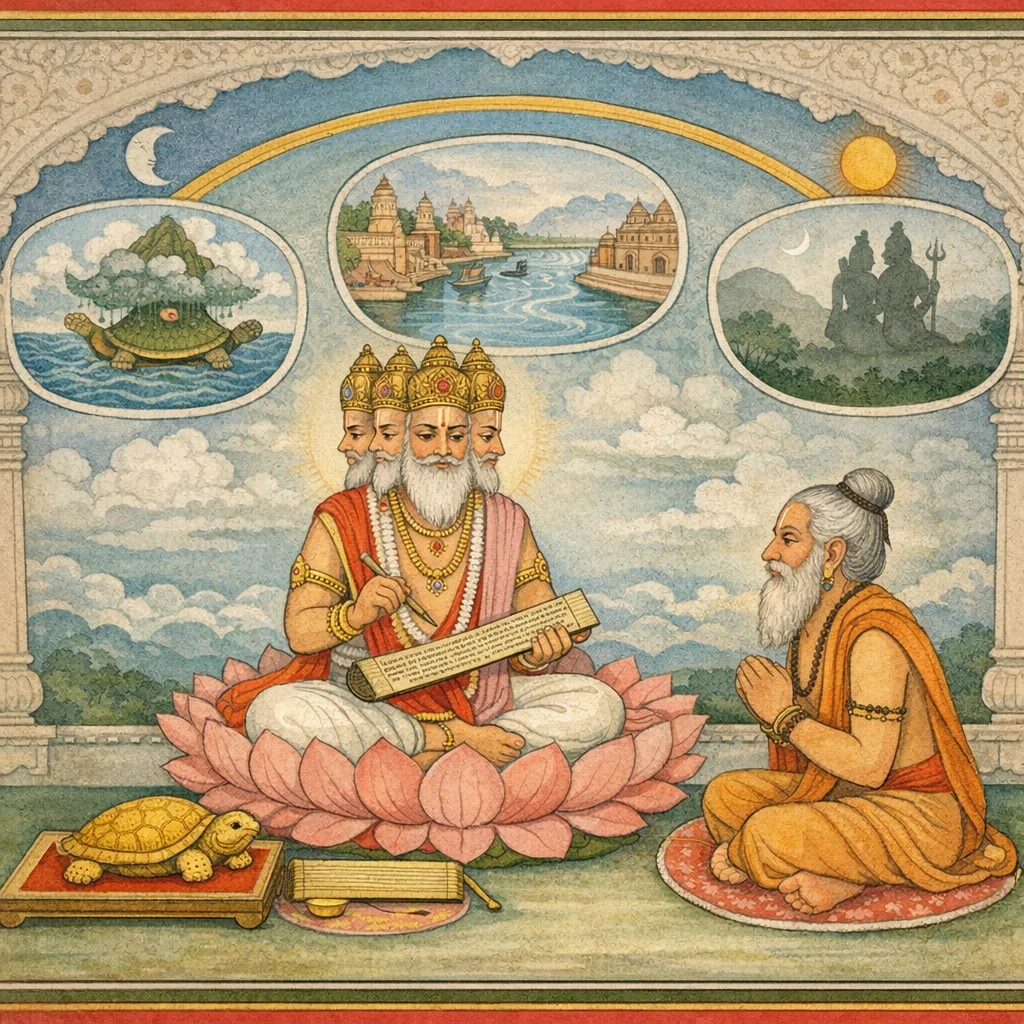
Brahmā instructs Marīci by giving a structured synopsis of the Kūrma Purāṇa, said to follow the Lakṣmī-kalpa and to center on Hari in His tortoise form. The work is framed as a four-part compilation of 17,000 verses teaching the four puruṣārthas through interwoven narratives, including the Lakṣmī–Indradyumna dialogue and sages connected with Kūrma. It lists doctrinal sections on varṇa–āśrama conduct, cosmogenesis, time-reckoning and pralaya with hymns to the all-pervading Lord, and Śiva-focused materials such as the Śaṅkara narrative, Pārvatī-sahasranāma, and yoga. Genealogies (Bhṛgu, Svāyambhuva Manu, Kaśyapa, Ātreya), episodes like the destruction and re-creation of Dakṣa’s yajña, Kṛṣṇa’s deeds, yuga-dharma, Vyāsa–Jaimini discussions, sacred geographies (Vārāṇasī, Prayāga), and Vedic-branch exposition are also noted. The chapter mentions embedded gītās (Aiśvarī, Vyāsa-gītā), tīrtha-māhātmya passages, pratisarga as the Brāhmīya Saṃhitā, and the Bhāgavatī Saṃhitā on varṇa livelihoods (including a five-pāda exposition attributed to Saṅkaraja), along with a Saurī teaching and a Vaiṣṇavī caturthī vrata. It ends with phalaśruti and a donation rite: copy the text with a golden tortoise emblem and gift it at ayana for supreme attainment.
Shlokas
Verse 1
ब्रह्मोवाच । श्रृणु वत्स मरीचे त्वं पुराणं कूर्मसंज्ञकम् । लक्ष्मीकल्पानुचरितं यत्र कूर्मवपुर्हरिः ॥ १ ॥
Brahmā said: “Listen, dear child Marīci, to the Purāṇa known as the Kūrma (Purāṇa), which follows the account of the Lakṣmī-kalpa, and in which Hari (Viṣṇu) is described as having assumed the form of the Tortoise.”
Verse 2
धर्मार्थकाममोक्षाणां माहात्म्यं च पृथक्पृथक् । इंद्रद्युम्नप्रसंगेन प्राहर्षिभ्यो दयान्वितः ॥ २ ॥
With compassion, he spoke to the sages—taking up the episode of Indradyumna—about the distinct greatness of dharma, artha, kāma, and mokṣa, each in turn.
Verse 3
तत्सप्तदशसाहस्रं सुचतुः संहितं शुभम् । यत्र ब्राह्माः पुरा प्रोक्ता धर्मा नानाविधा मुने ॥ ३ ॥
That work comprises seventeen thousand verses—a fine and auspicious compilation in four sections—wherein, O sage, the Brahmā-born seers of old taught many kinds of dharma.
Verse 4
नाननाकथाप्रसंगेन नृणां सद्गतिदायकाः । तत्र पूर्वविभागे तु पुराणोपक्रमः पुरा ॥ ४ ॥
Through the interweaving of many narrative episodes, these teachings become bestowers of a noble destiny for human beings. In that work, in the earlier section, the ancient introductory framework of the Purāṇa was set forth.
Verse 5
लक्ष्मींद्रद्युम्नसंवादः कूर्म्मर्षिगणसंकथा । वर्णाश्रमाचारकथा जगदुत्पत्तिकीर्तनम् ॥ ५ ॥
It contains: the dialogue between Lakṣmī and King Indradyumna; the account of the sages associated with the Kūrma incarnation; the discourse on proper conduct for the varṇas and āśramas; and the narration of the origin of the universe.
Verse 6
कालसंख्या समासेन लयांते स्तवनं विभोः । ततः संक्षेपतः सर्गः शांकरं चरितं तथा ॥ ६ ॥
In brief, the reckoning of time is described; then the dissolution at the end is spoken of, along with a hymn in praise of the All-pervading Lord. After that, creation is summarized, and likewise the sacred account of Śaṅkara (Śiva) is related.
Verse 7
सहस्रनाम पार्वत्या योगस्य च निरूपणम् । भृगुवंशसमाख्यानं ततः स्वायम्भुवस्य च ॥ ७ ॥
It includes the thousand names of Pārvatī, an exposition of Yoga, the narration of the lineage of Bhṛgu, and thereafter the account of Svāyambhuva (Manu).
Verse 8
देवादीनां समुत्पत्तिर्दक्षयज्ञाहतिस्ततः । दक्षसृष्टिकथा पश्चात्कश्यपान्वयकीर्तनम् ॥ ८ ॥
Then is described the origin of the gods and other beings; thereafter the destruction of Dakṣa’s sacrifice; next the account of Dakṣa’s creation; and finally the narration of Kaśyapa’s lineage.
Verse 9
आत्रेयवंशकथनं कृष्णस्यं चरितं शुभम् । मार्तंडकृष्णसंवादो व्यासपाण्डवसंकथा ॥ ९ ॥
It contains the narration of the lineage of Ātreya; the auspicious deeds of Kṛṣṇa; the dialogue between Mārtaṇḍa and Kṛṣṇa; and the account concerning Vyāsa and the Pāṇḍavas.
Verse 10
युगधर्मानुकथनं व्यासजैमिनिकीर्तनम् । वाराणस्याश्च माहात्म्यं प्रयागस्य ततः परम् ॥ १० ॥
It then recounts the duties of Dharma for the different ages (yugas), and speaks of Vyāsa and Jaimini; thereafter it proclaims the greatness of Vārāṇasī, and then, beyond that, the greatness of Prayāga.
Verse 11
त्रैलोक्यवर्णनं चैव वेदशाखानिरूपणम् । उत्तरेऽस्या विभागे तु पुरा गीतैश्वरी ततः ॥ ११ ॥
It contains, indeed, a description of the three worlds and an exposition of the branches of the Veda. And then, in its later division, there is the ancient Gītā called “Aiśvarī” (the Lordly/Divine Song).
Verse 12
व्यासगीता ततः प्रोक्ता नानाधर्मप्रबोधिनी । नानाविधानां तीर्थानां माहात्म्यं च पृथक् ततः ॥ १२ ॥
Thereafter, the Vyāsa-gītā was taught—awakening understanding of many forms of dharma. Then, separately, the greatness (māhātmya) of many kinds of sacred pilgrimage places (tīrthas) was also described.
Verse 13
प्रतिसर्गप्रकथनं ब्राह्मीयं संहिता स्मृता । अतः परं भागवतीसंहितार्थ निरूपणम् ॥ १३ ॥
The narration of the secondary creation (pratisarga) is remembered as the Brāhmīya Saṃhitā. Henceforth, the meaning of the Bhāgavatī Saṃhitā shall be expounded.
Verse 14
कथिता यत्र वर्णानां पृथक्वृत्तिरुदाहृता । पादऽस्याः प्रथमे प्रोक्ता ब्राह्मणानां व्यवस्थितिः ॥ १४ ॥
Here are described the distinct modes of conduct and livelihood of the varṇas; and in its first section (pāda) are set forth the proper discipline and established duties of the Brāhmaṇas.
Verse 15
सदा चागत्मिका वत्स भोगसौख्यविवर्द्धनी । द्वितीये क्षत्त्रियाणां तु वृत्तिः सम्यक्प्रकीर्तिता ॥ १५ ॥
And, dear child, it is ever connected with “receiving/income” and increases enjoyment and comfort. In the second section, the proper livelihood and conduct of the Kṣatriyas has been rightly declared.
Verse 16
यया त्वाश्रितया पापं विधूयेह व्रजेद्दिवम् । तृतीये वैश्यजातीनां वृत्तिरुक्ता चतुर्विधा ॥ १६ ॥
By taking refuge in it, one washes away sin here itself and goes to heaven. In the third section, the fourfold means of livelihood for the Vaiśyas is described.
Verse 17
यया चरितया सम्यग्लभे गतिमुत्तमाम् । चतुर्थेऽस्यास्तथा पादे शूद्रवृत्तिरुदाहृता ॥ १७ ॥
By living in accordance with that prescribed discipline, one rightly attains the highest goal. Likewise, in its fourth section, the duties and livelihood of the Śūdras are also described.
Verse 18
यया संतुष्यति श्रीशो नृणां श्रेयोविवर्द्धनः । पंचमेऽस्यास्ततः पादे वृत्तिः संकरजोदिता ॥ १८ ॥
That discipline by which Śrīśa (Viṣṇu, the Lord of Lakṣmī) is pleased—and by which the highest welfare of humankind is increased—was expounded by Saṅkaraja in the fifth pāda that follows.
Verse 19
यया चरितयाप्नोति भाविनीं गतिमुत्तमाम् । इत्येषा पंचपद्युक्ता द्वितीया संहिता मुने ॥ १९ ॥
By practicing this and living in accordance with it, one attains the supreme destination that lies ahead. Thus, O sage, this is the second Saṃhitā, consisting of five verses.
Verse 20
तृतीयात्रोदिता सौरी नॄणां कार्यविधायिनी । षोढा षट्कर्मसिर्द्धि बोधयन्ती च कामिनाम् ॥ २० ॥
The third teaching proclaimed here is the Saurī, the science of the Sun: it prescribes the proper method for human undertakings and, in sixfold form, instructs seekers of results in the accomplishment of the six ritual operations (ṣaṭkarman).
Verse 21
चतुर्थीवैष्णवो नाम मोक्षदा परिकीर्तिता । चतुष्पदी द्विजातीनां साक्षाद्ब्रह्मस्वरूरिणी ॥ २१ ॥
The fourth day is called Vaiṣṇavī and is praised as the giver of mokṣa, liberation. For the twice-born it is a complete, fourfold sacred observance, directly embodying the very nature of Brahman.
Verse 22
ताः क्रमात्षट्चतुर्द्वीषुसाहस्राः परिकीर्तिताः ॥ २२ ॥
These, in due order, are declared to be six thousand, four thousand, and two thousand.
Verse 23
एतत्कूर्मपुराणं तु चतुर्वर्गफलप्रदम् । पठतां श्रृण्वतां नॄणां सर्वोत्कृष्टगतिप्रदम् ॥ २३ ॥
This Kūrma Purāṇa bestows the fruits of the four aims of life; for those who read it or listen to it, it grants the highest and most excellent spiritual destination.
Verse 24
लिखित्वैतत्तु यो भक्त्या हेमकूर्मसमन्वितम् । ब्राह्मणायायने दद्यात्स याति परमां गतिम् ॥ २४ ॥
But whoever, with devotion, has this text written out, together with a golden tortoise emblem, and gives it to a brāhmaṇa at the time of ayana, attains the supreme state.
Verse 25
इति श्रीबृहन्नारदीयपुराणे पूर्वभागे बृहदुपाख्याने चतुर्थपादे कूर्मपुराणानुक्रमणीकथनं नाम षडुत्तरशततमोऽध्यायः ॥ १०६ ॥
Thus ends the one-hundred-and-sixth chapter of the first (Pūrva) part of the Śrī Bṛhannāradīya Purāṇa, in the Great Narrative, in the Fourth Section, entitled “The Account of the Index/Summary of the Kūrma Purāṇa.”
Frequently Asked Questions
Because the synopsis explicitly states that the Kūrma Purāṇa teaches dharma, artha, kāma, and mokṣa in sequence through narrative interweaving, positioning it as a puruṣārtha-integrated Purāṇa rather than a single-theme treatise.
The phalaśruti frames it as a meritorious dāna aligned with Viṣṇu’s Kūrma form; copying the text and donating it at ayana (a solstitial sacred juncture) is prescribed as a direct cause for attaining the supreme state.
It compresses a broad doctrinal library—cosmology, yuga-dharma, varṇa–āśrama norms, yoga, Śaiva–Śākta modules, genealogies, tīrtha geography, and embedded gītās—into an indexable outline that enables cross-referencing across Purāṇic literature.