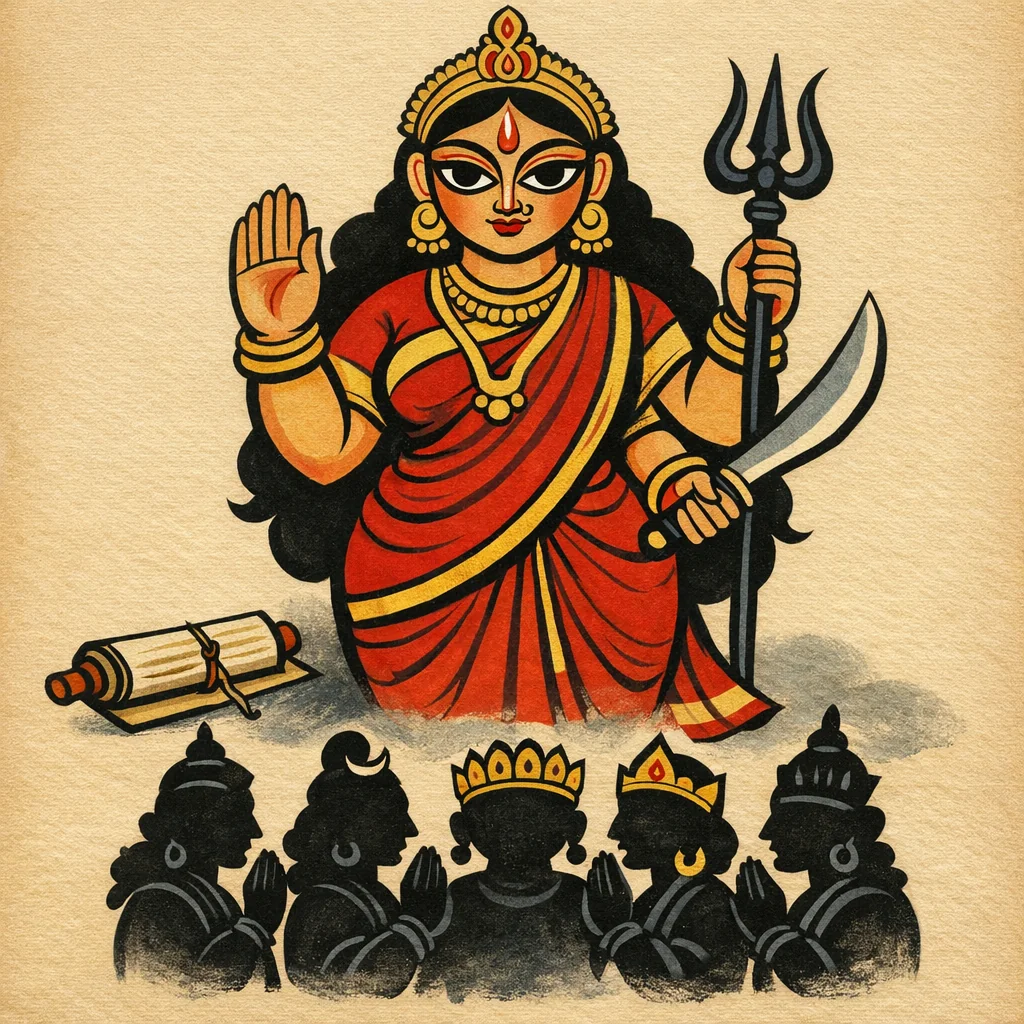
Adhyaya 92: Devi’s Assurance of Protection and the Fruits of Reciting the Devi Mahatmyam
देवीमाहात्म्य-फलश्रुति (DevīMāhātmya-Phalaśruti)
Blessings of Knowledge
This chapter proclaims the Goddess’s assurance of protection for all who, with faith, listen to, read, or recite the Devi Mahatmyam. She dispels fear, calamity, disease, and obstacles, and grants victory, peace, prosperity, and well-being. It also sets forth the phalaśruti—the sacred fruits of recitation—especially when performed at auspicious times and with pure-hearted worship and devotion.
Divine Beings
Celestial Realms
Key Content Points
Focus Keywords
Shlokas in Adhyaya 92
Verse 1
देव्युवाच एभिः स्तवैश्च मां नित्यं स्तोष्यते यः समाहितः । तस्याहं सकलां बाधां नाशयिष्याम्यसंशयम् ॥
The Goddess said: Whoever, with mind collected, continually praises me with these hymns—of that devotee I shall surely destroy every affliction, without doubt.
Verse 2
मधुकैटभनाशं च महिषासुरघातनम् । कीर्तयिष्यन्ति ये तद्वद्वधं शुम्भनिशुम्भयोः ॥
Those who recount the destruction of Madhu and Kaiṭabha, the slaying of Mahiṣāsura, and likewise the killing of Śumbha and Niśumbha—(they gain the Devī’s favor and protection, as the phalaśruti continues).
Verse 3
अष्टम्यां च चतुर्दश्यां नवम्यां चैकचेतसः । स्तोष्यन्ति चैव ये भक्त्या मम माहात्म्यमुत्तमम् ॥
Those who, with one-pointed mind, devoutly praise my supreme Māhātmya on the eighth, the fourteenth, and the ninth lunar days—(they receive the promised blessings).
Verse 4
न तेषां दुष्कृतं किञ्चिद् दुष्कृतोत्था न चापदः । भविष्यति न दारिद्र्यं न चैवेष्टवियोजनम् ॥
For them there will be no wrongdoing that bears fruit, nor calamity arising from wrongdoing; there will be no poverty, nor separation from what is dear.
Verse 5
शत्रुतो न भयं तस्य दस्युतो वा न राजतः । न शस्त्रानलतोयौघात् कदाचित् सम्भविष्यति ॥
For that devotee no fear will arise from enemies, from robbers, or from the king; nor will there ever be danger from weapons, fire, or floods of water.
Verse 6
तस्मान्ममैन्माहात्म्यं पठितव्यं सहाहितैः । श्रोतव्यं च सदा भक्त्या परं स्वस्त्ययनं महत् ॥
Therefore this Māhātmya of mine should be recited by those who are attentive; and it should always be listened to with devotion—for it is the supreme and great rite of auspicious well-being (svastyayana).
Verse 7
उपसर्गानशेषांस्तु महामारीसमुद्भवान् । तथा त्रिविधमुत्पातं माहात्म्यं शमयेन्रमम् ॥
But my Māhātmya will pacify all afflictions arising from great epidemics, and likewise the threefold portents (utpāta).
Verse 8
यत्रैतत् पठ्यते सम्यङ्नित्यमायतने मम । सदा न तद्विमोक्ष्यामि सान्निध्यं तत्र मे स्थितम् ॥
Wherever this is properly recited daily in my shrine, I shall never forsake that place; my presence abides there.
Verse 9
बलिप्रदाने पूजायामग्निकार्ये महोत्सवे । सर्वं ममैत्तच्चरितमुच्चार्यं श्राव्यमेव च ॥
At the giving of offerings (bali), in worship (pūjā), in fire-rites, and in great festivals—this entire account of my deeds should be recited aloud and indeed also made to be heard.
Verse 10
जानताजानता वापि बलिपूजां तथा कृताम् । प्रतीच्छिष्याम्यहं प्रीत्या वह्निहोमं तथा कृतम् ॥
Whether done knowingly or unknowingly, I accept with delight such worship with offerings (bali and pūjā), and likewise the fire-offering (homa) performed in that manner.
Verse 11
शरत्काले महापूजा क्रियते या च वार्षिकी । तस्यां ममैतन्माहात्म्यं श्रुत्वा भक्तिसमन्वितः ॥
In the autumn season the great annual worship is performed. On that occasion, whoever hears this My Māhātmya with devotion attains the fruits that have been promised.
Verse 12
सर्वबाधाविनिर्मुक्तो धनधान्यसमन्वितः । मनुष्यो मत्प्रसादेन भविष्यति न संशयः ॥
By My grace a person is freed from all afflictions and endowed with wealth and grain—of this there is no doubt.
Verse 13
श्रुत्वा ममैतन्माहात्म्यं तथोत्पत्तीः पृथक् शुभाः । पराक्रमं च युद्धेषु जायते निर्भयः पुमान् ॥
Having heard this My Māhātmya, and also the auspicious accounts of the Devī’s manifestations separately, a man gains valor in battles and becomes fearless.
Verse 14
रिपवः संक्षयं यान्ति कल्याणं चोपपद्यते । नन्दते च कुलं पुंसां माहात्म्यं मम शृण्वताम् ॥
Enemies go to ruin; well-being arises; and the family of those who hear My Māhātmya rejoices and flourishes.
Verse 15
शान्तिकर्मणि सर्वत्र तथा दुःस्वप्नदर्शने । ग्रहपीडासु चोग्रासु माहात्म्यं शृणुयान्मम ॥
In all pacificatory rites, likewise when bad dreams are seen, and also in fierce afflictions caused by planets, one should hear My Māhātmya.
Verse 16
उपसर्गाः शमं यान्ति ग्रहपीडाश्च दारुणाः । दुःस्वप्नं च नृभिर्दृष्टं सुस्वप्नमुपजायते ॥
Calamities subside, and dreadful afflictions arising from the planets are also pacified. And an evil dream seen by people turns into an auspicious dream.
Verse 17
बालग्रहाभिभूतानां बालानां शान्तिकारकम् । संघातभेदे च नृणां मैत्रीकरणमुत्तमम् ॥
It pacifies children afflicted by bāla-grahas; and when groups of people are split by conflict, it is the best means for restoring friendship.
Verse 18
दुर्वृत्तानामशेषाणां बलहानिकरं परम् । रक्षोभूतपिशाचानां पठनादेव नाशनम् ॥
It is supremely effective in diminishing the strength of all the wicked; and for rākṣasas, bhūtas, and piśācas, it brings destruction merely by its recitation.
Verse 19
सर्वं ममैतन्माहात्म्यं मम सन्निधिकारकम् ॥
All of this My Māhātmya brings about My living presence.
Verse 20
पशुपुष्पार्घ्यधूपैश्च गन्धदीपैस्तथोत्तमैः । विप्राणां भोजनैर्हेमैः प्रॊक्षणीयैरहर्निशम् ॥
With offerings of sacrificial animals, flowers, arghya, and incense; with excellent fragrances and lamps; with feeding of Brahmins, with gold, and with sprinklings of consecrated water—thus, by day and by night, one should worship and propitiate (Her).
Verse 21
अन्यैश्च विविधैर्भोगैः प्रदानैर्वत्सरेण या । प्रीतिर्मे क्रियते सास्मिन् सकृत्सुचरिते श्रुते ॥
The satisfaction (devotional delight) that is produced for Me by various enjoyments and gifts offered over the course of a year—that very same satisfaction arises when this excellent account is heard even once.
Verse 22
श्रुतं हरति पापानि तथाऽरोग्यं प्रयच्छति । रक्षां करोति भूतेभ्यो जन्मनां कीर्तनं मम ॥
When heard, it removes sins and also bestows health. The recitation of My births (manifestations) provides protection from spirits and harmful beings.
Verse 23
युद्धेषु चरितं यन्मे दुष्टदैत्यनिबर्हणम् । तस्मिन् श्रुते वैरिकृतं भयं पुंसां न जायते ॥
When My deeds in battles—where the wicked demons are destroyed—are heard, the fear produced by enemies does not arise in people.
Verse 24
युष्माभिः स्तुतयो याश्च याश्च ब्रह्मर्षिभिः कृताः । ब्रह्मणा च कृतास्तास्तु प्रयच्छन्ति शुभां गतिम् ॥
Those hymns that have been composed by you (the gods), and those composed by the Brahmarṣis, and those composed by Brahmā—these indeed bestow an auspicious destination (a blessed end).
Verse 25
अरण्ये प्रान्तरे वापि दावाग्निपरिवारितः । दस्युभिर्वा वृतः शून्ये गृहीतो वापि शत्रुभिः ॥
Whether in a forest or in a desolate region, surrounded by a wildfire; or hemmed in by bandits in a lonely place; or even seized by enemies—
Verse 26
सिंहव्याघ्रानुयातो वा वने वा वनहस्तिभिः । राज्ञा क्रुद्धेन चाज्ञप्तो वध्यो बन्धगतोऽपि वा ॥
Or if one is pursued by lions and tigers, or by wild elephants in the forest; or if, by an angry king, one is ordered to be executed; or even if one has been bound and imprisoned—
Verse 27
आघूर्णितो वा वातेन स्थितः पोते महार्णवे । पतत्सु चापि शस्त्रेषु संग्रामे भृशदारुणे ॥
Or if, while in a boat on the great ocean, one is tossed about by winds; and even in a battle exceedingly dreadful, when weapons are falling—
Verse 28
सर्वाबाधासु घोरासु वेदनाभ्यर्दितोऽपि वा । स्मरन्ममैत्तच्छरितं नरो मुच्येत सङ्कटात् ॥
In all frightful afflictions, even when tormented by pain, a person who remembers this account of Mine is freed from distress.
Verse 29
मम प्रभावात्सिंहाद्या दस्यवो वैरिणस्तथा । दूरादेव पलायन्ते स्मरतश्चरितं मम ॥
By My power, lions and the like, bandits, and enemies likewise flee from afar when one remembers My deeds.
Verse 30
ऋषिरुवाच इत्युक्त्वा सा भगवती चण्डिका चण्डविक्रमā । पश्यतामेव देवानां तत्रैवान्तरधीयत ॥
The Ṛṣi said: Having spoken thus, that Blessed Goddess—Caṇḍikā, of fierce valor—vanished right there, even as the gods were looking on.
Verse 31
तेऽपि देव्याः निरातङ्काः स्वाधिकारान् यथा पुरा । यज्ञभागभुजः सर्वे चक्रुर्विनिहतारयः ॥
Then those gods too, freed from fear by the Goddess, resumed their rightful offices as before; with their enemies slain, all of them again partook of their shares in the sacrifices.
Verse 32
दैत्याश्च देव्याः निहते शुम्भे देवरिपौ युधि । जगद्विध्वंसके तस्मिन् महोग्रेऽतुलविक्रमॆ । निशुम्भे च महावीर्ये शेषाः पातालमाययुः ॥
And when the Goddess slew Śumbha—the enemy of the gods—in battle, that world-destroying one, terribly fierce and of incomparable prowess, and when Niśumbha too, of great valor, was slain, the remaining daityas went down to Pātāla.
Verse 33
एवं भगवती देवी सा नित्यापि पुनः पुनः । सम्भूय कुरुते भूूप जगतः परिपालनम् ॥
Thus the Blessed Goddess—though eternal—again and again takes form, O king, and brings about the protection of the world.
Verse 34
तयैतन्मोह्यते विश्वं सैव विश्वं प्रसूयते । सा याचिता च विज्ञानं तुष्टा ऋद्धिं प्रयच्छति ॥
By her this whole universe is deluded, and she herself gives birth to the universe. When entreated, she grants knowledge; when pleased, she bestows prosperity.
Verse 35
व्याप्तं तयैतत्सकलं ब्रह्माण्डं मनुजेश्वर । महाकाल्या महाकाले महाकारिस्वरूपया ॥
O lord of men, this entire cosmic egg is pervaded by her—by Mahākālī—at the great time, in her form as the mighty doer of cosmic acts.
Verse 36
सैव काले महामारी सैव सृष्टिर्भवत्यजा । स्थितिं करोति भूतानां सैव काले सनातनी ॥
She alone, at one time, becomes the great pestilence; she alone becomes creation—unborn. She sustains the existence of beings; and at another time she alone, the Eternal, acts accordingly.
Verse 37
भवकाले नृणां सैव लक्ष्मीर्वृद्धिप्रदा गृहे । सैवाभावे तथालक्ष्मीर्विनाशायोपजायते ॥
In times of people’s well-being, she herself becomes Lakṣmī in the home, granting increase; and in times of decline, she becomes Alakṣmī, arising for destruction.
Verse 38
स्तुता सम्पूजिता पुष्पैर्धूपगन्धादिभिस्तथा । ददाति वित्तं पुत्रांश्च मतिं धर्मे गतिं शुभाम् ॥
When praised and duly worshiped with flowers, incense, fragrance, and the like, she grants wealth and children, understanding aligned with dharma, and an auspicious course (destiny/afterlife).
Frequently Asked Questions
The chapter articulates a practical theology of śravaṇa and pāṭha: devotionally reciting and hearing sacred narrative is presented as an efficacious means to transform suffering into well-being. Ethically, it frames worship as cultivating steadiness (samāhita-bhāva), gratitude, and dharmic orientation, with protection and prosperity arising as the ordered consequence of aligning with Devī’s cosmic sovereignty.
While not adding new genealogical data, Adhyaya 92 functions as the liturgical and doctrinal capstone of the Devī Māhātmya embedded in the Sāvarṇika Manvantara. It closes the immediate conflict-cycle (post Śumbha-Niśumbha) by restoring the devas’ yajña-bhāga and re-stabilizing cosmic administration, thereby reaffirming Manvantara order through Devī’s intervention.
It serves as the Devī Māhātmya’s phalaśruti and ritual mandate: Devī promises continual presence where the text is recited, specifies festival and worship settings (bali, pūjā, homa, śaratkāla mahāpūjā), and enumerates protective results against calamities, ग्रहपीडा, nightmares, and spirit-afflictions. The concluding theology universalizes Devī as the all-pervading power behind creation, preservation, prosperity, and dissolution—central to Śākta interpretive tradition.