Adhyaya 81: Suratha and Samadhi Seek Sage Medhas; Introduction to Mahamaya and the Madhukaitabha Origin Account
सुरथ-समाधि-मेधसोपाख्यानम् (Suratha-Samadhi-Medhasopakhyanam)
Death of Nishumbha
King Suratha and the merchant Samadhi, distressed by the loss of kingdom and wealth, approach the sage Medhas seeking understanding. The rishi teaches the majesty of Mahamaya, the divine power that binds beings’ minds through illusion, and begins the origin account of Madhu and Kaitabha.
Divine Beings
Celestial Realms
Key Content Points
Focus Keywords
Shlokas in Adhyaya 81
Verse 1
इति श्रीमार्कण्डेयपुराणेऽशीतितमोऽध्यायः एकाशीतितमोऽध्यायः- ८१/ मार्कण्डेय उवाच सावर्णिः सूर्यतनयो यो मनुः कथ्यतेऽष्टमः । निशामय तदुत्पत्तिं विस्ताराद्गदतो मम ॥
Thus ends the eightieth chapter in the Śrī Mārkaṇḍeya Purāṇa. Chapter eighty-one: Mārkaṇḍeya said—Listen as I describe in detail the origin of Sāvarṇi, the son of the Sun, who is called the eighth Manu.
Verse 2
महामायानुभावेन यथा मन्वन्तराधिपः । स बभूव महाभागः सावर्णिस्तनयो रवेः ॥
By the power of Mahāmāyā, the fortunate Sāvarṇi, son of Ravi (the Sun), became the lord of a Manvantara.
Verse 3
स्वारोचिषेऽन्तरे पूर्वं चैत्रवंशसमुद्भवः । सुरथो नाम राजाभूत् समस्ते क्षितिमण्डले ॥
Formerly, in the Manvantara of Svārociṣa, there was a king named Suratha, born in the lineage of Caitra, who ruled over the entire earth.
Verse 4
तस्य पालयतः सम्यक् प्रजाः पुत्रानिवौरसान् । बभूवुः शत्रवो भूपाः कोलाविध्वंसिनस्तथा ॥
While he protected his subjects properly, like his own true-born sons, hostile kings arose—destroyers of the Kolas as well.
Verse 5
तस्य तैरभवद्युद्धमतिप्रबलदण्डिनः । न्यूनैरपि स तैर्युद्धे कोलाविध्वंसिभिर्जितः ॥
He, though a wielder of very powerful punishment and force, fought with them; yet in that battle he was defeated by those destroyers of the Kolas, even though they were fewer.
Verse 6
ततः स्वपुरमायातो निजदेशाधिपोऽभवत् । आक्रान्तः स महाभागस्तैस्तदा प्रबलारिभिः ॥
Then he came to his own city and remained ruler only of his own land; at that time, that fortunate king was overrun by those powerful enemies.
Verse 7
अमात्यैर्बलिभिर्दुष्टैर्दुर्बलस्य दुरात्मभिः । कोषो बलञ्चापहृतं तत्रापि स्वपुरे ततः ॥
Then, even there in his own city, his treasury and his army were taken away by wicked, powerful, evil-minded ministers—taking advantage of his weakness.
Verse 8
ततो मृगयाव्याजेन हृतस्वाम्यः स भूपतिः । एकाकी हयमारुह्य जगाम गहनं वनम् ॥
Then that king, deprived of his sovereignty under the pretext of a hunt, mounted a horse and went alone into a dense forest.
Verse 9
स तत्राश्रममद्राक्षीद् द्विजवर्यस्य मेधसः । प्रशान्तश्वापदाकीर्णं मुनिशिष्योपशोभितम् ॥
There he saw the hermitage of the excellent Brahmin Medhas—frequented by peaceful wild animals and adorned by sages and their disciples.
Verse 10
तस्थौ कञ्चित् स कालञ्च मुनिना तेन सत्कृतः । इतश्चैतश्च विचरंस्तस्मिन् मुनिवराश्रमे ॥
Honored by that sage, he stayed there for some time, wandering here and there within that excellent sage’s hermitage.
Verse 11
सोऽचिन्तयत् तदा तत्र ममत्वाकृष्टचेतनः । मत्पूर्वैः पालितं पूर्वं मया हीनं पुरं हि तत् । मद्भृत्यैस्तै रसद्वृत्तैर्धर्मतः पालयते न वा ॥
There, his mind drawn by possessiveness, he thought: ‘That city, once protected by my ancestors and formerly by me, is now without me. Are those servants of mine—of wicked conduct—governing it according to dharma or not?’
Verse 12
न जाने स प्रधानो मे शूरहस्ती सदामदः । मम वैरिवशं यातः कान् भोगानुपलप्स्यते ॥
‘I do not know what enjoyments my chief elephant—heroic and ever in rut—will obtain, now that he has fallen under the control of my enemies.’
Verse 13
ये मामनुगता नित्यं प्रसादधनभोजनैः । अनुवृत्तिं ध्रुवं तेऽद्य कुर्वन्त्यन्यमहीभृताम् ॥
“Those who constantly followed me, sustained by my favors—gifts, wealth, and food—today surely render their allegiance to another king.”
Verse 14
असम्यग्व्ययशीलैस्तैः कुर्वद्भिः सततं व्ययम् । संचितः सोऽतिदुःखेन क्षयं कोशो गमिष्यति ॥
“By those given to improper spending, constantly making expenditures, that accumulated treasury will, with great sorrow, go to ruin.”
Verse 15
एतच्चान्यच्च सततं चिन्तयामास पार्थिवः । तत्र विप्राश्रमाभ्याशे वैश्यामेकं ददर्श सः ॥
“Thinking constantly of this and other matters, the king saw a merchant near the hermitage of a Brahmin.”
Verse 16
स पृष्टस्तेन कस्त्वं भोः हेतुश्चागमनेऽत्र कः । सशोक इव कस्मात्त्वं दुर्मना इव लक्ष्यसे ॥
“Questioned by him: ‘Who are you, sir, and what is the reason for your coming here? Why do you appear as if grieving, as if downcast?’”
Verse 17
इत्याकर्ण्य वचस्तस्य भूपतेः प्रणयोदितम् । प्रत्युवाच स तं वैश्यः प्रश्रयावनतो नृपम् ॥
“Hearing the king’s affectionate words, the merchant replied to that ruler, bowing with humility and respect.”
Verse 18
वैश्य उवाच समाधिर्नाम वैश्योऽहमुत्पन्नो धनिनां कुले । पुत्रदारैर्निरस्तश्च धनलोभादसाधुभिः ॥
The merchant said: “I am a Vaiśya named Samādhi, born into a wealthy family. Driven by greed for riches, my own sons and wife—unrighteous and contrary to dharma—have cast me out.”
Verse 19
विहीनश्च धनैर्दारैः पुत्रैरादाय मे धनम् । वनमभ्यागतो दुःखी निरस्तश्चाप्तबन्धुभैः ॥
Deprived of wealth and wife, my sons having taken my money, I came to the forest in misery; and I was rejected even by trusted relatives and friends.
Verse 20
सोऽहं न वेद्मि पुत्राणां कुशलाकुशलात्मिकाम् । प्रवृत्तिं स्वजनानाञ्च दाराणाञ्चात्र संस्थितः ॥
Thus I do not know the condition of my sons—whether well or ill—nor the state of my own people and my wife, while I remain here.
Verse 21
किं नु तेषां गृहे क्षेममक्षेमं किं नु साम्प्रतम् । कथं ते किं नु सद्वृत्ताः दुर्वृत्ताः किं नु मे सुताः ॥
Is there welfare or distress now in their household? How are they? Are my sons well-conducted, or ill-conducted?
Verse 22
राजोवाच यैर्निरस्तो भवांल्लुब्धैः पुत्रदारादिभिर्धनैः । तेषु किं भवतः स्नेहमनुबध्नाति मानसम् ॥
The king said: “Though you were cast out by those greedy ones—your sons, wife, and the rest, for the sake of wealth—why does your mind still cling to them with affection?”}]}}
Verse 23
वैश्य उवाच एवमेतद्यथा प्राह भवानस्मद्गतं वचः । किं करोमि न बद्नाति मम निष्ठुरतां मनः ॥
The merchant said: “It is exactly as you have spoken regarding my condition. What can I do? My mind does not become firm in the hardness of detachment (vairāgya).”
Verse 24
यैः सन्त्यज्य पितृस्नेहं धनलुब्धैर्निराकृतः । पतिस्वजनहार्दं च हार्दि तेष्वेव मे मनः ॥
“Cast off by those who, greedy for wealth, abandoned me—even forsaking the affection children owe a father—though they have set aside marital tenderness and kinly love, my heart still rests in them alone.”
Verse 25
किमेतन्नाभिजानामि जानन्नपि महामते । यत्प्रेमप्रवणं चित्तं विगुणेष्वपि बन्धुषु ॥
“What is this, O great-minded one, that I do not truly understand, though I know much—that the mind inclines toward love even for relatives who lack virtue?”
Verse 26
तेषां कृते मे निःश्वासो दौर्मनस्यं च जायते । करोमि किं यन्न मनस्तेष्वप्रीतिषु निष्ठुरम् ॥
“For their sake I sigh, and dejection arises in me. What can I do, since my mind does not become hard toward them—even though they are displeased (with me)?”
Verse 27
मार्कण्डेय उवाच ततस्तौ सहितौ विप्र तं मुनिं समुपस्थितौ । समाधिर्नाम वैश्योऽसौ स च पार्थिवसत्तमः ॥
Markandeya said: “Then those two together, O brahmin, approached that sage. The merchant was named Samadhi, and the other was the excellent king.”
Verse 28
कृत्वा तु तौ यथान्यायं यथार्हं तेन संविदम् । उपविष्टौ कथाः काश्चिच्चक्रतुर्वैश्य-पार्थिवौ ॥
After exchanging with him due and fitting courtesies, the merchant and the king sat down and held some conversation.
Verse 29
राजोवाच भगवंस्त्वामहं प्रष्टुमिच्छाम्येकं वदस्व तत् । दुःखाय यन्मे मनसः स्वचित्तायत्ततां विना ॥
The king said: “Blessed sir, I wish to ask you one thing—tell me: why does my mind become sorrowful, not depending upon my own will (self-control)?”
Verse 30
ममत्वं गतराज्यस्य राज्याङ्गेष्वखिलेष्वपि । जानतोऽपि यथाज्ञस्य किमेतन्मुनिसत्तम ॥
“Though my kingdom is gone, possessiveness persists in me toward all its parts. Though I know (the truth), I am as if ignorant. What is this, O best of sages?”
Verse 31
अयं च निकृतः पुत्रैर्दारैर्भृत्यैस्तथोज्झितः । स्वजनेन च सन्त्यक्तस्तेषु हार्दे तथाप्यति ॥
“And this man—deceived by his sons, abandoned by wife and servants, and forsaken by his own people—still has deep affection for them.”
Verse 32
एवमेष तथा अहं च द्वावप्यत्यन्तदुःखितौ । दृष्टदोषेऽपि विषये ममत्वाकृष्टमानसौ ॥
“Thus he, and I as well—we both are exceedingly unhappy; though the faults are seen, our minds are drawn by possessiveness toward the very objects (of attachment).”
Verse 33
तत्किमेतन्महाभाग यन्मोहो ज्ञानिनोरपि । ममास्य च भवत्येषा विवेकान्धस्य मूढता ॥
“What is this, O noble one, that delusion arises even in those who possess knowledge? And why does this foolishness come upon me as well—me whose discernment has become blind?”
Verse 34
ऋषिरुवाच ज्ञानमस्ति समस्तस्य जन्तोर्विषयगोचरे । विषयश्च महाभाग याति चैवं पृथक् पृथक् ॥
The sage said: “Every creature possesses knowledge within the range of its own objects of experience; and those objects, O noble one, are accordingly different—each in its own way.”
Verse 35
दिवान्धाः प्राणिनः केचिद्रात्रावन्धास्तथापरे । केचिद् दिवा तथा रात्रौ प्राणिनस्तुल्यदृष्टयः ॥
“Some creatures are blind by day; others are blind at night. And some beings see equally by day and by night.”
Verse 36
ज्ञानिनो मनुजाः सत्यं किन्तु ते न हि केवलम् । यतो हि ज्ञानिनः सर्वे पशु-पक्षि-मृगादयः ॥
“Humans are indeed possessed of knowledge; yet they are not the only ones. For animals, birds, beasts, and the like—all are knowers in their own way.”
Verse 37
ज्ञानं च तन्मनुष्याणां यत्तेषां मृगृपक्षिणाम् । मनुष्याणां च यत्तेषां तुल्यमन्यत्तथोभयोः ॥
“Some knowledge that humans have is the same as that of beasts and birds; and some knowledge that they have is the same as humans’. Yet other knowledge differs in both.”
Verse 38
ज्ञानेऽपि सति पश्यैतान् पतङ्गाञ्छावचञ्चुषु । कणमोक्षादृतान् मोहात्पीड्यमानानपि क्षुधा ॥
Even though they have knowledge, look at these insects: out of delusion they fall into the beaks of young birds, drawn by a mere scattering of grains—even though they are tormented by hunger.
Verse 39
मानुषा मनुजव्याघ्र साभिलाषाः सुतान् प्रति । लोभात्प्रत्युपकाराय नन्वेतान् किं न पश्यसि ॥
O tiger among men, do you not see how humans, full of longing toward their children, act from greed—seeking some return (reciprocity)?
Verse 40
तथापि ममतावर्ते मोहगर्ते निपातिताः । महामायाप्रभावेण संसारस्थितिकारिणा ॥
Even so, they are cast into the whirlpool of ‘mine-ness’ and into the pit of delusion—by the power of Mahāmāyā, who causes the continuance of worldly existence (saṃsāra).
Verse 41
तन्नात्र विस्मयः कार्यो योगनिद्रा जगत्पतेः । महामाया हरेश्चैतत्तथा संमोह्यते जगत् ॥
Therefore no wonder should be felt here: this is the Lord of the world’s Yogic Sleep. This is Mahāmāyā of Hari; thus the entire world is deluded.
Verse 42
ज्ञानिनामपि चेतांसि देवी भगवती हि सा । बलादाकृष्य मोहाय महामाया प्रयच्छति ॥
Even the minds of the wise—she, the Blessed Goddess—forcefully draws them toward delusion; Mahāmāyā bestows this power of bewilderment.
Verse 43
तया विसृज्यते विश्वं जगदेतच्चराचरम् । सैषा प्रसन्ना वरदा नृणां भवति मुक्तये ॥
By Her this whole universe—the moving and the unmoving world—is projected forth. When She is gracious, She becomes the boon-giver for human beings, leading to liberation (mokṣa).
Verse 44
सा विद्या परमा मुक्तेर्हेतुभूता सनातनी । संसारबन्धहेतुश्च सैव सर्वेश्वरेश्वरि ॥
She is the supreme Knowledge, eternal, the very cause of liberation. And She herself is also the cause of bondage in saṃsāra—O Sovereign of the Lord of all.
Verse 45
राजोवाच भगवन् ! का हि सा देवी महामायेति यां भवान् । ब्रवीति कथमुत्पन्ना सा कर्मास्याश्च किं द्विज ॥
The King said: “Revered sir, who indeed is that Goddess whom you call Mahāmāyā? How did She arise, and what is her function (karma), O twice-born?”
Verse 46
यत्स्वभावा च सा देवी यत्स्वरूपा यदुद्भवा । तत् सर्वं श्रोतुमिच्छामि त्वत्तो ब्रह्मविदां वर ॥
What is the Goddess’s inherent nature, what is her true form, and what is her manifestation? All that I wish to hear from you, O best of knowers of Brahman.
Verse 47
ऋषिरुवाच नित्यैव सा जगन्मूर्तिस्तया सर्वमिदं ततम् । तथापि तत्समुत्पत्तिर्बहुधा श्रूयतां मम ॥
The sage said: She is indeed eternal, the very embodiment of the world; by Her all this is pervaded. Even so, hear from me of her ‘arising’ as it is told in many ways.
Verse 48
देवानां कार्यसिद्ध्यर्थमाविर्भवति सा यदा । उत्पन्नेति तदा लोके सा नित्याप्यभिधीयते ॥
Whenever She becomes manifest to accomplish the gods’ purpose, then in the world She is spoken of as “born,” though She is eternal.
Verse 49
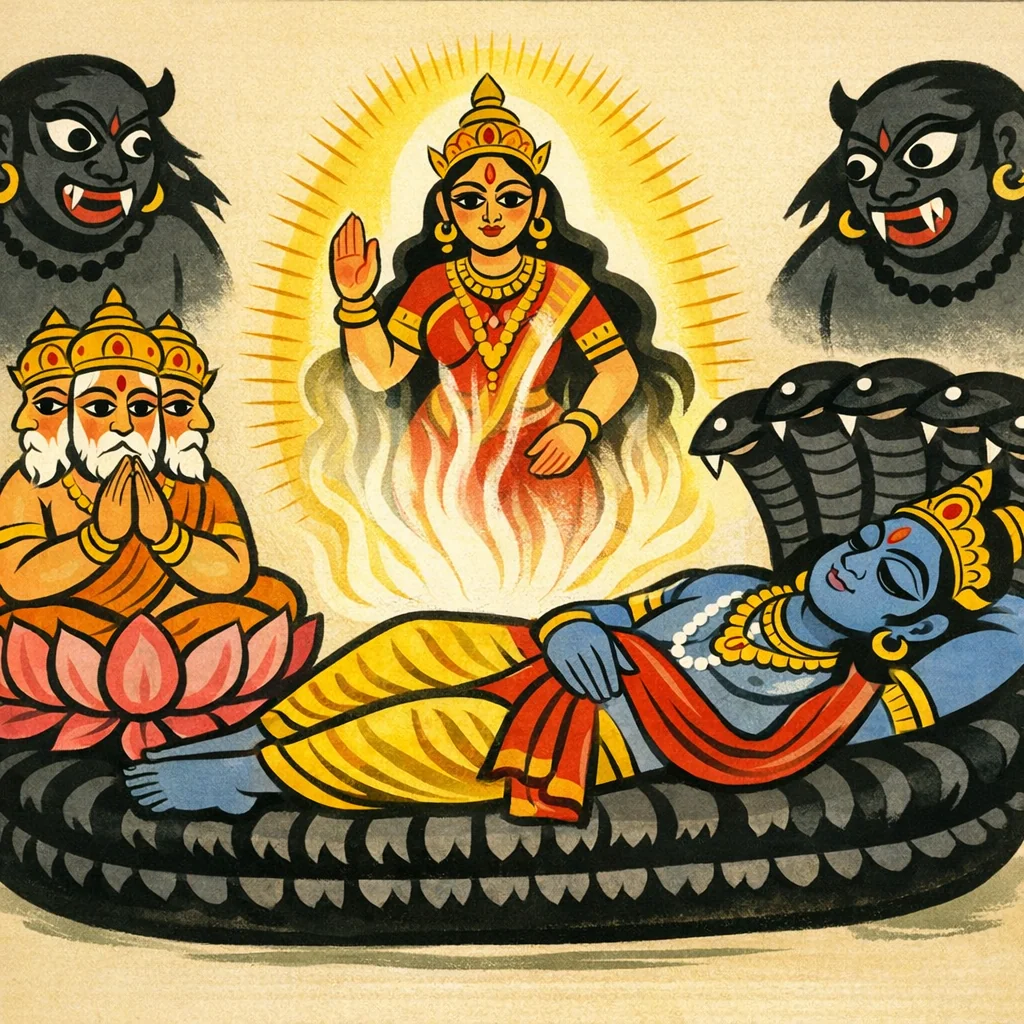
योगनिद्रां यदा विष्णुर्जगत्येकर्णवीकृते । आस्तीर्य शेषमभजत् कल्पान्ते भगवान् प्रभुः ॥
When Viṣṇu, at the end of the aeon, entered yogic sleep, and the world had become a single ocean, the Blessed Lord lay upon Śeṣa.
Verse 50
तदा द्वावसुरौ घोरौ विख्यातौ मधुकैटभौ । विष्णुकर्णमलोद्भूतौ हन्तुं ब्रह्माणमुद्यतौ ॥
Then two dreadful asuras, famed as Madhu and Kaiṭabha, arising from the impurity of Viṣṇu’s ears, became intent on killing Brahmā.
Verse 51
स नाभिकमले विष्णोः स्थितो ब्रह्मा प्रजापतिः । दृष्ट्वा तावसुरौ चोग्रौ प्रसुप्तं च जनार्दनम् ॥
Brahmā, the Lord of creatures, was seated upon the lotus of Viṣṇu’s navel. Seeing those two fierce asuras and also Janārdana asleep,
Verse 52
तुष्टाव योगनिद्रां तामेकाग्रहृदयस्थितः । विबोधनार्थाय हरेर्हरिनेत्रकृतालयाम् ॥
With a concentrated mind, he praised that Yogic Sleep, who dwells in the eyes of Hari, in order to awaken Hari.
Verse 53
ब्रह्मोवाच विश्वेश्वरीं जगद्धात्रीं स्थितिसंहारकारिणीम् । निद्रां भगवतीं विष्णोरतुलां तेजसः प्रभुः ॥
Brahmā said: The Lord Brahmā, master of splendor, praised the Sovereign of the universe—the Sustainer of the world, the agent of preservation and dissolution—namely the blessed Nidrā of Viṣṇu, incomparable in radiance.
Verse 54
त्वं स्वाहा त्वं स्वधा त्वं हि वषट्कारः स्वरात्मिका । सुधा त्वमक्षरे नित्ये त्रिधा मात्रात्मिका स्थिता ॥
You are Svāhā; you are Svadhā; you indeed are the Vaṣaṭ-call, embodied as sound itself. You are Amṛta, the nectar of immortality. In the eternal, imperishable syllable, you abide as the threefold measure (mātrā).
Verse 55
अर्धमात्रा स्थिता नित्या याऽनुच्चार्या विशेषतः । त्वमेव सन्ध्या सावित्री त्वं देवि जननी परा ॥
You are eternally established as the half-mātrā—especially that which is not pronounced. You alone are Sandhyā (the twilight rite) and Sāvitrī (Gāyatrī); O Goddess, you are the supreme Mother.
Verse 56
त्वयैव धार्यते सर्वं त्वयैतत्सृज्यते जगत् । त्वयैतत्पाल्यते देवि त्वमस्यन्ते च सर्वदा ॥
By you alone is all this upheld; by you this world is created; by you it is protected, O Goddess; and you always consume it at the end.
Verse 57
विसृष्टौ सृष्टिरूपा त्वं स्थितिरूपा च पालने । तथा संहृतिरूपान्ते जगतोऽस्य जगन्मये ॥
At the time of emanation you are of the form of creation; in protection you are of the form of preservation; likewise at the end you are of the form of dissolution of this world—O you who are made of the universe.
Verse 58
महाविद्या महामाया महमेधा महस्मृतिः । महामोहा च भवती महादेवी महेश्वरी ॥
You are Great Knowledge, Great Illusion (Mahāmāyā), Great Intelligence, Great Memory; and you are also Great Delusion—the Great Goddess, the Supreme Sovereign.
Verse 59
प्रकृतिस्त्वञ्च सर्वस्य गुणत्रयविभाविनी । कालरात्रिर्महारात्रिर्मोहरात्रिश्च दारुणा ॥
You are the Prakṛti of all, the one who manifests the three guṇas. You are Kālarātri, Mahārātri, and the dreadful Moharātri.
Verse 60
त्वं श्रीस्त्वमीश्वरी त्वं ह्रीस्त्वं बुद्धिर्बोधलक्षणा । लज्जा पुष्टिस्तथा तुष्टिस्त्वं शान्तिः क्षान्तिरेव च ॥
You are Prosperity (Śrī); you are Sovereignty; you are Modesty (Hrī). You are Intelligence whose mark is awakening. You are Shame (moral restraint), Nourishment, Contentment; you are Peace and also Forbearance.
Verse 61
खड्गिनी शूलिनी घोरा गदिनी चक्रिणी तथा । शङ्खिनी चापिनी बाणभुशुण्डी परिघायुधा ॥
You are the sword-bearing one, the trident-bearing one—terrible; the mace-bearer and likewise the discus-bearer; the conch-bearing one, the bow-bearing one; the wielder of arrows and the bhuśuṇḍī, and the one whose weapon is the iron club (parigha).
Verse 62
सौम्या सौम्यतराशेषसौम्येभ्यस्त्वतिसुन्दरी । परापराणां परमा त्वमेव परमेश्वरी ॥
You are gentle—gentler than all that is gentle—exceedingly beautiful. Supreme among both the higher and the lower, you alone are the highest Sovereign Lady (Parameśvarī).
Verse 63
यच्च किञ्चित् क्वचिद्वस्तु सदसद्वाखिलात्मिके । तस्य सर्वस्य या शक्तिः सा त्वं किं स्तूयते तदा ॥
O Devī, You are the very Self of all that is—both the real and the unreal; whatever exists anywhere, the power belonging to all of it is You. How, then, can You be praised adequately?
Verse 64
यया त्वया जगत्स्रष्टा जगत्पात्यत्ति यो जगत् । सोऽपि निद्रावशं नीतः कस्त्वां स्तोतुमिहेश्वरः ॥
By You, the creator of the world, even he who sustains and governs the world has been brought under the sway of sleep. Who, then, here can praise You, O Sovereign Lady?
Verse 65
विष्णुः शरीरग्रहणमहामीशान एव च । कारितास्ते यतोऽतस्त्वां कः स्तोतुं शक्तिमान् भवेत् ॥
Since even Viṣṇu’s taking of a body—and likewise the great Īśāna—are brought about by You, who could possibly be capable of praising You?
Verse 66
सा त्वमित्थं प्रभावैः स्वैरुदारैर्देवि संस्तुता । मोहयैतौ दुराधर्षावसुरौ मधुकैटभौ ॥
Thus praised, O Devī, by Your own exalted powers and glories—delude these two invincible demons, Madhu and Kaiṭabha.
Verse 67
प्रबोधञ्च जगत्स्वामी नीयतामच्युतो लघु । बोधश्च क्रियतामस्य हन्तुमेतौ महासुरौ ॥
And may the Lord of the world, Acyuta, quickly be brought to awakening; let his awakening be effected, so that he may slay these two great demons.
Verse 68
ऋषिरुवाच एवम् स्तुता तदा देवी तामसी तत्र वेधसा । विष्णोः प्रबोधनार्थाय निहन्तुं मधुकैटभौ ॥
The Ṛṣi said: Thus praised at that time by Vedhas (Brahmā), the Tāmasī Devī there set herself to awaken Viṣṇu, so that Madhu and Kaiṭabha might be slain.
Verse 69
नेत्रास्यनासिका-बाहु-हृदयebhyस्तथोरसः । निर्गम्य दर्शने तस्थौ ब्रह्मणोऽव्यक्तजन्मनः ॥
Emerging from his eyes, mouth, nostrils, arms, heart, and also from his chest, she stood manifest before Brahmā, the one of unmanifest origin.
Verse 70
उत्तस्थौ च जगन्नाथस्तया मुक्तो जनार्दनः । एकार्णवेऽहिशयनात्ततः स ददृशे च तौ ॥
Released by her, Janārdana—the Lord of the world—arose; and then, from his serpent-couch upon the single ocean, he beheld those two.
Verse 71
मधुकैटभौ दुरात्मानावतिवीर्यपराक्रमौ । क्रोधरक्तेक्षणावत्तुं ब्रह्माणं जनितोद्यमौ ॥
Madhu and Kaiṭabha, wicked by nature, of immense strength and valor—eyes reddened with rage—had roused themselves with the intent to devour Brahmā.
Verse 72
समुत्थाय ततस्ताभ्यां युयुधे भगवान् हरिः । पञ्चवर्षसहस्राणि बाहुप्रहरणो विभुः ॥
Then the Blessed Lord Hari rose and fought those two; the mighty one, using his arms as weapons, battled for five thousand years.
Verse 73
तावप्यतिबलोन्मत्तौ महामायाविमोहितौ । उक्तवन्तौ वरोऽस्मत्तो व्रियतामिति केशवम् ॥
Even those two, made wildly arrogant by their great strength and deluded by Mahāmāyā, said to Keśava: “Choose a boon from us.”
Verse 74
भगवानुवाच भवनेतामद्य मे तुष्टौ मम वध्यावुभावपि । किमन्येन वरेणात्र एतावद्धि वृतं मम ॥
The Blessed Lord said: “O sir, today you two have pleased me; yet you both are to be slain by me. What need have I here of any other boon? This alone is what I choose.”
Verse 75
ऋषिरुवाच वञ्चिताभ्यामिति तदा सर्वमापोमयं जगत् । विलोक्य ताभ्यां गदितो भगवान् कमलेक्षणः ॥
The Ṛṣi said: Thus deceived, they then saw the entire world as made of water; and the Lord, lotus-eyed, spoke to them.
Verse 76
आवां जहि न यत्रोर्वो सलिलेन परिप्लुता । प्रीतौ स्वस्तव युद्धेन श्लाघ्यस्त्वं मृत्युरावयोः ॥
“Kill us in a place where the earth is not flooded with water. We are pleased by your battle; you are praiseworthy—be the death of us two.”
Verse 77
ऋषिरुवाच तथेत्युक्त्वा भगवता शङ्ख-चक्र-गदाभृता । कृत्वा चक्रेण वै छिन्नॆ जघने शिरसी तयोः ॥
The Ṛṣi said: Saying “So be it,” the Lord—bearer of conch, discus, and mace—cut off their two heads with the discus, placing them upon his thighs (thus not on the earth).
Verse 78
एवमेषा समुत्पन्ना ब्रह्मणा संस्तुता स्वयम् । प्रभावमस्या देव्यास्तु भूयः शृणु वदामि ते ॥
Thus the Goddess manifested and was praised by Brahmā himself. Now hear again, as I recount the greatness of this Devī.
Frequently Asked Questions
The chapter investigates why even discerning persons remain bound by mamatva (possessive attachment) toward those who harm them—Suratha toward his lost kingdom and Samadhi toward his dispossessing family—and explains this as moha generated by Mahāmāyā (Yoganidrā), a power that can both bind and liberate.
Markandeya briefly foregrounds the eighth Manu, Sāvarṇi (son of Sūrya), stating that his emergence as Manvantara ruler is shaped by Mahāmāyā; the chapter then pivots into the Devi Mahatmya frame that will supply the theological basis for such cosmic transitions.
It inaugurates the Devi Mahatmya by defining the Goddess as Mahāmāyā/Yoganidrā, presenting Brahmā’s stuti of her as the supreme power behind creation, preservation, and dissolution, and narrating her manifestation to awaken Viṣṇu and facilitate the defeat of Madhu and Kaiṭabha—an archetypal myth establishing Devi’s primacy.