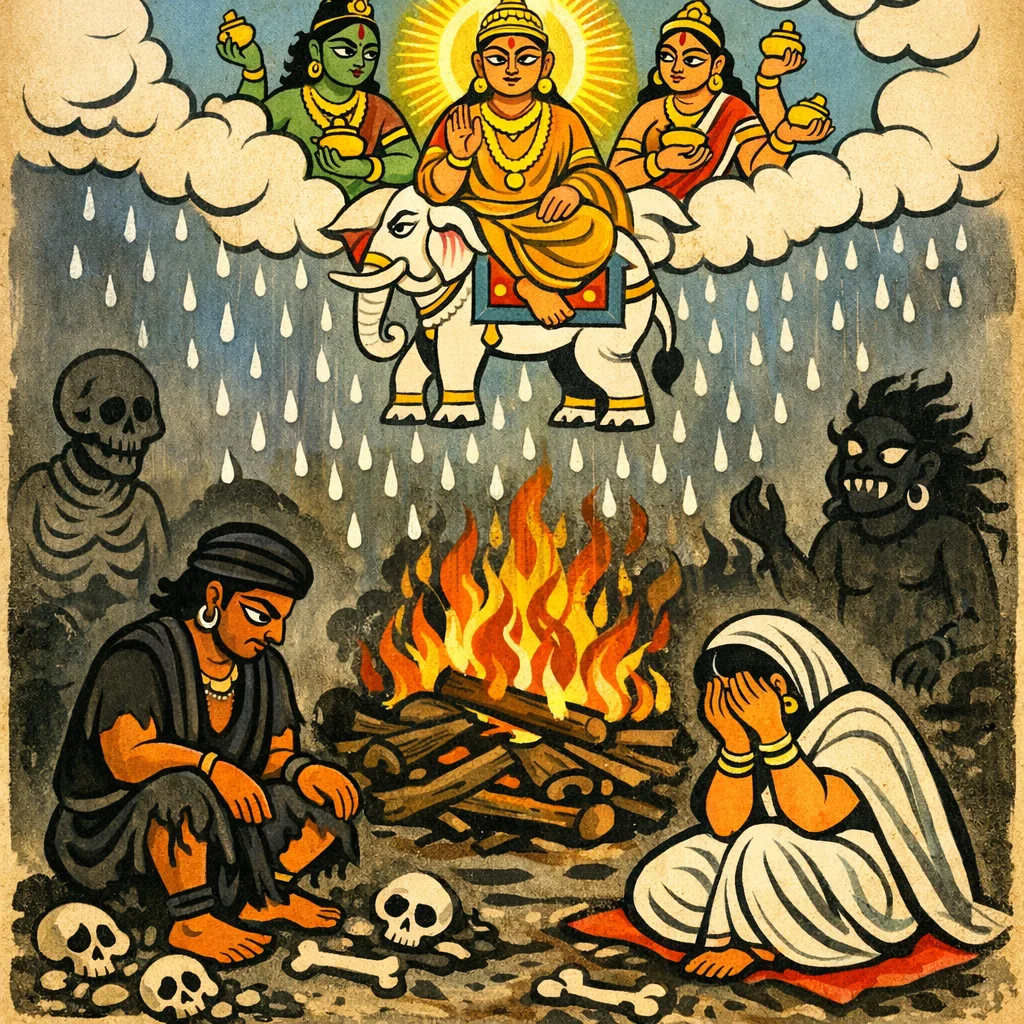
Adhyaya 8: Harishchandra’s Trial: Truth, the Sale of Family, and Bondage to a Chandala
हरिश्चन्द्रसत्यपरीक्षा (Hariścandra-satya-parīkṣā)
Vasu's Redemption
This adhyaya recounts King Harishchandra’s ordeal as his truthfulness is tested. To uphold satya and dharma, he relinquishes his kingdom, sells his queen and son, and is finally bound to servitude under a Chandala at the cremation ground. The chapter conveys sacred pathos—sorrow, endurance, and unwavering fidelity to truth.
Divine Beings
Celestial Realms
Key Content Points
Focus Keywords
Shlokas in Adhyaya 8
Verse 1
इति श्रीमार्कण्डेयपुराणे द्रौपदेयोत्पत्तिर्नाम सप्तमोऽध्यायः । अष्टमोऽध्यायः । जैमिनिरुवाच । भवद्भिरिदमाख्यातं यथाप्रश्नमनुक्रमात् । महत् कौतूहलं मेऽस्ति हरिश्चन्द्रकथां प्रति ॥
Thus, in the revered Mārkaṇḍeya Purāṇa, ends the seventh chapter called “The Birth of Draupadeya.” Now begins the eighth chapter. Jaimini said: “You have related this to me in due order, exactly according to my questions. Yet a great curiosity remains in me concerning the story of Hariścandra.”
Verse 2
अहो महात्मना तेन प्राप्तं कृच्छ्रमनुत्तमम् । कच्चित् सुखमनुप्राप्तं तादृगेव द्विजोत्तमाः ॥
Ah! That great-souled one has endured hardship unsurpassed. O best of the twice-born, has he now attained happiness—of that very kind befitting such a one?
Verse 3
पक्षिण ऊचुः विश्वामित्रवचः श्रुत्वा स राजा प्रययौ शनैः । शैव्यानुगतो दुःखी भार्यया बलपुत्रया ॥
The birds said: Having heard Viśvāmitra’s words, that king set out slowly. Sorrowful, he followed Śaivyā, accompanied by his wife and his young son.
Verse 4
स गत्वा वसुधापालो दिव्यां वाराणसीं पुरीम् । नैषा मनुष्यभोग्येति शूलपाणेः परिग्रहः ॥
Having gone to the divine city of Vārāṇasī, that ruler of the earth realized: “This is not a place meant for human enjoyment; it is the possession of Śūlapāṇi (Śiva, the bearer of the trident).”
Verse 5
जगाम पद्भ्यां दुःखार्तः सह पत्न्यानुकूलया । पुरीप्रवेशे ददृशे विश्वामित्रमुपस्थितम् ॥
Afflicted by sorrow, he went on foot, accompanied by his devoted wife. At the entrance to the city, he saw Viśvāmitra standing there.
Verse 6
तं दृष्ट्वा समनुप्राप्तं विनयावनतोऽभवत् । प्राह चैवाञ्जलिं कृत्वा हरिश्चन्द्रो महामुनिम् ॥
Seeing the great sage arrive, Hariścandra bowed down in humility; and, joining his palms in reverence, he addressed the mahāmuni.
Verse 7
इमे प्राणाः सुतश्चायमियं पत्नी मुने मम । येन ते कृत्यमस्त्याशु तद्गृहाणार्घ्यमुत्तमम् ॥
“These are my very life-breaths; and this is my son, and this my wife, O sage. Whatever task you have—quickly accept this excellent arghya (honor-offering).”
Verse 8
यद्वान्यत् कार्यमस्माभिस्तदनुज्ञातुमर्हसि ।
If there is any other task for us to accomplish, be pleased to grant permission and authorize it.
Verse 9
विश्वामित्र उवाच । पूर्णः स मासो राजर्षे दीयतां मम दक्षिणा । राजसूयनिमित्तं हि स्मर्यते स्ववचो यदि ॥
Viśvāmitra said: “O royal sage, that month has now been completed; let my priestly fee (dakṣiṇā) be given. For it is remembered that, on account of the Rājasūya, a gift is due—if indeed you keep your own word in mind.”
Verse 10
हरिश्चन्द्र उवाच ब्राह्मन्नद्यैव सम्पूर्णो मासोऽम्लानतपोधन । तिष्ठत्येतद् दानार्धं यत्तत् प्रतीक्षस्व माचिरम् ॥
Hariścandra said: “O Brāhmaṇa, today itself a month has been fully completed, O you whose wealth is unfading austerity. This matter remains only for the sake of the gift; therefore wait for that—do not wait long.”
Verse 11
विश्वामित्र उवाच एवमस्तु महाराज आगमिष्याम्यहं पुनः । शापं तव प्रदास्यामि न चेदद्य प्रदास्यसि ॥
Viśvāmitra said: “So be it, O great king. I shall come again. If you do not grant it today, I will bestow a curse upon you.”
Verse 12
पक्षिण ऊचुः इत्युक्त्वा प्रययौ विप्रो राजा चाचिन्तयत् तदा । कथमस्मै प्रदास्यामि दक्षिणां या प्रतिश्रुता ॥
The birds said: Having spoken thus, the brāhmaṇa departed. Then the king reflected: “How shall I give him the priestly fee (dakṣiṇā) that I had promised?”
Verse 13
कुतः पुष्टानि मित्राणि कुतोऽर्थः साम्प्रतं मम । प्रतिग्रहः प्रदुष्टो मे नाहं यायामधः कथम् ॥
“From where, now, are my friends to be supported, and from where is wealth for me at present? My acceptance of gifts has become tainted—how am I not to sink downward?”
Verse 14
किमु प्राणान् विमुञ्चामि कां दिशं याम्यकिञ्चनः । यदि नाशं गमिष्यामि अप्रदाय प्रतिश्रुतम् ॥
“Shall I then give up my life? Or, having become utterly bereft, to what direction shall I go? If I am destined for ruin, (let it not be) without first fulfilling what I have promised.”
Verse 15
ब्रह्मस्वहृत्कृमिः पापो भविष्याम्यधमाधमः । अथवा प्रेष्यतां यास्ये वरमेवात्मविक्रयः ॥
“I shall become a sinful worm—one who steals Brahmin property—most base among the base. Or else I will fall into servitude; better indeed is the selling of oneself (as a slave) than that.”
Verse 16
पक्षिण ऊचुः राजानं व्याकुलं दीनं चिन्तयानमधोमुखम् । प्रत्युवाच तदा पत्नी बाष्पगद्गदयाि गिरा ॥
The birds said: The king—agitated, dejected, and brooding with his face cast down—was then addressed in reply by his wife, her words choked and trembling with tears.
Verse 17
त्यज चिन्तां महाराज स्वसत्यमनुपालय । श्मशानवद् वर्जनीयो नरः सत्यबहिष्कृतः ॥
“Abandon anxiety, O great king; uphold your own truth. A man who is cast out from truth should be avoided—like a cremation ground.”
Verse 18
नातः परतरं धर्मं वदन्ति पुरुषस्य तु । यादृशं पुरुषव्याघ्र स्वसत्यपरिपालनम् ॥
They declare that, for a man, there is no dharma higher than this: the keeping and protection of one’s own truth—one’s pledged word—O tiger among men.
Verse 19
अग्निहोत्रमधीतं वा दानाद्याश्चाखिलाः क्रियाः । भजन्ते तस्य वैफल्यम् यस्य वाक्यमकारणम् ॥
Whether it be the Agnihotra sacrifice, Vedic study, or all acts beginning with charity—these become fruitless for that person whose speech is without cause, purposeless and groundless.
Verse 20
सत्यमत्यन्तमुदितं धर्मशास्त्रेषु धीमताम् । तारणायानृतं तद्वत् पातनायाकृतात्मनाम् ॥
In the Dharma-śāstras, the wise have extolled truth as supremely beneficial. Likewise, falsehood is said to save the unsteady from peril, yet it brings about the downfall of those whose selves are undisciplined and morally unformed.
Verse 21
सप्ताश्वमेधानाहृत्य राजसूयं च पार्थिवः । कृतिर्नाम च्युतः स्वर्गादसत्यवचनात् सकृत् ॥
A king, having performed seven Aśvamedha sacrifices and also the Rājasūya, saw a man named Kṛti fall from heaven—because he spoke a single falsehood.
Verse 22
राजन् जातमपत्यं मे इत्युक्त्वा प्ररुरोद ह । बाष्पाम्बुप्लुतनेत्रान्तामुवाचेदं महीपतिः ॥
Saying, “O King, a child has been born to me,” she burst into tears. Then the ruler spoke these words to her, whose eyes were filled and overflowing with tears.
Verse 23
हरिश्चन्द्र उवाच विमुञ्च भद्रे सन्तापमयं तिष्ठति बालकः । उच्यतां वक्तुकामासि यद्वा त्वं गजगामिनि ॥
Harīścandra said: “O auspicious lady, abandon your grief; the child stands here, overcome with distress. Speak what you wish to speak—O you whose gait is like that of an elephant.”
Verse 24
पत्नी उवाच राजन् जातम् अपत्यं मे सतां पुत्रफलाः स्त्रियः । स मां प्रदाय वित्तेन देहि विप्राय दक्षिणाम् ॥
The wife said: “O king, a child has been born to me. For the virtuous, women attain the fruit of having a son. Therefore, after providing for me with wealth, give a priestly Brahmana the proper sacrificial fee (dakṣiṇā).”
Verse 25
पक्षिण ऊचुः एतद्वाक्यमुपश्रुत्य ययौ मोहं महीपतिः । प्रतिलभ्य च संज्ञां स विललापातिदुःखितः ॥
The birds said: Hearing these words, the king fell into delusion. And when he regained consciousness, he lamented, overwhelmed with intense sorrow.
Verse 26
महद्दुःखमिदं भद्रे यत् त्वमेवं ब्रवीषि माम् । किं तव स्मितसंलापा मम पापस्य विस्मृताः ॥
“O auspicious lady, it is a great sorrow that you speak to me in this way. Have your smiling words and gentle conversation forgotten my sin (my wrongdoing)?”
Verse 27
हा हा कथं त्वया शक्यं वक्तुमेतत् शुचिस्मिते । दुर्वाच्यमेतद्वचनं कर्तुं शक्नोम्यहं कथम् ॥
“Alas, alas! How could you be capable of saying this, O you of pure smile? This is a harsh, improper utterance—how could I possibly bring myself to say such words?”
Verse 28
इत्युक्त्वा स नरश्रेष्ठो धिग्धिगित्यसकृद्ब्रुवन् । निपपात महीपृष्ठे मूर्च्छयाभिपरिप्लुतः ॥
Having spoken thus, that foremost of men, repeatedly exclaiming “Shame! Shame!”, fell upon the surface of the earth, overcome and flooded by swoon.
Verse 29
शयानं भुवि तं दृष्ट्वा हरिश्चन्द्रं महीपतिम् । उवाचेदं सकरुणं राजपत्नी सुदुःखिता ॥
Seeing King Hariścandra lying on the ground, the queen—deeply afflicted—spoke these words with compassion.
Verse 30
पत्नी उवाच । हा महाराज कस्येदमपध्यानमुपस्थितम् । यत् त्वं निपतितो भूमौ राङ्कवास्तरणोचितः ॥
The wife said: “Alas, O great king! Whose ill-fate (or evil influence) has come upon you, that you—worthy of a blanket and bedding—have fallen down upon the bare ground?”
Verse 31
येन कोट्यग्रगोवित्तं विप्राणामपवर्जितम् । स एष पृथिवीनाथो भूमौ स्वपिति मे पतिः ॥
He by whom wealth in the form of countless cows and riches was bestowed upon the Brahmins—he, that very lord of the earth, my husband, now lies asleep upon the ground.
Verse 32
हा कष्टं किं तवानॆन कृतं देव! महीक्षिताः | यदिन्द्रोपेन्द्रतुल्योऽयं नीतः प्रस्वापनीं दशाम् ||
“Alas, what hardship! O Lord, what has been done to you by these rulers of the earth, that you—equal to Indra and Upendra—have been brought to the condition of deep sleep?”
Verse 33
इत्युक्त्वा सापि सुश्रोणी मूर्च्छिता निपपात ह । भर्तृदुःखमहाभारेणासह्येन निपीडिता ॥
Having spoken thus, that fair-hipped lady too, overcome by grief, swooned and fell down—crushed by the unbearable, heavy burden of sorrow for her husband.
Verse 34
तौ तथा पतितौ भूमावनाथौ पितरौ शिशुः । दृष्ट्वात्यन्तं क्षुधाविष्टः प्राह वाक्यं सुदुःखितः ॥
Seeing his parents lying thus on the ground, helpless, the child—overcome by intense hunger—spoke a sentence, deeply distressed.
Verse 35
तात तात ! ददस्वान्नमम्बाम्ब ! भोजनं दद / क्षुन्मे बलवती जाता जिह्वाग्रं शुष्यते तथा ॥
“Father, father! Give me food; O mother, mother! Give me something to eat. My hunger has grown very strong, and the tip of my tongue is drying up as well.”
Verse 36
पक्षिण ऊचुः । एतस्मिन्नन्तरे प्राप्तो विश्वामित्रो महातपाः । दृष्ट्वा तु तं हरिश्चन्द्रं पतितं भुवि मूर्च्छितम् ॥
The birds said: Meanwhile, the great ascetic Viśvāmitra arrived. Seeing Hariścandra fallen on the ground and unconscious,
Verse 37
स वारिणा समभ्युक्ष्य राजानमिदमब्रवीत् । उत्तिष्ठोत्तिष्ठ राजेन्द्र तां ददस्वेष्टदक्षिणाम् ॥
Having sprinkled the king with water, he said this: “Rise, rise, O lord of kings; grant her the desired dakṣiṇā (the sacrificial fee/gift).”
Verse 38
ऋणं धारयतो दुःखमह्न्यहनि वर्धन्ते । आप्याय्यमानः स तदा हिमशीतन वारिणा ॥
For one who bears an unpaid debt, suffering increases day after day. Though he may be kept alive and nourished, at that time it is as if he is sustained by water that is icy-cold.
Verse 39
अवाप्य चेतनां राजा विश्वामित्रमवेक्ष्य च । पुनर्मोहं समापेदे स च क्रोधं ययौ मुनिः ॥
Regaining consciousness, the king looked upon Viśvāmitra; once again he fell into delusion, and that sage, for his part, went into anger.
Verse 40
स समाश्वास्य राजानं वाक्यमाह द्विजोत्तमः । दीयतां दक्षिणा सा मे यदि धर्ममवेक्षसे ॥
Having thus comforted the king, the foremost of the twice-born spoke: “Let that honorarium (dakṣiṇā) be given to me, if you have regard for dharma.”
Verse 41
सत्येनार्कः प्रतपति सत्ये तिष्ठति मेदिनी । सत्यं चोक्तं परो धर्मः स्वर्गः सत्ये प्रतिष्ठितः ॥
By truth the Sun gives heat and light; upon truth the Earth stands firm. Truth is declared to be the highest dharma, and heaven itself is established upon truth.
Verse 42
अश्वमेधसहस्रं च सत्यं च तुलया धृतम् । अश्वमेधसहस्राद्धि सत्यमेव विशिष्यते ॥
A thousand Aśvamedha sacrifices and Truth were placed on a balance; indeed, Truth outweighs even a thousand Aśvamedhas.
Verse 43
अथवा किं ममैतेन साम्ना प्रोक्तेन कारणम् । अनार्ये पापसङ्कल्पे क्रूरे चानृतवादिनि ॥
“Otherwise, what purpose is served for me by speaking to you with conciliatory words? You are ignoble, intent on sinful designs, cruel, and a speaker of falsehood.”
Verse 44
त्वयि राज्ञि प्रभवति सद्भावः श्रूयतामयम् । अद्य मे दक्षिणां राजन् न दास्यति भवान् यदि ॥
“In you, O king, good intent and uprightness prevail—listen to this. If today you will not give me my priestly fee (dakṣiṇā), O king…”
Verse 45
अस्ताचलं प्रयातेर्'के शप्स्यामि त्वां ततो ध्रुवम् । इत्युक्त्वा स ययौ विप्रो राजा चासीद्भयातुरः ॥
“When the sun has gone to the western mountain (at sunset), I will surely curse you then.” Having spoken thus, the Brahmin departed; and the king became distressed with fear.
Verse 46
काण्डिग्भूतोऽधमो निःस्वो नृशंसधनिनार्दितः । भार्यास्य भूयः प्राहेदं क्रियतां वचनं मम ॥
“Reduced to a wretched state—base and destitute—tormented by a cruel rich man, the man’s wife again spoke this: ‘Let my words be carried out.’”
Verse 47
मा शापानलनिर्दग्धः पञ्चत्वमुपयास्यसि । स तथा चोद्यमानस्तु राजा पत्न्या पुनः पुनः ॥
“Do not act thus! Burned by the fire of a curse, you will meet destruction (be reduced to the five elements).” Thus repeatedly urged again and again by his wife, the king nevertheless continued.
Verse 49
प्राह भद्रे करोम्येष विक्रयं तव निर्घृणः । नृशंसैरपि यत् कर्तुं न शक्यं तत् करोम्यहम् ॥ यदि मे शक्यते वाणी वक्तुमीदृक् सुदुर्वचः । एवमुक्त्वा ततो भार्यां गत्वा नागरमातुरः । बाष्पापिहितकण्ठाक्षस्ततो वचनमब्रवीत् ॥
He said, “O good lady, I—pitiless—am going to sell you. I am doing what even cruel men cannot bring themselves to do. If my voice is even capable of uttering such harsh words…” Having spoken thus, he then went to his wife; distressed, with throat and eyes choked by tears, he spoke further.
Verse 50
राजोवाच भो भो नागरिकाḥ सर्वे शृणुध्वं वचनं मम । किं मां पृच्छथ कस्त्वं भो नृशंसोऽहममानुषः ॥
The king said: “Ho! Ho! All you townsmen, listen to my words. Why do you question me, ‘Who are you?’ I am a cruel one—no (true) man at all.”
Verse 51
राक्षसो वातिकठिनस्ततः पापतरोऽपि वा । विक्रेतुं दयितां प्राप्तो यो न प्राणांस्त्यजाम्यहम् ॥
“Even if one is a rākṣasa—hard as the wind—and even more sinful still; yet if he has come to the point of selling his beloved, I will not surrender my life (my vital breath), I will not yield.”
Verse 52
यदि वः कस्यचित् कार्यं दास्या प्राणेष्टया मम । स ब्रवीतु त्वरायुक्तो यावत् सन्धारयाम्यहम् ॥
If any of you has some business to be done with my dear servant, let him speak quickly—so long as I am holding her back.
Verse 53
पक्षिण ऊचुः अथ वृद्धो द्विजः कश्चिदागत्याह नराधिपम् । समर्पयस्व मे दासीमहम् क्रेता धनप्रदः ॥
The birds said: Then a certain aged brāhmaṇa came and spoke to the king: “Hand over to me the maidservant; I am the purchaser, and I will pay the money.”
Verse 54
अस्ति मे वित्तमस्तोके सुकुमारी च मे प्रिया । गृहकर्म न शक्नोति कर्तुमस्मात् प्रयच्छ मे ॥
“I have abundant wealth, and I also have my beloved, delicate young wife. She is unable to perform the duties of household work; therefore grant me help in this need.”
Verse 55
कर्मण्यता-वयो-रूप-शीलानां तव योषितः । अनुरूपमिदं वित्तं गृहाणार्पय मेऽबलाम् ॥
“O Lady, for your women who possess skill in work, youth, beauty, and good conduct—accept this wealth that is fitting for them. I offer to you my maiden daughter.”
Verse 56
एवमुक्तस्य विप्रेण हरिश्चन्द्रस्य भूपतेः । व्यदीर्यत मनो दुःखान्न चैनं किञ्चिदब्रवीत् ॥
When the brahmin had spoken thus, King Harishchandra’s mind was torn apart by sorrow; yet he said nothing to him at all.
Verse 57
ततः स विप्रो नृपतेर्वल्कलान्ते दृढं धनम् । बद्ध्वा केशेष्वथादाय नृपपत्नीमकर्षयत् ॥
Then that brahmin, having firmly tied up the king’s wealth in the edge of a bark-garment, and seizing the king’s wife by her hair, dragged her away.
Verse 58
रुरोद रोहिताश्वोऽपि दृष्ट्वा कृष्टां तु मातरम् । हस्तेन वस्त्रमाकर्षन् काकपक्षधरः शिशुः ॥
Rohitāśva too began to cry on seeing his mother being dragged away; the child, wearing his hair in the ‘crow-wing’ style, pulled at her garment with his hand.
Verse 59
राजपत्नी उवाच । मुञ्चार्य मुञ्च तावन्मां यावत्पश्याम्यहं शिशुम् । दुर्लभं दर्शनं तात पुनरस्य भविष्यति ॥
The queen said: “Release me, revered sir—release me at least until I can see the child. For, dear one, the sight of him will be difficult to obtain again.”
Verse 60
पश्यैहि वत्स मामेवं मातरं दास्यतां गताम् । मां मा स्प्रार्क्षो राजपुत्र ! अस्पृश्याहं तवाधुना ॥
“Look, dear child, at me—your mother—who has been reduced to the condition of a maidservant. Do not touch me, O prince; for now I am untouchable to you.”
Verse 61
ततः स बालः सहसा दृष्ट्वा कृष्टां तु मातरम् । समभ्यधावदम्बेति रुदन् सास्त्राविलेक्षणः ॥
Then that child, suddenly seeing his mother being dragged away, ran up crying, “Ambā! (Mother!)”, his face disfigured and blurred with streaming tears.
Verse 62
तमागतं द्विजः क्रोधाद्वालमभ्याहनत् पदाः । वदंस्तथापि सोऽम्बेति नैवामुञ्चत मातरम् ॥
When the brāhmaṇa arrived, in anger he struck the child with his foot. Yet the child kept crying, “Mother!” and did not let go of his mother.
Verse 63
राजपत्नी उवाच । प्रसादं कुरु मे नाथ क्रीणीष्वेमं च बालकम् । क्रीतापि नाहं भवतो विनैनं कार्यसाधिकाः ॥
The queen said: “Show me favor, my lord—buy this boy as well. Even if I am purchased, without him I cannot serve to accomplish your purposes.”
Verse 64
इत्थं ममाल्पभाग्यायाः प्रसादसुमुखो भव । मां संयोजय बालेन वत्सेनेव पयस्विनीम् ॥
“Therefore, be gracious and kindly disposed toward me, a woman of little fortune. Reunite me with my child—just as a milk-bearing cow is joined with her calf.”
Verse 65
ब्राह्मण उवाच गृह्यतां वित्तमेतत् ते दीयतां बालको मम । स्त्रीपुंसोर्धर्मशास्त्रज्ञैः कृतमेव हि वेतनम् । शतं सहस्रं लक्षं च कोटिमूल्यं तथा परैः ॥
The Brāhmaṇa said: “Accept this wealth, and give my boy back. For in matters between woman and man, those who know the Dharmaśāstras have indeed fixed a lawful ‘fee’ as settlement—some at a hundred, others at a thousand, others at a lakh, and others even at the value of a crore.”
Verse 66
पक्षिण ऊचुः तथैव तस्य तद्वित्तं बद्ध्वोत्तरपटे ततः । प्रगृह्य बालकं मात्रा सहैकस्थमबन्धयत् ॥
The birds said: “Likewise, having tied up his wealth in an upper cloth, then taking the child together with its mother, he bound them both in one place.”
Verse 67
नीयमानौ तु तौ दृष्ट्वा भार्यापुत्रौ स पार्थिवः । विललाप सुदुःखार्तो निःश्वस्योष्णं पुनः पुनः ॥
But when the king saw the two—his wife and son—being led away, he wailed, overwhelmed by intense sorrow, and again and again he heaved hot sighs.
Verse 68
यां न वायुर्न चादित्यो नेन्दुर्न च पृथग्जनः । दृष्टवन्तः पुरा पत्नीं सेयं दासीत्वमागता ॥
She whom neither the Wind nor the Sun nor the Moon—nor ordinary people—had ever seen before as a wife: that very one has now come to the condition of a slave.
Verse 69
सूर्यवंशप्रसूतो 'यं सुकुमारकराङ्गुलिः । सम्प्राप्तो विक्रयं बालो धिङ्मामस्तु सुदुर्मतिम् ॥
“This boy—born in the Solar dynasty, with tender hands and fingers—has come to be sold. Shame on me, of perverted understanding!”
Verse 70
हा प्रिये! हा शिशो! नत्स! ममानार्यस्य दुर्नयैः । दैवाधीनां दशां प्राप्तो न मृतोऽस्मि तथापि धिक् ॥
“Alas, my beloved! Alas, my child! Alas, Natsa! By the wicked conduct of me—an ignoble man—I have fallen into a condition dependent on fate. Yet I am not dead; shame on me even so.”
Verse 71
पक्षिण ऊचुः एवम् विलपतो राज्ञः स विप्रोऽन्तरधीयत । वृक्षगेहादिभिस्तुङ्गैस्तावादाय त्वरान्वितः ॥
The birds said: While the king was lamenting thus, that Brahmin vanished from sight. Then, swiftly taking the two of them, he hurried to lofty places—tree-houses and other high shelters.
Verse 72
विश्वामित्रस्ततः प्राप्तो नृपं वित्तमयाचत । तस्मै समर्पयामास हरिश्चन्द्रोऽपि तद्धनम् ॥
Then Viśvāmitra arrived and asked the king for wealth; and Hariścandra, too, handed over that wealth to him.
Verse 73
तद्वित्तं स्तोकमालोक्य दारविक्रयसम्भवम् । शोकाभिभूतं राजानं कुपितः कौशिकोऽब्रवीत् ॥
Seeing that his wealth was meagre and had arisen from selling firewood, and seeing the king overwhelmed by grief, Kauśika—angered—spoke to him.
Verse 74
क्षत्रबन्धो! ममेमां त्वं सदृशीं यज्ञदक्षिणाम् । मन्यसे यदि तत्क्षिप्रं पश्य त्वं मे बलं परम् ॥
“O disgrace to the kṣatriyas! If you deem yourself fit to receive this sacrificial fee (dakṣiṇā), this offering due to me, then quickly behold my supreme power.”
Verse 75
तपसोऽत्र सुतप्तस्य ब्राह्मण्यस्यामलस्य च । मत्प्रभावस्य चोग्रस्य शुद्धस्याध्ययनस्य च ॥
Here, in this hymn/recitation, is the fruit of austerity well performed, of stainless Brahminical holiness, of my own fierce and pure power, and of purified sacred study (adhyayana).
Verse 76
अन्यां दास्यामि भगवन् ! कालः कश्चित्प्रतीक्ष्यताम् । साम्प्रतं नास्ति विक्रीता पत्नी पुत्रश्च बालकः ॥
“I will give another woman/servant, O revered sir; please wait for a little while. At present, my wife and my little son have not yet been sold.”
Verse 77
विश्वामित्र उवाच चतुर्भागः स्थितो योऽयं दिवसस्य नराधिप । एष एव प्रतीक्ष्यो मे वक्तव्यं नोत्तरं त्वया ॥
Viśvāmitra said: “O lord of men, this portion—one fourth of the day—that now remains: wait for just this much for me. Until then, you are not to speak any further reply.”
Verse 78
पक्षिण ऊचुः तमेवमुक्त्वा राजेन्द्रं निष्ठुरं निर्घृणं वचः । तदादाय धनं तूर्णं कुपितः कौशिको ययौ ॥
The birds said: Having thus addressed the lord of kings with harsh and pitiless words, Kauśika—angered—quickly took the wealth and departed.
Verse 79
विश्वामित्रे गते राजा भयशोकाब्धिमध्यगः । सर्वाकारं विनिश्चित्य प्रोवाचोच्चैरधोमुखः ॥
When Viśvāmitra had departed, the king—sunk in the ocean of fear and grief—having firmly resolved on every point, spoke aloud with his face cast down.
Verse 80
वित्तक्रीतेन यो ह्यर्थो मया प्रेष्येण मानवः । स ब्रवीतु त्वरायुक्तो यावत् तपति भास्करः ॥
“O man, whatever matter has been secured by me, your messenger, through payment—let him report it at once, with urgency, while the Sun still shines (i.e., before day ends).”
Verse 81
अथाजगाम त्वरितो धर्मश्चाण्डालरूपधृक् । दुर्गन्धो विकृतो रूक्षः श्मश्रुलो दन्तुरो घृणी ॥
Then Dharma quickly arrived, having assumed the form of a caṇḍāla (an outcaste). Foul-smelling, misshapen, harsh, bearded, with crooked teeth, and repulsive, he appeared.
Verse 82
कृष्णो लम्बोदरः पिङ्गरूक्षाक्षः परुषाक्षरः । गृहीतपक्षिपुञ्जश्च शवमाल्यैरलङ्कृतः ॥
Black in hue, pot-bellied, with tawny and harsh eyes, and with a rough, grating voice—he held a cluster of birds (in his grasp) and was adorned with garlands of corpses.
Verse 83
कपालहस्तो दीर्घास्यो भैरवोऽतिवदन् मुहुः । श्वगणाभिवृतो घोरो यष्टिहस्तो निराकृतिः ॥
Bhairava—holding a skull, with a long mouth—kept roaring again and again. Terrifying, surrounded by packs of dogs, staff in hand, and of strange (unearthly) form, he appeared (in the battle-scene).
Verse 84
चाण्डाल उवाच अहमार्थो त्वया शीघ्रं कथयस्वात्मवेतनम् । स्तोकेन बहुना वापि येन वै लभ्यते भवान् ॥
The Caṇḍāla said: “I have a purpose to ask. Quickly tell me your own ‘fee’—what you require. Whether briefly or at length, tell that by which one truly attains you, that is, how your help and fulfilment may be obtained.”
Verse 85
पक्षिण ऊचुः तं तादृशमथालक्ष्य क्रूरदृष्टिं सुनिष्ठुरम् । वदन्तमतिदुःशीलं कस्त्वमित्याह पार्थिवः ॥
The birds said: Seeing him thus—fierce of gaze, exceedingly harsh, and speaking with very ill conduct—the king asked, “Who are you?”
Verse 86
चण्डाल उवाच चण्डालोऽहमिहाख्यातः प्रवीरेति पुरोत्तमे । विख्यातो वध्यवधको मृतकम्बलहारकः ॥
The Caṇḍāla said: “Here I am known as Pravīra, O best among men. I am notorious as the executioner of those condemned to death, and as one who carries away the blankets of the dead.”
Verse 87
हरिश्चन्द्र उवाच नाहं चण्डालदासत्वमिच्छेयं सुविगर्हितम् । वरं सापाग्निना दग्धो न चण्डालवशं गतः ॥
Hariścandra said: “I do not wish to become the slave of a Caṇḍāla—an utterly disgraceful thing. Better that I be burned by the fire of a curse than fall under the control of a Caṇḍāla.”
Verse 88
पक्षिण ऊचुः तस्यैवं वदतः प्राप्तो विश्वामित्रस्तपोनिधिः । कोपामर्षविवृताक्षः प्राह चेदं नराधिपम् ॥
The birds said: As he was speaking in this manner, Viśvāmitra—treasure-house of austerity—arrived. With eyes widened in anger and indignation, he then spoke these words to the king.
Verse 89
विश्वामित्र उवाच । चण्डालोऽयमनल्पं ते दातुं वित्तमुपस्थितः । कस्मान्न दीयते मह्यमशेषा यज्ञदक्षिणा ॥
Viśvāmitra said: “This Caṇḍāla has come forward with no small amount of wealth for you to give. Why, then, is the entire sacrificial fee (yajña-dakṣiṇā) not being given to me?”
Verse 90
हरिश्चन्द्र उवाच भगवन् । सूर्यवंशोत्थमात्मानं वेद्मे कौशिक । कथं चाण्डालदासत्वं गमिष्ये वित्तकामुकः ॥
Hariścandra said: “O Blessed one, O Kauśika, I know myself to be born of the Solar dynasty. How, being desirous of wealth, could I ever come to the state of becoming a slave to a Caṇḍāla?”
Verse 91
विश्वामित्र उवाच यदि चाण्डालवित्तं त्वमात्मविक्रयजं मम । न प्रदास्यसि कालेन शाप्स्यामि त्वामसंशयम् ॥
Viśvāmitra said: “If you do not give me, at the proper time, that wealth of a caṇḍāla—wealth born of selling oneself—then I shall certainly curse you.”
Verse 92
पक्षिण ऊचुः हरिश्चन्द्रस्ततो राजा चिन्तावस्थितजीवितः । प्रसीदेति वदन् पादावृषेरजग्राह विह्वलः ॥
The birds said: Then King Hariścandra—his very life held fast in anxious thought—became distraught and, saying “Be gracious (to me),” clasped the feet of the sage.
Verse 93
दासोऽस्म्यार्तोऽस्मि भीतोऽस्मि त्वद्भक्तश्च विशेषतः । कुरु प्रसादं विप्रर्षे कष्टश्चण्डालसङ्करः ॥
“I am your servant; I am afflicted; I am afraid; and, most of all, I am your devotee. O sage among brāhmaṇas, show me favor—for my condition is grievous, being of mixed and outcaste association.”
Verse 94
भवेयं वित्तशेषेण सर्वकर्मकरॊ वशः । तवैव मुनिशार्दूल ! प्रेष्यश्चित्तानुवर्तकः ॥
With whatever wealth remains to me, I shall become your obedient servant, performing every task—O tiger among sages—your attendant, following your intention in all things.
Verse 95
विश्वामित्र उवाच यदि प्रेष्यो मम भवान् चण्डालाय ततो मया । दासभावमनुप्राप्तो दत्तो वित्तार्बुदेन वै ॥
Viśvāmitra said: “If you are my servant, then I have indeed handed you over to a Caṇḍāla. Having thus come into the condition of slavery, you were given to him in exchange for an arbuda of wealth.”
Verse 96
पक्षिण ऊचुः एकमुक्ते तदा तेन श्वपाको हृष्टमानसः । विश्वामित्राय तद्द्रव्यं दत्त्वा बद्ध्वा नरेश्वरम् ॥
The birds said: When that single statement—his command—was uttered, the outcaste (śvapāka), delighted in mind, gave that wealth to Viśvāmitra and bound the king.
Verse 97
दण्डप्रहारसम्भ्रान्तमतीव व्याकुलेन्द्रियम् । इष्टबन्धुवियोगार्तम् अनयन् निजपत्तनम् ॥
His mind shaken by the blows of punishment, his senses greatly agitated, and tormented by separation from his beloved friends and kinsmen, he was led back to his own city.
Verse 98
हरिश्चन्द्रस्ततो राजा वसञ्चाण्डालपत्तने । प्रातर्मध्याह्नसमये सायञ्चैतदगायत ॥
Then King Hariścandra, dwelling in the outcaste-settlement, sang this lament in the morning, at midday, and again in the evening.
Verse 99
बाला दीनमुखी दृष्ट्वा बालं दीनमुखं पुरः । मां स्मरत्यसुखाविष्टा मोचयिष्यति नौ नृपः ॥
Seeing the young girl with a sorrowful face, and the child before her likewise sorrowful, she—overwhelmed by grief—remembers me; and thereby she will set us free, O king.
Verse 100
उपात्तवित्तो विप्राय दत्त्वा वित्तमतोऽधिकम् । न सा मां मृगशावाक्षी वेत्ति पापतरं कृतम् ॥
Having acquired wealth, I gave a brāhmaṇa even more than that wealth; yet that doe‑eyed woman does not know the still more sinful deed that I have done.
Verse 101
राज्यनाशः सुहृत्त्यागो भार्यातनयविक्रयः । प्राप्ता चाण्डालताचैवमहो दुःखपरम्परा ॥
“The loss of my kingdom, the abandonment by friends, the selling away of wife and children, and now this fall into the state of a caṇḍāla—ah, what an unbroken succession of sorrows!”
Verse 102
एवं स निवसन्नित्यं सस्मार दयितं सुतम् । आर्याञ्चात्मसमाविष्टां हृतसर्वस्व आतुरः ॥
Thus, dwelling there continually, he kept remembering his beloved son; and, distressed—having been deprived of all his possessions—he also thought of his noble wife, who had entered deeply into his heart.
Verse 103
कस्यचित्त्वथ कालस्य मृतचेलापहारकः । हरिश्चन्द्रोऽभवद्राजा श्मशाने तद्वशानुगः ॥
Then, after some time had passed, King Hariścandra became a taker of the cloth of the dead in the cremation ground, moving in obedience to that condition (fate).
Verse 104
चण्डालेनानुशिष्टश्व मृतचेलापहारीणा । शवागमनमन्विच्छन्निह तिष्ठ दिवानिशम् ॥
Instructed by a Caṇḍāla—one who steals the cloth from the dead—he, awaiting the arrival of a corpse, remained there day and night.
Verse 105
इदं राज्ञेऽपि देयञ्च षड्भागन्तु शवं प्रति । त्रयस्तु मम भागाः स्युर्द्वौ भागौ तव वेतनम् ॥
“This too must be given to the king; as for the corpse, it is to be divided into six shares. Three shares shall be mine; two shares are your wage.”
Verse 106
इति प्रतिसमादिष्टो जगाम शवमन्दिरम् । दिशन्तु दक्षिणां यत्र वाराणस्यां स्थितं तदा ॥
Thus instructed, he went to the “house of corpses,” the cremation-ground. At that time it lay to the south, situated at Vārāṇasī.
Verse 107
श्मशानं घोरसंनादं शिवाशतसमाकुलम् । शवमौलिसमाकीर्णं दुर्गन्धं बहुधूमकम् ॥
The cremation-ground resounded with dreadful sounds, crowded with hundreds of jackals; strewn with corpse-heads, foul-smelling, and thick with smoke.
Verse 108
पिशाच-भूत-वेताल-डाकिनी-यक्षसङ्कुलम् । गृध्रगोमायुसङ्कीर्णं श्ववृन्दपरिवारितम् ॥
It was thronged with piśācas, ghosts, vetālas, ḍākinīs, and yakṣas; filled with vultures and jackals, and surrounded by packs of dogs.
Verse 109
अस्थिसंघातसङ्कीर्णं महादुर्गन्धसङ्कुलम् । नानामृतसुहृन्नाद-रौद्रकोलाहलायुतम् ॥
It was strewn with heaps of bones, filled with overpowering stench, and charged with a fierce uproar—the many cries of those mourning their dead loved ones.
Verse 110
हा पुत्र ! मित्र ! हा बन्धो ! भ्रातर् वत्स ! प्रियाद्य मे । हा पते ! भगिनि ! मातर्हा मातुल ! पितामह ॥
‘Alas, my son! my friend! alas, my kinsman! brother! dear child! my beloved! Alas, husband! sister! mother—alas! uncle! grandfather!’
Verse 111
मातामह ! पितः ! क्व गतोऽस्येहि बान्धव । इत्येवं वदतां यत्र ध्वनिः संश्रूयते महान् ॥
‘Grandfather! Father! where has he gone—come back, kinsman!’ Thus, where such people were speaking, a great clamour was heard.
Verse 112
ज्वलन्मांस-वसा-मेदच्छमच्छमितसङ्कुलम् ॥
It was filled with the ‘chamaccham’ sounds of burning flesh, fat, and marrow.
Verse 113
अर्धदग्धाः शवाः श्यामाः विकसद्दन्तपङ्क्तयः । हसन्तीवाग्निमध्यस्थाः कायस्येयं दशा त्विति ॥
Half-burnt corpses, darkened, with rows of teeth exposed, stood amid the fire as if laughing—(showing) that such indeed is the condition of the body.
Verse 114
अग्नेश्चटचटाशब्दो वयसामस्थिपङ्क्तिषु । बान्धवाक्रन्दशब्दश्च पुक्कसेषु प्रहर्षजः ॥
There was the crackling of fire amid rows of bones where vultures gathered; and among the outcaste pukkasas there arose a sound like the wailing of kinsmen—yet born of ghastly delight.
Verse 115
गायतां भूतवेतालपिशाचगणरक्षसाम् । श्रूयते सुमहान् घोरः कल्पान्त इव निःस्वनः ॥
As hosts of bhūtas, vetālas, piśācas, and rākṣasas sang, there was heard an immense and dreadful roar—like the sound at the end of an aeon.
Verse 116
महामहिषकारीषगोशकृद्राशिसङ्कुलम् । तदुत्थभस्मकूटैश्च वृतं सास्थिभिरुन्नतैः ॥
It was crowded with heaps of dung of great buffaloes and of cows; and it was surrounded by mounds of ash arising from that, together with elevated piles of bones.
Verse 117
नानोपहारस्त्रग्दीपकाकविक्षेपकालिकम् । अनेकशब्दबहुलं श्मशानं नरकायते ॥
With various offerings, garlands, lamps, and the tossing about of crows—dark with such rites—and thick with many noises, that cremation-ground seemed like hell itself.
Verse 118
सवह्निगर्भैरशिवैः शिवारुतैर्निनादितं भीषणरावगह्वरम् । भयं भयस्याप्युपसञ्जनैर्भृशं श्मशानमाक्रन्दविरावदारुणम् ॥
That cremation-ground resounded with inauspicious jackal-cries heavy with fire; it was a cavern of dreadful roars—fear itself, producing even fear of fear—terrible with wailing and shrieks.
Verse 119
स राजा तत्र सम्प्राप्तो दुःखितः शोचनॊद्यतः । हा भृत्या मन्त्रिणो विप्राः तद्राज्यं विधे गतम् ॥
That king reached that place, sorrowful and ready to weep: “Alas—my servants, my ministers, my brāhmaṇas! That kingdom has gone to ruin by fate!”
Verse 120
हा शैव्ये पुत्र हा बाल मां त्यक्त्वा मन्दभाग्यकम् । विश्वामित्रस्य दोषेण गताः कुत्रापि ते मम ॥
“Alas, Śaivyā! Alas, my son—my child! Having abandoned me, ill-fated as I am, you have gone somewhere—because of Viśvāmitra’s fault.”
Verse 121
इत्येवं चिन्तयंस् तत्र चण्डालोक्तं पुनः पुनः । मलिनो रूक्षसर्वाङ्गः केशवान् गन्धवान् ध्वजी ॥
While he was thinking thus there, the words spoken by a caṇḍāla were repeated again and again. He was filthy, with rough limbs all over, long-haired, reeking, and bearing a banner.
Verse 122
लकुटी कालकल्पश्च धावंश्चापि ततस्ततः । अस्मिन् शव इदं मूल्यं प्राप्तं प्राप्स्यामि चाप्युत ॥
Club in hand, deathlike in appearance, he ran here and there (saying): “For this corpse, this is the price I have obtained—and I shall obtain it indeed.”
Verse 123
इदं मम इदं राज्ञे मुख्यचण्डालके त्विदम् । इति धावन् दिशो राजा जीवन् योन्यन्तरं गतः ॥
“This is mine; this belongs to the king; and this to the chief caṇḍāla!”—thus crying, the king ran in all directions; and while still alive, he passed into another womb (took another birth).
Verse 124
जीर्णकर्पण्टसुग्रन्थिकृतकन्थापरिग्रहः । चिताभस्मरजोलिप्तमुखबाहूदराङ्घ्रकः ॥
He wore as his garment a patched, knotted rag, and his face, arms, belly, thighs, and feet were smeared with the ash-dust of funeral pyres.
Verse 125
नानामेदोवसामज्जा लिप्तपाण्यङ्गुलिः श्वसन् । नानाशवोदनकृता हारतृप्तिपरायणः ॥
Breathing heavily, with the fingers of his hands smeared with various fats, grease, and marrow, he lived intent on satisfying hunger—feeding on rice prepared from many corpses (that is, food obtained in connection with the dead).
Verse 126
तदीयमाल्यसंश्लेषकृतमस्तक मण्डनः । न रात्रौ न दिवा शेते हा हेति प्रवदन् मुहुः ॥
His head was adorned with wreaths belonging to them (the dead), and he neither slept by night nor by day, repeatedly crying, “Alas! Alas!”
Verse 127
एवं द्वादशमासास्तु नीताः शतसमोपमाः । स कदाचिन्नृपश्रेष्ठः श्रान्तो बन्धुवियोगवान् ॥
Thus twelve months passed, seeming like a hundred years. Then, at one time, that best of kings—exhausted and separated from his kinsmen—reached a breaking point.
Verse 128
निद्राभिभूतो रूक्षाङ्गो निश्चेष्टः सुप्त एव च । तत्रापि शयनीये स दृष्टवानद्भुतं हि मत् ॥
Overcome by sleep, his limbs dried and rough, motionless and truly asleep—yet even while lying there he beheld a wondrous thing.
Verse 129
श्मशानाभ्यासयोगेन दैवस्य बलवत्तया । अन्यदेहेन दत्त्वा तु गुरवे गुरुदक्षिणाम् ॥
Through habitual association with the cremation-ground, and by the overpowering force of fate, he paid the teacher his guru’s fee (guru-dakṣiṇā) by means of another body—that is, through a different embodiment.
Verse 130
तदा द्वादश वर्षाणि दुःखदानात्तु निष्कृतिः । आत्मानं स ददर्शाथ पुक्कसीगर्भसम्भवम् ॥
Then, after twelve years, the expiation arising from the giving of suffering—namely, the endurance of painful consequences—was completed; and he saw himself as one born from the womb of a pukkasī, a woman of a very low social group.
Verse 131
तत्रस्थश्चाप्यसौ राजा सोऽचिन्तयदिदं तदा । इतो निष्क्रान्तमात्रो हि दानधर्मं करोम्यहम् ॥
There too, that king reflected at that time: “The moment I come out from here, I will practice the dharma of giving—charity (dāna).”
Verse 132
अनन्तरं स जातस्तु तदा पुक्कसबालकः । श्मशानमृतसंस्कारकरणेषु सदोद्यतः ॥
Soon after, he was born as a pukkasa boy, ever engaged at the cremation-ground in performing funerary rites for the dead.
Verse 133
प्राप्ते तु सप्तमे वर्षे श्मशानेऽथ मृतो द्विजः । आनीतो बन्धुभिर्दृष्टस्तेन तत्राधनो गुणी ॥
When the seventh year came, a twice-born man (a brahmin) died and was brought to the cremation-ground by his relatives; there he saw that person—poor, yet worthy and deserving—upon the spot.
Verse 134
मूल्यार्थिना तु तेनापि परिभूतास्तु ब्राह्मणाः । ऊचुस्ते ब्राह्मणास्तत्र विश्वामित्रस्य चेष्टितम् ॥
Those brāhmaṇas, insulted by him who sought a price (gain), spoke there, recounting the conduct and deeds of Viśvāmitra.
Verse 135
पापिष्ठमशुभं कर्म कुरु त्वं पापकाकरक । हरिश्चन्द्रः पुरा राजा विश्वामित्रेण पुक्कसः ॥
“You commit the most sinful and inauspicious deed, O doer of evil! Long ago King Hariścandra was made a pukkasa by Viśvāmitra.”
Verse 136
कृतः पुण्यविनाशेन ब्राह्मणस्वापनाशनात् । यदा न क्षमते तेषां तैः स शप्तो रुषा तदा ॥
Because he harmed the brāhmaṇas’ peaceful repose, he was brought to the destruction of his merit. When they could endure it no longer, they cursed him in anger.
Verse 137
गच्छ त्वं नरकं घोरमधुनैव नराधम । इत्युक्तमात्रे वचने स्वप्नस्थः स नृपस्तदा ॥
“Go now, this very moment, to dreadful hell, O basest of men!” As soon as these words were spoken, that king found himself in a dream-state.
Verse 138
अपश्यद्यददूतान् वै पाशहस्तान् भयावहान् । तैः संगृहीतमात्मानं नीयमानं तदा बलात् ॥
He saw the messengers of Yama, terrifying, holding nooses; and he saw himself seized by them and then carried off by force.
Verse 139
पश्यति स्म भृशं खिन्नो हा मातः पितरद्य मे । एवंवादी स नरके तैलद्रोण्यां निपातितः ॥
Greatly distressed, he kept seeing (and crying), “Alas, my mother, my father—today (what has become of me)!” Speaking thus, he was cast in hell into a trough/cauldron of oil.
Verse 140
क्रकचैः पाट्यमानस्तु क्षुरधाराभिरप्यधः । अन्धे तमसि दुःखार्तः पूयशोणितभोजनः ॥
He was being sawn with saws, and below (also) by razor-edged blades; in blind darkness, afflicted with pain, he had pus and blood as his food.
Verse 141
सप्तवर्षं मृतात्मानं पुक्कसत्वे ददर्श ह । दिनं दिनन्तु नरके दह्यते पच्यतेऽन्यतः ॥
For seven years he saw that dead-souled one in the state of a pukkasa. Day after day in hell, he is burned; elsewhere he is cooked.
Verse 142
खिद्यते क्षोभ्यतेऽन्यत्र मार्यते पाट्यतेऽन्यतः । क्षार्यते दीप्यतेऽन्यत्र शीतवाताहतोऽन्यतः ॥
Elsewhere he is wearied and tormented; elsewhere he is struck down and cut; elsewhere he is treated with caustics and set ablaze; elsewhere he is battered by cold winds.
Verse 143
एवं दिनं वर्षशत-प्रमाणं नरकेऽभवत् । तथा वर्षशतं तत्र श्रीवितं नरके भटैः ॥
Thus a single day there in hell amounted to a hundred years. Likewise, there he ‘lived’ a hundred years in hell, (handled) by the attendants/executioners.
Verse 144
ततो निपातितो भूमौ विष्ठाशी श्वा व्यजायत । वान्ताशी शीतदग्धश्च मासमात्रे मृतोऽपि सः ॥
Then, cast down upon the ground, he was born as a dog that ate excrement. Feeding on vomit and scorched by cold, he died within only a month.
Verse 145
अथापश्यत् खरं देहं हस्तिनं वानरं पशुम् । छागं विडालं कङ्कञ्च गामविं पक्षिणं कृमिम् ॥
Then he saw (beings taking) the bodies of a donkey, an elephant, a monkey, and a beast; of a goat, a cat, and a heron; and also of a cow, a bird, and a worm.
Verse 146
मत्स्यं कूर्मं वराहञ्च श्वाविधं कुक्कुटं शुकम् । शारिकां स्थावरांश्चैव सर्पमन्यांश्व देहिनः ॥
He saw (beings becoming) a fish, a tortoise, a boar, a porcupine, a cock, and a parrot; a myna-bird; and even immobile (plant-like) beings, and serpents and other embodied creatures.
Verse 147
दिवसे दिवसे जन्म प्राणिनः प्राणिनस्तदा । अपश्यद् दुःखसन्तप्तो दिनं वर्षशतं तथा ॥
Day after day he saw the births of living beings. Tormented by sorrow, he thus watched for a full hundred years.
Verse 148
एवं वर्षशतं पूर्णं गतं तत्र कुयोनिṣu । अपश्यच्च कदाचित् स राजा तत् स्वकुलोद्भवम् ॥
Thus, a full hundred years passed there among the low births. And at one time that king saw someone born from his own lineage.
Verse 149
तत्र स्थितस्य तस्यापि राज्यं द्यूतेन हारितम् । भार्या हृता च पुत्रश्च स चैकाकी वनं गतः ॥
While he was there, even his kingdom was lost through gambling; his wife was taken away, and his son as well. And he, alone, went to the forest.
Verse 150
तत्रापश्यत स सिंहं वै व्यादितास्यं भयावहम् । बिभक्षयिषुमायातं शरभेण समन्वितम् ॥
There he saw a lion, its mouth gaping, terrifying—approaching to devour—together with a śarabha.
Verse 151
पुनश्च भक्षितः सोऽपि भार्यां शोचितुमुद्यतः । हा शैव्ये ! क्व गतास्यद्य मामिहापास्य दुःखितम् ॥
And again he too was devoured; yet he set about lamenting his wife: “Alas, Śaivyā! Where have you gone today, leaving me here in sorrow?”
Verse 152
अपश्यत् पुनरेवापि भार्यां स्वं सहपुत्रकाम् । त्रायस्व त्वं हरिश्चन्द्र किं द्यूतेन तव प्रभो ॥
Again he saw his own wife together with his son. (She said:) “Save us, you Hariścandra! What has gambling to do with you, O lord?”
Verse 153
पुत्रस्ते शोच्यतां प्राप्तो भार्यंयाः शैव्यया सह । स नापश्यत् पुनरपि धावमानः पुनः पुनः ॥
(She said:) “Your son has come to a state fit for lamentation, along with your wife Śaivyā.” But he did not see them again, though he ran about again and again.
Verse 154
अथापश्यत् पुनरपि स्वर्गस्थः स नराधिपः । नीयते मुक्तकेशी सा दीना विवसना बलात् ॥
Then that king, stationed in heaven, saw again: a woman—her hair loose, wretched, and unclothed—being dragged away by force.
Verse 155
हाहावाक्यं प्रमुञ्चन्ती त्रायस्वेत्यसकृत्स्वना । अथापश्यत् पुनस्तत्र धर्मराजस्य शासनात् ॥
Crying out ‘Alas, alas!’ and repeatedly calling, ‘Save me!’, she wailed. Then he saw again there—(all this) occurring by the command of Dharmarāja (Yama).
Verse 156
आक्रन्दन्त्यन्तरीक्षस्था आगच्छेह नराधिप । विश्वामित्रेण विज्ञप्तो यमो राजंस्तवार्थतः ॥
Wailing from the mid-sky (a voice said), ‘Come here, O king.’ Yama had been entreated by Viśvāmitra—O king—for your sake.
Verse 157
इत्युक्त्वा सर्पपाशैस्तु नीयते बलवद्विभुः । श्राद्धदेवेन कथितं विश्वामित्रस्य चेष्टितम् ॥
Having spoken thus, the mighty lord was led away, bound with serpent-nooses. This deed of Viśvāmitra was related by Śrāddhadeva.
Verse 158
तत्रापि तस्य विकृतिर्नाधर्मोत्था व्यवर्धत । एताः सर्वा दशास्तस्य याः स्वप्ने सम्प्रदर्शिताः ॥
Even there, his affliction did not increase as something born of adharma. These were all the states of his that had been shown (to him) in a dream.
Verse 159
सर्वास्तास्तेन सम्भुक्ता यावद्वर्षाणि द्वादश । अतीते द्वादशे वर्षे नीयमानो भटैर्बलात् ॥
He underwent all those states for twelve years. When the twelve years had elapsed, he was being led away by attendants, by force.
Verse 160
यमं सोऽपश्यदाकारादुवाच च नराधिपम् । विश्वामित्रस्य कोपोऽयं दुर्निवार्यो महात्मनः ॥
He beheld Yama in his manifested form, and Yama spoke to the king: “The wrath of the great-souled Viśvāmitra is difficult to avert.”
Verse 161
पुत्रस्य ते मृत्युमपि प्रदास्यति स कौशिकः । गच्छ त्वं मानुषं लोकं दुःखशेषञ्च भुङ्क्ष्व वै । गतस्य तत्र राजेन्द्र श्रेयस्तव भविष्यति ॥
“That Kauśika (Viśvāmitra) will even bring about the death of your son. Go to the human world and truly undergo the remaining portion of sorrow. When you have gone there, O best of kings, your welfare will come to pass.”
Verse 162
व्यतीते द्वादशे वर्षे दुःखस्यान्ते नराधिपः । अन्तरीक्षाच्च पतितो यमदूतैः प्रणोदितः ॥
When twelve years had passed, at the end of the sorrow, the king fell down from the mid-sky, driven on by Yama’s messengers.
Verse 163
पतितो यमलोकाच्च विबुद्धो भयसम्भ्रमात् । अहो कष्टमिति ध्यात्वा क्षते क्षारावसेवनम् ॥
Having fallen from Yama’s world, he awoke in a whirl of fear. Thinking, “Ah, how grievous!”, he felt pain as though alkali were applied to a wound.
Verse 164
स्वप्ने दुःखं महद्दृष्टं यस्यान्तो नोपलभ्यते । स्वप्ने दृष्टं मया यत्तु किं नु मे द्वादशाः समाः ॥
In a dream I beheld a great sorrow whose end could not be discerned. Yet what I saw in that dream—does it signify that twelve years are to pass for me?
Verse 165
गतेत्यपृच्छत तत्रस्थान् पुक्कसांस्तु स संभ्रमात् । नेत्युचुः केचित् तत्रस्थाः एवमेवापरेऽब्रुवन् ॥
In agitation he asked the pukkasas standing there, “Has (he/she) gone?” Some who were present replied, “No”; others spoke likewise.
Verse 166
श्रुत्वा दुःखी तदा राजा देवान् शरणमीयिवान् । स्वस्ति कुर्वन्तु मे देवाः शैव्यायाः बालकस्य च ॥
Hearing this, the king grew sorrowful and then took refuge in the gods: “May the gods grant well-being to me, to Śaivyā, and to the child.”
Verse 167
नमो धर्माय महते नमः कृष्णाय वेधसे । परावराय शुद्धाय पुराणायाव्ययाय च ॥
Homage to great Dharma; homage to Kṛṣṇa, the Ordainer (Vidhātṛ). (Homage) to the Lord of the higher and the lower, the Pure One, the Ancient One, and the Imperishable.
Verse 168
नमो बृहस्पते तुभ्यं नमस्ते वासवाय च । एवमुक्त्वा स राजा तु युक्तः पुक्कसकर्मणि ॥
Homage to you, Bṛhaspati; and homage also to Vāsava (Indra). Having spoken thus, that king then engaged in the work of the pukkasas.
Verse 169
शवानां मूल्यकरणे पुनर्नष्टस्मृतिर्यथा । मलिनो जटिलः कृष्णो लकुटी विह्वलो नृपः ॥
While he was pricing and trading in corpses, his memory was again lost. The king—filthy, with matted hair, his visage darkened, holding a club—was bewildered and shaken.
Verse 170
नैव पुत्रो न भार्या तु तस्य वै स्मृतिगोचरे । नष्टोत्साहो राज्यनाशात् श्मशाने निवसंस्तदा ॥
Neither his son nor his wife came within the range of his memory. His spirit broken by the loss of his kingdom, he was then living in the cremation-ground.
Verse 171
अथाजगाम स्वसुतं मृतमादाय लापिनी । भार्या तस्य नरेन्द्रस्य सर्पदष्टं हि बालकम् ॥
Then, wailing, the wife of that king arrived, carrying her own son—dead indeed, the child having been bitten by a snake.
Verse 172
हा वत्स ! हा पुत्र ! शिशो ! इत्येवं वदती मुहुः । कृशा विवर्णा विमनाः पांशुध्वस्तशिरोरुहा ॥
‘Alas, my calf! Alas, my son! O child!’—thus she cried again and again. She was emaciated, pale, dejected, with the hair of her head fouled and strewn with dust.
Verse 173
राजपत्नी उवाच— हा राजन्नद्य बालं त्वं पश्य सोमं महीतले । रममाणं पुरा दृष्टं दुष्टाहिना मृतम् ॥
The queen said: ‘Alas, O king—today look upon the child, like the moon, lying on the ground. Formerly seen playing, he has been killed by a wicked serpent.’
Verse 174
तस्याः विलापशब्दं तमाकर्ण्य स नराधिपः । जगाम त्वरितोऽत्रेति भविता मृतकम्बलः ॥
Hearing her sound of lamentation, the king hurried there, thinking, “Surely it must be Mṛtakambalā.”
Verse 175
स तां रोरुदतीं भार्यां नाभ्यजानात्तु पार्थिवः । चिरप्रवाससंतप्तां पुनर्जातामिवाबलाम् ॥
But the king did not recognize his own wife as she wept—worn down by long absence, appearing like a woman newly born, utterly changed.
Verse 176
सापि तं चारुकेशान्तं पुरा दृष्ट्वा जटालकम् । नाभ्यजानान्नृपसुता शुष्कवृक्षोपमं नृपम् ॥
She too—the king’s daughter—did not recognize the king, who had once had lovely hair, now matted-haired, resembling a dried-up tree.
Verse 177
सोऽपि कृष्णपटे बालं दृष्ट्वाशीविषपीडितम् । नरेन्द्रलक्षणोपेतं चिन्तामाप नरेश्वरः ॥
He too, seeing a child on a black cloth, tormented by a venomous serpent, and endowed with signs of royalty, fell into anxious thought.
Verse 178
अहो कष्टं नरेन्द्रस्य कस्याप्येष कुले शिशुः । जातो नीतः कृतान्तेन कामप्याशां दुरात्मना ॥
Alas, how grievous for some king—this child, born in some royal line, has been carried off by Kṛtānta (Death), that cruel one, along with some hope of life.
Verse 179
एवं दृष्ट्वा हि मे बालं मातुरुत्सङ्गशायिनम् । स्मृतिमभ्यागतो बालो रोहिताश्वोऽब्जलोचनः ॥
Seeing the child lying thus upon his mother’s lap, the lotus-eyed boy Rohitāśva returned again to my remembrance.
Verse 180
सोऽप्येतामेव मे वत्सो वयोऽवस्थामुपागतः । नीतो यदि न घोरेण कृतान्तेनात्मनो वशम् ॥
My dear child too would have reached this very age—had he not been borne away into the dreadful power of Kṛtānta (Death).
Verse 181
राजपत्नीउवाच हा वत्स ! कस्य पापस्य अपध्यानादिदं महत् । दुःखमापतितं घोरं यस्यान्तो नोपलभ्यते ॥
The queen said: “Alas, my child! By brooding over what sin has this great and dreadful sorrow fallen upon us—one whose end cannot be found?”
Verse 182
हा नाथ ! राजन् ! भवता मामनाश्वास्य दुःखिताम् । क्वापि सन्तिष्ठता स्थाने विश्रब्धं स्थीयते कथम् ॥
“O lord, O king! Without comforting me in this distress, how can anyone remain calm, abiding anywhere, in any place?”
Verse 183
राज्यनाशः सुहृत्त्यागो भार्यातनयविक्रयः । हरिश्चन्द्रस्य राजर्षेः किं विधे ! न कृतं त्वया ॥
“The loss of the kingdom, abandonment by friends, the selling of wife and son—O Vidhi (Fate)! What have you not done to the royal sage Harīścandra?”
Verse 184
इति तस्याः वचः श्रुत्वा राजा स्वस्थानतश्च्युतः । प्रत्यभिज्ञाय दयितां पुत्रञ्च निधनं गतम् ॥
Hearing her words, the king was shaken from his composure. Recognizing his beloved queen and his son who had gone to death, he was overcome with grief.
Verse 185
कष्टं शैव्येयमेषा हि स बालोऽयमितीरयन् । रुरोद दुःखसंतप्तो मूर्च्छामभिजगाम च ॥
Crying out, “Alas! this is indeed Śaivya, and this is that boy!”, he wept, scorched by sorrow, and fell into a faint as well.
Verse 186
सा च तं प्रत्यभिज्ञाय तामवस्थामुपागतम् । मूर्च्छिता निपपातार्ता निष्चेष्टा धरणीतले ॥
And she, recognizing him and seeing him fallen into that condition, herself swooned; afflicted, she collapsed, motionless upon the ground.
Verse 187
चेतः संप्राप्य राजेंद्रो राजपत्नी च तै समम् । विलेपतुः सुसंतप्तौ शोकभारावपीडितौ ॥
Regaining consciousness, the king and the queen, together with them, lamented—burning with anguish and crushed by the weight of sorrow.
Verse 188
राजोवाच हाऽ वत्स ! सुकुमारं ते स्वक्षिभ्रूनासिकालकम् । पश्यतो मे मुखं दीनं हृदयं किं न दीर्यते ॥
The king said: “Alas, my child! Your tender face—with its own eyes, brows, and little nose—while it looks upon my wretched face, why does my heart not split apart?”
Verse 189
तात ! तातेति मधुरं ब्रुवाणं स्वयमागतम् । उपगुह्य वदिष्ये कं वत्स ! वत्सेति सौहृदात् ॥
Speaking sweetly, “Father! Father!” and coming of his own accord—whom shall I now embrace and, out of affection, call “my child, my child”?
Verse 190
कस्य जानुप्रणीतेन पिङ्गेन क्षितिरेणुना । ममोत्तरीयमुत्सङ्गं तथाङ्गं मलमेṣ्यति ॥
By whose tawny earth-dust—kicked up by little knees—will my upper cloth, my lap, and my body again be soiled?
Verse 191
अङ्गप्रत्यङ्गसम्भूतो मनोहृदयनन्दनः । मया कुपित्रा हा वत्स ! विक्रीतो येन वस्तुवत् ॥
Born of my own limbs and sub-limbs, delighting my mind and heart—alas, my child!—you were sold by me, an evil father, like a mere object.
Verse 192
हृत्वा राज्यमशेषं मे ससाधनधनं महत् । दैवाहिना नृशंसनेन दष्टो मे तनयस्ततः ॥
After taking away my entire kingdom—together with its great wealth and resources—then my son was bitten by a cruel serpent of fate.
Verse 193
अहं दैवाहिदष्टस्य पुत्रस्य आननपङ्कजम् । निरीक्षन्नपि घोरेण विषेणान्धीकृतोऽधुना ॥
Even as I looked upon the lotus-face of my son, bitten by the serpent of fate, I am now as though blinded by that terrible poison.
Verse 194
एकमुक्त्वा तमादाय बालकं बाष्पगद्गदः । परिष्वज्य च निष्चेष्टो मूर्च्छया निपपात ह ॥
Having spoken a single word, he took up the child; his voice was choked with tears. Embracing him, he became motionless and, overcome by fainting, fell down.
Verse 195
राजपत्नी उवाच— अयं स पुरुषव्याघ्रः स्वरेणैवोपलक्ष्यते । विद्वज्जनमनश्चन्द्रो हरिश्चन्द्रो न संशयः ॥
The queen said: “This is that tiger among men—he is recognized by his very voice. He is Hariścandra, the moon to the minds of the learned; of this there is no doubt.”
Verse 196
तथास्य नासिका तुङ्गा अग्रतोऽधोमुखं गता । दन्ताश्च मुकुलप्रख्याः ख्यातकीर्तेर्महात्मनः ॥
And his nose—high—sloped downward at the front; and his teeth were like buds—these were the features of that great-souled man of renowned fame.
Verse 197
श्मशानमागतः कस्मादद्यैष स नरेश्वरः । अपहाय पुत्रशोकं सापश्यत् पतितं पतिम् ॥
“Why has that lord of men come today to the cremation-ground?” Casting aside her grief for her son, she saw her husband fallen down.
Verse 198
प्रकृष्टा विस्मिता दीना भर्तृपुत्राधिपीडिता । वीक्षन्ती सा ततोऽपश्यद् भर्तृदण्डं जुगुप्सितम् ॥
Utterly shaken, astonished, and wretched—afflicted by the calamity concerning husband and son—while looking about, she then saw the loathsome staff of her husband (the staff he bears in his degraded role).
Verse 199
श्वपाकार्हमतो मोहं जगामायतलोचना । प्राप्य चेतश्च शनकैः सगद्गदमभाषत ॥
Therefore the wide-eyed lady fell into bewilderment on seeing him fit for a caṇḍāla’s lot. Regaining her senses little by little, she spoke with a choking voice.
Verse 200
धिक् त्वां दैवातिकरुणां निर्मर्यादं जुगुप्सितम् । येनायममरप्रख्यो नीतो राजा श्वपाकताम् ॥
Shame on you, O fate—so ‘over-merciful’ (in irony), without restraint, and hateful; by you this king, godlike in splendor, has been brought to the state of a śvapāka (outcaste).
Verse 201
राज्यनाशं सुहृत्त्यागं भार्या-तनयविक्रयम् । प्रापयित्वापि नो कुक्तश्चण्डालोऽयं कृतो नृपः ॥
Even after bringing about the loss of his kingdom, the abandonment of friends, and the selling of wife and son—still you are not satisfied: this king has been made a caṇḍāla.
Frequently Asked Questions
The chapter tests whether satya (truthfulness) remains obligatory when it destroys social status and personal welfare. Through Hariścandra’s escalating sacrifices—culminating in self-sale and cremation-ground labor—the narrative argues that satya is the highest dharma and the stabilizing principle of cosmic and moral order.
Jaimini’s curiosity prompts the birds (zoomorphic sages) to recount Hariścandra’s ordeal as an exemplum. The frame preserves an archival, didactic tone: the birds narrate events, embed doctrinal claims about satya, and connect personal suffering to karmic causality and royal responsibility.
This Adhyāya is not part of the Devī Māhātmya (Adhyāyas 81–93) and does not function as a Manvantara-chronology unit. Its primary relevance is ethical-karmic: a solar-dynasty royal exemplum centered on satya, yajña-dakṣiṇā obligation, and the social inversion of kingship under ascetic power.