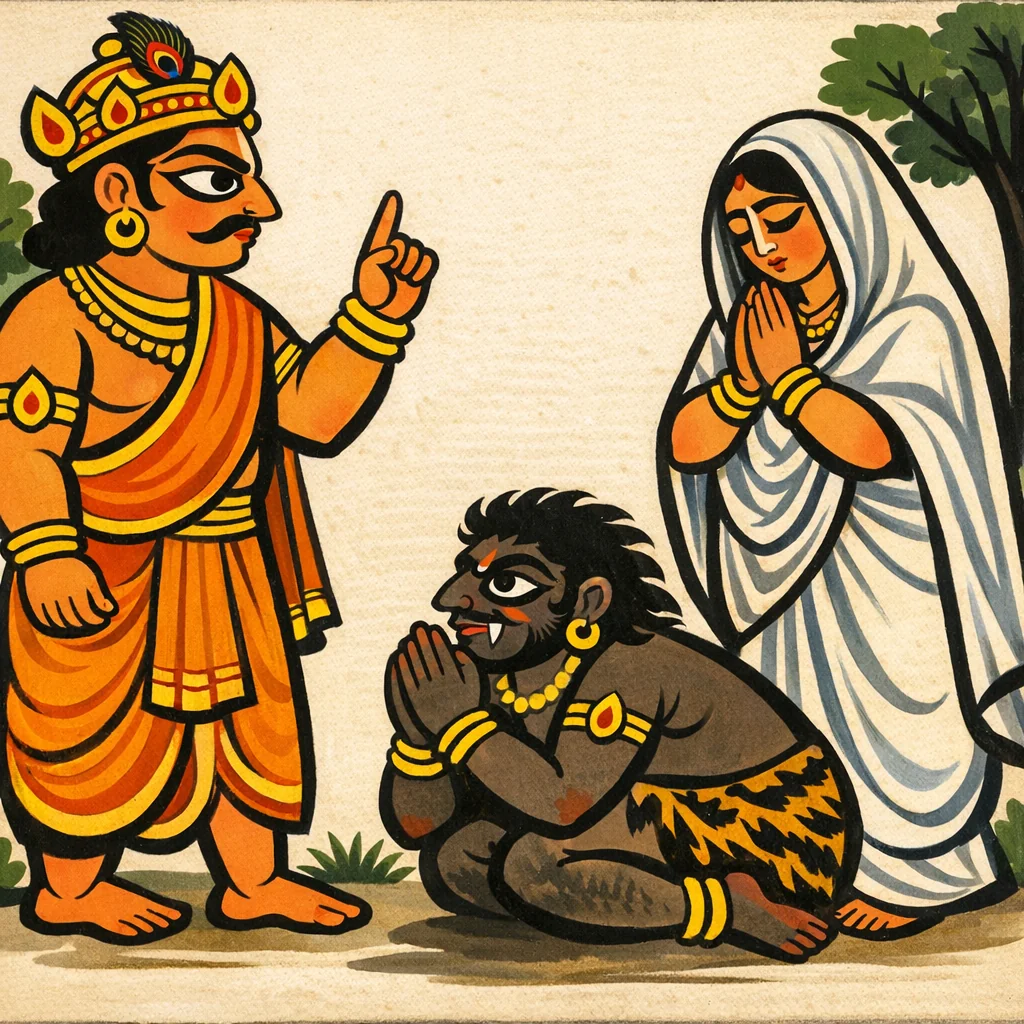
Adhyaya 70: The King Confronts the Rakshasa and Restores the Brahmin’s Wife
राक्षसोपाख्यानम् (Rākṣasopākhyānam)
Meditation on Devi
In Adhyaya 70, the king confronts a fierce rakshasa that has brought suffering upon a Brahmin. Upholding Dharma with courage and compassion, he overcomes the fiend, rescues the Brahmin’s wife, and restores peace and order to the realm.
Key Content Points
Focus Keywords
Shlokas in Adhyaya 70
Verse 1
इति श्रीमार्कण्डेयपुराणे औत्तममन्वन्तरे एकोनसप्ततितमोऽध्यायः । सप्ततितमोऽध्यायः- ७० । मार्कण्डेय उवाच । अथारुरोह स्वरथं प्रणिपत्य महामुनिम् । तेनाख्यातं वनं तच्च प्रययावुत्पलावतम् ॥
Thus, in the Śrī Mārkaṇḍeya Purāṇa, in the Auttama-manvantara, the sixty-ninth chapter ends, and the seventieth begins. Mārkaṇḍeya said: Then he mounted his own chariot; having bowed to the great sage, he set out for the forest indicated by him, to Utpalāvataka.
Verse 2
यथाख्यातस्वरूपां च भार्यां भर्त्रा द्विजस्य ताम् । भक्षयन्तीं ददर्शाथ श्रीफलानि नरेश्वरः ॥
And the king then saw that Brahmin’s wife—just as she had been described—eating śrīphala fruits.
Verse 3
पप्रच्छ च कथं भद्रे ! त्वमेतद्वनमागता । स्फुटं ब्रवीहि वैशालेरपि भार्या सुशर्मणः ॥
He asked: “O good lady, how did you come to this forest? Tell clearly—are you the wife of Suśarman of Vaiśālī?”
Verse 4
ब्राह्मण्युवाच । सुताहमतिरात्रस्य द्विजस्य वनवासिनः । पत्नी विशालपुत्रस्य यस्य नाम त्वयोदितम् ॥
The Brahmin woman said: “I am the daughter of Atirātra, a twice-born who dwells in the forest. And I am the wife of the son of Viśāla, whose name you have spoken.”
Verse 5
साहं हृता बलाकेन राक्षसेन दुरात्मना । प्रसुप्ता भवनस्यान्ते भ्रातृमातृवियोजिता ॥
“While I slept at the edge of the house, Balāka, that wicked rākṣasa, carried me off—separating me from my brother and my mother.”
Verse 6
भस्मीभवतु तद्रक्षो येनास्म्येवं वियोजिता । मात्रा भ्रातृभिरन्यैश्च तिष्ठाम्यत्र सुदुःखिता ॥
May that rākṣasa by whom I have been thus separated be reduced to ashes. Separated from my mother, my brothers, and others, I remain here in exceedingly great sorrow.
Verse 7
अस्मिन्वनेऽतिगहने तेनानीयाहमुज्झिता । न वेद्मि कारणं किं तन्नोपभुङ्क्ते न खादति ॥
In this exceedingly dense forest he brought me and then abandoned me. I do not know the reason—he neither enjoys me nor eats me.
Verse 8
राजोवाच अपि तज्ज्ञायते रक्षस्त्वामुत्सृज्य क्व वै गतम् । अहं भर्त्रा तवैवात्र प्रेषितो द्विजनन्दिनि ॥
The king said: “Is it known where the rākṣasa went after abandoning you? I have been sent here by your husband, O delight of the twice-born.”
Verse 9
ब्राह्मण्युवाच अस्यैव काननस्यान्ते स तिष्ठति निशाचरः । प्रविश्य पश्यतु भवान् न बिभेति ततो यदि ॥
The Brahmin woman said: “That night-roamer stands at the edge of this very forest. Enter and see—if you do not fear him, then do so.”
Verse 10
मार्कण्डेय उवाच प्रविवेश ततः सोऽथ तया वर्त्मनि दर्शिते । ददृशे परिवारॆण समवेतञ्च राक्षसम् ॥
Mārkaṇḍeya said: “Then he entered, shown the path by her, and he saw the rākṣasa assembled together with his attendants.”
Verse 11
दृष्टमात्रे ततस्तस्मिन् त्वरमाणः स राक्षसः । दूरादेव महीं मूर्ध्ना स्पृशन् पादान्तिकं ययौ ॥
At the very moment he beheld him, the rākṣasa hastened; even from afar, touching the earth with his head in obeisance, he drew near to the king’s feet.
Verse 12
राक्षस उवाच ममात्रागच्छता गेहं प्रसादस्ते महान् कृतः । प्रसाधि किं करोम्येष वसामि विषये तव ॥
The rākṣasa said: “By your coming here to my dwelling, a great favor has been done to me. Be gracious—what shall I do? I dwell within your realm.”
Verse 13
अर्घञ्चेमं प्रतीच्छ त्वं स्थीयताञ्चेदमासनम् । वयं भृत्या भवान् स्वामी दृढमाज्ञापयस्व माम् ॥
“Accept this arghya, and take this seat. We are your servants; you are the master—command me firmly.”
Verse 14
राजोवाच कृतमेव त्वया सर्वं सर्वामेवातिथिक्रियाम् । किमर्थं ब्राह्मणवधूस्त्वयानीता निशाचर ॥
The king said: “You have indeed done everything—every act of hospitality. But for what purpose did you bring (abduct) a Brahmin’s wife, O night-roamer?”
Verse 15
नेयं सुरूपा सन्त्यन्या भाय्र्यार्थञ्चेद् हृता त्वया । भक्ष्यार्थं चेत्कथं नात्ता त्वयैतत्कथ्यतां मम ॥
“She is not particularly beautiful—there are others. If you carried her off as a wife, why her? And if it was for food, how is it that you did not eat her? Tell me this.”
Verse 16
राक्षस उवाच न वयं मानुषाहारा अन्ये ते नृप ! राक्षसाः । सुकृतस्य फलं यत्तु तदश्नीमो वयं नृप ॥
The Rākṣasa said: “We are not eaters of human flesh, O king—those are other Rākṣasas. We, O king, subsist on whatever is the fruit of merit (sukṛta).”
Verse 17
स्वभावञ्च मनुष्याणां योषिताञ्च विमानिताः । मानिताश्च समश्नीमो न वयं जन्तुखादकाः ॥
“We consume the very nature of humans—and of women when they are dishonored; and even when they are honored, we consume that too. We are not devourers of living beings.”
Verse 18
यदस्माभिर्नृणां क्षान्तिर्भुक्ता क्रुध्यन्ति ते तदा । भुक्ते दुष्टे स्वभावे च गुणवन्तो भवन्ति च ॥
“When we have ‘consumed’ people’s forbearance, they then become angry. And when their wicked disposition has been ‘consumed’, they even become possessed of virtues.”
Verse 19
सन्ति नः प्रमदा भूप ! रूपेणाप्सरसां समाः । राक्षस्यस्तासु तिष्ठत्सु मानुषीषु रतिः कथम् ॥
“We have women, O king, whose beauty equals that of the Apsarases. When such Rākṣasī women are available, how could there be desire for human women?”
Verse 20
राजोवाच यद्येषा नोपभोगाय नाहाराय निशाचर । गृहं प्रविश्य विप्रस्य तत्किमेषा हृता त्वया ॥
The King said: “If she is neither for enjoyment nor for food, O night-roamer, then why—having entered a brāhmaṇa’s house—have you taken her away?”
Verse 21
राक्षस उवाच मन्त्रवित् स द्विजश्रेष्ठो यज्ञे यज्ञे गतस्य मे । रक्षोघ्नमन्त्रपठनात् करोत्युच्चाटनं नृप ॥
The Rākṣasa said: “That best of brāhmaṇas is a knower of mantras. Whenever I go to a sacrifice, by reciting rākṣasa-slaying mantras he drives me away, O king.”
Verse 22
वयं बुभुक्षितास्तस्य मन्त्रोच्चाटनकर्मणा । क्व यामः सर्वयज्ञेषु स ऋत्विग् भवति द्विजः ॥
“We are left hungry because of his mantra-driven expulsions. Where can we go? In every sacrifice that brāhmaṇa serves as the officiating priest (ṛtvij).”
Verse 23
ततोऽस्माभिरिदन्तस्य वैकल्यमुपपादितम् । पत्नीविना पुमानिज्याकर्मयोग्यो न जायते ॥
“Therefore we brought about this disability for him: without a wife, a man does not become fit to perform sacrificial worship (ijyā-karman).”
Verse 24
मार्कण्डेय उवाच वैकल्योच्चारणात्तस्य ब्राह्मणस्य महामतेः । ततः स राजातिभृशं विषण्णः समजायत ॥
Mārkaṇḍeya said: “Upon hearing of the impairment of that great-minded brāhmaṇa, the king then became exceedingly distressed.”
Verse 25
वैकल्यमेवं विप्रस्य वदन्मामेव निन्दति । अनर्हमर्घस्य च मां सोऽप्याह मुनिसत्तमः ॥
“Speaking thus about the brāhmaṇa’s impairment, he even censures me; and that best of sages also said that I was unworthy of honor (argha).”
Verse 26
वैकल्यं तस्य विप्रस्य राक्षसोऽप्याह मे यथा । अपत्नीकतया सोऽहं सङ्कटं महदास्थितः ॥
Just as I have described the deficiency in that brāhmaṇa, the rākṣasa also told me: “Because I am without a wife, I have fallen into a great distress.”
Verse 27
मार्कण्डेय उवाच एवम् चिन्तयतस्तस्य पुनरप्याह राक्षसः । प्रणामनम्रो राजानं बद्धाञ्जलिपुटो मुने ॥
Mārkaṇḍeya said: “As he was thinking thus, the rākṣasa again spoke—bowing in salutation to the king, with joined palms, O sage.”
Verse 28
नरेन्द्राज्ञाप्रदानेन प्रसादः क्रियतां मम । भृत्यस्य प्रणतस्य त्वं युष्मद्विषयवासिनः ॥
“By granting a command, O king, show me favor. You are lord over one who dwells in your realm—your servant, bowed before you.”
Verse 29
राजोवाच स्वभावं वयमश्नीमस्त्वयोक्तं यन्निशाचर । तदर्थिनो वयं येन कार्येण शृणु तन्मम ॥
The king said: “We accept and deal with things according to their nature, O night-roamer, as you have spoken. We too have a purpose—listen to the task I require for that favor.”
Verse 30
अस्यास्त्वयाद्य ब्राह्मण्या दौःशील्यमुपभुज्यताम् । येन त्वयात्तदौःशील्या तद्विनीता भवेदियम् ॥
“Today, consume or remove the bad conduct of this brāhmaṇa woman—so that, once that bad conduct is taken away by you, she may become disciplined and well-trained.”
Verse 31
नीयतां यस्य भार्येयं तस्य वेश्म निशाचर । अस्मिन् कृते कृतं सर्वं गृहमभ्यागतस्य मे ॥
“Take her to the house of the man whose wife she is, O night-roamer. When this is done, everything is accomplished for me, a guest who has come to this house.”
Verse 32
मार्कण्डेय उवाच ततः स राक्षसस्तस्याः प्रविश्यान्तः स्वमायया । भक्षयामास दौःशील्यं निजशक्त्या नृपाज्ञया ॥
Mārkaṇḍeya said: “Then that rākṣasa, entering within her by his own māyā, devoured her bad conduct—by his own power, in accordance with the king’s command.”
Verse 33
दौःशील्येनातिरौद्रेण पत्नी तस्य द्विजन्मनः । तेन सा संपरित्यक्ता तमाह जगतीपतिम् ॥
“Because of her extremely fierce ill-conduct, the wife of that twice-born man was abandoned by him; having been cast off, she spoke to the lord of the land (the king).”
Verse 34
स्वकर्मफलपाकेन भर्तुस्तस्य महात्मनः । वियोजिताहं तद्धेतुरयमासीन् निशाचरः ॥
“By the ripening of the fruit of my own deeds, I have been separated from that great-souled husband. The cause of that separation was this night-roamer (rākṣasa).”
Verse 35
नास्य दोषो न वा तस्य मम भर्तुर्महात्मनः । ममैव दोषो नान्यस्य सुकृतं ह्युपभुज्यते ॥
“There is no fault in him—nor in that great-souled husband of mine. The fault is mine alone, not another’s; for merit (and its result) is indeed enjoyed by the one who has done it.”
Verse 36
अन्यजन्मनि कस्यापि विप्रयोगः कृतो मया । सोऽयं ममाप्युपगतः को दोषोऽस्य महात्मनः ॥
“In another birth I caused someone’s separation. That very fruit of karma has now come upon me as well. What fault is there in this great-souled man?”
Verse 37
राक्षस उवाच प्रापयामि तवादेशादिमां भर्तृगृहं प्रभो । यदन्यत्करणीयन्ते तदाज्ञापय पार्थिव ॥
The rākṣasa said: “By your command, O lord, I shall deliver this woman to her husband’s house. Whatever else must be done—command that too, O king.”
Verse 38
राजोवाच अस्मिन् कृते कृतं सर्वं त्वया मे रजनीचर । आगन्तव्यञ्च ते वीर कार्यकाले स्मृतेन मे ॥
The king said: “When this is done, everything will have been done for me by you, O night-roamer. And you, O hero, must come when there is a task—whenever I remember and summon you.”
Verse 39
नाथेत्युक्त्वा तु तद्रक्षस्तामादाय द्विजाङ्गनाम् । निन्ये भर्तृगृहं शुद्धां दौःशील्यापगमात्तदा ॥
Mārkaṇḍeya said: Saying “So be it, my lord,” that rākṣasa took the brāhmaṇa woman and led her to her husband’s house—then she was pure, for the stain of ill repute had departed.
Frequently Asked Questions
The chapter examines how dharma is upheld when harm is caused indirectly through ritual and karmic mechanisms—balancing royal justice, household sanctity, and the purāṇic claim that suffering can arise as the maturation of one’s own prior actions (karmaphalapāka).
It functions as an Auttama-manvantara moral-analytic exemplum: within the manvantara setting, it illustrates how social-ritual order (yajña, gṛhastha-dharma, and royal protection) is destabilized and then restored, reinforcing manvantara-era dharma as a governing principle.
This Adhyāya is not part of the Devī Māhātmya (Adhyāyas 81–93) and contains no direct Śākta stuti or Devī-epithet cycle; its primary relevance is manvantara-contextual dharma and karma analysis rather than shaktic theology.