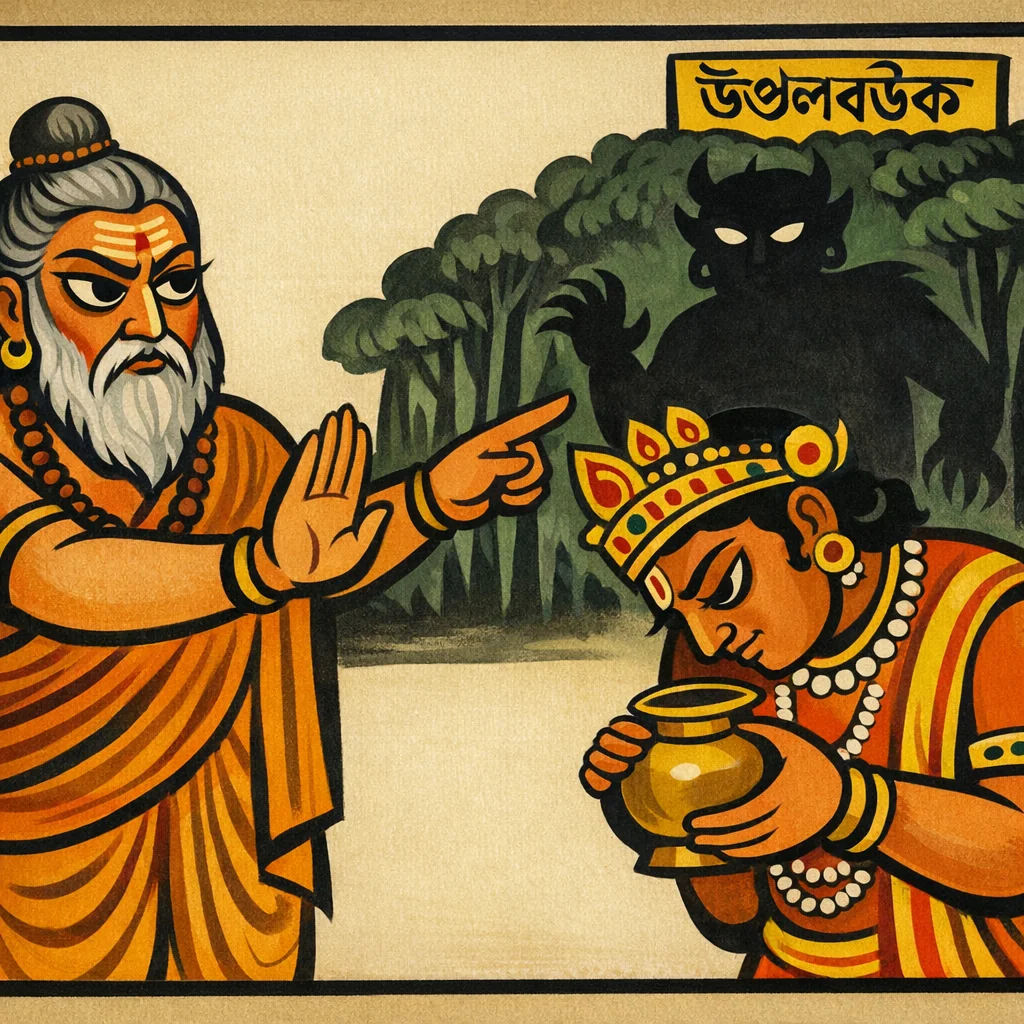
Adhyaya 69: The King’s Neglect of His Wife and the Restoration of Dharma
भार्यापरित्यागदोषप्रायश्चित्तोपाख्यान (Bhāryā-parityāga-doṣa-prāyaścittopākhyāna)
Prelude to Devi Mahatmya
Adhyaya 69 tells of a king who, through negligence, neglects and abandons his wife, causing Dharma to decline in his realm. The sages explain the grave fault of forsaking one’s wife and prescribe prāyaścitta (expiatory atonement) and self-correction, by which the king restores sacred order, honor, and peace to his household and kingdom.
Celestial Realms
Key Content Points
Focus Keywords
Shlokas in Adhyaya 69
Verse 53
इति श्रीमार्कण्डेयपुराणे स्वारोचिषे मन्वन्तरे पञ्चषष्टितमोऽध्यायः । यथाहं समतीतञ्च वर्तमानञ्च सर्वतः ॥
Thus ends the sixty-fifth chapter in the Śrī Mārkaṇḍeya Purāṇa, in the Svārociṣa Manvantara. (And:) “Just as I everywhere (know) the past as well as the present…”
Verse 54
आलोच्याज्ञापयेत्युक्ते ततो ज्ञातं मयापि तत् । ततो न दत्तवानर्घमहं तुभ्यं विधानतः ॥
When it was said, “Reflect and then command,” that matter became known to me as well. Therefore, in due form, I did not give you the arghya (honor-offering).
Verse 55
सत्यं राजन् ! त्वमर्घार्हः कुले स्वायम्भुवस्य च । तथापि नार्घयोग्यं त्वां मन्यामो वयमुत्तमम् ॥
True, O King—you are fit for arghya and are of the lineage of Svāyambhuva (Manu). Yet at present we do not consider you, the excellent one, to be worthy of arghya.
Verse 56
राजोवाच किं कृतं हि मया ब्रह्मन् ! ज्ञानादज्ञानतोऽपि वा । येन त्वत्तोऽर्घमर्हामि नाहमभ्यागतश्चिरात् ॥
The king said: “What, indeed, have I done, O brāhmaṇa—whether knowingly or even unknowingly—because of which I do not deserve arghya (the water-offering of honor) from you? I have come to you after a long time.”
Verse 57
ऋषिरुवाच किं विस्मृतं ते यत्पत्नी त्वया त्यक्ता च कानने । परित्यक्तस्तया सार्धं त्वया धर्मो नृपाखिलः ॥
The sage said: “Have you forgotten that you abandoned your wife in the forest? Together with her, you abandoned dharma in its entirety, O king.”
Verse 58
पक्षेण कर्मणो हान्या प्रयात्यस्पर्शतां नरः । विण्मूत्रैर्वार्षिकी यस्य हानिस्ते नित्यकर्मणः ॥
By the loss of the prescribed rites for a fortnight, a man falls into ritual impurity (as though ‘untouchable’). For one whose cleansing is only yearly with feces and urine, that amounts to the loss of daily duties.
Verse 59
पत्नीानुकूलया भाव्यं यथाशीलेऽपि भर्तरि । दुःशीलापि तथा भार्या पोषणीयाऽऽ नरेश्वर ॥
One should conduct oneself in a manner favorable to one’s wife, even if the husband’s own conduct is of such-and-such a kind. Likewise, even if a wife is ill-behaved, she must be maintained, O lord of men.
Verse 60
प्रतिकूला हि सा पत्नी तस्य विप्रस्य या हृता । तथापि धर्मकामोऽसौ त्वामुद्योतितवान् नृप ॥
Indeed, that brāhmaṇa’s wife—who was taken away—was unfavorable to him. Even so, that man, desiring dharma, caused your fault to be ‘brought to light’ (made evident), O king.
Verse 61
चलतः स्थापयस्यान्यान् स्वधर्मेषु महीपते । त्वां स्वधर्माद्विचलितं कोऽपरः स्थापयिष्यति ॥
O king, you steady others who have slipped from their own dharma and duty. But if you yourself are shaken from your own duty, who then will steady you?
Verse 62
मार्कण्डेय उवाच । विलक्ष्यः स महीपाल इत्युक्तस्तेन धीमता । तथेत्युक्त्वा च पप्रच्छ हृतां पत्नीं द्विजन्मनः ॥
Mārkaṇḍeya said: Thus addressed by that wise man, the king was abashed. Saying, “So be it,” he then asked about the Brahmin’s wife who had been carried off.
Verse 63
भगवन् ! केन नीता सा पत्नी विप्रस्य कुत्र वा । अतीतानागतं वेत्ति जगत्यवितथं भवान् ॥
Venerable sir, by whom was that Brahmin’s wife taken, and where? You truly know, without error, what is past and what is yet to come in the world.
Verse 64
ऋषिरुवाच । तां जहाराद्रितनयो बलाको नाम राक्षसः । द्रक्ष्यसे चाद्य तां भूप ! उत्पलावतके वने ॥
The seer said: She was carried off by Balāka, a rākṣasa, the son of a mountain, born of the hills. And today, O king, you will see her in the forest of Utpalāvataka.
Verse 65
गच्छ संयो जयाशु त्वं भार्यया हि द्विजात्तमम् । मा पापास्पदतां यातु त्वमिवासौ दिने दिने ॥
Go—quickly reunite that excellent Brahmin with his wife, lest he, day after day, fall into a seat of sin, as you did.
Frequently Asked Questions
It examines how personal marital abandonment (patnī-parityāga) constitutes a public dharmic breach for a ruler, diminishing ritual eligibility (arghya) and undermining the king’s role as the exemplar who anchors others in svadharma.
Situated in the Svārociṣa Manvantara frame, the chapter uses the sage’s atītānāgata-jñāna to connect ethical causality with cosmic-era narration, showing how dharma is assessed and restored within the Manvantara’s moral order.
It foregrounds gṛhastha- and rāja-dharma norms: sustaining and protecting one’s wife (even amid difficulty) is treated as integral to maintaining nitya-karman, purity, and the king’s capacity to stabilize society’s adherence to duty.