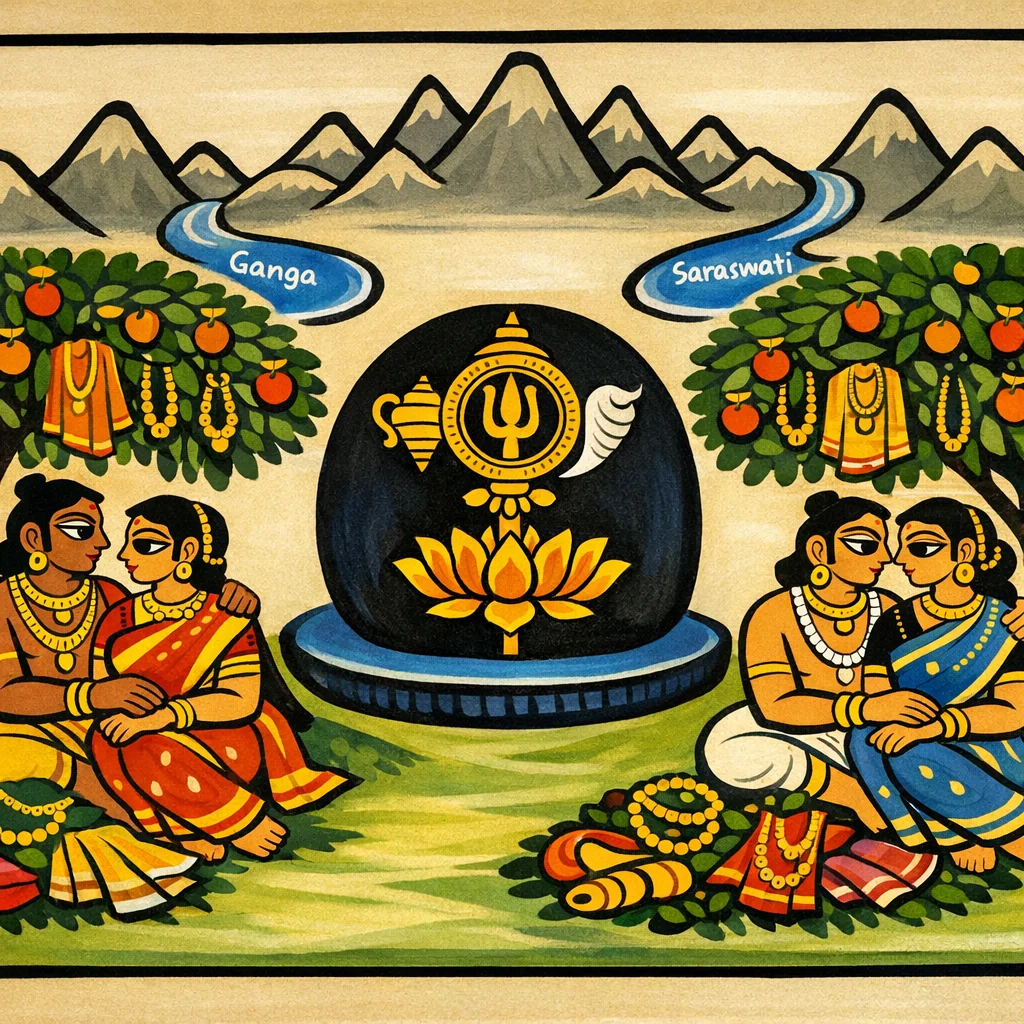
Adhyaya 59: Cosmic Geography and Yuga-Order: Bhadrashva, Ketumala, and the Northern Kuru Region
कूर्मनिवेशो नाम एकोनषष्टितमोऽध्यायः (Kūrmaniveśa-nāma Ekonaṣaṣṭitamo ’dhyāyaḥ)
Markandeya and Vishnu
This adhyaya sets forth Purāṇic cosmic geography, describing the varṣas of Bhadrāśva, Ketumāla, and the northern Kuru region (Uttara-Kuru), their placement and distinguishing features. It also explains the ordered succession of the Yugas and the law of time and karma by which beings’ conditions change, showing how dharma rises and declines across the ages in a reverent, sacred tone.
Divine Beings
Celestial Realms
Key Content Points
Focus Keywords
Shlokas in Adhyaya 59
Verse 1
इति श्रीमार्कण्डेयपुराणे कूर्मनिवेशो नामाष्टपञ्चाशोऽध्यायः । ऊनषष्टितमोऽध्यायः- ५९ । मार्कण्डेय उवाच । एवंतु भारतं वर्षं यथावत् कथितं मुने । कृतं त्रेता द्वापरञ्च तथाथिष्यम् चतुष्टयम् ॥
Thus, in the Śrī Mārkaṇḍeya Purāṇa, the fifty-eighth chapter called ‘Kūrma-niveśa’ concludes. (Now begins) Chapter 59. Mārkaṇḍeya said: ‘Thus, O sage, Bhārata-varṣa has been described properly; and the four ages—Kṛta, Tretā, Dvāpara, and likewise Kali—are to be understood.’
Verse 2
अत्रैवैतद्युगानान्तु चातुर्वर्ण्योऽत्र वै द्विज । चत्वारि त्रीणि द्वे चैव तथैकञ्च शरच्छतम् ॥
Here indeed, O twice-born, the fourfold social order exists. And the span of life here, in the sequence of the yugas, is four hundred, three hundred, two hundred, and one hundred years, respectively.
Verse 3
जीवन्त्यत्र नरा ब्रह्मन् ! कृतत्रेतादिके क्रमात् । देवकूटस्य पूर्वस्य शैलेन्द्रस्य महात्मनः ॥
Men live here, O Brahmin, according to the order beginning with the Kṛta and Tretā yugas. This region lies to the east of the great mountain-lord Devakūṭa.
Verse 4
पूर्वेण यत् स्थितं वर्षं भद्राश्वं तन्निबोध मे । श्वेतपर्णश्च नीलश्च शैवालश्चाचलोत्तमः ॥
Understand from me that to the east lies the varṣa called Bhadrāśva. There are the excellent mountains Śvetaparṇa, Nīla, and Śaivāla.
Verse 5
कौरञ्जः पर्णशालाग्रः पञ्चैते तु कुलाचलाः । तेषां प्रसूतिरन्ये ये बहवः क्षुद्रपर्वताः ॥
Kaurañja and Parṇaśālāgra—these, together with those previously named, are the five principal ‘family mountains’ (kulācalas). From them are born many other lesser hills.
Verse 6
तैर्विशिष्टा जनपदा नानारूपाः सहस्रशः । ततः कुमुदसंकाशाः शुद्धसानुसुमङ्गलाः ॥
Marked out by them are thousands of provinces of many kinds. Thereafter come regions like white lotuses, with pure slopes and auspicious beauty.
Verse 7
इत्येवमादयोऽन्येऽपि शतशोऽथ सहस्रशः । सीता शङ्खावती भद्रा चक्रावर्तादिकास्तथा ॥
Thus there are others as well—by hundreds and by thousands—such as Sītā, Śaṅkhāvatī, Bhadrā, and likewise Cakrāvartā and others.
Verse 8
नद्योऽथ बह्व्यो विस्तीर्णाः शीततोयौघवाहिकाः । अत्र वर्षे नराः शङ्खशुद्धहेमसमप्रभाः ॥
And many broad rivers flow, carrying streams of cool waters. In this varṣa, the people shine like conch-shell, pure gold, and the like.
Verse 9
दिव्यसङ्गमिनः पुण्या दशवर्षशतायुषः । मन्दोत्तमौ न तेषु स्तः सर्वे ते समदर्शनाः ॥
They associate with the divine, are meritorious, and live for a thousand years. Among them there are no ‘dull’ or ‘excellent’ (as extremes); all are equal in outlook.
Verse 10
तितिक्षादिभिरष्टाभैः प्रकृत्या ते गुणैर्युताः । तत्राप्यश्वशिरा देवश्चतुर्बाहुर्जनार्दनः ॥
By nature they are endowed with eight qualities beginning with forbearance. And there too (in that region) is the god Aśvaśiras—Janārdana with four arms.
Verse 11
शिरोहृदयमेड्ह्राङ्घ्रिहस्तैश्चाक्षित्रयान्वितः । तस्याप्यथैवं विषयाः विज्ञेया जगतः प्रभोः ॥
Endowed with head, heart, organ of generation, feet, and hands—and possessed of three eyes—so too should the domains of that Lord of the world be understood in this manner.
Verse 12
केतुमालमतो वर्षं निबोध मम पश्चिमम् । विशालः कम्बलः कृष्णो जयन्तो हरिपर्वतः ॥
Learn from me of the western region called Ketumāla-varṣa. There are the mountains Viśāla, Kambala, Kṛṣṇa, Jayanta, and Hari-parvata.
Verse 13
विशोको वर्धमानश्च सप्तैते कुलपर्वताः । अन्ये सहस्रशः शैला येषु लोकगणः स्थितः ॥
Viśoka and Vardhamāna—these seven are the clan-mountains (kulaparvatas). There are also thousands of other mountains on which multitudes of beings dwell.
Verse 14
मौलयस्ते महाकायाः शाकपोतकम्बकाः । अङ्गुलप्रमुखाश्चापि वसन्ति शतशो जनाः ॥
There dwell the Maulayas—people of great bodies—as well as the Śāka, Potaka, and Kambhaka. Also, people such as the Aṅgula-pramukhas live there in hundreds.
Verse 15
ये पिबन्ति महानद्यो वङ्क्षुं श्यामां सकम्बलाम् । अमोघां कामिनीं श्यामां तथैवान्याः सहस्रशः ॥
They drink from the great rivers—Vaṅkṣu, Śyāmā, Sakambalā, Amoghā, Kāminī, Śyāmā—and likewise from thousands of other rivers.
Verse 16
अत्राप्यायुḥ समं पूर्वैरत्रापि भगवान् हरिः । वराहरूपी पादास्यहृत्पृष्ठपार्श्वतस्तथा ॥
Here too, the lifespan is the same as in the eastern region. Here too, the Blessed Hari (Bhagavān Hari) is present in the form of the Boar (Varāha), manifest as feet, mouth, heart, back, and sides.
Verse 17
त्रिनक्षत्रयुते देशे नक्षत्राणि शुभानि च । इत्येतत् केतुमालान्ते कथितं मुनिसत्तम ॥
In that land endowed with three constellations, the stars are auspicious. Thus, O best of sages, the account of Ketumāla has been told.
Verse 18
अतः परं कुरून् वक्ष्ये निबोधेह ममोत्तरान् । तत्र वृक्षाः मधुफलाः नित्यपुष्पफलोपगाः ॥
Next I shall describe the Kurus—understand now about my northern region. There, the trees bear honey-sweet fruits and are ever endowed with flowers and fruits.
Verse 19
वस्त्राणि च प्रसूयन्ते फलेष्वाभरणानि च । सर्वकामप्रदास्ते हि सर्वकामफलप्रदाः ॥
Garments are produced there, and ornaments too appear in the fruits. Indeed, they bestow all desired things and yield the fruits of every wish.
Verse 20
भूमिर्मणिमयी वायुः सुगन्धः सर्वदा सुखः । जायन्ते मानवास्तत्र देवलोकपरिच्युताः ॥
The ground is made of jewels; the wind is fragrant and always pleasant. Humans are born there—those who have fallen from the world of the gods.
Verse 21
मिथुनानि प्रसूयन्ते समकालस्थितानि वै । अन्योन्यमनुरक्तानि चक्रवाकोपमानि च ॥
Pairs are born there, appearing at the same time; they are mutually devoted, like the cakravāka birds.
Verse 22
चतुर्दशसहस्राणि तेषां सार्धानि वै स्थितिः । चन्द्रकान्तश्च शैलेन्द्रः सूर्यकान्तस्तथापरः ॥
Their extent is fourteen thousand yojanas, and their height is the same, increased by a further half. There is the mountain-king Candrakānta, and likewise another called Sūryakānta.
Verse 23
तस्मिन् कुलाचलौ वर्षे तन्मध्ये च महानदी । भद्रसोमा प्रयात्युर्व्यां पुण्यामलजलौघिनी ॥
In that varṣa, among those boundary-mountains, and in its very middle, a great river flows upon the earth—Bhadrasomā—bearing sacred, pure streams of water.
Verse 24
सहस्रशस्तथैवान्या नद्यो वर्षेऽपि चोत्तरे । तथान्याः क्षीरवाहिन्यो घृतवाहिन्य एव च ॥
Likewise, in that northern varṣa there are other rivers by the thousand; and there are others that carry milk, and indeed others that carry ghee.
Verse 25
दध्नो ह्रदास्तथा तत्र तथान्ये चानुपर्वताः । अमृतास्वादकल्पानि फलानि विविधानि च ॥
There, too, are lakes of curds, and other features along the mountains; and fruits of many kinds, whose taste is comparable to nectar (amṛta).
Verse 26
वनेषु तेषु वर्षेषु शतशोऽथ सहस्रशः । तत्रापि भगवान् विष्णुः प्राक्शिरा मत्स्यरूपवान् ॥
In the forests of those regions, by the hundreds and by the thousands, there too the Blessed Lord Viṣṇu is present—Prākśiras—having the form of a fish.
Verse 27
विभक्तो नवधा विप्र ! नक्षत्राणां त्रयं त्रयम् । दिशस्तथापि नवधा विभक्ता मुनिसत्तम ॥
O brāhmaṇa, the system is divided ninefold—the nakṣatras in groups of three and three; likewise the directions too are divided ninefold, O best of sages.
Verse 28
चन्द्रद्वीपः समुद्रे च भद्रद्वीपस्तथापरः । तत्रापि पुण्यो विख्यातः समुद्रान्तर्महामुने ॥
In the ocean there is Candradvīpa, and likewise another, Bhadradvīpa. There too, within the sea, a place is renowned as sacred, O great sage.
Verse 29
इत्येतत् कथितं ब्रह्मन् ! कुरुवर्षं मयोत्तरम् । शृणु किंपुरुषादीनि वर्षाणि गदतो मम ॥
Thus, O brāhmaṇa, I have described to you Uttara-Kuruvarṣa. Now hear, as I speak, of the varṣas beginning with Kiṃpuruṣa.
Frequently Asked Questions
The chapter frames geography as a moral-anthropological map: regions are distinguished not only by mountains and rivers but by the innate virtues, longevity, and social harmony of their inhabitants, implying that cosmic order (dharma-like regularity) is legible through spatial arrangement.
While not narrating a specific Manu’s reign, Adhyāya 59 supplies Manvantara-adjacent cosmography: it stabilizes the world-stage (varṣas, kulaparvatas, rivers, astral divisions) upon which Manvantara histories and dharmic conditions unfold, and it reiterates yuga-sequencing as the temporal logic for Bhārata.
This chapter is not part of the Devī Māhātmya corpus (Adhyāyas 81–93). Its theological emphasis is instead Vaiṣṇava-cosmographic: it associates specific regions with Hari/Viṣṇu’s manifestations (including varāha- and matsya-associated forms), integrating divine presence into the cosmological map.