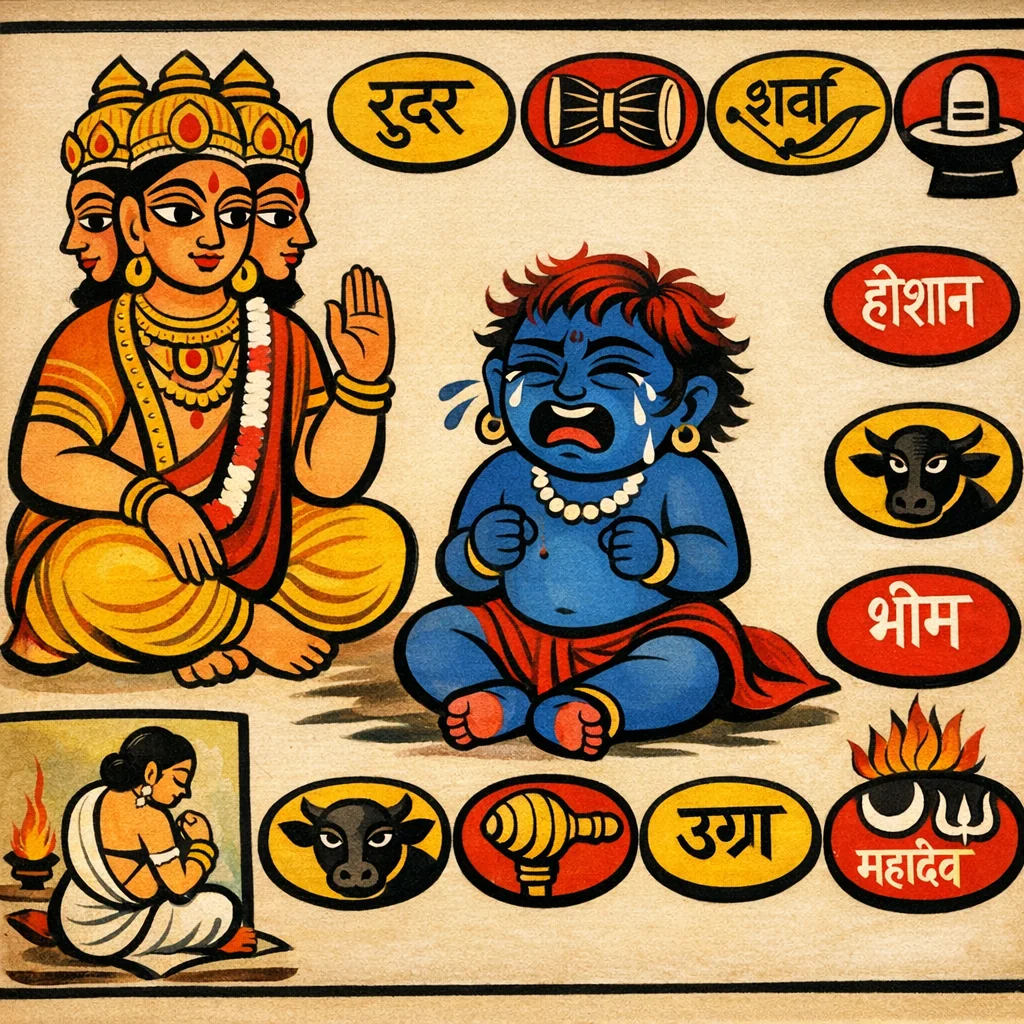
Adhyaya 52: The Manifestation of Nilalohita (Rudra) and the Allocation of His Names, Abodes, Consorts, and Lineages
नीललोहितरुद्रप्रादुर्भाव-नामस्थानपत्नीपुत्रवर्णन (Nīlalohita-Rudra-prādurbhāva–nāma-sthāna-patnī-putra-varṇana)
Markandeya's Powers
This chapter recounts the awe-inspiring manifestation of Nīlalohita (Rudra) and Brahmā’s orderly allotment of his many names, abodes, directions, and sacred seats. It further enumerates Rudra’s consorts (Śakti), his sons, and the lineages that arise from him, thereby affirming cosmic order and the sanctity of devotion to Lord Rudra.
Divine Beings
Celestial Realms
Key Content Points
Focus Keywords
Shlokas in Adhyaya 52
Verse 1
इति श्रीमार्कण्डेयपुराणे दुः सहोत्पत्तिसमापनं नामैकपञ्चाशौऽध्यायः द्विपञ्चाशोऽध्यायः— मार्कण्डेय उवाच । इत्येष तामसः सर्गो ब्रह्मणोऽव्यक्तजन्मनः । रुद्रसर्गं प्रवक्ष्यामि तन्मे निगदतः शृणु ॥
Thus ends, in the Śrī Mārkaṇḍeya Purāṇa, the fifty-first chapter called “The Conclusion of the Origin of Duḥsaha.” Mārkaṇḍeya said: “So concludes this tāmasa creation of Brahmā, whose birth is from the Unmanifest (Avyakta). I shall now describe the creation connected with Rudra; listen as I declare it.”
Verse 2
तनयाश्च तथैवाष्टौ पत्न्यः पुत्राश्च ते तथा । कल्पादावात्मनस्तुल्यं सुतं प्रध्यायतः प्रभोः ॥
Likewise there were eight sons, and for them too there were wives and sons. At the beginning of the kalpa, as the Lord (Brahmā) was absorbed in meditation, a son equal to him in nature was conceived/manifested.
Verse 3
प्रादुरासीदथाङ्के ’स्य कुमारो नीललोहितः । रुरोद सुस्वरं सो ’थ द्रवंश्च द्विजसत्तम ॥
Then, in his lap, there appeared a boy named Nīlalohita. He cried loudly and also ran about, O best of the twice-born.
Verse 4
किं रोदिषीति तं ब्रह्मा रुदन्तं प्रत्युवाच ह । नाम देहीति तं सो ’थ प्रत्युवाच जगत्पतिम् ॥
Brahmā said to him as he cried, “Why do you cry?” Then he replied to the Lord of the world, “Grant me a name.”
Verse 5
रुद्रस्त्वं देव ! नाम्नासि मा रोदीर्धैर्यमावह । एवमुक्तस्ततः सो ’थ सप्तकृत्वो रुरोद ह ॥
“Your name is Rudra, O god; do not cry—compose yourself.” Though addressed thus, he then cried seven times.
Verse 6
ततो ’न्यानि ददौ तस्मै सप्त नामानि वै प्रभुः । स्थानानि चैषामष्टानां पत्नीः पुत्रांश्च वै द्विज ॥
Then the Lord gave him seven other names. And he also assigned the abodes of these eight, together with their wives and sons, O brāhmaṇa.
Verse 7
भवं शर्वं तथेशानं तथा पशुपतिं प्रभुः । भीममुग्रं महादेवमुवाच स पितामहः ॥
That Grandsire (Brahmā) declared the names: Bhava, Śarva, Īśāna, Paśupati, Bhīma, Ugra, and Mahādeva, in addition to Rudra.
Verse 8
चक्रे नामान्यथैतानि स्थानान्येषाञ्चकार ह । सूर्यो जलं मही वह्निर्वायुराकाशमेव च ॥
Thus he established these names, and he made their stations as well: the Sun, Water, Earth, Fire, Wind, and also Space (Ether).
Verse 9
दीक्षितो ब्राह्मणः सोम इत्येतास्तनवः क्रमात् । सुवर्चला तथैवोमा विकेशी चापरा स्वधा ॥
“The initiated (ascetic), the brāhmaṇa, and Soma”—these too (together with the prior ones) are the stations in due order. Their consorts are Suvarcalā, likewise Umā, Vikeśī, and another named Svadhā.
Verse 10
स्वाहा दिशस्तथा दीक्षा रोहिणी च यथाक्रमम् । सूर्यादीनां द्विजश्रेष्ठ ! रुद्राद्यैर्नामभिः सह ॥
And the remaining consorts are Svāhā, the Directions (Diśaḥ), Dīkṣā, and Rohiṇī, respectively in order—together with the names beginning with Rudra, for the set beginning with the Sun, O best of brāhmaṇas.
Verse 11
शनैश्चरस्तथा शुक्रो लोहिताङ्गो मनोजवः । स्कन्दः सर्गो ’थ सन्तानो बुधश्चानुक्रमात् सुतः ॥
And their sons, in order, were: Śanaiścara, Śukra, Lohitāṅga, Manojava, Skanda, Sarga, Santāna, and Budha.
Verse 12
एवम्प्रकारो रुद्रोऽसौ सतीं भार्यामविन्दत । दक्षकोपाच्च तत्याज सा सती स्वं कलेवरम् ॥
Thus Rudra obtained Satī as his wife. But because of Dakṣa’s anger she was rejected, and that Satī abandoned her own body.
Verse 13
हिमवद्दुहिता साभून्मेनायां द्विजसत्तम । तस्या भ्राता तु मैनाकः सखाम्भोधेरनुत्तमः ॥
O best of the twice-born, she became the daughter of Himavat, born of Menā. Her brother was Maināka, the unsurpassed friend of the ocean.
Verse 14
उपयेमे पुनश्चैनामनन्यां भगवान्भवः । देवौ धाताविधातारौ भृगोः ख्यातिरसूयत ॥
Then the Blessed Bhava (Śiva) married her again, the incomparable one. Khyāti, the wife of Bhṛgu, bore the two gods Dhātṛ and Vidhātṛ.
Verse 15
श्रियञ्च देवदेवस्य पत्नी नारायणास्य या । आयातिर्नियतिश्चैव मेरोः कन्ये महात्मनः ॥
And Śrī—who is the wife of Nārāyaṇa, the God of gods. Also Āyāti and Niyati were the two daughters of the great-souled Meru.
Verse 16
धाताविधात्रोस्ते भार्ये तयोर्जातौ सुतावुभौ । प्राणश्चैव मृकण्डुश्च पिता मम महायशाः ॥
Dhātṛ and Vidhātṛ had two wives; from them were born two sons—Prāṇa and Mṛkaṇḍu, my illustrious father.
Verse 17
मनस्विन्यामहं तस्मात् पुत्रो वेदशिरा मम । धूम्रवत्यां समभवत् प्राणस्यापि निबोध मे ॥
From Manasvinī I had a son named Vedaśiras. And from Dhūmravatī there was also born a son of Prāṇa—understand this from me.
Verse 18
प्राणस्य द्युतिमान् पुत्र उत्पन्नस्तस्य चात्मजः । अजराश्च तयोः पुत्राः पौत्राश्च बहवोऽभवन् ॥
Dyutimān, Prāṇa’s son, was born, and he too had a son. From those two came sons named Ajarā, and many grandsons as well.
Verse 19
पत्नी मरीचेः सम्भूतिः पौर्णमासमसूयत । विराजाः पर्वतश्चैव तस्य पुत्रौ महात्मनः ॥
Sambhūti, the wife of Marīci, bore Paurṇamāsa. And Virajā and Parvata were the two sons of that great-souled one.
Verse 20
तयोः पुत्रांस्तु वक्ष्येऽहं वंशसंकीर्तने द्विज । स्मृतिश्चाङ्गिरसः पत्नी प्रसूता कन्यकास्तथा ॥
I shall now tell of their sons in the recitation of lineages, O twice-born. Smṛti, the wife of Aṅgiras, also gave birth to daughters.
Verse 21
सिनीवाली कुहूश्चैव राका भानुमती तथा । अनसूया तथैवात्रेर् जज्ञे पुत्रानकल्मषान् ॥
Sinīvālī and Kuhū, Rākā and Bhānumatī—these were the daughters. Likewise, Anasūyā, the wife of Atri, bore sons who were free from impurity.
Verse 22
सोमं दुर्वाससं चैव दत्तात्रेयञ्च योगिनम् । प्रीत्यां पुलस्त्यभार्यायां दत्तोऽन्यस्तत्सुतोऽभवत् ॥
Soma, Durvāsas, and the yogin Dattātreya—these (sons) were born. And from Prīti, the wife of Pulastya, another (son) named Datta was born; he became her son.
Verse 23
पूर्वजन्मनि सोऽगस्त्यः स्मृतः स्वायम्भुवेऽन्तरे । कर्दमश्चार्ववीरश्च सहिष्णुश्च सुतत्रयम् ॥
In a former birth he is remembered as Agastya, during the Svāyambhuva Manvantara. He had three sons: Kardama, Ārvavīra, and Sahiṣṇu.
Verse 24
क्षमा तु सुषुवे भार्या पुलहस्य प्रजापतेः । क्रतोस्तु सन्नतिर्भार्या बालखिल्यानसूयत ॥
Kṣamā, the wife of the Prajāpati Pulaha, gave birth to offspring. And Sannati, the wife of Kratu, gave birth to the Bālakhilyas.
Verse 25
षष्टिर्यानि सहस्राणि ऋषीणामूर्ध्वरेतसाम् । ऊर्जायान्तु वसिष्ठस्य सप्ताजायन्त वै सुताः ॥
There were sixty thousand ṛṣis who were ūrdhvaretas—continent, conserving their generative energy. And in Ūrjā, Vasiṣṭha’s wife, seven sons were indeed born.
Verse 26
रजोगात्रोर्ध्वबाहुश्च सबलश्चानघस्तथा । सुतपाः शुक्ल इत्येते सर्वे सप्तर्षयः स्मृताः ॥
Rajogātra, Ūrdhvabāhu, Sabala, Anagha, Sutapā, and Śukla—these are all remembered as the seven ṛṣis (saptarṣis).
Verse 27
योऽसावग्निरभीमानी ब्रह्मणस्तनयोऽग्रजः । तस्मात् स्वाहा सुतान् लेभे त्रीन् उदारौजसो द्विज ॥
That Agni—Abhimānī—Brahmā’s son, the eldest: from him Svāhā obtained three sons, O twice-born, of splendid energy.
Verse 28
पावकं पवमानञ्च शुचिं चापि जलाशिनम् । तेषान्तु सन्ततावन्ये चत्वारिंशच्च पञ्च च ॥
Pāvaka, Pavamāna, and Śuci—also called Jalāśin. In their lineage there were others—forty-five in number.
Verse 29
कथ्यन्ते बहुशश्चैते पिता पुत्रत्रयञ्च यत् । एवमेकोनपञ्चाशद् दुर्जयाः परिकीर्तिताः ॥
These are spoken of repeatedly—namely, the father and the triad of sons. Thus, forty-nine ‘Durjayās’ are recounted.
Verse 30
पितरो ब्रह्मणा सृष्टा ये व्याख्याता मया तव । अग्निष्वात्ता बर्हिषदोऽनग्नयः साग्नयश्च ये ॥
The Pitṛs created by Brahmā—whom I have explained to you—are the Agniṣvāttas, the Barhiṣads, and those who are without fire and those who are with fire.
Verse 31
तेभ्यः स्वधा सुते जज्ञे मेनां वै धारिणीं तथा । ते उभे ब्रह्मवादिन्यौ योगिन्यौ चाप्युभे द्विज ॥
From them, Svadhā bore two daughters—Menā and likewise Dhāriṇī. Both of them were brahmavādinīs (expounders of Brahman) and both were yoginīs, O twice-born.
Verse 32
उत्तमज्ञानसम्पन्ने सर्वैः समुदिते गुणैः । इत्येषा दक्षकन्यानां कथितापत्यसन्ततिः । श्रद्धावान् संस्मरन्नित्यं प्रजावानभिजायते ॥
Endowed with excellent knowledge and possessing all virtues in full measure—thus has the lineage of the offspring born of Dakṣa’s daughters been described. One who, with faith, remembers it daily becomes blessed with progeny.
Frequently Asked Questions
The chapter frames a theological logic of naming and cosmic function: Rudra’s affect (his weeping) becomes the etiological basis for divine nomenclature, while the allocation of multiple names and stations articulates how a single deity is systematized into differentiated cosmic roles within creation.
Rather than detailing a specific Manu, the chapter supplies the genealogical infrastructure used by Manvantara narratives: it enumerates lineages of deities, ṛṣis, and Pitṛs (e.g., Dhātā–Vidhātā; Prāṇa–Mṛkaṇḍu; Agni’s sons; Pitṛ classes), which later function as recurring anchors for Manvantara-era progeny and cosmic administration.
This Adhyāya is outside the Devī Māhātmya (81–93), but it contributes a key Śaiva–Śākta connective motif through Satī: her relinquishing of the body due to Dakṣa’s conflict and her rebirth as Himavat’s daughter anticipates later Śākta/Śaiva theological developments without presenting the Devī Māhātmya’s battle-narratives or stutis.