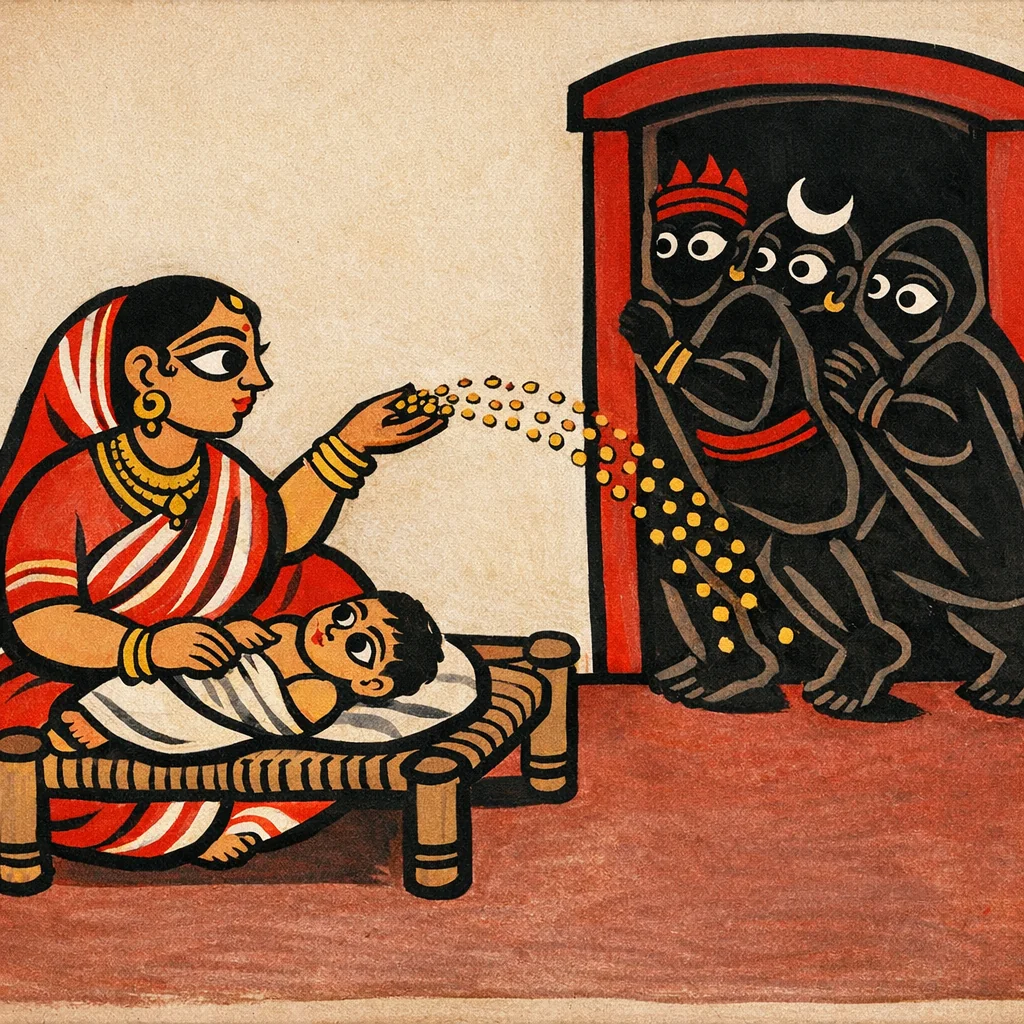
Adhyaya 51: Yaksha Injunctions: Graha-Children and Female Spirits Causing Domestic and Ritual Disruptions
यक्षानुशासन (Yakṣānuśāsana)
Jaimini Returns
This adhyaya sets forth injunctions concerning the Yakshas and the means of safeguarding the household and sacred rites from disruptions caused by Graha-afflictions in children and by female spirits that disturb domestic and ritual order. It notes ominous signs and teaches precautions, purification, offerings, and the observance of dharma and mantra to remove obstacles, restore peace, and preserve the sanctity of family life.
Divine Beings
Celestial Realms
Key Content Points
Focus Keywords
Shlokas in Adhyaya 51
Verse 1
इति श्रीमार्कण्डेयपुराणे यक्षानुशासनो नाम पञ्चाशोऽध्यायः । एकपञ्चाशोऽध्यायः- ५१ मार्कण्डेय उवाच दुःसहस्याभवद्भार्या निर्माष्टिर्नाम नामतः । जाता कलॆस्तु भार्यायामृतौ चाण्डालदर्शनात् ॥
Thus ends, in the Śrī Mārkaṇḍeya Purāṇa, the fiftieth chapter called “Instruction to the Yakṣa.” Chapter 51: Mārkaṇḍeya said: Duḥsaha had a wife named Nirmāṣṭi. In the time of Kali, because she beheld a Caṇḍāla (an outcaste), she conceived in her season.
Verse 2
तयोरपत्यान्यभवने जगद्व्यापीनि षोडश । अष्टौ कुमाराः कन्याश्च तथाष्टावतिभीषणाः ॥
From those two were born sixteen offspring, roaming and pervading the world: eight were “kumāras” (afflictors of male children), and likewise eight were exceedingly terrifying “kanyās” (their female counterparts).
Verse 3
तन्ताकृष्टिस्तथोक्तिश्च परिवर्तस्तथापरः । अङ्गध्रुक् शकुनिश्चैव गण्डप्रान्तरतिस्तथा ॥
They are: Tantākṛṣṭi, Tathokti, Parivarta, and Apara; also Aṅgadhṛk, Śakuni, and Gaṇḍaprāntarati.
Verse 4
गर्भहा सस्यहा चान्यः कुमारास्तनयास्तयोः । कन्याश्चान्यास्तथैवाष्टौ तासां नामानि मे शृणु ॥
Also among the sons—those kumāras—were Garbhahā, Sasyahā, and another; and likewise there were eight other kanyās. Hear their names from me.
Verse 5
नियोजिका वै प्रथमा तथैवान्या विरोधिनी । स्वयंहारकरी चैव भ्रामणी ऋतुहारिका ॥
The first is Niyojikā; likewise another is Virodhinī; also Svayaṃhārakarī, Bhrāmaṇī, and Ṛtuhārikā.
Verse 6
स्मृतिबीजहरे चान्ये तयोः कन्ये 'तिदारुणे । विद्वेषण्यष्टमी नाम कन्या लोकभयावहा ॥
And the other two are Smṛtibījahare—those two kanyās are exceedingly dreadful. The eighth kanyā is named Vidveṣaṇī, bringing fear to the world.
Verse 7
एतासां कर्म वक्ष्यामि दोषप्रशमनञ्च यत् । अष्टानाञ्च कुमाराणां श्रुयतां द्विजसत्तम ॥
I shall describe their deeds, and also the means by which faults and afflictions are pacified. Listen, O best of the twice-born, concerning the eight Kumāras.
Verse 8
दन्ताकृष्टिः प्रसुप्तानां बालानां दशनस्थितः । करोति दन्तसंघर्षं चिकीर्षुर्दुःसहागमम् ॥
Dantākṛṣṭi, dwelling in the teeth of sleeping children, causes the grinding of teeth, intent on producing an unbearable affliction.
Verse 9
तस्योपशमनं कार्यं सुप्तस्य सितसर्षपैः । शयनस्योपरि क्षिप्तैर्मानुषैर्दशनोपरि ॥
Its pacification should be performed for the sleeping child with white mustard-seeds—cast by people upon the bed and upon/over the teeth.
Verse 10
सुवार्च्चलौषधीस्नानात्तथा सच्छास्त्रकीर्तनात् । उष्ट्रकण्टकखड्गास्थि-क्षौमवस्त्रविधारणात् ॥
By bathing with the herb Suvārccalā, by recitation of good and true śāstra, and by wearing protective items such as camel-thorn, sword-bone, and linen cloth—the affliction is pacified.
Verse 11
तिष्ठत्यन्यकुमारस्तु तथास्त्त्वित्यसकृद्ब्रुवन् । शुभाशुभे नृणां युङ्क्ते तथोक्तिस्तच्च नान्यथा ॥
Another Kumāra remains present, repeatedly uttering “tathāstu” (“so be it”). He assigns to people auspicious and inauspicious results—this is Tathokti, and it is indeed so.
Verse 12
तस्माददुष्टं माङ्गल्यं वक्तव्यं पण्डितैः सदा । दुष्टे श्रुते तथैवोक्ते कीर्तनीयो जनार्दनः ॥
Therefore, the learned should always speak what is untainted and auspicious. But if something inauspicious is heard or uttered, then Janārdana (Viṣṇu) should be praised and remembered at once.
Verse 13
चराचरगुरुर्ब्रह्मा या यस्य कुलदेवता । अन्यगर्भे परान् गर्भान् सदैव परिवर्तयन् ॥
Brahmā, the teacher of all moving and unmoving beings—whoever has him as their family-deity—there is one who constantly “turns aside,” diverting other intentions into another womb or track (that is, causing displacement or redirection).
Verse 14
रतिमाप्नोति वाक्यञ्च विवक्षोरन्यदेव यत् । परिवर्तकसंज्ञो 'यं तस्यापि सितसर्षपैः ॥
The speaker takes on a different inclination, and even the words of one intending to speak become “something else.” This is called the Parivartaka (“the Diverter”); for him too there is a remedy with white mustard seeds.
Verse 15
रक्षोघ्नमन्त्रजप्यैश्च रक्षाṃ कुर्वोत तत्त्ववित् । अन्यश्चानिलवन्नृणामङ्गेषु स्फुरणोदितम् ॥
By recitation of mantras that destroy harmful beings, the knower of principles should perform protection. Another sign arises like wind: twitchings appearing in the limbs of men.
Verse 16
शुभाशुभं समाचष्टे कुशैस्तस्याङ्गताडनम् । काकादिपक्षिसंस्थो 'न्यः श्वादेरङ्गगतो 'पि वा ॥
Striking his body with kuśa grass indicates (foretells) good or bad. Another portent is found in birds such as crows, or even in bodily contact by a dog and the like.
Verse 17
शुभाशुभञ्च शकुनिः कुमारो 'न्यो ब्रवीति वै । तत्रापि दुष्टे व्याक्षेपः प्रारम्भत्याग एव च ॥
The omen-bird indicates good and bad; and another “kumāra” (a youth, an agent of signs) likewise truly speaks forth portents. There, when the sign is inauspicious, one should counteract it and even abandon the undertaking.
Verse 18
शुभे द्रुततरं कार्यमिति प्राह प्रजापतिः । गण्डान्तेषु स्थितश्चान्यो मुहूर्तार्धं द्विजोत्तम ॥
Prajāpati said: “When the sign is auspicious, the act should be carried out more swiftly.” Another condition remains at the ends of a gaṇḍa for half a muhūrta, O best of the twice-born.
Verse 19
सर्वारम्भान् कुमारो 'त्ति शस्ताताञ्चानसूयताम् । विप्रोक्त्या देवतास्तुत्या मूलोत्खातेन च द्विज ॥
The “kumāra” (the omen-agent) consumes and spoils all undertakings; and one should not find fault with what has been well spoken. By a brāhmaṇa’s counsel, by praising the deities, and by uprooting the matter at its very root, O twice-born, it is remedied.
Verse 20
गोमूत्रसर्षपस्त्राणैस्तदृक्षग्रहपूजनैः । पुनश्च धर्मोपनिषत्करणैः शास्त्रदर्शनैः ॥
With protective rites using cow-urine and mustard, with worship of the relevant constellations and planets, and again with practices that embody the “secret essence of dharma” and with consultation of śāstra, the affliction is pacified.
Verse 21
अनज्ञया जन्मनश्च प्रशमं याति गण्डवान् । गर्भे स्त्रीणां तथान्यस्तु फलनाशी सुदारुणः ॥
By proper authorization and by birth-rites, one afflicted with gaṇḍa comes to pacification. But another affliction in the wombs of women is exceedingly terrible, destroying the fruit—the fetus.
Verse 22
तस्य रक्षा सदा कार्या नित्यं शौचनि सेवनात् । प्रसिद्धमन्त्रलिखनाच्छस्तमाल्यादिधारणात् ॥
His protection should always be undertaken: by constant observance of purity, by writing down well-known and approved mantras, and by wearing auspicious garlands and the like.
Verse 23
विशुद्धगेहावसथादनायासाच्च वै द्विज । तथैव सस्यहा चान्यः सस्यर्धिमुपहन्ति यः ॥
O twice-born, protection is maintained by living in a purified house and dwelling, and by freedom from undue strain; likewise, there is another—one who destroys crops—who harms the prosperity of the harvest.
Verse 24
तस्यापि रक्षां कुर्वोत जीर्णोपानद्विधारणात् । तथापसव्यगमनाच्छाण्डालस्य प्रवेशणात् ॥
For him too, protection should be undertaken: by not wearing worn-out footwear, by avoiding improper (inauspicious) movement or behavior, and by preventing the entry of a caṇḍāla (an outcaste person) into the protected space.
Verse 25
बहिर्बलिप्रदानाच्च सोमाम्बुपरिकीर्तनात् । परदारपहद्रव्यहरणादिषु मानवान् ॥
Also by offering bali (propitiatory offerings) outside, and by recitation or mention of Soma-water; one should restrain people from acts such as approaching another’s wife and stealing another’s property, and from similar offenses.
Verse 26
नियोजयति चैवाऽन्यान् कन्या सा च नियोजिका । तस्याः पवित्रपठनात् क्रोधलोभादिवर्जनात् ॥
A maiden who sets others to act is called an instigator. Protection from her influence is achieved by reciting purificatory texts and by abandoning anger, greed, and the like.
Verse 27
नियोजयति मामिष्टविरोधाच्च विवर्जनम् । आक्रुष्टोऽन्येन मन्येत ताडितो वा नियोजिका ॥
Thinking, “She is impelling me,” one should avoid acting out of hostility toward what is dear (to others or to one’s own good). If abused by another or even struck, one should understand it as the work of an instigator and not be driven into reaction.
Verse 28
नियोजयत्येनमिति न गच्छेत् तद्वशं बुधः । परदारादिसंसर्गे चित्तमात्मानमेव च ॥
The wise should not fall under her control thinking, “She is directing him.” In associations such as with another’s wife and the like, one must guard the mind—and indeed oneself.
Verse 29
नियोजयत्यत्र सा मामिति प्राज्ञो विचिन्तयेत् । विरोधं कुरुते चान्या दम्पत्योः प्रीयमाणयोः ॥
The discerning person should reflect, “Here she is directing me.” Another instigator creates hostility between a husband and wife who are otherwise affectionate.
Verse 30
बन्धूनां सुहृदां पित्रोः पुत्रैः सावर्णिकैश्च या । विरोधिनी सा तद्रक्षां कुर्वोत बलिकर्मणा ॥
Against her who arouses hostility—toward kinsmen, friends, parents, children, and those of one’s own group—one should perform that protection by means of a bali-offering rite.
Verse 31
तथातिवादसहनाच्छास्त्राचारनिषेवणात् । धान्यं खलाद् गृहाद् गोभ्यः पयः सर्पिस्तथापरा ॥
Likewise, protection comes from enduring excessive or harsh speech and from practicing conduct in accord with scripture and custom. One should safeguard grain on the threshing-floor and the house; and from cows, milk and ghee—likewise in other cases.
Verse 32
समृद्धिमृद्धिमद्रव्यादपहिन्ति च कन्यका । सा स्वयंहारिकेत्युक्ता सदान्तर्धानतत्परा ॥
A certain maiden-spirit removes prosperity and increase from a person’s goods. She is called “Svayaṃhārikā,” ever intent on vanishing and remaining unseen.
Verse 33
महानसादर्धसिद्धमन्नागारस्थितं तथा । परिविश्यमाणञ्च सदासार्धं भुङ्क्ते च भुञ्जता ॥
From the kitchen she takes what is half-cooked, and likewise what is kept in the granary; and when food is being served, she always eats together with the one who is eating.
Verse 34
उच्छेषणं मनुष्याणां हरत्यन्नञ्च दुर्हरा । कर्मान्तागारशालाभ्यः सिद्धर्धि हरति द्विज ॥
Hard to ward off, she carries away people’s leftovers and also their food; and from work-sheds and workshops she takes away accomplished success and increase, O twice-born.
Verse 35
गोस्त्रीस्तनेभ्यश्च पयः क्षीरहारी सदैव सा । दध्नो घृतं तिलात्तैलं सुरागारात्तथा सुराम् ॥
She always steals milk—milk from cows and from women’s breasts; from curd she takes ghee, from sesame she takes oil, and from the liquor-house she takes liquor as well.
Verse 36
रागं कुसुम्भकादीनां कार्पासात् सूत्रमेव च । सा स्वयंहारिका नाम हरत्यविरतं द्विज ॥
She takes away the dyes of safflower and the like, and also the thread from cotton. She is called Svayaṃhārikā, and she steals without pause, O twice-born.
Verse 37
कुर्याच्छिखण्डिनोर्द्वन्द्वं रक्षार्थं कुट्रिमां स्त्रियम् । रक्षाश्चैव गृहे लेख्या वर्ज्याचोच्छिष्टता तथा ॥
For protection, one should fashion an artificial woman as a pair of ‘śikhaṇḍins’; protective signs should be drawn within the house; and impurity—especially contamination from leftovers—should likewise be avoided.
Verse 38
होमाग्निदेवताधूपभस्मना च परिष्क्रिया । कार्याः क्षीरादिभाण्डानामेवं तद्रक्षणं स्मृतम् ॥
Purification should be performed with the sanctity of the homa-fire’s deity, with incense and with ash—especially for vessels of milk and the like. Thus is their protection taught.
Verse 39
उद्वेगं जनयत्यन्या एकस्थाननिवासिनः । पुरुषस्य तु या प्रोक्ता भ्रामणी सा तु कन्यका ॥
Another causes anxiety among those dwelling in one place. She who, with respect to a man, is spoken of as ‘Bhrāmaṇī’—she too is a kanyakā, an affliction of the maiden type.
Verse 40
तस्याथ रक्षां कुर्वोत विक्षिप्तैः सितसर्षपैः । आसने शयने चोर्व्यां यत्रास्ते स तु मानवः ॥
Against her (that Bhrāmaṇī), protection should be performed by scattering white mustard seeds—upon the seat, upon the bed, and upon the ground where that person sits.
Verse 41
चिन्तयेच्च नरः पापा मामेषा दुष्टचेतना । भ्रामयत्यसकृज्जप्यं भुवः सूक्तं समाधिना ॥
And the man should reflect: “This sinful one, of wicked intent, is causing me to wander and be confounded.” Repeatedly, with concentration, he should recite the Bhūḥ-sūkta.
Verse 42
स्त्रीणां पुष्पं हरत्यन्या प्रवृत्तं सा तु कन्यका । तथाप्रवृत्तं सा ज्ञेया दौः सहा ऋतहारिका ॥
Another kind of maiden-affliction removes women’s “flower” (that is, the menstrual flow) when it has begun; that maiden is to be known as the hard-to-endure Ṛtahārikā, the “stealer of the menses.”
Verse 43
कुर्वोत तीर्थदेवौकश्चैत्यपर्वतसानुषु । नदीसङ्गमखातेषु स्त्रपनं तत्प्रशान्यते ॥
By performing bathing and ablutions at sacred fords, at the dwellings of the gods, at shrines, on mountain-slopes, and at river confluences and holy pools, that (affliction) is pacified.
Verse 44
मन्त्रवित् कृततत्त्वज्ञः पर्वसूषसि च द्विज । चिकित्साज्ञश्च वै वैद्यः संप्रयुक्तैर्वरौषधैः ॥
O twice-born, a knower of mantras who understands the established principles, and a physician skilled in treatment—by properly applying excellent medicines—bring about pacification and remedy.
Verse 45
स्मृतिं चापहरत्यन्या स्त्रीणां सा स्मृतिहारिका । विविक्तदेशसेवित्वात्तस्याश्चोपशमो भवेत् ॥
Another (affliction) takes away women’s memory; she is called Smṛtihārikā, the “stealer of memory.” By residing in secluded places, her disturbance is calmed.
Verse 46
बीजापहारिणी चान्या स्त्रीपुंसोरतिभीषणाः । मेध्यान्नभोजनैः स्नानैस्तस्याश्चोपशमो भवेत ॥
Another (affliction), Bījāpahāriṇī, is exceedingly terrifying to woman and man, as she steals the seed (the power of procreation). By eating pure (consecrated/wholesome) food and by baths, her disturbance is pacified.
Verse 47
अष्टमी द्वेषणी नाम कन्या लोकभयावहा । या करोति जनद्विष्टं नरं नारीमथापि वा ॥
The eighth is the maiden called Dveṣaṇī, who brings fear to the world; she causes a man—or likewise a woman—to become hated by people.
Verse 48
मधुक्षीरघृताक्तांस्तु शान्त्यर्थं होमयेत् तिलान् । कुर्वोत मित्रविन्दांश्च तथेष्टिं तत्प्रशान्यते ॥
For peace, one should offer sesame into the fire anointed with honey, milk, and ghee; one should also perform acts that win friends, and an iṣṭi-offering—thus that (affliction) is pacified.
Verse 49
एतेषान्तु कुमाराणां कन्यानां द्विजसत्तम । अष्टत्रिंशदपत्यानि तेषां नामानि मे शृणु ॥
O best of twice-born, these maidens have thirty-eight ‘offspring’ (derivative forms/effects); hear their names from me.
Verse 50
दन्ताकृष्टेरभूत् कन्या विजल्पा कलहा तथा । अवज्ञानृतदुष्टोक्तिर्विजल्पा तत्प्रशान्तये ॥
From (the doṣa called) Dantākṛṣṭi arose the maiden Vijalpā, and likewise Kalahā. Disdain, falsehood, and wicked speech are (the marks of) Vijalpā; for its pacification (the following is taught).
Verse 51
तामेव चिन्तयेत् प्राज्ञः प्रयतश्च गृही भवेत् । कलहा कलहं गेहे करोत्यविरतं नृणाम् ॥
The wise person should meditate on her alone (i.e., keep the prescribed focus), and the householder should be disciplined and self-restrained. Kalahā produces ceaseless quarrel among people within the home.
Verse 52
कुटुम्बनाशहेतुः सा तत्प्रशान्तिं निशामय । दूर्वाङ्कुरान्मधुघृतक्षीराक्तान् बलिकर्मणि ॥
She is a cause of the destruction of a household; hear the rite for her pacification. In making the bali offering, one should use shoots of dūrvā grass anointed with honey, ghee, and milk.
Verse 53
विक्षिपेज्जुहुयाच्चैवानलं मित्रञ्च कीर्तयेत् । भूतानां मातृभिः सार्धं बालकानान्तु शान्तये ॥
One should scatter the offering, and also make oblations into the fire, and recite the invocation of Mitra; together with the Mothers (mātṛs) of the beings (bhūtas), for the pacification and protection of children.
Verse 54
विद्यानां तपसाञ्चैव संयमस्य यमस्य च । कृष्यां वाणिज्यलाभे च शान्तिं कुर्वन्तु मे सदा ॥
May they always bring me peace and well-being in learning, in austerities, in self-restraint and discipline, and also in agriculture and in the gains of trade.
Verse 55
पूजिताश्च यथान्यायं तुष्टिं गच्छन्तु सर्वशः । कुष्माण्डा यातुधानाश्च ये चान्ये गणसंज्ञिताः ॥
Having been worshipped according to proper rule, may they all, in every way, go to satisfaction—the Kuṣmāṇḍas, the Yātudhānas, and whatever others are known as gaṇas.
Verse 56
महादेवप्रसादेन महेश्वरमतेन च । सर्व एते नृणां नित्यं तुष्टिमाशु व्रजन्तु ते ॥
By the grace of Mahādeva and according to the ordinance of Maheśvara, may all these beings quickly and always attain satisfaction toward men.
Verse 57
तुष्टाः सर्वं निरस्यन्तु दुष्कृतं दुरनुष्ठितम् । महापातकजं सर्वं यच्चान्यद्विघ्नकारणम् ॥
When they are satisfied, may they drive away all evil-doing and ill-formed acts—everything that arises from great sins, and whatever else is a cause of obstacles.
Verse 58
तेषामेव प्रसादेन विघ्ना नश्यन्तु सर्वशः । उद्वाहेषु च सर्वेषु वृद्धिकर्मंसु चैव हि ॥
By their very grace, may obstacles utterly perish—during all marriages and also during rites intended for increase and prosperity.
Verse 59
पुण्यानुष्ठानयोगेषु गुरुदेवार्चनेषु च । जपयज्ञविधानेषु यात्रासु च चतुर्दश ॥
In auspicious religious undertakings, and in the worship of guru and deity; in the procedures of japa and yajña; and in pilgrimages—also on the fourteenth lunar day.
Verse 60
शरीरारोग्यभोग्येषु सुखदानधनेषु च । वृद्धबालातुरेष्वेव शान्तिं कुर्वन्तु मे सदा ॥
In bodily health and in enjoyments; in happiness, giving (charity), and wealth—especially with regard to the aged, children, and the sick—may they always grant me peace.
Verse 61
सोमाम्बुपौ तथाम्भोधिः सविता चानिलानलौ । तथोक्तेः कालजिह्वोऽभूत् पुत्रस्तालनिकेतनः ॥
Soma and Ambupā, likewise the Ocean; Savitṛ, and also Wind and Fire—thus it is said. From that aforementioned utterance, Kāla-jihva came to be; and his son was Tāla-niketana.
Verse 62
सा येषां रसना-संस्थास्तानसाधून् विबाधते । परिवर्तसुतौ द्वौ तु विरूपविकृतौ द्विज ॥
She (that being), abiding upon the tongues of those people, harasses the wicked. And two sons of Parivarta were born—misshapen and deformed, O brāhmaṇa.
Verse 63
तौ तु वृक्षाग्र-परिखा-प्राकाराम्भोधि-संश्रयौ । गुर्विण्याः परिवर्तन्तौ कुरुतः पादपाणिषु ॥
Those two took refuge in places such as the tops of trees, moats, ramparts, and the great ocean. Moving about within the pregnant woman, they caused affliction in her feet and hands.
Verse 64
क्रौष्टुके परिवर्तः स्यात् गर्भस्य अन्योदरात् ततः । न वृक्षं चैव नैवाद्रिं न प्राकारं महोदधिम् ॥
Parivarta would then be reborn in the womb of a krauṣṭuka; thereafter he would no longer be associated with a tree, nor a mountain, nor a rampart, nor the great ocean.
Verse 65
परिखां वा समाक्रामेद् अबला गर्भधारिणी । अङ्गध्रुक् तनयं लेभे पिशुनं नाम नामतः ॥
Or a weak pregnant woman might step across a moat. Then Aṅgadhṛk obtained a son—named Piśuna.
Verse 66
सोऽस्थिमज्जागतः पुंसां बलमत्त्यजितात्मनाम् । श्येन-काक-कपोताṃश्च गृध्रोलूकैश्च वै सुतान् ॥
He, entering into the bones and marrow of men, devours the strength of those who are not self-controlled. And there were sons in the forms of the hawk, crow, pigeon, vulture, and owl.
Verse 67
अवाप शकुनिः पञ्च जगृहुस्तान् सुरासुराः । श्येनं जग्राह मृत्युः च काकं कालो गृहीतवान् ॥
The bird (śakuni) obtained five such beings, and the gods and the asuras seized them. Death seized the hawk, and Time (Kāla) took hold of the crow.
Verse 68
उलूकं निरृतिश्चैव जग्राहातिभयावहम् । गृध्रं व्याधिस्तदीशोऽथ कपोतं च स्वयं यमः ॥
Nirṛti seized the owl—exceedingly fearsome. Disease took the vulture; and the pigeon was taken by Yama himself.
Verse 69
एतेषामेव चैवोक्ता भूताḥ पापोपपादने । तस्माच्छ्येनादयो यस्य निलीयेयुः शिरस्यथ ॥
These very beings are said to be present where sin is being produced. Therefore, if hawk and the others should settle upon someone’s head, then…
Verse 70
तेनात्मरक्षणायालं शान्तिं कुर्याद्विजोत्तम । गेहे प्रसूतिर् एतेषां तद्वन् नीडनिवेशनम् ॥
Therefore, for the sake of protecting oneself, one should perform a pacificatory rite (śānti), O best of brāhmaṇas. Likewise, it is inauspicious if these creatures give birth in the house, or similarly if they establish nests there.
Verse 71
नरस् तं वर्जयेद् गेहं कपोताक्रान्तमस्तकम् । श्येनः कपोतो गृध्रश्च काकोलूकौ गृहे द्विज ॥
A man should avoid that house whose head (occupant) is overrun or alighted upon by a pigeon. Such omens include the hawk, pigeon, vulture, crow, and owl appearing in the house, O brāhmaṇa.
Verse 72
प्रविष्टः कथयेदन्तं वसतां तत्र वेश्मनि । ईदृक् परित्यजेद् गेहं शान्तिं कुर्याच्च पण्डितः ॥
If such a creature or portent enters a house, it foretells the end for those dwelling in that home. Therefore, in such a case, a wise person should abandon the house and perform rites of pacification (śānti).
Verse 73
स्वप्नेऽपि हि कपोतस्य दर्शनं न प्रशस्यते । षडपत्यानि कथ्यन्ते गण्डप्रान्तरतिस्तथा ॥
Even in a dream, the sight of a pigeon is not considered auspicious. Also mentioned are omens such as “six offspring,” and likewise indulgence at the edge of the cheek/temple (gaṇḍa-prānta-rati) as inauspicious indications.
Verse 74
स्त्रीणां रजस्यवस्थानं तेषां कालांश्च मे शृणु । चत्वार्यहानि पूर्वाणि तथैवाऽन्यत् त्रयोदश ॥
Hear from me about the state of menstruation in women and the associated time-periods: the first four days, and likewise the subsequent thirteen days.
Verse 75
एकादश तथैवाऽन्यदपत्यं तस्य वै दिने । अन्यद्दिनाभिगमने श्राद्धदाने तथाऽपरे ॥
On the eleventh day, too, it is said that a particular kind of offspring results on that day. On another day, in approaching union, and on others, in connection with śrāddha and the giving of gifts (dāna), specific outcomes or inauspiciousness are taught.
Verse 76
पर्वस्वथाऽन्यत् तस्मात्तु वर्ज्यान्येतानि पण्डितैः । गर्भहन्तुः सुतो निघ्नो मोहनी चापि कन्यका ॥
On festival or transition days (parvan), and likewise on certain others, the learned should avoid these times. Otherwise, it is said there result a “destroyer of the fetus” (garbha-hantṛ), a “son who kills” (suta-nighna), and a “bewitching, deluding daughter” (mohanī kanyakā).
Verse 77
प्रविश्य गर्भमत्त्येको भुक्त्वा मोहयतेऽपरा । जायन्ते मोहनात् तस्याः सर्पमण्डूककच्छपाः ॥
Entering the womb, one force devours the embryo; another, having ‘fed’, brings about delusion. From her delusion are born serpents, frogs, and tortoises.
Verse 78
सरीसृपाणि चाऽन्यानि पुरीषमथवा पुनः । षण्मासान् गुर्विणीं मांसमश्नुवानामसंयताम् ॥
And other creeping creatures—or even excrement—may be produced or manifest. This is said of a woman six months pregnant who eats meat and is uncontrolled (undisciplined).
Verse 79
वृक्षच्छायाश्रयां रात्रावथवा त्रिचतुष्पथे । श्मशानकटभूमिष्ठामुत्तरीयविवर्जिताम् ॥
A woman lying at night under the shelter of a tree’s shade, or at a three- or four-way crossroads; or situated in scrubland on a cremation-ground; and without an upper garment—such a condition is, in this context, deemed perilous and inauspicious.
Verse 80
रुदमानाṃ निशीथेऽथ आविशेत्तामसौ स्त्रियम् । शस्यहन्तुस्तथैवैकः क्षुद्रको नाम नामतः ॥
Then, at midnight, he may enter that woman while she is crying. Likewise there is one called the ‘destroyer of crops’, by name Kṣudraka.
Verse 81
शस्यार्धिं स सदा हन्ति लब्ध्वा रन्ध्रं शृणुष्व तत् । अमङ्गल्यदिनारम्भे अतृप्तो वपते च यः ॥
He always destroys half the crop once he finds an opening—listen to that. Whoever sows while unsatisfied (or without proper appeasement) at the start of an inauspicious day invites such loss.
Verse 82
क्षेत्रेष्वनुप्रवेशं वै करोत्यान्तोपसङ्गिषु । तस्मात्कल्पः सुप्रशस्ते दिनेऽभ्यर्च्य निशाकरम् ॥
Indeed it enters the fields among those who cling to improper associations. Therefore the rite should be undertaken on a most auspicious day, after worshipping the Moon (Candra).
Verse 84
कुर्यादारम्भमुप्तिं च हृष्टतुष्टः सहायवान् । नियोजिकेति या कन्या दुःसहस्य मयोदिता ॥ जातं प्रचोदिकासंज्ञं तस्याः कन्याचतुष्टयम् । मत्तोन्मत्तप्रमत्तास्तु नरान् नारीस्तु ताः सदा ॥
Let one begin undertakings, even the work of sowing, while joyful, content, and supported by helpers. The maiden called Niyojikā—spoken of by me as belonging to Duḥsaha—gave birth to one named Pracodikā; and from her arose four maidens, ever intoxicated, frenzied, and heedless, who constantly drive men and women toward harm.
Verse 85
समाविशन्ति नाशाय चोदयन्तीह दारुणम् । अधर्मं धर्मरूपेण कामञ्चाकामरूपिणम् ॥
They enter people for destruction and here impel what is dreadful—presenting adharma in the guise of dharma, and kāma (desire) in the guise of non-desire.
Verse 86
अनर्थञ्चार्थरूपेण मोक्षञ्चामोक्षरूपिणम् । दुर्विनीता विना शौचं दर्शयन्ति पृथङ्नरान् ॥
They show misfortune as though it were profit, and a path of non-liberation as though it were liberation. Ill-disciplined and without purity, they mislead people one by one.
Verse 87
भ्रश्यन्त्याभिः प्रविष्टाभिः पुरुषार्थात् पृथङ्नराः । तासां प्रवेशश्च गृहे संध्यारक्ते ह्यथाम्बरे ॥
When they have entered, each person falls away from the four aims of life (puruṣārtha). Their entry into a house occurs when the sky is reddened at twilight.
Verse 88
धाताविधात्रोश्च बलिर्यत्र काले न दीयते । भुञ्जतां पिबतां वापि सङ्गिभिर्जलविप्रुषैः ॥
Where, at the proper time, the bali-offering to Dhātā and Vidhātā is not given, and where those who are eating or drinking are disturbed by splashes of water from companions—there such harmful influences arise.
Verse 89
नवनारीषु संक्रान्तिस्तासामाश्वभिजायते । विरोधिन्यास्त्रयः पुत्राश्चोदको ग्राहकस्तथा ॥
Their transference into nine women quickly comes about. From Virodhinī are born three sons—Codaka and also Grāhaka (and another).
Verse 90
तमः प्रच्छादकश्चान्यस्तत्स्वरूपं शृणुष्व मे । प्रदीपदैलसंसर्गदूषिते लङ्घिते खले ॥
And another is Tamaḥ-pracchādaka (“the darkener/obscurer”); hear from me his nature. He operates when something is defiled by contact with a lamp and oil, and when a base act of stepping over/transgressing is done.
Verse 91
मुषलो लूखले यत्र पादुके वासने स्त्रियः । शूर्पदात्रादिकं यत्र पदाकृष्य तथासनम् ॥
Where one steps over or treats improperly the pestle and mortar, footwear, and women’s garments; where the winnowing-basket, sickle, and such items are dragged by the foot, and likewise seats—there the obscuring force finds occasion.
Verse 92
यत्रोपलिप्तञ्चानर्च्य विहारः क्रियते गृहे । दर्वोमुखेन यत्राग्निराहृतोऽन्यत्र नीयते ॥
Where, in a house, a plastered spot is used for leisure or lying about without being worshipped; and where fire is taken up with the mouth of a ladle and carried elsewhere—there inauspiciousness is fostered.
Verse 93
विरोधिनीसुतास्तत्र विजृम्भन्ते प्रचोदिताः । एको जिह्वागतः पुंसां स्त्रीणाञ्चालीकसत्यवान् ॥
There, the sons of Virodhinī—the spirit of opposition—awaken and become active when provoked. One of them dwells upon the tongues of men and women, speaking with a mixture of falsehood and seeming truth.
Verse 94
चोदको नाम स प्रोक्तः पैशुन्यं कुरुते गृहे । अवध्यानगतश्चान्यः श्रवणस्थोऽतिदुर्मतिः ॥
He is called ‘Codaka’—the instigator; he breeds backbiting and tale-bearing within the household. Another, exceedingly ill-minded, abides in the ear, drawing one into inattentiveness.
Verse 95
करोति ग्रहणन्तेषां वचसां ग्राहकस्तु सः । आक्रम्यान्यो मनो नॄणां तमसाच्छाद्य दुर्मतिः ॥
He causes the ‘grasping’ of their words—he is the perverter and mis-grasper of speech. Another wicked one assails the minds of people, covering them with darkness (tamas).
Verse 96
क्रोधं जनयते यस्तु तमः प्रच्छादकस्तु सः । स्वयंहार्यास्तु चौर्येण जनितन्तनयत्रयम् ॥
He who generates anger is indeed the very ‘veiler’ of darkness (tamas). And there is also a triad of offspring, produced through theft, who themselves become things that are carried off (stolen away).
Verse 97
सर्वहार्यर्धहारी च वीर्यहारी तथैव च । अनाचान्तगृहेष्वेते मन्दाचारगृहेषु च ॥
There are also beings called ‘stealers of all’, ‘stealers of half’, and ‘stealers of vigor’. They roam in houses where people do not cleanse themselves, and in houses of lax conduct.
Verse 98
अप्रक्षालितपादेषु प्रविशत्सु महानसम् । खलेषु गोष्ठेषु च वै द्रोहो येषु गृहेषु वै ॥
In homes where people enter the kitchen with unwashed feet, and where treachery abides in filthy places and cattle-sheds—there, indeed, such harmful forces dwell.
Verse 99
तेषु सर्वे यथान्यायं विहरन्ति रमन्ति च । भ्रामण्यास्तनयस्त्वेकः काकजङ्घ इति स्मृतः ॥
In such houses, all of them roam about and take delight according to their nature. And one son of Bhrāmaṇī is remembered as “Kākajaṅgha”.
Verse 100
तेनाविष्टो रतिं सर्वो नैव प्राप्नोति वै पुरे । भुञ्जन् यो गायते मैत्रे गायते हसते च यः ॥
When possessed by him, a man gains no satisfaction in love within the city. One who sings while eating, O Maitra, who sings and laughs (at improper times)…
Verse 101
सन्ध्यामैथुनिनञ्चैव नरमाविशति द्विज । कन्यात्रयं प्रसूता सा या कन्या ऋतुहारिणी ॥
O twice-born, he enters (possesses) the man who engages in intercourse at twilight. She (that force) gives birth to a triad of maidens—of whom one is called “ṛtu-hāriṇī,” the stealer of menses/season.
Verse 102
एका कुचहरा कन्या अन्याव्यञ्जनहारिका । तृतीया तु समाख्याता कन्यका जातहारिणी ॥
One maiden is a “stealer of breasts”; another is a “stealer of prepared foods/condiments”; and the third maiden is said to be the “stealer of newborns”.
Verse 103
यस्यान न क्रियते सर्वः सम्यग् वैवाहिको विधिः । कालातीतोऽथवा तस्याः हरत्येका कुचद्वयम् ॥
For a girl whose marriage-rite is not properly performed in full, or is performed after the proper time has passed—one female afflicting being steals away her pair of breasts.
Verse 104
सम्यक् श्राद्धमदत्त्वा च तथानर्च्य च मातरम् । विवाहितायाः कन्यायाः हरति व्यञ्जनं तथा ॥
And if one has not properly given the due offering of śrāddha, and likewise has not worshipped the mother—then, in the case of a married maiden, it similarly takes away her adornment or beautifying mark.
Verse 105
अग्न्यम्बुशून्ये च तथा विधूपे सूतिकागृहे । अदीपशस्त्रमुसले भूतिसर्षपवर्जिते ॥
In a lying-in chamber that lacks fire and water, that is without incense or smoke, without a lamp, without weapons and a pestle, and devoid of ash and mustard—
Verse 106
अनुप्रविश्य सा जातमपहृत्यात्मसम्भवम् । क्षणप्रसविनी बालं तत्रैवोत्सृजते द्विज ॥
Having entered there, she carries off the newborn—one’s own offspring—and, O twice-born, that moment-delivering one abandons the child right there.
Verse 107
सा जातहारीणी नाम सुघोरा पिशिताशना । तस्मात् संरक्षणं कार्यं यत्नतः सूतिकागृहे ॥
She is called Jātahāriṇī—most dreadful, a flesh-eater. Therefore protection must be undertaken with great effort in the lying-in chamber.
Verse 108
स्मृतिं चाप्रयतानाञ्च शून्यागारनिषेवणात् । अपहन्ति सुतस्तस्याः प्रचण्डो नाम नामतः ॥
And through heedlessness (the loss of mindful recollection) and by resorting to empty houses, her son was carried off by one named Pracaṇḍa.
Verse 109
पौत्रेभ्यस्तस्य संभूता लीकाः शतसहस्रशः । चण्डालयोनयश्चाष्टौ दण्डपाशातिभीषणाः ॥
From his grandsons there arose lice in hundreds of thousands; and eight beings born from caṇḍāla wombs, exceedingly terrifying, bearing staff and noose.
Verse 110
क्षुधाविष्टास्ततो लीकास्ताश्च चण्डालयोनयः । अभ्यधावन्त चान्योन्यमत्तुकामाः परस्परम् ॥
Then, afflicted by hunger, those lice and those caṇḍāla-born beings rushed at one another, each desiring to eat the other.
Verse 111
प्रचण्डो वारियित्वा तु तास्ताश्चण्डालयोनयः । समये स्थापयामास यादृशे तादृशं शृणु ॥
But Pracaṇḍa restrained them—those caṇḍāla-born beings—and appointed each to its proper time and occasion. Hear what was assigned to each accordingly.
Verse 112
अद्यप्रभृति लीकानामावासं यो हि दास्यति । दण्डं तस्याहमतुलं पातयिष्ये न संशयः ॥
From today onward, whoever gives lodging to lice—upon him I shall inflict incomparable punishment; of this there is no doubt.
Verse 113
चण्डालयोन्योऽवसथे लीका या प्रसविष्यति । तस्याश्च सन्तिः पूर्वा सा च सद्यो नशिष्यति ॥
In the dwelling of one born from a Caṇḍāla womb, a woman named Līkā will give birth. Her earlier offspring is called Santiḥ, and she (Santiḥ) perishes immediately.
Verse 114
प्रसूते कन्यके द्वे तु स्त्रीपुंसोर्बोजहारिणी । वातरूपामरूपाञ्च तस्याः प्रहरणन्तु ते ॥
She gives birth to two daughters who steal the generative power of women and men: one is Vātarūpā and the other Arūpā. These two are her instruments (weapons/agents).
Verse 115
वातरूपा निषेकान्ते सा यस्मै क्षिपते सुतम् । स पुमान् वातशुक्रत्वं प्रयाति वनितापि वा ॥
At the end of intercourse/conception, Vātarūpā casts a child upon whomever she chooses; that man becomes one whose semen is “wind-like” (ineffective), or the woman likewise (is rendered impaired).
Verse 116
तथैव गच्छतः सद्यो निर्बोजत्वमरूपया । अस्नाताशी नरो यो वै तथैव पिशिताशनः ॥
Likewise, as one goes along, Arūpā causes immediate loss of generative power. A man who eats without bathing, and likewise one who eats flesh, is (thus) affected.
Verse 117
विद्वेषिणी तु या कन्या भृकुटीकुटिलानना । तस्या द्वौ तनयौ पुंसामपकारप्रकाशकौ ॥
Now, the maiden called Vidveṣiṇī, whose face is twisted with a frowning brow, has two sons who reveal (bring to light) harms against men.
Verse 118
निर्बोजत्वं नरो याति नारी वा शौचवर्जिता । पैशुन्याभिरतं लोलमसज्जननिषेवणम् ॥
A man—or a woman—who lacks cleanliness falls into the loss of generative vigor; so too one devoted to slander, fickle in mind, and given to the company of the wicked.
Verse 119
पुरुषद्वेषिणञ्चैतौ नारमाक्रम्य तिष्ठतः । मात्रा भ्रात्रा तथा मित्रैरभीष्टैः स्वजनैः परैः ॥
These two, seizing a man who hates people (or is hostile toward others), remain upon him, so that he is opposed by mother, brother, friends, beloveds, his own folk, and even outsiders.
Verse 120
विद्विष्टो नाशमायाति पुरुषो धर्मतोऽर्थतः । एकस्तु स्वगुणाँल्लोके प्रकाशयति पापकृत् ॥
A man who is hated comes to ruin—both in dharma and in wealth. One of the two makes the evil-doer’s own qualities, his true nature and faults, manifest in the world.
Verse 121
द्वितीयस्तु गुणान् मैत्रीं लोकस्थामपकर्षति । इत्येते दुः सहाः सर्वे यक्ष्मणः सन्ततावथ । पापाचाराः समाख्याताः यैर्व्याप्तमखिलं जगत् ॥
The second diminishes virtues and the friendship that abides among people. Thus all these Duḥsahas are declared to be the progeny, the continuation, of Yakṣman; they are called evil practices, by which the entire world is pervaded.
Frequently Asked Questions
The chapter frames household misfortune as a joint product of metaphysical affliction (graha-agency) and human vulnerability created by aśauca and anācāra. Its ethical inquiry is practical-normative: how disciplined conduct, auspicious speech, and properly performed domestic rites reduce susceptibility to disruptive forces.
It does not develop Manvantara chronology or Manu lineages. Instead, it functions as a prescriptive interlude—an applied ritual-legal catalogue of afflictions and pacifications—without anchoring the material to a specific Manvantara transition.
This Adhyāya is outside the Devi Māhātmya (Adhyāyas 81–93) and contains no Śākta battle narrative or stuti of the Devī. Its contribution is ancillary: it preserves a non-Śākta, yakṣa/graha-centered ritual taxonomy used for domestic śānti rather than Shakti theology.